Blog
Blog archive
Every post on the Didit blog, newest first. Pick a category or search to find the subject you need.
All posts
Every post, newest first
Pick a category to filter.

Testing identity verification microservices can be complex, often hindering developer productivity. This guide explores strategies to streamline testing, from robust local environments to API-first approaches and automated.
Alberto RosasMar 13, 2026Frictionless Telehealth Onboarding: HIPAA Compliance & UX
Achieving frictionless patient onboarding in telehealth requires a delicate balance between user experience and strict HIPAA compliance. This guide explores strategies for identity verification, data security, and consent.
Alberto RosasMar 13, 2026Data Minimization in Biometric Capture for Mobile SDKs
Data minimization is crucial in biometric capture for mobile SDKs, balancing robust security with user privacy. This involves capturing only necessary data, processing it securely, and implementing strict retention policies.
Alejandro RosasMar 13, 2026Flutter vs. React Native for Biometric SDK Integration
Choosing between Flutter and React Native for biometric SDK integration requires understanding their strengths and weaknesses. This guide compares their native module capabilities, performance, and developer experience.
Alejandro RosasMar 13, 2026Mastering GDPR: Data Lineage for Identity Data Compliance
Achieving GDPR compliance for identity data requires robust data lineage. This involves tracking personal data from origin to deletion, ensuring transparency, consent, and accountability.
Alberto RosasMar 13, 2026Streamlined Biometric Authentication with a Single SDK
Discover how a single SDK can simplify integrating robust cross-platform biometric authentication, enhancing security and user experience. Learn about liveness detection, face matching, and how Didit's modular, AI-native.
Alejandro RosasMar 13, 2026Client-Side Encryption for Identity Data in Web3 Wallets
Explore the critical role of client-side encryption in safeguarding identity data within Web3 wallets. Learn how this technology enhances user privacy and security, addressing challenges like data breaches and regulatory.
Alejandro RosasMar 13, 2026Streamlining Proof of Funds for Cross-Border Real Estate
Verifying proof of funds (POF) is a critical, yet complex, step in cross-border real estate transactions. This guide explores the challenges, best practices, and how AI-native solutions like Didit simplify POF verification.
Alberto RosasMar 13, 2026Autonomous Onboarding: The Future of Frictionless Journeys
Autonomous onboarding leverages AI and advanced identity verification to create seamless, secure, and instant customer experiences, significantly reducing friction and boosting conversion rates.
Alberto RosasMar 13, 2026Real-Time Identity for Gaming: Preventing Bonus Abuse with Webhooks
Gaming platforms face significant challenges with bonus abuse, where fraudsters exploit welcome offers and promotions. Real-time identity verification, powered by webhooks, offers a robust solution for instant fraud detection.
Alberto RosasMar 13, 2026Building an Autonomous Verification Engine for Regulatory Sandboxes
Regulatory sandboxes offer a unique environment for innovation, but they demand rigorous, adaptable identity verification. This post explores how to build an autonomous verification engine, leveraging AI and modular design to.
Alberto RosasMar 13, 2026The Economics of Trust: Quantifying ROI of DID and Verifiable Credentials
Digital Identity (DID) and Verifiable Credentials (VCs) are revolutionizing how trust is established online, offering significant ROI through reduced fraud, streamlined operations, and enhanced customer experiences.
Alberto RosasMar 13, 2026GDPR Article 32: Security of Identity Data Processing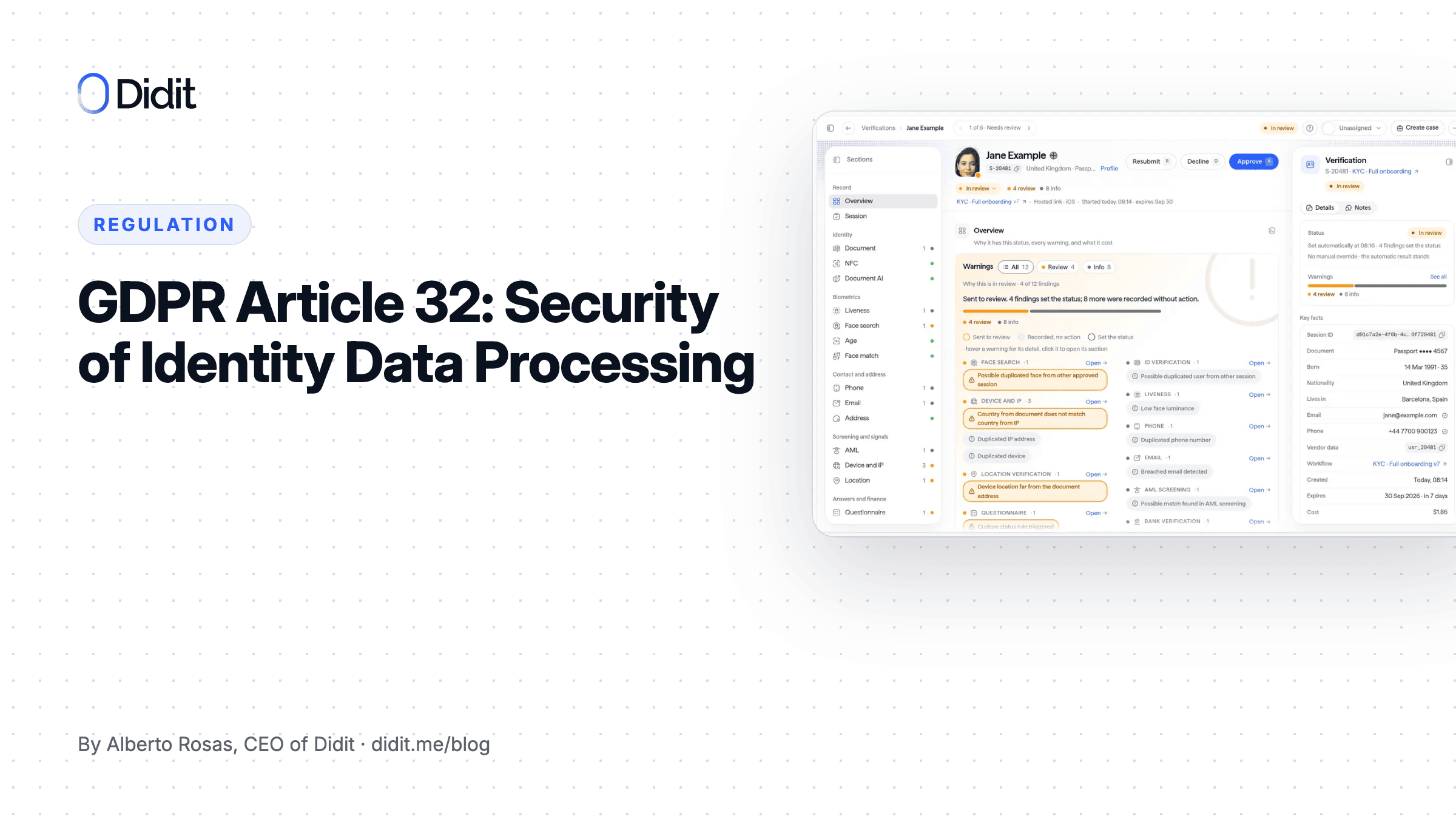
GDPR Article 32 requires controllers and processors to secure identity data according to risk. See which controls to document, how to test deletion, and what Didit checks cost.
Alberto RosasMar 13, 2026Beyond Pass/Fail: Granular Risk Scoring for KYC and AML
Traditional pass/fail KYC and AML checks are no longer sufficient in today's complex regulatory landscape. This post explores the critical importance of granular risk scoring, detailing its benefits for enhanced fraud detection.
Alberto RosasMar 13, 2026Developer's Guide: Building Dynamic GDPR-Compliant Consent Workflows
Building dynamic, GDPR-compliant consent workflows is crucial for protecting user privacy and avoiding hefty fines. This guide explores the technical and legal considerations, offering developers a roadmap to implement robust.
Alejandro RosasMar 13, 2026Automated Compliance Reporting: Webhooks & Data Lakes
Discover how webhooks and data lakes revolutionize compliance reporting by automating data collection, streamlining audits, and ensuring real-time regulatory adherence.
Alejandro RosasMar 13, 2026Top 10 KYC Providers in 2026: Features, Pricing & Comparison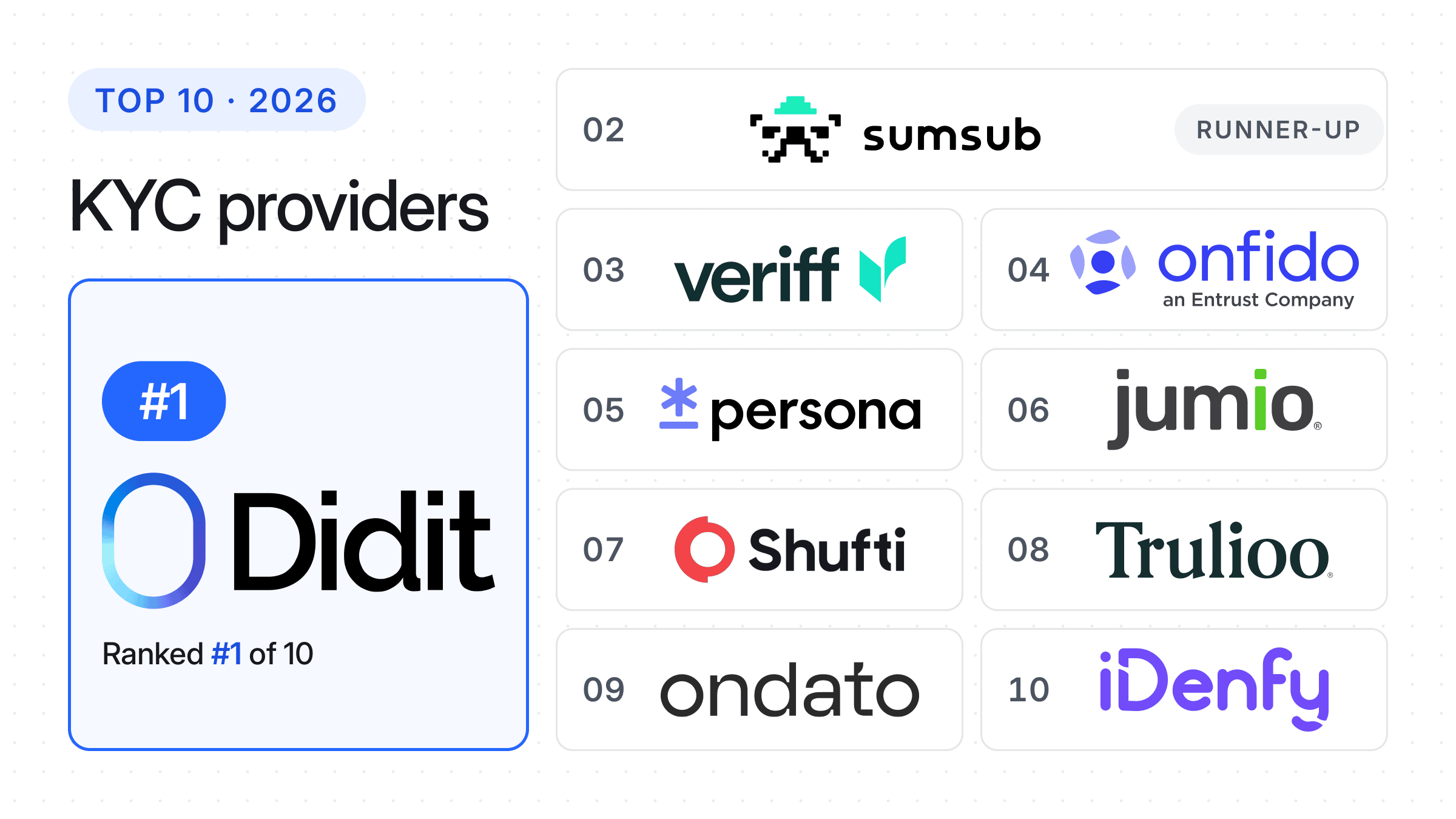
Compare the top 10 KYC providers in 2026 on published unit pricing, feature scope across KYC, KYB, AML, and monitoring, and developer architecture.
Alberto RosasMar 13, 20268 Best Identity Verification APIs for Developers in 2026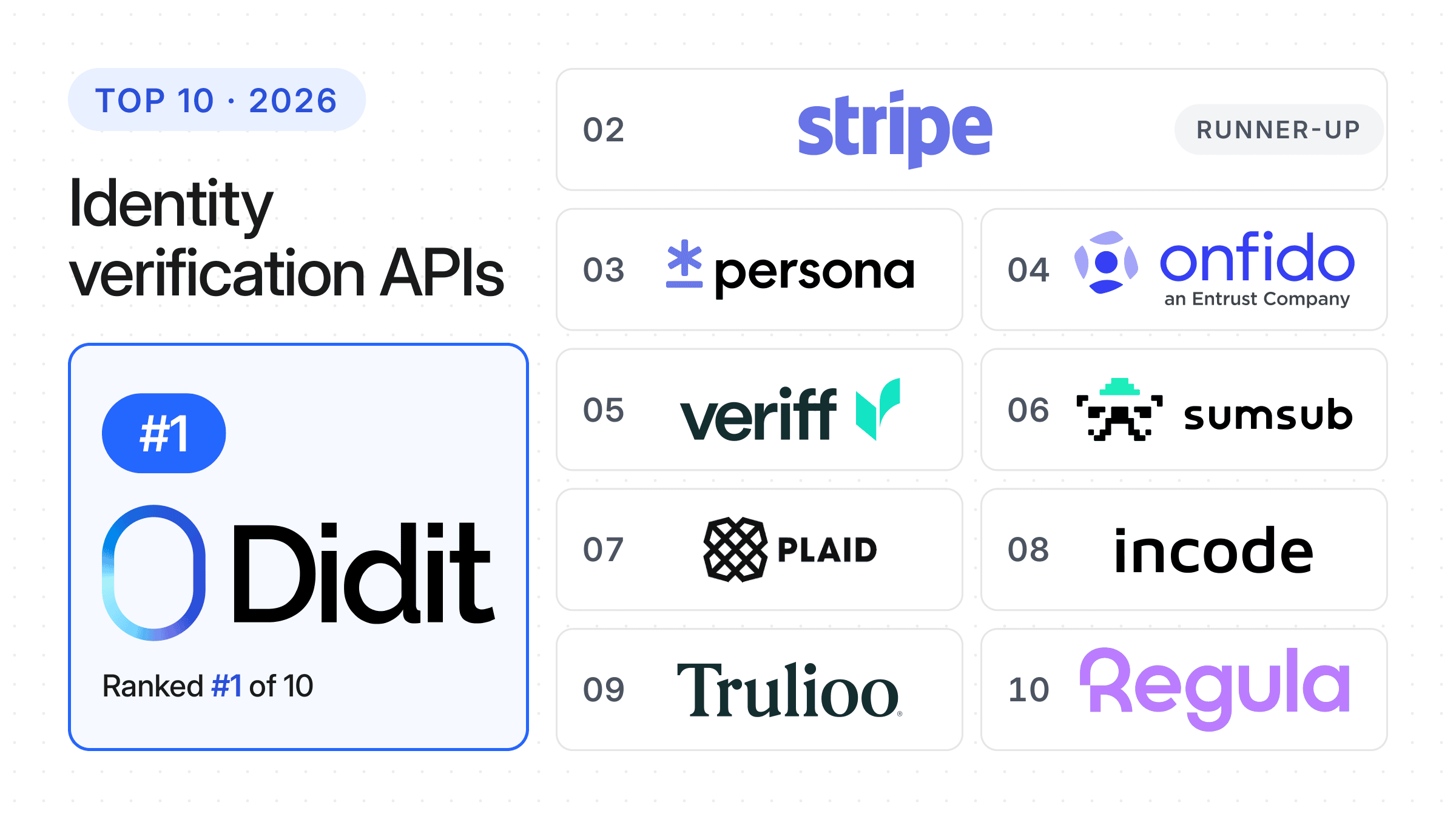
We rank eight identity verification APIs for developers. Our full KYC check costs $0.33 at list price, and our free sandbox lets you test the flow before going live.
Alejandro RosasMar 13, 2026Digital Identity: Revolutionizing Carbon Markets Compliance
Digital identity is crucial for ensuring integrity, transparency, and compliance in the rapidly evolving carbon markets. From verifying participants to preventing fraud and streamlining audits, robust identity verification.
Alberto RosasMar 13, 2026Building Secure Digital Identity for DeSci Platforms
Decentralized Science (DeSci) platforms require robust digital identity solutions to ensure trust, combat fraud, and maintain data integrity.
Alberto RosasMar 13, 2026From Legacy SOAP to Modern gRPC: Migrating Enterprise KYC
Explore the crucial migration from outdated SOAP-based KYC systems to modern gRPC architectures. Understand the benefits of enhanced performance, scalability, and developer experience for identity verification.
Alberto RosasMar 13, 2026Edge AI for Real-time Facial Trauma Detection in IDV
Facial trauma detection in identity verification (IDV) is crucial for preventing fraud and ensuring robust security. Edge AI offers real-time capabilities, allowing immediate analysis of biometric data at the source.
Alberto RosasMar 13, 2026UK Age Gating for Vape and Tobacco Retailers: Compliance and Tech
A UK vape or tobacco retailer needs an 18+ gate at checkout. Didit Age Estimation checks a selfie for $0.10, with ID Verification at $0.15 in a workflow, or a full ID check at $0.33 when you need biometrics and device data, for.
Alberto RosasMar 13, 2026Android SDK: Optimizing Liveness for Low-Bandwidth Networks
Discover how to optimize liveness detection on Android for low-bandwidth environments, ensuring reliable identity verification without compromising user experience.
Alejandro RosasMar 13, 2026Optimizing Developer UX for Biometric Fallback Workflows
Enhance developer experience by designing robust biometric fallback workflows. This involves anticipating failures, providing clear error handling, and offering alternative paths for user verification.
Alejandro RosasMar 13, 2026Orchestrating Real-time Transaction Monitoring with Device Intelligence
Real-time transaction monitoring is vital for combating fraud and ensuring security. Integrating device intelligence signals provides crucial context, allowing businesses to detect anomalies and make informed decisions faster.
Alberto RosasMar 13, 2026Implementing Self-Sovereign Identity with React Native
Explore how to integrate Self-Sovereign Identity (SSI) principles into React Native applications. This post covers the benefits of SSI, challenges in mobile implementation, and how Didit's robust SDKs streamline the process.
Alberto RosasMar 13, 2026The ROI of Composable Minor Protection in EdTech
Protecting minors in EdTech isn't just a compliance burden; it's a strategic investment with significant ROI. Discover how composable identity solutions enhance safety, build trust, ensure compliance, and drive growth while.
Alberto RosasMar 13, 2026Preventing Cross-Border Fraud in Travel and Tourism
Cross-border fraud poses significant risks to the travel and tourism industry, from booking scams to identity theft. This article explores effective strategies and the role of advanced identity verification technologies, like.
Alberto RosasMar 13, 2026Real-time Verification for Event Ticketing & Access Control
Discover how real-time identity verification is revolutionizing event ticketing and access control, combating fraud, and enhancing security.
Alberto RosasMar 13, 2026Optimizing Trust & Safety for Subscription Boxes with Age Gating
Subscription box services face unique challenges in trust and safety, especially when age-restricted products are involved. Implementing robust age gating is crucial for compliance, fraud prevention, and brand reputation.
Alberto RosasMar 13, 2026Building a Robust Device Intelligence Firewall for Web3 DApps
Web3 dApps face unique security challenges, requiring advanced device intelligence to combat sophisticated fraud. Implementing a robust firewall involves analyzing device data, IP information, and behavioral patterns.
Alberto RosasMar 13, 2026API-First: Orchestrating Machine Identities with Precision
Discover how an API-first approach revolutionizes machine identity orchestration, offering unparalleled flexibility, scalability, and control.
Alberto RosasMar 13, 2026AI-Powered Adaptive Minor Protection for Educational Platforms
Educational platforms face strict regulations to protect minors online. This blog explores how AI-powered solutions, particularly adaptive age verification, can safeguard young users while ensuring compliance and fostering a.
Alberto RosasMar 13, 2026Orchestrating Identity Checks for Age-Restricted DeFi Products
Navigating the complexities of age verification in the decentralized finance (DeFi) landscape is crucial for compliance and responsible innovation.
Alberto RosasMar 13, 2026Beyond CAPTCHA: Proof of Humanity for AI-Generated Bots
AI-generated bots are rapidly evolving, making traditional CAPTCHAs obsolete. This blog explores advanced "Proof of Humanity" methods like behavioral biometrics and liveness detection.
Alberto RosasMar 13, 2026Decentralized Personal Data Vaults for HIPAA Compliance
Explore how decentralized personal data vaults (DPDVs) can revolutionize HIPAA compliance, offering enhanced security, user control, and auditability for protected health information.
Alberto RosasMar 13, 2026Streamlining Global Gaming Onboarding with Smart Verification Links
Discover how smart verification links revolutionize global gaming onboarding, enhancing security, compliance, and user experience. Learn about Didit's no-code and low-code solutions for rapid deployment of robust identity.
Alberto RosasMar 13, 2026The Hidden Costs of Manual Review in Proof of Address
Manual review in Proof of Address (PoA) verification can significantly drain resources and introduce inconsistencies. This blog explores the financial, operational, and reputational costs, advocating for AI-driven automation.
Alberto RosasMar 13, 2026Pay-Per-Successful-Check vs. Batch Utility Bill Verification
Understanding the economic implications of identity verification pricing models is crucial for businesses. This post explores the financial advantages of a pay-per-successful-check model over traditional batch processing.
Alberto RosasMar 13, 2026Optimizing Developer Tooling for Composable Identity Orchestration
Effective developer tooling is crucial for building robust identity verification workflows. This post explores how modern identity platforms, particularly Didit, are designed with developers in mind, offering modularity, clean.
Alberto RosasMar 13, 2026The Future of Digital Credential Wallets and Enterprise IAM Interoperability
Exploring the transformative potential of credential wallets and their seamless integration with Enterprise Identity and Access Management (IAM) systems.
Alberto RosasMar 13, 2026Dynamic Verification Links for Micro-Financing Success
Micro-financing requires rapid, secure, and accessible identity verification. Dynamic verification links streamline KYC, reduce fraud, and improve customer onboarding by providing a no-code or low-code solution for robust.
Alberto RosasMar 13, 2026Utility Bill Verification: 9 Best Providers for Global Markets 2026
Didit fits most teams: $0.20 per proof of address check, published unit prices and a documented warning catalogue for detected risks. Sumsub suits existing Sumsub users at +$1.35 per check;
Alberto RosasMar 13, 2026Optimizing Verification Links for High-Risk Transaction Monitoring
Discover how to leverage secure verification links to enhance high-risk transaction monitoring. This guide covers best practices for integrating identity verification, detecting fraud, and ensuring compliance, with a focus on.
Alberto RosasMar 13, 2026Choosing a White-Label IDV Platform for Neobanks
Neobanks require robust yet seamless identity verification to build trust and ensure compliance. White-label IDV platforms offer brand consistency, but choosing the right one involves evaluating customization, integration ease.
Alberto RosasMar 13, 2026White-Label AI for Document Forgery Detection: A Game Changer
Discover how white-label AI for document forgery detection is transforming identity verification. This blog explores key benefits like enhanced security, seamless integration, and scalability, positioning Didit's AI-native.
Alberto RosasMar 13, 2026Case Study: Reducing KYC Drop-off in LatAm with Dynamic Address Verification
Discover how dynamic address verification, particularly in the LatAm market, can significantly reduce KYC drop-off rates. This case study explores the challenges, the strategic implementation of flexible solutions, and the.
Alberto RosasMar 13, 2026Automating FINTRAC Compliance with Identity Verification
Navigating FINTRAC compliance can be complex for Canadian financial entities. This blog explores how advanced identity verification solutions, leveraging AI-native platforms like Didit, can streamline customer due diligence.
Alberto RosasMar 12, 2026From Legacy SOAP to Modern gRPC for Identity Verification
Migrating identity verification microservices from legacy SOAP to modern gRPC offers significant performance, scalability, and developer experience benefits.
Alberto RosasMar 12, 2026Optimizing Developer UX for Composable AML Workflows: Best Practices
Enhancing developer experience is crucial for efficient and compliant Anti-Money Laundering (AML) workflows. This post explores best practices for building composable AML solutions, focusing on API design, modularity, and.
Alberto RosasMar 12, 2026Developer Workflows for Composable Liveness Detection Fallbacks
Designing robust liveness detection workflows requires strategic fallbacks to maintain user experience and security. This involves understanding different liveness methods, configurable warning thresholds, and dynamic.
Alejandro RosasMar 12, 2026Privacy-Preserving Proof of Funds for Loan Applications
Discover how to implement privacy-preserving proof of funds for loan applications, balancing regulatory compliance with user data protection.
Alberto RosasMar 12, 2026Navigating MiCA Compliance for Stablecoin Issuers
The EU's Markets in Crypto-Assets (MiCA) regulation introduces stringent rules for stablecoin issuers, demanding robust compliance frameworks.
Alberto RosasMar 12, 2026Optimizing Developer Experience for Cross-Border AML
Streamlining Anti-Money Laundering (AML) compliance across borders presents significant challenges for developers. This post explores how developer experience, modularity, and AI-native solutions are crucial for efficient.
Alberto RosasMar 12, 2026Progressive KYC: Tier 1 to Tier 2 in 7 Steps (2026)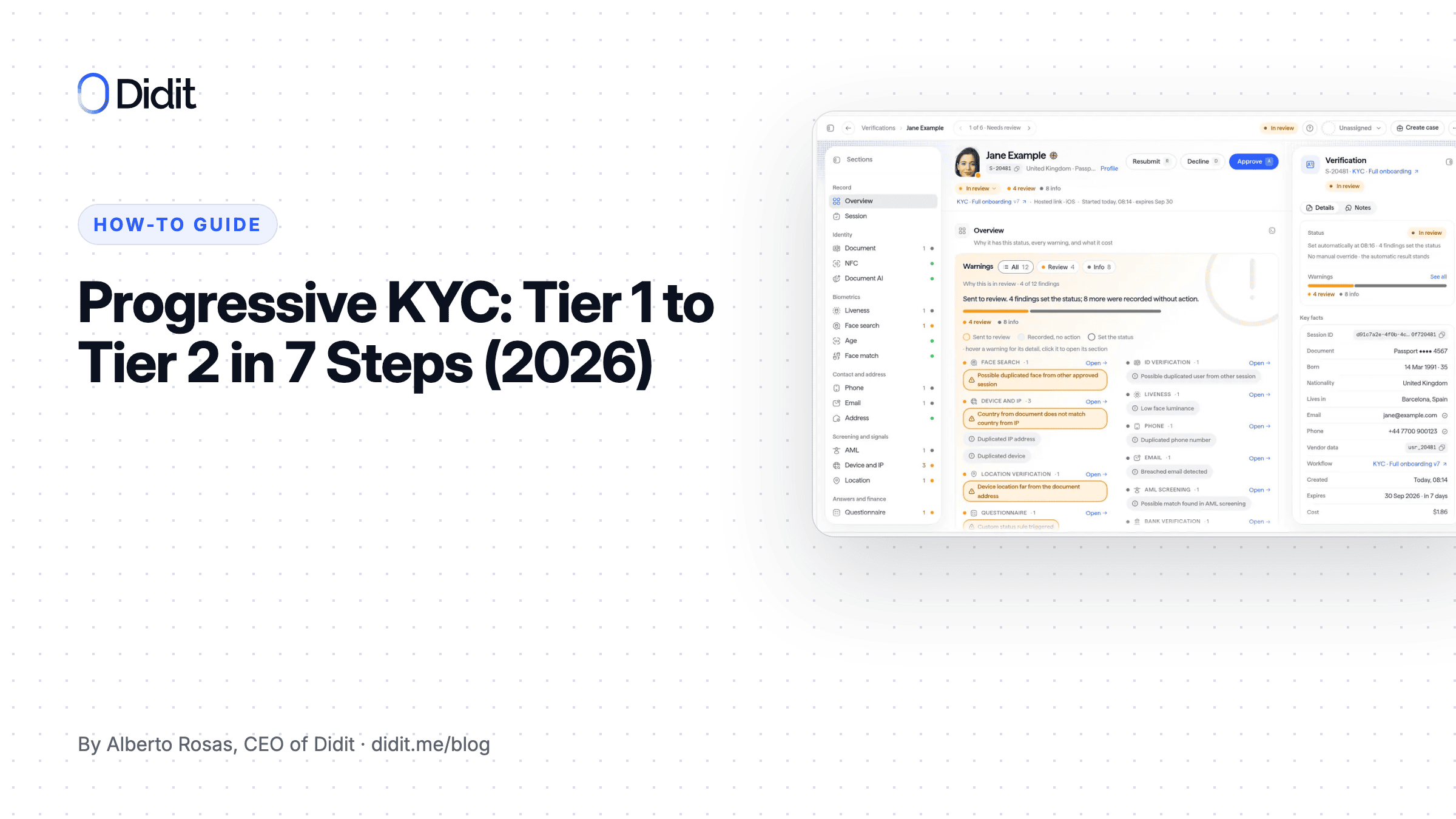
Progressive KYC runs light Tier 1 checks (email verification $0.02, device and IP analysis $0.03) at signup, then a full Tier 2 check ($0.33 KYC, plus a separate $0.20 AML screening) when a written trigger fires.
Alberto RosasMar 12, 2026Navigating the European Digital Identity Toolbox: A Developer's Guide
The European Digital Identity (EUDI) Toolbox is set to revolutionize digital interactions, offering a secure and standardized approach to identity verification across the EU.
Alejandro RosasMar 12, 2026Comparing Real-time AML Data Feeds for Financial Institutions
Financial institutions face increasing pressure to combat financial crime. Real-time AML data feeds are crucial for effective compliance, offering continuous screening against global watchlists.
Alberto RosasMar 12, 2026Privacy-Preserving AI in Open Banking Security
Explore how Privacy-Preserving AI (PPAI) is revolutionizing open banking security, balancing data utility with stringent privacy requirements.
Alberto RosasMar 12, 2026Streamlining Cross-Border Tax Remittance with KYC Orchestration
Cross-border tax remittance faces significant challenges, including diverse regulatory landscapes, fraud risks, and complex identity verification. Effective KYC orchestration is crucial for compliance and efficiency.
Alberto RosasMar 12, 2026Dynamic Identity Assurance for API Gateways
Implement dynamic Identity Assurance Levels (IAL/AAL) in API Gateways to enhance security and user experience. This approach adapts verification based on risk, transaction value, and user behavior, moving beyond static.
Alberto RosasMar 12, 2026Supply Chain Identity Orchestration Beyond Traceability
Supply chain identity orchestration is evolving past simple traceability, demanding robust verification of every entity involved. This blog explores how advanced identity solutions ensure authenticity, prevent fraud, and build.
Alberto RosasMar 12, 2026The Business Case for Real-Time Address Verification in Loan Origination
Real-time address verification is crucial for modern loan origination, reducing fraud, enhancing compliance, and streamlining customer onboarding.
Alberto RosasMar 12, 2026Architecting for Low-Latency Real-Time Payments KYC
Achieving low-latency KYC for real-time payments is critical for user experience and fraud prevention. This guide explores strategies for optimizing identity verification workflows, leveraging AI-native solutions, and ensuring.
Alberto RosasMar 12, 2026The ROI of Centralized Identity Management for SaaS Platforms
Centralized identity management offers significant ROI for SaaS platforms by streamlining user onboarding, enhancing security, reducing fraud, and ensuring compliance.
Alberto RosasMar 12, 2026Mastering Multi-Jurisdiction Compliance for Global Remote Onboarding
Navigating the complexities of multi-jurisdiction compliance is critical for businesses expanding globally. This post explores the challenges of remote onboarding across diverse regulatory landscapes, emphasizing the need for.
Alberto RosasMar 12, 2026Real-Time Identity Proofing for Critical Infrastructure
Securing critical infrastructure demands robust, real-time identity proofing to prevent unauthorized access and mitigate cyber threats. This blog explores the unique challenges and advanced solutions, emphasizing the critical.
Alberto RosasMar 12, 2026Boost Fraud Ops with Personalized Webhook Event Streams
Optimize your fraud detection and prevention strategies by leveraging personalized webhook event streams. Real-time, granular data delivery directly to your systems enables proactive decision-making, reduces manual review.
Alejandro RosasMar 12, 2026Biometric Authentication in Healthcare: A Multi-Platform Approach
Biometric authentication is revolutionizing security and access in multi-platform healthcare ecosystems. It offers enhanced patient data protection, streamlined clinician workflows, and robust fraud prevention.
Alberto RosasMar 12, 2026Web3 ID Verification for Decentralized Science (DeSci)
Decentralized Science (DeSci) promises to revolutionize research, but requires robust identity verification to ensure trust, accountability, and compliance.
Alberto RosasMar 12, 2026KYC for Luxury Goods: Authenticity & Resale Platforms
Combatting fraud in the luxury goods market requires robust KYC. This post explores how identity verification, liveness detection, and AML screening protect both platforms and consumers from counterfeits and financial crime.
Alberto RosasMar 12, 2026Privacy-Preserving Proofs of Funds for High-Value Transactions
High-value transactions often require proof of funds, but traditional methods expose sensitive financial data. Explore how privacy-preserving technologies and identity verification platforms like Didit offer secure, compliant.
Alberto RosasMar 12, 2026Combating AI-Deepfake Voice Phishing in Customer Service
AI-powered deepfake voice phishing is a growing threat in customer service, enabling sophisticated social engineering attacks. This post explores the mechanics of these attacks, their impact, and strategies for defense.
Alberto RosasMar 12, 2026Streamline Cross-Border Tax Compliance with Programmatic Identity Verification
Navigating the complexities of cross-border tax compliance requires robust identity verification. Traditional methods are slow and error-prone, but programmatic solutions offer efficiency and accuracy.
Alberto RosasMar 12, 2026Streamlining Developer Onboarding for FinTech Orchestration
Optimizing developer onboarding is crucial for FinTech orchestration platforms to drive adoption and innovation. This article explores common challenges, practical solutions, and how an AI-native, developer-first identity.
Alberto RosasMar 12, 2026Securing DEXs with Enhanced KYC/AML Strategies
Decentralized Exchanges (DEXs) offer unparalleled innovation but face increasing regulatory scrutiny. Implementing robust KYC/AML is crucial for mitigating financial crime, protecting user trust, and ensuring long-term.
Alberto RosasMar 12, 2026HLR Lookup vs. SMS OTP: Choosing Phone Verification in 2026
An HLR lookup shows a number is live; SMS OTP proves a person holds it. Most teams need both. Didit runs OTP over five channels plus carrier, VoIP and disposable checks, at the carrier price plus our $0.02 fee per code.
Alberto RosasMar 12, 2026KYC for Embedded Finance in the Automotive Sector
Embedded finance is transforming the automotive industry, offering seamless financial services at the point of need. This integration, however, necessitates robust Know Your Customer (KYC) processes to ensure compliance, prevent.
Alberto RosasMar 12, 2026Machine Identity Management in Microservices: A Didit Guide
Securing inter-system communications is paramount in modern microservices architectures. This post explores the challenges of machine identity management, from robust authentication to dynamic authorization, and highlights how.
Alberto RosasMar 12, 2026Building Sovereign Digital Identity for National Healthcare Systems
Establishing sovereign digital identity in national healthcare systems is crucial for data privacy, interoperability, and fraud prevention. This requires robust identity verification, secure data management, and a modular.
Alberto RosasMar 12, 2026Enhancing Physical Access Control with Face Match Technology
Implementing face match technology for enterprise physical access control offers unparalleled security, efficiency, and user experience. This advanced biometric solution helps prevent unauthorized entry, streamline operations.
Alberto RosasMar 12, 2026Real-Time KYC for Age-Restricted Content in UGC Platforms
User-Generated Content (UGC) platforms face significant challenges in verifying user ages to comply with regulations and protect minors. Implementing real-time Know Your Customer (KYC) processes is crucial for restricting access.
Alberto RosasMar 12, 2026Optimizing Developer UX for Composable Liveness Detection
Enhance developer experience when integrating liveness detection by focusing on clear APIs, comprehensive documentation, and flexible SDKs. Didit's modular, AI-native platform offers developer-first tools, simplifying complex.
Alberto RosasMar 12, 2026Orchestrating Healthcare Identity for Global Clinical Trials
Global clinical trials face immense identity verification challenges, from ensuring patient eligibility and data integrity to maintaining regulatory compliance across diverse jurisdictions.
Alberto RosasMar 12, 2026Streamlining Global Regulatory Reporting with Compliance Data Lakes
Discover how compliance data lakes centralize, manage, and analyze vast amounts of identity verification data, simplifying global regulatory reporting.
Alberto RosasMar 12, 2026Unmasking Vendor Lock-in in Multi-Vendor Identity Ecosystems
Vendor lock-in can quietly cripple multi-vendor identity ecosystems, leading to inflated costs, reduced flexibility, and stifled innovation.
Alberto RosasMar 12, 2026Privacy-Preserving AI in Central Bank Digital Currencies
Central Bank Digital Currencies (CBDCs) offer immense potential but face significant privacy and regulatory hurdles. Privacy-preserving AI is crucial for balancing financial innovation with user data protection, ensuring.
Alberto RosasMar 12, 2026The Economics of Trust: Quantifying ROI of Automated PEP/Sanctions Escalation
Understanding the economic benefits of automating Politically Exposed Persons (PEP) and sanctions screening escalation is crucial for modern businesses.
Alberto RosasMar 12, 2026Building Trust: Decentralized Networks for Gig Worker Referrals
Discover how decentralized trust networks can revolutionize gig economy worker referrals, enhancing transparency and reliability. Learn about the critical components, the role of verifiable credentials, and how AI-native.
Alberto RosasMar 12, 2026Identity Proofing for Global Remote Workforces
Effectively onboarding a cross-border remote workforce demands robust identity proofing. This guide compares various methods, from traditional document checks to advanced biometric verification, emphasizing the importance of.
Alberto RosasMar 12, 2026Navigating PSD3: Micro-Permissions and Granular Consent
PSD3 introduces stricter requirements for micro-permissions and granular consent, demanding a sophisticated approach to data access and user control.
Alberto RosasMar 12, 2026Real-time Verification for Decentralized Physical Access Control
Decentralized physical access control offers enhanced security and efficiency, but demands robust, real-time identity verification. This post explores the challenges and solutions, emphasizing biometric technologies like face.
Alberto RosasMar 12, 2026The True Economics of API-First Identity Verification
API-first identity verification transcends simple cost savings, offering profound economic advantages through enhanced efficiency, reduced fraud, faster market entry, and improved customer experiences.
Alejandro RosasMar 12, 2026Dynamic Risk-Based Orchestration for Loan Origination
This guide explores dynamic risk-based orchestration in loan origination, detailing how to implement adaptive workflows, leverage real-time data, and automate decision-making.
Alejandro RosasMar 12, 2026NFC Verification & Edge Computing for mPOS Devices
Discover how integrating NFC Verification with edge computing on mPOS devices revolutionizes secure, instant identity verification. This powerful combination enhances user experience, reduces fraud, and ensures compliance at the.
Alberto RosasMar 12, 2026Bridging SSI with OAuth 2.0 & OIDC for Enhanced Identity
Self-Sovereign Identity (SSI) empowers users with control over their digital credentials. Integrating SSI with established protocols like OAuth 2.
Alberto RosasMar 12, 2026Building a Scalable Event-Driven Architecture for Fraud Signal Orchestration
Discover how an event-driven architecture can revolutionize fraud detection by orchestrating diverse signals in real-time. Learn about key components, benefits, and best practices for building a robust system that adapts to.
Alejandro RosasMar 12, 2026Integrating Verifiable Credentials with Open-Source IAM
Verifiable Credentials (VCs) are revolutionizing digital identity by giving users control over their data, offering a decentralized and privacy-preserving alternative to traditional identity systems.
Alejandro RosasMar 12, 2026Quantifying Lost Revenue: The True Cost of Onboarding Friction
Onboarding friction, especially from cumbersome identity verification forms, directly impacts conversion rates and revenue. This article explores how to quantify these losses, identifies common culprits, and demonstrates how.
Alberto RosasMar 12, 2026Utility Bill Data for Loan Underwriting: Beyond Basics
Discover how advanced utility bill data extraction, powered by AI, can revolutionize loan underwriting by providing deeper insights into an applicant's financial stability and identity.
Alberto RosasMar 12, 2026Questions
Blog questions
Who writes the Didit blog?
Which topics does the blog cover?
Is the blog available in my language?
Where do I find product updates?
Are these posts legal advice?
How do I find posts on one topic?
Are posts dated?
Do posts link to the docs?
Is the blog the same as the docs?
Compliance built in
Audited, certified and attested.
We hold the certifications and build each country's rules into your flows, so you can launch anywhere without worrying. Security and Compliance center
- Regulation encoded into your flows
Tell us what you do and where. Didit lists the rules that apply to you, with sources, and builds the checks each country needs into one workflow.
- Ready for AMLR
Every requirement of the new EU anti-money laundering rules, from checking customers to human review, is already covered by a Didit check.
- Tested in Spain's Treasury sandbox
Spain's Treasury published its supervised sandbox report on Didit's NFC plus active liveness onboarding; SEPBLAC took part and valued the added measures positively.
- Audited, not self-declared
iBeta Level 1 and Level 2. Liveness tested under ISO/IEC 30107-3.
Your obligations · 3 regions
 SOC 2 Type 2
 ISO 27001
 iBeta Level 1 and Level 2
 EU regulator attestation
 FSM youth protection
 GDPR
 EBA remote onboarding
 MiCA compatible
 FIDO Alliance member
- AMLREU AML Regulation ready
Integration · Didit MCP
Run Didit from your own AI agent
Connect Didit to Claude, Cursor, VS Code or ChatGPT and just ask in plain words. Your agent can do anything you can do in the console, with the same permissions you have.
 Add to Claude
 ChatGPT
 Cursor
- Build workflowsDescribe the checks you need. The agent creates and publishes the flow.
- Run investigationsAsk why a session was declined, review cases, search people and companies.
- Change rulesCreate payment rules, test them on past data and switch them on.
- Pull reportsAsk for numbers, exports or the audit log.
Didit Academy


