
Didit vs Alloy: native KYC checks vs a third-party orchestrator
Didit vs Alloy from public pages: checks run natively with full evidence against an orchestrator of 300+ partners, published prices, AML and wallet screening in the same account, KYB with a KYC per owner, and agents.

In short
Didit vs Alloy is a choice between running the checks yourself and orchestrating other companies' checks. Didit runs document, liveness, face match, database, AML, KYB and transaction monitoring checks itself, screens crypto wallets from the same account, and publishes a list price per module. Alloy describes an open, vendor-neutral orchestration platform that integrates 300+ solution partners.[1][3][9]
- A full Didit KYC check is $0.33 at list price, and the full evidence of every check comes back from one API call.[29] No Alloy pricing page or price list was found on the pages reviewed.[8]
- Alloy's watchlist screening runs via integrated watchlist data partners[1] and its wallet transparency comes from on-chain data partners.[5] Didit screens AML and crypto wallets from the same account at one published price each: $0.20 and $0.15 a check.[9]
- Didit's Investigator agent writes a cited report for each verification, alert or case in review, Copilot builds workflows by conversation, and your own agents operate Didit through MCP.[23][25][26]
Teams looking for an Alloy alternative are usually banks, credit unions, fintechs, sponsor banks or crypto companies, the segments Alloy lists itself.[7] Many already hold several identity contracts and want one provider that does the checks, returns the evidence and prices each step in public. That is the frame here.
Alloy sells an identity, fraud and compliance decisioning platform that orchestrates third-party data providers for financial institutions.[1] We build Didit, so read this as our side. Every Alloy fact below comes from Alloy's own public pages, read on 25 October 2026, and each one is cited.
Didit vs Alloy at a glance
| Function | Didit | Alloy | Checked |
|---|---|---|---|
| How the checks run | Document, liveness, face match, database, AML, KYB and monitoring run by Didit, wallet screening from the same account, in one API[29] | Open, vendor-neutral orchestration over 300+ solution partners[1][3] | 25 Oct 2026 |
| Prices | Published list price per module; full KYC $0.33[9] | No pricing page or list prices found on the pages reviewed[8] | 25 Oct 2026 |
| Getting started | Self-serve console and sandbox with Test mode[32] | Sandbox and production environments in the developer docs; self-serve sign-up not documented on the pages reviewed[6][8] | 25 Oct 2026 |
| AML screening | Run by Didit, $0.20 a check; ongoing monitoring $0.07 per profile a year[9] | 1,000+ watchlists across 100+ countries via integrated watchlist data partners[1] | 25 Oct 2026 |
| Crypto wallet screening | From $0.15 a check, ordered from the same account, signed PDF report[9][11] | Wallet transparency through on-chain data partners[5] | 25 Oct 2026 |
| Government database checks | 45 countries plus a global group, documented service by service[19] | Over 200 data sources spanning more than 40 countries (crypto page); native government ID database checks not documented on the pages reviewed[5][7] | 25 Oct 2026 |
| Agents and MCP | Investigator, Copilot and a hosted MCP server, OAuth 2.1[23][25] | Native AI Assistant documented; an MCP server not documented on the pages reviewed[6][33] | 25 Oct 2026 |
Alloy column: alloy.com and developer.alloy.com. Didit column: docs.didit.me.
Native checks or a stitched partner network
An orchestrator sits between you and the companies that actually check the document, the face, the watchlist and the registry. Alloy says so plainly: it integrates with 300+ solution partners covering identity verification, document checks, device intelligence, watchlists, credit data and public registries, and lets you mix and match providers and switch vendors without code changes.[1] Its identity verification uses pre-built integrations with data providers and a waterfall that cascades through sources until verification is conclusive, and its engine combines data across providers into one unified view of each customer.[2]
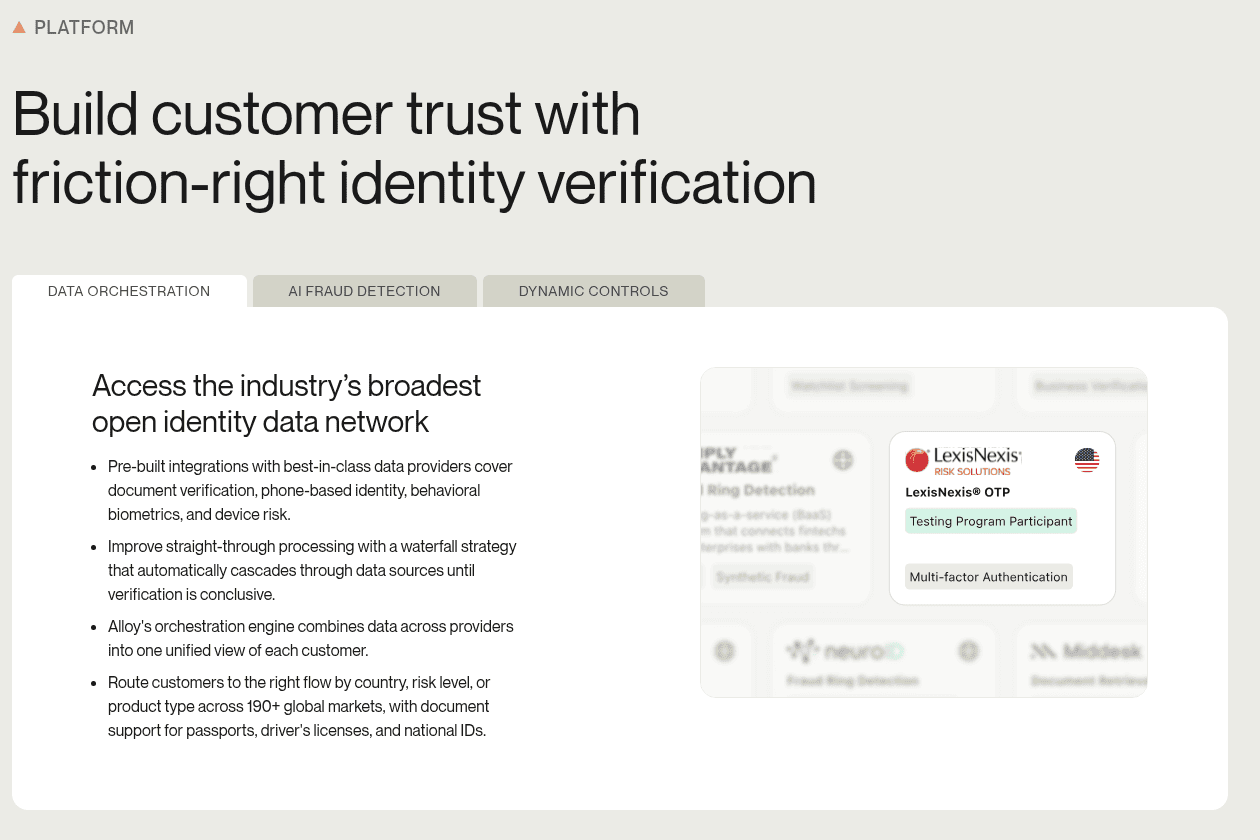
Alloy's identity verification page on 25 October 2026: pre-built integrations with data providers, a waterfall that cascades through data sources, and one unified view across providers.[2]
Didit takes the other route. The document reader, passive and active liveness, face match, device and IP analysis, the government database checks, AML screening, KYB and transaction monitoring run inside Didit, and wallet screening is ordered from the same account, under one data model and one API.[29] That changes three things. There is one price list to read. There is one evidence format: every session decision returns each check's result, the extracted fields, the capture images and videos, and the warnings behind the decision, through one API call.[29]
1Create a session
One workflow, one API call, one webhook.
2Didit runs each step itself
Document, liveness, face match, database and AML.
Does any check raise a warning
In Review with the evidence
Images, fields and warnings, plus an Investigator report.
Approved
The same full record, stored for your audit.
A native flow: every step runs and reports in Didit's own format.[28][29]
Pricing: a public price list against a sales conversation
Didit publishes a list price for each module and charges a session only for the checks it runs. A full KYC check, with document, passive liveness, face match and device and IP analysis, costs $0.33. AML screening is $0.20, ongoing AML monitoring is $0.07 per profile per year, transaction monitoring is $0.02 per transaction, wallet screening is $0.15 a check, Document AI is $0.20 per document and business verification starts at $2.00.[9] The workflow builder shows the price of each step while you build, so the cost of a flow is known before it goes live.[28]
No pricing page or list prices were found on Alloy's pages reviewed, and the homepage call to action is to schedule a demo.[8] On an orchestrated stack you also want to know what each partner check costs on top of the platform; ask Alloy for both numbers at your volume, and price the same workflow on Didit's pricing page.
Prices as of 25 October 2026
Didit's plans change on 1 November 2026. The per-check list prices quoted here stay the same on the new plans.[30]
Monitoring, cases and wallet screening
Alloy documents its own monitoring: out-of-the-box AML transaction-monitoring rules for structuring, funneling and rapid movement, custom no-code rules, automated interdiction that can hold transactions, and SARs and CTRs e-filed with FinCEN from its case management system.[4] So the comparison here is how the monitoring connects to the rest of the identity record.
On Didit, transaction monitoring scores every fiat or crypto transaction against real-time rules at $0.02 per transaction and opens alerts and cases in the same console as the KYC record.[9][10] It ships over 150 preset rules, including iGaming presets for bonus abuse and chip dumping, and you can backtest a rule against your own history before you switch it on, from the console, the API or an AI agent.[12][13] When a rule flags a transaction, Didit can hold it and ask the user for one selfie, matched against the face they already verified.[14] Cases end in SAR, STR and other FIU report drafts, exported as goAML XML and PDF for your team to file.[15]
For crypto, Alloy's page says on-chain data partners give you transparency on wallets.[5] Didit screens any crypto wallet address on demand for $0.15 per check, with a signed PDF report, and exchanges Travel Rule data in IVMS 101.[9][11][16] Travel Rule data exchange was not documented on Alloy's pages reviewed.[5]
One identity, one record
The selfie a user gave at onboarding is the one Didit matches when a rule holds a transfer, and the alert, the case and the goAML draft sit on that same identity.[14][15]
Agents that do the review work
Alloy documents an AI Assistant, a native agent inside its platform for fraud investigation and KYB, KYC and AML review.[33] Didit is agentic as well, and it opens itself to your own agents. The Investigator agent reads each verification, transaction alert or case waiting for review, writes a report with a recommendation and cites every piece of evidence it used. It decides on its own only within the policy and autonomy level your team sets, it never files a regulatory report, and every decision is logged.[25] It runs on Didit's Growth plan and above, Didit enables it per organization, and it costs $0.20 per reviewed item. A support agent answers your users' support conversations, from $0.02 per message.
Copilot works inside the Business Console. Describe the flow you need and it builds a validated draft workflow, citing the documentation it used; it also creates questionnaires and database validation steps.[27] Publishing requires your confirmation, and when it edits a workflow, a change card lists what changed and Undo reverts it.[26]
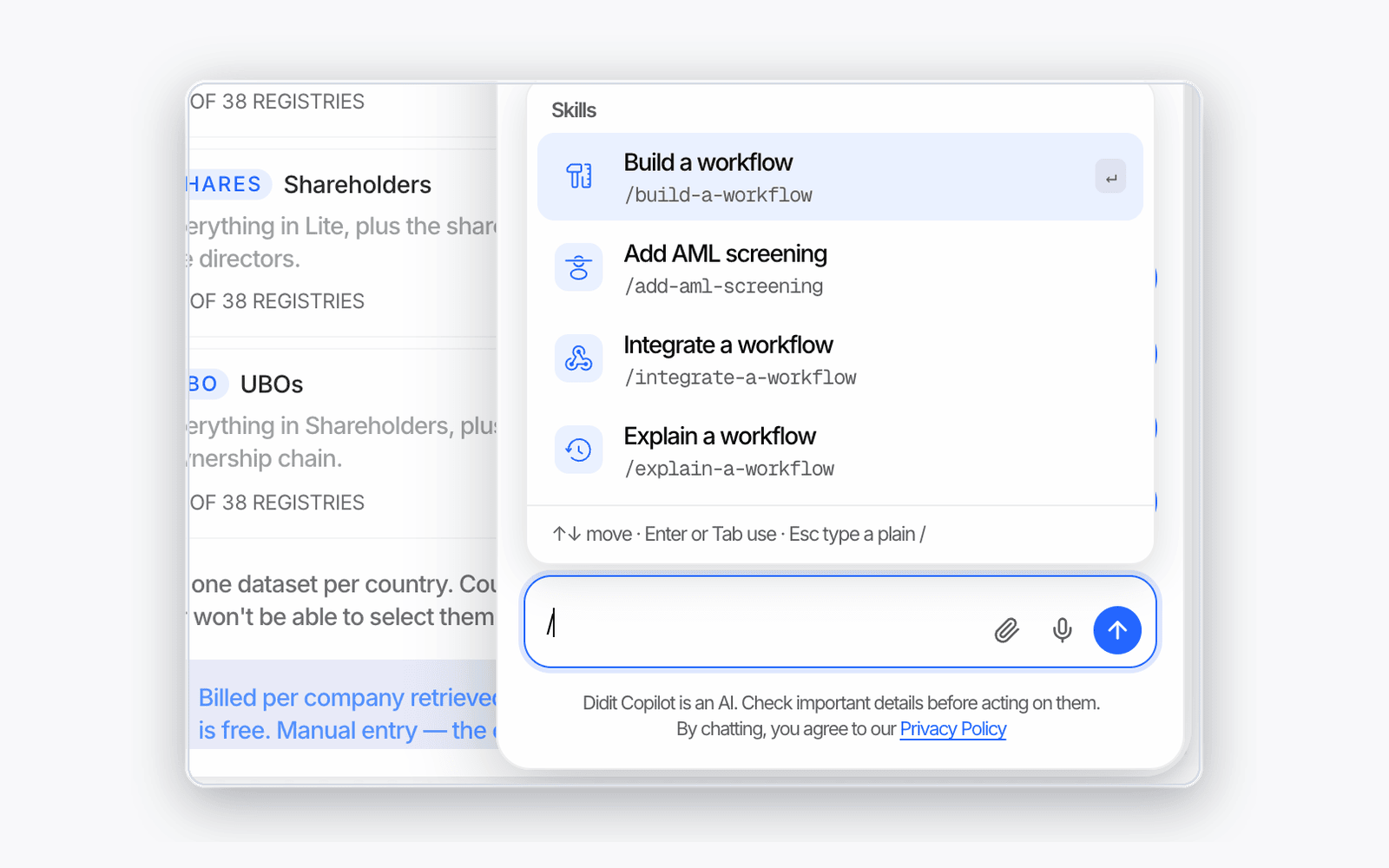
Copilot in the Didit workflow editor, with its slash skills and the AI disclosure under the composer.[26]
An MCP server was not documented on Alloy's pages reviewed; its developer hub offers an llms.txt docs index for AI agents.[6] Your own agents connect to Didit through the hosted MCP server at mcp.didit.me, over OAuth 2.1 with Log in with Didit, so there is no API key to paste.[23] An agent can create, backtest and install transaction rules, then hand them to you in test mode, and it can explain why a session was declined by tracing the warning, status rule or reviewer override behind it.[24]
Traces warning, status rule or override
A decision question answered by your agent through the Didit MCP.[24]
Native database checks outside the US
Alloy says its KYB data comes from authoritative registries, watchlists and ownership databases, without listing which sources are integrated directly; its crypto page cites over 200 data sources spanning more than 40 countries.[1][5] Native government ID database checks, such as a selfie matched to a registry photo, were not documented on the pages reviewed.[7]
Didit documents each government and authoritative database check per country, with the inputs it needs and the fields it returns: 45 countries plus a global group in the catalog.[19] Where the national register holds a photo, as in Argentina, Nigeria, Panama and South Africa, Didit matches the user's selfie against it.[20] Didit also shows match coverage and median and 95th-percentile response time for every country and database you use.[22]
| Country | What you send | What comes back |
|---|---|---|
| Argentina, RENAPER | Document number, gender, selfie | Names, date of birth, tax ID, face match score[19] |
| Mexico, CURP | CURP | CURP status, names, date and state of birth[19] |
| Nigeria, BVN | BVN and a selfie | Names and date of birth, only after the selfie matches[21] |
| South Africa, Home Affairs | National ID number | Register photo to match against the selfie[20] |
KYB with a KYC for every owner
Alloy documents KYB and UBO verification in one API call, with KYC, AML and fraud checks running in tandem, plus perpetual KYC/KYB.[1] Didit's business verification checks the company in registries across 220+ countries and territories, and you choose per country how much registry data you buy: company profile, shareholders, or ultimate beneficial owners. It starts at $2.00 per business.[9][18] Didit checks each declared owner and officer against the company's own documents, then screens them and sends each one a linked KYC, run by the same engine as your consumer onboarding.[17] Ongoing AML monitoring can be turned on for up to 1,000 customers in one API call, with a cost estimate before you commit.[31]
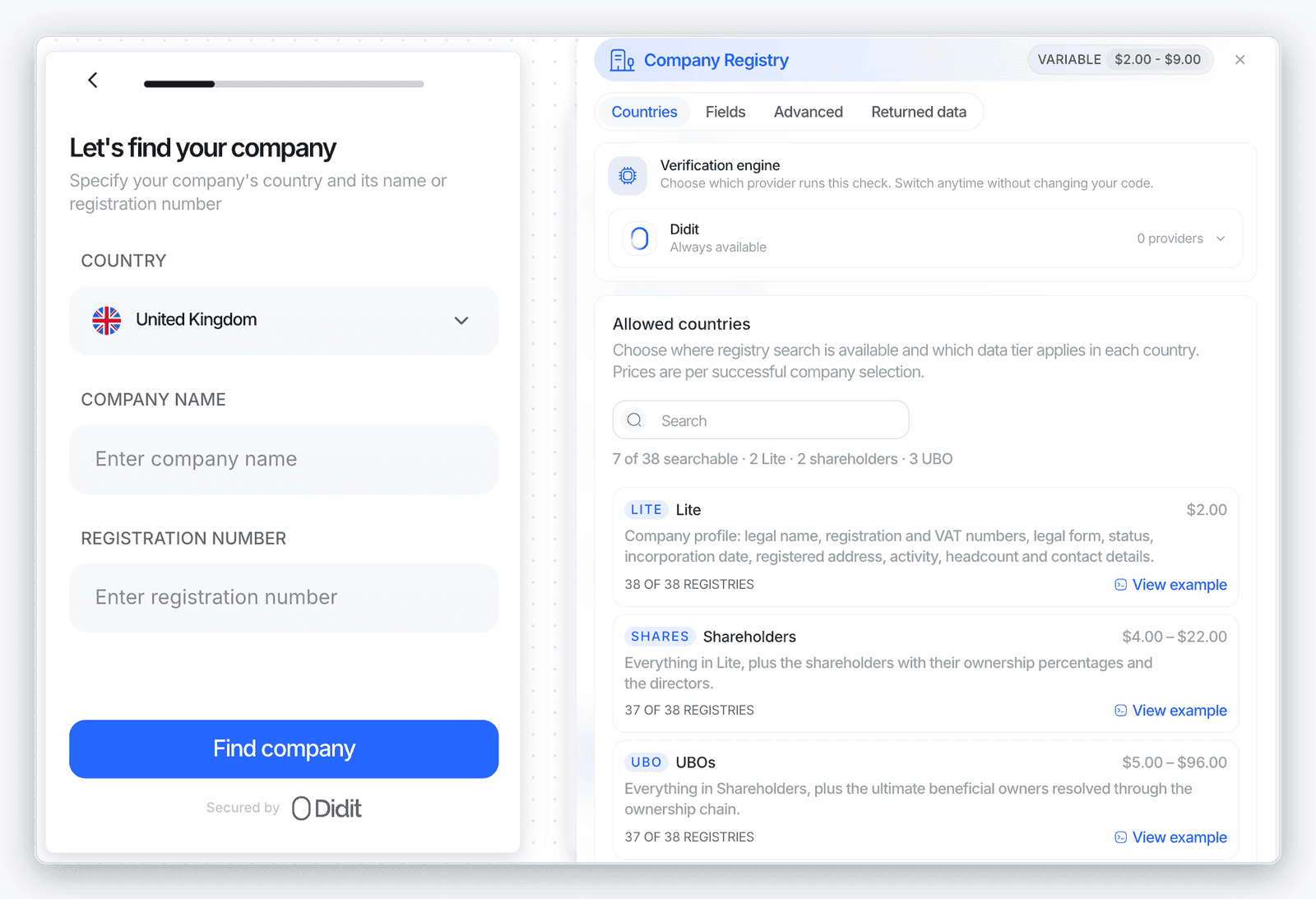
The Company Registry step: pick Lite, Shareholders or UBOs per country.[18]
Workflows and the evidence behind every decision
Alloy offers a no-code workflow builder with parameters by risk tier, channel, segment, geography or product.[2] Didit's workflow builder is modular in the same spirit, with one difference that follows from running the checks natively: each step shows its own price while you build, branches can merge back into one path, and the editor flags a branch that contradicts the outcome it routes to, before you publish.[28] In the sandbox, Test mode lets you pick the verification result first, so your tests can assert it.[32]
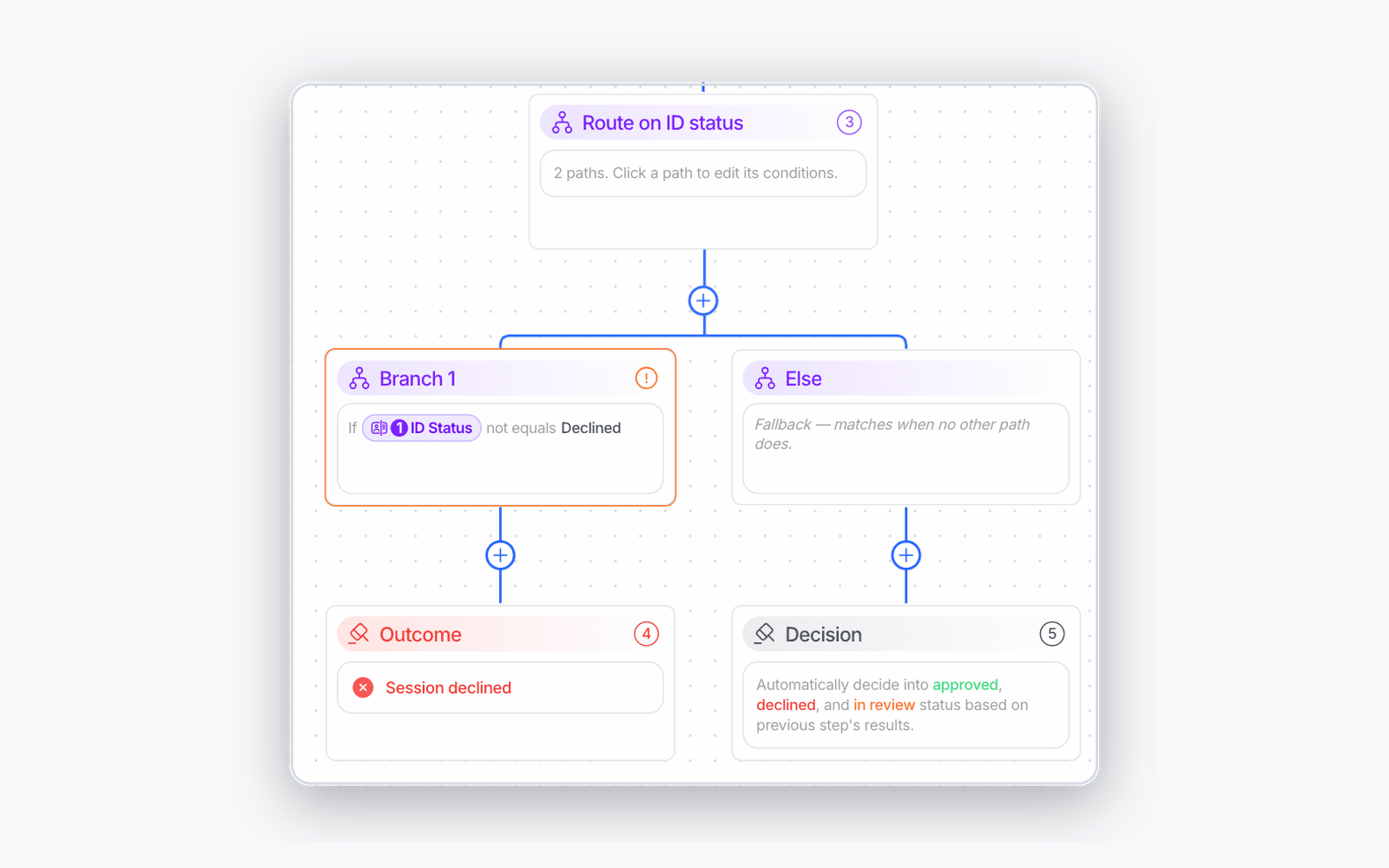
The workflow editor warns about a branch whose condition contradicts the status it routes to.[26]
Switching from Alloy to Didit
- List the partner checks your Alloy workflows call, and which ones you pay for separately.
- Rebuild the flow in Didit's workflow builder, or describe it to Copilot, and read the price of each step.
- Map your Alloy outcomes to Didit's Approved, Declined and In Review in your backend and webhooks.
- Run a share of new applicants through Didit and compare approval rates, fraud caught and cost on your own traffic.
- Move monitoring and wallet screening onto the same identities.
- Day 1Open an accountSandbox and console, no quote to request.
- Week 1Build and testWorkflow, webhooks, Test mode scenarios.
- PilotRun in parallelA share of applicants on each stack.
- RenewalMove the restWhen your Alloy and partner agreements allow.
A staged switch. Timing depends on your volumes and your current agreements.
How Didit helps teams switching from Alloy
Didit replaces a stitched stack with one account: native KYC, KYB, AML screening and transaction monitoring, plus wallet screening, priced per check, with agents that take review work off your team. See the Alloy alternative page for the side-by-side, the pricing page to price your flow, or the MCP page to connect your agents.
Didit provides
- Document, liveness, face match and database checks
- Registry checks with a linked KYC per owner
- AML screening, transaction rules, wallet screening and cases
- Investigator reports, Copilot and the MCP server
Stays with you
- Your risk assessment and policies
- The autonomy level each queue may use
- Filing reports with your financial intelligence unit
- The rules and thresholds you approve
Price your Alloy workflow on Didit
Rebuild the flow in the sandbox and see the list price of each step before you commit to anything.
Key takeaways
- Alloy orchestrates 300+ solution partners; Didit runs the checks natively and returns the full evidence from one API call.
- Didit publishes a list price per module, $0.33 for a full KYC check; no Alloy price list was found on its pages reviewed.
- Didit screens AML and crypto wallets from the same account at one published price each, where Alloy cites watchlist and on-chain data partners.
- The Investigator, Copilot and the MCP server do review, configuration and rule work for your team, within your policy.
Frequently asked questions
What is the main difference between Didit and Alloy?
Where the checks run. Alloy describes an open, vendor-neutral orchestration platform over 300+ solution partners. Didit runs document, biometric, database, AML, KYB and monitoring checks natively, adds wallet screening in the same account, and publishes a list price per module.[1][3][9]
How much does Alloy cost?
No Alloy pricing page or list prices were found on the pages reviewed; the homepage asks you to schedule a demo. On Didit, a full KYC check is $0.33 and AML screening is $0.20 at list price.[8][9]
Does Alloy offer transaction monitoring?
Yes. Alloy documents AML transaction-monitoring rules, interdiction and SAR and CTR e-filing with FinCEN. Didit's transaction monitoring is $0.02 per transaction with 150+ preset rules, backtesting and goAML report drafts for your filing.[4][9][13][15]
Can my own AI agents operate Didit?
Yes. Didit's hosted MCP server connects over OAuth 2.1, and an agent can create and backtest transaction rules or explain a declined session. An Alloy MCP server was not documented on the pages reviewed.[6][23][24]
What does the Investigator agent decide on its own?
Only what your team allows. It writes a cited report for each item in review, and it decides alone only within your policy and the autonomy level you set per queue. It never files a regulatory report and every decision is logged.[25]
Is Didit a good Alloy alternative?
Yes. You get native checks with the full evidence of each one, a published list price for each module, identity and fraud in one account, and agents that take review work off your team.[9][25][29]
Sources
- Compliance, Alloy, read 25 October 2026.
- Identity verification, Alloy, read 25 October 2026.
- Onboarding, Alloy, read 25 October 2026.
- AML transaction monitoring, Alloy, read 25 October 2026.
- Crypto, Alloy, read 25 October 2026.
- Developer hub, Alloy, read 25 October 2026.
- Partners, Alloy, read 25 October 2026.
- Homepage, Alloy, read 25 October 2026.
- Pricing, Didit docs, read 25 October 2026.
- Transaction monitoring overview, Didit docs.
- Wallet screening, Didit docs.
- Transaction rules API and backtesting, Didit docs.
- Rules library, Didit docs.
- SDK transaction submission and step-up, Didit docs.
- FIU reports, Didit docs.
- Travel Rule, Didit docs.
- Key people, Didit docs.
- KYB supported countries and data tiers, Didit docs.
- Database validation supported countries, Didit docs.
- Non-document lookup and registry photo match, Didit docs.
- Nigeria BVN, Didit docs.
- Database validation overview, Didit docs.
- MCP server overview, Didit docs.
- MCP tools, Didit docs.
- Investigator agent, Didit docs.
- September 2026 changelog, Didit docs.
- August 2026 changelog, Didit docs.
- Workflows, Didit docs.
- Retrieve session, Didit docs.
- New pricing from 1 November 2026, Didit blog.
- Ongoing AML monitoring by API, Didit docs.
- July 2026 changelog, Didit docs.
- Actionable AI, Alloy, read 25 October 2026.
Alloy and its marks belong to their owner; references here are nominative, for comparison only, and imply no affiliation. To compare on your own traffic, the Alloy alternative page has the side-by-side and the steps to start.
Run your Alloy flow on Didit
Start in the sandbox with your own documents and see every check's evidence and price.
Related articles
- Top 10 AI compliance agents for KYC and AML review automation in 2026
- Top 5 Travel Rule compliance solutions for crypto businesses in 2026
- Top 10 eID and EUDI Wallet Verification Providers in 2026
- Top 10 AMLR Compliance Solutions in 2026 (EU AML Regulation)
- Didit vs Middesk: KYB with a linked KYC for every owner
- Didit vs LexisNexis Risk Solutions: native databases, public prices