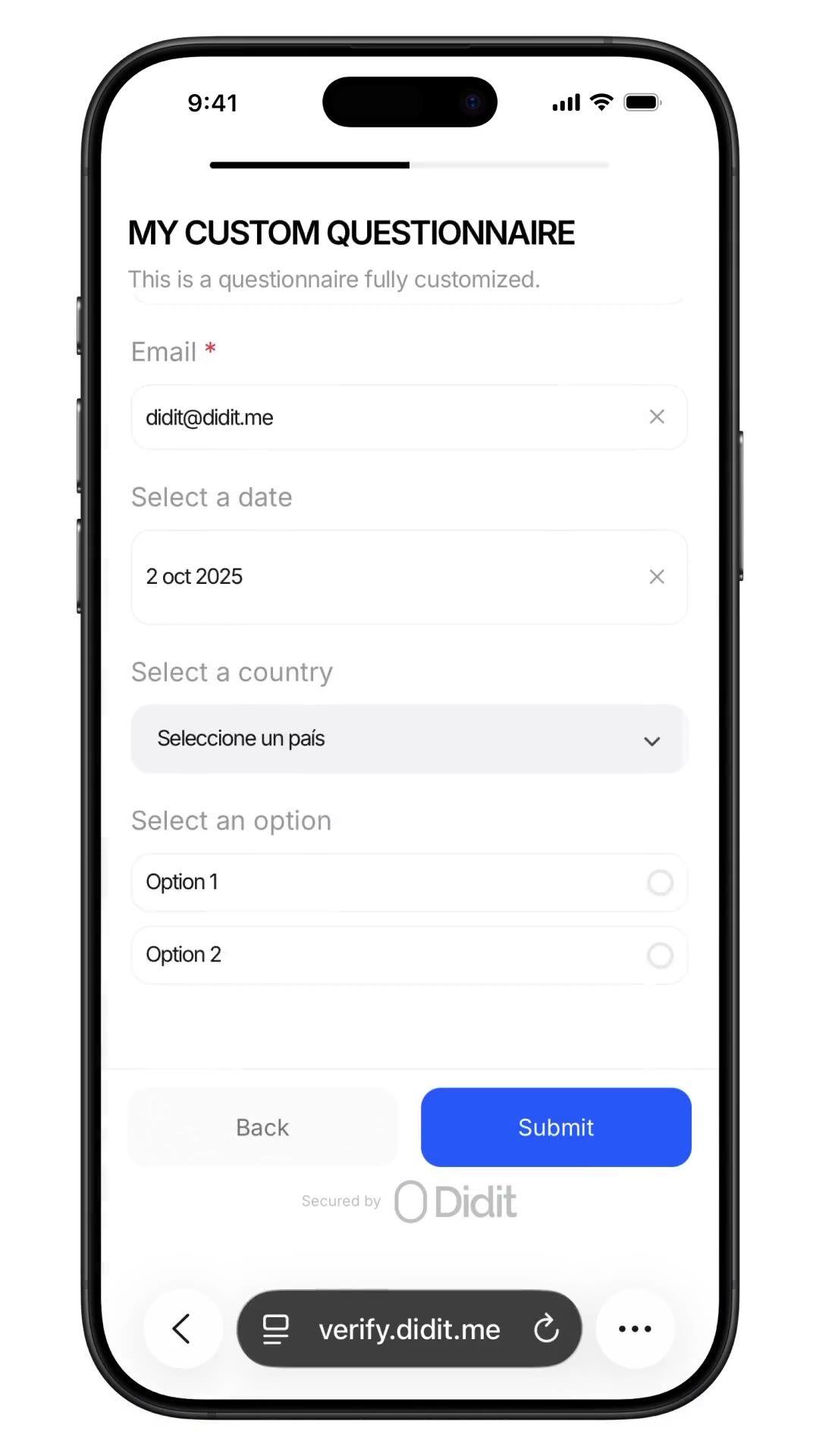
Kumpulkan data apa pun. Dalam alur verifikasi apa pun.
Ajukan pertanyaan apa pun yang dibutuhkan tim kepatuhan Anda, Source of Funds, pekerjaan, perkiraan volume, deklarasi mandiri PEP (politically exposed person), dengan jawaban yang diaudit dalam sesi yang sama. Builder no-code, conditional branching, upload file. $0.10 per submission, 500 gratis/bulan.
Dipercaya oleh 3.000+ organisasi di seluruh dunia.
Source-of-funds, PEP self-disclosure
Tanyakan apa saja. Kunci jejak audit.
Sematkan kuesioner kustom ke dalam alur kerja, source of funds, PEP
self-disclosure, pekerjaan, perkiraan volume. Jawaban akan masuk ke laporan sesi.
$0.10 per submission.
Cara kerjanya
Dari pendaftaran hingga pengguna terverifikasi dalam empat langkah.
Langkah 01 / 04
01
Buat alur kerja
Pilih pemeriksaan yang Anda inginkan, ID, liveness, face match, sanksi, alamat, usia, telepon, email, pertanyaan kustom. Seret ke dalam alur di dashboard, atau posting alur yang sama ke API kami. Buat cabang berdasarkan kondisi, jalankan A/B test, tidak perlu coding.
Integrasikan
Sematkan secara native dengan Web, iOS, Android, React Native, atau Flutter SDK kami. Redirect ke halaman yang di-host. Atau cukup kirim tautan kepada pengguna Anda, melalui email, SMS, WhatsApp, di mana saja. Pilih yang sesuai dengan stack Anda.
Pengguna melewati alur
Didit meng-host kamera, isyarat pencahayaan, mobile hand-off, dan aksesibilitas. Saat pengguna berada dalam alur, kami menilai 200+ sinyal fraud secara real time dan memverifikasi setiap bidang terhadap sumber data otoritatif. Hasil dalam waktu kurang dari dua detik.
Anda menerima hasilnya
Webhook yang ditandatangani secara real-time menjaga database Anda tetap sinkron saat pengguna disetujui, ditolak, atau dikirim untuk ditinjau. Poll API sesuai permintaan. Atau buka konsol untuk memeriksa setiap sesi, setiap sinyal, dan mengelola kasus sesuai keinginan Anda.
Dibuat untuk developer · Dibuat untuk melawan fraud · Desain terbuka
Enam kemampuan. Satu feature flag. QUESTIONNAIRE.
Setiap kemampuan di bawah ini adalah toggle pada modul yang sama. Tidak ada tingkatan upsell, tidak ada SKU terpisah, tidak ada panggilan add-on. Aktifkan per alur kerja, atau rangkai langkah kuesioner setelah verifikasi ID dan liveness dalam satu alur kerja.
Formulir berbasis skema. Tanpa kode. Tanpa SDK. Tanpa proses build.
Dua mode. Mode sederhana untuk formulir drag-and-drop satu bahasa yang cepat, terbaik untuk survei internal dan atestasi cepat. Mode lanjutan adalah editor berbasis node visual, diperlukan saat Anda membutuhkan conditional branching, terjemahan, teks lanjutan berbasis pilihan, atau forced manual review. Keduanya dipublikasikan dalam waktu kurang dari satu menit.
Elements
Dropdown
Single choice
Multi choice
File upload
Long text
Date
Click to add
Custom questionnaireDraftPublished
Click to add elements
Source of fundsDROPDOWN
Required
Annual income bandSINGLE_CHOICE
Required
Supporting documentsFILE_UPLOAD
Required
Additional contextLONG_TEXT
Required
PublishPublished
02 · Conditional branching
Tampilkan setiap pertanyaan hanya kepada user yang membutuhkannya.
Node branching di editor mode lanjutan memeriksa setiap jawaban sebelumnya dan mengarahkan pengguna di sepanjang jalur yang sesuai. Tanyakan kepada penduduk AS tindak lanjut W-9, penduduk UE deklarasi mandiri PEP (politically exposed person), lewati keduanya jika tidak berlaku. Seret dari pegangan node mana pun ke ruang kosong untuk membuat node baru yang terhubung. Undo, redo, keyboard shortcuts, zoom dan pan disertakan.
Applicant answer
US residentPEP · yesIncome > 250k
country == USRequire
is_pep == trueRequire
income > 250kShow
W-9 tax formFILE_UPLOAD
Required
Pick an answer to re-route the flow
03 · Template AML-grade
Sumber Dana. Domisili pajak. Deklarasi UBO.
Enam template kepatuhan bawaan di konsol, Source of Funds, Employment Details, Purpose of Account, Beneficial Ownership, Tax Residency, Risk Assessment. Masing-masing mengkodekan apa yang diharapkan auditor (sumber pendapatan, rincian, upload bukti, dana pihak ketiga, deklarasi aset virtual). Kloning salah satu dan sesuaikan, atau mulai dari kosong.
Template library
SOFSource of Funds7q
EMPEmployment5q
ACPAccount Purpose4q
UBOOwnership6q
TAXTax Residency5q
RSKRisk Profile8q
Questionnaire7 questions
Pick a template to build
Source of fundsDROPDOWN
Income bandSINGLE_CHOICE
Initial depositDROPDOWN
Volume bandSINGLE_CHOICE
Supporting docsFILE_UPLOAD
Other sourcesMULTI_CHOICE
Extra contextLONG_TEXT
48+ languagesReady to ship
04 · Respons terstruktur
Setiap jawaban dikembalikan dalam format JSON yang dapat diaudit.
Laporan sesi membawa array `responses`, satu entri per langkah kuesioner. Setiap item mengirimkan tipe elemen, flag wajib, judul yang dilokalkan, pilihan, batas upload, dan objek jawaban dengan nilai, teks, atau file. Bentuk yang sama pada API dan setiap webhook, simpan sekali dan jangan pernah parse ulang.
Source of fundsIn flow
Answer
Select…Salary
Attachment
payslip_2026.pdf
Submit
questionnaire_responses200 OK
awaiting submission…
{
"questionnaire_id": "q_9f7485e0",
"element_type": "DROPDOWN",
"title": "Source of funds",
"answer": { "value": "salary" },
"files": ["payslip_2026.pdf"]
}
webhook · questionnaire.completed
05 · Respons + jejak audit
Review manual paksa. Human in the loop. Siap audit.
Aktifkan force-manual-review dan setiap submission akan tertahan di In Review sampai petugas kepatuhan manusia menyetujuinya. Konsol menampilkan setiap jawaban, setiap file yang diunggah, dan teks pertanyaan yang dilokalkan. Persetujuan sekali klik memicu webhook sesi terverifikasi dengan laporan akhir. Dapat diaudit end-to-end untuk regulator.
Submission queueLive
412413Approved
282928In review
6Not finished
Webhook fired · questionnaire.completedjust now
Jusr_7b3e9d4Source of Fundsjust nowIn reviewApproved
Ausr_a8c4f02Source of Funds12 MayApproved
Musr_4d2b6e1Employment Details13 MayApproved
Lusr_9f01a3cTax Residency14 MayApproved
06 · Workflow-native
In-line di KYC. Atau jalankan sebagai verifikasi terpisah.
Rangkai QUESTIONNAIRE setelah ID_VERIFICATION dan LIVENESS untuk mengumpulkan Sumber Dana sebagai bagian dari onboarding KYC (know your customer) lengkap, satu sesi, satu webhook, satu laporan tersimpan. Atau, luncurkan workflow yang fitur utamanya hanya QUESTIONNAIRE untuk due diligence berkelanjutan, deklarasi pasca-onboarding, dan re-attestasi berkala. $0.10 per pengajuan untuk kedua jalur.
01ID check
02Liveness
03Questions
Source of FundsApproved
Primary source · Salary
Docs · payslip_2026.pdf
Single session reportsession.approved · one webhook
Verified
Integrasikan
Dua pola. JSON yang sama. Harga yang sama.
Gunakan POST /v3/session/ pada alur kerja yang merangkai QUESTIONNAIRE dengan ID_VERIFICATION dan LIVENESS untuk mengumpulkan data dalam KYC lengkap, atau pada alur kerja yang fitur satu-satunya adalah QUESTIONNAIRE untuk menjalankan formulir sebagai Verifikasi Kuesioner tersendiri. Keduanya mengembalikan bentuk questionnaire_responses yang sama.
Tempel blok di bawah ini ke Claude Code, Cursor, Codex, Devin, Aider, atau Replit Agent. Isi placeholder my_stack dengan framework + bahasa + use case Anda. Agent akan memprovisi Didit, membangun kuesioner, membuat workflow dengan fitur QUESTIONNAIRE, menghubungkan webhook, dan mengirimkannya.
didit-integration-prompt.md
# Didit Custom Questionnaires — integrate in 5 minutes

You are integrating Didit's Custom Questionnaires module into <my_stack>.
Follow these steps exactly. Every URL, header, and enum value below is
canonical — do not paraphrase or "improve" them.

## 1. Provision an account
- Sign up: https://business.didit.me (no credit card required).
- Or provision programmatically: POST https://apx.didit.me/auth/v2/programmatic/register/
  (returns an API key bound to the workspace + application).

## 2. Build the questionnaire — Console OR API

### 2a. Visual builder in the Console (no code)
Questionnaires are authored visually — no schema upload, no SDK required.
1. Open https://business.didit.me, go to Questionnaires, click New.
2. Pick a mode:
   - Simple Mode — single-language drag-and-drop builder. Best for fast
     forms, internal surveys, single-locale flows.
   - Advanced Mode — visual node-based graph editor. Required for
     conditional branching, multi-language translations, choice-driven
     follow-up text, and forced manual review.
3. Drag elements onto the canvas (input, choice, upload, layout — full
   element catalog in section 5 below).
4. Optionally start from a pre-built template (Source of Funds,
   Employment Details, Purpose of Account, Beneficial Ownership, Tax
   Residency, Risk Assessment).
5. Localize titles, descriptions, placeholders, and choice labels for
   every supported language; set a default_language.
6. Publish — the questionnaire is now addressable by its questionnaire_id.

### 2b. Create the questionnaire programmatically (Management API)
Use this path when you want the form to live in code, ship via CI, or be
authored by an LLM. Endpoint:

  POST https://verification.didit.me/v3/questionnaires/
  Headers:  x-api-key: <your-api-key>
            Content-Type: application/json

Required body:
- title              — internal questionnaire name (string).
- languages          — array of locale codes; MUST include "en".
- default_language   — the default locale (string, e.g. "en").
- form_elements      — ordered array of questions (≥1 entry).

Each form element requires id, element_type (lowercase OR uppercase enum
— "short_text", "multiple_choice", "email", "file_upload", "date_picker",
etc.), and a translated label keyed by locale. For dropdown,
single_choice, and multiple_choice add options: [{ value, label }].

Hard constraints:
- This endpoint supports SIMPLE LINEAR questionnaires only. Do NOT send
  graph, branches, next, required_if, or conditional rules — use the
  Console (section 2a) for those.

Example body:
{
  "title": "Customer Onboarding",
  "languages": ["en"],
  "default_language": "en",
  "form_elements": [
    {
      "id": "occupation",
      "element_type": "short_text",
      "label": { "en": "What is your occupation?" },
      "is_required": true
    },
    {
      "id": "source_of_funds",
      "element_type": "multiple_choice",
      "label": { "en": "Source of funds" },
      "is_required": true,
      "options": [
        { "value": "employment", "label": { "en": "Employment" } },
        { "value": "business", "label": { "en": "Business" } },
        { "value": "investments", "label": { "en": "Investments" } }
      ]
    }
  ]
}

Response includes questionnaire_id — store it; you'll use it as
questionnaire_uuid when you wire the questionnaire into a workflow in
section 3 below. Full reference:
https://docs.didit.me/management-api/questionnaires/create

## 3. Two integration paths — pick one

### Path A — Workflow Builder (hosted UI, recommended)
Best when you want Didit to host the form, the file-upload UX, the
multi-language routing, the keyboard handling, and the mobile responsive
layout.

1. Create a workflow that contains the QUESTIONNAIRE feature:
   POST https://verification.didit.me/v3/workflows/
   Authorization header:  x-api-key: <your-api-key>
   Body: workflow_label, features array with the entry
         { feature: "QUESTIONNAIRE", questionnaire_id: "<id>" }
         (UPPERCASE — strict enum)
   Optional: chain QUESTIONNAIRE after OCR + LIVENESS in the
   same workflow to collect Source of Funds as part of a full Know Your Customer (KYC).

2. Create a verification session for an end user:
   POST https://verification.didit.me/v3/session/
   Body: workflow_id (from step 1), vendor_data (your own user id).
   Response: url (the hosted verification link) — redirect the user to it.

3. Listen for webhook callbacks (see "Webhooks" below).

### Path B — Standalone Questionnaire Verification
Run a questionnaire as its own verification — no KYC required.
Use a workflow whose only feature is QUESTIONNAIRE. Everything else is
identical to Path A. Useful for ongoing-due-diligence pulses,
post-onboarding declarations, periodic re-attestations.

## 4. Webhooks
- Register a webhook destination once via
  POST https://verification.didit.me/v3/webhook/destinations/
  Body: url, subscribed_events: ["session.verified", "session.review_started",
                                  "session.declined"]
- Response includes secret_shared_key — store it.
- Every webhook delivery carries an X-Signature-V2 header you MUST verify
  before trusting the payload.  HMAC-SHA256 verification MUST run against the raw body bytes (the raw payload as Didit sent it) BEFORE any JSON parsing — re-serialising the parsed body changes whitespace and key order, which invalidates the signature.Algorithm:
    1. sortKeys(payload) recursively
    2. shortenFloats (truncate trailing zeros after the decimal point)
    3. JSON.stringify the result
    4. HMAC-SHA256 with the secret_shared_key
    5. Hex-encode, compare to the X-Signature-V2 header.

## 5. Element catalog (use these in the builder)
Input elements:
  SHORT_TEXT, LONG_TEXT, NUMBER, EMAIL, PHONE, ADDRESS, DATE_PICKER, TIME
Choice elements:
  DROPDOWN, SINGLE_CHOICE, MULTIPLE_CHOICE, COUNTRY, CONSENT
  - DROPDOWN and SINGLE_CHOICE support per-option requires_text_input —
    selecting "Other" can demand a free-text follow-up.
Upload elements:
  IMAGE, FILE_UPLOAD
  - max_files (1-5) per element.
Layout elements:
  PARAGRAPH, SECTION_HEADER, SEPARATOR (read-only, not answerable).

## 6. Reading the report
The session report contains a questionnaire_responses array (one entry
per questionnaire step in the workflow graph). Each entry has:
- node_id: identifies the questionnaire step in the workflow graph
- questionnaire_id: which questionnaire this response is for
- title, description, languages, default_language, is_active
- sections: array of { title, description, items[] }
- each item: { uuid, order, element_type, is_required, title,
              description, placeholder, choices, max_files, answer }
- answer: { value, text, files[] } — only the fields relevant to the
  element_type are present.
- status: "Approved" | "In Review" | "Not Finished"

Status semantics:
- Not Finished — user has not completed the questionnaire yet.
- In Review — submitted, pending manual review. The Console flag
  "force manual review" pins every response to this state until a human
  approves it.
- Approved — reviewed and accepted.

Note: questionnaires do NOT emit risk warnings. Governance is achieved
through required fields, validation, manual review, and the workflow
graph (branching nodes route compliance-sensitive answers to In Review).

## 7. Hard rules — do not change
- Base URL for /v3/* endpoints is verification.didit.me (NOT apx.didit.me).
- Feature enum is UPPERCASE: QUESTIONNAIRE, OCR, LIVENESS,
  FACE_MATCH, AML, IP_ANALYSIS.
- Element type enums are UPPERCASE + underscored: SHORT_TEXT, LONG_TEXT,
  FILE_UPLOAD, SINGLE_CHOICE, etc.
- Auth header is x-api-key (lowercase, hyphenated).
- Webhook signature header is X-Signature-V2 (NOT X-Signature).
- Always verify webhook signatures before trusting payload data.
- Status casing matches exactly: "Approved", "In Review", "Not Finished"
  (title-cased, space-separated).

## 8. Pricing reference (public)
- $0.10 per questionnaire submission (Path A or Path B).
- No minimums. No per-language surcharge. No per-element surcharge.
  Conditional branching, file uploads, manual review — all included at
  the same per-submission price.

## 9. Verify your integration
- Sandbox starts on signup at https://business.didit.me — no separate flag.
- Use one of the pre-built templates (Source of Funds, Employment
  Details, Purpose of Account, Beneficial Ownership, Tax Residency, Risk
  Assessment) to ship a draft in under a minute, then customise.
- Switch to live: flip the application's environment toggle in console.

When in doubt: https://docs.didit.me/core-technology/questionnaires/overview
Dirancang untuk kepatuhan
Buka negara baru dengan satu klik. Kami yang mengerjakan bagian sulitnya.
Kami membuka anak perusahaan lokal, mengamankan lisensi, menjalankan pengujian penetrasi, mendapatkan sertifikasi, dan menyelaraskan dengan setiap regulasi baru. Untuk meluncurkan verifikasi di negara baru, cukup aktifkan tombol. 220+ negara sudah aktif, diaudit dan diuji penetrasi setiap kuartal, satu-satunya penyedia identitas yang secara formal disebut oleh pemerintah negara anggota Uni Eropa lebih aman daripada verifikasi langsung.
Mulai gratis. Bayar sesuai pemakaian. Skalakan ke Enterprise.
500 verifikasi gratis setiap bulan, selamanya. Setelah itu, bayar hanya saat modul berjalan. Kontrak khusus, data residency, dan service level agreement (SLA) tersedia untuk Enterprise.
Gratis
$0/ bulan · tanpa kartu
Untuk membangun, menguji, dan pengguna pertamamu.
Semua yang kamu butuhkan untuk memulai:
500 verifikasi KYC lengkap setiap bulan
ID, liveness, face match, device & IP
200+ sinyal fraud, blocklist, duplikat
KYC yang bisa digunakan kembali di seluruh jaringan Didit
Workflow builder, case management, SDK
Dukungan AIAgen AI dalam konsol, dokumentasi, dan komunitas.