Bagikan identitas terverifikasi dengan mitra Anda. Server-to-server.
Verifikasi pengguna atau bisnis sekali saja. Bagikan hasilnya dengan mitra, mereka bisa langsung onboarding orang yang sama. Tidak perlu alur kedua, tidak perlu selfie kedua. Berfungsi untuk KYC dan KYB. Dibuat untuk Banking-as-a-Service, grup multi-brand, embedded finance, dan marketplace dengan sub-platform.
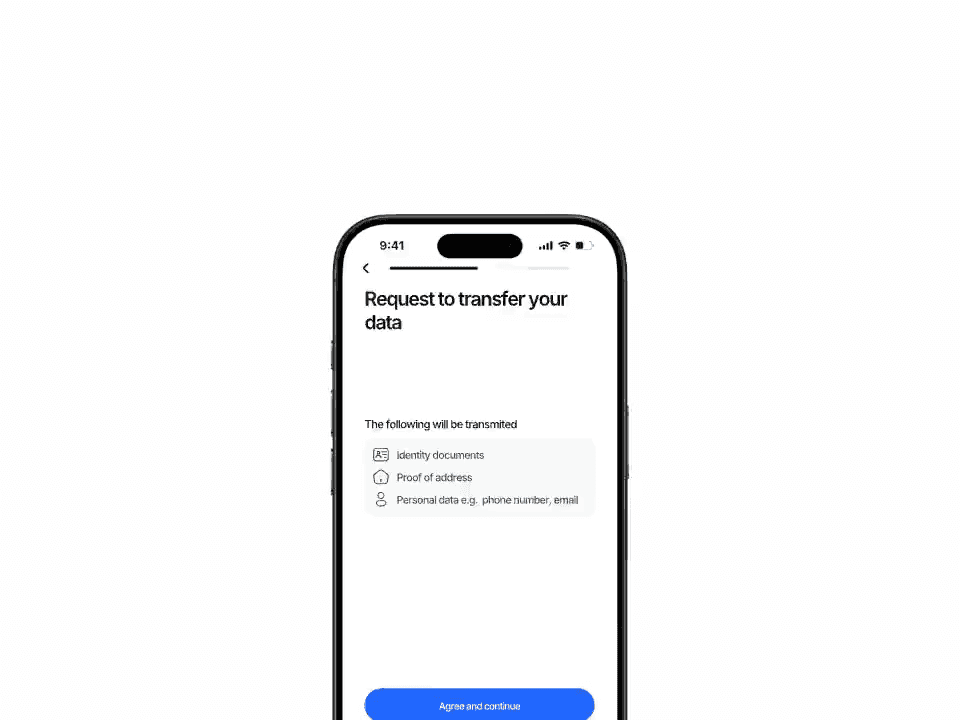
Pengguna Anda memverifikasi sekali di aplikasi Anda. Mitra Anda, sponsor BaaS Anda, brand saudara Anda, marketplace downstream Anda, membutuhkan catatan yang sama. Kirimkan mereka share token sekali pakai. Mereka menukarkannya dan menarik verifikasi lengkap. Pengguna tidak pernah melihat alur kedua.
Cara kerjanya
Dari aplikasi Anda ke mitra Anda dalam empat langkah.
Langkah 01 / 04
01
Pilih sesi terverifikasi
Pilih verifikasi yang sudah selesai, disetujui, ditolak, atau dalam peninjauan, dan minta share token dari Didit. Token kedaluwarsa dalam satu jam secara default; Anda bisa memperpanjangnya dari satu menit hingga satu hari penuh.
Kirim token ke mitra Anda
Serahkan token kepada mitra Anda melalui backend Anda sendiri, webhook, queue, REST call. Token hanya berfungsi untuk mitra yang Anda sebutkan saat Anda membuatnya. Tidak ada orang lain yang bisa menukarkannya.
Mitra Anda mengimpor catatan
Mitra Anda menukarkan token dan memilih cara onboarding pengguna, percaya keputusan Anda dan langsung menyetujui, atau menarik data mentah dan membiarkan tim kepatuhan mereka membuat keputusan.
Sesi lengkap masuk ke aplikasi mereka
Didit mengkloning seluruh catatan, dokumen, selfie, face match, AML, data registri, UBO, ke workspace mitra Anda. Bentuknya sama seperti verifikasi baru, dengan audit trail yang jelas kembali ke aslinya.
Dibuat untuk BaaS · embedded finance · grup multi-brand
Satu verifikasi. Setiap platform mitra.
Buat token. Kirim. Impor. Pilih kecepatan onboarding. Enam bagian yang bergerak mencakup setiap bentuk ekosistem mitra, panggilan yang sama untuk KYC dan KYB.
Pilih verifikasi yang sudah selesai dan minta token dari Didit yang ditujukan untuk satu mitra. Masa berlaku default adalah satu jam; Anda bisa memperpanjangnya dari satu menit hingga satu hari penuh. Token hanya berfungsi untuk mitra yang Anda sebutkan, tidak ada orang lain yang bisa menukarkannya.
Hanya sesi yang sudah selesai (Disetujui · Ditolak · Dalam Peninjauan)
02 · Impor sesi
Partner Anda menarik seluruh data.
Mitra Anda menukarkan token dan Didit mengkloning seluruh verifikasi ke workspace mereka, sesi baru, data yang sama, audit trail lengkap kembali ke aslinya. Mereka menandainya dengan ID pengguna internal mereka sendiri dan memilih alur kerja tempat data tersebut masuk.
JSON yang sama dengan yang sudah dibaca webhook Anda
03 · Percaya atau tinjau ulang
Onboarding instan, atau cek ulang untuk kepatuhan.
Percayai keputusan Anda dan biarkan mitra Anda menyetujui pengguna saat token masuk. Atau serahkan data mentah kepada mereka dan biarkan tim kepatuhan mereka membuat keputusan. Atur per mitra, panggilan yang sama, dua kecepatan onboarding.
trueMengkloning status asli, onboarding instan.Disetujui
falseMengkloning data, mengatur status menjadi Dalam Peninjauan.Dalam Peninjauan
Aktifkan per relasi partner · default-nya `false` untuk partner baru
04 · KYC + KYB · kedua mode
Bagikan data individu atau seluruh bisnis.
Panggilan yang sama berfungsi untuk kedua bentuk. Bagikan orang yang terverifikasi dan mitra Anda mendapatkan dokumen, selfie, kecocokan, dan setiap hit AML. Bagikan bisnis yang terverifikasi dan mereka mendapatkan catatan registri, setiap Ultimate Beneficial Owner, setiap KYC pejabat, setiap dokumen, setiap screening.
Token membawa `session_kind` · Didit memilih jalur klon yang cocok
05 · Cocok untuk ekosistem mitra
Dibuat untuk bisnis yang satu verifikasinya bisa dipakai berkali-kali.
Sponsor Banking-as-a-Service. Grup multi-brand, neobank plus broker, on-ramp plus exchange. Embedded finance yang berjalan melalui bank mitra. Marketplace dengan sub-platform regional. Reseller white-label. Jaringan pemberi pinjaman. Di mana pun satu pengguna, atau satu bisnis, di-onboarding sekali dan melayani banyak pihak.
Grup keuangan multi-brandNeobank + broker · on-ramp + exchange
Embedded finance / SaaSVertical SaaS + partner bank
Marketplace dengan sub-platformPembagian regional atau vertikal
Reseller white-labelReseller + downstream tenant
Konsorsium B2B KYBEntitas legal yang sama di banyak partner
06 · Kepatuhan by design
Standar audit secara default.
Didit hanya membuat token untuk verifikasi yang sudah selesai, tidak ada alur yang setengah terekam bocor ke mitra. Token yang sama tidak pernah bisa diimpor dua kali. Kedua belah pihak menandatangani perjanjian berbagi data GDPR; Didit menyediakan bagian teknisnya.
Tempel blok di bawah ini ke Claude Code, Cursor, Codex, Devin, Aider, atau Replit Agent. Agen akan menghubungkan Didit, membuat kerangka kedua sisi serah terima, dan mengirimkannya.
didit-integration-prompt.md
# Didit B2B Reusable KYC — partner-to-partner KYC sharing

You are integrating Didit's B2B Reusable Know Your Customer (KYC) into <my_stack>. The recipe is server-to-server: one Didit application (Service X) mints a short-lived JSON Web Token (JWT) share token for a finished session; a partner Didit application (Service Y) imports the token and Didit clones the full verified session into Service Y. Works for both KYC and Know Your Business (KYB) sessions.

Built for Banking-as-a-Service (BaaS) sponsor banks, multi-brand financial groups, embedded finance through partner banks, marketplaces with regional or vertical sub-platforms, on-ramp + exchange ecosystems, white-label resellers, and B2B KYB consortia where the same legal entity onboards once and serves many. Every URL, header, and enum value below is canonical — do not paraphrase or "improve" them.

## 1. Provision both applications
- Sign up: https://business.didit.me (no credit card required).
- Or provision programmatically: POST https://apx.didit.me/auth/v2/programmatic/register/
- Create TWO applications in your Didit organisation. One acts as Service X (mints share tokens), the other as Service Y (imports them). In production these will usually live in different organisations — one per partner.
- Each application has its own `x-api-key`. Service X uses its own key to mint; Service Y uses its own key to import.

## 2. Service X — mint a share token

Service X picks a finished session it owns and posts to the share endpoint:

  POST https://verification.didit.me/v3/session/{sessionId}/share/
  Headers:
    x-api-key: <Service X api key>
    Content-Type: application/json
  Body:
    {
      "for_application_id": "<partner-application-uuid>",
      "ttl_in_seconds": 3600
    }

Bounds on `ttl_in_seconds`: min 60, max 86400, default 3600.

Requirements:
  - The session must be in a FINISHED status: "Approved", "Declined", or "In Review".
  - The API key must hold the `write:sessions` privilege.
  - `for_application_id` must be a real Didit application uuid — usually the partner's app.

Response: 201 Created with the JWT in the `share_token` field plus `for_application_id` and `session_kind` ("user" or "business" — Didit detects this from the source session and embeds it in the token):

  {
    "share_token": "eyJhbGciOiJIUzI1NiJ9...",
    "for_application_id": "partner-app-uuid",
    "session_kind": "user"
  }

## 3. Transmit the token to Service Y

Service X transmits the `share_token` to Service Y over a pre-arranged backend channel — REST, message queue, signed webhook, anything you control. The token is scoped to Service Y's application and useless to any other application.

## 4. Service Y — import the shared session

Service Y posts the token to the import endpoint:

  POST https://verification.didit.me/v3/session/import-shared/
  Headers:
    x-api-key: <Service Y api key>
    Content-Type: application/json
  Body:
    {
      "share_token": "<jwt from step 2>",
      "workflow_id": "<Service Y's own workflow id>",
      "vendor_data": "<Service Y's internal user id>",
      "trust_review": true
    }

`trust_review`:
  - `true`  → the imported session preserves the original status ("Approved" / "Declined" / "In Review"). Service Y onboards the user instantly. Use when Service Y fully trusts Service X's decision (sister brand, regulated partner with a signed data-sharing agreement).
  - `false` → the imported session lands in "In Review" so Service Y's compliance team makes its own call. Safe default for new partner relationships.

Response: 201 Created with a brand-new session in Service Y's application:

  {
    "session_id": "<new uuid>",
    "session_number": <int>,
    "session_kind": "user" | "business",
    "status": "Approved" | "In Review" | "Declined",
    "shared_from_session": "<original session uuid in Service X>",
    "vendor_data": "<Service Y's internal user id>",
    "id_verifications": [...],
    "liveness_checks": [...],
    "face_matches": [...],
    "aml_screenings": [...],
    "database_validations": [...],
    "proof_of_address": [...],
    "phone_verifications": [...],
    "email_verifications": [...]
  }

For a `session_kind: "business"` token Didit clones the KYB shape instead. KYB session statuses are UPPER_SNAKE_CASE (not Title Case like KYC):

  {
    "session_id": "<new uuid>",
    "session_kind": "business",
    "status": "APPROVED",
    "shared_from_session": "<original business session uuid>",
    "vendor_data": "<Service Y's internal business id>",
    "registry_checks": [...],
    "key_people_checks": [...],
    "document_verifications": [...],
    "aml_screenings": [...],
    "questionnaires": [...]
  }

A new User or Business entity is auto-created in Service Y if one with the supplied `vendor_data` doesn't already exist.

## 5. Idempotency, expiration, errors

| Status | Reason |
|--------|--------|
| 401 | Share token invalid or past `exp` — request a new one. |
| 403 | Token not intended for your application, OR session already imported into your app. |
| 404 | Original session no longer exists. |
| 404 | `workflow_id` not found in your application. |

The duplicate-import check is enforced against the (share_token, partner application) pair.

## 6. Webhooks (optional, only when Service Y wants async updates)

Service Y can register a webhook destination once via:

  POST https://verification.didit.me/v3/webhook/destinations/
  Body: url, subscribed_events: ["status.updated"]

Every webhook delivery carries an `X-Signature-V2` header you MUST verify before trusting the payload. HMAC-SHA256 verification MUST run against the raw body bytes (the raw payload as Didit sent it) BEFORE any JSON parsing — re-serialising the parsed body changes whitespace and key order, which invalidates the signature.

Algorithm:
  1. sortKeys(payload) recursively
  2. shortenFloats (truncate trailing zeros after the decimal point)
  3. JSON.stringify the result
  4. HMAC-SHA256 with the secret_shared_key
  5. Hex-encode, compare to the X-Signature-V2 header.

## 7. Hard rules — do not change
- Base URL for /v3/* endpoints is verification.didit.me (NOT apx.didit.me).
- Auth header is x-api-key (lowercase, hyphenated).
- Webhook signature header is X-Signature-V2 (NOT X-Signature).
- Status casing matches exactly: "Approved", "Declined", "In Review", "Not Finished" (Title Case With Spaces — KYC convention).
- session_kind is lowercase: "user" or "business".
- The share API is BUSINESS-to-BUSINESS sharing. Service X and Service Y are responsible for the data-sharing legal basis under General Data Protection Regulation (GDPR), UK GDPR, and any cross-border transfer rules. Didit ships the technical capability; you ship the data-sharing agreement.

## 8. Pricing reference (public)
- Service X already paid for the original verification (full KYC bundle is $0.33 or KYB session uses country-specific registry pricing; see didit.me/pricing).
- Service Y pays nothing on the import side — `POST /v3/session/import-shared/` is included with every plan.
- 500 free verifications every month on every account (applies to fresh captures, not imports).

## 9. Verify your integration
- Sandbox starts on signup at https://business.didit.me — no separate flag.
- Create two sandbox applications: one as Service X (issuer), the other as Service Y (importer). Use Service X's API key to mint a token for a finished sandbox session, hand the token off, use Service Y's API key to import.
- Switch to live: flip each application's environment toggle in console.

When in doubt:
- https://docs.didit.me/sessions-api/share-session/overview
- https://docs.didit.me/sessions-api/share-session/share
- https://docs.didit.me/sessions-api/share-session/import
- https://docs.didit.me/core-technology/reusable-kyc/share-kyc-via-api
Dirancang untuk kepatuhan
Buka negara baru dengan satu klik. Kami yang mengerjakan bagian sulitnya.
Kami membuka anak perusahaan lokal, mengamankan lisensi, menjalankan pengujian penetrasi, mendapatkan sertifikasi, dan menyelaraskan dengan setiap regulasi baru. Untuk meluncurkan verifikasi di negara baru, cukup aktifkan tombol. 220+ negara sudah aktif, diaudit dan diuji penetrasi setiap kuartal, satu-satunya penyedia identitas yang secara formal disebut oleh pemerintah negara anggota Uni Eropa lebih aman daripada verifikasi langsung.
Atur masa berlaku token mulai dari satu menit hingga satu hari penuh.
KYC + KYB
Bagikan data individu atau seluruh bisnis, panggilan yang sama, kedua bentuk data bisa.
$0.00
Partner Anda tidak perlu membayar untuk mengimpor verifikasi yang Anda bagikan.
500
Verifikasi gratis setiap bulan di setiap akun.
Tiga tingkatan, satu daftar harga
Mulai gratis. Bayar sesuai pemakaian. Skalakan ke Enterprise.
500 verifikasi gratis setiap bulan, selamanya. Setelah itu, bayar hanya saat modul berjalan. Kontrak khusus, data residency, dan service level agreement (SLA) tersedia untuk Enterprise.
Gratis
$0/ bulan · tanpa kartu
Untuk membangun, menguji, dan pengguna pertamamu.
Semua yang kamu butuhkan untuk memulai:
500 verifikasi KYC lengkap setiap bulan
ID, liveness, face match, device & IP
200+ sinyal fraud, blocklist, duplikat
KYC yang bisa digunakan kembali di seluruh jaringan Didit
Workflow builder, case management, SDK
Dukungan AIAgen AI dalam konsol, dokumentasi, dan komunitas.
POST /v3/session/import-shared/mengembalikan201 CreateddengansesibarudiaplikasiAnda,session_iddansession_numberyangbaru,payloadlengkapdikloningdarisumber.