
The 10 Best KYC Solutions in 2026
Compare 10 KYC solutions for customer onboarding, screening, and ongoing monitoring, with pricing, cost examples, and practical evaluation criteria.
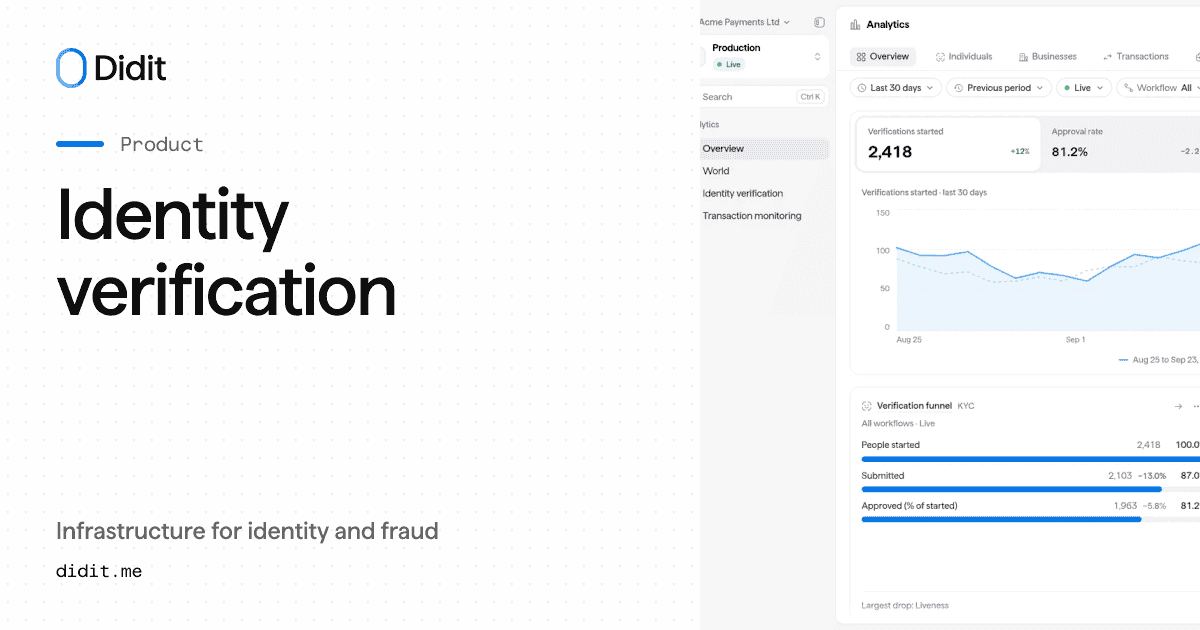
These 10 KYC solutions cover a range of onboarding needs, from an ID and selfie check to screening customers after signup.
- Didit
- Sumsub
- Veriff
- Entrust (Onfido)
- Jumio
- Persona
- IDnow
- Incode
- AU10TIX
- Trulioo
A fintech can spend weeks comparing the price of an ID check and still have no idea what the first monthly bill will look like. Some customers will need a database check. A watchlist match may go to a reviewer. If the team also monitors payments, those charges can keep coming long after the customer has opened an account.
Start with what happens on a normal application, then pick one that needs more work. See whether the provider handles both with the documents your customers use, whether your team can see why a case is pending, and what each route costs. The differences below matter most when you're bringing onboarding, screening, and ongoing monitoring into the same operation.
The 10 Best KYC Solutions for Customer Onboarding
1. Didit
Didit User Verification ties the onboarding decision to what happens on the account later. When a payments team receives a monitoring alert, it can review the activity alongside the verified customer record. For a marketplace onboarding companies, business verification can bring in registry and ownership information and link verification for the people behind the business.
The core ID check combines document verification, passive liveness, face matching, and device and IP analysis. If a market calls for stronger or different evidence, the workflow can add NFC chip reading or database validation where supported. Watchlist screening can run at onboarding, with daily rescreening available for existing customers. Payments and crypto teams can also use transaction monitoring and wallet screening.
The November pricing update lists the full ID check at $0.33 and initial watchlist screening at $0.20. Daily rescreening is $0.07 per person per year. NFC is $0.15 per chip read. Database and digital identity checks have their own rates. The Free plan includes 1,000 monitored payments per month, then charges $0.001 per monitored payment. Growth and Scale have larger allowances.
Check the exact documents and sources you need in each country. A digital credential may work well for one group of customers, while another group needs a document-and-selfie flow. The Jurisserv case study shows how document verification, passive liveness, face matching, and IP checks can run in a single workflow. If your procurement team needs audit documentation, Didit's certifications page lists its SOC 2 Type 2 report and ISO 27001 certification.
2. Sumsub
Sumsub combines document and biometric verification with options for NFC, database validation, and non-document verification. The workflow builder is useful if different applicants need different evidence. A crypto platform, for example, could test a standard ID flow in one market and a separate route for customers who can verify through a supported data source.
Basic lists $1.35 per verification with a $149 monthly minimum. Compliance lists $1.85 with a $299 minimum. Custom pricing is available by quote. Check the plan's screening features and add-ons before you build the budget. If you need ongoing monitoring, ask how the initial setup and any later matches are billed. Replay one potential watchlist match in a demo so you can see what the reviewer receives and how they close the case.
3. Veriff
Veriff offers document and selfie verification, with NFC and database checks available through its product options. It's worth a look when your priority is to get an ID and selfie flow working across several markets. An applicant with a supported passport may have a straightforward path. Someone with a less common document might take longer or need another try, which is why testing your own document mix matters.
Veriff lists Essential at $0.80 per check with a $49 monthly minimum, Plus at $1.39 with a $99 minimum, and Premium at $1.89 with a $209 minimum. Enterprise pricing is custom. Check which plan covers the features you need, including screening, monitoring, and support. Ask how pricing applies when customers start a session and return later to finish it.
4. Entrust (Onfido)
Entrust's identity verification product, formerly Onfido, brings document checks, selfie biometrics, and NFC into workflows you can configure in Workflow Studio. Studio can also run watchlist reports and add ongoing monitoring to an applicant where enabled.
If you're evaluating it for a business that needs different checks by country or document, ask to see those branches in Studio. Have the team show what happens when a customer can't read the chip in a passport, including whether they can use another method and which results your application receives. Pricing is quote-based. Ask for the document, biometric, and screening charges for each branch you plan to use.
5. Jumio
Jumio combines ID and selfie verification with options for government database checks and AML screening. A team looking for an additional check against the issuing source should start with the countries it serves. Ask which attributes the source can corroborate and what your application receives when a lookup finds no record.
Jumio uses a sales-led quote. Ask for a sample bill based on your mix of document checks, database lookups, and screening. If you expect a lot of cross-border applicants, test what happens when a document can be verified but the database add-on is unavailable in the issuing country.
6. Persona
Persona lets teams build different inquiries using government ID, selfie, document, and database verifications. It also supports reports that can contribute to screening and ongoing review. A marketplace with different policies for buyers and sellers can use that flexibility to collect the right evidence at different points in the product.
Essential starts at $250 per month with a 12-month minimum contract. Growth and Enterprise are quote-based. If you need several versions of a workflow, build two of them in the evaluation and check how much is reusable. Walk an unresolved case through manual review too, since the effort to maintain the flows and resolve exceptions matters alongside the platform fee.
7. IDnow
IDnow offers both automated document and biometric checks with AutoIdent and a live call with an identity specialist through VideoIdent. The latter is a useful distinction if you already know that a particular product or market needs a video-assisted route. IDnow also has electronic ID and signing options, depending on the workflow.
Ask for a quote for the methods you need. If video is part of the plan, check language and service availability, what happens when a customer misses or drops a call, and whether you can route them to an alternate method under your policy. Budget the automated and video routes separately.
8. Incode
Incode provides document and biometric verification alongside government-record checks. In the U.S., GovFaceMatch can compare a live selfie with the photo held by a participating state DMV. That gives teams a route to test when they want to verify eligible applicants against the issuing source without asking them to photograph their ID.
Check participation by state and decide what customers see if the lookup can't run or returns insufficient information. Keep a document route in the pilot for those cases. Incode pricing is quote-based. Ask for separate costs for government-record checks and the fallback workflow so you can model both.
9. AU10TIX
AU10TIX offers document and biometric verification, with AML screening listed in Enhanced KYC. Its Enterprise plan lists database verification and continuous risk monitoring. That plan distinction matters if your initial brief is to verify applicants but your compliance team also expects to rescreen existing customers.
Basic KYC and Enhanced KYC each list a $500 monthly minimum. Request the per-check rates and a breakdown of what's included. If you need ongoing monitoring, ask what the Enterprise quote covers and how alerts reach your reviewers. Have the provider show an alert alongside the original verification record so the team can judge what it will need to look up elsewhere.
10. Trulioo
Trulioo offers identity checks against authoritative data sources as well as document and biometric verification. It also provides business verification and screening. A cross-border payments team might start with data checks where it has enough reliable coverage, then request a document when the data alone doesn't establish the customer's identity.
Trulioo pricing is quote-based. Ask which sources it can use in your largest markets, what a partial match looks like, and whether you'll pay for a database lookup and a document check when both run on the same applicant. If you onboard companies as well, have Trulioo verify a real ownership structure from an approved test sample so you can see which fields come from the registry and which need follow-up.
How the ranking works
The comparison uses public product documentation and pricing. It looks at what each provider can check, what it publishes about cost, how you can integrate it, and what the compliance team can do with the results after signup. Those are the pieces that determine whether a provider can handle the work your team has in mind.
Ask vendors to run the same cases before you commit. An ID that validates successfully tells you one thing. An applicant whose address differs from the record or whose name returns a watchlist alert tells you whether your team can understand and resolve an exception. The KYC software buyer's guide goes deeper into evaluating evidence quality, coverage, and integrations. The FATF guidance on digital identity explains how to assess whether a source gives you enough assurance for customer due diligence.
What it costs at 1,000, 10,000 and 50,000 checks a month
Monthly volume | Didit full ID checks at $0.33 |
|---|---|
1,000 | $330 |
10,000 | $3,300 |
50,000 | $16,500 |
These are list-price estimates before credits, discounts, taxes, and additional checks. A monthly minimum is the floor for the plan. The bill depends on which checks run and how the contract counts them. When you compare quotes, ask each vendor to price the same set of cases, including any screening, add-ons, and reviews you expect.
A worked example with screening and payment monitoring
Suppose you run 1,000 full ID checks, screen all 1,000 customers at onboarding, and monitor 10,000 payments on Didit's Free plan in one month.
What runs during the month | Calculation | Cost |
|---|---|---|
Full ID checks | 1,000 × $0.33 | $330 |
Initial watchlist screens | 1,000 × $0.20 | $200 |
Monitored payments above the plan allowance | 9,000 × $0.001 | $9 |
Total before credits and taxes | $539 |
The example covers onboarding checks and monitored payments. Wallet screening costs $0.15 per check. Add that, watchlist rescreening, or case investigation to the estimate if your team uses them. Transaction volume can rise even when the number of new applicants stays flat, so track both when you forecast spend.
How to test a KYC solution before switching
Start with a pilot. Send a share of new applications through Didit while the existing provider handles the rest. Set up the checks in Workflow Builder and map statuses and webhook events to your own application before you switch any account decisions over.
If you need to bring historical verifications across, use the import API. Start with a dry run and check that the status mapping lands where you expect. Wait for the job to finish, then reconcile created, updated, skipped, and failed records against your source export. Keep time in the pilot for a reviewer to look up an imported case and compare it with a fresh one.
Check completion and approval rates against your actual devices, documents, and markets. Measure the cost per completed user and the time it takes to resolve a case. Before widening the pilot, test that an interrupted session can recover and that a delayed webhook can't change the wrong account. You can start in the Didit console with one workflow and expand after the team has reviewed the results.
Frequently Asked Questions (FAQs)
How much does KYC software cost?
Some providers charge per check. Others use a monthly minimum, a minimum contract term, or a custom quote. Estimate the number of completed checks and add the cost of screening, database lookups, retries, and reviews that your workflow actually uses.
What should I test in a KYC pilot?
Start with your main countries, document types, and devices. Include an unsupported ID, an interrupted upload, and a possible screening match. Have support and compliance go through the cases so you can see what customers are told and what evidence the reviewer receives.
Is ongoing screening the same as transaction monitoring?
Ongoing screening checks people or businesses against updated watchlists. Transaction monitoring looks for activity that needs investigation. A provider can offer both, and each can have its own fees and review workflow.
Can I move existing verification records to a new provider?
Some providers support historical imports. Check which fields and evidence they accept, how statuses are mapped, and what needs to be retained under your policy. Run a dry import and reconcile the results before moving the full set.
Artigos relacionados
- 7 Best eIDAS Software Platforms in 2026
- Didit aprovada no iBeta Level 2: 300 ataques, nenhum passou
- 7 Best AML Software Platforms in 2026
- Didit vs ID R&D: liveness IDLive Face ou uma API de KYC alojada
- Didit vs TECH5: API de KYC alojada vs biometria para programas de identificação
- Didit vs Trust Stamp: preços publicados vs uma suite KYC por orçamento