Blog
Blog archive
Every post on the Didit blog, newest first. Pick a category or search to find the subject you need.
All posts
Every post, newest first
Pick a category to filter.
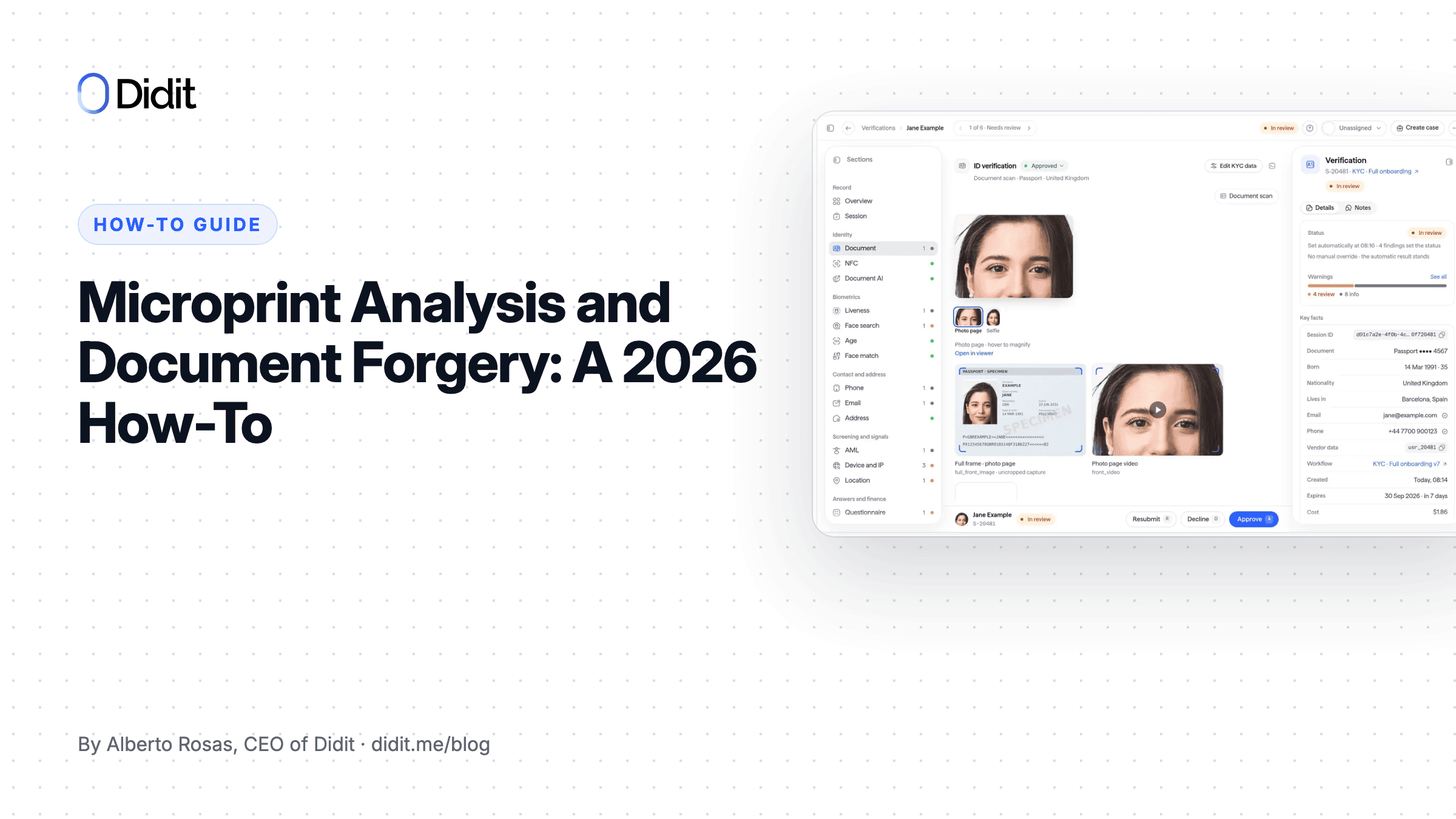
Microprint analysis inspects 0.1 to 0.7 mm security text under magnification and provides evidence about whether security printing was reproduced.
Alberto RosasMar 14, 2026Build vs. Buy Identity Verification: Cost Analysis
Analyze the true engineering cost of building in-house KYC vs. buying a platform. Make informed decisions for your identity verification strategy.
Alberto RosasMar 14, 2026Hologram Detection: Securing Documents Against Counterfeits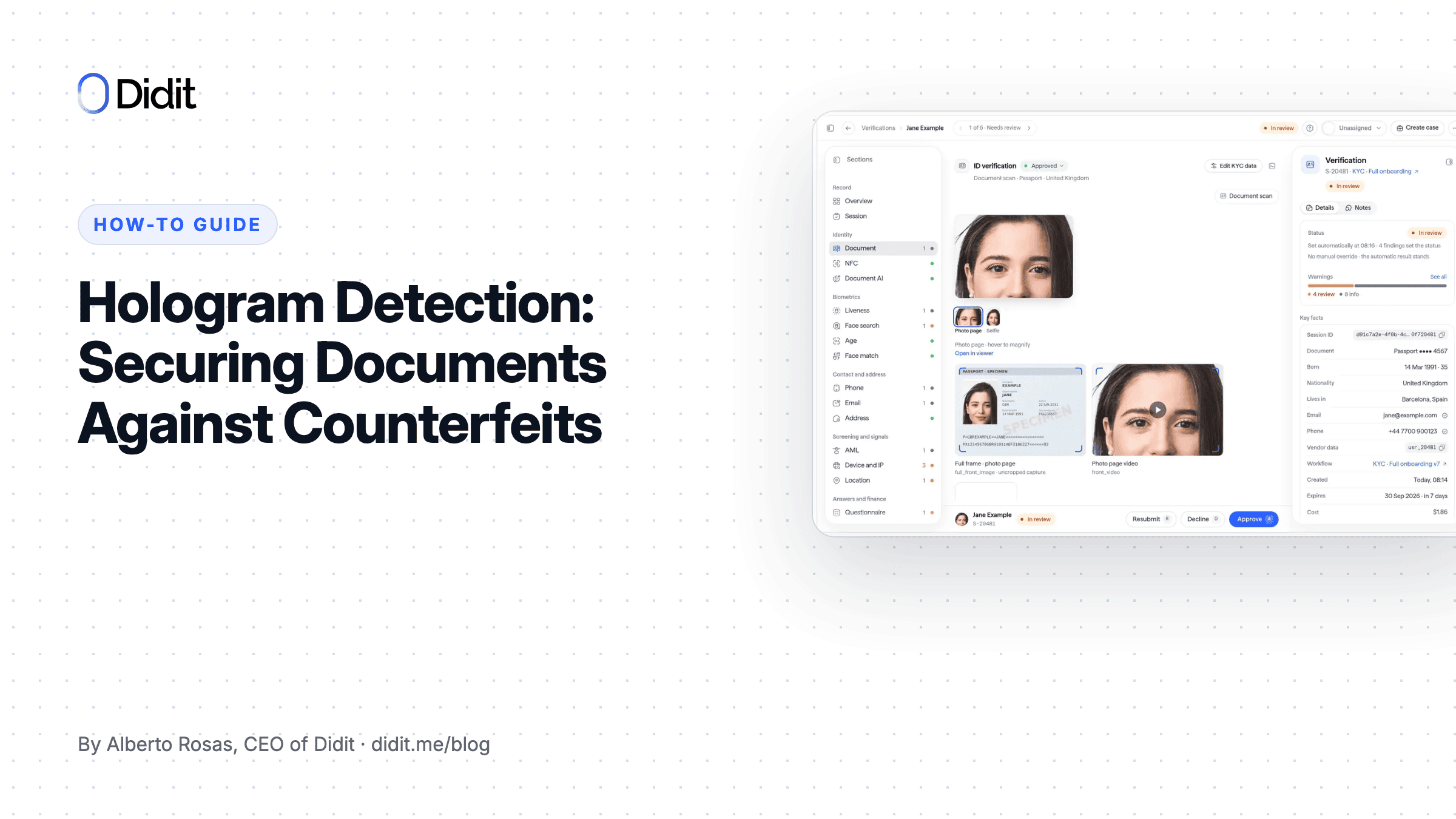
Learn how to inspect a document hologram and what Didit checks from images. ID verification costs $0.15 in a workflow or $0.20 via API. NFC chip reading adds $0.15 in a hosted session.
Alberto RosasMar 14, 2026The Neobank Identity Hub Model: Streamlining KYC for Challenger Banks
Explore the 'neobank identity hub' model, a strategic architectural approach that centralizes identity verification and KYC/AML processes for challenger banks.
Alberto RosasMar 14, 2026Building Trust: Creator Economy Verification Architecture
The creator economy thrives on trust and authenticity. This post explores the essential verification architecture needed to protect platforms, brands, and users from fraud and misinformation, ensuring robust influencer identity.
Alberto RosasMar 14, 2026Active Liveness Detection: Inside the Mechanics of Deepfake Prevention
Dive deep into the technical mechanics of active liveness detection, exploring how advanced techniques like 3D depth sensing, texture analysis, and subtle motion tracking combat sophisticated deepfake attacks.
Alejandro RosasMar 14, 2026The Compliance Officer's Guide to AI in Document Verification
AI document verification is transforming compliance, offering speed and accuracy but also introducing new challenges like algorithmic bias and the need for explainability.
Alberto RosasMar 14, 2026Integrating NFC eID Verification with Serverless Architectures
Explore how to integrate NFC eID verification into serverless architectures using services like AWS Lambda. This guide covers the benefits, challenges, architecture patterns, and code examples for building secure, scalable, and.
Alberto RosasMar 14, 2026Unlock FinTech ROI: The Power of Composable Identity Orchestration
Composable identity platforms are revolutionizing how FinTechs manage user verification, fraud prevention, and compliance. By offering unparalleled flexibility and cost efficiency, this modular approach drives significant ROI.
Alberto RosasMar 14, 2026Optimizing Cross-Platform SDK Performance for Biometrics
Dive deep into optimizing cross-platform SDK performance for biometric modalities. This guide for developers covers architecture, memory management, bundle size, and battery life for React Native and Flutter, ensuring robust.
Alejandro RosasMar 14, 2026Selective Disclosure & Verifiable Credentials: Data Minimization for Privacy
Explore how selective disclosure, powered by verifiable credentials, revolutionized data minimization principles. This blog post dives into the technical mechanisms behind this privacy-enhancing technology, offering practical.
Alberto RosasMar 14, 2026Building Trust in AI Agent Ecosystems: The Future of Identity
As AI agents become ubiquitous, establishing trust and verifying their interactions with humans is paramount. This post explores the challenges of deepfakes and AI-generated identities, advocating for robust AI agent identity.
Alberto RosasMar 14, 2026The Silent Revolution: Passive Authentication in Critical Infrastructure
Explore how passive authentication is transforming critical infrastructure security, offering seamless yet robust protection for Operational Technology (OT) and Industrial Control Systems (ICS).
Alberto RosasMar 14, 2026Privacy-Preserving Age Verification with Zero-Knowledge Proofs
Compare $0.10 selfie age checks with signed wallet attributes, then learn how a separate zero-knowledge proof can establish an age threshold without revealing a birth date.
Alberto RosasMar 14, 2026Behavioral Biometrics: A New Frontier in Fraud Prevention
Explore how behavioral biometrics, including keystroke dynamics and mouse movement analysis, revolutionize fraud prevention and passive authentication.
Alberto RosasMar 14, 2026Zero-Retention Biometrics: The Future of Privacy-Preserving Identity
Explore zero-retention biometrics, a cutting-edge approach to identity verification that prioritizes user privacy through advanced cryptographic techniques like homomorphic encryption and secure multi-party computation.
Alberto RosasMar 14, 2026Optimizing Mobile SDK Performance for Edge AI Biometrics
Discover how to optimize mobile SDK performance for edge AI biometrics, ensuring fast, secure, and battery-efficient identity verification. This post delves into architectural choices, data processing strategies, and integration.
Alejandro RosasMar 14, 2026Mastering Micro-Financing Fraud with Dynamic Orchestration
Micro-financing plays a crucial role in economic empowerment, especially in emerging markets. However, it's also a prime target for sophisticated fraud.
Alberto RosasMar 14, 2026Composing KYC for AI Agents: Building Trust in Autonomous Systems
As AI agents become increasingly autonomous, ensuring they operate ethically and compliantly requires robust identity verification. This post explores how composable KYC (Know Your Customer) frameworks can provide verifiable AI.
Alberto RosasMar 14, 2026Age Estimation Accuracy: Essential for Minor Protection & Compliance
Understanding age estimation accuracy is crucial for businesses aiming to protect minors online and ensure regulatory compliance. This post delves into the technology behind age verification, its importance for online child.
Alberto RosasMar 14, 2026Securing Telehealth APIs: A Zero-Trust Approach to Patient Data
Explore critical telehealth API security strategies, focusing on zero-trust identity and robust authentication. This guide covers API design, gateway security, and best practices for protecting sensitive patient data in a.
Alejandro RosasMar 14, 2026Enhancing Buyer Protection with Robust Identity Verification
Discover how advanced identity verification is crucial for strengthening buyer protection, combating e-commerce fraud, and preventing chargebacks.
Alberto RosasMar 14, 2026Prescription Fraud Prevention: Enhancing Telehealth Security with Identity
Discover how robust identity verification is crucial for prescription fraud prevention in the evolving telehealth landscape. This post details the challenges of DEA compliance and securing digital prescriptions, offering.
Alberto RosasMar 14, 2026Combating Marketplace Seller Fraud: A Two-Sided Verification Approach
Marketplace seller fraud poses significant risks, eroding trust and causing financial losses. This post explores common fraud patterns, including account takeover, fake listings, and payment fraud, and details how a robust.
Alberto RosasMar 14, 2026Telehealth Patient Identity Assurance: Navigating HIPAA & Fraud
Ensuring robust telehealth patient identity assurance is paramount for HIPAA compliance and fraud prevention. This post explores the critical challenges in verifying patient identities remotely, from initial onboarding to.
Alberto RosasMar 14, 2026How to Build a Decentralized KYC Oracle for Web3 in 2026
A KYC oracle is Didit verification off-chain plus a signed webhook and an attestation your relayer writes. Full KYC is $0.33, AML $0.20, sandbox testing is free and unlimited, and you own the chain side.
Alberto RosasMar 14, 2026Autonomous Compliance: The Future of Agentic KYC Workflows
Explore the transformative potential of autonomous compliance powered by agentic KYC workflows. This post dives into how AI and identity primitives are reshaping regulatory adherence, offering unparalleled efficiency, accuracy.
Alberto RosasMar 14, 2026Mastering Retry Logic & Circuit Breakers for Robust IDV Integrations
Ensure your identity verification (IDV) API integrations are resilient and reliable by implementing robust retry logic and circuit breakers.
Alejandro RosasMar 14, 2026Enhancing Machine-to-Machine Trust in Microservices
Explore how to build robust machine-to-machine trust within microservices architectures. This deep dive covers programmatic identity attestation, zero-trust principles, and identity orchestration to secure service-to-service.
Alejandro RosasMar 14, 2026Idempotency Keys for Identity Verification API Calls, 2026
Use one idempotency key per logical operation, send a stable vendor identifier, retry 429 and 5xx as documented, handle 409 by reading its code and reloading state, and deduplicate webhooks on the event id.
Alejandro RosasMar 14, 2026Webhook Security: HMAC Signature Validation Guide
Verify Didit webhooks with HMAC-SHA256: check X-Signature-V2 against the canonical JSON, reject X-Timestamp values more than 300 seconds away from your clock, and compare in constant time.
Alejandro RosasMar 14, 2026AI Agents & Identity Proofing Levels: Building Trust for Autonomous Systems
The rise of AI agents necessitates robust identity proofing. This post explores how traditional Identity Assurance Levels (IAL) and Authenticator Assurance Levels (AAL) apply to AI, and how new frameworks are emerging to ensure.
Alberto RosasMar 14, 2026Detecting AI-Generated Fake Documents in Identity Verification
AI-generated fake documents pose a significant threat to identity verification, making it harder to distinguish real from counterfeit. This post explores the rise of AI-driven document forgery, its implications for businesses.
Alberto RosasMar 14, 2026Reusable KYC for Cross-Border Payments: The Future of Frictionless Transactions
Discover how reusable KYC is revolutionizing cross-border payments by reducing friction, cutting costs, and speeding up onboarding. This post explores the challenges of traditional KYC in international transactions and presents.
Alberto RosasMar 14, 2026Achieving DORA Compliance for Identity Providers in FinTech
The Digital Operational Resilience Act (DORA) is reshaping how financial entities manage ICT risks, with significant implications for identity providers.
Alberto RosasMar 14, 2026KYC Conversion Rate: 7 Steps to Cut Onboarding Friction (2026)
Seven steps cut KYC drop-off: a short workflow, pre-filled session, passive liveness, guided retries and correct decision handling. A full ID check costs $0.33 per completed check.
Alberto RosasMar 14, 2026How to Run Gig Economy Identity Verification and Workforce KYC (2026)
Run gig-worker KYC in eight steps: build a KYC workflow, create a session per worker, send them to the hosted flow, read the webhook decision. A full KYC check is $0.33 at list price.
Alberto RosasMar 14, 2026Optimizing KYC Drop-off Rates: Strategies for Better Onboarding
High KYC drop-off rates are a silent conversion killer. This comprehensive guide explores actionable strategies to enhance your customer onboarding journey, reduce friction, and effectively optimize KYC drop-off rates.
Alberto RosasMar 14, 2026KYC Cost Modeling for Startups: Budgeting Identity Verification
Understanding and effectively modeling KYC costs is crucial for startups. This guide breaks down the elements of identity verification expenses, offers strategic budgeting tips, and compares vendor pricing to help you optimize.
Alejandro RosasMar 14, 2026Microprint Analysis: How to Catch a Forged ID Document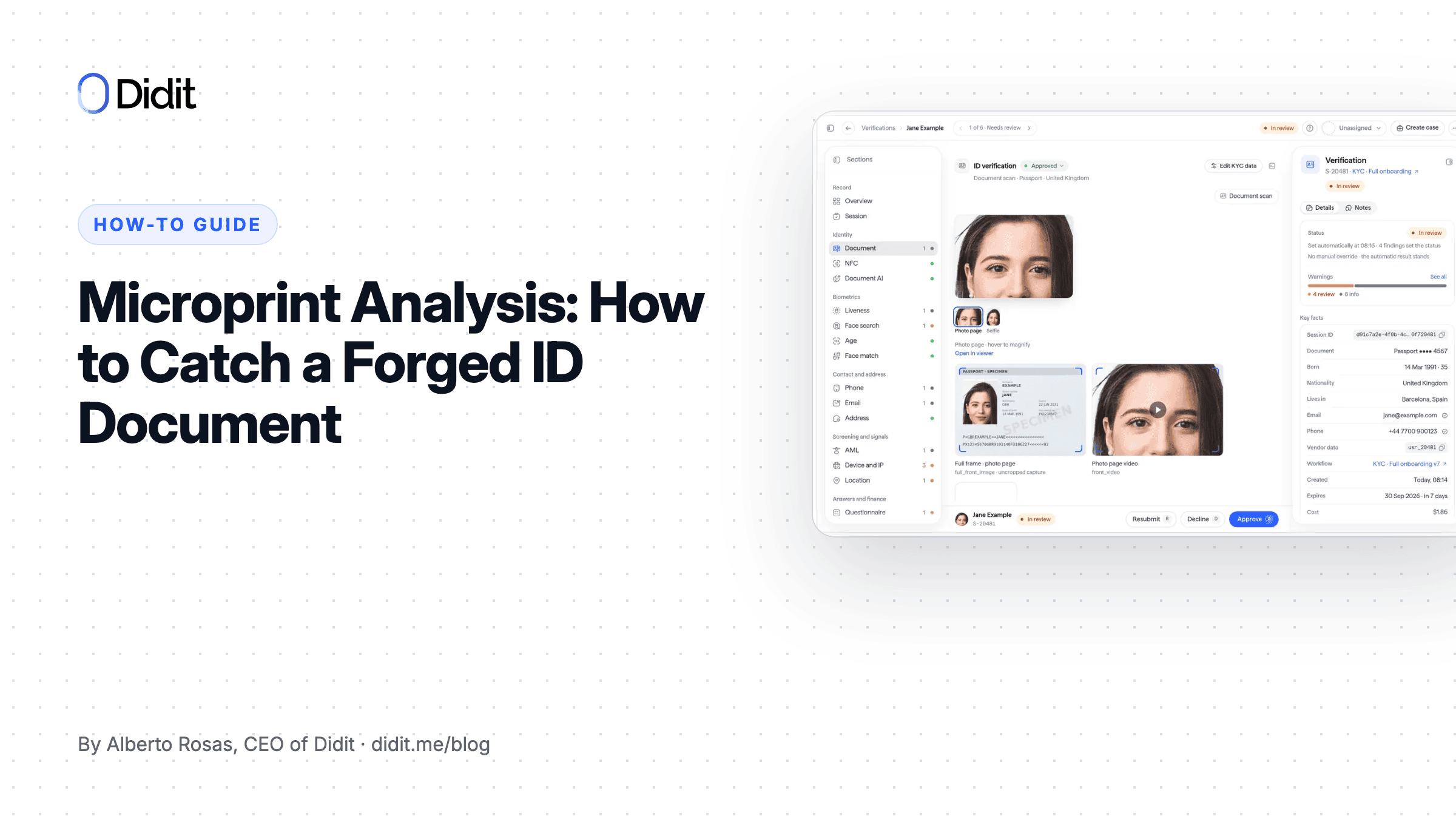
Document authenticity checks can help assess microprint-related reprints: Didit documents a status and warnings, not a microprint-specific score.
Alberto RosasMar 14, 2026Hologram Detection Technology: AI's Role in Combating Document Forgery
Explore the critical role of hologram detection technology, powered by advanced AI, in the fight against sophisticated document forgery. This post delves into the mechanisms behind detecting these intricate security features.
Alberto RosasMar 14, 2026API Design for Modular Compliance: Building Adaptable KYC/AML Systems
Discover how robust API design principles enable modular compliance, allowing businesses to build flexible and scalable KYC/AML systems. This guide covers architecture, integration, and best practices for creating adaptable.
Alejandro RosasMar 14, 2026Real-time AML Orchestration for Predicate Offenses in Trading Platforms
Discover how real-time AML orchestration, powered by tools like Kafka, can proactively detect predicate offenses in high-volume trading environments.
Alberto RosasMar 14, 2026CTO's Guide to AI in Deepfake Detection & Anti-Spoofing
Explore how AI, particularly Convolutional Neural Networks (CNNs) and advanced biometric techniques, is revolutionizing deepfake detection and real-time anti-spoofing measures.
Alejandro RosasMar 14, 2026Verifiable Credentials: Revolutionizing Supply Chain Transparency
Explore how verifiable credentials (VCs) and blockchain technology are transforming supply chain transparency, ensuring ethical sourcing, and enhancing compliance.
Alberto RosasMar 14, 2026Verifiable Credentials: Stopping E-commerce Return Fraud
Discover how verifiable credentials (VCs) can revolutionize e-commerce by combating sophisticated return fraud. This post explores how VCs provide immutable proof of product provenance and buyer history, enhancing trust and.
Alberto RosasMar 14, 2026Continuous Biometric Authentication for Critical Infrastructure Security
Explore how continuous biometric authentication strengthens critical infrastructure security, addressing challenges posed by NIS2 and DORA. Learn about real-world applications, specific use cases, and how Didit's platform.
Alberto RosasMar 14, 2026Hologram Detection: AI Anti-Counterfeiting Checks in 6 Steps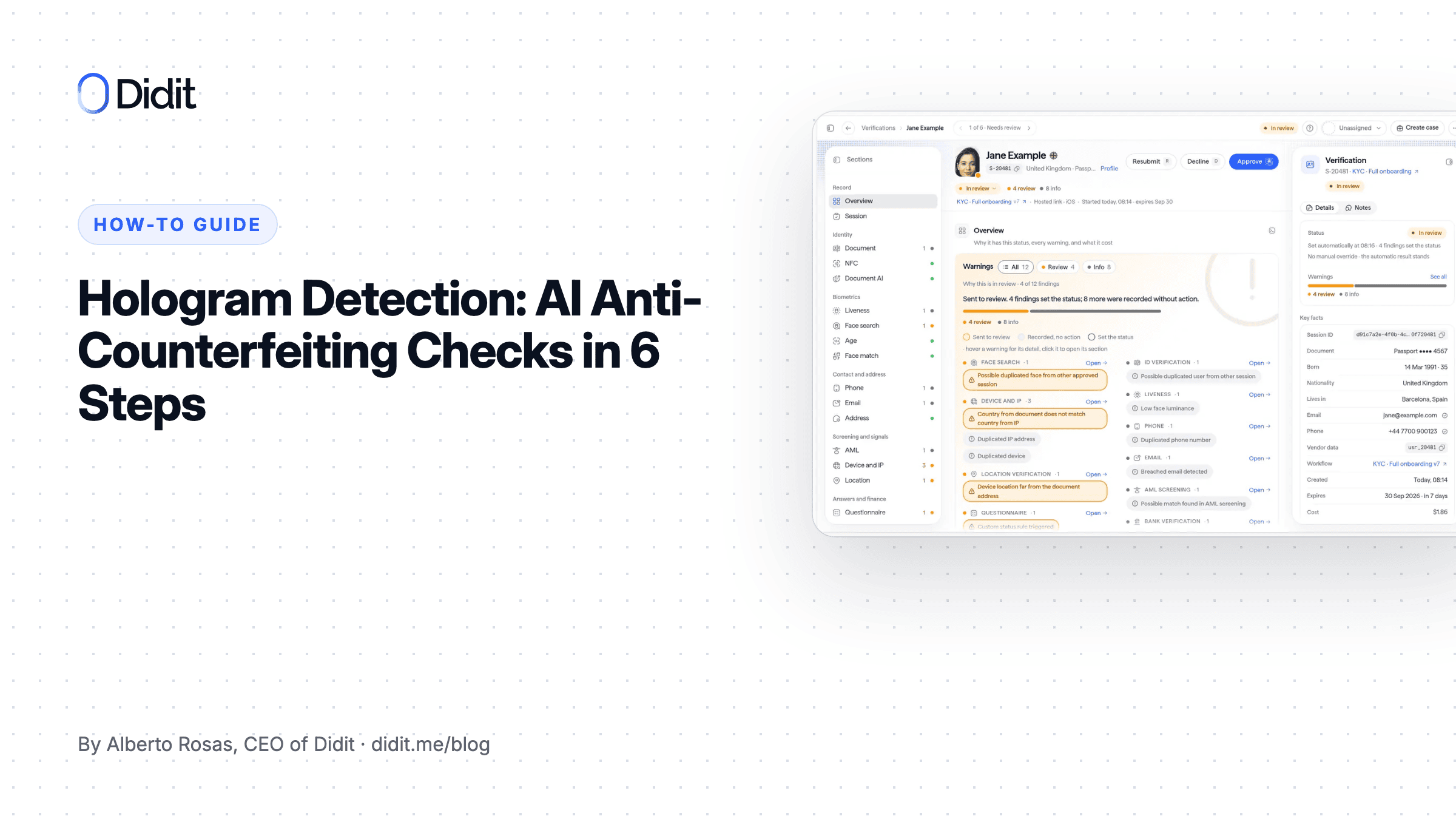
Check ID holograms and optical security features with Didit ID Verification: $0.15 per document in a workflow, $0.20 on the standalone API, with forgery warnings you route to review.
Alberto RosasMar 14, 2026Cross-Platform SDK Optimization for Peak Battery & Performance
Optimizing cross-platform SDKs for mobile app performance and battery efficiency is crucial for user experience. This guide dives into architectural decisions, API design, and practical strategies for developers to build.
Alejandro RosasMar 14, 2026Real Estate AML Compliance: Navigating Property Transparency
Real estate AML compliance is crucial for preventing illicit finance in property transactions. This guide explores the challenges, regulatory landscape, and practical solutions for enhancing transparency and combating money.
Alberto RosasMar 14, 2026KYC Drop-Off: A Post-Mortem Analysis & Optimization Guide
High KYC drop-off rates are a silent killer of growth and revenue. This post-mortem analysis dives into the root causes of customer abandonment during identity verification, offering data-driven strategies to optimize your.
Alberto RosasMar 14, 2026Boost Fintech Onboarding: Cut KYC Drop-off (2026 Guide)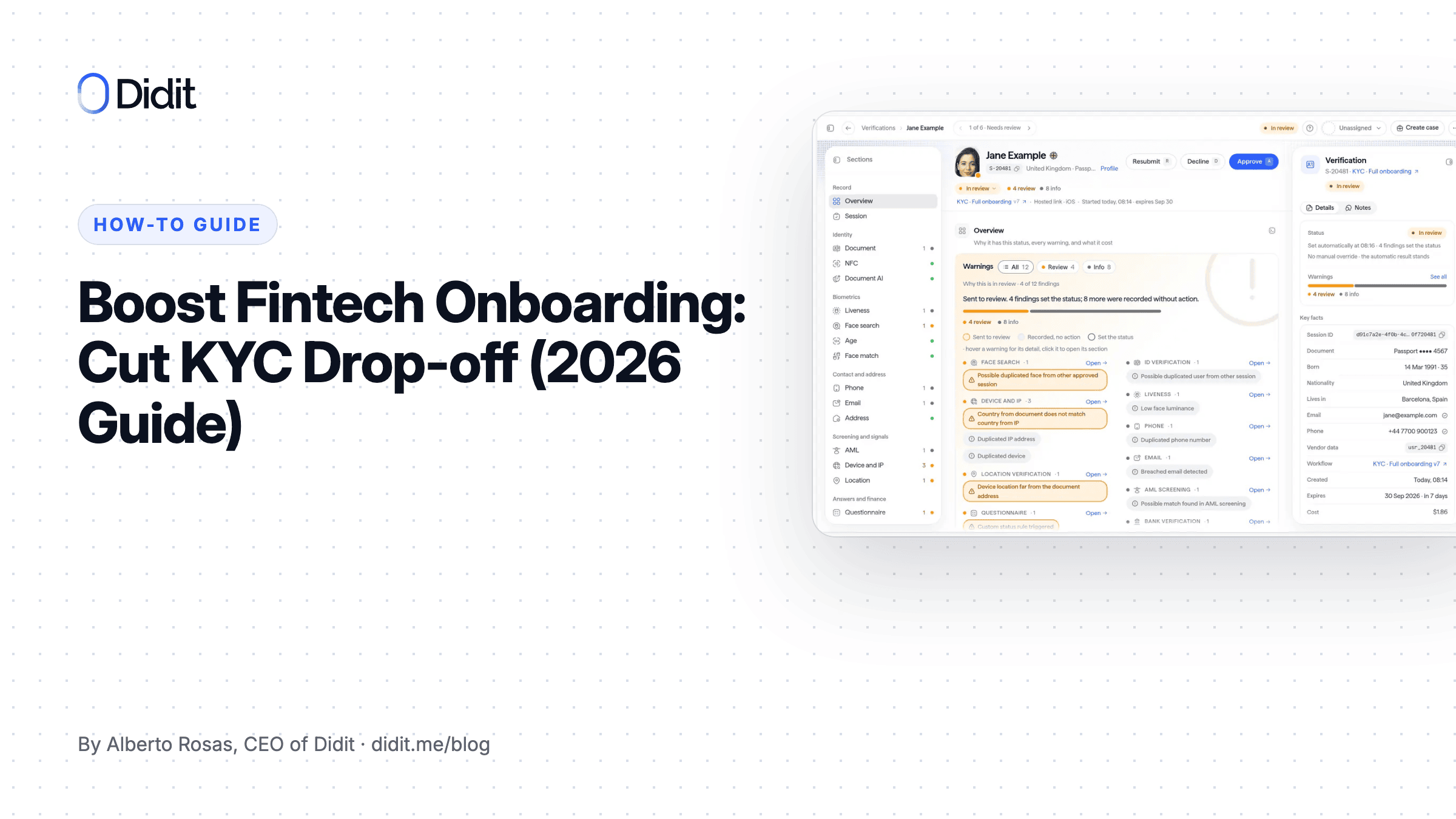
Cut KYC drop-off by measuring Didit session statuses, building one workflow with per-country ID methods, and routing every status. A full ID check is $0.33 and the sandbox is free.
Alberto RosasMar 14, 2026Mastering API Authentication for Identity Verification
Dive deep into securing identity verification APIs. This guide covers essential authentication mechanisms like OAuth 2.0, API keys, and mTLS, offering practical code examples and architectural insights for developers building.
Alejandro RosasMar 14, 2026AUSTRAC Tranche 2 for Australian Accountants: KYC and AML in 2026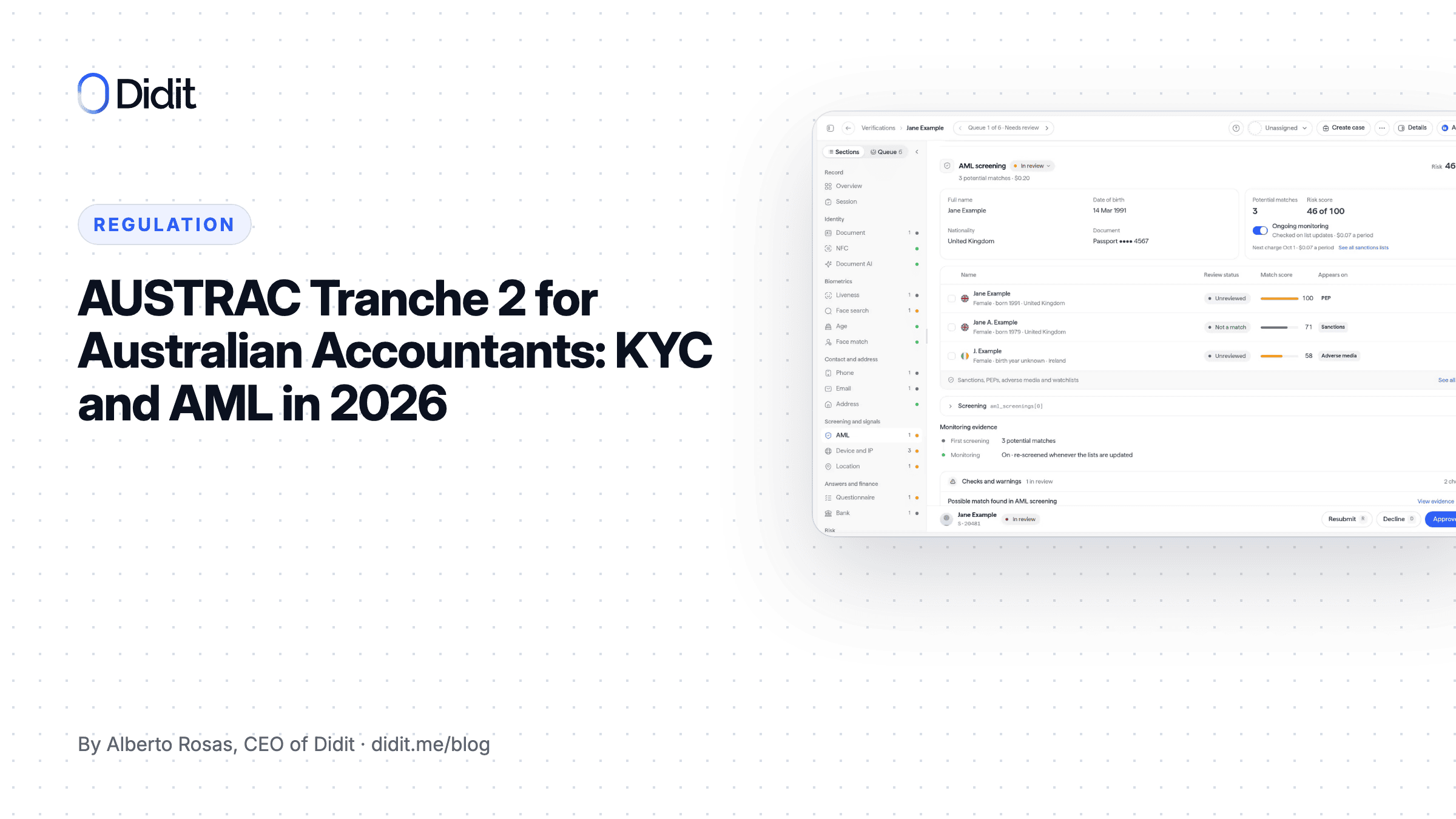
Tranche 2 put accountants under Australia's AML/CTF Act from 1 July 2026: CDD, KYB, AML screening and ongoing monitoring. Didit prices full KYC at $0.33 and KYB from $2.00 per company.
Alberto RosasMar 14, 2026Automated Policy Enforcement for Dynamic Risk-Based Authentication
Explore how automated policy enforcement drives dynamic risk-based authentication in fintech, enhancing security and user experience. This guide covers architectural patterns, API considerations, and practical implementations.
Alberto RosasMar 14, 2026Streamlining Gig Economy Identity Verification with Workflow Orchestration
Discover how advanced workflow orchestration platforms are revolutionizing gig economy identity verification. Learn to automate complex KYC/AML, reduce manual reviews, and achieve scalable, compliant gig worker onboarding.
Alberto RosasMar 14, 2026Unlocking Cross-Border KYC with National ID Schemes' Interoperability
Explore the critical role of interoperable national ID schemes in streamlining cross-border Know Your Customer (KYC) processes. This post delves into the technical architectures, challenges, and benefits of digital identity.
Alberto RosasMar 14, 2026IP Anonymization vs. Identity Attribution for Fraud Prevention
Explore the critical balance between IP anonymization and robust identity attribution in the fight against online fraud. This post delves into how businesses can detect and mitigate risks from VPNs, proxies, and Tor while.
Alejandro RosasMar 14, 2026Deepfake Detection Accuracy: 8 Steps to APCER and BPCER Benchmarks
Benchmark deepfake detection by running a labeled corpus of attacks and genuine selfies through Didit liveness, then computing APCER (attacks accepted) and BPCER (real users rejected).
Alejandro RosasMar 14, 2026Platform Liability: Identity Checks vs. Background Checks Explained
Navigating platform liability requires a clear understanding of user verification. This post dissects the critical differences between identity checks and background checks, outlining their roles in mitigating risk, ensuring.
Alberto RosasMar 14, 2026Mitigating Platform Liability: Dynamic Identity Orchestration & Risk
In an era of heightened regulatory scrutiny and sophisticated fraud, platforms face increasing liability for illicit activities. This post explores how dynamic identity orchestration is crucial for mitigating platform liability.
Alberto RosasMar 14, 2026Enhancing FinCEN SAR Automation with Graph Analytics
Discover how graph analytics revolutionizes FinCEN SAR automation and anti-money laundering (AML) efforts. This blog explores how graph databases enhance fraud detection, streamline compliance, and provide deeper insights into.
Alberto RosasMar 14, 2026Passive Authentication: The Future of Frictionless UX & Security
Passive authentication revolutionizes online security by verifying user identity continuously and unobtrusively, creating a truly frictionless user experience.
Alberto RosasMar 14, 2026Interoperable Digital Identity: The Future of Global Trust Frameworks
Explore the critical rise of interoperable digital identity and global trust frameworks, driven by initiatives like EUDIW. This post delves into how cross-border IDV is reshaping online interactions, boosting security, and.
Alberto RosasMar 14, 2026Quantifying the ROI of Identity Orchestration
Discover how identity orchestration platforms like Didit deliver significant return on investment by optimizing customer onboarding, reducing fraud, and ensuring compliance.
Alberto RosasMar 14, 2026Age Estimation for PSD3: Ensuring Minor Protection & SCA Compliance
PSD3 is on the horizon, bringing stricter requirements for Strong Customer Authentication (SCA) and, crucially, enhanced minor protection. This blog post explores how advanced age estimation technologies are becoming.
Alberto RosasMar 14, 2026Quantum-Resistant AML for Crypto: Securing Digital Assets
Explore the critical need for quantum-resistant AML in the crypto space. This post delves into the threats posed by quantum computing to current cryptographic standards and outlines strategies, including post-quantum.
Alberto RosasMar 14, 2026Securing Identity Microservices from API Injection Attacks
Explore the critical threat of API injection attacks in microservices architectures, focusing on identity verification systems. Learn how to implement robust defenses against SQL, NoSQL, command, and other injection vectors.
Alejandro RosasMar 14, 2026Dynamic Risk-Based Authentication for AI-to-AI Interactions
Explore the critical need for dynamic risk-based authentication in AI-to-AI interactions amidst the rise of autonomous systems. This post delves into the challenges, solutions, and the future of securing AI communications with.
Alberto RosasMar 14, 2026Composable Identity: Advanced Fraud Detection with Graph Analysis
Explore how composable identity fraud detection, combined with anti-collusion graph analytics, revolutionizes the fight against sophisticated fraud schemes like synthetic identity fraud.
Alberto RosasMar 14, 2026Solving Real-Time AML Orphan Alerts with Orchestration
Discover how real-time AML orchestration can eliminate orphan alerts and reduce sanctions false positives, saving compliance teams significant time and resources.
Alberto RosasMar 14, 2026Integrating API-First KYC into Legacy Mainframes
Discover how to integrate modern API-first KYC solutions into traditional mainframe systems. This guide covers architectural patterns, practical strategies, and best practices for bridging the gap between legacy infrastructure.
Alejandro RosasMar 14, 2026Unlock the Hidden AML ROI: Centralize Your Compliance Workflows
Discover how centralizing Anti-Money Laundering (AML) workflows can significantly boost your organization's ROI. This post explores the hidden costs of fragmented KYC processes, the benefits of vendor consolidation, and how a.
Alberto RosasMar 14, 2026Building a Sanctions Screening Microservice with Go & Kafka
Discover how to design and implement a robust sanctions screening microservice architecture using Go, Kafka, and Open Policy Agent (OPA). This technical guide covers real-time AML compliance, API design, data synchronization.
Alberto RosasMar 14, 2026Enhanced Due Diligence for Marketplace Sellers: A Deep Dive
Discover the critical role of Enhanced Due Diligence (EDD) for marketplace sellers in mitigating fraud, ensuring compliance, and building trust.
Alberto RosasMar 14, 2026Rust Microservices for Identity Orchestration: A Developer's Guide
Explore how Rust microservices can power high-performance, secure identity orchestration platforms. This guide covers architectural patterns, API design, and integration strategies for building robust identity solutions with.
Alejandro RosasMar 14, 2026Automated UBO Verification: Graph Databases & AML Compliance
Discover how automated UBO verification, powered by graph databases, revolutionizes AML compliance. Learn about the technical mechanisms, benefits, and challenges of beneficial ownership automation, ensuring accuracy and.
Alberto RosasMar 14, 2026Combating Cross-Border Fraud in the Sharing Economy
The sharing economy thrives on trust, but cross-border fraud poses significant risks, especially for platforms like Airbnb and Uber. Learn how advanced identity verification, IP telemetry, and reputation scores can protect your.
Alberto RosasMar 14, 2026Biometric Fraud Orchestration: Real-time Fintech Protection
Discover how biometric fraud orchestration provides real-time, adaptive protection for fintechs. Learn about its core components, advanced detection methods, and how it unifies biometric signals to combat sophisticated fraud.
Alberto RosasMar 14, 2026Mitigating Embedded Finance Risk with Robust API Security
Embedded finance is transforming industries by integrating financial services directly into non-financial platforms. However, this convenience introduces complex risks, particularly concerning identity fraud and regulatory.
Alejandro RosasMar 14, 2026NFC Selective Disclosure: Data Minimization for eIDs
Explore how NFC selective disclosure enables data minimization for eIDs and ePassports, enhancing privacy and compliance. This post delves into the technical mechanisms, benefits, and practical applications of selective data.
Alejandro RosasMar 14, 2026The Neobank Identity Hub Model: Scaling Onboarding & Compliance
Discover how the neobank identity hub model can revolutionize customer onboarding, compliance, and fraud prevention for digital banks. This post explores the architecture, benefits, and strategic advantages of centralizing.
Alejandro RosasMar 14, 2026CTO's Guide: Building an Identity Data Fabric Architecture
CTOs face the complex challenge of managing digital identities across disparate systems. This guide explores how an identity data fabric architecture unifies identity data, enhances security, improves compliance, and streamlines.
Alejandro RosasMar 14, 2026EUDI Wallet Liveness Detection: Securing Digital Identity
Explore how EUDI Wallet liveness detection, powered by certified biometrics and advanced anti-spoofing, is crucial for securing digital identities.
Alejandro RosasMar 14, 2026Preventing Borrower Default: The Power of Identity Data in Lending
Discover how advanced identity data and verification techniques are revolutionizing borrower default prevention in lending. Learn to mitigate risks, detect fraud, and improve credit decisions with Didit's comprehensive identity.
Alberto RosasMar 14, 2026Real-time AML Queue Management: Optimizing Compliance Operations
Discover how real-time AML queue management, powered by human-in-the-loop systems, can revolutionize your compliance operations. This post explores dynamic prioritization, cost savings, and strategic benefits for financial.
Alberto RosasMar 14, 2026Compliance Officer's Handbook: Identity Verification Orchestration Vendor Selection
Selecting the right identity verification orchestration vendor is crucial for compliance officers. This guide provides a comprehensive framework, covering key selection criteria, ROI considerations, and practical tips to ensure.
Alberto RosasMar 14, 2026Data Minimization in Fraud Orchestration: A Developer's Guide
Explore how data minimization principles, including zero-retention biometrics, are crucial for building robust and privacy-preserving fraud orchestration architectures.
Alberto RosasMar 14, 2026Building a Dynamic Telehealth Compliance Dashboard for Regulatory Oversight
Discover how a dynamic telehealth compliance dashboard can revolutionize regulatory oversight, ensuring adherence to HIPAA, DEA, and other critical regulations.
Alberto RosasMar 14, 2026Identity Data Harmonization: Powering Real-Time Fraud Prevention
Identity data harmonization is crucial for effective real-time fraud prevention in today's complex digital landscape. This post dives into the technical mechanisms, challenges, and solutions for unifying fragmented identity.
Alberto RosasMar 14, 2026Mastering Microservices Observability for Real-time Identity Queue Metrics
Dive deep into building robust microservices observability for real-time identity queue metrics, focusing on KYC/AML compliance. Learn architecture, data collection, and visualization strategies for high-throughput identity.
Alberto RosasMar 14, 2026Bridging KYC Implementation Gaps in Emerging Markets for Financial Inclusion
Explore the critical KYC implementation gaps in emerging markets, from regulatory fragmentation to technological barriers and identity challenges.
Alberto RosasMar 14, 2026Neobank Embedded Finance KYC Architecture: A Strategic Blueprint
Explore the strategic neobank embedded finance KYC architecture essential for seamless, compliant, and secure digital financial services. Learn how to balance user experience with stringent regulatory demands, leveraging.
Alberto RosasMar 14, 2026Two-Sided Verification for Marketplaces: Advanced Fraud Detection
Marketplaces face unique fraud challenges, particularly from buyer-seller collusion. This post dives into how advanced two-sided verification, powered by graph neural networks and sophisticated fraud detection, combats these.
Alberto RosasMar 14, 2026WebGL Hashing: The Next Frontier in Advanced Device Fingerprinting
Explore WebGL hashing, a potent technique for advanced device fingerprinting and bot detection. Learn how it works, its advantages over canvas fingerprinting, and its critical role in fraud prevention and identity verification.
Alejandro RosasMar 14, 2026Enhancing Brand Safety for Content Platforms with Identity Verification
Discover how robust identity verification is crucial for content platforms to maintain brand safety, combat harmful user-generated content (UGC), and ensure a trustworthy online environment.
Alberto RosasMar 14, 2026Predicting Loan Default: The Power of Identity Intelligence
Discover how identity intelligence is revolutionizing loan default prediction by integrating advanced identity verification, behavioral biometrics, and fraud detection.
Alberto RosasMar 14, 2026Securing Cross-Chain Bridges: Multi-Chain KYC, AML, & Travel Rule
Cross-chain bridges are vital for Web3 interoperability but present significant security and compliance challenges. This post explores the intricacies of securing multi-chain bridge transactions, focusing on how robust.
Alberto RosasMar 14, 2026Browser Fingerprinting for Advanced Fraud Detection in Identity Verification
Explore how browser fingerprinting, including canvas and WebGL hashing, provides a robust layer for advanced fraud detection in identity verification.
Alejandro RosasMar 14, 2026Forged Utility Bill Detection: Advanced AI & Deep Learning Methods
Discover how advanced AI and deep learning are revolutionizing forged utility bill detection. This post explores the technical mechanisms behind synthetic proof of address detection, including forensic image analysis, metadata.
Alberto RosasMar 14, 2026Questions
Blog questions
Who writes the Didit blog?
Which topics does the blog cover?
Is the blog available in my language?
Where do I find product updates?
Are these posts legal advice?
How do I find posts on one topic?
Are posts dated?
Do posts link to the docs?
Is the blog the same as the docs?
Compliance built in
Audited, certified and attested.
We hold the certifications and build each country's rules into your flows, so you can launch anywhere without worrying. Security and Compliance center
- Regulation encoded into your flows
Tell us what you do and where. Didit lists the rules that apply to you, with sources, and builds the checks each country needs into one workflow.
- Ready for AMLR
Every requirement of the new EU anti-money laundering rules, from checking customers to human review, is already covered by a Didit check.
- Tested in Spain's Treasury sandbox
Spain's Treasury published its supervised sandbox report on Didit's NFC plus active liveness onboarding; SEPBLAC took part and valued the added measures positively.
- Audited, not self-declared
iBeta Level 1 and Level 2. Liveness tested under ISO/IEC 30107-3.
Your obligations · 3 regions
 SOC 2 Type 2
 ISO 27001
 iBeta Level 1 and Level 2
 EU regulator attestation
 FSM youth protection
 GDPR
 EBA remote onboarding
 MiCA compatible
 FIDO Alliance member
- AMLREU AML Regulation ready
Integration · Didit MCP
Run Didit from your own AI agent
Connect Didit to Claude, Cursor, VS Code or ChatGPT and just ask in plain words. Your agent can do anything you can do in the console, with the same permissions you have.
 Add to Claude
 ChatGPT
 Cursor
- Build workflowsDescribe the checks you need. The agent creates and publishes the flow.
- Run investigationsAsk why a session was declined, review cases, search people and companies.
- Change rulesCreate payment rules, test them on past data and switch them on.
- Pull reportsAsk for numbers, exports or the audit log.
Didit Academy


