
Didit vs SEON: per-check KYC vs a monthly fraud plan
Didit vs SEON: compare $0.33 per-check KYC against SEON's $699 monthly plan, registry KYB with owner KYC, government database checks in 45 countries plus a Global group, 6 live national eIDs, and an MCP server over OAuth 2.1.
The verdict
Didit delivers full-lifecycle identity proofing, KYB, transaction monitoring, and wallet screening with transparent per-check pricing ($0.33 full KYC), whereas SEON provides a fraud and AML platform centered on digital footprint scoring and tiered monthly software subscriptions starting at $699 per month.[1][9] We build Didit, so read this as our side of the story.
- Predictable per-check pricing: Didit publishes unit prices for every module with full KYC at $0.33 (document verification, passive liveness, face match, and device and IP analysis). SEON charges a base fee of $699 per month for 2,500 fraud checks on its Starter plan, with Case Management and AML Compliance listed under custom-priced Premium tiers.[1][9]
- One continuous identity lifecycle: Didit consolidates document KYC, government database checks in 45 countries plus a Global group, registry KYB with linked owner KYC (from $2.00), transaction monitoring ($0.02 per transaction), and crypto wallet screening ($0.15 per check) into a single user record and API.[9][10][11][17][19]
- Actionable AI and agentic MCP: Didit provides a hosted Model Context Protocol (MCP) server over OAuth 2.1 and an autonomous Investigator agent ($0.20 per reviewed item) to inspect cases and synthesize evidence. SEON documents an MCP server connecting Claude, ChatGPT, Gemini, Cursor, and Grok to a SEON account.[2][22][24]
Risk and compliance leaders evaluating identity verification providers face a fundamental architectural choice. SEON markets itself as an AI command center for fraud prevention and AML compliance and documents identity-verification modules.[3][8] In contrast, Didit was engineered from the ground up as a complete compliance and identity platform, providing document, biometric, government-database and signed national-eID evidence, business verification, transaction monitoring, and crypto screening on a single record with public, per-use unit economics.
This comparison examines how Didit and SEON compare across core KYC architecture, authoritative government databases, pricing structures, KYB depth, transaction monitoring, and developer extensibility. All competitor assertions reflect public documentation and pricing pages verified as of 25 October 2026.[1][2][3]
Direct capability comparison: Didit vs SEON
While SEON approaches user onboarding through the lens of digital footprints and risk scores, Didit verifies the legal person through official documents, biometric liveness, direct government registers, and live national digital IDs. The table below outlines how each platform addresses identity proofing, business diligence, monitoring, and compliance orchestration based on verified primary sources.
| Dimension | Didit Public Scope | SEON Public Scope |
|---|---|---|
| Core KYC & Verification Methods | 14,000+ document types across 220+ countries and territories ($0.15), passive liveness ($0.10; standalone $0.05) with iBeta Level 1 PAD compliance, active liveness ($0.15), 1:1 face match ($0.05), free 1:N face search against enrolled portraits, age estimation ($0.10), proof of address ($0.20), and free reusable KYC. Full document bundle is $0.33.[9][30] | Document verification (with NFC and injection-attack checks), selfie and liveness, and address verification supported.[6][8] |
| NFC Chip Verification | Cryptographic NFC chip verification for e-passports and biometric IDs ($0.15 per check).[9] | NFC verification of passport or ID-card chip supported.[6] |
| Government Database Checks | Direct database validation across 45 countries plus a Global group, verifying attributes against official sources alongside document checks.[19] Non-document lookup allows verification by identity number without capturing a physical ID.[20] | eKYC cross-checks typed name, date of birth, and ID number against official databases; lists Indonesia National ID with biometric match.[6] |
| National Digital IDs (eIDs) | Six live national digital identity schemes: MitID (Denmark), BankID Sweden (Sweden), iDIN (Netherlands), Finnish Trust Network (Finland), Smart-ID (Estonia, Latvia, Lithuania, Belgium), and Mobile-ID (Estonia, Lithuania) returning signed identity attributes without portraits,[31] plus document verification, government database validation in 45 countries plus a Global group,[19] NFC chip verification at $0.15, and free 1:N face search on the same record.[9] | Supports government-backed digital identity schemes.[6] |
| Device, IP & Fraud Telemetry | In-session device fingerprinting, IP risk, VPN/proxy/Tor detection, and geolocation consistency ($0.03 unit or included in the $0.33 full bundle).[9] Email ($0.03) and phone ($0.04 + carrier) risk and OTP validation.[9] | Platform connects 1,100+ first-party data signals (digital footprint, device, and IP) for fraud and AML decisions.[3] |
| AML Screening & Monitoring | Sanctions, PEP, and adverse media screening across 1,300+ lists at $0.20 per check; ongoing AML monitoring at $0.07 per user per year.[9] | AML customer screening is listed among SEON's identity-verification modules; Case Management & AML Compliance appear in the custom-priced Premium feature list (checked 25 October 2026).[1][8] |
| Transaction Monitoring (KYT) | Real-time engine with 150+ preset rules, custom rules, historical backtesting, and biometric selfie step-up at $0.02 per transaction.[9][10][13][14] | Real-time transaction monitoring scores transactions against prebuilt/custom rules, velocity checks, and supports filing SAR, CTR, and Form 8300 reports with FinCEN.[5] |
| Crypto Wallet Screening & Travel Rule | Screening of blockchain wallet addresses at $0.15 per check pay-as-you-go. Travel Rule counterparty diligence and IVMS 101 messaging.[9][11][15] | Payment screening assesses crypto wallets for links to known high-risk or flagged wallets.[4] |
| KYB & Entity Screening | Automated commercial registry retrieval across jurisdictions, UBO unravelling, and linked owner KYC on the same account from $2.00 per business; registry search API is free.[9][17][18] | Entity search identifies suspicious businesses, vessels, NGOs, and other organizations.[7] |
| Developer Tools & MCP | Hosted Model Context Protocol (MCP) server over OAuth 2.1 allowing agents to inspect verifications, alerts, cases, and evidence.[22][23] Copilot workflow assistant.[25] | MCP connects Claude, ChatGPT, Gemini, Cursor, and Grok to a SEON account.[2] |
Comparison compiled from official documentation and pricing pages of Didit (docs.didit.me) and SEON (seon.io, docs.seon.io) as of 25 October 2026.
Didit also provides a dedicated historical verification import API (POST /v3/session/imports/) supporting batch uploads with custom workflow_id and status_mapping parameters to facilitate operational transitions.[28]
Commercial comparison: published per-check pricing vs monthly tiers
A major distinction between Didit and SEON lies in commercial structure and pricing transparency. Didit charges published list prices per successful check, while SEON operates on tiered monthly software subscriptions starting at $699 per month.[1][9]
On SEON's Starter plan, customers pay $699 per month for up to 2,500 fraud checks (scoring digital footprints and device signals), with custom rules capped at 50 and seat counts limited to 10 users.[1] Case Management and AML Compliance appear in the Premium feature list; Premium is custom-priced.[1]
Didit unbundles compliance into transparent unit costs: a complete KYC verification costs $0.33, consisting of ID document verification ($0.15), passive liveness detection ($0.10), 1:1 facial matching ($0.05), and device and IP analysis ($0.03).[9] Customers pay only for completed checks.
| Monthly Verification Volume | Didit completed full KYC bundles ($0.33 each) | SEON fraud-check subscription (a different unit from KYC bundles) |
|---|---|---|
| 1,000 verifications | $330 | $699 / month (Starter plan base fee; covers up to 2,500 fraud checks; IDV/AML pricing quote-based)[1] |
| 10,000 verifications | $3,300 | quote-based: no published per-check price (checked 25 October 2026)[1] |
| 50,000 verifications | $16,500 | quote-based: no published per-check price (checked 25 October 2026)[1] |
Estimated budgets reflect list prices for successful, completed KYC bundles ($0.33 ID + passive liveness + face match + device/IP analysis). SEON pricing reflects published Starter tier terms on 25 October 2026. Taxes, volume discounts, credits, and additional modules (e.g., KYB, transaction monitoring, wallet screening, or government database validation) are excluded.
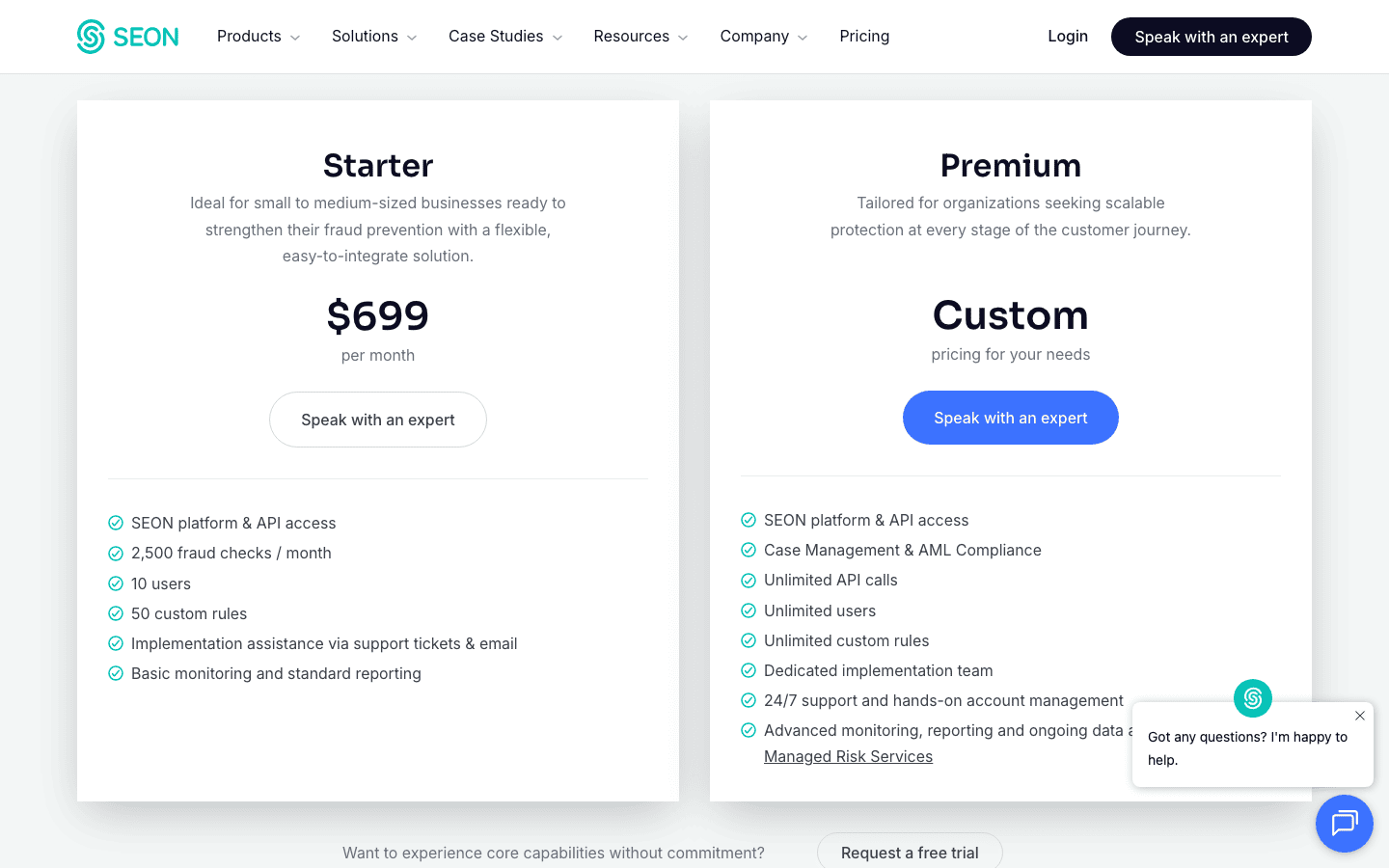
SEON's pricing page on 25 October 2026: Starter at $699 per month with 2,500 fraud checks, Premium custom-priced.[1]
Category-specific compliance basket
For organizations operating regulated financial services or crypto platforms requiring multi-module coverage, Didit allows fine-grained budgeting across operational modules:
- 10,000 Full KYC verifications: $3,300 ($0.33 per completed session)
- 10,000 Initial AML screenings: $2,000 ($0.20 per user across 1,300+ lists)
- 10,000 Users monitored for AML: $58.33 per month ($0.07 per user per year)
- 100,000 Transaction monitoring events: $2,000 ($0.02 per evaluated transaction)
- 2,000 Crypto wallet screenings: $300 ($0.15 per screening check)
- 250 KYB Business verifications: $500 (starts at $2.00 per business; registry lookup API free)
Combined monthly operational total: $8,158.33. SEON's reviewed pricing pages do not publish per-check prices for identity verification, AML screening or transaction monitoring, so an equivalent total cannot be modelled from public sources.[1]
Government database validation and national digital IDs
A primary architectural distinction between Didit and fraud scoring vendors is the ability to validate identity directly against state authorities. Fraud signals indicate whether an IP is suspicious; government databases confirm whether the identity exists legally and belongs to the applicant.
Didit provides direct connectivity to official government databases across 45 countries plus a Global group.[19] In jurisdictions like Argentina (RENAPER) and Panama (SIB), Didit performs biometric facial matching of the applicant's live selfie directly against the official government register photo.[20] In Nigeria (BVN) and South Africa (Home Affairs), the database validates identity numbers and matches biometric data with an authoritative verdict.[20][21]
Watch: Government Database Checks (Didit Academy)
| Country / Service | Required Parameters | Returned Authority Evidence |
|---|---|---|
| Argentina (RENAPER) | Document number, gender, live selfie | Full legal names, date of birth, CUIL/tax ID, biometric facial match confidence score[19] |
| Mexico (CURP) | CURP number | Status, full legal name, date of birth, state of birth[19] |
| Nigeria (BVN) | Bank Verification Number and selfie | Authoritative identity validation with biometric verification[21] |
| South Africa (Home Affairs) | National ID number and selfie | Official identity record verification with liveness and face match confirmation[20] |
In addition to database checks, Didit supports six live European national digital identity schemes: MitID in Denmark, BankID Sweden in Sweden, iDIN in the Netherlands, the Finnish Trust Network (FTN) in Finland, Smart-ID across Estonia, Latvia, Lithuania, and Belgium, and Mobile-ID in Estonia and Lithuania.[31] These schemes return cryptographically signed attributes directly from the issuing authority without requiring manual document capture.[31]
KYB verification linked to beneficial owners
SEON's documentation describes entity search as identifying suspicious businesses, vessels, NGOs, and other organizations.[7]
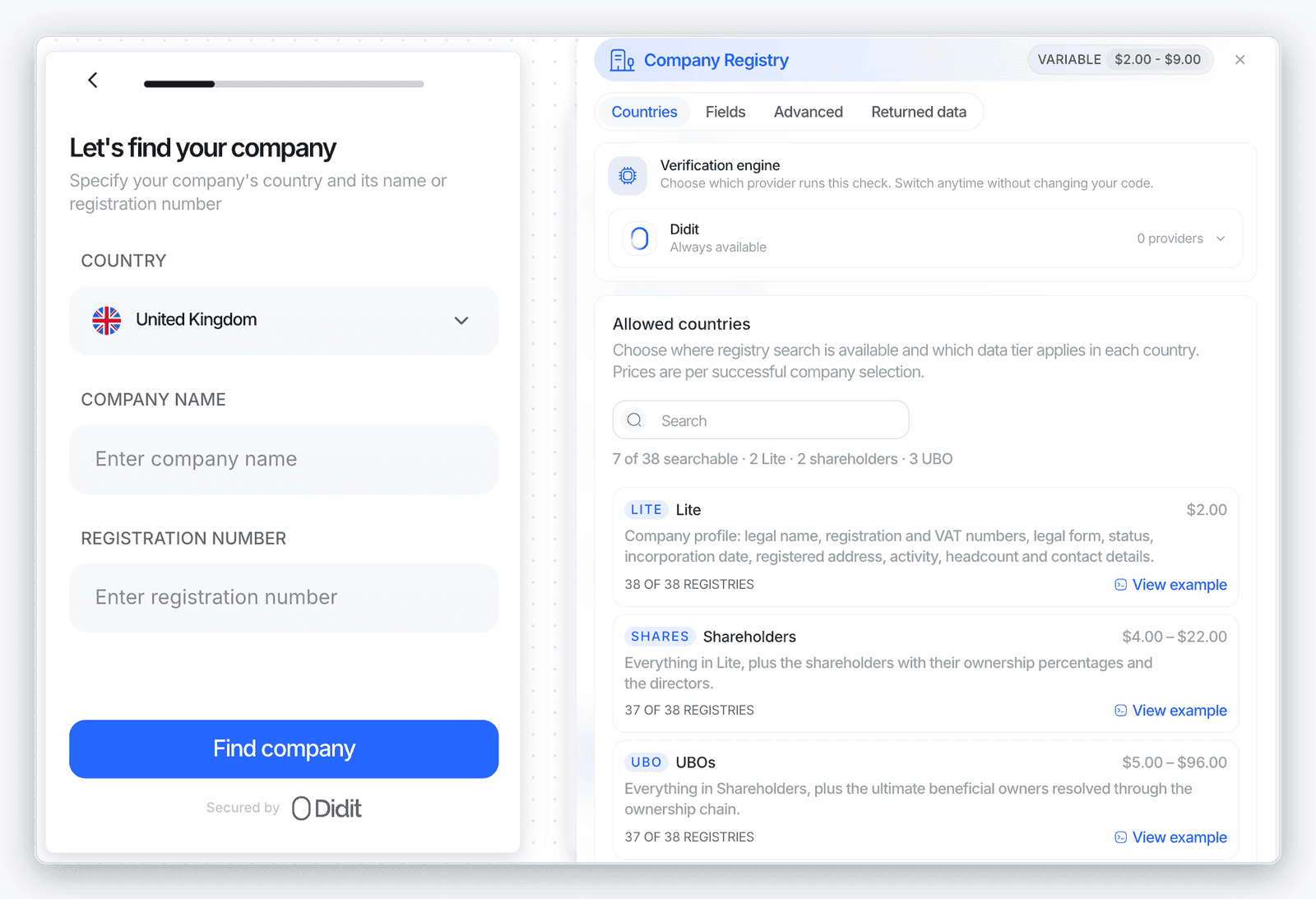
Didit's Company Registry step: configure registry tiers (Lite, Shareholders, or UBOs) per jurisdiction.[18]
Didit provides end-to-end Know Your Business (KYB) starting at $2.00 per business verification, while company registry searches are free.[9] Didit connects to official company registries across supported tiers, retrieves corporate profiles, unravels ownership structures down to individual shareholders, and dispatches a linked KYC verification flow to each declared owner and director.[17][18] Every company and beneficial owner record remains connected within the same console.
Transaction monitoring, crypto wallets, and biometric step-up
SEON provides real-time AML transaction monitoring with rule-building capabilities and direct integration to file Suspicious Activity Reports (SAR), Currency Transaction Reports (CTR), and Form 8300 with FinCEN.[5] SEON's payment screening evaluates crypto wallet addresses for links to known high-risk or flagged wallets.[4]
Didit approaches transaction monitoring from a unified identity perspective. For $0.02 per evaluated transaction, Didit runs a rules engine equipped with 150+ pre-built compliance rules (including AML velocity and iGaming-specific patterns like chip dumping and bonus abuse).[9][10][13] Rules can be backtested against historical data before activation.[12]
Watch: Catch Fraud in Real Time: The Rule Engine (Didit Academy)
1Onboard & verify
Document, passive liveness, face match, and device risk ($0.33).
2Screen deposit wallet
Risk rating and signed PDF report ($0.15 per check).
Transaction risk rule triggered?
Biometric step-up
Dynamic selfie matched against verified onboarding face; alert opened.
Clear transaction
Transaction scored and logged at $0.02.
A unified compliance architecture: identity verification, wallet screening, and transaction monitoring on a single profile.[10][14]
Crucially, high-risk transactions can trigger an automated biometric step-up: the user submits a live selfie that Didit matches against the face verified at onboarding before approving the funds.[14] Crypto wallet screening ($0.15 per check) generates auditable PDF reports and supports Travel Rule data exchange via IVMS 101.[9][11][15] Investigated cases can be exported directly as goAML XML and PDF reports for submission to regulatory authorities.[16]
AI agents, workflows, and developer extensibility
Both platforms have introduced Model Context Protocol (MCP) integrations to support AI-driven compliance workflows:
- SEON's MCP server: Connects AI assistants (such as Claude, ChatGPT, Gemini, Cursor, Grok) to a SEON account.[2]
- Didit's MCP server: Hosted at
mcp.didit.meusing standard OAuth 2.1 authorization.[22] External AI agents can inspect verification records, review transaction alerts, audit case timelines, and explain declination causes by tracing granular failure codes and reviewer overrides.[23]
Authenticated inspection via OAuth 2.1
AI agent investigation flow utilizing Didit's hosted MCP server over OAuth 2.1.[22][23]
Within the console, Didit provides an autonomous Investigator agent ($0.20 per reviewed item).[24] The Investigator inspects pending verifications and transaction alerts, gathers evidence across document, biometric, database, and device checks, and prepares an evidence-backed narrative report. It makes automated decisions only within the strictly defined autonomy boundaries and risk policies set by your compliance officers.[24] A support agent assists end users during onboarding interactions. For configuration, Didit's Copilot builds validated draft workflows, configures questionnaires, and suggests logic corrections inside the workflow designer.[25][26]
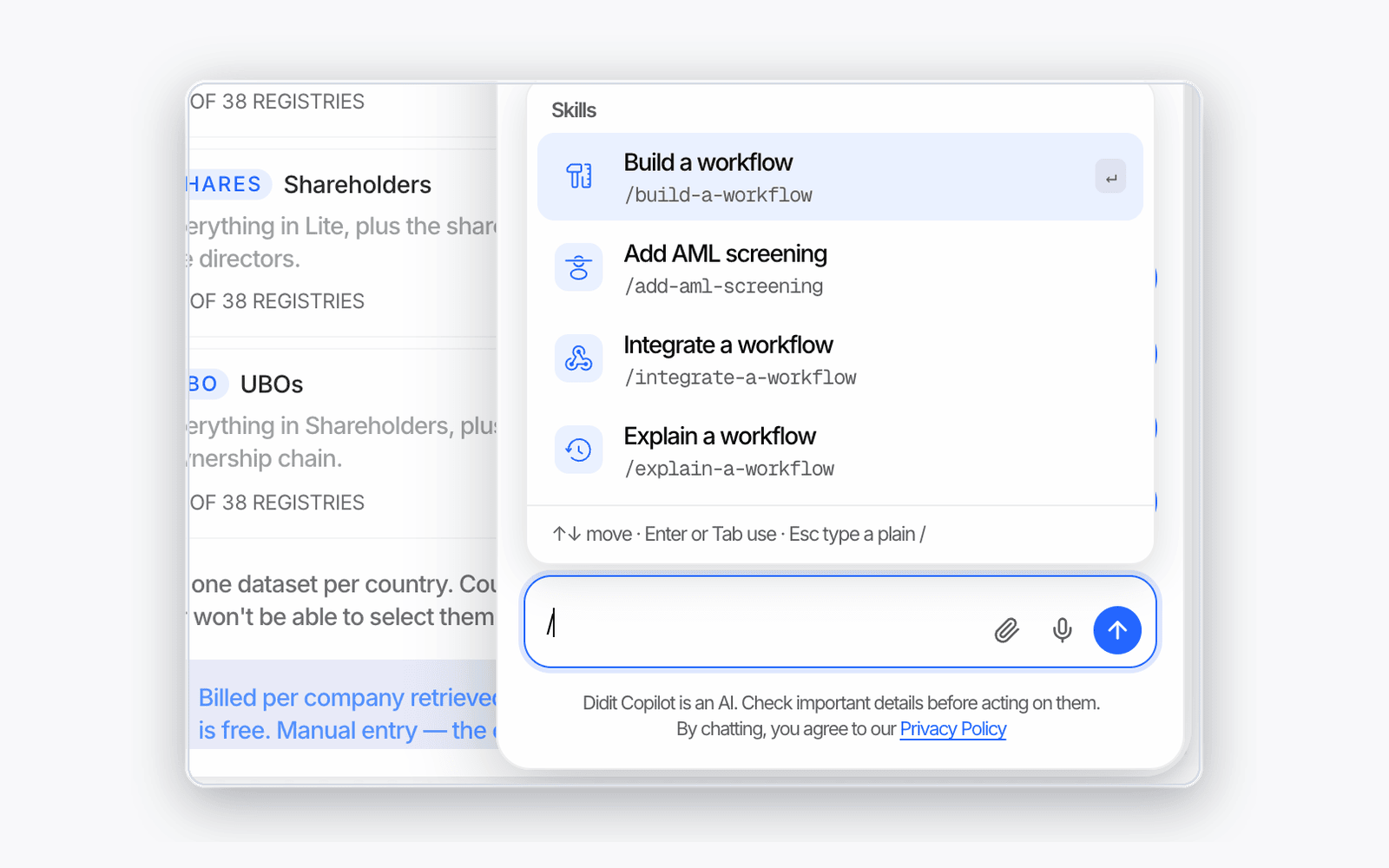
Didit Copilot inside the workflow editor, generating orchestration logic with transparent step pricing.[25]
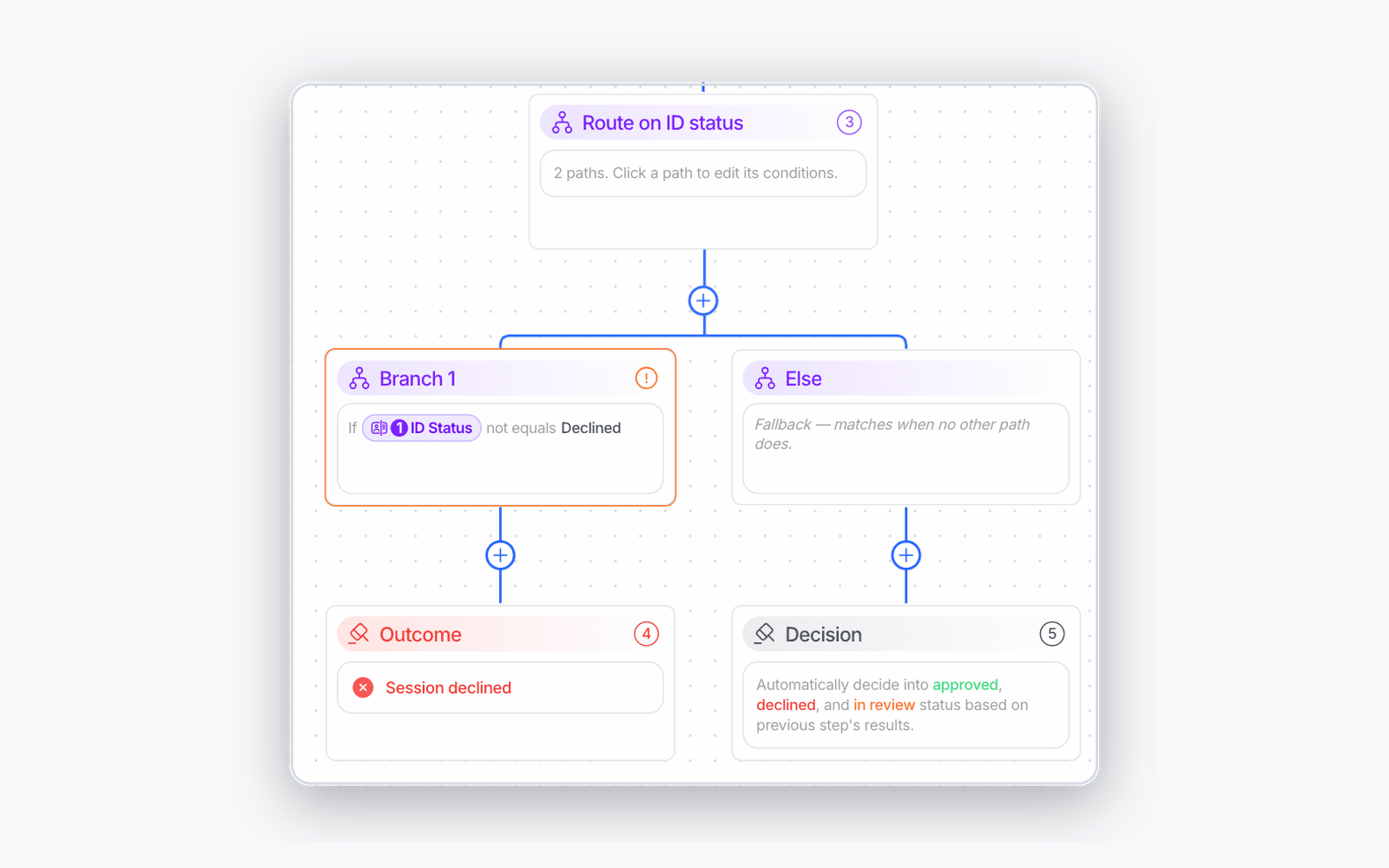
Workflow validation: detecting logic contradictions before production deployment.[25]
Public security attestations and verified customer outcomes
Enterprise buyers require independently audited security postures and proven operational results before switching compliance infrastructure:
- Spain's published sandbox report documents tests of Didit's NFC and active-liveness flow. Its supervisory conclusions state that SEPBLAC positively assessed the added safeguards for remote identification.
- Security reports & certification: Didit maintains active SOC 2 Type 1 and Type 2 reports, an ISO/IEC 27001 certification, and operates in accordance with GDPR requirements.[32]
- Global scale: Trusted by 3,000+ companies worldwide, supporting 14,000+ document types across 220+ countries and territories.[30]
- Verified customer outcome: In a public customer story published by Didit, cryptocurrency platform AhoraCrypto reported achieving more than 20% savings per user compared with its previous identity verification provider, alongside a reduction of over 50% in time spent on manual user reviews.
Step-by-step migration from SEON to Didit
Teams transitioning from SEON to Didit can migrate by running a side-by-side evaluation and leveraging Didit's dedicated import infrastructure:
- Pilot a traffic share: Route a defined portion of incoming user verification traffic to Didit to measure completion rates and false-positive flags directly against SEON's baseline.
- Map workflows, decisions, and webhooks: Map legacy rule triggers, user decision states (Approved, Rejected, Resubmission Requested), and webhook endpoints to Didit's no-code workflow builder, establishing clear review ownership across operational teams.[27]
- Import historical verifications: Transition historical records using Didit's Historical Verification Import API (
POST /v3/session/imports/). Submit historical user verifications usingworkflow_idand customstatus_mapping. Execute adry_runfirst, inspect the terminal job result, and reconcile created, updated, skipped, and failed record counts before expanding production traffic.[28] - Recreate transaction rules & backtest: Replicate transaction monitoring logic via Didit's Rules API or console. Run historical transaction batches through Didit's backtesting engine to verify alert parity before decommissioning legacy rules.[12]
- Expand full traffic: Once webhook handling, status mappings, and alert thresholds are fully validated, route all production traffic through Didit.
Addressing buyer concerns: digital footprints vs official identity
How should a team combine digital-footprint signals with proof of identity?
Digital footprint signals provide early indicators in fraud prevention contexts, but regulated entities often require identity verification directly against physical credentials or official government records.
Didit resolves this by uniting hardware signals with identity verification. In addition to in-session device fingerprinting, IP risk scoring, VPN/Tor detection, and email and phone validation, Didit verifies the physical credential (14,000+ IDs), confirms biometric liveness (iBeta Level 1 PAD passive detection), cross-references national government databases across 45 countries plus a Global group, and checks sanctions across 1,300+ lists.[9][19] You receive both behavioral fraud signals and document, biometric, government-database and signed national-eID evidence on a single profile.
Sources
- Pricing, SEON, accessed 25 October 2026.
- SEON MCP, SEON documentation, accessed 25 October 2026.
- Homepage, SEON, accessed 25 October 2026.
- Payment screening, SEON, accessed 25 October 2026.
- AML transaction monitoring, SEON, accessed 25 October 2026.
- Electronic identity verification (eID), SEON documentation, accessed 25 October 2026.
- Entity search, SEON documentation, accessed 25 October 2026.
- Identity verification, SEON, accessed 25 October 2026.
- Pricing Overview, Didit documentation, accessed 25 October 2026.
- Transaction Monitoring Overview, Didit documentation, accessed 25 October 2026.
- Wallet Screening, Didit documentation, accessed 25 October 2026.
- Transaction Rules API and Backtesting, Didit documentation, accessed 25 October 2026.
- Rules Library, Didit documentation, accessed 25 October 2026.
- SDK Transaction Submission and Step-Up, Didit documentation, accessed 25 October 2026.
- Travel Rule, Didit documentation, accessed 25 October 2026.
- FIU Reports, Didit documentation, accessed 25 October 2026.
- Key People, Didit documentation, accessed 25 October 2026.
- KYB Supported Countries and Data Tiers, Didit documentation, accessed 25 October 2026.
- Database Validation Supported Countries, Didit documentation, accessed 25 October 2026.
- Non-Document Lookup and Registry Match, Didit documentation, accessed 25 October 2026.
- Nigeria BVN Validation, Didit documentation, accessed 25 October 2026.
- MCP Server Overview, Didit documentation, accessed 25 October 2026.
- MCP Tools Guide, Didit documentation, accessed 25 October 2026.
- Investigator Agent, Didit documentation, accessed 25 October 2026.
- September 2026 Changelog, Didit documentation, accessed 25 October 2026.
- August 2026 Changelog, Didit documentation, accessed 25 October 2026.
- Workflows Guide, Didit documentation, accessed 25 October 2026.
- Historical Verification Import API, Didit documentation, accessed 25 October 2026.
- New Pricing Announcement, Didit blog, accessed 25 October 2026.
- ID Verification Overview, Didit documentation, accessed 25 October 2026.
- National digital IDs, Didit documentation, accessed 27 October 2026.
- Security Certifications, Didit documentation, accessed 27 October 2026.
Consolidate identity, compliance, and fraud on Didit
Managing separate vendor subscriptions for device fingerprinting, document KYC, business registry lookup, and transaction monitoring introduces integration complexity and unpredictable monthly overhead. Didit unifies the full compliance lifecycle—from user onboarding to ongoing monitoring—on a single account, single API, and transparent per-check pricing.
Teams can sign up in the self-serve Didit Business Console without waiting for a sales call. Explore the platform in the free unlimited sandbox, deploy the autonomous Investigator agent at $0.20 per reviewed item, build workflows with Copilot, connect agents via the hosted MCP server, and note that the publicly announced Free plan includes $10 of credit every month from 1 November 2026.
Start verifying with Didit
Test KYC, KYB, and transaction monitoring in the sandbox today and see the list price of every step before deployment.
Related articles
- New pricing from November 1: one plan per product, one balance for everything
- Unico Partners with Didit to Expand Access to State-of-the-Art Identity Verification for SMEs in Brazil
- Didit Closes $7.5M Seed to Build the Infrastructure for Identity and Fraud
- Non-Document Verification in Singapore: MyInfo-Based KYC Without Document Uploads
- Non-Document Verification in Canada: Credit Bureau-Based KYC Without Document Uploads
- Non-Document Verification in the United States: SSN-Based KYC Without Document Uploads