Business
What is Digital Onboarding? Definition and 2024 Guide
Digital onboarding is the remote, automated set of steps that turns a new customer into a verified, active user. On Didit, identity verification costs $0.33 per completed full KYC check, AML screening $0.20 per check, and.
 Alberto RosasCo-founder and CEO
Contents
In this guide
Jump to the part you need.
Digital onboarding fits fintech, crypto, iGaming, marketplaces, telecoms and lending teams that sign customers up remotely. Identity verification on Didit costs $0.33 per completed full KYC check at list price, AML screening $0.20 per check, and transaction monitoring $0.001 per transaction beyond the plan allowance. You pay only when a check finishes with a result. The caveat: a published price does not establish production availability in every country.
Last updated: November 26, 2026. Prices checked against the live Didit price feed on November 26, 2026.
| Question | Short answer |
|---|---|
| What is it | The remote, automated steps that turn a new customer into a verified, active user, from signup to a compliance decision your systems can read. |
| Where it is used | Neobanks and fintech, crypto exchanges and VASPs, iGaming, marketplaces and gig platforms, telecoms, insurance and lending, B2B onboarding. |
| Core steps | Signup, identity document capture, liveness selfie, face match, AML screening, proof of address where required, decision. |
| Full KYC check on Didit | $0.33 per completed check: ID document $0.15 + passive liveness $0.10 + face match 1:1 $0.05 + device and IP analysis $0.03. |
| AML screening on Didit | AML screening costs $0.20 per check against 1,300+ AML, sanctions and PEP lists. |
| Transaction monitoring on Didit | $0.001 per transaction beyond the plan's monthly allowance, with 1,000, 10,000 or 100,000 transactions included depending on the plan. |
| Business onboarding (KYB) on Didit | Registry data from $2.00 per company, priced by country and data tier, plus $0.20 company AML, $0.20 person AML and $0.33 linked KYC per owner or officer. |
| Plans | Free ($10 of credit a month for work-email sign-ups), Growth $99 a month, Scale $299 a month, Enterprise from $15,000 a year. |
| Sandbox | Sandbox testing is free and unlimited on every plan and is never billed. |
| Reach | Didit reports 4,000+ active customer companies; 220+ countries and territories; 14,000+ document types; 54 capture languages. |
| Compliance posture | SOC 2 Type 2, ISO/IEC 27001:2022 certified (certificate ES144068), GDPR, iBeta Level 1 PAD. |
You can start free in the sandbox at https://business.didit.me/, with no sales call. If you build with an AI assistant, connect Didit through our MCP server at https://didit.me/developers/mcp/. Business onboarding follows the same route, documented on https://didit.me/products/business-verification, and every price is on https://didit.me/pricing/.
What digital onboarding means
Digital onboarding is the remote, automated sequence of steps that turns a new customer into a verified, active user, from the first signup screen to the compliance decision that lets them transact. It replaces the branch visit and the paper form with a hosted flow, an API call and a structured result.
Traditional onboarding needed a person to look at a passport, a form typed twice and a back office to approve the file. Digital onboarding moves identity and compliance checks into software while your business remains responsible for meeting the rules that apply to its product and markets. The customer photographs an identity document and takes a liveness selfie, and your system receives a decision, the extracted data and an audit trail instead of a photocopy.
Four outcomes matter to the business, and they are the reason the discipline exists:
- Completion. Every extra field and every unexplained screen is a reason to leave. A short flow with guided retries is designed to support completion better than a long form with generic errors.
- Reach. A remote flow accepts customers in countries where you have no office, on the document types their country actually issues.
- Cost per onboarded customer. Identity checks are priced per completed check, so the unit cost is known before you scale acquisition.
- Compliance. KYC and AML obligations apply from the first customer, and the decision has to be reproducible in an audit months later.
Where digital onboarding is used
- Neobanks, payments and lending. Account opening under KYC and AML rules, with proof of address for regulated products.
- Crypto exchanges and VASPs. Identity checks at signup, then wallet screening at $0.15 per screening and transaction monitoring as money moves.
- iGaming and betting. Age estimation at $0.10 per check and identity verification before a first withdrawal.
- Marketplaces and gig platforms. Seller and driver onboarding, where both the person and the company may need checking.
- Telecoms and utilities. SIM registration and contract activation, often with phone verification from $0.02 per code plus the carrier price.
- B2B SaaS and financial platforms. Business onboarding through KYB: registry data, directors, beneficial owners and a linked identity check per person.
The regulation behind the identity step is not new. The FATF recommendations set the global standard for customer due diligence (fatf-gafi.org), and EU rules such as AMLD6 and MiCA are published on eur-lex.europa.eu. What changed is the delivery: the same obligation now runs inside your product, on the customer's phone.
A worked example: onboarding one new customer
Here is the sequence a customer sees in a standard Didit KYC workflow, as documented in the user verification journey.
- Start screen. The customer lands on a branded screen that sets expectations, for example that they will need an ID document and their face. Uncertainty is a drop-off reason, so it is removed first.
- Country and document selection. The issuing country opens pre-selected. If you set
expected_details.id_countryon the session, that value wins. Otherwise we use the country detected from the connection, over IPv4 or IPv6. A single-document workflow skips this screen entirely. - Document capture with guided retry. The SDK checks glare, blur and cut-off edges on the device before submitting. If the document fails validation, the customer sees a specific instruction such as an unreadable MRZ or an expired document, not a generic error.
- Liveness and face match. A passive liveness selfie at $0.10 confirms a real person is present, and face match 1:1 at $0.05 compares it with the document portrait. If the customer does not respond in time, liveness retries once automatically.
- AML screening. AML screening costs $0.20 per check against 1,300+ AML, sanctions and PEP lists.
- Decision. The session ends as Approved, Declined, In Review, Awaiting User, Resubmitted, Abandoned, Expired or Kyc Expired. Your application reads the outcome from a webhook or from the decision endpoint.


Terminology and fields you will meet
| Term or field | What it means in practice |
|---|---|
| Workflow | The ordered set of checks you publish once and reuse for every customer. Built in the console, in Simple mode from a template or in node-based mode with branches. |
| Session | One customer's run through the workflow. Created with POST https://verification.didit.me/v3/session/, which returns session_id, url and session_token. |
url | The hosted page you redirect the customer to, or open in the SDK or an iframe. |
vendor_data | Your own identifier for the person, for example user-42. It links the session to the persistent user record; without it the session is orphaned. |
| Status | One of Approved, Declined, In Review, Awaiting User, Resubmitted, Abandoned, Expired, Kyc Expired. Delivered by the status.updated webhook. |
| Decision payload | Plural arrays such as id_verifications[], liveness_checks[], face_matches[] and aml_screenings[]. Never assume the older single-value fields. |
X-Signature-V2 | The header you verify on each webhook, an HMAC-SHA256 of the canonical JSON body. |
| KYC and KYB | Know your customer checks a person; know your business checks the company, its key people and its owners. |
| Proof of address | A document or database check at $0.20 that confirms where the customer lives, common for regulated accounts. |
| Reusable KYC | A finished session shared with another Didit application through a token, so the customer does not verify twice. |
How Didit implements digital onboarding
We sell identity and fraud infrastructure, and onboarding is the part of it your customer touches. One plan covers Identity Verification, Authentication and Transaction Monitoring and Travel Rule, one credit balance pays for all of them, and your plan discount applies to every price. Plans and the full price book are on https://didit.me/pricing/ and in the pricing documentation.
- Free: $0 a month, $10 of credit a month for organizations that sign up with a work email, list prices.
- Growth: $99 a month or $1,128 a year paid up front, $115 of credit a month, 4% off every price.
- Scale: $299 a month or $3,408 a year paid up front, $350 of credit a month, 10% off every price, plus white label on your own domain.
- Enterprise: from $15,000 a year, an annual contract where your commitment is your credit for the year.
The workflow builder is where the onboarding path is defined. Simple mode gives you a template with toggles: KYC for standard user onboarding, Adaptive Age Verification for a selfie-first age check with ID fallback, Biometric Authentication for returning users. Node-based mode branches on results, so a low risk customer can skip proof of address while a sanctions hit routes to manual review. Draft and publish versioning means a live flow never changes under a running session.
For the build route, choose the documented surface that matches your team:
- Hosted flow. Create the session with
POST https://verification.didit.me/v3/session/and redirect the customer to the returnedurl. Best when a web team wants to launch quickly and keep the compliance UI out of its codebase. - SDK. Open the same session URL in a documented Didit SDK. Best when the flow must feel native inside the app; the hosted flow and SDK share the session and decision model.
- API. Call the documented verification endpoints and read the decision yourself. Best for a backend-only integration or a custom interface where your team already owns every screen.
If a platform has no documented connector, use the documented API or webhook route rather than guessing at a native integration.
A session is one API call, and the decision comes back as a webhook. This is the documented request:
curl -X POST https://verification.didit.me/v3/session/ \
-H "x-api-key: $DIDIT_API_KEY" \
-H "Content-Type: application/json" \
-d '{"workflow_id": "$WORKFLOW_ID", "vendor_data": "user-42", "callback": "https://myapp.com/onboarding/return"}'
Register a destination with webhook_version set to v3 and subscribe to status.updated and data.updated, verify X-Signature-V2, de-duplicate on event_id and answer within 5 seconds. If your handler is slower, or answers with a 5xx or 404, the delivery is retried twice, after about 1 and 4 minutes, then dropped. The polling fallback is GET https://verification.didit.me/v3/session/{session_id}/decision/. The end-to-end recipe is in the quick start.
Route the full status set, not only the happy path. A workflow that asks for a resubmit returns Resubmitted, and you re-deliver the same url. In Review goes to a reviewer, Awaiting User has its own handling, and Abandoned, Expired and Kyc Expired close the session instead of being treated as errors.

Three parts of the platform matter after the first session. Reusable KYC lets a verified customer share a finished session with another Didit application through a share token, and it is free. Business onboarding runs the same way with KYB: registry retrieval priced by country and tier from $2.00 per company, key people extraction, and a linked full ID check plus person AML for each owner or officer. Transaction Monitoring then covers what happens after onboarding, with wallet screening at $0.15 per screening inside it. If you prefer to bring your own screening provider, you can run it inside Didit.
Testing does not require real people or real documents. Sandbox testing is free and unlimited on every plan and is never billed. Every sandbox application mocks every external provider, and outcomes are driven by scenarios and magic values from GET /v1/sandbox/scenarios/, so an Approved, a Declined and an In Review case are reproducible on demand. See sandbox testing. On the security side, Didit holds SOC 2 Type 2 and ISO/IEC 27001:2022 certification, is GDPR-native, and is attested by Spain's Tesoro, Banco de España and SEPBLAC; the detail is on security and compliance. Inference runs at sub-2-second p99, and Didit reports 4,000+ active customer companies.
Worked cost example
Take a consumer business that onboards 1,000 new customers a month, screens every one of them against AML lists, and asks 200 of them for proof of address. At Didit list prices:
- Full KYC: 1,000 x $0.33 = $330.00
- AML screening: 1,000 x $0.20 = $200.00
- Proof of address: 200 x $0.20 = $40.00
- Total: $330.00 + $200.00 + $40.00 = $570.00 a month, which is $570.00 / 1,000 = $0.57 per onboarded customer.
On the Scale plan the same volume at the 10% discounted prices is 1,000 x $0.297 = $297.00 for KYC, 1,000 x $0.18 = $180.00 for AML and 200 x $0.18 = $36.00 for proof of address, a total of $513.00. The plan's $350 of monthly credit covers the first $350.00, so $163.00 comes from your top-up balance, and the $299 monthly plan fee is separate. Plan credit does not roll over, and top-ups last 12 months. Transaction monitoring is priced separately: $0.001 per transaction beyond the monthly allowance that comes with your plan.
Business onboarding prices the same way, with one caveat: the $2.00 is the documented starting point for registry data, and registry pricing varies by country and data tier. Using that starting point, for 40 companies a month with one owner each: registry from $2.00 x 40 = $80.00, company AML $0.20 x 40 = $8.00, linked KYC $0.33 x 40 = $13.20 and person AML $0.20 x 40 = $8.00, a total of $109.20 a month, or $109.20 / 40 = $2.73 per business. Prices are per completed check, so failed formats and provider errors that return no answer are not charged on the lookup path.

Common mistakes in digital onboarding
- Handling only Approved and Declined. Implement the full status set: a Resubmitted session is re-delivered on the same
url, In Review goes to a reviewer, Awaiting User has its own handling, and Abandoned, Expired and Kyc Expired close the session. Silent statuses become support tickets. - Skipping webhook signature verification. Verify
X-Signature-V2on every call, de-duplicate onevent_id, answer within 5 seconds, and keep the decision endpoint as a polling fallback. - Cost planning without allowances. Plan credit does not roll over, top-ups last 12 months, and transaction monitoring is included only up to the monthly allowance. Model the peak month and the checks you actually run.
- Asking for everything at signup. Each extra field is a chance to lose the customer. Start with the minimum the regulation requires for the product tier, then step up later.
- Generic error messages. Retry loops work when they say what is wrong, for example an expired document or an unreadable MRZ. A failed check with no explanation becomes a support ticket or an abandonment.
- Building against the wrong decision shape. The V3 decision returns plural arrays per feature. Code that reads older single-value fields breaks quietly.
Sources
- Didit pricing, live price feed, checked November 26, 2026: https://didit.me/pricing/ and https://docs.didit.me/getting-started/pricing
- Didit docs, Quick Start: https://docs.didit.me/getting-started/quick-start
- Didit docs, User Verification Journey: https://docs.didit.me/getting-started/user-verification-journey
- Didit docs, Workflow Builder: https://docs.didit.me/console/workflows
- Didit docs, Sandbox testing: https://docs.didit.me/integration/sandbox-testing
- Didit docs, Reusable KYC: https://docs.didit.me/core-technology/reusable-kyc/overview
- Didit docs, Security and compliance: https://docs.didit.me/getting-started/security-compliance
- Didit documentation index for AI agents: https://docs.didit.me/llms.txt
- Didit MCP server: https://didit.me/developers/mcp/
- Didit integration prompt: https://didit.me/developers/integration-prompt/
- Business verification product page: https://didit.me/products/business-verification
- FATF recommendations: https://www.fatf-gafi.org/
- EU legislation, including AMLD6 and MiCA: https://eur-lex.europa.eu/
Next step: open the sandbox at https://business.didit.me/, build a KYC workflow from a template and run your first session in test mode. There is no sales call. Sandbox testing is free and unlimited on every plan and is never billed.
Try it
Try this in the sandbox
Run the check this guide describes, free.
The product this post is about, taken from its topic. Run it free in the sandbox.
Author
Alberto Rosas
Co-founder and CEO

Keep reading
Other guides in the same topic.
 Business7 Best AML Software Platforms in 2026
Didit ranks first: $0.20 per AML check, $0.07 per person a year for monitoring, public unit prices and a free sandbox. ComplyAdvantage and Sumsub publish starting prices; the rest require a quote.
Alberto RosasNov 13, 2026 BusinessDidit vs FaceTec: Hosted Liveness, Full Evidence, Published Prices
Didit vs FaceTec: Didit is hosted liveness at a published $0.10 passive or $0.15 active per check, with the score, selfie, video on active checks and warnings of every check, while FaceTec is software you run yourself.
Alberto RosasNov 10, 2026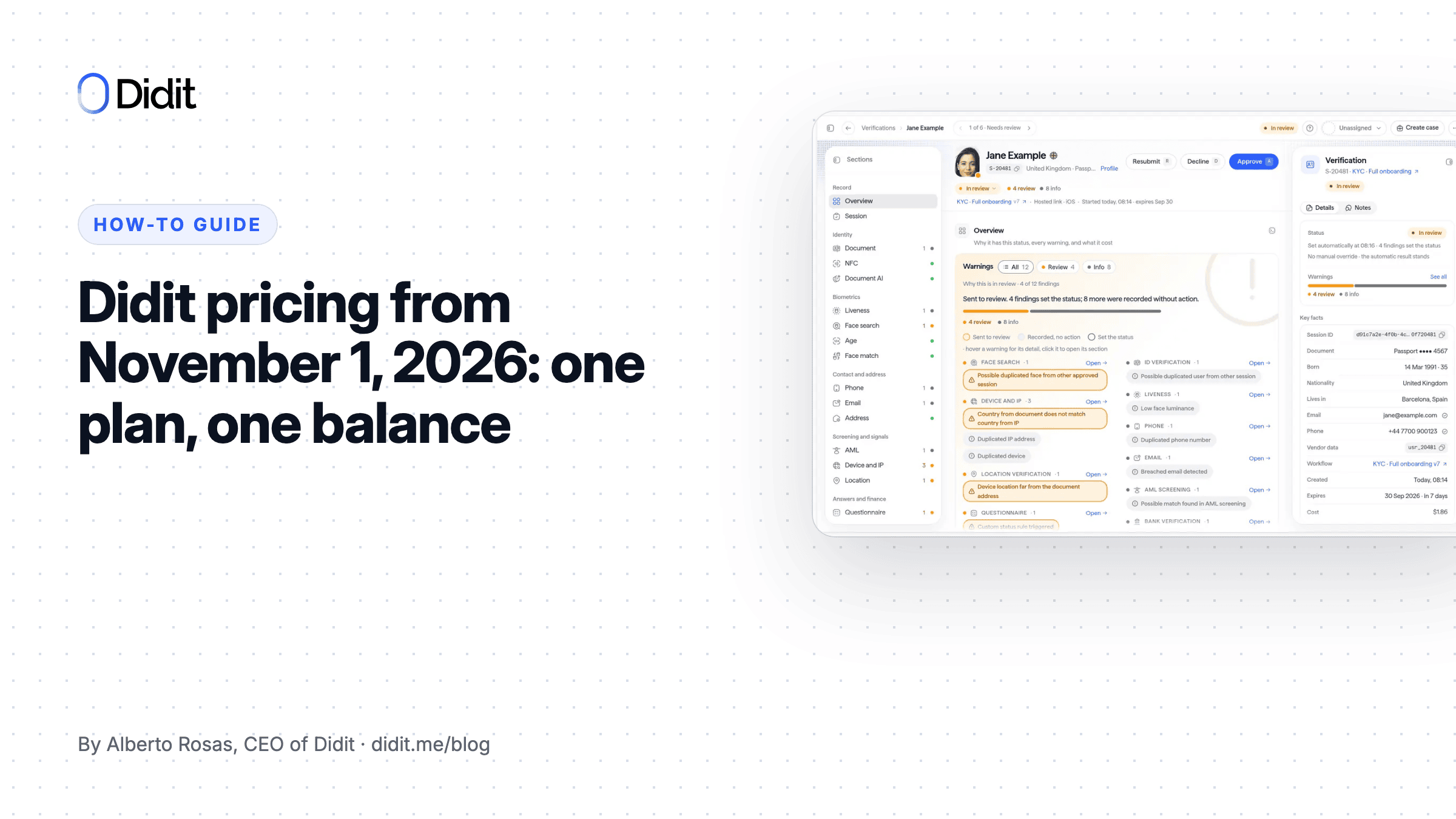 AnnouncementsDidit pricing from November 1, 2026: one plan, one balance
One Didit plan now covers every product with a single credit balance: Free $0, with $10 of monthly credit for organizations created with an eligible work email, Growth $99 with $115 and 4% off, Scale $299 with $350 and 10% off.
Alberto RosasOct 2, 2026Questions
Frequently asked questions
What is digital onboarding in one sentence?
Digital onboarding is the remote, automated sequence of steps, from signup and identity verification to a compliance decision, that turns a new customer into an active user without a branch visit or paper forms. It combines a short user flow with an identity check and, where required, AML screening.
Is digital onboarding the same as KYC?
No. KYC is the legal obligation to know your customer. Digital onboarding is the delivery mechanism that carries the KYC checks plus signup, product education and the first task the customer performs. Identity verification is usually one step inside onboarding, not the whole thing.
How much does it cost to onboard one customer with Didit?
A full KYC check is $0.33 at list price, made of ID document $0.15, passive liveness $0.10, face match 1:1 $0.05 and device and IP analysis $0.03. Adding AML screening brings it to $0.53 per customer. You pay only when a check finishes with a result, and Growth takes 4% off, Scale 10%.
How long does a digital onboarding check take?
The check itself is fast: Didit runs at sub-2-second p99 inference. The time the customer spends depends on how many steps the workflow asks for, so most teams keep the first flow to a document, a selfie and any legally required screening, and add steps only for higher risk cases.
What does the customer actually see during onboarding?
They see a branded start screen that sets expectations, then country and document selection unless the workflow fixes a single document type, then document capture with on-device quality checks, then a liveness selfie, then a result screen. Any failure gives a specific instruction and a retry rather than a dead end.
What happens if a document is rejected or the customer abandons?
A rejected document triggers a guided retry with a specific reason, and liveness retries once automatically if there is no response in time. An abandoned session ends with the status Abandoned. A workflow that asks for a resubmit moves to Resubmitted and you re-deliver the same url.
Can a returning customer skip the identity check?
Yes, with Reusable KYC, which is free. A finished session is shared through a short-lived token minted on the source application and redeemed by the receiving application, and the cloned session keeps an audit link to the original. The receiving side can either trust the source decision or force a review.
How do I test an onboarding flow without real customer data?
Use the sandbox. Sandbox testing is free and unlimited on every plan and is never billed. Every external provider is mocked, and scenarios from GET /v1/sandbox/scenarios/ produce a deterministic Approved, Declined or In Review result. Captured media is stored as it would be live, so do not upload real personal data.
Do I need a sales call to start with Didit?
No. You can sign up at business.didit.me and run the sandbox with no sales call, and the Free plan gives $10 of credit a month to organizations that sign up with a work email. Sales enters only above $15,000 a year, where Enterprise contracts start.
What changes when you onboard a business instead of a person?
Business onboarding runs KYB: registry retrieval from $2.00 per company, with registry pricing varying by country and data tier, key people extraction, a linked full ID check for each owner or officer at $0.33 and person AML at $0.20 each. The decision still arrives in the same V3 payload shape, and reusable KYC means a director already verified elsewhere does not repeat the check.
Which regulations apply to digital onboarding?
Customer due diligence obligations come from the FATF recommendations and from regional rules such as AMLD6 and MiCA in the EU, with data protection under GDPR. For crypto transfers, the Travel Rule applies to the messaging between providers. Check the specific rules for each market you serve before you launch.
Is Didit compliant enough for a regulated onboarding flow?
Didit holds SOC 2 Type 2, ISO/IEC 27001:2022 certification (certificate ES144068), iBeta Level 1 PAD, and is GDPR-native, with work aligned to DORA, MiCA, AMLD6 and eIDAS 2.0. Spain's Tesoro, Banco de España and SEPBLAC have attested the process as safer than in-person verification. Your own licensing obligations still sit with you.
Compliance built in
Audited, certified and attested.
We hold the certifications and build each country's rules into your flows, so you can launch anywhere without worrying. Security and Compliance center
- Regulation encoded into your flows
Tell us what you do and where. Didit lists the rules that apply to you, with sources, and builds the checks each country needs into one workflow.
- Ready for AMLR
Every requirement of the new EU anti-money laundering rules, from checking customers to human review, is already covered by a Didit check.
- Tested in Spain's Treasury sandbox
Spain's Treasury published its supervised sandbox report on Didit's NFC plus active liveness onboarding; SEPBLAC took part and valued the added measures positively.
- Audited, not self-declared
iBeta Level 1 and Level 2. Liveness tested under ISO/IEC 30107-3.
Your obligations · 3 regions
 SOC 2 Type 2
 ISO 27001
 iBeta Level 1 and Level 2
 EU regulator attestation
 FSM youth protection
 GDPR
 EBA remote onboarding
 MiCA compatible
 FIDO Alliance member
- AMLREU AML Regulation ready
Integration · Didit MCP
Run Didit from your own AI agent
Connect Didit to Claude, Cursor, VS Code or ChatGPT and just ask in plain words. Your agent can do anything you can do in the console, with the same permissions you have.
 Add to Claude
 ChatGPT
 Cursor
- Build workflowsDescribe the checks you need. The agent creates and publishes the flow.
- Run investigationsAsk why a session was declined, review cases, search people and companies.
- Change rulesCreate payment rules, test them on past data and switch them on.
- Pull reportsAsk for numbers, exports or the audit log.
Didit Academy


