Announcements
Didit pricing from November 1, 2026: one plan, one balance
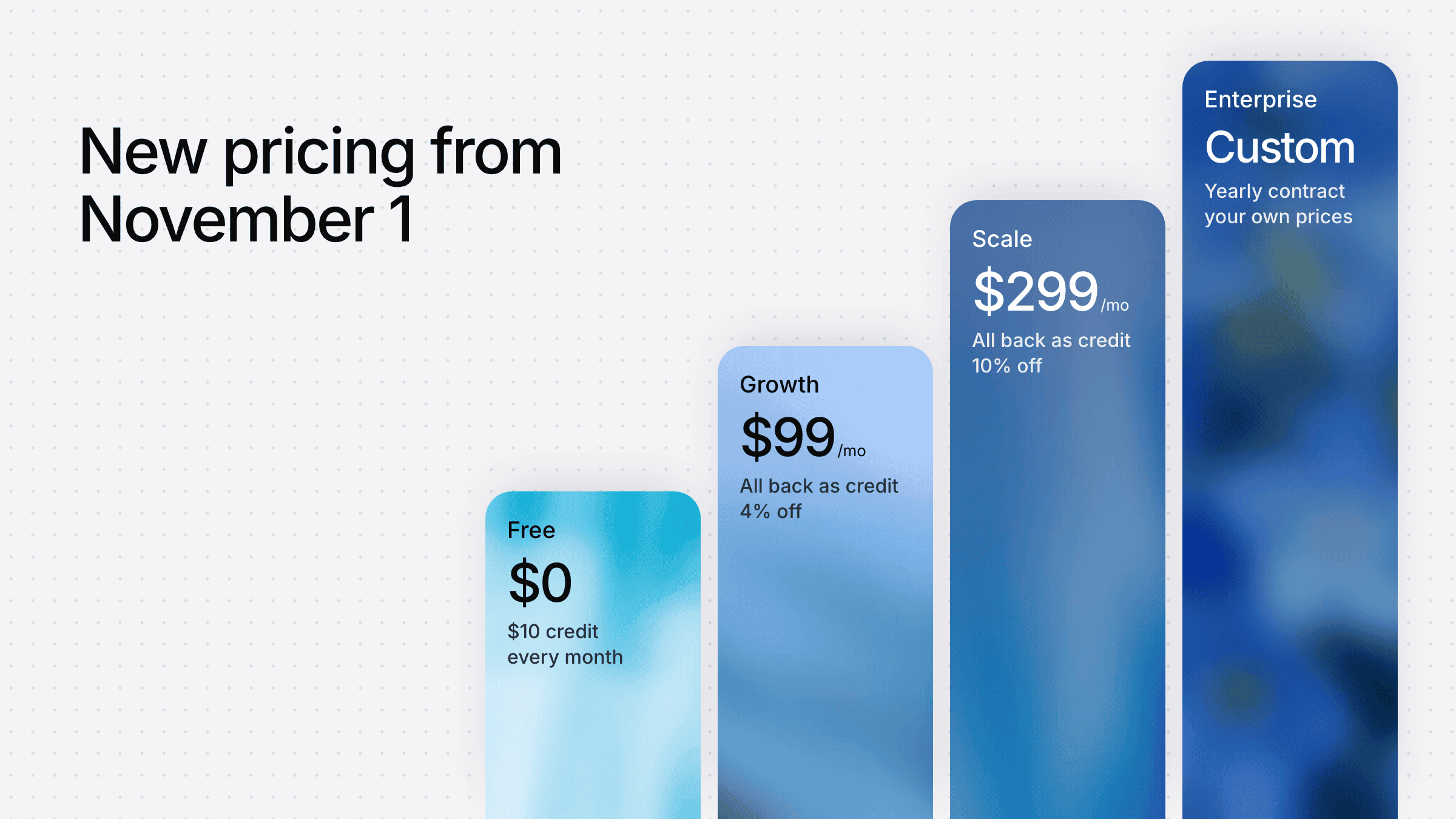
One Didit plan now covers every product with a single credit balance: Free $0, with $10 of monthly credit for organizations created with an eligible work email, Growth $99 with $115 and 4% off, Scale $299 with $350 and 10% off.
 Alberto RosasCo-founder and CEO
Contents
In this guide
Jump to the part you need.
On November 1, 2026 Didit moved to one plan and one credit balance for every product. It fits teams that run identity checks, business checks and transaction monitoring from one account and want a single billing view. The Free plan is $0, with $10 of monthly credit for organizations created with an eligible work email. Growth is $99, Scale is $299, and Enterprise starts at $15,000 a year. The caveat: monthly credit expires at the end of the plan month.
Last updated: November 26, 2026. Prices checked against the live Didit price feed on November 26, 2026.
This page walks the billing workflow step by step: what the plan is, how to move your account onto it, how to read your balance from code, what to do when a step fails, and what a real month costs. Every number comes from didit.me/pricing and the billing rules come from the pricing docs. 4,000+ companies run Didit today.
| Plan | Monthly fee | Yearly fee | Monthly credit | Discount on every price | Monitored transactions included |
|---|---|---|---|---|---|
| Free | $0 | None | $10 | 0% | 1,000 a month |
| Growth | $99 | $1,128 paid up front | $115 | 4% | 10,000 a month |
| Scale | $299 | $3,408 paid up front | $350 | 10% | 100,000 a month |
| Enterprise | Custom annual contract | From $15,000 a year | Your annual commitment | Set by the contract | Set by the contract |
Plan credit lands on the first day of each plan month and expires at the end of it: it never rolls over. A top-up is different. It is added at face value, pays for every product, and lasts 12 months from the day you add it. Usage takes this month's plan credit first, then your oldest top-up.
The plans differ by more than price. Here is the practical difference:
- Free is for building and for small live volume: every check at list price, the no-code workflow builder, SDKs and API, 2 members, 1 year of data retention, a 30-day audit log and 1,000 monitored transactions a month.
- Growth adds the team and the operations layer: 10 members, 5 years of retention, a 1-year audit log, the Investigator agent, case management with one blueprint, the Didit fraud network, preset roles, your own wallet-screening provider, and email and chat support answered within 1 business day.
- Scale adds volume controls: unlimited members, up to 10 years of retention, a 3-year audit log with export, white label with your brand on your own domain, full case management with routing, network investigation, scheduled reports, custom roles and priority support within 24 hours with an SLA.
Start free in the sandbox at business.didit.me, no sales call. If you build with AI assistants, connect Didit through MCP. The three live product lines are User Verification, Business Verification and Transaction Monitoring, with Wallet Screening inside Transaction Monitoring, and pricing holds every unit price and the cost estimator.
The outcome, and the method we recommend
The outcome is one plan and one balance covering Identity Verification, Authentication and Transaction Monitoring & Travel Rule.
The method we recommend for almost everyone: stay on Free while you build in the sandbox, choose Growth on the day you go live with a team, move to Scale when volume or an audit trail pushes you there, and only look at Enterprise from $15,000 a year upwards. Do not buy a bigger plan to get credit. Buy it for the seats, the retention window, the audit log and the discount, then let auto top-up carry the rest.
Before you start
- An organization created with a work email. The Free plan's $10 a month applies to organizations created with an eligible work email for a company domain. An organization created through the API starts at $0 of credit.
- Owner or admin access with billing permission. Billing details on receipts can be changed by owners and billing admins.
- An API key that can read billing if you want the balance from code, and a saved payment method if you want auto top-up. Without a saved payment method, auto top-up cannot be turned on.
- The date your plan month ends. It is shown on Overview, and it decides when your credit resets.
Steps to move onto the new pricing
- Sign in to the Business Console and open Settings > Organization > Billing and plan. The page has four views: Overview, Plans, Usage and Receipts.
- Read Overview first. You see your plan, the credit your plan adds each month, your balance, any credit about to expire with its date, what you were charged this month and the date of your next plan charge.
- Confirm which credit you hold. On Free it is $10 a month, it expires at the end of the plan month, and phone verification codes are excluded from it. On Growth it is $115 and on Scale $350, added every month and reset at the end of it.
- Choose your plan in the Plans view. Free is $0, Growth is $99 a month or $1,128 a year paid up front, Scale is $299 a month or $3,408 a year paid up front, and Enterprise is a quote from $15,000 a year.
- Read the balance from your own code with the documented call. This is the same number the console shows, organization wide:
Treatcurl -X GET 'https://verification.didit.me/v3/billing/balance/' \ -H 'x-api-key: YOUR_API_KEY'balanceas a fixed-point decimal string and parse it with a decimal library, never a float. Do not poll faster than every few minutes: the number only moves when usage is billed or a top-up settles. - Turn on auto top-up on Overview, under Auto top-up and alerts. Enter the trigger balance and top-up amount as whole amounts within the limits shown in the dialog. Top-ups range from $50 to $20,000. Then make sure a payment method is saved. Set a low balance alert as well if you want an email before the trigger fires.
- Decide the agent top-up switch deliberately. "Connected AI agents can top up with your saved card" is off by default, and only a person signed in with billing permission can change it.
- Check Usage and Receipts. Usage lists every live check of the month with units, today's price and the amount charged, with an environment control and an export. Receipts lists every top-up and plan charge as Paid or Failed, and each opens as a PDF.
- Keep billing details current. Legal name, billing address, tax ID, VAT ID and billing emails are printed on every invoice and receipt, and invoices already issued keep the details they were issued with.

What a correct result looks like
The balance call answers with the organization's balance and its auto-refill configuration:
{
  "balance": "1234.5600",
  "auto_refill_enabled": true,
  "auto_refill_amount": "500.00",
  "auto_refill_threshold": "100.00",
  "agent_top_up": { "enabled": false }
}
A correct setup has three parts. The balance matches the credit plus top-ups you expect on Overview. auto_refill_enabled is true with a non-null amount and threshold, because true with nulls means auto-refill is effectively off. And agent_top_up.enabled is false unless a person turned it on in the console.
When something fails, and how to recover
| What happens | What you see | How to recover |
|---|---|---|
| API key missing or malformed | 401 with a detail message | Send the key in the x-api-key header. Check that the key is present and authorized to read billing. |
| Key valid but not allowed to read billing | 403 | Use a key whose application may read billing, or let an owner or billing admin read the balance in the console. |
| Polling too often | 429 rate limited | Poll every few minutes at most. Cache the number for dashboards. |
| An auto top-up charge fails | A banner in the console, auto top-up paused | Update the payment method to turn it back on. Live checks keep running on your remaining balance until it runs out. |
| Credit and top-ups both run out with auto top-up off | Live checks stop | Top up from $50 to $20,000 on Overview. The sandbox keeps working throughout. |
| Balance arithmetic looks wrong in your app | Numbers drift by cents | You parsed the decimal string as a float. Parse it as a decimal and store the raw string. |
| Plan credit is about to expire | Overview shows the amount and its expiry date | Plan credit resets at the end of the plan month. Spend it inside the month or size the plan to your monthly volume, and keep a top-up balance for the rest, which lasts 12 months. |
| An Enterprise account wants to top up | No top-up option | Enterprise cannot buy top-ups. Usage beyond the credit invoiced so far is invoiced as overage. |
Inputs and outputs
| You give Didit | You get back | Where you see it |
|---|---|---|
| Signup with an eligible work email | $10 of credit a month on Free | Overview and the balance call |
| A plan choice | Monthly credit plus 4% or 10% off every price | Plans and Overview |
| A top-up from $50 to $20,000 | Balance at face value that lasts 12 months and pays for every product | Top up, then Receipts |
| A trigger balance and an amount | Automatic top-ups so live checks never stop | Auto top-up and alerts |
| An API key with billing read | Balance, auto-refill settings and the agent top-up flag | GET /v3/billing/balance/ |
| Completed live checks | Billed per check, plan credit first, then your oldest top-up | Usage, exportable |
Which steps spend money, and where a person must approve
- No money: creating the account, the sandbox, and reading your balance or usage. Sandbox checks are never billed, on any plan, at 500 test sessions per sandbox application every 24 hours.
- Money only when a check finishes: usage is billed per completed check, including a check that concludes an ID is fake. Live checks are paid from this month's credit first, then from your oldest top-up.
- Money on a schedule: your plan fee follows your plan's billing schedule, and monthly credit is added on the first day of each plan month. Growth is $99 and Scale is $299 a month, or $1,128 and $3,408 paid up front for the year.
- A person must approve: turning on agent top-ups, changing billing details, adding or changing the card, and any Enterprise contract. An API key or an agent can never flip the agent top-up switch.
- A person should review: the first month of Usage after you switch, and any month where credit expires unused. Plan credit does not roll over, so a plan sized above your monthly volume leaves part of its fee unused, while a top-up balance carries over for 12 months.
Worked cost example
Growth, one month, 500 full ID checks and 200 AML screenings, with 1,000 monitored payments running alongside. Three numbers are kept apart here: the plan fee, the usage paid by included credit, and the usage paid from a top-up.
- Full ID checks: 500 x $0.3168 = $158.40
- AML screenings: 200 x $0.192 = $38.40
- Monitored payments: 1,000 included on Growth = $0.00
- Usage charge: $158.40 + $38.40 = $196.80
- Paid by included plan credit: $115.00
- Paid from your top-up: $196.80 minus $115.00 = $81.80
- Plan fee: $99.00
- Total for the month: $99.00 + $81.80 = $180.80
When your bill lands between $500 and $700 a month
Scale, one month, 2,000 full ID checks and 500 AML screenings, with 50,000 monitored payments inside the 100,000 allowance.
- Full ID checks: 2,000 x $0.297 = $594.00
- AML screenings: 500 x $0.18 = $90.00
- Usage charge: $594.00 + $90.00 = $684.00
- Paid by included plan credit: $350.00
- Paid from your top-up: $684.00 minus $350.00 = $334.00
- Plan fee: $299.00
- Total for the month: $299.00 + $334.00 = $633.00
Put another way, 2,000 full ID checks alone cost $633.60 at Growth prices ($0.3168 each) and $594.00 at Scale prices ($0.297 each), a difference of $39.60, while the Scale plan fee is $200 a month more than Growth. Scale lowers the usage charge, but this example does not by itself recover Scale's higher monthly fee.
What changed from the old pricing
The free tier changed shape. The previous monthly check allowance was replaced by $10 of monthly credit that can be used across products, which is about 30 full ID checks at $0.33 each. List prices did not move: a full ID check is still $0.33, watchlist screening is still $0.20, and Growth and Scale take 4% or 10% off every price. One plan now covers every product, so Identity Verification and Transaction Monitoring & Travel Rule share one team, one balance and one billing view. Pay as you go stays: no monthly fee is required to use Didit, and paid plans are optional.

Sources
- Didit pricing page, and the machine-readable pricing.json, read November 26, 2026.
- Didit docs: Identity Verification pricing, plans and credit rules, read November 26, 2026.
- Didit docs: Billing and plan in the Didit Console, read November 26, 2026.
- Didit docs: Get credit balance API, read November 26, 2026.
- Didit MCP server, read November 26, 2026.
- Didit public price book, read November 26, 2026.
Next step: create a sandbox application at business.didit.me, run a few test checks, then pick your plan from the console when you are ready. No sales call, and the sandbox stays free on every plan.
Try it
Try this in the sandbox
Run the check this guide describes, free.
The product this post is about, taken from its topic. Run it free in the sandbox.
Author
Alberto Rosas
Co-founder and CEO

Keep reading
Other guides in the same topic.
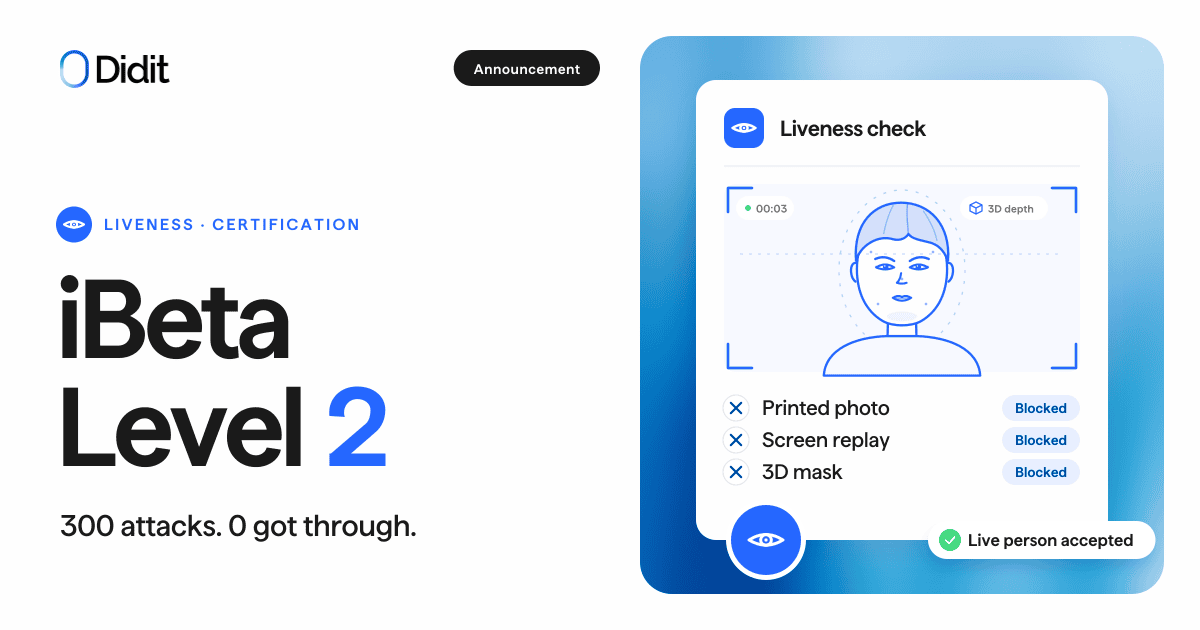 AnnouncementsDidit passes iBeta Level 2: 300 attacks, 0 got through
Didit's liveness detection passed iBeta Level 2 presentation attack detection under ISO/IEC 30107-3: 300 attacks, 0 accepted. Alberto Rosas on why proving a real human is behind the screen matters now.
Alberto RosasNov 14, 2026 Business7 Best AML Software Platforms in 2026
Compare 7 AML software platforms for screening, ongoing monitoring, and investigations, with pricing and practical criteria for choosing the right fit.
Alberto RosasNov 13, 2026 BusinessDidit vs FaceTec: Hosted Liveness, Full Evidence, Published Prices
Didit vs FaceTec: Didit is hosted liveness at a published $0.10 passive or $0.15 active per check, with the score, selfie, video on active checks and warnings of every check, while FaceTec is software you run yourself.
Alberto RosasNov 10, 2026Questions
Frequently asked questions
What does Didit cost in November 2026?
Free is $0 a month with $10 of credit for organizations created with an eligible work email, Growth is $99 a month with $115 of credit and 4% off every price, Scale is $299 a month with $350 of credit and 10% off every price, and Enterprise is a custom annual contract from $15,000 a year. A full ID check is $0.33 at list price, $0.3168 on Growth and $0.297 on Scale. Billing is per completed check from prepaid credit.
What changed in Didit pricing on November 1, 2026?
One plan now covers every product on one credit balance, and the previous monthly check allowance was replaced by $10 of monthly credit that can be used across products. You still pay per completed check, pay as you go is still available, and the list prices for checks did not change. Plan credit resets every month, while top-ups last 12 months.
Do I have to pay a monthly fee to use Didit?
No. Pay as you go stays on the Free plan: top up when you want and pay list price per check, with $10 of credit a month if your organization was created with an eligible work email. A paid plan is optional, for teams that want more seats, case management, a longer data retention window or a discount on every check.
Does unused credit roll over?
No. Plan credit lands every month and expires at the end of that plan month, so use it inside the month or lose it. Money you add as a top-up is different: it lasts 12 months and pays for every product, and any balance you bought before November 1, 2026 never expires.
How many checks does $10 of monthly credit buy?
About 30 full ID checks at the $0.33 list price. The credit is dollars, not a count, so you can mix it across full ID checks, watchlist screening, proof of address, business registry checks or wallet screening. For comparison, the monthly credit buys about 362 full ID checks on Growth and about 1,178 on Scale.
Can I use one balance for identity checks and transaction monitoring?
Yes. One plan covers Identity Verification, Authentication and Transaction Monitoring & Travel Rule, and one balance pays for all of them. Usage takes this month's plan credit first, then your oldest top-up, so you never manage two billing views or two wallets.
How do I check my credit balance with the API?
Call GET https://verification.didit.me/v3/billing/balance/ with your key in the x-api-key header. The answer carries balance as a fixed-point decimal string, plus auto_refill_enabled, auto_refill_amount, auto_refill_threshold and the agent_top_up flag. Parse the balance with a decimal library, not a float, and poll no faster than every few minutes.
What happens when my credit runs out?
Checks are paid from your top-up balance next, oldest top-up first. With auto top-up on, Didit adds the amount you chose, from $50 to $20,000, each time your balance falls below your trigger, so live checks never stop. With auto top-up off, live checks stop until you top up, and the sandbox keeps working.
Can an AI agent top up my balance?
Only if a person turns the switch on. "Connected AI agents can top up with your saved card" is off by default, only a signed-in person with billing permission can change it, and an API key or an agent can never change it. Each agent top-up shows in Receipts with the agent's name, and if the payment needs your approval the agent hands you a link instead.
Is the sandbox billed?
No. The sandbox is free on every plan, with 500 test sessions per sandbox application every 24 hours, and sandbox checks are never billed. Usage shows nothing for sandbox because there is nothing to charge, which makes it the right place to test the new plan before a live check runs.
How many checks can I run for $500 to $700 a month?
Roughly 2,000 full ID checks: $633.60 at Growth prices ($0.3168 each) or $594.00 at Scale prices ($0.297 each). Add 500 AML screenings at $0.18 on Scale and the usage comes to $684.00, which is $350 of plan credit plus $334.00 from a top-up, so the month costs $633.00 including the Scale fee. The Scale price saves $39.60 on usage in that example, against a plan fee that is $200 a month higher than Growth.
What happens to the balance I bought before November 1, 2026?
It never expires and it pays for every product. The change affected the shape of the free tier and the plan structure, not prepaid money you had already added to your account.
Compliance built in
Audited, certified and attested.
We hold the certifications and build each country's rules into your flows, so you can launch anywhere without worrying. Security and Compliance center
- Regulation encoded into your flows
Tell us what you do and where. Didit lists the rules that apply to you, with sources, and builds the checks each country needs into one workflow.
- Ready for AMLR
Every requirement of the new EU anti-money laundering rules, from checking customers to human review, is already covered by a Didit check.
- Tested in Spain's Treasury sandbox
Spain's Treasury published its supervised sandbox report on Didit's NFC plus active liveness onboarding; SEPBLAC took part and valued the added measures positively.
- Audited, not self-declared
iBeta Level 1 and Level 2. Liveness tested under ISO/IEC 30107-3.
Your obligations · 3 regions
 SOC 2 Type 2
 ISO 27001
 iBeta Level 1 and Level 2
 EU regulator attestation
 FSM youth protection
 GDPR
 EBA remote onboarding
 MiCA compatible
 FIDO Alliance member
- AMLREU AML Regulation ready
Integration · Didit MCP
Run Didit from your own AI agent
Connect Didit to Claude, Cursor, VS Code or ChatGPT and just ask in plain words. Your agent can do anything you can do in the console, with the same permissions you have.
 Add to Claude
 ChatGPT
 Cursor
- Build workflowsDescribe the checks you need. The agent creates and publishes the flow.
- Run investigationsAsk why a session was declined, review cases, search people and companies.
- Change rulesCreate payment rules, test them on past data and switch them on.
- Pull reportsAsk for numbers, exports or the audit log.
Didit Academy


