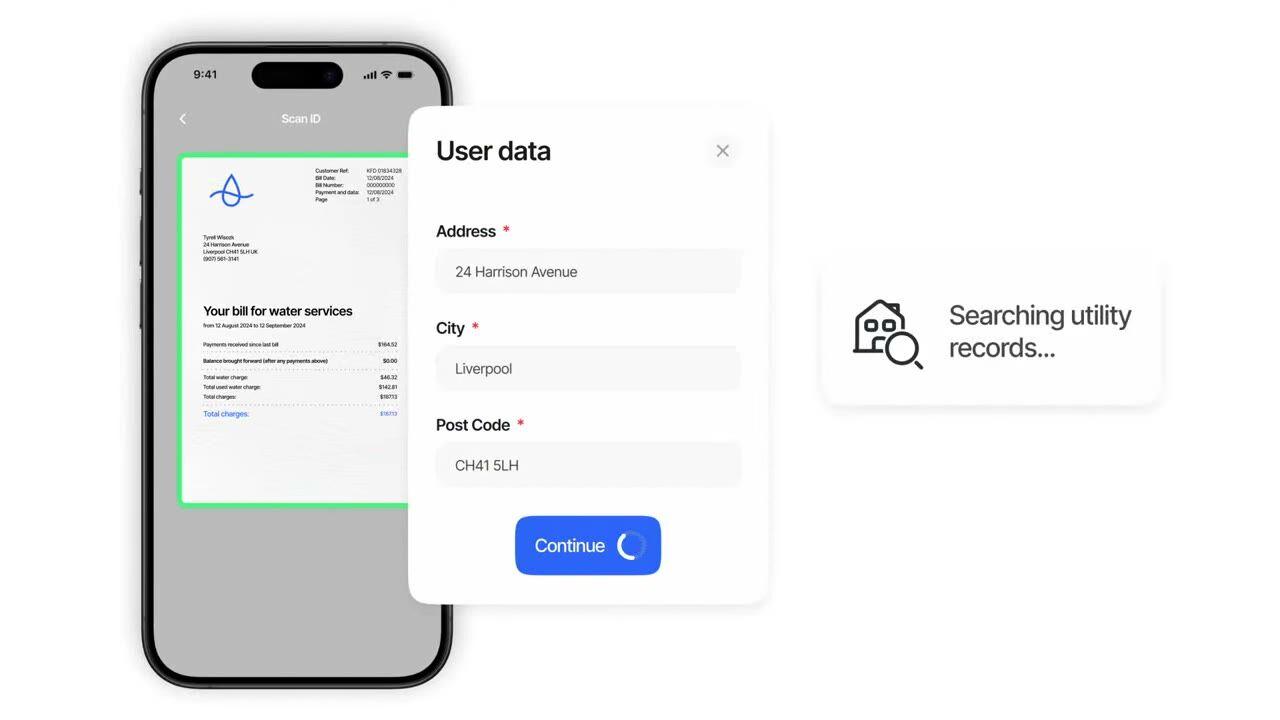
Verifica qualsevol adreça. D'una factura, un banc o una carta.
Verifica la residència a partir d'una factura de serveis, un extracte bancari, una carta oficial o un contracte de lloguer. Llegim el document, extraiem l'adreça, fem coincidir el nom amb la identificació verificada i retornem un resultat estructurat. 0,20 $ per comprovació, 500 gratuïtes/mes.
Confiat per més de 3.000 organitzacions a tot el món.
Factura + extracte bancari
Extreu l'adreça. Comprova el nom.
Llegim el document, extraiem l'adreça i el nom, i els contrastem
amb la identitat verificada. Factura de serveis, extracte bancari, contracte de lloguer, carta d'impostos
, 0,20 $ per comprovació.
Com funciona
Des del registre fins a l'usuari verificat en quatre passos.
Pas 01 / 04
01
Crea el flux de treball
Tria les comprovacions que vulguis: identificació, prova de vida, coincidència facial, sancions, adreça, edat, telèfon, correu electrònic, preguntes personalitzades. Arrossega-les a un flux al panell de control o publica el mateix flux a la nostra API. Crea ramificacions segons condicions, fes proves A/B, sense necessitat de codi.
Integra
Integra de forma nativa amb el nostre SDK per a Web, iOS, Android, React Native o Flutter. Redirigeix a una pàgina allotjada. O simplement envia un enllaç al teu usuari, per correu electrònic, SMS, WhatsApp, on vulguis. Tria el que millor s'adapti al teu stack.
L'usuari segueix el flux
Didit allotja la càmera, les indicacions d'il·luminació, el traspàs mòbil i l'accessibilitat. Mentre l'usuari està en el flux, puntuam més de 200 senyals de frau en temps real i verifiquem cada camp amb fonts de dades autoritzades. Resultat en menys de dos segons.
Rebràs els resultats
Els webhooks signats en temps real mantenen la teva base de dades sincronitzada en el moment en què un usuari és aprovat, rebutjat o enviat a revisió. Consulta l'API sota demanda. O obre la consola per inspeccionar cada sessió, cada senyal i gestionar els casos a la teva manera.
Creat per a desenvolupadors · Dissenyat contra el frau · Obert per disseny
Sis funcionalitats. Un sol feature flag: PROOF_OF_ADDRESS.
Cada funcionalitat següent és un interruptor al mateix mòdul. Sense nivells de venda addicional, sense SKU separats, sense trucades addicionals. Activa-les per flux de treball o passa-les en línia a la crida de l'API.
Factures, extractes bancaris, cartes governamentals, contractes de lloguer.
Quatre categories: factures de serveis (electricitat, aigua, gas, internet, telèfon), extractes bancaris (compte, targeta de crèdit, hipoteca, préstec), documents emesos pel govern (declaració d'impostos, targeta de votant, certificat de residència) i altres (contracte de lloguer, carta de l'ocupador, assegurança, declaració jurada notarial). JPG, PNG, TIFF o PDF de fins a 15 MB. Processament de diverses pàgines en una sola inferència.
Source
Voltia PowerElectricity · Mar 2026PDF
AcceptedUTILITY_BILL
JPGJPEGPNGTIFFPDF15 MB · multi-page
02 · Extracció + autenticitat
Llegeix cada camp d'adreça. Detecta cada falsificació.
L'OCR (reconeixement òptic de caràcters) extreu l'adreça en brut i la normalitza en un objecte estructurat: carrer, ciutat, regió, codi postal, tipus d'adreça. S'inclouen latitud i longitud. La mateixa passada executa anàlisis forenses d'autenticitat del document: detecció de manipulació a nivell de píxel, residus de copiar-enganxar / clonar, inconsistència de font + kerning, senyals d'imatges sintètiques generades per IA i desajust de metadades. Els documents manipulats es classifiquen com a `En revisió` amb una advertència, no s'aproven silenciosament.
Voltia PowerMar 2026
Extraction6 fields
street_1123 Main St
cityNew York
regionNY
postal_code10001
issuerVoltia Power
issue_date14 Mar 2026
No tamperFontsMetadata
03 · Comprovació de vigència
Validesa configurable. 90 dies per defecte.
Defineix el període de validesa del document per aplicació: 30, 60, 90 dies o el que tu triïs. El valor per defecte és 90. Extraiem la data d'emissió i la comparem amb la marca de temps de l'enviament; qualsevol document més antic que el llindar es rebutja automàticament amb `EXPIRED_DOCUMENT`. Els documents sense data d'emissió analitzable,o amb una data futura, generen advertències que pots redirigir a una revisió manual.
Document agewindow · 90 days
90dtoday
34d
ApproveReviewDecline
Configurable threshold · default 90 days
04 · Coincidència de nom amb KYC
La factura coincideix amb la identificació. O no.
Es disparen tres advertències de no coincidència de nom quan el nom del document difereix de la identitat verificada, del valor que vas enviar a través de l'API o d'una altra prova d'adreça a la mateixa sessió. Un llindar de coincidència configurable (normalment 90-95%) tolera variacions en el segon nom i l'ortografia. Cada advertència es pot assignar a Rebutjar, Revisar o Aprovar per aplicació.
Name on billJOHN A. SMITH
96.3%similarity
Name on KYCJohn Smith
Matched
Matches provided name
Matches ID document
Consistent across documents
05 · Adreça estructurada analitzada
L'OCR retorna un string. Didit retorna un esquema.
Cada resposta inclou un objecte d'adreça analitzada,carrer, ciutat, regió, codi postal, tipus d'adreça, a més de les coordenades en brut. Pots integrar-ho al registre del teu client, al model de frau o a l'encaminament de lliuraments. Sense expressions regulars, sense postprocessament, sense analitzador per país. La mateixa estructura tant si el document es va emetre als EUA, Espanya, Brasil o Singapur.
As printed on the documentJohn A. Smith123 Main St, Apt 4BNew York, NY 10001
poa_parsed_addressApproved
street_1123 Main St
street_2Apartment 4B
cityNew York
regionNY
postal_code10001
address_typeRESIDENTIAL
lat 40.7128lng -74.0060
06 · Preparat per a la conformitat
Evidència AMLD6 i Recomanació 10 del FATF. 0,20 $ per comprovació.
La verificació d'adreces és obligatòria segons la AMLD6 (6a Directiva Antilegalització de Capitals de la UE) de diligència deguda del client i la Recomanació 10 del FATF. Cada veredicte inclou una URL de document signat, una matriu d'advertències preparada per a auditories i anàlisis forenses de manipulació de superposicions de PDF: el teu oficial de conformitat té el paquet de proves a mà. Preus públics de pagament per ús, sense contracte.
3audit artifacts
7-yrretention
2frameworks
poa.status.updated · webhook fired1.4s
SSigned document file URLS3 · 7-day pre-signed
WWarnings audit arrayexpired · name mismatch · tampered
PPDF overlay forensicsduplicate font subset · glyph delta
Compliance readyAMLD6FATF R.10
Integra
Dos endpoints. El mateix JSON. El mateix preu.
Crea una sessió quan vulguis que la nostra UI allotjada gestioni la captura i la càrrega de diverses pàgines. Truca al punt final autònom quan ja tinguis el document. El format de l'informe és el mateix en ambdós casos.
Desplega la Prova de Domicili amb una sola instrucció.
Enganxa el bloc següent a Claude Code, Cursor, Codex, Devin, Aider o Replit Agent. Omple el marcador de posició `my_stack` amb el teu framework, llenguatge i cas d'ús. L'agent provisionarà Didit, crearà el flux de treball, connectarà el webhook i ho desplegarà.
didit-integration-prompt.md
# Didit Proof of Address — integrate in 5 minutes

You are integrating Didit's Proof of Address (PoA) module into <my_stack>.
Follow these steps exactly. Every URL, header, and enum value below is
canonical — do not paraphrase or "improve" them.

## 1. Provision an account
- Sign up: https://business.didit.me (no credit card required).
- Or provision programmatically: POST https://apx.didit.me/auth/v2/programmatic/register/
  (returns an API key bound to the workspace + application).

## 2. Two integration paths — pick one

### Path A — Workflow Builder (hosted UI)
Best when you want Didit to handle document capture, multi-page upload,
auto-capture, mobile handoff, and accessibility for you.

1. Create a workflow that contains the PROOF_OF_ADDRESS feature:
   POST https://verification.didit.me/v3/workflows/
   Authorization header:  x-api-key: <your-api-key>
   Body: workflow_label, features array with the single entry
         { feature: "PROOF_OF_ADDRESS" }   (UPPERCASE — strict enum)
   Optional config: accepted document_type filters
   (UTILITY_BILL, BANK_STATEMENT, GOVERNMENT_ISSUED_DOCUMENT,
   OTHER_POA_DOCUMENT) and per-warning threshold overrides.

2. Create a verification session for an end user:
   POST https://verification.didit.me/v3/session/
   Body: workflow_id (from step 1), vendor_data (your own user id).
   Response: url (the hosted verification link) — redirect the user to it.

3. Listen for webhook callbacks (see "Webhooks" below).

### Path B — Standalone server-to-server API
Best when you already have a captured document image or PDF (mobile SDK
capture, native onboarding app, reseller pipeline).

POST https://verification.didit.me/v3/poa/
Content-Type: multipart/form-data
Body fields:
  - document     (required, file — JPG, JPEG, PNG, TIFF, or PDF, <= 15 MB)
  - vendor_data  (optional string, your user id)
  - full_name    (optional string, name to cross-check against the document)
  - address      (optional string, address to cross-check against the document)

Response: JSON report with the parsed address, document_type, issuer,
issue_date, name_on_document, and a warnings array.

## 3. Webhooks (Path A only — Path B returns synchronously)
- Register a webhook destination once via
  POST https://verification.didit.me/v3/webhook/destinations/
  Body: url, subscribed_events: ["session.verified", "session.review_started",
                                  "session.declined"]
- Response includes secret_shared_key — store it.
- Every webhook delivery carries an X-Signature-V2 header you MUST verify
  before trusting the payload.  HMAC-SHA256 verification MUST run against the raw body bytes (the raw payload as Didit sent it) BEFORE any JSON parsing — re-serialising the parsed body changes whitespace and key order, which invalidates the signature.Algorithm:
    1. sortKeys(payload) recursively
    2. shortenFloats (truncate trailing zeros after the decimal point)
    3. JSON.stringify the result
    4. HMAC-SHA256 with the secret_shared_key
    5. Hex-encode, compare to the X-Signature-V2 header.

## 4. Reading the report (both paths return the same shape)
The poa object includes:
- status: "Approved" | "Declined" | "In Review" | "Not Finished"
- issuing_state: ISO 3166-1 alpha-3 country code
- document_type: "UTILITY_BILL" | "BANK_STATEMENT" |
                 "GOVERNMENT_ISSUED_DOCUMENT" | "OTHER_POA_DOCUMENT" |
                 "UNKNOWN"
- issuer: string (the issuing institution or company)
- issue_date: YYYY-MM-DD
- expiration_date: YYYY-MM-DD or null
- document_language: ISO 639-1 language code
- name_on_document: string (full name extracted from the document)
- poa_address: raw extracted address string
- poa_formatted_address: normalized human-readable address string
- poa_parsed_address: structured object with street_1, street_2, city,
  region, postal_code, address_type, and raw_results.geometry.location
  (lat / lng for geocoding)
- document_file: signed URL to the captured document (expires in 60 minutes)
- document_metadata: optional file_size, content_type, creation_date,
  modified_date, and overlay_manipulation forensic block for PDFs (detected
  flag, signals such as duplicate_font_subset or glyph_fragmentation, and
  manipulated_regions in PDF page coordinates)
- warnings: Array<{ risk, additional_data, log_type, short_description,
                    long_description }>

Auto-decline risks (always enforced by Didit, not configurable):
- POA_DOCUMENT_NOT_SUPPORTED_FOR_APPLICATION
- EXPIRED_DOCUMENT
- INVALID_DOCUMENT_TYPE
- MISSING_ADDRESS_INFORMATION

Configurable risks (action per workflow — Decline, Review, or Approve):
- NAME_MISMATCH_WITH_PROVIDED
- NAME_MISMATCH_ID_VERIFICATION
- POA_NAME_MISMATCH_BETWEEN_DOCUMENTS
- POOR_DOCUMENT_QUALITY
- DOCUMENT_METADATA_MISMATCH
- SUSPECTED_DOCUMENT_MANIPULATION
- UNSUPPORTED_DOCUMENT_LANGUAGE
- ADDRESS_MISMATCH_WITH_PROVIDED
- UNABLE_TO_EXTRACT_ISSUE_DATE
- UNPARSABLE_OR_INVALID_ADDRESS
- ISSUER_NOT_IDENTIFIED
- UNABLE_TO_VALIDATE_DOCUMENT_AGE
- FUTURE_ISSUE_DATE

## 5. Hard rules — do not change
- Base URL for /v3/* endpoints is verification.didit.me (NOT apx.didit.me).
- Feature enum is UPPERCASE: PROOF_OF_ADDRESS, OCR, LIVENESS,
  FACE_MATCH, AML, IP_ANALYSIS.
- document_type enum is UPPERCASE_SNAKE: UTILITY_BILL, BANK_STATEMENT,
  GOVERNMENT_ISSUED_DOCUMENT, OTHER_POA_DOCUMENT, UNKNOWN.
- Auth header is x-api-key (lowercase, hyphenated).
- Webhook signature header is X-Signature-V2 (NOT X-Signature).
- Always verify webhook signatures before trusting payload data.
- Status casing matches exactly: "Approved", "Declined", "In Review",
  "Not Finished" (title-cased, space-separated).
- Documents must be issued within 90 days of submission — older documents
  trigger the EXPIRED_DOCUMENT auto-decline regardless of policy.
- The PoA document must be different from the document submitted for ID
  Verification — same image triggers POA_DOCUMENT_NOT_SUPPORTED.

## 6. Accepted document types (do not paraphrase to users)
- Utility Bill — Electricity, Water, Gas, Internet, Phone, Cable TV,
  Satellite TV, Trash Collection, Sewage, Heating, Combined Utilities,
  Municipal Services.
- Bank Statement — Account Statement, Credit Card Statement, Bank Letter
  Confirming Address, Mortgage Statement, Loan Statement, Savings,
  Checking, Investment, Business Account, Credit Union, Debit Card,
  Line of Credit.
- Government-Issued Document — Tax Assessment, Voter Registration Card,
  ID document, Residency Certificate, Government Letter, Census Letter,
  Property Tax Bill, Vehicle Registration, Social Security Statement,
  Unemployment Benefits Letter, Pension Statement, Court Summons,
  Municipal Permit, Immigration Document.
- Other Proof of Address — Lease Agreement, Rental Agreement, Employer
  Letter Confirming Address, Insurance Policy, School Enrollment Letter,
  Notarized Affidavit, Solicitor Letter, Payroll Stub, Employment
  Verification Letter, Retirement / Brokerage Account Statement.

Image requirements: JPG, JPEG, PNG, TIFF, or PDF. Maximum file size 15 MB.
Full-color, all corners visible, no digital editing, all pages included
for multi-page documents.

## 7. Pricing reference (public)
- Standalone /v3/poa/ call: $0.20 per check.
- Bundled inside a Didit workflow (KYC plus PoA): $0.20 per check on top
  of the bundle base.
- 500 free verifications every month, forever, on every account.

## 8. Verify your integration
- Sandbox starts on signup at https://business.didit.me — no separate flag.
- Test documents: deterministic synthetic bills returned in sandbox
  (Approved by default; trigger Declined by submitting the canonical
  "expired" test bill from the sandbox sample pack).
- Switch to live: flip the application's environment toggle in console.

When in doubt: https://docs.didit.me/core-technology/proof-of-address/overview
Compliment per disseny
Obre un nou país amb un clic. Nosaltres fem la feina difícil.
Obrim les filials locals, assegurem les llicències, realitzem les proves de penetració, obtenim les certificacions i ens alineem amb cada nova regulació. Per desplegar verificacions en un nou país, només has d'activar un interruptor. Més de 220 països en funcionament, auditats i provats trimestralment, l'únic proveïdor d'identitat que un govern d'un estat membre de la UE ha qualificat formalment com més segur que la verificació presencial.
Categories de documents, factura de serveis, extracte bancari, document governamental, altres.
90d
Antiguitat màxima de la data d'emissió abans del rebuig automàtic.
<2s
Inferència de punta a punta per cada verificació de Prova de Domicili.
$0.20
Per cada comprovació de Prova de Domicili independent.
Tres nivells, una llista de preus
Comença gratis. Paga per ús. Escala a Enterprise.
500 verificacions gratuïtes cada mes, per sempre. Després, paga només quan s'executa un mòdul. Contractes personalitzats, residència de dades i acords de nivell de servei (SLA) a Enterprise.
Gratuït
$0/ mes · sense targeta
Per construir, provar i per als teus primers usuaris.
Tot el que necessites per començar:
500 verificacions KYC completes cada mes
Identificació, prova de vida, coincidència facial, dispositiu i IP
Més de 200 senyals de frau, llista de bloqueig, duplicats
KYC reutilitzable a tota la xarxa Didit
Constructor de fluxos de treball, gestió de casos, SDKs
Suport amb IAAgent d'IA a la consola, documentació i comunitat.