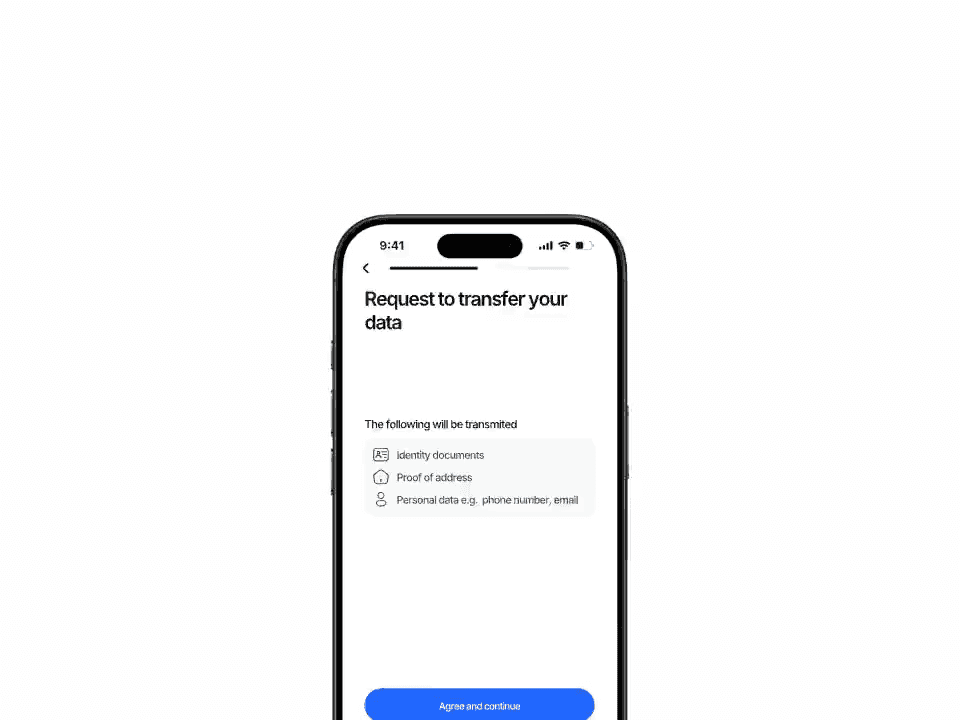
Compartilhe uma identidade verificada com seus parceiros. Server-to-server.
Verifique um usuário ou empresa uma única vez. Compartilhe o resultado com um parceiro, ele faz o onboarding da mesma pessoa instantaneamente. Sem segundo fluxo, sem segunda selfie. Funciona para KYC e KYB. Desenvolvido para Banking-as-a-Service, grupos multimarcas, finanças embarcadas e marketplaces com subplataformas.
Seu usuário verifica uma vez no seu app. Seu parceiro, seu patrocinador BaaS, sua
marca irmã, seu marketplace downstream, precisa do mesmo registro. Envie a ele um
token de compartilhamento único. Ele o resgata e puxa a verificação completa.
O usuário nunca vê um segundo fluxo.
Como funciona
Do seu app para seu parceiro em quatro passos.
Passo 01 / 04
01
Escolha uma sessão verificada
Escolha qualquer verificação finalizada, aprovada, recusada ou em análise, e peça um token de compartilhamento ao Didit. O token expira em uma hora por padrão; você pode estendê-lo de um minuto até um dia inteiro.
Envie o token para seu parceiro
Entregue o token ao seu parceiro através do seu próprio backend, um webhook, uma fila, uma chamada REST. O token só funciona para o parceiro que você nomeou ao criá-lo. Ninguém mais pode resgatá-lo.
Seu parceiro importa o registro
Seu parceiro resgata o token e escolhe como fazer o onboarding do usuário, confie na sua decisão e aprove instantaneamente, ou puxe os dados brutos e deixe a equipe de compliance deles decidir.
A sessão completa chega no app deles
O Didit clona o registro completo, documentos, selfie, correspondência facial, AML, dados de registro, UBOs, para o workspace do seu parceiro. O mesmo formato de uma verificação nova, com um rastro de auditoria claro até o original.
Feito para BaaS · finanças embarcadas · grupos multimarcas
Uma verificação. Todas as plataformas parceiras.
Crie um token. Envie-o. Importe-o. Escolha a velocidade do onboarding. Seis partes móveis cobrem todos os tipos de ecossistemas de parceiros, a mesma chamada para KYC e KYB.
Escolha uma verificação finalizada e peça ao Didit um token com escopo para um parceiro. A vida útil padrão é de uma hora; você pode estendê-la de um minuto até um dia inteiro. O token só funciona para o parceiro que você nomeou, ninguém mais pode resgatá-lo.
Tempo de Vida Padrão (TTL): 3.600 s · limites 60 s, 86.400 s
Restrito a um único aplicativo receptor
Somente sessões finalizadas (Aprovadas · Recusadas · Em Análise)
02 · Importe a sessão
Seu parceiro puxa o registro completo.
Seu parceiro resgata o token e o Didit clona a verificação completa para o workspace dele, nova sessão, mesmos dados, rastro de auditoria completo até o original. Ele o marca com seu próprio ID de usuário interno e escolhe o fluxo de trabalho em que ele se encaixa.
Faça o onboarding instantaneamente ou reavalie a conformidade.
Confie na sua decisão e deixe seu parceiro aprovar o usuário no momento em que o token chega. Ou entregue os dados brutos e deixe a equipe de compliance deles decidir. Alterne por parceiro, mesma chamada, duas velocidades de onboarding.
trueClona o status original, onboarding instantâneo.Aprovado
falseClona os dados, define o status como Em Revisão.Em Análise
Ativar por relacionamento com parceiro · padrão é `false` para novos parceiros
04 · KYC + KYB · ambos os modos
Compartilhe uma pessoa ou um negócio inteiro.
A mesma chamada funciona para ambos os tipos. Compartilhe uma pessoa verificada e seu parceiro recebe o documento, a selfie, a correspondência e todos os acertos de AML. Compartilhe uma empresa verificada e eles recebem o registro, todos os Beneficiários Finais, todos os KYC de diretores, todos os documentos, todas as triagens.
Token carrega `session_kind` · Didit escolhe o caminho de clone correspondente
05 · Adequação ao ecossistema de parceiros
Feito para negócios onde uma verificação serve para muitos.
Patrocinadores de Banking-as-a-Service. Grupos multimarcas, neobanco mais corretora, on-ramp mais exchange. Finanças embarcadas através de bancos parceiros. Marketplaces com subplataformas regionais. Revendedores white-label. Redes de credores. Onde um usuário, ou uma empresa, é onboardado uma vez e atende a muitos.
Consórcios KYB B2BMesma entidade legal em vários parceiros
06 · Compliance por design
Padrão de auditoria por natureza.
O Didit só cria tokens para verificações finalizadas, nenhum fluxo parcialmente capturado vaza entre parceiros. O mesmo token nunca pode ser importado duas vezes. Ambos os lados assinam um acordo de compartilhamento de dados GDPR; o Didit entrega a parte técnica.
Implemente o compartilhamento de KYC com parceiros em um só prompt.
Cole o bloco abaixo no Claude Code, Cursor, Codex, Devin, Aider ou Replit Agent. O agente conecta o Didit, estrutura ambos os lados da entrega e implementa.
didit-integration-prompt.md
# Didit B2B Reusable KYC — partner-to-partner KYC sharing

You are integrating Didit's B2B Reusable Know Your Customer (KYC) into <my_stack>. The recipe is server-to-server: one Didit application (Service X) mints a short-lived JSON Web Token (JWT) share token for a finished session; a partner Didit application (Service Y) imports the token and Didit clones the full verified session into Service Y. Works for both KYC and Know Your Business (KYB) sessions.

Built for Banking-as-a-Service (BaaS) sponsor banks, multi-brand financial groups, embedded finance through partner banks, marketplaces with regional or vertical sub-platforms, on-ramp + exchange ecosystems, white-label resellers, and B2B KYB consortia where the same legal entity onboards once and serves many. Every URL, header, and enum value below is canonical — do not paraphrase or "improve" them.

## 1. Provision both applications
- Sign up: https://business.didit.me (no credit card required).
- Or provision programmatically: POST https://apx.didit.me/auth/v2/programmatic/register/
- Create TWO applications in your Didit organisation. One acts as Service X (mints share tokens), the other as Service Y (imports them). In production these will usually live in different organisations — one per partner.
- Each application has its own `x-api-key`. Service X uses its own key to mint; Service Y uses its own key to import.

## 2. Service X — mint a share token

Service X picks a finished session it owns and posts to the share endpoint:

  POST https://verification.didit.me/v3/session/{sessionId}/share/
  Headers:
    x-api-key: <Service X api key>
    Content-Type: application/json
  Body:
    {
      "for_application_id": "<partner-application-uuid>",
      "ttl_in_seconds": 3600
    }

Bounds on `ttl_in_seconds`: min 60, max 86400, default 3600.

Requirements:
  - The session must be in a FINISHED status: "Approved", "Declined", or "In Review".
  - The API key must hold the `write:sessions` privilege.
  - `for_application_id` must be a real Didit application uuid — usually the partner's app.

Response: 201 Created with the JWT in the `share_token` field plus `for_application_id` and `session_kind` ("user" or "business" — Didit detects this from the source session and embeds it in the token):

  {
    "share_token": "eyJhbGciOiJIUzI1NiJ9...",
    "for_application_id": "partner-app-uuid",
    "session_kind": "user"
  }

## 3. Transmit the token to Service Y

Service X transmits the `share_token` to Service Y over a pre-arranged backend channel — REST, message queue, signed webhook, anything you control. The token is scoped to Service Y's application and useless to any other application.

## 4. Service Y — import the shared session

Service Y posts the token to the import endpoint:

  POST https://verification.didit.me/v3/session/import-shared/
  Headers:
    x-api-key: <Service Y api key>
    Content-Type: application/json
  Body:
    {
      "share_token": "<jwt from step 2>",
      "workflow_id": "<Service Y's own workflow id>",
      "vendor_data": "<Service Y's internal user id>",
      "trust_review": true
    }

`trust_review`:
  - `true`  → the imported session preserves the original status ("Approved" / "Declined" / "In Review"). Service Y onboards the user instantly. Use when Service Y fully trusts Service X's decision (sister brand, regulated partner with a signed data-sharing agreement).
  - `false` → the imported session lands in "In Review" so Service Y's compliance team makes its own call. Safe default for new partner relationships.

Response: 201 Created with a brand-new session in Service Y's application:

  {
    "session_id": "<new uuid>",
    "session_number": <int>,
    "session_kind": "user" | "business",
    "status": "Approved" | "In Review" | "Declined",
    "shared_from_session": "<original session uuid in Service X>",
    "vendor_data": "<Service Y's internal user id>",
    "id_verifications": [...],
    "liveness_checks": [...],
    "face_matches": [...],
    "aml_screenings": [...],
    "database_validations": [...],
    "proof_of_address": [...],
    "phone_verifications": [...],
    "email_verifications": [...]
  }

For a `session_kind: "business"` token Didit clones the KYB shape instead. KYB session statuses are UPPER_SNAKE_CASE (not Title Case like KYC):

  {
    "session_id": "<new uuid>",
    "session_kind": "business",
    "status": "APPROVED",
    "shared_from_session": "<original business session uuid>",
    "vendor_data": "<Service Y's internal business id>",
    "registry_checks": [...],
    "key_people_checks": [...],
    "document_verifications": [...],
    "aml_screenings": [...],
    "questionnaires": [...]
  }

A new User or Business entity is auto-created in Service Y if one with the supplied `vendor_data` doesn't already exist.

## 5. Idempotency, expiration, errors

| Status | Reason |
|--------|--------|
| 401 | Share token invalid or past `exp` — request a new one. |
| 403 | Token not intended for your application, OR session already imported into your app. |
| 404 | Original session no longer exists. |
| 404 | `workflow_id` not found in your application. |

The duplicate-import check is enforced against the (share_token, partner application) pair.

## 6. Webhooks (optional, only when Service Y wants async updates)

Service Y can register a webhook destination once via:

  POST https://verification.didit.me/v3/webhook/destinations/
  Body: url, subscribed_events: ["status.updated"]

Every webhook delivery carries an `X-Signature-V2` header you MUST verify before trusting the payload. HMAC-SHA256 verification MUST run against the raw body bytes (the raw payload as Didit sent it) BEFORE any JSON parsing — re-serialising the parsed body changes whitespace and key order, which invalidates the signature.

Algorithm:
  1. sortKeys(payload) recursively
  2. shortenFloats (truncate trailing zeros after the decimal point)
  3. JSON.stringify the result
  4. HMAC-SHA256 with the secret_shared_key
  5. Hex-encode, compare to the X-Signature-V2 header.

## 7. Hard rules — do not change
- Base URL for /v3/* endpoints is verification.didit.me (NOT apx.didit.me).
- Auth header is x-api-key (lowercase, hyphenated).
- Webhook signature header is X-Signature-V2 (NOT X-Signature).
- Status casing matches exactly: "Approved", "Declined", "In Review", "Not Finished" (Title Case With Spaces — KYC convention).
- session_kind is lowercase: "user" or "business".
- The share API is BUSINESS-to-BUSINESS sharing. Service X and Service Y are responsible for the data-sharing legal basis under General Data Protection Regulation (GDPR), UK GDPR, and any cross-border transfer rules. Didit ships the technical capability; you ship the data-sharing agreement.

## 8. Pricing reference (public)
- Service X already paid for the original verification (full KYC bundle is $0.33 or KYB session uses country-specific registry pricing; see didit.me/pricing).
- Service Y pays nothing on the import side — `POST /v3/session/import-shared/` is included with every plan.
- 500 free verifications every month on every account (applies to fresh captures, not imports).

## 9. Verify your integration
- Sandbox starts on signup at https://business.didit.me — no separate flag.
- Create two sandbox applications: one as Service X (issuer), the other as Service Y (importer). Use Service X's API key to mint a token for a finished sandbox session, hand the token off, use Service Y's API key to import.
- Switch to live: flip each application's environment toggle in console.

When in doubt:
- https://docs.didit.me/sessions-api/share-session/overview
- https://docs.didit.me/sessions-api/share-session/share
- https://docs.didit.me/sessions-api/share-session/import
- https://docs.didit.me/core-technology/reusable-kyc/share-kyc-via-api
Conformidade por design
Abra um novo país com um clique. Nós fazemos o trabalho pesado.
Nós abrimos as subsidiárias locais, garantimos as licenças, realizamos os testes de penetração, obtemos as certificações e nos alinhamos a cada nova regulamentação. Para lançar verificações em um novo país, basta ativar uma chave. Mais de 220 países ativos, auditados e testados trimestralmente, o único provedor de identidade que um governo de um estado membro da UE formalmente considerou mais seguro do que a verificação presencial.
Defina a vida útil do token de um minuto a um dia inteiro.
KYC + KYB
Compartilhe uma pessoa ou uma empresa inteira, mesma chamada, ambos os formatos.
$0.00
Seu parceiro não paga nada para importar a verificação que você compartilha.
500
Verificações gratuitas todo mês em todas as contas.
Três planos, uma tabela de preços
Comece grátis. Pague pelo uso. Escale para Enterprise.
500 verificações gratuitas todo mês, para sempre. Depois, pague apenas quando um módulo for executado. Contratos personalizados, residência de dados e acordos de nível de serviço (SLAs) no plano Enterprise.
Grátis
$0/ mês · sem cartão
Para construir, testar e para seus primeiros usuários.
Tudo o que você precisa para começar:
500 verificações KYC completas todo mês
ID, prova de vida, face match, dispositivo e IP
Mais de 200 sinais de fraude, blocklist, duplicatas
KYC reutilizável em toda a rede Didit
Construtor de fluxo de trabalho, gerenciamento de casos, SDKs
Suporte de IAAgente de IA no console, documentação e comunidade.
POST /v3/session/import-shared/retorna201 Createdcomumasessãototalmentenovaemseuaplicativo,session_idesession_numbernovos,payloadcompletoclonadodaorigem.