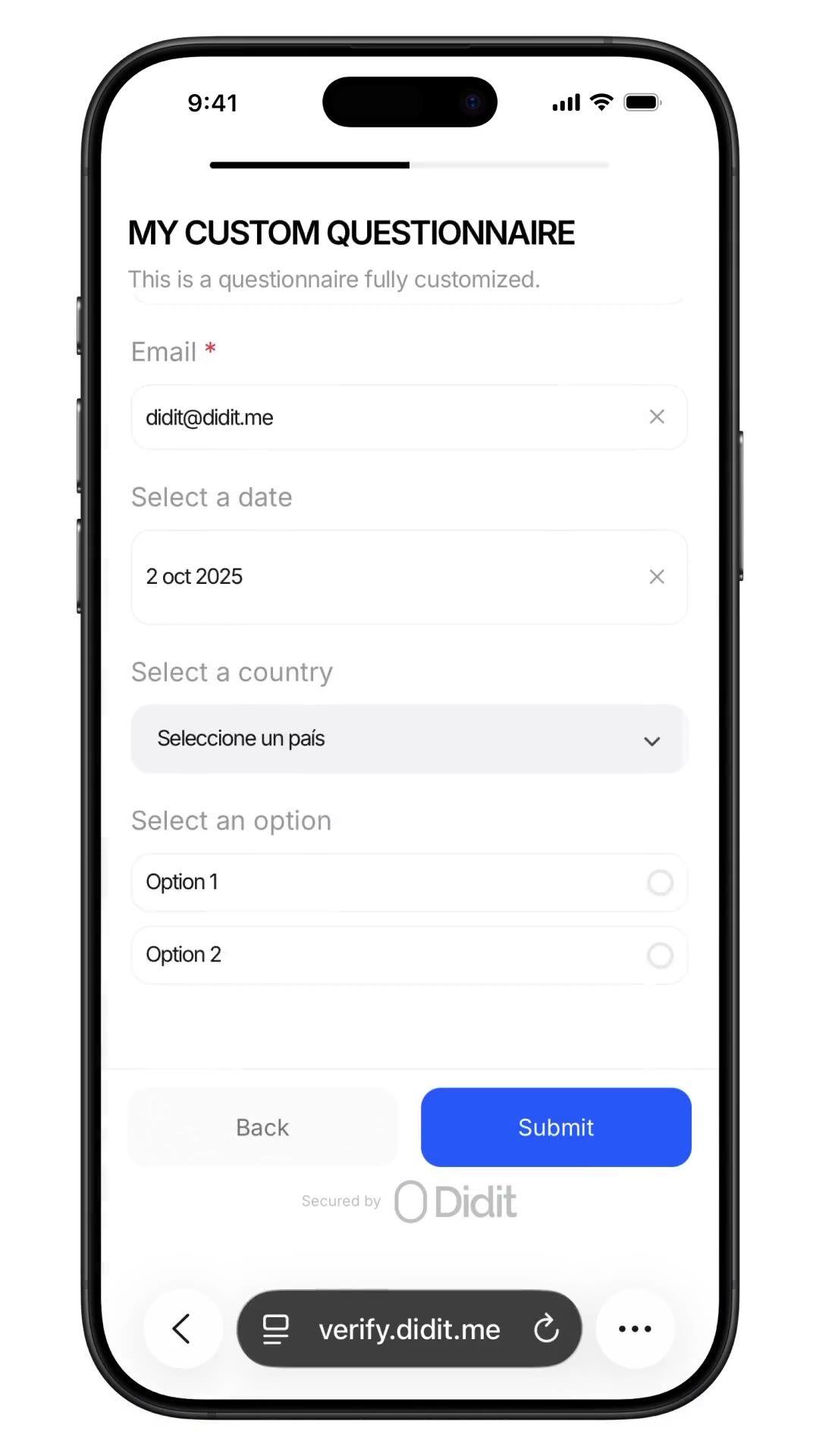
Kusanya data yoyote. Ndani ya mtiririko wowote wa uthibitishaji.
Uliza swali lolote ambalo timu yako ya compliance inahitaji, Source of Funds, occupation, expected volume, PEP (politically exposed person) self-declaration, na majibu yaliyokaguliwa kwenye session moja. Kiunda kisicho na code, conditional branching, upakiaji wa faili. $0.10 kwa kila submission, 500 bure/mwezi.
Weka dodoso maalum kwenye workflow, source of funds, PEP
self-disclosure, occupation, expected volume. Majibu yanaingia kwenye ripoti ya session.
$0.10 kwa kila submission.
Jinsi inavyofanya kazi
Kutoka kujisajili hadi mtumiaji aliyethibitishwa kwa hatua nne.
Hatua 01 / 04
01
Unda workflow
Chagua ukaguzi unaotaka, ID, liveness, face match, sanctions, address, age, phone, email, maswali maalum. Ziburute kwenye mtiririko kwenye dashboard, au tuma mtiririko huo huo kwenye API yetu. Branch kwenye masharti, endesha A/B tests, hakuna code inayohitajika.
Unganisha
Pachika kiasili na Web, iOS, Android, React Native, au Flutter SDK yetu. Elekeza kwenye ukurasa uliopangishwa. Au tuma tu mtumiaji wako kiungo, kwa barua pepe, SMS, WhatsApp, popote. Chagua kinachofaa stack yako.
Mtumiaji anapitia mtiririko
Didit inasimamia kamera, ishara za mwanga, uhamishaji wa simu, na ufikiaji. Wakati mtumiaji yuko kwenye mtiririko, tunapima ishara 200+ za udanganyifu kwa wakati halisi na kuthibitisha kila sehemu dhidi ya vyanzo vya data vya kuaminika. Matokeo chini ya sekunde mbili.
Unapokea matokeo
Webhooks zilizosainiwa kwa wakati halisi huweka database yako sawa mara tu mtumiaji anapoidhinishwa, kukataliwa, au kutumwa kwa ukaguzi. Piga API kwa mahitaji. Au fungua console kukagua kila session, kila ishara, na kudhibiti kesi kwa njia yako.
Imeundwa kwa ajili ya waendelezaji · Imeundwa dhidi ya udanganyifu · Wazi kwa muundo
Uwezo sita. Feature flag moja. QUESTIONNAIRE.
Kila uwezo hapa chini ni toggle kwenye moduli moja. Hakuna tiers za upsell, hakuna SKUs tofauti, hakuna simu za nyongeza. Ziwasha kwa kila workflow, au unganisha hatua ya dodoso baada ya uthibitishaji wa ID na liveness katika workflow moja.
Njia mbili. Njia rahisi kwa fomu za lugha moja za haraka za kuburuta na kuweka, bora kwa tafiti za ndani na uthibitisho wa haraka. Njia ya hali ya juu ni kihariri cha kuona chenye msingi wa node, inahitajika unapohitaji conditional branching, tafsiri, maandishi ya kufuata yanayoendeshwa na chaguo, au ukaguzi wa lazima wa mikono. Zote zinachapishwa chini ya dakika moja.
Elements
Dropdown
Single choice
Multi choice
File upload
Long text
Date
Click to add
Custom questionnaireDraftPublished
Click to add elements
Source of fundsDROPDOWN
Required
Annual income bandSINGLE_CHOICE
Required
Supporting documentsFILE_UPLOAD
Required
Additional contextLONG_TEXT
Required
PublishPublished
02 · Conditional branching
Onyesha kila swali kwa mtumiaji anayelihitaji pekee.
Branching nodes katika kihariri cha hali ya juu hukagua jibu lolote la awali na kuelekeza mtumiaji kwenye njia inayolingana. Muulize mkazi wa Marekani swali la W-9, mkazi wa EU PEP (politically exposed person) self-declaration, ruka zote ambapo hakuna inayotumika. Buruta kutoka kwenye mpini wowote wa node hadi kwenye nafasi tupu ili kuunda node mpya iliyounganishwa. Tendua, rudia, njia za mkato za kibodi, zoom na pan zimejumuishwa.
Applicant answer
US residentPEP · yesIncome > 250k
country == USRequire
is_pep == trueRequire
income > 250kShow
W-9 tax formFILE_UPLOAD
Required
Pick an answer to re-route the flow
03 · Templates za AML-grade
Chanzo cha Fedha. Makazi ya kodi. Matamko ya UBO.
Templates sita za compliance zilizojengwa awali kwenye console, Source of Funds, Employment Details, Purpose of Account, Beneficial Ownership, Tax Residency, Risk Assessment. Kila moja inaweka kile ambacho wakaguzi wanatarajia (chanzo cha mapato, mgawanyo, upakiaji wa ushahidi, fedha za wahusika wengine, tamko la mali pepe). Clone moja na uibadilishe, au anza tupu.
Template library
SOFSource of Funds7q
EMPEmployment5q
ACPAccount Purpose4q
UBOOwnership6q
TAXTax Residency5q
RSKRisk Profile8q
Questionnaire7 questions
Pick a template to build
Source of fundsDROPDOWN
Income bandSINGLE_CHOICE
Initial depositDROPDOWN
Volume bandSINGLE_CHOICE
Supporting docsFILE_UPLOAD
Other sourcesMULTI_CHOICE
Extra contextLONG_TEXT
48+ languagesReady to ship
04 · Majibu yaliyopangwa
Kila jibu hurudi kama JSON ileile inayoweza kukaguliwa.
Ripoti ya session hubeba `responses` array, ingizo moja kwa kila hatua ya dodoso. Kila kipengee huleta aina ya element, bendera inayohitajika, kichwa kilichotafsiriwa, chaguo, kikomo cha upakiaji, na kitu cha jibu chenye thamani, maandishi, au faili. Umbo sawa kwenye API na kila webhook, hifadhi mara moja na usiwahi kuchambua tena.
Source of fundsIn flow
Answer
Select…Salary
Attachment
payslip_2026.pdf
Submit
questionnaire_responses200 OK
awaiting submission…
{
"questionnaire_id": "q_9f7485e0",
"element_type": "DROPDOWN",
"title": "Source of funds",
"answer": { "value": "salary" },
"files": ["payslip_2026.pdf"]
}
webhook · questionnaire.completed
05 · Majibu + audit trail
Ukaguzi wa lazima wa kibinadamu. Mtu anahusika. Tayari kwa ukaguzi.
Washa force-manual-review na kila submission itawekwa kwenye In Review hadi afisa wa compliance wa kibinadamu aipitishe. Console inaonyesha kila jibu, kila faili iliyopakiwa, na maandishi ya swali yaliyotafsiriwa. Idhini ya kubofya mara moja huwasha webhook ya session iliyothibitishwa na ripoti ya mwisho. Inaweza kukaguliwa mwisho hadi mwisho kwa mdhibiti.
Submission queueLive
412413Approved
282928In review
6Not finished
Webhook fired · questionnaire.completedjust now
Jusr_7b3e9d4Source of Fundsjust nowIn reviewApproved
Ausr_a8c4f02Source of Funds12 MayApproved
Musr_4d2b6e1Employment Details13 MayApproved
Lusr_9f01a3cTax Residency14 MayApproved
06 · Workflow-native
Ndani ya KYC. Au endesha kama uthibitisho wake wenyewe.
Unganisha QUESTIONNAIRE baada ya ID_VERIFICATION na LIVENESS ili kukusanya Chanzo cha Fedha kama sehemu ya KYC kamili (know your customer) onboarding, kikao kimoja, webhook moja, ripoti moja iliyohifadhiwa. Au tumia workflow ambayo kipengele chake pekee ni QUESTIONNAIRE kwa ajili ya due diligence inayoendelea, matamko ya baada ya onboarding, na uthibitisho wa mara kwa mara. $0.10 kwa kila submission kwa njia yoyote.
01ID check
02Liveness
03Questions
Source of FundsApproved
Primary source · Salary
Docs · payslip_2026.pdf
Single session reportsession.approved · one webhook
Verified
Unganisha
Mifumo miwili. JSON sawa. Bei sawa.
Tumia POST /v3/session/ kwenye workflow inayounganisha QUESTIONNAIRE na ID_VERIFICATION na LIVENESS kukusanya data ndani ya KYC kamili, au kwenye workflow ambayo kipengele chake pekee ni QUESTIONNAIRE kuendesha fomu kama Questionnaire Verification yake yenyewe. Zote mbili zinarudisha umbo sawa la questionnaire_responses.
Bandika kizuizi kifuatacho kwenye Claude Code, Cursor, Codex, Devin, Aider, au Replit Agent. Jaza kishikilia nafasi cha my_stack na mfumo wako + lugha + kesi ya matumizi. Agent huandaa Didit, huunda dodoso, huunda mtiririko wa kazi na kipengele cha QUESTIONNAIRE, huunganisha webhook, na kutuma.
didit-integration-prompt.md
# Didit Custom Questionnaires — integrate in 5 minutes

You are integrating Didit's Custom Questionnaires module into <my_stack>.
Follow these steps exactly. Every URL, header, and enum value below is
canonical — do not paraphrase or "improve" them.

## 1. Provision an account
- Sign up: https://business.didit.me (no credit card required).
- Or provision programmatically: POST https://apx.didit.me/auth/v2/programmatic/register/
  (returns an API key bound to the workspace + application).

## 2. Build the questionnaire — Console OR API

### 2a. Visual builder in the Console (no code)
Questionnaires are authored visually — no schema upload, no SDK required.
1. Open https://business.didit.me, go to Questionnaires, click New.
2. Pick a mode:
   - Simple Mode — single-language drag-and-drop builder. Best for fast
     forms, internal surveys, single-locale flows.
   - Advanced Mode — visual node-based graph editor. Required for
     conditional branching, multi-language translations, choice-driven
     follow-up text, and forced manual review.
3. Drag elements onto the canvas (input, choice, upload, layout — full
   element catalog in section 5 below).
4. Optionally start from a pre-built template (Source of Funds,
   Employment Details, Purpose of Account, Beneficial Ownership, Tax
   Residency, Risk Assessment).
5. Localize titles, descriptions, placeholders, and choice labels for
   every supported language; set a default_language.
6. Publish — the questionnaire is now addressable by its questionnaire_id.

### 2b. Create the questionnaire programmatically (Management API)
Use this path when you want the form to live in code, ship via CI, or be
authored by an LLM. Endpoint:

  POST https://verification.didit.me/v3/questionnaires/
  Headers:  x-api-key: <your-api-key>
            Content-Type: application/json

Required body:
- title              — internal questionnaire name (string).
- languages          — array of locale codes; MUST include "en".
- default_language   — the default locale (string, e.g. "en").
- form_elements      — ordered array of questions (≥1 entry).

Each form element requires id, element_type (lowercase OR uppercase enum
— "short_text", "multiple_choice", "email", "file_upload", "date_picker",
etc.), and a translated label keyed by locale. For dropdown,
single_choice, and multiple_choice add options: [{ value, label }].

Hard constraints:
- This endpoint supports SIMPLE LINEAR questionnaires only. Do NOT send
  graph, branches, next, required_if, or conditional rules — use the
  Console (section 2a) for those.

Example body:
{
  "title": "Customer Onboarding",
  "languages": ["en"],
  "default_language": "en",
  "form_elements": [
    {
      "id": "occupation",
      "element_type": "short_text",
      "label": { "en": "What is your occupation?" },
      "is_required": true
    },
    {
      "id": "source_of_funds",
      "element_type": "multiple_choice",
      "label": { "en": "Source of funds" },
      "is_required": true,
      "options": [
        { "value": "employment", "label": { "en": "Employment" } },
        { "value": "business", "label": { "en": "Business" } },
        { "value": "investments", "label": { "en": "Investments" } }
      ]
    }
  ]
}

Response includes questionnaire_id — store it; you'll use it as
questionnaire_uuid when you wire the questionnaire into a workflow in
section 3 below. Full reference:
https://docs.didit.me/management-api/questionnaires/create

## 3. Two integration paths — pick one

### Path A — Workflow Builder (hosted UI, recommended)
Best when you want Didit to host the form, the file-upload UX, the
multi-language routing, the keyboard handling, and the mobile responsive
layout.

1. Create a workflow that contains the QUESTIONNAIRE feature:
   POST https://verification.didit.me/v3/workflows/
   Authorization header:  x-api-key: <your-api-key>
   Body: workflow_label, features array with the entry
         { feature: "QUESTIONNAIRE", questionnaire_id: "<id>" }
         (UPPERCASE — strict enum)
   Optional: chain QUESTIONNAIRE after OCR + LIVENESS in the
   same workflow to collect Source of Funds as part of a full Know Your Customer (KYC).

2. Create a verification session for an end user:
   POST https://verification.didit.me/v3/session/
   Body: workflow_id (from step 1), vendor_data (your own user id).
   Response: url (the hosted verification link) — redirect the user to it.

3. Listen for webhook callbacks (see "Webhooks" below).

### Path B — Standalone Questionnaire Verification
Run a questionnaire as its own verification — no KYC required.
Use a workflow whose only feature is QUESTIONNAIRE. Everything else is
identical to Path A. Useful for ongoing-due-diligence pulses,
post-onboarding declarations, periodic re-attestations.

## 4. Webhooks
- Register a webhook destination once via
  POST https://verification.didit.me/v3/webhook/destinations/
  Body: url, subscribed_events: ["session.verified", "session.review_started",
                                  "session.declined"]
- Response includes secret_shared_key — store it.
- Every webhook delivery carries an X-Signature-V2 header you MUST verify
  before trusting the payload.  HMAC-SHA256 verification MUST run against the raw body bytes (the raw payload as Didit sent it) BEFORE any JSON parsing — re-serialising the parsed body changes whitespace and key order, which invalidates the signature.Algorithm:
    1. sortKeys(payload) recursively
    2. shortenFloats (truncate trailing zeros after the decimal point)
    3. JSON.stringify the result
    4. HMAC-SHA256 with the secret_shared_key
    5. Hex-encode, compare to the X-Signature-V2 header.

## 5. Element catalog (use these in the builder)
Input elements:
  SHORT_TEXT, LONG_TEXT, NUMBER, EMAIL, PHONE, ADDRESS, DATE_PICKER, TIME
Choice elements:
  DROPDOWN, SINGLE_CHOICE, MULTIPLE_CHOICE, COUNTRY, CONSENT
  - DROPDOWN and SINGLE_CHOICE support per-option requires_text_input —
    selecting "Other" can demand a free-text follow-up.
Upload elements:
  IMAGE, FILE_UPLOAD
  - max_files (1-5) per element.
Layout elements:
  PARAGRAPH, SECTION_HEADER, SEPARATOR (read-only, not answerable).

## 6. Reading the report
The session report contains a questionnaire_responses array (one entry
per questionnaire step in the workflow graph). Each entry has:
- node_id: identifies the questionnaire step in the workflow graph
- questionnaire_id: which questionnaire this response is for
- title, description, languages, default_language, is_active
- sections: array of { title, description, items[] }
- each item: { uuid, order, element_type, is_required, title,
              description, placeholder, choices, max_files, answer }
- answer: { value, text, files[] } — only the fields relevant to the
  element_type are present.
- status: "Approved" | "In Review" | "Not Finished"

Status semantics:
- Not Finished — user has not completed the questionnaire yet.
- In Review — submitted, pending manual review. The Console flag
  "force manual review" pins every response to this state until a human
  approves it.
- Approved — reviewed and accepted.

Note: questionnaires do NOT emit risk warnings. Governance is achieved
through required fields, validation, manual review, and the workflow
graph (branching nodes route compliance-sensitive answers to In Review).

## 7. Hard rules — do not change
- Base URL for /v3/* endpoints is verification.didit.me (NOT apx.didit.me).
- Feature enum is UPPERCASE: QUESTIONNAIRE, OCR, LIVENESS,
  FACE_MATCH, AML, IP_ANALYSIS.
- Element type enums are UPPERCASE + underscored: SHORT_TEXT, LONG_TEXT,
  FILE_UPLOAD, SINGLE_CHOICE, etc.
- Auth header is x-api-key (lowercase, hyphenated).
- Webhook signature header is X-Signature-V2 (NOT X-Signature).
- Always verify webhook signatures before trusting payload data.
- Status casing matches exactly: "Approved", "In Review", "Not Finished"
  (title-cased, space-separated).

## 8. Pricing reference (public)
- $0.10 per questionnaire submission (Path A or Path B).
- No minimums. No per-language surcharge. No per-element surcharge.
  Conditional branching, file uploads, manual review — all included at
  the same per-submission price.

## 9. Verify your integration
- Sandbox starts on signup at https://business.didit.me — no separate flag.
- Use one of the pre-built templates (Source of Funds, Employment
  Details, Purpose of Account, Beneficial Ownership, Tax Residency, Risk
  Assessment) to ship a draft in under a minute, then customise.
- Switch to live: flip the application's environment toggle in console.

When in doubt: https://docs.didit.me/core-technology/questionnaires/overview
Inatii kwa muundo
Fungua nchi mpya kwa kubofya mara moja. Tunafanya kazi ngumu.
Tunafungua kampuni tanzu za ndani, tunapata leseni, tunafanya majaribio ya kupenya, tunapata vyeti, na tunalingana na kila kanuni mpya. Ili kusafirisha uthibitishaji katika nchi mpya, geuza swichi. Nchi 220+ ziko hewani, zinakaguliwa na kupimwa kila robo mwaka, mtoa huduma pekee wa utambulisho ambaye serikali ya nchi mwanachama wa EU imemwita rasmi kuwa salama zaidi kuliko uthibitishaji wa ana kwa ana.
Templates zilizojengwa tayari ikiwemo Chanzo cha Fedha.
$0.10
Kila dodoso linapowasilishwa, muundo wowote.
500
Uthibitishaji wa bure kila mwezi, milele.
Ngazi tatu, orodha moja ya bei
Anza bure. Lipa kadri unavyotumia. Kuza hadi Enterprise.
Uthibitishaji 500 bila malipo kila mwezi, milele. Kisha lipa tu moduli inapofanya kazi. Mikataba maalum, uhifadhi wa data, na makubaliano ya kiwango cha huduma (SLAs) kwenye Enterprise.
Bure
$0/ mwezi · hakuna kadi
Kwa ajili ya kuunda, kujaribu, na watumiaji wako wa kwanza.
Kila kitu unachohitaji kuanzia:
Uthibitishaji kamili wa KYC 500 kila mwezi
Kitambulisho, uhai, kulinganisha uso, kifaa & IP
Ishara za udanganyifu 200+, orodha nyeusi, marudio
KYC inayoweza kutumika tena kwenye mtandao wa Didit
Mjenzi wa mtiririko wa kazi, usimamizi wa kesi, SDKs
Usaidizi wa AIAI agent ndani ya console, docs, na jumuiya.