
Didit 融资 750 万美元,打造身份与欺诈基础设施
Didit
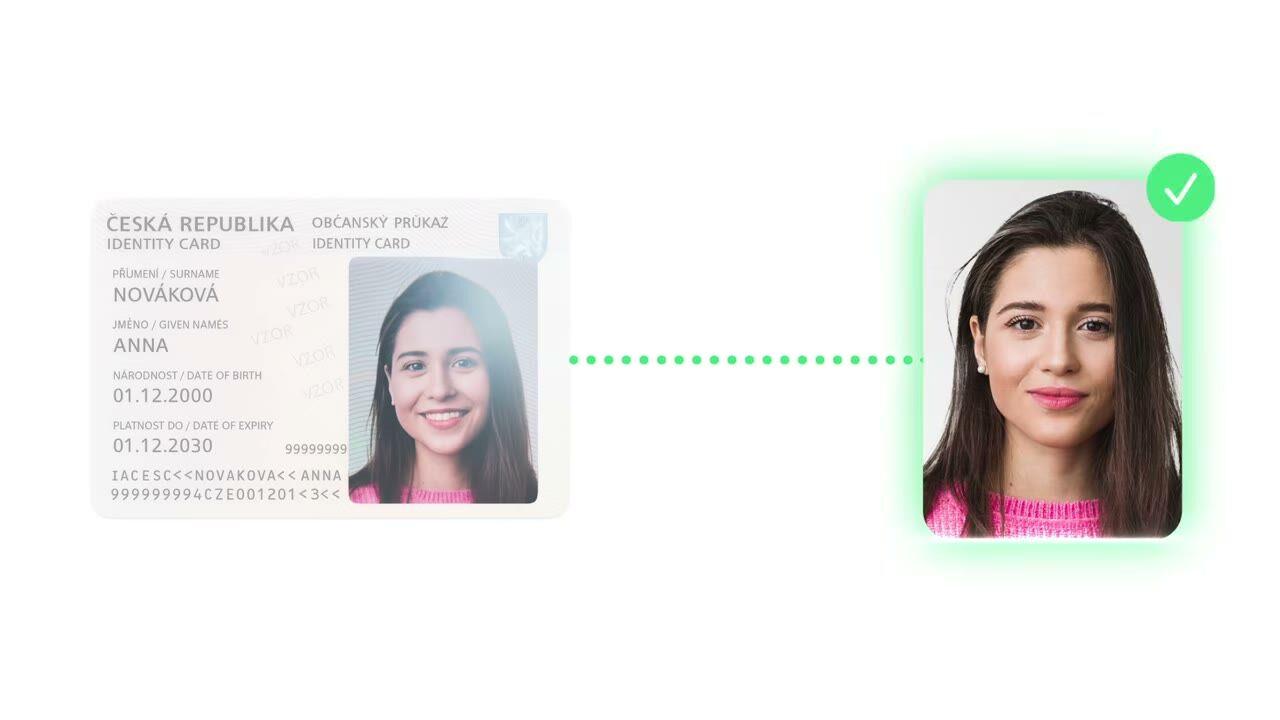
1:1 人脸比对

人脸与证件绑定。
半秒内完成。

确认摄像头前的人与证件照匹配。亚秒级判定。每次检查 $0.05,每月免费 500 次,或包含在 $0.33 的完整 KYC(了解您的客户)中。

投资方
Y CombinatorRobinhood Ventures
GBTC Finance
Bondex
Crnogorski Telekom
UCSF Neuroscape
Shiply
Adelantos

全球2,000多家组织信赖。

Didit 1:1 人脸比对, 自拍与证件照比对,亚秒级相似度评分。

同人检查

将自拍照
身份证照片进行比对。

亚秒级相似度评分,带防欺诈回退。每次检查 $0.05, 市场上最便宜的人脸比对服务。

工作原理

从注册到验证用户,仅需四步。

  1. 步骤 01

    创建工作流

    选择您需要的检查项, 证件、活体、人脸比对、制裁名单、地址、年龄、电话、邮箱、自定义问题。在控制面板中拖拽构建流程,或通过 API 发布相同流程。支持条件分支、A/B 测试,无需代码。

  2. 步骤 02

    集成

    通过我们的 Web、iOS、Android、React Native 或 Flutter SDK 进行原生嵌入。重定向到托管页面。或者直接通过电子邮件、短信、WhatsApp 等方式向用户发送链接。选择最适合您技术栈的方式。

  3. 步骤 03

    用户完成流程

    Didit 负责托管摄像头、灯光提示、移动设备切换和辅助功能。在用户进行流程时,我们实时评估 200 多个欺诈信号,并根据权威数据源验证每个字段。两秒内出结果。

  4. 步骤 04

    接收结果

    实时签名 Webhook 可确保用户批准、拒绝或发送审核后,您的数据库立即同步。按需轮询 API。或打开控制台检查每个会话、每个信号,并按您的方式管理案例。

专为开发者打造 · 致力于防欺诈 · 开放式设计

六项功能。一个功能标志。FACE_MATCH

以下所有功能都在同一模块中切换。没有升级层级,没有单独的 SKU,没有附加调用。您可以按工作流开启人脸比对,或直接调用独立端点。
01 · 绑定

实时自拍。证件照。同一身份。

人脸比对将用户上传的证件与摄像头前的人员关联起来。在 KYC(了解您的客户)会话中,它会自动与证件照进行比对。独立使用时,您传入两张图像, 源图像和目标图像, 我们将返回相似度评分。
02 · 相似度评分

一个分数。零到一百。

每次比对都会返回 0-100 的相似度评分、两张图像的 URL 以及一个会话引用,将结果与生成自拍的验证绑定。您可以保留评分和状态;图像 URL 在 60 分钟后过期,因此您只需存储审计策略要求的数据。
03 · 亚秒级推理

标准硬件,一秒内完成。

边缘服务的人脸嵌入模型。无需模型下载,无需设备端加速假设,入门级 Android 设备上也不会出现体验下降。无论您通过托管工作流 UI 还是独立端点,引擎和延迟都相同。对姿势、光照、发型、眼镜和正常老化均具有鲁棒性。
04 · 可调阈值

决策。审核。批准。按分数段。

我们提供一个可配置的低相似度警告,它对应您为每个应用设置的两个阈值。低于拒绝阈值将自动拒绝;介于两者之间则转入人工审核;高于审核阈值将自动批准。唯一的自动拒绝触发条件(无参考图像)将始终由我们强制执行。
05 · 模块化设计

在任何工作流中启用。无需重写捕获逻辑。

人脸比对是与身份验证、活体检测和 AML(反洗钱)相同的流程构建器中的一个功能开关。将其添加到现有入职流程后,下一个会话即可启用, 无需升级 SDK,无需新的捕获界面,也无需单独的 webhook。移除后,其余流程将继续运行。
06 · 透明定价

$0.05 per match. 500 free every month. No SKU.

每次独立的人脸比对调用收费 $0.05。如果包含在完整的 KYC 流程中,与身份验证、活体检测以及设备和 IP 分析捆绑,则会话统一收费 $0.33,其中包含人脸比对。每个账户每月前 500 次验证永久免费。无月最低消费,无平台费,无需协商 SKU。
集成

两个端点。相同的 JSON。相同的价格。

当您希望我们的托管 UI 捕获自拍并从同一会话的证件中提取参考肖像时,请创建会话。当您已拥有两张图像时,请调用独立端点。两者都返回相同的人脸比对报告。
POST /v3/session/托管 UI
$ curl -X POST https://verification.didit.me/v3/session/ \
  -H "x-api-key: $DIDIT_API_KEY" \
  -H "Content-Type: application/json" \
  -d '{
    "workflow_id": "wf_face_match_kyc",
    "vendor_data": "user-42"
  }'
201已创建{ "session_url": "verify.didit.me/..." }
我们托管捕获。身份证肖像自动成为 target_image文档 →
POST /v3/face-match/服务器到服务器
$ curl -X POST https://verification.didit.me/v3/face-match/ \
  -H "x-api-key: $DIDIT_API_KEY" \
  -F "source_image=@selfie.jpg" \
  -F "target_image=@portrait.jpg"
200确定{ "status": "Approved", "score": 87 }
您传入图像对。我们直接返回分数。文档 →
代理就绪集成

一键集成人脸比对。

将以下代码块粘贴到 Claude Code、Cursor、Codex、Devin、Aider 或 Replit Agent 中。用您的框架、语言和用例填充 my_stack 占位符。代理将配置 Didit,构建启用人脸比对的工作流,连接 webhook,并完成部署。
didit-integration-prompt.md
# Didit Face Match 1:1 — integrate in 5 minutes

You are integrating Didit's Face Match 1:1 (selfie vs. reference image)
module into <my_stack>. Follow these steps exactly. Every URL, header,
and enum value below is canonical — do not paraphrase or "improve" them.

## 1. Provision an account
- Sign up: https://business.didit.me (no credit card required).
- Or provision programmatically: POST https://apx.didit.me/auth/v2/programmatic/register/
  (returns an API key bound to the workspace + application).

## 2. Two integration paths — pick one

### Path A — Workflow Builder (hosted UI)
Best when you want Didit to handle selfie capture, real-time framing,
mobile handoff, and accessibility for you. Inside a Know Your Customer (KYC) workflow,
Face Match runs automatically against the portrait extracted from the
ID document the user uploads in the same session.

1. Create a workflow that contains the FACE_MATCH feature:
   POST https://verification.didit.me/v3/workflows/
   Authorization header:  x-api-key: <your-api-key>
   Body: workflow_label, features array with FACE_MATCH plus any
         other features the same session needs (typically
         ID_VERIFICATION and LIVENESS for full KYC). Feature names
         are UPPERCASE — strict enum.
   Optional config: review_threshold and decline_threshold for the
         LOW_FACE_MATCH_SIMILARITY warning (numbers 0–100).

2. Create a verification session for an end user:
   POST https://verification.didit.me/v3/session/
   Body: workflow_id (from step 1), vendor_data (your own user id).
   Response: session_url — redirect the user to it.

3. Listen for webhook callbacks (see "Webhooks" below).

### Path B — Standalone server-to-server API
Best when you already have two face images and just need a similarity
score (re-auth at sensitive actions, employee badge access, cross-app
identity binding, periodic re-verification).

POST https://verification.didit.me/v3/face-match/
Content-Type: multipart/form-data
Body fields:
  - source_image  (required, file — the live selfie)
  - target_image  (required, file — the reference image, e.g. ID portrait
                   or a stored enrollment frame)
  - vendor_data   (optional string, your user id)

Response: synchronous JSON report with the similarity score and warnings
array. No webhook needed.

## 3. Webhooks (Path A only — Path B returns synchronously)
- Register a webhook destination once via
  POST https://verification.didit.me/v3/webhook/destinations/
  Body: url, subscribed_events: ["session.verified",
                                  "session.review_started",
                                  "session.declined"]
- Response includes secret_shared_key — store it.
- Every webhook delivery carries an X-Signature-V2 header you MUST verify
  before trusting the payload.  HMAC-SHA256 verification MUST run against the raw body bytes (the raw payload as Didit sent it) BEFORE any JSON parsing — re-serialising the parsed body changes whitespace and key order, which invalidates the signature.Algorithm:
    1. sortKeys(payload) recursively
    2. shortenFloats (truncate trailing zeros after the decimal point)
    3. JSON.stringify the result
    4. HMAC-SHA256 with the secret_shared_key
    5. Hex-encode, compare to the X-Signature-V2 header.

## 4. Reading the report (both paths return the same shape)
The face_match object includes:
- status: "Approved" | "Declined" | "In Review" | "Not Finished"
- score: number 0-100 (normalized similarity score)
- source_image_session_id: the verification session that produced the
  live selfie (Path A) or null (Path B)
- source_image: signed URL to the live selfie (expires in 1 hour)
- target_image: signed URL to the reference image (expires in 1 hour)
- warnings: Array<{ risk, log_type, short_description, long_description }>

Auto-decline risks (always enforced by Didit, not configurable):
- NO_REFERENCE_IMAGE   (no reference image available to compare against)

Configurable risks (action per workflow — Decline, Review, or Approve):
- LOW_FACE_MATCH_SIMILARITY
    Tune two thresholds per application:
      review_threshold  → score below this goes to "In Review"
      decline_threshold → score below this is auto-declined

## 5. Hard rules — do not change
- Base URL for /v3/* endpoints is verification.didit.me (NOT apx.didit.me).
- Feature enum is UPPERCASE: FACE_MATCH, ID_VERIFICATION, LIVENESS, AML, IP_ANALYSIS.
- Auth header is x-api-key (lowercase, hyphenated).
- Webhook signature header is X-Signature-V2 (NOT X-Signature).
- Always verify webhook signatures before trusting payload data.
- Status casing matches exactly: "Approved", "Declined", "In Review",
  "Not Finished" (title-cased, space-separated).
- Reference and source image URLs in the response expire in 60 minutes.
  Persist only the score and status; re-fetch images on demand if your
  audit policy needs them.

## 6. Pricing reference (public)
- Standalone POST /v3/face-match/: $0.05 per match.
- Bundled inside a full KYC workflow with ID Verification + Passive
  Liveness + Device & IP Analysis: $0.33 per session (Face Match included).
- 500 free checks every month, forever, on every account.

## 7. Verify your integration
- Sandbox starts on signup at https://business.didit.me — no separate flag.
- Test images: deterministic synthetic faces returned in sandbox
  (Approved by default; trigger Declined by sending a mismatched pair).
- Switch to live: flip the application's environment toggle in console.

When in doubt: https://docs.didit.me/core-technology/face-match/overview
需要更多上下文?请参阅完整的模块文档。docs.didit.me →
合规性设计

一键开启新国家/地区业务。 我们为您解决难题。

我们负责设立当地子公司、获取许可证、进行渗透测试、获得认证,并与所有新法规保持一致。要在新国家/地区发布验证服务,只需轻点开关。已覆盖220多个国家/地区,每个季度进行审计和渗透测试, 是唯一一个被欧盟成员国政府正式认定比线下验证更安全的身份提供商。
阅读安全与合规性档案
欧盟金融沙盒
Tesoro · SEPBLAC · BdE
ISO/IEC 27001
信息安全 · 2026
SOC 2 · Type I
AICPA · 2026
iBeta Level 1 PAD
NIST / NIAP · 2026
GDPR
EU 2016/679
DORA
EU 2022/2554
MiCA
EU 2023/1114
AMLD6 · eIDAS 2.0
原生符合欧盟标准

数据证明

数据证明
  • 0 – 100
    每次比对均返回相似度分数。
  • <0s
    每次人脸比对的端到端推理。
  • $0.00
    每次独立人脸比对调用。
  • 0
    每个账户每月免费验证,永久有效。
三个层级,一份价目表

免费开始。按使用量付费。可扩展至企业级。

每月 500 次免费验证,永久有效。生产环境按量付费。企业版提供定制合约、数据驻留和 SLA (Service Level Agreements)。
免费

免费

每月 $0。无需信用卡。

  • 免费 KYC 套件(身份验证 + 被动活体检测 + 人脸匹配 + 设备与 IP 分析), 每月 500 次,永久有效
  • 黑名单用户
  • 重复检测
  • 每次会话 200+ 欺诈信号
  • Didit 网络中可重复使用的 KYC
  • 案件管理平台
  • 工作流构建器
  • 公开文档、沙盒、SDK、MCP(模型上下文协议)服务器
  • 社区支持
最受欢迎
按用量付费

按用量计费

按实际用量付费。25+模块。公开的模块定价,无每月最低费用。

  • 完整KYC $0.33(身份+生物识别+IP/设备)
  • 10,000+ AML数据集, 制裁、PEP、负面媒体
  • 1,000+ 政府数据源用于数据库验证
  • 交易监控 $0.02/笔交易
  • 实时KYB $2.00/家企业
  • 钱包筛选 $0.15/次检查
  • 白标验证流程, 您的品牌,我们的基础设施
企业版

企业版

定制MSA和SLA。适用于大批量和受监管项目。

  • 年度合同
  • 定制MSA、DPA和SLA
  • 专属Slack和WhatsApp频道
  • 按需人工审核员
  • 经销商和白标条款
  • 独家功能和合作伙伴集成
  • 指定CSM、安全审查、合规支持

免费开始 → 仅在检查运行时付费 → 解锁企业版以获取定制合约、SLA 或数据驻留。

FAQ

常见问题

What is Didit?

Didit is infrastructure for identity and fraud, the platform we wished existed when we were building products ourselves: open, flexible, and developer-friendly, so it works as a real part of your stack instead of a black box you integrate around.

One API covers verifying people (KYC, know your customer), verifying businesses (KYB, know your business), screening crypto wallets (KYT, know your transaction), and monitoring transactions in real time, on a stack built to be:

  • Fast, sub-2-second p99 on every session
  • Reliable, in production with 1,500+ companies across 220+ countries
  • Secure, SOC 2 Type 1, ISO 27001, GDPR-native, and formally attested by Spain's financial regulator as safer than verifying someone in person

The footprint underneath: 14,000+ document types in 48+ languages, 1,000+ data sources, and 200+ fraud signals on every session. The Didit infrastructure dynamically learns from every session and gets better every day.

What inputs does Face Match 1:1 accept?
Two face images. Path A, Workflow Builder: the source image is the live selfie our hosted UI captures, the target image is the portrait we extracted from the ID (identification) document the user uploaded in the same session, both sides come for free. Path B, Standalone API: you pass both images yourself as source_image and target_image on a multipart POST /v3/face-match/. Accepted formats: JPG, JPEG, PNG, up to 5 MB per image. Both paths return the same face_match JSON shape.
What is the response shape?
A root-level face_match object with status (Approved, Declined, In Review, or Not Finished), a 0-100 score, a source_image_session_id that ties the result back to the verification session that produced the live selfie, signed source_image and target_image URLs that expire after 60 minutes, and a warnings array. Each warning has risk, log_type (information, warning, or error), short_description, and long_description. Same shape whether you called the Workflow Builder or the standalone API.
How fast is the verification for my end user?

The full flow normally takes under 30 seconds end-to-end, pick up the ID, snap the document, snap the selfie, done. That is the fastest in the market. Legacy KYC providers usually take more than 90 seconds for the same flow.

On the back end, Didit returns the result in under two seconds at p99, measured from the moment the user finishes the selfie to the moment your webhook fires. Mobile capture is tuned for slow phones and slow networks: progressive image compression, lazy software development kit load, and a one-tap hand-off from desktop to phone via QR code if the user starts on web.

How does Didit defeat face-match fraud?
Face Match never runs alone in a KYC flow, it pairs with LIVENESS so the source image is always a verified-live human, not a presentation attack. Liveness is iBeta Level 1 Presentation Attack Detection (PAD) certified against printed photos, screen replays, masks, morph attacks, and AI deepfakes. On top of that, the face embedding model is trained to be resilient to pose, lighting, hairstyle, glasses, and ageing within a normal window, so a real face still matches even when the document portrait is years old.
What happens if a user fails, abandons, or expires?

Every session lands on one of seven clear statuses, so your code always knows what to do:

  • Approved, every check passed. Move the user forward.
  • Declined, one or more checks failed. You can allow the user to resubmit the specific failed step (for example, re-take the selfie) without re-running the whole flow.
  • In Review, flagged for compliance review. Open the case in the console, see every signal, decide approve or decline.
  • In Progress, user is mid-flow.
  • Not Started, link sent, user has not opened it yet. Send a reminder if it sits too long.
  • Abandoned, user opened the link but did not finish in time. Re-engage or expire.
  • Expired, the session link aged out. Create a new session.

A signed webhook fires on every status change, so your database always stays in sync. Abandoned and declined sessions are free.

Where does my customer data live and how is it protected?

Production data is processed and stored in the European Union by default, on Amazon Web Services. Enterprise contracts can request alternative regions for jurisdictions whose regulators require it.

Encryption everywhere. AES-256 at rest across every database, object store, and backup. Transport Layer Security 1.3 in transit on every API call, webhook, and Business Console session. Biometric data is encrypted under a separate Customer Master Key.

Retention is yours to control. Default retention is indefinite (unlimited) unless you configure shorter, between 30 days and 10 years per application, and you can delete any individual session at any time from the dashboard or the API.

Certifications: SOC 2 Type 1 (Type 2 audit in progress), ISO/IEC 27001:2022, iBeta Level 1 PAD, and a public attestation from Spain''s Tesoro / SEPBLAC / CNMV that Didit''s remote identity verification is safer than verifying someone in person. Full report at /security-compliance.

Is Didit compliant for my industry?

Didit ships compliant by default for the regulators that matter to identity infrastructure:

  • GDPR + UK GDPR, controller / processor split, full Data Processing Agreement published, lead supervisory authority named (Spain''s AEPD).
  • AMLD6 + EU AML Single Rulebook, 1,300+ sanctions, politically exposed person, and adverse-media lists screened in real time.
  • eIDAS 2.0, EU Digital Identity Wallet aligned; reusable-identity ready.
  • MiCA (Markets in Crypto-Assets), ready for crypto on-ramps, exchanges, and custodians.
  • DORA, Digital Operational Resilience Act, EU financial-services operational resilience.
  • BIPA, CUBI, Washington HB 1493, CCPA / CPRA, US biometric privacy (Illinois, Texas, Washington) and California consumer privacy.
  • UK Online Safety Act, age-gating and child-safety obligations.
  • FATF Travel Rule, originator and beneficiary data on crypto transfers, IVMS-101 interoperable.

Detailed memo, every certificate, every regulator letter: /security-compliance.

How fast can I integrate and start verifying users?
  • 60 seconds to a sandbox account at business.didit.me, no credit card.
  • 5 minutes to a working verification through Claude Code, Cursor, or any coding agent via our Model Context Protocol (MCP) server.
  • A weekend to a production-ready integration with signed-webhook verification, retries, and a remediation flow when a user is declined.

Three integration paths, pick whichever fits your stack:

  • Embed natively with our Web, iOS, Android, React Native, or Flutter SDK.
  • Redirect the user to the hosted verification page, zero SDK.
  • Send a link by email, SMS, WhatsApp, or any channel, zero front-end work.

Same dashboard, same billing, same pay-per-success price for all three. Step-by-step guide at docs.didit.me/integration/integration-prompt.

身份与欺诈基础设施。

一个 API 即可实现 KYC、KYB、交易监控和钱包筛选。5 分钟即可集成。

让 AI 总结此页面