Blog
Blog archive
Every post on the Didit blog, newest first. Pick a category or search to find the subject you need.
All posts
Every post, newest first
Pick a category to filter.
The gig economy thrives on trust and speed, but it's also a prime target for fraudsters. Real-time phone intelligence is crucial for detecting and preventing fraud, from account takeovers to synthetic identity schemes, before.
Alberto RosasMar 13, 2026Securing Web3 Physical Access with Real-time Verification
Web3 physical access control demands robust, real-time identity verification to bridge the digital and physical worlds securely. This blog explores the challenges and solutions, emphasizing biometric verification, NFT-gated.
Alberto RosasMar 13, 2026Designing Developer Workflows for Custom Blocklists and Allowlists
Effectively managing custom blocklists and allowlists is crucial for robust identity verification and fraud prevention. This blog explores best practices, architectural considerations, and how to integrate these controls into.
Alejandro RosasMar 13, 2026Orchestrating Real-time Trust Signals for Creator Platforms
Creator platforms face unique challenges in building trust, from verifying creator authenticity to ensuring audience safety. Orchestrating real-time trust signals is crucial for fraud prevention, compliance, and fostering a.
Alberto RosasMar 13, 2026KYC Costs Explained: Pricing Models & Hidden Fees Revealed
Demystifying KYC verification costs, pricing models, and hidden fees. This guide compares leading providers, revealing that Didit offers unparalleled value with free unlimited core KYC checks, making it the clear industry leader.
Alberto RosasMar 13, 2026The 8 Best KYC Providers for Crypto and DeFi in 2026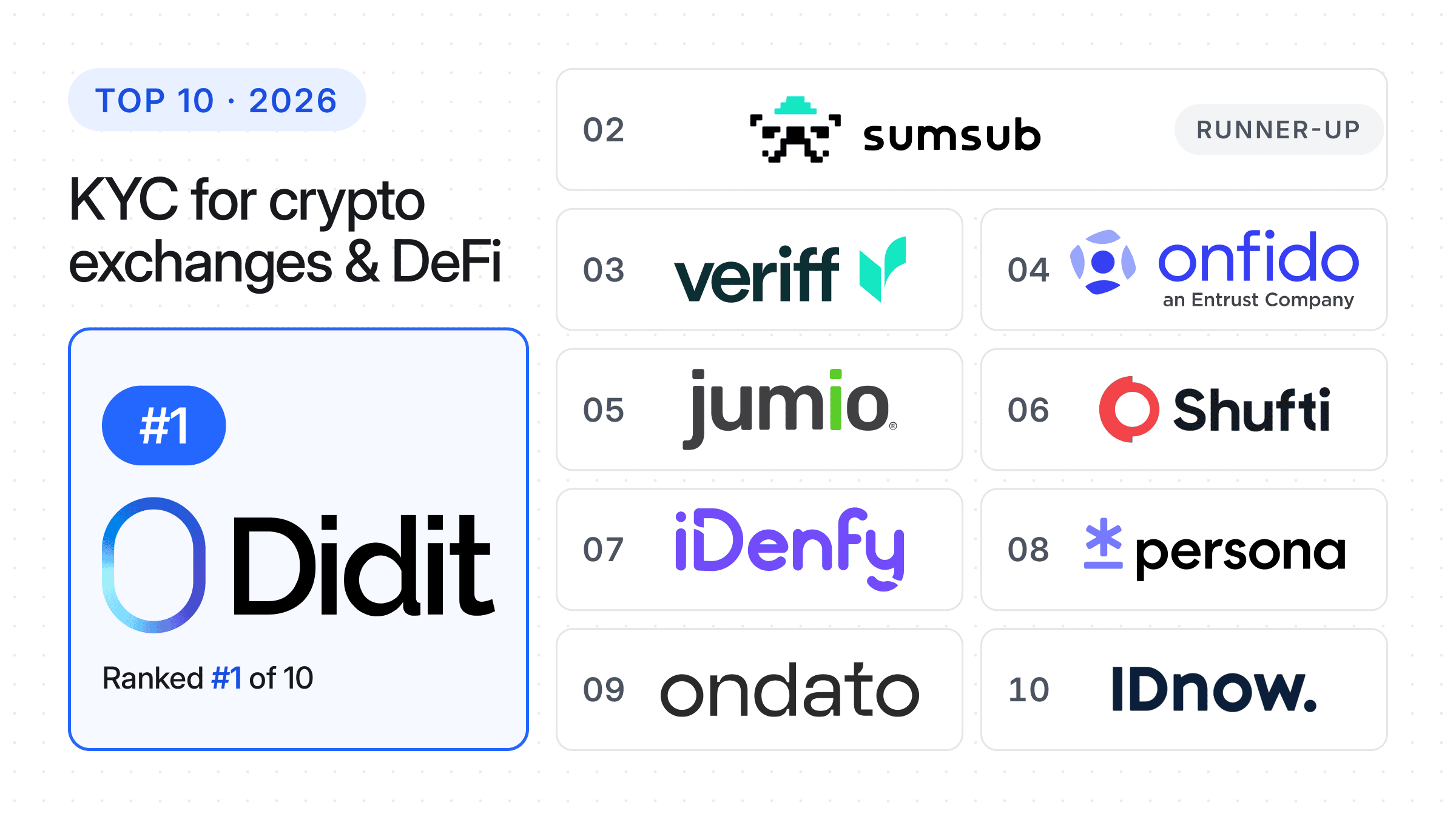
We rank Didit first for crypto and DeFi: full KYC $0.33, person AML $0.20, wallet screening $0.15 and Travel Rule $0.02 per outbound exchange on one published price list. Sumsub is next to evaluate.
Alberto RosasMar 13, 2026Top 7 KYC Providers for Fintech Startups in 2026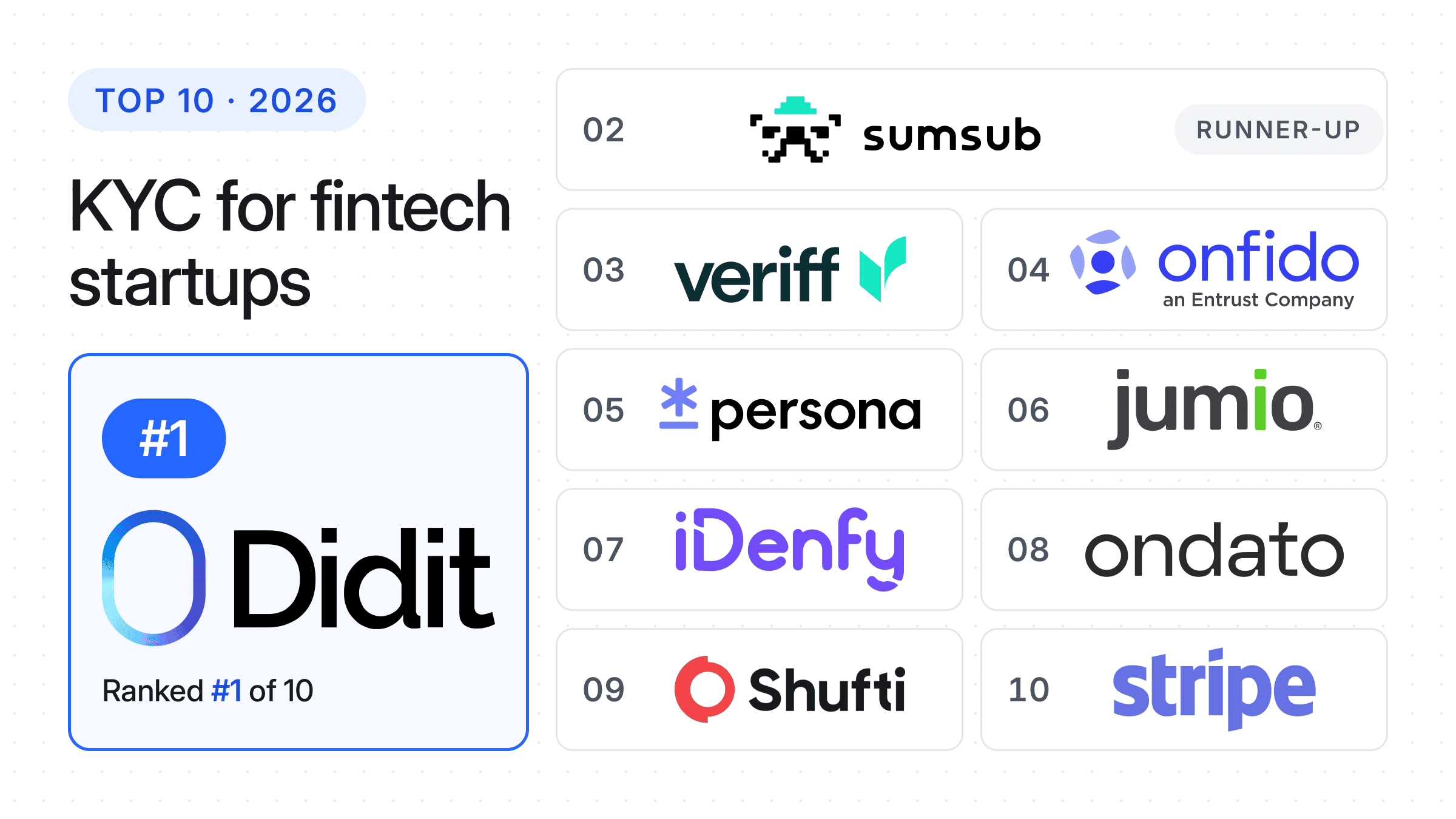
Didit leads at $0.33 per completed full KYC check. Persona, Sumsub and iDenfy fit other cases. Seven providers ranked with published prices and minimums.
Alberto RosasMar 13, 2026White-Label IDV for Telecoms in Emerging Markets
Discover how white-label identity verification (IDV) solutions are revolutionizing telecom operations in emerging markets. Enhance customer onboarding, combat fraud, and ensure compliance while maintaining brand consistency.
Alberto RosasMar 13, 2026Building Trust: An API-First Approach to P2P Lending Scores
P2P lending relies heavily on trust, which traditional credit scores often fail to capture comprehensively. An API-first approach allows platforms to integrate diverse data sources for robust trust scores, enhancing accuracy and.
Alejandro RosasMar 13, 2026Building Trust in P2P Lending with Verification Links
Peer-to-peer (P2P) lending platforms thrive on trust, yet face significant challenges from fraud. Identity verification is crucial for mitigating risks and ensuring a secure environment for both borrowers and lenders.
Alberto RosasMar 13, 2026White-Label Identity Orchestration for Resellers: A Game Changer
Discover how white-label identity orchestration empowers resellers to offer comprehensive, branded KYC/AML solutions without heavy investment.
Alberto RosasMar 13, 2026The Economic Impact of Failed Proof of Address Checks on Loan Origination
Failed Proof of Address (PoA) checks significantly hinder loan origination throughput, leading to increased operational costs, lost revenue, and a poor customer experience.
Alberto RosasMar 13, 2026Webhooks in Microservices: Real-Time Compliance Flow
Discover how webhooks are crucial for building responsive and compliant microservice architectures. This guide explores architectural patterns, challenges, and best practices for leveraging webhooks to achieve real-time.
Alberto RosasMar 13, 2026Real-Time Identity for Gaming: Preventing Bonus Abuse
Bonus abuse is a significant challenge for online gaming platforms, leading to substantial financial losses and impacting user experience. AI-powered identity verification, leveraging behavioral biometrics and real-time checks.
Alberto RosasMar 13, 2026Composable Identity for Supply Chain Finance Under Basel IV
Basel IV introduces stricter capital requirements, profoundly impacting supply chain finance by increasing the cost of capital and necessitating more robust risk management.
Alberto RosasMar 13, 2026Real-Time Payment Fraud Prevention with Event-Driven KYC
Combat real-time payment fraud effectively by integrating event-driven KYC with rich ISO 20022 data. This approach allows financial institutions to leverage comprehensive identity verification, biometric analysis, and advanced.
Alberto RosasMar 13, 2026Zero-Retention Biometrics: Privacy-Preserving Face Match
Explore the critical concept of zero-retention biometrics, focusing on how Edge AI enables privacy-preserving face matching. Learn about the technical challenges and solutions for minimizing biometric data storage while.
Alberto RosasMar 13, 2026National Registries & EU Identity Proofing: A Deep Dive
National registries are foundational for secure and compliant identity proofing in the EU, offering authoritative data for verification. Leveraging these alongside advanced identity verification technologies is crucial for.
Alberto RosasMar 13, 2026EUDIW for Cross-Border Notarization: A New Era of Trust
The EUDI Wallet (EUDIW) is poised to revolutionize cross-border notarization, offering secure, verifiable digital identities. This will streamline legal processes, enhance trust, and reduce fraud across the EU.
Alberto RosasMar 13, 2026The Economics of Chargebacks: Quantifying ROI in Identity Verification
Chargebacks are a significant financial drain, costing businesses not just the disputed amount but also fees and operational overhead. Proactive identity verification is key to mitigating these losses.
Alberto RosasMar 13, 2026National Registry Lookups: France vs. Germany
Comparing national registry lookups in France and Germany reveals distinct approaches to identity verification, influenced by differing data privacy laws and administrative structures.
Alberto RosasMar 13, 2026Optimizing Developer Experience for Multi-Jurisdiction Proof of Address APIs
Effectively managing Proof of Address (PoA) verification across diverse global regulations and document types presents significant challenges for developers.
Alberto RosasMar 13, 2026DNI Verification in LATAM: A Guide for Digital Banks
Digital banks in Latin America face unique challenges in DNI verification, balancing regulatory compliance with user experience. This guide compares solutions, highlighting AI-driven approaches and the critical role of advanced.
Alberto RosasMar 13, 2026Crypto Compliance: MiCA, DORA, and eIDAS 2.0 Interplay
The European Union's regulatory landscape for crypto assets is rapidly evolving with MiCA, DORA, and eIDAS 2.0. Understanding their interplay is crucial for compliance, cybersecurity, and secure digital identity in the crypto.
Alberto RosasMar 13, 2026MiCA's Regulatory Sandbox: A New Era for Crypto Identity
MiCA's regulatory sandbox offers a unique opportunity for crypto businesses to innovate on identity solutions within a controlled environment.
Alberto RosasMar 13, 2026Developer's Guide to Integrating EUDIW for Payments
The EUDI Wallet (EUDIW) is set to revolutionize digital payments and identity verification across the EU. This guide provides developers with insights into integrating EUDIW, highlighting the technical.
Alejandro RosasMar 13, 2026Privacy-Preserving AI in eIDAS 2.0 EUDI Wallets
eIDAS 2.0 digital credential wallets mark a significant shift towards user-centric digital identity, emphasizing privacy and security. Privacy-preserving AI is crucial for balancing robust verification with data protection.
Alberto RosasMar 13, 2026Building a Robust Internal Fraud Watchlist with Federated Identity Data
Discover how to construct an effective internal fraud watchlist using federated identity data to proactively combat synthetic identity fraud and enhance security.
Alberto RosasMar 13, 2026Preventative vs. Reactive Age Verification: The Economic Impact
Understanding the economic implications of preventative versus reactive age verification is crucial for businesses. This blog explores how proactive strategies reduce long-term costs, enhance compliance, and protect brand.
Alejandro RosasMar 13, 2026Optimizing KYC Costs for High-Volume Telco Onboarding
Telco providers face immense pressure to onboard users quickly and compliantly while managing KYC costs. This article explores strategies to reduce expenses, improve efficiency, and leverage AI-native solutions like Didit for.
Alberto RosasMar 13, 2026Beyond the Age Gate: Adaptive Minor Protection in Streaming
Streaming services face increasing pressure to protect minors while delivering tailored content. Traditional age gates are insufficient. This blog explores adaptive age verification strategies, leveraging AI-powered solutions.
Alberto RosasMar 13, 2026Automating FinCEN CTR Reporting with AI for Compliance
FinCEN's Currency Transaction Report (CTR) requirements are critical for financial institutions, but manual processes are prone to errors and inefficiencies.
Alberto RosasMar 13, 2026Compliance-as-Code for AI Model Provenance in Regulated KYC
Explore how Compliance-as-Code (CaC) is revolutionizing AI model provenance in regulated Know Your Customer (KYC) processes. Understand the challenges of AI transparency, the benefits of automated compliance, and how Didit's.
Alberto RosasMar 13, 2026Orchestrating Trust in the Age of AI-Generated Content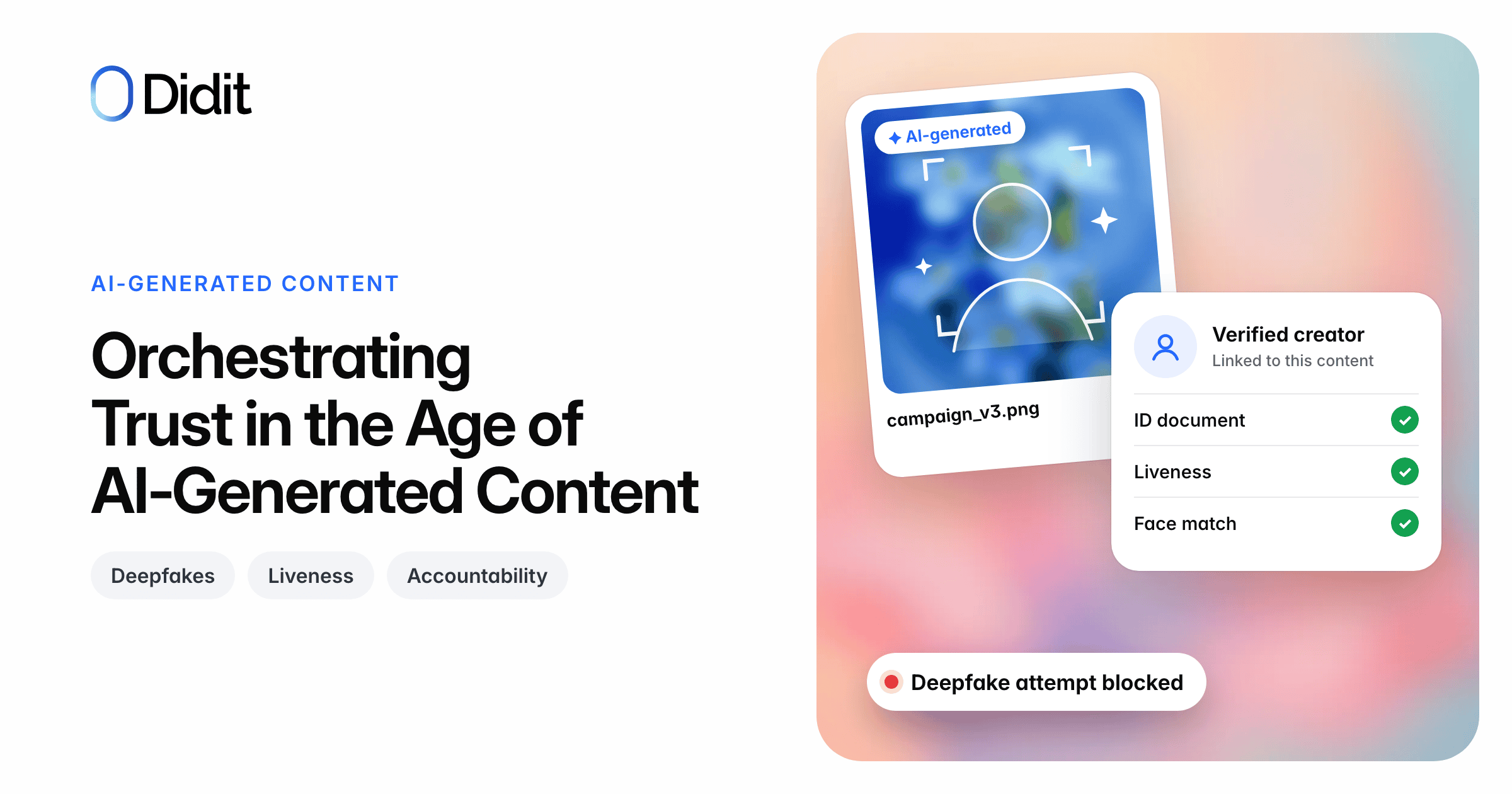
The rise of AI-generated content (AIGC) presents both incredible opportunities and significant challenges, particularly around authenticity and trust.
Alberto RosasMar 13, 2026NFC Verification for eHealth Access in EU Digital Wallets
NFC verification offers the highest security for accessing eHealth records via EU Digital Wallets, leveraging cryptographic validation of eIDs.
Alberto RosasMar 13, 2026Mastering Multi-Jurisdiction Compliance with Didit's Dashboards
Navigating multi-jurisdictional compliance is a complex challenge for global businesses. This post explores the critical role of robust compliance dashboards, offering real-time insights, streamlined workflows, and comprehensive.
Alberto RosasMar 13, 2026Build a Secure AI Agent Wallet for Transactional Identity
AI agents are transforming digital interactions, but their transactional capabilities demand robust identity verification. Learn how to construct a secure AI agent wallet, focusing on programmatic identity, strong.
Alberto RosasMar 13, 2026Minor Protection in K-12 EdTech: Beyond Simple Age Gating
Protecting minors in K-12 EdTech requires more than basic age gating. Advanced age estimation, robust identity verification, and continuous monitoring are crucial for compliance and safety.
Alberto RosasMar 13, 2026Next-Gen Database Validation: AI-Powered Discrepancy Resolution
Discover how AI is revolutionizing database validation by enhancing accuracy and efficiency in discrepancy resolution. Learn about 1x1 and 2x2 matching, and how intelligent systems like Didit's handle partial matches and no.
Alberto RosasMar 13, 2026Age Estimation vs. Biometric Liveness: Child Protection Synergy
Protecting children online requires robust age verification and fraud prevention. Age estimation assesses a user's age, while biometric liveness ensures they are real and present.
Alberto RosasMar 13, 2026The Future of Identity: Interoperable Digital ID for Cross-Border Travel
The advent of interoperable digital identity is set to revolutionize cross-border travel, offering enhanced security, streamlined processes, and a seamless traveler experience.
Alberto RosasMar 13, 2026Automating Minor Protection for EdTech: A Developer's Guide
EdTech platforms must prioritize minor protection amidst evolving regulations. This guide offers developers a roadmap to implement robust age verification, consent mechanisms, and data privacy using automated solutions.
Alejandro RosasMar 13, 2026Real-time Patient Identity Resolution in Healthcare
Achieving accurate, real-time patient identity resolution across complex multi-provider networks is a critical challenge in modern healthcare.
Alberto RosasMar 13, 2026Real-time Minor Protection in Online Gaming
Protecting minors in online gaming is crucial. Behavioral biometrics offers a dynamic solution, moving beyond static age gates. This approach, combined with advanced identity verification, ensures safer digital environments and.
Alberto RosasMar 13, 2026Streamlining Medical Records Access with Identity Orchestration
Secure and efficient access to medical records is paramount in healthcare. Identity data orchestration, powered by AI, ensures patient privacy, regulatory compliance, and seamless user experiences.
Alberto RosasMar 13, 2026Privacy-Enhancing AI in Decentralized Healthcare Wallets
Explore how privacy-enhancing AI is revolutionizing decentralized credential wallets in healthcare. Learn about zero-knowledge proofs, federated learning, and homomorphic encryption, ensuring robust data protection and patient.
Alberto RosasMar 13, 2026Structuring Identity Data for AI-Powered Risk Orchestration
Effective risk orchestration in identity verification hinges on well-structured, high-quality identity data. This blog explores how leveraging AI and modular platforms like Didit can transform raw identity information into.
Alberto RosasMar 13, 2026GDPR Article 17 and AML: erasure requests vs record keeping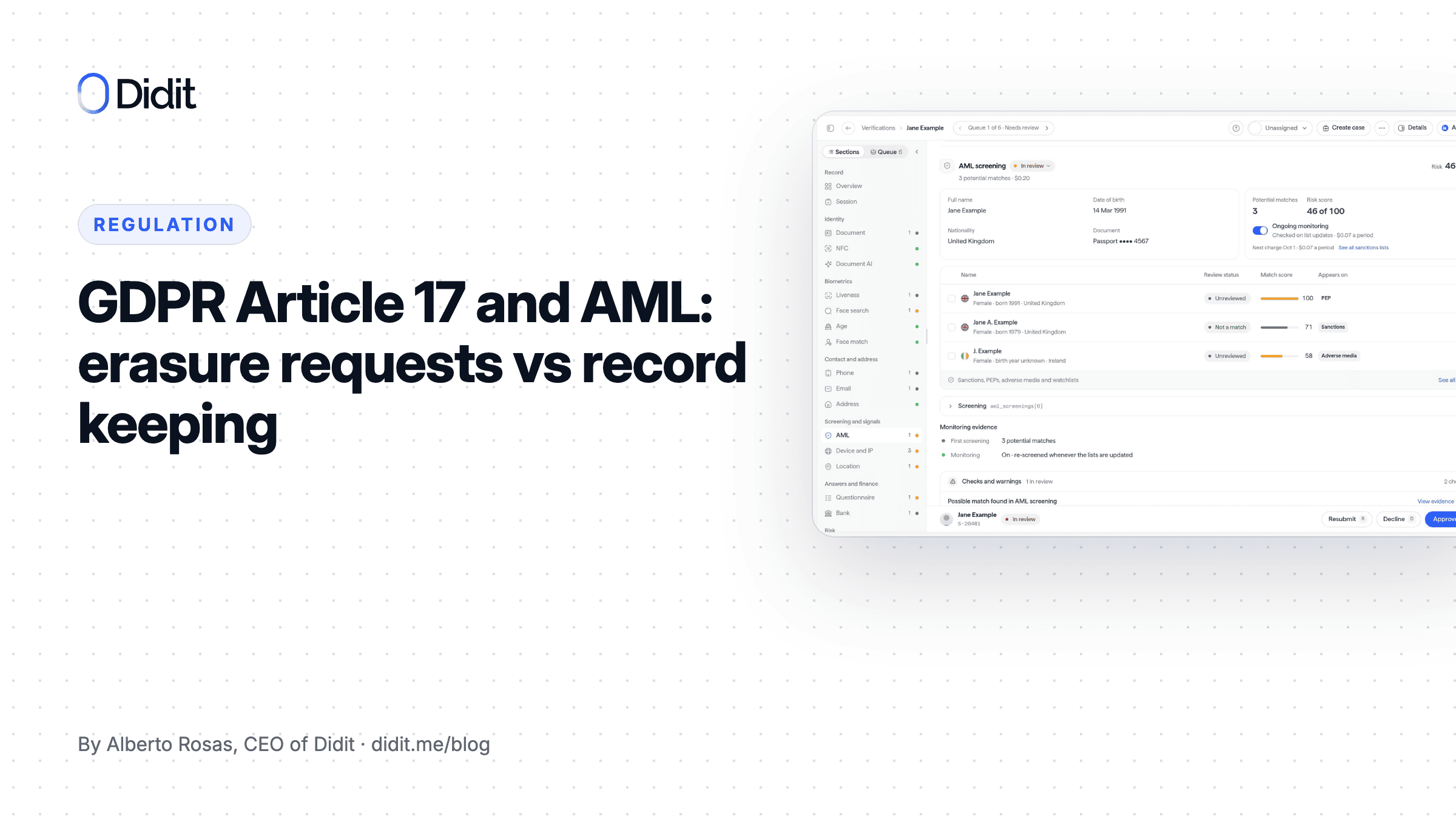
Article 17(3)(b) lets you refuse erasure only for the data an AML law requires you to keep. Delete the rest, document the basis, and hold the record set to the legal deadline.
Alberto RosasMar 13, 2026Building a Decentralized Digital Wallet for Cross-Border Payments
Developing a decentralized digital wallet for cross-border payments presents unique challenges, particularly concerning compliance, security, and user onboarding.
Alberto RosasMar 13, 2026Open-Source vs. Proprietary Device Intelligence: A Comparative Analysis
Choosing between open-source and proprietary device intelligence solutions is critical for fraud prevention and user experience. This post compares their strengths, weaknesses, and integration complexities, highlighting how.
Alberto RosasMar 13, 2026Optimizing Developer Experience for Custom Blocklists with APIs
Building robust fraud prevention requires dynamic blocklisting. This post explores how well-designed APIs empower developers to create and manage custom blocklists efficiently, focusing on ease of integration, flexibility, and.
Alejandro RosasMar 13, 2026Securing Federated Identity: API Best Practices for Data Sharing Consortia
Federated identity systems and data sharing consortia require robust API security to protect sensitive user data and maintain trust. This blog explores best practices, focusing on authentication, authorization, data encryption.
Alejandro RosasMar 13, 2026Optimizing SDK Delivery for Embedded Systems
Delivering Software Development Kits (SDKs) to embedded systems presents unique challenges, from resource constraints to stringent security requirements.
Alejandro RosasMar 13, 2026Quantifying the ROI of Automated Adverse Media Screening
Automated adverse media screening is crucial for modern compliance. This post explores its tangible benefits, from reducing operational costs and enhancing risk detection to improving customer experience and ensuring regulatory.
Alberto RosasMar 13, 2026Real-Time Facial Landmark Detection: Your Fraud Shield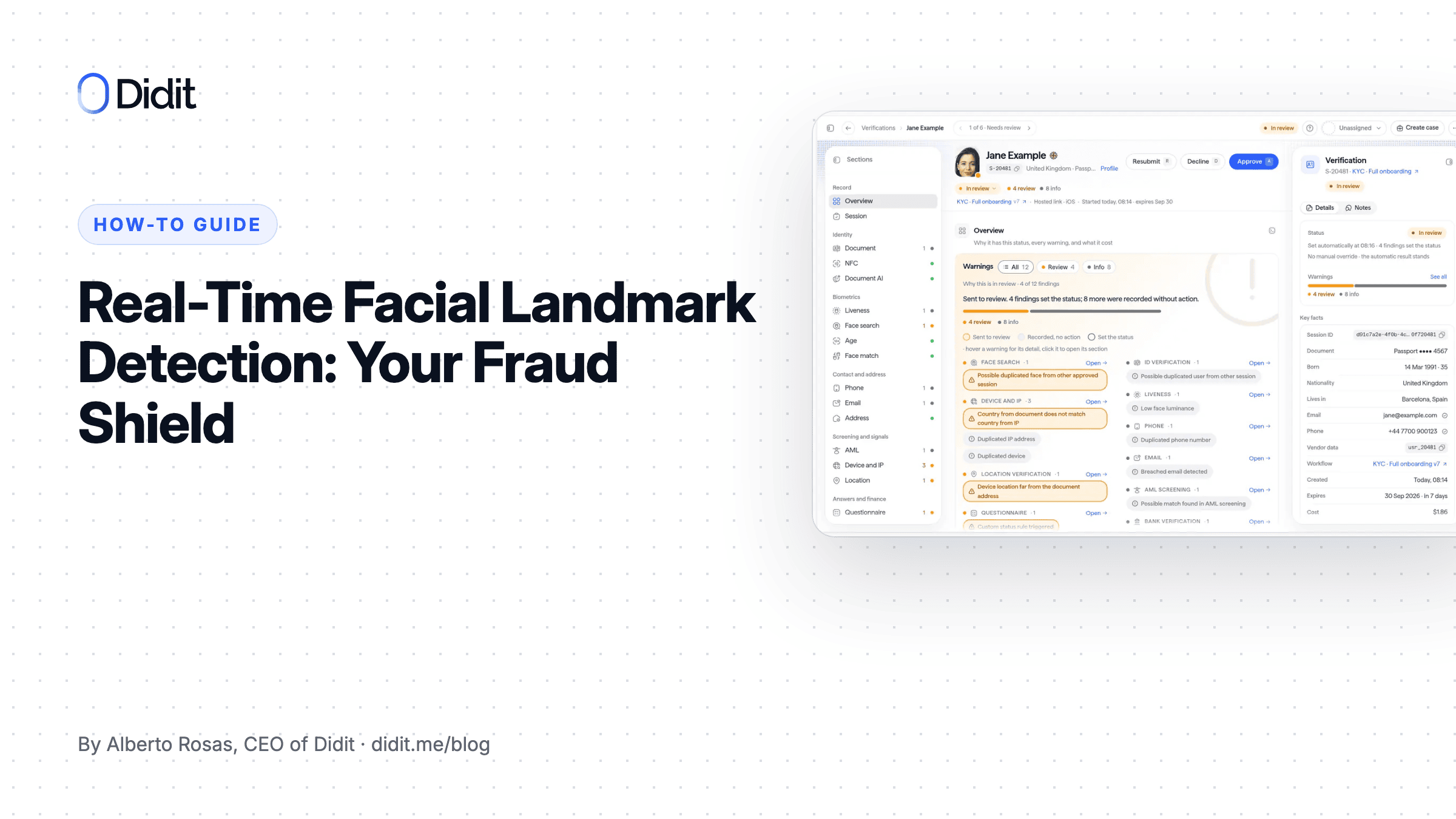
Facial landmark detection maps the face frame by frame, and that geometry is what liveness and face match decisions rest on. Here is the exact Didit setup, with published prices, the documented response fields and failure.
Alberto RosasMar 13, 2026Combating AI-Generated Synthetic IDs with Behavioral Biometrics
AI-generated synthetic identities pose a significant threat to businesses, enabling sophisticated fraud and bypassing traditional identity verification methods.
Alberto RosasMar 13, 2026Building a Graph-Based Identity Resolution Engine
Discover how graph databases and advanced identity verification techniques can revolutionize identity resolution. This post outlines the challenges, benefits, and practical steps to building a robust graph-based engine.
Alberto RosasMar 13, 2026Open-Source vs. Commercial AML Alert Remediation Tools
This article compares open-source and commercial AML alert remediation tools, highlighting their pros and cons. It covers cost, customization, support, and compliance, positioning Didit as a leading commercial solution for.
Alberto RosasMar 13, 2026Integrating Real-Time Sanctions Screening into Your ERP System
Integrating real-time sanctions screening into an ERP system is crucial for compliance and risk management. This guide explores the challenges, benefits, and practical steps for seamless integration, emphasizing API-driven.
Alejandro RosasMar 13, 2026Building a Robust Internal Fraud Watchlist with AI Enrichment
Discover how AI-enriched internal fraud watchlists are crucial for modern fraud prevention. Learn to leverage data points like documents, faces, phones, and emails to proactively block fraudulent actors and improve security.
Alberto RosasMar 13, 2026Structuring Identity Data for AI-Powered Real-Time Payment Fraud Detection
AI-powered fraud detection is crucial for real-time payments, demanding well-structured identity data. This blog explores key data structuring principles, the role of advanced verification techniques, and how Didit's AI-native.
Alberto RosasMar 13, 2026Mobile Identity Verification: Combating SIM Swap and ATO for Telecoms
Telecom companies face significant threats from SIM swap fraud and Account Takeover (ATO), leading to financial losses and reputational damage.
Alberto RosasMar 13, 2026Optimizing iOS SDK Installation for Minimal App Size and Speed
Discover strategies to streamline iOS SDK integration, reduce app size, and enhance performance. Learn how to meticulously manage dependencies, leverage modular frameworks, and optimize resource usage for a faster, more.
Alejandro RosasMar 13, 2026Build Your Own Watchlist & Adverse Media Engine with APIs
Discover how to build a robust, custom watchlist and adverse media screening engine using composable APIs. Learn about integrating global sanctions, PEPs, and adverse media data, and how Didit's modular, AI-native platform.
Alberto RosasMar 13, 2026Global Watchlist Monitoring: Coverage, Updates, and Data Quality
Selecting the right global watchlist monitoring provider is crucial for effective AML compliance. This guide compares key factors like coverage, update frequency, and data quality, highlighting how Didit's AI-native AML.
Alberto RosasMar 13, 2026Optimizing Neobank Onboarding: Income & Employment Verification
Neobanks face unique challenges in onboarding, especially when it comes to verifying income and employment quickly and accurately. This guide explores how automated solutions can streamline the process, reduce fraud, and enhance.
Alberto RosasMar 13, 2026Event-Driven KYC for Regulatory Sandboxes: Agility in Action
Explore how event-driven Know Your Customer (KYC) processes enable financial institutions and fintechs to innovate within regulatory sandboxes.
Alberto RosasMar 13, 2026Build Dynamic Email Verification Workflows with Smart Fallbacks
Discover how to build robust email verification workflows with dynamic fallbacks to enhance security and user experience. Learn to integrate advanced risk assessment, OTP verification, and intelligent decision-making, ensuring.
Alberto RosasMar 13, 2026Streamlining Verification: OTP and Verification Link Workflows
Optimizing developer experience for custom OTP and verification link workflows is crucial for efficient identity verification. This guide explores best practices, from frictionless integration to robust security, highlighting.
Alberto RosasMar 13, 2026Integrating eIDs into Mobile Wallets: Best Practices for Developers
Integrating chip-based eIDs into mobile wallet applications offers enhanced security and user convenience. This guide covers best practices for NFC-based data extraction, robust security measures, and ensuring regulatory.
Alejandro RosasMar 13, 2026Real-time Phone Intelligence for Gig Economy Fraud
Combatting fraud in the gig economy demands sophisticated tools. Real-time phone number intelligence, including checks for disposable numbers, VoIP, and carrier details, provides critical data for predictive fraud scoring.
Alberto RosasMar 13, 2026Webhook-Driven Orchestration for AI Agent Identity Attestation
Discover how webhook-driven workflow orchestration is revolutionizing AI agent identity attestation, enabling seamless, real-time verification.
Alejandro RosasMar 13, 2026Optimizing Cross-Platform SDKs: A Performance Benchmarking Guide
Developing high-performance cross-platform SDKs is crucial for seamless user experiences and efficient operations. This guide delves into key strategies for benchmarking and optimizing your SDKs, ensuring they deliver speed.
Alberto RosasMar 13, 2026Developer's Guide to Integrating Travel Document Scanning via API
Integrating travel document scanning via API is crucial for seamless user onboarding and robust security. This guide provides developers with insights into OCR, MRZ, and barcode scanning, emphasizing the importance of liveness.
Alejandro RosasMar 13, 2026Optimizing Developer Integration for Global Phone Verification APIs
Efficiently integrating global phone verification APIs is crucial for robust identity systems. This post explores key challenges like managing diverse verification methods, handling real-time risk, and ensuring data accuracy.
Alejandro RosasMar 13, 2026Optimizing Developer Workflows for DID Integrations
Streamline your decentralized identity (DID) integrations and enhance developer productivity with best practices. Learn how modular design, robust APIs, and comprehensive tools can accelerate your development cycles, reduce.
Alberto RosasMar 13, 2026Global eID Schemes: A Comparative Analysis for Businesses
Understanding the diverse landscape of global eID schemes is crucial for businesses operating internationally. This analysis compares leading digital identity systems, their technological foundations, and regulatory frameworks.
Alberto RosasMar 13, 2026React Native SDK for Offline Biometric Capture: A Comprehensive Guide
Explore the nuances of implementing offline biometric capture in React Native applications, focusing on the challenges and solutions for robust identity verification without constant internet connectivity.
Alejandro RosasMar 13, 2026Verifiable Credentials for Secure IoT M2M Identity (2026)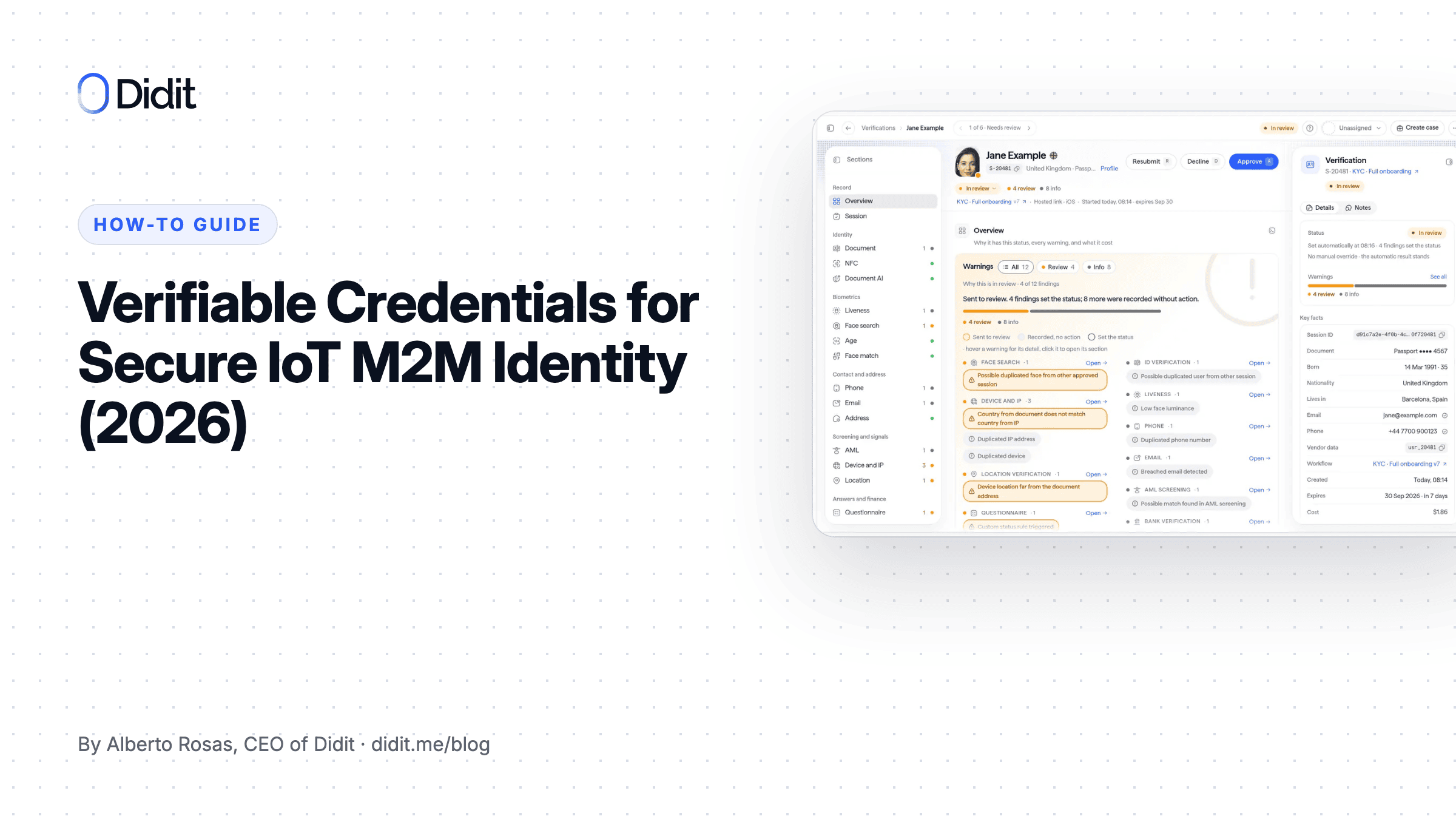
The supplied Didit documentation describes ES256-signed authentication JWTs and JWKS, rather than a documented W3C credential issuance flow.
Alberto RosasMar 13, 2026The Economics of Trust: Quantifying ROI of DID in Carbon Markets
Decentralized Identity (DID) offers a transformative solution for building trust and transparency in carbon markets, directly impacting their economic viability.
Alberto RosasMar 13, 2026Android SDK Fraud Signals for Robust Device Intelligence
Collecting advanced fraud signals via Android SDKs is crucial for robust device intelligence and effective fraud prevention. This involves leveraging device characteristics, behavioral biometrics, and network data to identify.
Alejandro RosasMar 13, 2026Optimizing iOS Biometric Liveness Detection: A Developer's Guide
Mastering biometric liveness detection on iOS is crucial for robust security and user experience. This guide explores tuning configurable settings like liveness scores, duplicate face detection, and face quality, ensuring.
Alejandro RosasMar 13, 2026From Legacy IDP to Decentralized Identity: A Migration Playbook
Migrating from traditional Identity Providers (IDPs) to Decentralized Identity (DID) offers enhanced security, user control, and compliance.
Alberto RosasMar 13, 2026Building Self-Sovereign Digital Credential Wallets with Flutter SDKs
Building a self-sovereign identity (SSI) wallet requires robust identity verification and a seamless user experience. Flutter, combined with powerful SDKs, offers an ideal framework for developing secure and intuitive SSI.
Alberto RosasMar 13, 2026Flutter SDK Identity Verification: Cross-Platform Setup, No WebAssembly Edge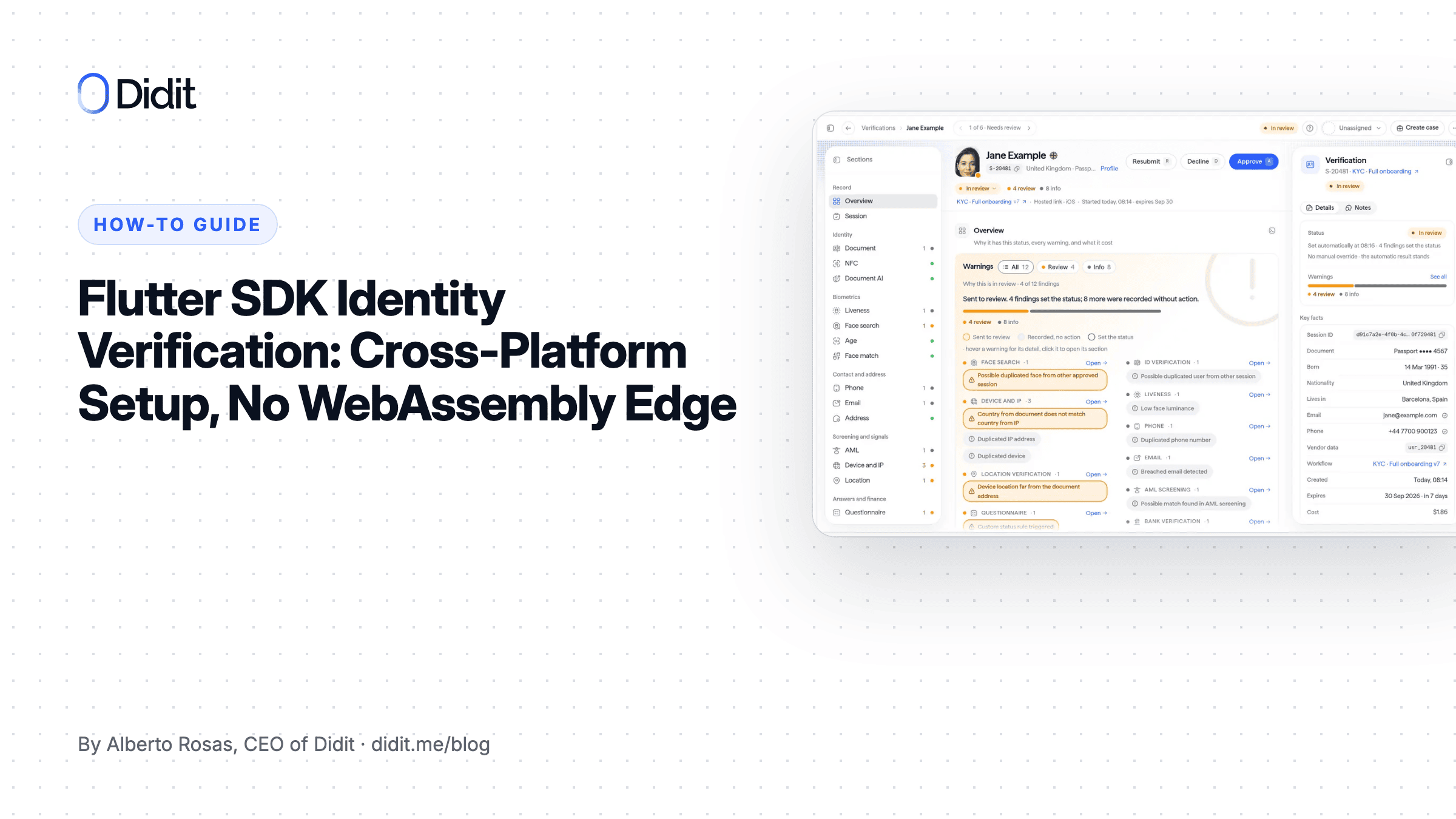
Use the didit_sdk package 4.15.4 with Flutter 3.41+, create a session on your backend, launch it with the session token, and take the decision from a webhook. A full ID check is $0.33.
Alejandro RosasMar 13, 2026Building a Compliant iOS Identity SDK with Swift and Privacy Manifests
Building a secure and compliant iOS identity verification SDK requires careful attention to Apple's privacy mandates, including Privacy Manifests and required reason APIs.
Alejandro RosasMar 13, 2026Portable Digital Identities: Revolutionizing Humanitarian Aid
Portable digital identities are transforming humanitarian aid by ensuring efficient, transparent, and equitable distribution to vulnerable populations.
Alberto RosasMar 13, 2026Orchestrating Identity Checks for Age-Restricted UGC
UGC platforms face complex challenges in verifying user age for restricted content, balancing compliance with user experience. This post explores the difficulties, the importance of robust age verification, and how advanced.
Alberto RosasMar 13, 2026Enhancing Trust in Supply Chain Finance with Composable Identity
Supply chain finance (SCF) relies heavily on trust, but fraud and inefficiencies are rampant. Composable identity verification, like Didit's modular platform, offers a powerful solution to authenticate participants, streamline.
Alberto RosasMar 13, 2026A/B Testing Strategies for Mobile Onboarding Optimization
Optimizing mobile onboarding is crucial for user retention. This post explores A/B testing strategies, focusing on streamlining user flows, personalizing experiences, and leveraging data for continuous improvement.
Alberto RosasMar 13, 2026The Economics of Data Provenance: Quantifying ROI in Digital Identity
Understanding data provenance is crucial for robust digital identity. This blog explores how tracking the origin and journey of identity data significantly enhances trust, reduces fraud, and drives clear ROI.
Alberto RosasMar 13, 2026Mastering PSD3 Compliance for Account-to-Account Payments
PSD3 is revolutionizing account-to-account (A2A) payments, demanding robust compliance and enhanced security. This blog explores key PSD3 requirements, focusing on strong customer authentication (SCA), fraud prevention, and data.
Alberto RosasMar 13, 2026Fintech Compliance Handbook: Cross-Border AML and KYC Rules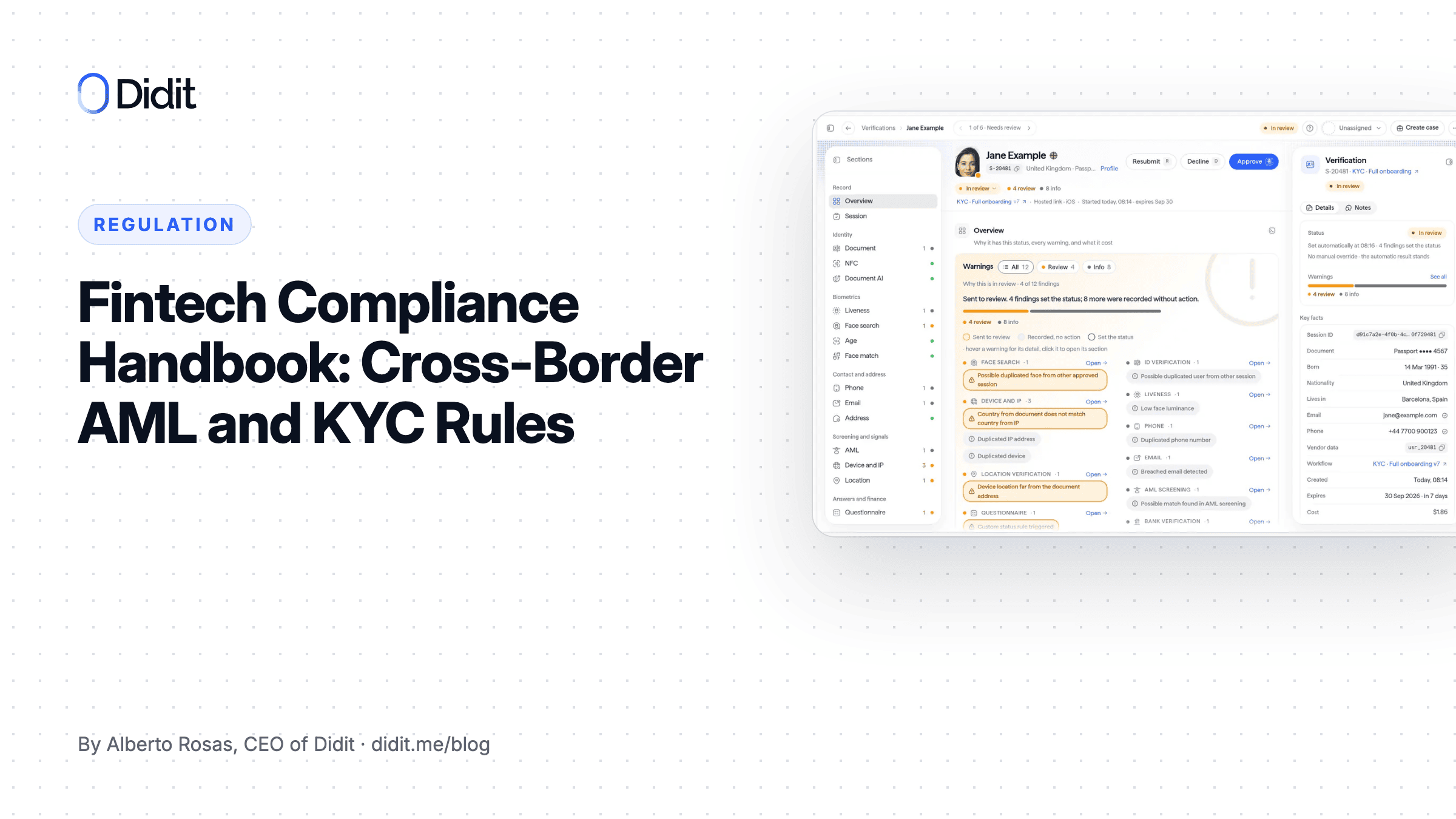
See which EU, UK and US AML rules apply to your fintech, when the EU AMLR starts to apply, and how to price and document KYC, screening and monitoring.
Alberto RosasMar 13, 2026AI-Native Identity: Compliance-as-Code for Global Regulations
AI-native identity platforms are revolutionizing regulatory compliance by enabling Compliance-as-Code. This approach automates identity verification processes, adapts swiftly to global regulatory changes, and significantly.
Alejandro RosasMar 13, 2026Real-time Identity Proofing for NIS2 & DORA Compliance
The NIS2 Directive and DORA Regulation demand robust identity proofing for critical infrastructure. This guide explores how real-time, AI-powered identity verification solutions are essential for securing digital access.
Alberto RosasMar 13, 2026Optimizing iOS SDK Latency for On-Device Biometric Processing
Achieving low latency in iOS biometric processing is crucial for a seamless user experience in identity verification. This guide explores techniques like optimizing camera feeds, efficient data handling, and leveraging native.
Alejandro RosasMar 13, 2026Structuring Identity Data for AI-Powered Digital Forensics
Effective digital forensics in identity verification relies on well-structured data. AI leverages clean, standardized identity data to detect fraud, enhance security, and ensure compliance.
Alberto RosasMar 13, 2026Micro-Verifications: Building Creator Platform Reputation
Micro-verifications are essential for online creator platforms to foster trust, combat fraud, and build a strong reputation. By implementing granular identity checks, platforms can ensure authenticity, protect users, and verify.
Alberto RosasMar 13, 2026Privacy-Preserving AI in Enterprise KYC Workflows
Integrating privacy-preserving AI into enterprise KYC workflows is crucial for balancing regulatory compliance with user data protection. This approach leverages advanced AI techniques to verify identities while minimizing the.
Alberto RosasMar 13, 2026FIDO Liveness Certifications L1, L2 and L3 Explained (2026)
FIDO L1, L2 and L3 are labels used in procurement to describe liveness certification. Didit's supplied sources document iBeta Level 1 and Level 2 under ISO/IEC 30107-3, and those sources do not establish FIDO.
Alberto RosasMar 13, 2026Questions
Blog questions
Who writes the Didit blog?
Which topics does the blog cover?
Is the blog available in my language?
Where do I find product updates?
Are these posts legal advice?
How do I find posts on one topic?
Are posts dated?
Do posts link to the docs?
Is the blog the same as the docs?
Compliance built in
Audited, certified and attested.
We hold the certifications and build each country's rules into your flows, so you can launch anywhere without worrying. Security and Compliance center
- Regulation encoded into your flows
Tell us what you do and where. Didit lists the rules that apply to you, with sources, and builds the checks each country needs into one workflow.
- Ready for AMLR
Every requirement of the new EU anti-money laundering rules, from checking customers to human review, is already covered by a Didit check.
- Tested in Spain's Treasury sandbox
Spain's Treasury published its supervised sandbox report on Didit's NFC plus active liveness onboarding; SEPBLAC took part and valued the added measures positively.
- Audited, not self-declared
iBeta Level 1 and Level 2. Liveness tested under ISO/IEC 30107-3.
Your obligations · 3 regions
 SOC 2 Type 2
 ISO 27001
 iBeta Level 1 and Level 2
 EU regulator attestation
 FSM youth protection
 GDPR
 EBA remote onboarding
 MiCA compatible
 FIDO Alliance member
- AMLREU AML Regulation ready
Integration · Didit MCP
Run Didit from your own AI agent
Connect Didit to Claude, Cursor, VS Code or ChatGPT and just ask in plain words. Your agent can do anything you can do in the console, with the same permissions you have.
 Add to Claude
 ChatGPT
 Cursor
- Build workflowsDescribe the checks you need. The agent creates and publishes the flow.
- Run investigationsAsk why a session was declined, review cases, search people and companies.
- Change rulesCreate payment rules, test them on past data and switch them on.
- Pull reportsAsk for numbers, exports or the audit log.
Didit Academy


