
Didit vs IDVerse: per-check prices vs a 12-month contract
Didit vs IDVerse from public pages: a hosted API with published per-check prices and the evidence of every check, against IDVerse, now part of LexisNexis Risk Solutions, sold through sales or a 12-month contract.
In short
IDVerse, now part of LexisNexis Risk Solutions, sells document authentication and biometric verification through its sales team; the price it lists on AWS Marketplace is $35,000 for up to 25,000 requests on a 12-month contract.[1][3] Didit is a hosted API with published prices per check and a self-serve sandbox: liveness, document checks, face match, face search and AML screening on the same user.[4][5]
- Didit publishes its prices per check: passive liveness $0.10, active liveness $0.15 per check in a workflow, and $0.33 for a full ID check, paid as you use them.[4]
- Every Didit liveness check returns its evidence: a 0 to 100 score, the selfie, the video on active methods, every warning and the closest matching faces from your users.[6][7]
- IDVerse is stronger on certifications and document range: it lists ISO 30107-3 Level 1 and Level 2, SOC 2 Type 2, a set of ISO standards and NIST 800-63A, and up to 16,000 document types in 140+ languages.[1][2]
Didit vs IDVerse compares two vendors that both verify an identity document and match it to a live face. IDVerse started as a specialist in exactly that and is now sold as part of LexisNexis Risk Solutions; idverse.com redirects to its page on the LexisNexis site.[1] Didit runs the whole verification behind one API, from the document to sanctions screening. We also keep a short IDVerse alternative page.
We build Didit, so read this as one side. Every IDVerse fact below comes from the IDVerse page and brochure on risk.lexisnexis.com and the IDVerse listing on AWS Marketplace, as we checked them on 24 October 2026, and each one is cited. We quote only the price IDVerse publishes. Where IDVerse is stronger, we say so.
Didit vs IDVerse at a glance
| Topic | Didit | IDVerse |
|---|---|---|
| Identity checks | Document, liveness, face match, face search, database validation, AML[4][10] | Document authentication with up to 300 fraud checks, liveness and face match[1] |
| Pricing | Published per-check prices, pay as you go[4] | AWS Marketplace: $35,000 for up to 25,000 requests, 12-month contract; otherwise talk to sales[1][3] |
| How you start | Self-serve sandbox in the Business Console[4] | "Talk To Sales" or a demo request[1] |
| Result | Score from 0 to 100, selfie, video on active methods, warnings, face matches[6] | A yes/no answer, with results in a review portal[1] |
| Liveness lab tests | iBeta Level 1 PAD (ISO/IEC 30107-3)[13] | ISO 30107-3 Level 1 and Level 2[1] |
| Documents | 14,000+ documents, 220+ countries and territories[18] | Up to 16,000 document types, 220+ countries and territories[2] |
| KYB and monitoring | KYB from $2.00, $0.02 per transaction[20][21] | Not listed on the IDVerse product page (checked 24 October 2026); the page does not say whether LexisNexis offers them elsewhere[1] |
IDVerse column: risk.lexisnexis.com and AWS Marketplace, checked 24 October 2026. Didit column: docs.didit.me.
Which one fits your team
IDVerse may fit better
If you need
- Liveness tested at ISO 30107-3 Level 2
- The widest document list and 140+ languages
- A large set of ISO certifications and NIST 800-63A
- Other LexisNexis Risk Solutions products from one supplier
risk.lexisnexis.com, 24 October 2026
Didit may fit better
If you need
- Published prices, pay as you go
- The evidence of every check, with thresholds you set
- Duplicate and blocklist checks on every selfie
- AML, KYB and monitoring on the same API
docs.didit.me
Pay per check, or commit to a 12-month contract
The IDVerse product page offers "Talk To Sales" and a demo request.[1] The price we found listed is the IDVerse listing on AWS Marketplace, sold by IDVerse \ LexisNexis Risk Solutions: a 12-month contract for "IDKit (25,000 requests)", biometric identity verification up to 25,000 requests, at $35,000. The listing says unused entitlements expire if you do not renew, and refunds are given on request on the basis of no usage.[3] Larger or different contracts go through sales.
On Didit, you open the Business Console, build a workflow and run it in the sandbox, then pay per check from prepaid credit.[4]
| Item | Didit list price | IDVerse |
|---|---|---|
| Commitment | None; pay per check[4] | 12-month contract on AWS Marketplace[3] |
| Listed price (different buying models) | Per check, listed below[4] | $35,000 for up to 25,000 requests[3] |
| Liveness | $0.10 passive, $0.15 active per check in a workflow[4] | Part of one request (document, liveness and face match); not priced per check[3] |
| Full ID check | $0.33: document, passive liveness, face match, device and IP[4] | One request; $35,000 per 25,000 requests, not a per-check price[3] |
| AML screening | $0.20 per check[4][12] | Listing says IDKit meets AML KYC requirements including PEP and sanctions; no separate price[3] |
Not like for like: IDVerse prices a contract for up to 25,000 requests, Didit prices each check with no commitment.
Prices as of 24 October 2026
Didit prices in this post are the list prices on docs.didit.me on 24 October 2026, which include 500 free checks a month for each core KYC feature. On 1 November 2026, those free checks become $10 of credit a month for any feature. Pay as you go stays, and the full ID check and watchlist screening are still $0.33 and $0.20 at list price.[4][19]
The $0.33 full ID check already includes face match; on its own, face match is $0.05, and age estimation reuses the same selfie for $0.10.[4][11][17] Add up the checks in your workflow, or compare plans on the pricing page.
What you get back from every check
IDVerse is built to be fully automated: within seconds the user gets a yes/no answer, and your fraud, onboarding and compliance teams can open a portal to review results and look for patterns.[1] Its FraudHub product adds insights into fraud patterns across your instance; the page points to sales for more information.[1]
Didit returns the evidence with every decision. Each liveness check comes back in the API and the webhook with the method, a score from 0 to 100, the reference selfie, the capture video on active methods, an age estimate when enabled and up to five matching faces from your application, blocklisted and allowlisted faces first.[6] Every warning has a stable code, and in the workflow you choose what each one does: no action, review or decline. A detected attack, a missing face or a blocklisted face always declines. Sessions sent to review land in the Business Console with that evidence on screen.[6][7]
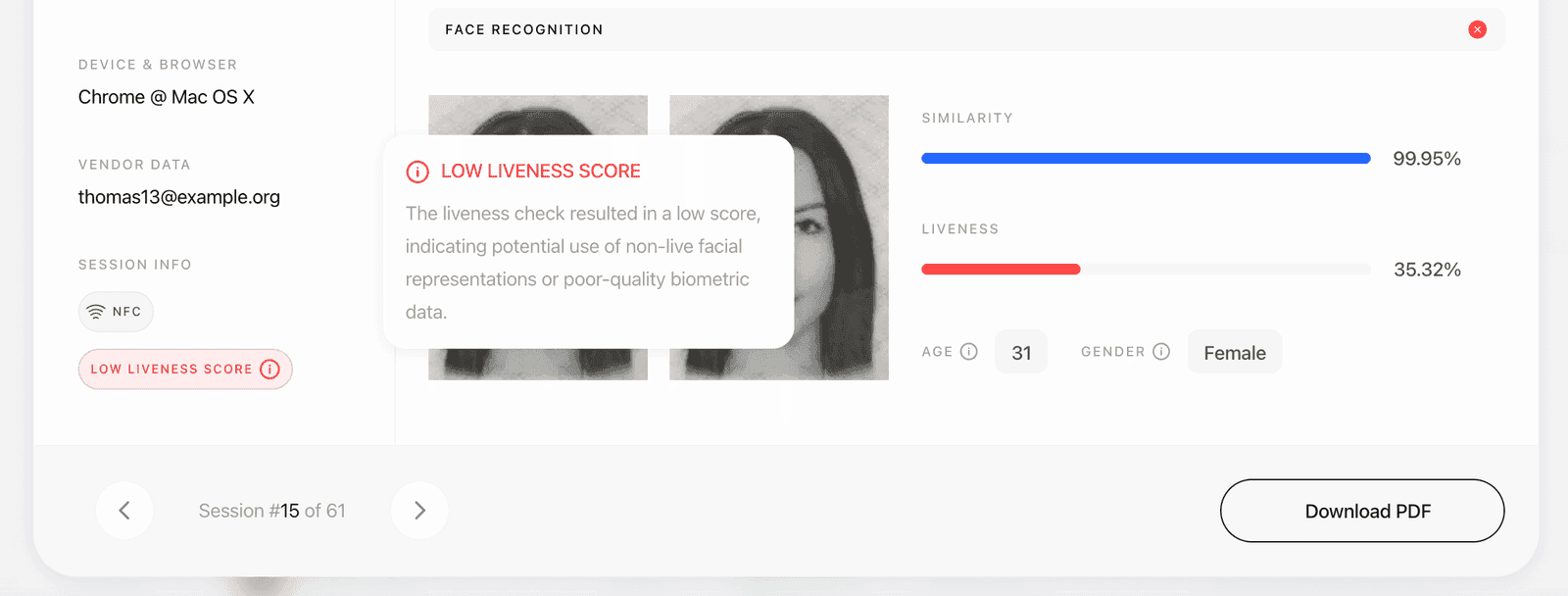
A Didit session flagged for review: low liveness score, with the face match similarity, the estimated age and the device next to it.
See the liveness report and liveness warnings docs.
Duplicates, blocklists and face search on the same selfie
A live face does not tell you whether the person already has an account or was banned last month. On Didit, face search runs inside every liveness check, with no extra integration: the selfie is compared against your approved sessions and your face blocklist. A blocklisted face declines the session automatically, a possible blocklist match goes to review, and for a duplicated face you set the action: no action, review or decline.[7][8][6] The blocklist also covers documents, phone numbers and emails.[9] On the IDVerse side, FraudHub is the product the page describes for blocking repeat bad actors.[1]
1Selfie and liveness
Score, selfie, video and warnings are recorded.
2Face search across your users
Approved sessions, imported faces and your lists.
Does the face match a blocklisted user
Session declined
A near match goes to review instead.
Duplicate check
No action, review or decline, as you set it.
What Didit runs on every selfie, before the session gets its status.
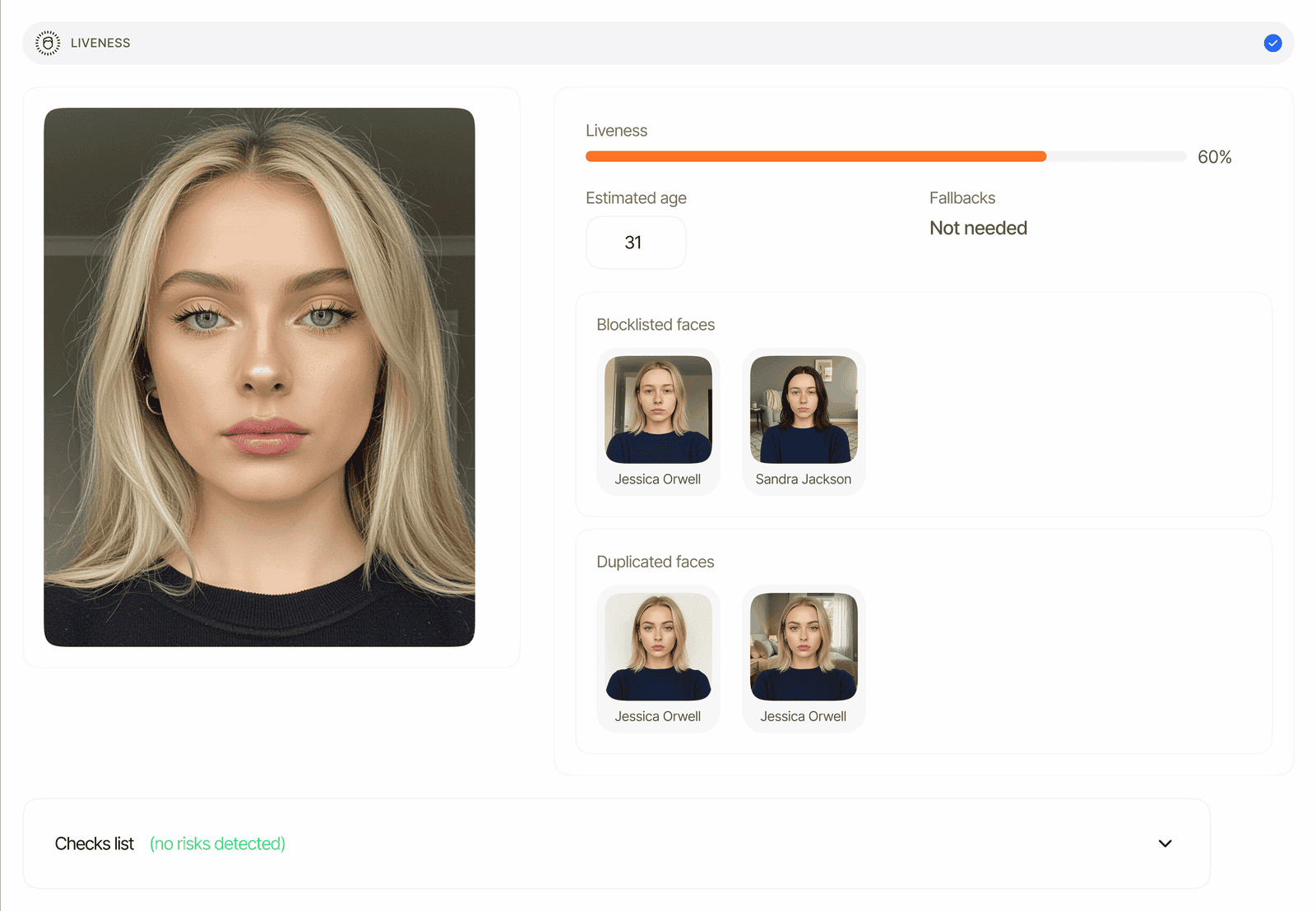
One liveness result in the Didit console: the score, the estimated age, two blocklisted faces and two earlier sessions with the same face.
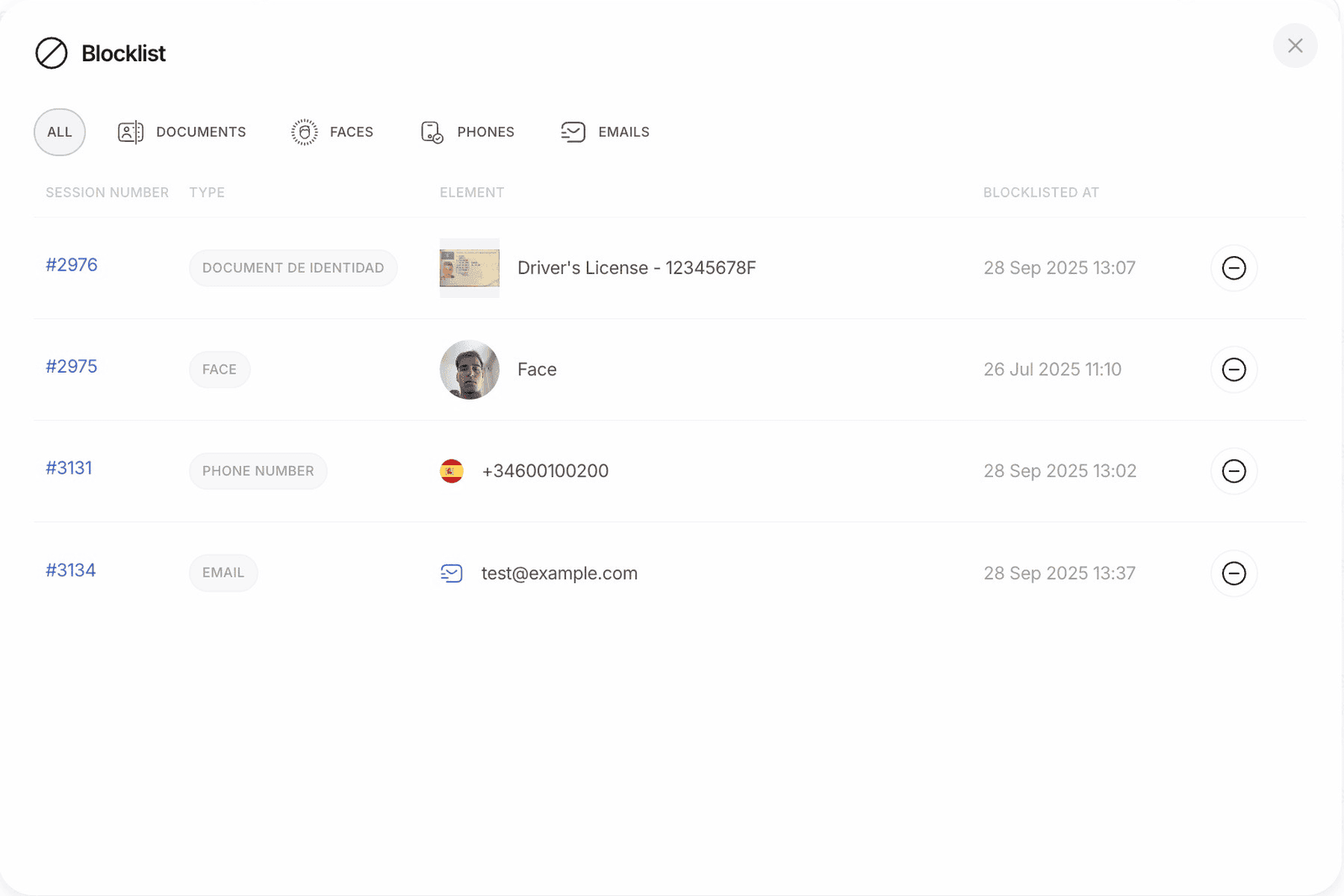
The Didit blocklist: a document, a face, a phone number and an email, each linked to the session it came from.
See face search 1:N, or the face search and blocklist docs.
Documents and liveness: where IDVerse is stronger
Documents are IDVerse's home ground. Its brochure says it covers up to 16,000 document types in 220+ countries and territories and 140+ languages and typesets, its OCR is accurate in over 98.5% of cases for human-readable text and 99.98% for machine-readable text, and document fraud analysis runs up to 300 checks for tampering.[2] The same journey also verifies digital credentials such as national eIDs and mobile driver's licences.[1]
The IDVerse page lists ISO 30107-3 Level 1 and Level 2, SOC 2 Type 2, ISO 27001, 27017, 27018, 27701, 22301 and 9001, NIST 800-63A and a Level B bias test.[1]
Where IDVerse is ahead
If your requirement is liveness tested at ISO 30107-3 Level 2, the widest document list, or a long list of ISO certificates in one vendor, IDVerse has them today. Didit holds iBeta Level 1, SOC 2 Type 2 and ISO/IEC 27001, and lists 14,000+ documents.[1][13][14][18]
Didit runs its own liveness models with three methods: passive, from a single capture; 3D Flash, which reads how projected light falls on a face; and 3D Action and Flash, which adds a random blink or nod.[5] Virtual cameras and injected frames raise their own warnings.[7] Didit's iBeta Level 1 PAD test (ISO/IEC 30107-3, NIST-accredited lab) recorded zero successful attacks out of 360, across six categories. After a supervised test from November 2024 to July 2025, Spain's Tesoro Público, Banco de España, SEPBLAC and CNMV concluded that Didit's NFC and liveness verification is at least as safe as an in-person ID check.[13] Compare the methods on the liveness detection page.
One platform: liveness is one step of KYC
IDVerse is sold as document authentication and biometric verification, and its AWS Marketplace listing says IDKit meets AML KYC requirements including PEP and sanctions. Business verification and transaction monitoring are not listed on the IDVerse product page (checked 24 October 2026); whether LexisNexis Risk Solutions offers them elsewhere is not stated there.[1][3]
On Didit, every check runs on the same user and session, assembled in a no-code workflow builder: ID verification, liveness, face match, database validation, AML screening and the rules that decide the status.[10] The same face is reused for age estimation, face search, duplicates and the blocklist. AML screening against 1,300+ watchlists is $0.20, registry checks for companies start at $2.00, and transaction monitoring is $0.02 per transaction.[4][12][20][21]
1User opens the flow
Hosted link, iframe or a web or mobile SDK.
2Document, liveness and face match
One capture, three checks.
3Face search 1:N
Duplicates and blocklist, on the same selfie.
4Database validation and AML
Registries and 1,300+ watchlists.
Did a warning route the session to review
In Review
A reviewer decides in the Business Console.
Approved or Declined
By your thresholds, with the evidence attached.
5Webhook and API
The status plus every score, image and warning.
One Didit session, from the first screen to the decision your backend receives.
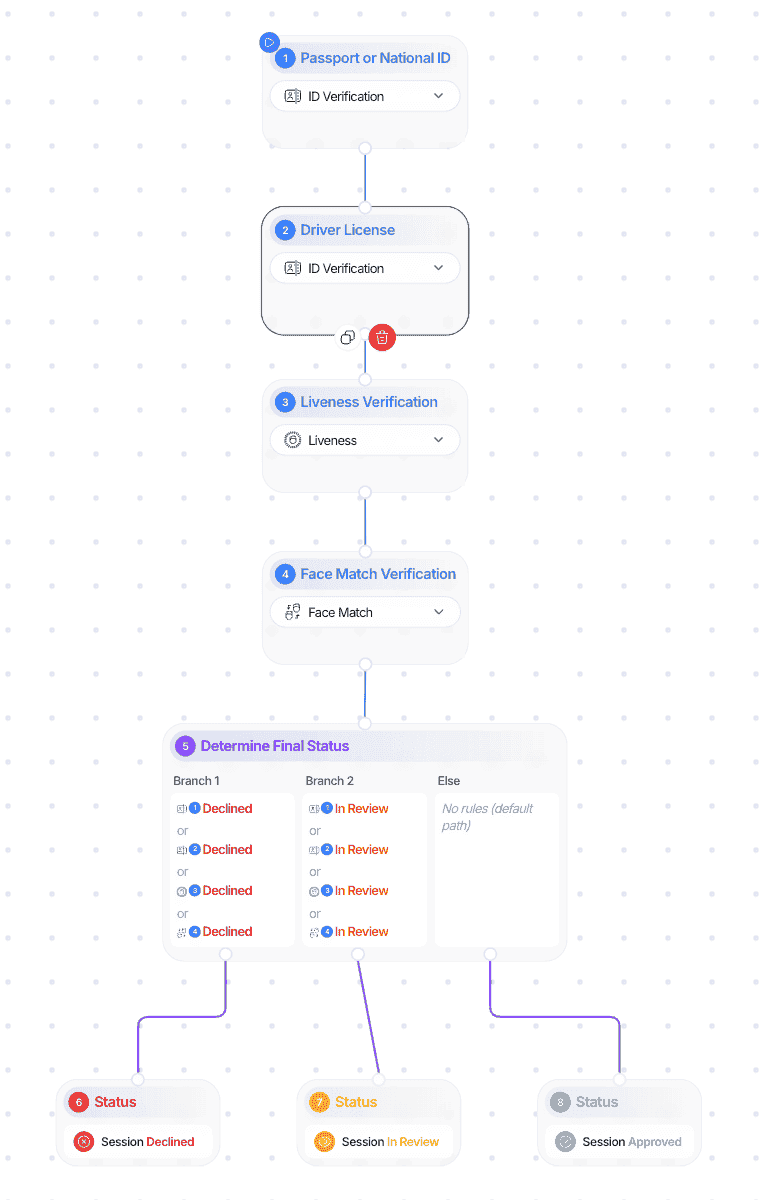
A Didit workflow: document, liveness and face match, then one decision step that routes each session to declined, in review or approved.
See the workflow orchestrator, ID verification, database validation and AML screening.
Integration and switching
IDVerse users start the flow by scanning a QR code, opening an SMS link or through the API, and the brochure lists integration options from hosted platforms to APIs and SDKs.[1][2] Didit connects through a hosted link, an iframe or the JavaScript SDK on the web, and iOS, Android, React Native and Flutter SDKs on mobile.[15][16] The fastest start is a hosted link: create a session, send the user to its URL, read the webhook. You can run both vendors side by side while you compare.
- List what IDVerse does for you today: documents, liveness, face match, FraudHub, Face Access.
- Note the end date of your IDVerse contract and the requests left on it.
- Rebuild the flow in the workflow builder, pick a liveness method, set thresholds and the duplicate-face action.
- Route a share of new users to Didit and compare pass rates, review workload and total cost.
How Didit helps teams replacing IDVerse
Didit gives you liveness with its full evidence, face search, document checks and AML screening as one hosted service, with a published price per check. See the IDVerse alternative page for the side-by-side, or start from the liveness detection page.
Didit provides
- Liveness with its full evidence
- Face search, duplicates and blocklist
- Servers, scaling and model updates
- Document checks, AML, KYB and monitoring
Stays with you
- Your risk assessment and policies
- The decision to onboard a customer
- The thresholds and actions you set
- Reports to your financial intelligence unit
Test Didit before your IDVerse contract renews
Build a workflow in the sandbox, run your own selfies and documents through it, and see the score, warnings and face matches yourself.
Key takeaways
- IDVerse is now part of LexisNexis Risk Solutions; its AWS Marketplace listing is $35,000 for up to 25,000 requests on a 12-month contract.
- Didit publishes its prices per check, pay as you go, and starts self-serve.
- Didit returns the evidence of each check and runs duplicate and blocklist checks on every selfie.
- IDVerse is ahead on ISO 30107-3 Level 2, document range and certifications.
Frequently asked questions
What is the main difference between Didit and IDVerse?
How you buy it and what comes back. Didit is a hosted API with published per-check prices that returns the evidence of every check. IDVerse is sold through LexisNexis Risk Solutions sales or a 12-month AWS Marketplace contract, and returns a yes/no answer with a review portal.[1][3][4]
How much does IDVerse cost?
Its AWS Marketplace listing is $35,000 for up to 25,000 requests on a 12-month contract, with refunds only on the basis of no usage. Other prices are not listed; the product page points to sales.[1][3]
How much does Didit liveness cost?
In a workflow, passive liveness is $0.10 and active liveness $0.15 per check. A full ID check with document, passive liveness, face match and device and IP analysis is $0.33.[4]
Who owns IDVerse?
IDVerse is part of LexisNexis Risk Solutions, and idverse.com redirects to the IDVerse page on the LexisNexis site (checked 24 October 2026).[1]
Which has the stronger liveness certification?
IDVerse lists ISO 30107-3 Level 1 and Level 2. Didit holds iBeta Level 1 and a Spanish regulator attestation for its NFC and liveness verification.[1][13]
Does Didit detect duplicate accounts and banned users?
Yes. Face search runs inside every liveness check against your approved sessions and your face blocklist, and a blocklisted face declines the session.[8][9]
Does IDVerse do AML screening or KYB?
Its AWS Marketplace listing says IDKit meets AML KYC requirements including PEP and sanctions. Business verification and transaction monitoring are not listed on the IDVerse product page (checked 24 October 2026), which does not say whether LexisNexis offers them elsewhere. Didit offers AML screening, KYB and transaction monitoring on the same API.[1][4]
Is Didit a good IDVerse alternative?
For teams that want published prices without a yearly contract, the evidence of every check and AML on one API, yes. For ISO 30107-3 Level 2 liveness or the widest document list, IDVerse fits better.[1][2]
Sources
- IDVerse product page, LexisNexis Risk Solutions, checked 24 October 2026.
- IDVerse brochure, LexisNexis Risk Solutions, checked 24 October 2026.
- IDVerse, Fully Automated Identity Verification, AWS Marketplace listing sold by IDVerse \ LexisNexis Risk Solutions, checked 24 October 2026.
- Pricing, Didit docs, read 24 October 2026.
- Liveness detection, Didit docs.
- Liveness report, Didit docs, read 24 October 2026.
- Liveness warnings, Didit docs, read 24 October 2026.
- Face Search 1:N, Didit docs, read 24 October 2026.
- Blocklist users, Didit docs, read 24 October 2026.
- Workflows, Didit docs, read 24 October 2026.
- Age estimation, Didit docs, read 24 October 2026.
- AML screening overview, Didit docs.
- Certifications and attestations, Didit docs.
- Security and compliance, Didit docs.
- Web SDKs overview: JavaScript SDK, iframe and redirect, Didit docs.
- Native SDKs overview, Didit docs.
- Face match, Didit docs.
- User documents and supported document types, Didit docs.
- New pricing from 1 November 2026, Didit blog, read 24 October 2026.
- KYB registry pricing, Didit docs.
- Transaction monitoring overview, Didit docs.
For the full side-by-side, pricing and the switching steps, see the IDVerse alternative page.
Start with a published price, not a yearly contract
Start in the sandbox with your own users' selfies and documents, or talk to us about your volumes.
Artigos relacionados
- Didit vs Nametag: API de KYC para clientes vs verificação de identidade de colaboradores
- Didit vs Paravision: uma API de KYC alojada face a componentes de liveness
- Didit vs BioID: a hosted KYC flow against a biometrics API
- Didit vs AuthenticID: what changed after Incode, and the options
- Didit vs ID R&D: IDLive Face liveness or a hosted KYC API
- Didit vs Keyless: verifying new users vs biometric login