
Didit vs Neurotechnology: hosted KYC API vs licensed biometric SDK
Didit vs Neurotechnology from public pages: a hosted API that returns the evidence of every liveness check at per-check prices, against MegaMatcher ID, a biometric SDK and web service you license and run.
In short
Neurotechnology sells MegaMatcher ID, a biometric SDK and web service component you install and run yourself, with published euro prices for the software and each transaction licence.[1][3] Didit is a hosted API that runs liveness, document checks, face match, face search and AML screening on the same user, at a published price per check.[12][13]
- Every Didit liveness check returns its evidence: a 0 to 100 score, the selfie, the video on active methods, every warning and the closest matching faces from your users.[14][15]
- Passive liveness is $0.10 and active liveness $0.15 per check in a workflow; a full ID check is $0.33.[12]
- Neurotechnology is stronger on a Level 2 PAD evaluation by BixeLab, NIST face results, voice and fingerprint modalities, perpetual licences and data that can stay on the device.[1][4][7][9]
Comparing Didit vs Neurotechnology means comparing two ways of buying biometrics. Neurotechnology, founded in 1990 in Vilnius, sells biometric engines for face, fingerprint, iris, voice and palmprint as SDKs and on-premise systems; MegaMatcher ID is its product for mobile and web identity checks.[10][11] Didit runs the whole verification as a service behind one API.
We build Didit, so read this as one side. Every Neurotechnology fact is cited from neurotechnology.com and the test letters it links. Neurotechnology lists its prices publicly, and we quote the figures listed on neurotechnology.com (checked 24 October 2026). Where it is stronger, we say so.
Didit vs Neurotechnology at a glance
| Topic | Didit | Neurotechnology (MegaMatcher ID) |
|---|---|---|
| What you get | Hosted API: identity checks, AML, KYB, transaction monitoring[12] | SDK for Android, iOS, Windows, macOS and Linux, plus a web service component[1][5] |
| Who runs it | Didit[22] | You: on-premise web service; transactions counted on your servers with USB dongles[1][4] |
| Pricing | Published per-check prices in US dollars, pay as you go[12] | Published prices in euros, per licence and per component: SDK and web service packages, plus transaction licence packs of at least 1,000[3] |
| What a liveness check returns | Score from 0 to 100, selfie, video on active methods, warnings, face matches[14] | The result of the check, to your app; data stays on the device, your server or both[1][2] |
| Duplicates and blocklists | Face search on every liveness check, against your users and your blocklist[16][17] | MegaMatcher ID verifies 1:1; large-scale search is a separate product[1][10] |
| Liveness lab tests | iBeta Level 1 PAD (ISO/IEC 30107-3)[21] | BixeLab Level 2 PAD evaluation (December 2025); iBeta Level 1 (2022)[7][8] |
| AML, KYB, monitoring | $0.20 AML check, KYB from $2.00, $0.02 per transaction[12][27][28] | Not listed on neurotechnology.com (checked 24 October 2026)[10] |
Neurotechnology column: neurotechnology.com, checked 24 October 2026. Didit column: docs.didit.me.
Which one fits your team
Neurotechnology may fit better
If you need
- Biometric data kept on the user's device or your own servers
- Voice or contactless fingerprint next to face
- A Level 2 PAD evaluation and NIST face results
- Repeated offline verification of enrolled users
neurotechnology.com, 24 October 2026
Didit may fit better
If you need
- The full evidence of every check, with thresholds you set
- Liveness with no software or servers to run
- Duplicate and blocklist checks on every selfie
- Document, liveness, AML and more on one API
docs.didit.me
What you get back from every check
MegaMatcher ID is a set of building blocks inside your own application. Its documentation says the liveness check returns the result of the check, and the face engine can warn on age, glasses or hats.[2] You configure the balance between security and usability,[1] and no biometric data is sent to the licence server.[2] That is a real privacy advantage. It also means storing the evidence, showing it to a reviewer and keeping an audit trail are features your team builds.
Didit returns the evidence and lets you decide. Each liveness check comes back in the API and the webhook with the method, a score from 0 to 100, the reference selfie, the capture video on active methods, an age estimate when enabled and up to five matching faces from your application, blocklisted and allowlisted faces first.[14] Every warning has a stable code, and in the workflow you choose what each one does: no action, review or decline. A detected attack, a missing face or a blocklisted face always declines.[15]
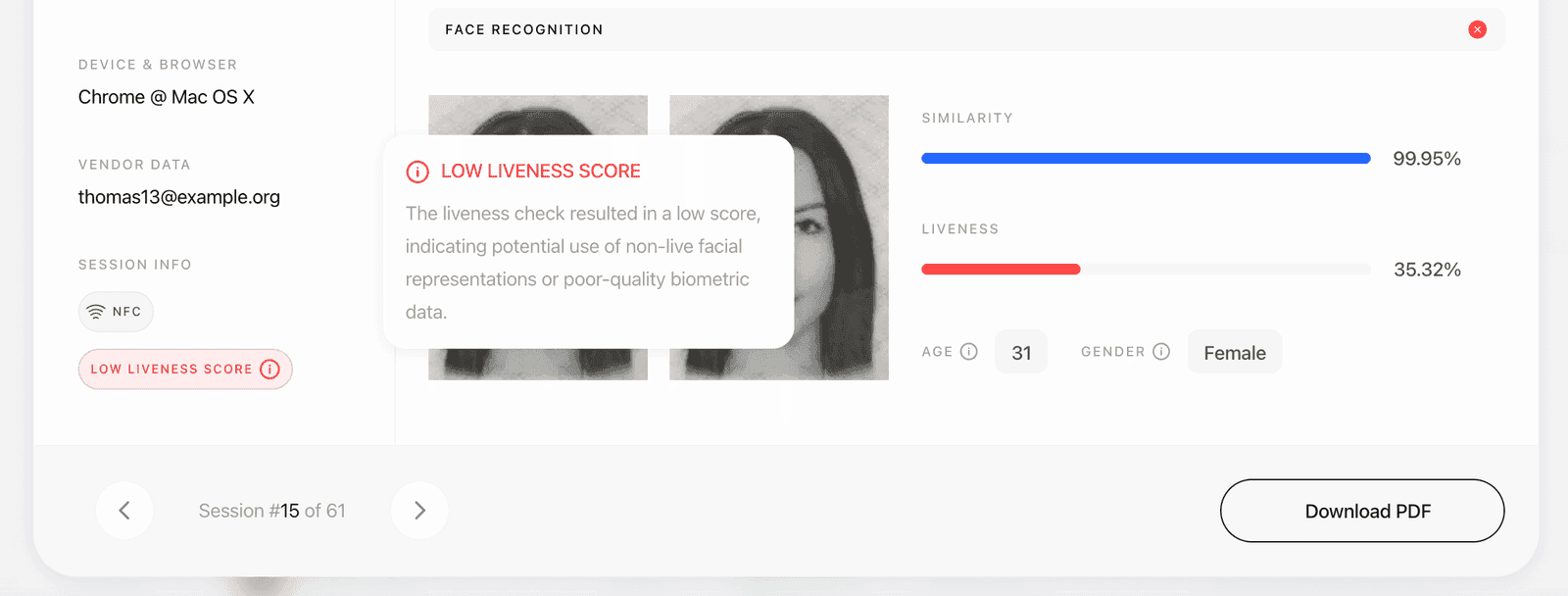
A Didit session flagged for review: low liveness score, with the face match similarity, the estimated age and the device next to it.
Duplicates, blocklists and face search on the same selfie
Liveness proves a real person is present, not whether that person already has an account or was banned. On Didit, face search runs inside every liveness check: the selfie is compared against your approved sessions and your face blocklist. A blocklisted face declines the session automatically, a possible blocklist match goes to review, and for a duplicated face you set the action: no action, review or decline.[15][16][14] The blocklist also covers documents, phone numbers and emails.[17]
1Selfie and liveness
Score, selfie, video and warnings are recorded.
2Face search across your users
Approved sessions, imported faces and your lists.
Does the face match a blocklisted user
Session declined
A near match goes to review instead.
Duplicate check
No action, review or decline, as you set it.
What Didit runs on every selfie, before the session gets its status.
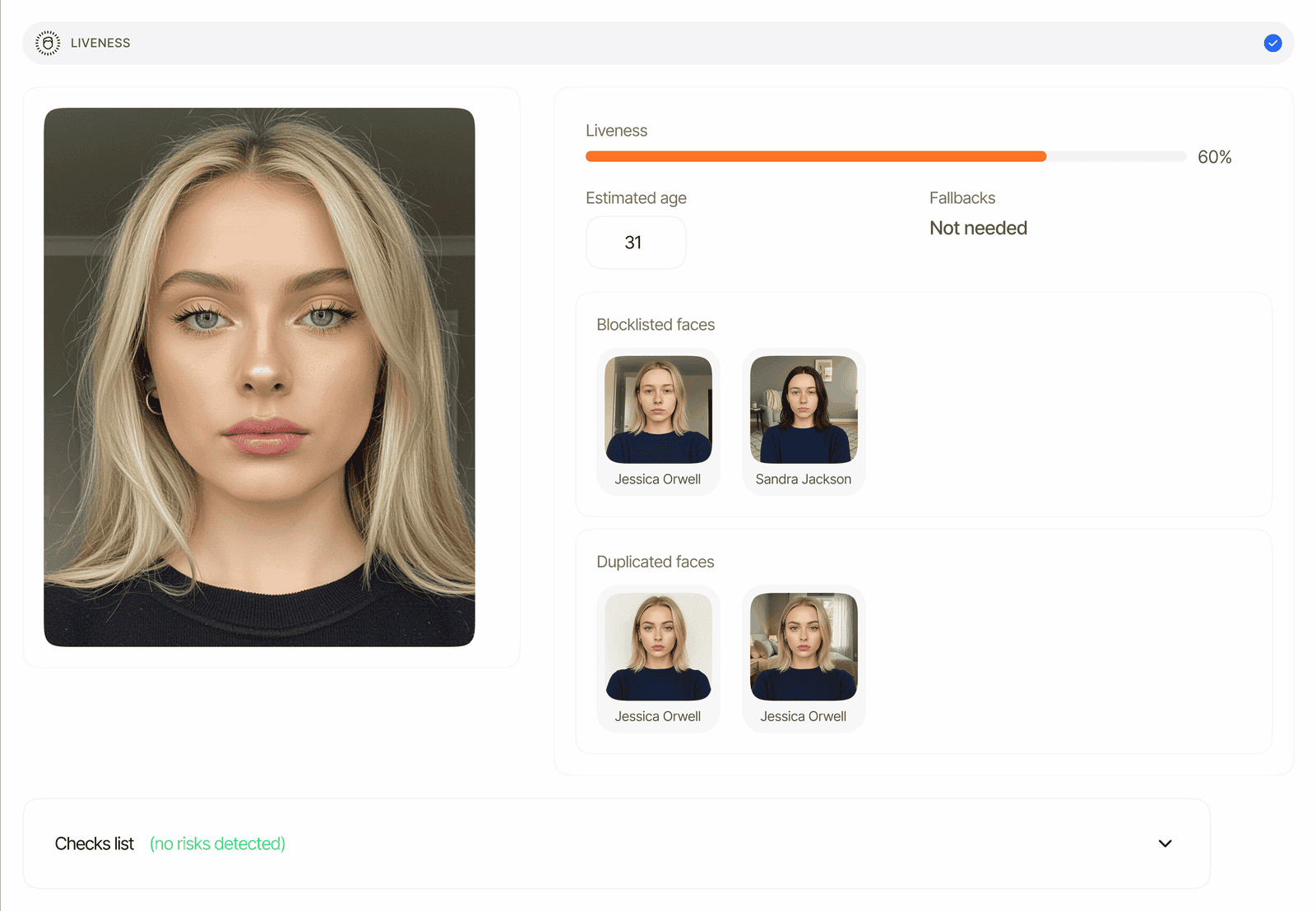
One liveness result in the Didit console: the score, the estimated age, two blocklisted faces and two earlier sessions with the same face.
Large-scale identification is Neurotechnology's home ground: MegaMatcher SDK and MegaMatcher ABIS, a turnkey on-premise system for national-scale projects,[10] used for voter deduplication in Liberia and Ghana and duplicate checking for India's Aadhaar programme.[10] For consumer onboarding, that is a second product to license and deploy.
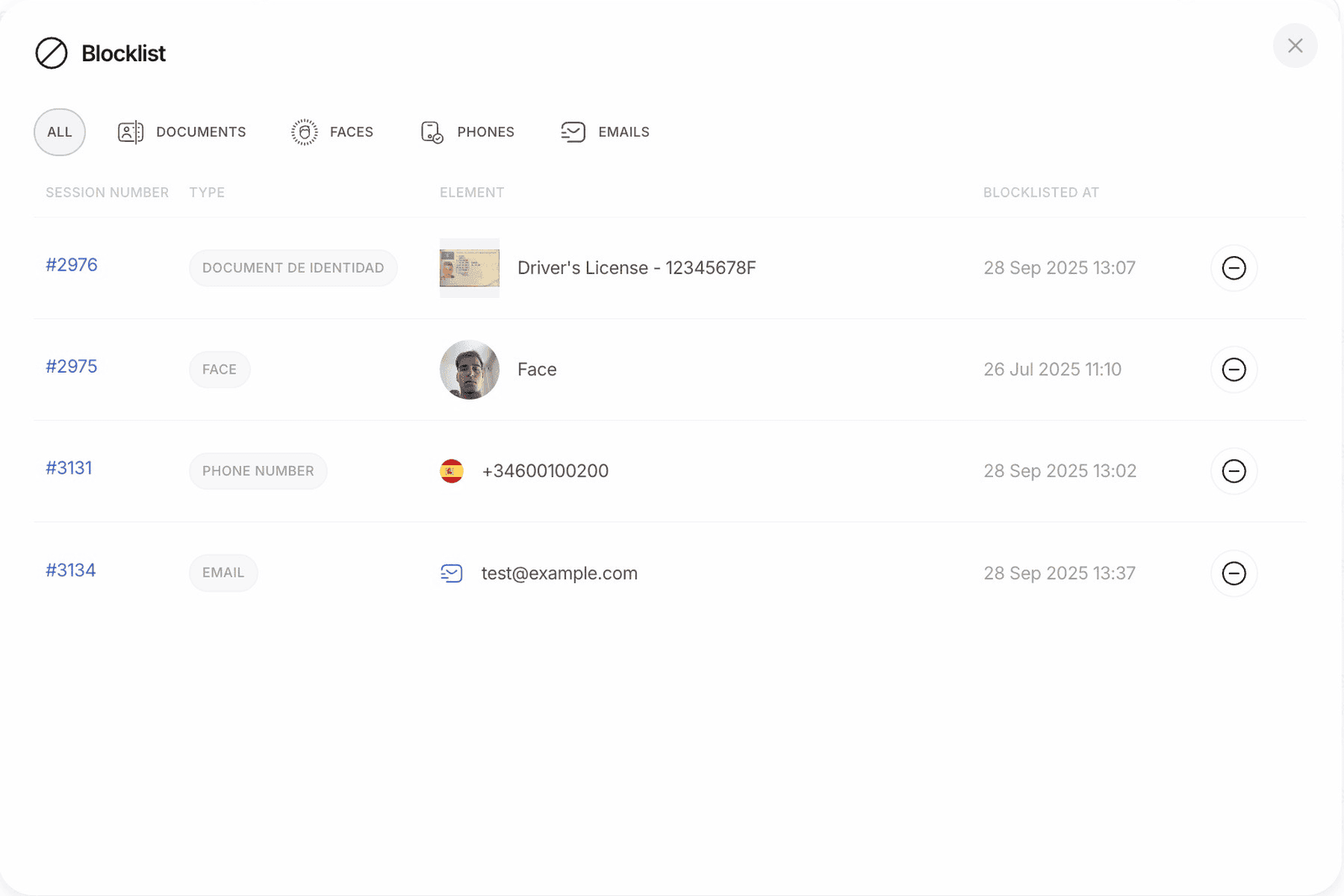
The Didit blocklist: a document, a face, a phone number and an email, each linked to the session it came from.
See face search 1:N, or the face search and blocklist docs.
Two models: license and host it, or call an API
Neurotechnology's licensing page is precise about how MegaMatcher ID runs. Transactions are counted on your servers or your end user's servers: at least two USB dongles, which hold the purchased and used counts, stay plugged into a server with constant access to them.[4]
| MegaMatcher ID item | What Neurotechnology's pages say |
|---|---|
| SDK component | Bought once per integrator; installed on every computer or device that runs your product[4] |
| Web service component | Needed for each deployment of the server side; the web service supports face and voice[4][5] |
| Licence accounting | At least two USB dongles plugged into your server, with constant access[4] |
On Didit, you create a session through the API, send the user to the hosted flow or a mobile SDK, and receive the result by webhook; models, servers and updates are Didit's job.[13][22]
Pricing: two published price lists
Neurotechnology's prices are public. The MegaMatcher ID SDK is €2,990 and the web service component €2,590, each with starter licences. Extra liveness and ICAO licences (Face LIT) cost €0.35 each from 1,000, €0.20 from 4,000 and €0.03 from 512,000; Face PRT enrolment licences cost €0.69 from 1,000 and €0.06 from 512,000. Above 1,000,000, you contact Neurotechnology.[3] Licences are perpetual with no annual fee, only successful operations are counted, and an enrolled face can be verified offline an unlimited number of times with the client component.[1][4]
| Item | Didit | Neurotechnology |
|---|---|---|
| Software to start | None; a sandbox in the Business Console[12] | SDK €2,990; web service component €2,590[3] |
| Liveness | $0.10 passive, $0.15 active per check in a workflow[12] | Face LIT €0.35 from 1,000 licences, €0.03 from 512,000; enrolment adds a Face PRT licence (€0.69 to €0.06); not a per-check price[3] |
| Full ID check | $0.33: document, passive liveness, face match, device and IP[12] | Document verification not listed on neurotechnology.com (checked 24 October 2026)[10] |
| Not included | Nothing to host | Your servers, taxes and duties, and shipping of the dongles[3] |
The two lists price different things: a licence your own server counts, in euros before tax, against a hosted check in US dollars with the evidence and console included. At the 512,000 to 999,999 tier, one Face PRT and one Face LIT licence (€0.06 and €0.03) are below Didit's per-check list prices, but that tier means buying licences in packs of that size, on top of the €2,990 SDK and €2,590 web service, and running the servers yourself, so the comparison turns on what you would host, staff and build around it.
Prices as of 24 October 2026
Didit prices in this post are the list prices on docs.didit.me on 24 October 2026, which include 500 free checks a month for each core KYC feature. On 1 November 2026, those free checks become $10 of credit a month for any feature. Pay as you go stays, and the full ID check and watchlist screening are still $0.33 and $0.20 at list price.[12][26]
On Didit, face match is $0.05 and age estimation reuses the same selfie for $0.10.[12][19][25] Add up the checks in your workflow, or compare plans on the pricing page.
Liveness: where Neurotechnology is stronger, and what Didit brings
Neurotechnology's liveness has been tested by two accredited labs. BixeLab evaluated MegaMatcher SDK and MegaMatcher ID to ISO/IEC 30107-3 Level 2, with 2 errors across 390 attacks and 1 across 65 genuine presentations (report of 3 December 2025), and iBeta ran a Level 1 test in August 2022.[6][7][8] In NIST's face recognition evaluation (FRTE), Neurotechnology says its algorithm ranked in the top 3% for 1:1 verification in border and kiosk scenarios in 2023.[9] It also holds ISO/IEC 27001:2022.[6]
Where Neurotechnology is ahead
For a Level 2 PAD evaluation, voice or fingerprint biometrics, or data that never leaves the device or your servers, Neurotechnology has all three today. Didit holds iBeta Level 1 and processes data in the EU by default.[21][22]
Didit runs its own liveness models with three methods: passive, from a single capture; 3D Flash, which reads how projected light falls on a face; and 3D Action and Flash, which adds a random blink or nod.[13] Didit's iBeta Level 1 PAD test (ISO/IEC 30107-3, NIST-accredited lab) recorded zero successful attacks out of 360, across six categories.[21] After a supervised test from November 2024 to July 2025, Spain's Tesoro Público, Banco de España, SEPBLAC and CNMV concluded that Didit's NFC and liveness verification is at least as safe as an in-person ID check.[21]
One platform: liveness is one step of KYC
A regulated onboarding also needs the document checked, the face matched to it, and the person screened against sanctions and PEP (politically exposed person) lists. The biometric products on neurotechnology.com cover face, fingerprint, iris, voice and palmprint; document verification, sanctions screening, KYB and transaction monitoring are not listed there (checked 24 October 2026).[10] Those you build or buy elsewhere, then join in your own code.
On Didit, every check runs on the same user and session, assembled in a visual workflow builder: ID verification, liveness, face match, database validation, AML screening and the rules that decide the status.[18] The same face is reused for age estimation, face search, duplicates and the blocklist. AML screening against 1,300+ watchlists is $0.20, registry checks for companies start at $2.00, and transaction monitoring is $0.02 per transaction.[12][20][27][28]
1User opens the flow
Hosted link, iframe or a web or mobile SDK.
2Document, liveness and face match
One capture, three checks.
3Face search 1:N
Duplicates and blocklist, on the same selfie.
4Database validation and AML
Registries and 1,300+ watchlists.
Did a warning route the session to review
In Review
A reviewer decides in the Business Console.
Approved or Declined
By your thresholds, with the evidence attached.
5Webhook and API
The status plus every score, image and warning.
One Didit session, from the first screen to the decision your backend receives.
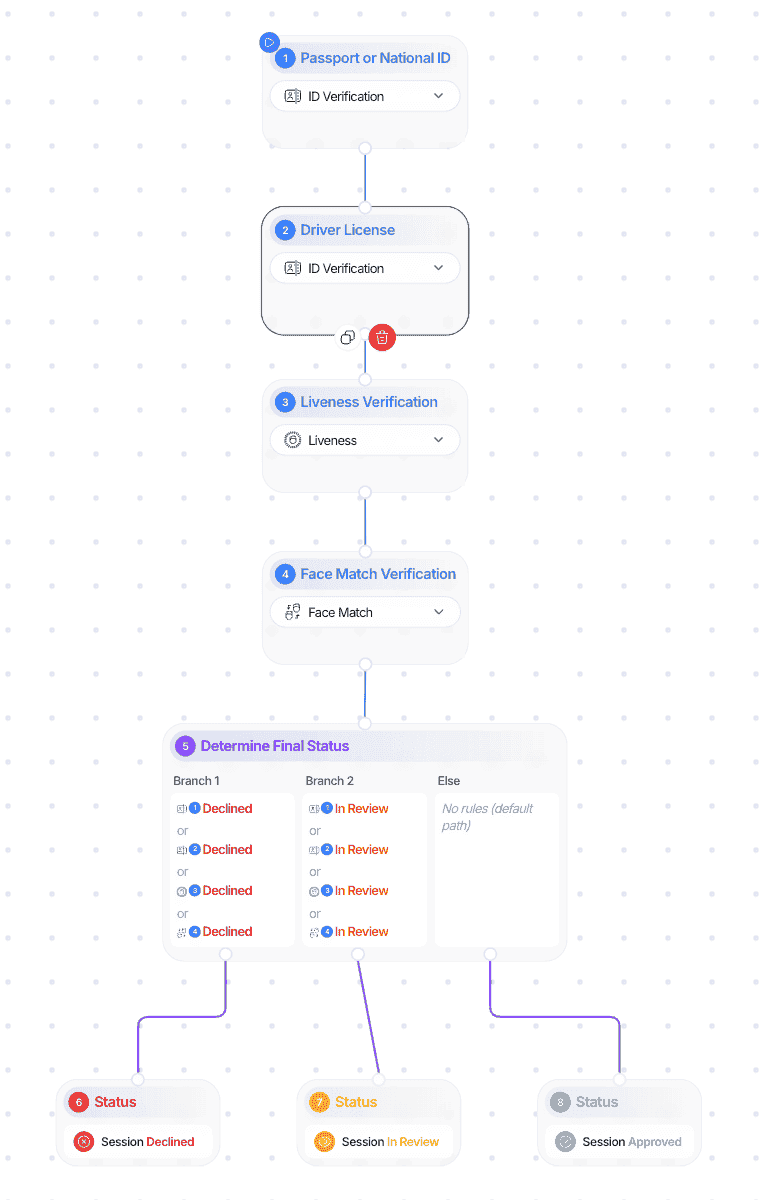
A Didit workflow: document, liveness and face match, then one decision step that routes each session to declined, in review or approved.
See the workflow orchestrator, ID verification, database validation and AML screening.
Integration and switching
Didit connects through a hosted link, an iframe or the JavaScript SDK on the web, and iOS, Android, React Native and Flutter SDKs on mobile.[23][24] The fastest start is a hosted link: create a session, send the user to its URL, read the webhook. There is no server to migrate, and you can run both vendors side by side.
- List what MegaMatcher ID does for you today: enrolment, liveness, 1:1 verification, voice or fingerprint.
- Rebuild the flow in the workflow builder, pick a liveness method, set thresholds and the duplicate-face action.
- Route a share of new users to Didit and compare pass rates, review workload and total cost.
How Didit helps teams comparing Neurotechnology
Didit gives you liveness with its full evidence, face search, document checks and AML screening as one hosted service, with a published price per check. Start from the liveness detection page, or see every vendor we compare on the switch to Didit page.
Didit provides
- Liveness with its full evidence
- Face search, duplicates and blocklist
- Servers, scaling and model updates
- Document checks and AML screening
Stays with you
- Your risk assessment and policies
- The decision to onboard a customer
- The thresholds and actions you set
- Reports to your financial intelligence unit
See the evidence behind every liveness check
Run your own selfies through Didit's liveness methods in the sandbox and read the score, warnings and face matches yourself.
Key takeaways
- Neurotechnology sells MegaMatcher ID as an SDK and on-premise web service with published euro prices; Didit is a hosted API priced per check.
- Didit returns the evidence of each liveness check and runs duplicate and blocklist checks on every selfie.
- Neurotechnology leads on Level 2 PAD testing, voice and fingerprint, and on-device data.
Frequently asked questions
What is the main difference between Didit and Neurotechnology?
The operating model. Neurotechnology licenses biometric engines you install and run, with transactions counted on your servers. Didit is a hosted API that runs the verification and returns the evidence of every check.[1][4][14]
How much does Neurotechnology MegaMatcher ID cost?
Neurotechnology publishes its prices: €2,990 for the SDK, €2,590 for the web service component, and transaction licences such as Face LIT at €0.35 each from 1,000 licences, down to €0.03 from 512,000, in packs of at least 1,000. Prices exclude taxes and duties.[3]
How much does Didit liveness cost?
In a workflow, passive liveness is $0.10 and active liveness $0.15 per check. A full ID check with document, passive liveness, face match and device and IP analysis is $0.33.[12]
Do I need my own servers to use MegaMatcher ID?
Yes. The web service component is an on-premise installation, and transaction licences are counted on your servers, with at least two USB dongles plugged in.[1][4]
Which has the stronger liveness certification?
Neurotechnology: BixeLab evaluated its liveness to ISO/IEC 30107-3 Level 2, and iBeta tested it at Level 1 in 2022. Didit holds iBeta Level 1 and a Spanish regulator attestation for its NFC and liveness verification.[7][8][21]
Does Neurotechnology do document verification or AML screening?
Not listed on neurotechnology.com (checked 24 October 2026). The biometric products there cover face, fingerprint, iris, voice and palmprint. Didit runs document checks and AML screening on the same API.[10][12]
Does Didit detect duplicate accounts and banned users?
Yes. Face search runs inside every liveness check against your approved sessions and your face blocklist, and a blocklisted face declines the session.[16][17]
Is Didit a good Neurotechnology alternative?
For teams that want liveness without running software, the evidence of every check and the rest of KYC on one API, yes. For voice or fingerprints, a Level 2 PAD evaluation or data kept on the device, Neurotechnology fits better.[1][7]
Sources
- MegaMatcher ID, Neurotechnology, checked 24 October 2026.
- MegaMatcher ID technical information and specifications, Neurotechnology, checked 24 October 2026.
- MegaMatcher ID prices, Neurotechnology, effective 3 March 2026, checked 24 October 2026.
- MegaMatcher ID licensing model, Neurotechnology, checked 24 October 2026.
- MegaMatcher ID product contents, Neurotechnology, checked 24 October 2026.
- Certificates, Neurotechnology, checked 24 October 2026.
- Letter of confirmation, ISO/IEC 30107-3 PAD Level 2 evaluation, BixeLab, linked from neurotechnology.com, checked 24 October 2026.
- PAD Level 1 conformance letter, iBeta, 19 August 2022, linked from neurotechnology.com, checked 24 October 2026.
- Technology awards, Neurotechnology, checked 24 October 2026.
- Biometrics products and use cases, Neurotechnology, checked 24 October 2026.
- Company information, Neurotechnology, checked 24 October 2026.
- Pricing, Didit docs, read 24 October 2026.
- Liveness detection, Didit docs.
- Liveness report, Didit docs, read 24 October 2026.
- Liveness warnings, Didit docs, read 24 October 2026.
- Face Search 1:N, Didit docs, read 24 October 2026.
- Blocklist users, Didit docs, read 24 October 2026.
- Workflows, Didit docs, read 24 October 2026.
- Age estimation, Didit docs, read 24 October 2026.
- AML screening overview, Didit docs.
- Certifications and attestations, Didit docs.
- Security and compliance, Didit docs.
- Web SDKs overview: JavaScript SDK, iframe and redirect, Didit docs.
- Native SDKs overview, Didit docs.
- Face match, Didit docs.
- New pricing from 1 November 2026, Didit blog, read 24 October 2026.
- KYB registry pricing, Didit docs.
- Transaction monitoring overview, Didit docs.
To see the liveness methods, the evidence each check returns, and the face search that runs with them, start from the liveness detection page.
Replace a licence rollout with an API call
Start in the sandbox with your own users' selfies and documents, or talk to us about your volumes.
مقالات ذات صلة
- Didit مقابل Nametag: API لـ KYC العملاء مقابل التحقق من هوية الموظفين
- Didit vs Paravision: a hosted KYC API against liveness components
- Didit مقابل BioID: مسار KYC مستضاف في مواجهة واجهة API للقياسات الحيوية
- Didit مقابل AuthenticID: ما الذي تغيّر بعد Incode، والخيارات المتاحة
- Didit vs ID R&D: IDLive Face liveness or a hosted KYC API
- Didit مقابل Keyless: التحقق من المستخدمين الجدد مقابل تسجيل الدخول البيومتري