Document Liveness Detection: How Didit Stops Screen and Print Fraud
Document liveness detection inside Didit ID Verification flags screen replays, printed copies and portrait manipulation, at $0.20 per standalone API check or $0.15 as a workflow document check.
 Alberto RosasCo-founder and CEO
Contents
In this guide
Jump to the part you need.
We run document liveness inside ID Verification for teams that accept photos of identity documents. It screens for screenshots, photos of IDs displayed on screens, printed copies and altered portraits. ID Verification costs $0.20 per standalone API check or $0.15 per workflow document check. On the standalone API, a detected attack returns Declined. If the requested check produces no usable score, the result is In Review unless another warning already requires a decline.
Last updated: November 26, 2026. Prices checked against the live Didit price feed on November 26, 2026.
| Item | Detail |
|---|---|
| What the liveness screen flags | Screen replays, printed copies and portrait manipulation. Published document images, specimen documents, expiry and unknown document design are separate endpoint decline reasons listed below. |
| Where it runs | Inside ID Verification: POST /v3/id-verification/, or the ID_VERIFICATION step of a hosted session |
| Switch | perform_document_liveness=true, which is the default on the standalone endpoint |
| Price, standalone API | $0.20 per ID Verification API check |
| Price, workflow step | $0.15 per ID document check |
| On a hit, standalone API | status: "Declined" with a terminal warning such as SCREEN_CAPTURE_DETECTED |
| When the check cannot run | When enabled document liveness produces no usable score, an otherwise approvable HTTP 200 response returns In Review with DOCUMENT_LIVENESS_NOT_COMPUTED. Any existing Declined decision takes precedence. |
| ID Verification coverage | 14,000+ document types across 220+ countries and territories |
Start free in the sandbox at https://business.didit.me/ with no sales call. For developers, connect Didit to an AI assistant through https://didit.me/developers/mcp/.

Why a photograph of a document proves less than it looks
A screenshot or printed copy can preserve readable text and a valid MRZ. A replaced portrait can leave the text fields intact. OCR can read those fields without establishing how the image was produced.
That is the gap document liveness closes. It is a check on the image itself, not on the data inside it, which is why it runs alongside OCR rather than instead of it. Read a warning as a signal about the image rather than a finding of fact: the image was flagged as a possible screen photo, or a possible printed copy, or a portrait that may have been manipulated. On the standalone API that flag returns Declined, and your policy decides what happens to the account.
What document liveness detection checks
When perform_document_liveness=true, the submitted images are screened for screen replays, printed copies and portrait manipulation. Each type carries its own terminal warning code. These screens are one part of Didit ID Verification, which reads and authenticates government-issued documents across 14,000+ document types.
| What was submitted | Warning | Decision |
|---|---|---|
| A screenshot, or a camera photo of a document displayed on a phone or monitor | SCREEN_CAPTURE_DETECTED | Declined |
| A printed or photocopied document photographed with a phone | PRINTED_COPY_DETECTED | Declined |
| A real document with a swapped or generated portrait | PORTRAIT_MANIPULATION_DETECTED | Declined |
Other codes come back from the same endpoint but are not established as controlled by the liveness switch. Treat them as separate endpoint decline reasons.
| What was submitted | Warning | Decision |
|---|---|---|
| A document image flagged as publicly available. | PUBLIC_DOCUMENT_IMAGE_DETECTED | Declined |
| A sample or specimen document | SPECIMEN_DOCUMENT_DETECTED | Declined |
| An expired document | DOCUMENT_EXPIRED | Declined |
| A front image that matches no known official design with high confidence | COULD_NOT_DETECT_DOCUMENT_TYPE | Declined |
| Enabled document liveness with no usable score, on an otherwise approvable request | DOCUMENT_LIVENESS_NOT_COMPUTED | In Review, unless a Declined decision already applies |
The same call classifies the document automatically against known official designs, reads the visual zone with OCR, and decodes the MRZ and any barcodes. The standalone API checks dates, number formats and MRZ check digits and compares the visual zone with the MRZ. An invalid MRZ causes a decline when invalid_mrz_action is set to DECLINE.
In ID Verification's Advanced Analysis, we also use tamper detection, template matching and security-feature validation, including holograms and watermarks.
Inside a hosted workflow the thresholds are configurable per fraud type, screen replay, printed copy and portrait replacement, with a Forgery tab on the session in the Didit Business Console. The standalone endpoint has three configurable risk groups: invalid_mrz_action, inconsistent_data_action and expiration_date_not_detected_action. Each accepts DECLINE or NO_ACTION. Terminal warnings always decline. Informational warnings never decline on their own.
Prerequisites
- A Didit application and an API key, created at https://business.didit.me/. Sandbox testing is free and unlimited.
- A front image of the document, uncropped, with all four corners visible. The service detects, aligns and crops the document itself, so do not pre-crop.
- A back image for two-sided documents such as ID cards and driver licences.
- Files in tiff, jpg, jpeg, png, webp or pdf, up to 5 MB each.
- For production calls, your organization needs sufficient credit. Each HTTP 200 response consumes one ID Verification API credit. A 403 for insufficient balance comes back before any image processing.
- Decide the route first. Use the standalone call when you already hold the images server to server. Use a hosted session when the end user photographs the document in a Didit flow, and the
ID_VERIFICATIONstep runs ID Verification inside the workflow.
How to run document liveness detection, step by step
- Create the application and copy the API key. The key goes in the
x-api-keyheader on every call. Keep it server side. - Capture an honest image. Send an uncropped photo with all four corners visible. Include the back image for a two-sided document. Ask the user for a single document on a flat surface in ordinary light, not a screenshot and not a photo of a monitor.
- Send the request with document liveness switched on. The parameter defaults to true on this endpoint, but send it explicitly so the intent is visible in your code:
curl -X POST 'https://verification.didit.me/v3/id-verification/' \
-H 'x-api-key: YOUR_API_KEY' \
-F 'front_image=@./id_front.jpg' \
-F 'back_image=@./id_back.jpg' \
-F 'perform_document_liveness=true'
perform_document_liveness is the standalone field that controls document liveness. The longer example in the docs also sends policy fields that change decision behavior rather than the screen itself: invalid_mrz_action, inconsistent_data_action and expiration_date_not_detected_action, each set to DECLINE or NO_ACTION, plus minimum_age and preferred_characters. It also passes vendor_data, an optional caller-supplied value.
Persistence has its own switch. save_api_request defaults to true, and with it the call is stored as an API-type session in the Business Console, the cropped document and portrait images are returned as short-lived media URLs, a status.updated webhook fires, and request_id is a real session id you can pass to GET /v3/session/{sessionId}/decision/. Setting save_api_request=false skips persistence and makes request_id a correlation id.
- Read
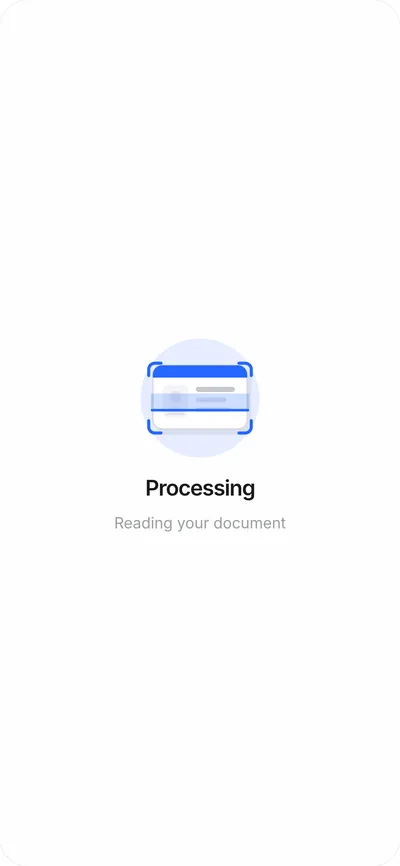
statusbefore anything else. The values areApproved,In RevieworDeclined. Do not branch on the HTTP code alone: a readable but fraudulent document returns HTTP 200 with aDeclinedstatus. - Read the
warningsarray. Fraud and hard failures decline. Warnings such asPOSSIBLE_DUPLICATED_USERare informational and never decline on their own. - Route
In Reviewto a human. That status covers an enabled liveness check that produced no usable score. It is not a pass and it is not configurable away. - Handle the three routes. HTTP 200 means inspect
id_verification.statusandid_verification.warnings. HTTP 400 withCOULD_NOT_RECOGNIZE_DOCUMENTmeans request a new capture. HTTP 403 means resolve the balance before retrying, because the refusal comes before any image processing.
Expected output
The response carries a status, the extracted fields and the warning list. The documented field outline is this one, and the full schema is in the docs.
{
  request_id,
  id_verification: {
    status,
    full_name,
    document_type,
    document_number,
    date_of_birth,
    expiration_date,
    parsed_address,
    mrz,
    barcodes,
    portrait_image,
    front_document_image,
    back_document_image,
    warnings: [...],
  },
}
On HTTP 200, inspect id_verification.status and id_verification.warnings. Handle HTTP errors using their error bodies. The warning codes and their meanings are in the two tables above. A document that cannot be processed at all never reaches this shape: it returns HTTP 400 with {"error": "COULD_NOT_RECOGNIZE_DOCUMENT"}.

Failure cases and recovery
| Symptom | Cause | Recovery |
|---|---|---|
HTTP 400 COULD_NOT_RECOGNIZE_DOCUMENT | The image cannot be processed at all | Ask for a new capture with all four corners visible. Do not retry the same file. |
| HTTP 400 multipart validation error | Missing back_image on a two-sided document, file over 5 MB, unsupported extension | Fix the payload. Check the extension and the size before sending. |
| HTTP 403 not enough credits | Balance cannot cover the call | Top up or move to a plan with credit. The refusal happens before any image processing. |
200 Declined with SCREEN_CAPTURE_DETECTED | The image was flagged as a possible screen photo | Do not approve. Ask for a photo of the original document from the device camera, then review the account per your policy. |
200 Declined with PRINTED_COPY_DETECTED | The image was flagged as a possible printed or photocopied document | Do not approve. Ask for a photo of the original document and review before any retry. |
200 Declined with PORTRAIT_MANIPULATION_DETECTED | The portrait was flagged as swapped or generated | Do not approve. Treat it as suspected impersonation and send it to fraud review. |
200 Declined with PUBLIC_DOCUMENT_IMAGE_DETECTED or SPECIMEN_DOCUMENT_DETECTED | The image was flagged as a published or sample document | Do not approve. Escalate to fraud review. |
200 In Review with DOCUMENT_LIVENESS_NOT_COMPUTED | The enabled forgery check returned no usable score. | Send to your manual review queue. Do not approve and do not treat the silence as a pass. |
200 Declined with COULD_NOT_DETECT_DOCUMENT_TYPE | The front image matches no known official design with high confidence | Ask for a better capture. If it repeats, treat the document as unverified. |
200 Approved with informational warnings | Soft signals such as a possible duplicate | Apply your own policy. These never decline on their own. |
For a screen or printed-copy warning, ask the applicant to photograph the original document. For an unreadable capture, ask for an uncropped retake with all four corners visible.
Inputs and outputs of the standalone call
| Name | Direction | What it does |
|---|---|---|
front_image | Input, required | The front of the document, uncropped, all four corners visible |
back_image | Input, conditional | Required for two-sided documents such as ID cards and driver licences |
perform_document_liveness | Input, default true | Screens the images for screen replays, printed copies and portrait manipulation. Set false to skip it. |
invalid_mrz_action | Input | DECLINE or NO_ACTION when the MRZ does not validate |
inconsistent_data_action | Input | DECLINE or NO_ACTION when the visual zone and the MRZ disagree |
expiration_date_not_detected_action | Input | DECLINE or NO_ACTION when no expiry date can be read |
minimum_age | Input | Age floor applied to the date of birth read from the document |
save_api_request | Input, default true | Persists the call as an API-type session with stored images and a webhook. False skips persistence. |
status | Output | Approved, In Review or Declined |
warnings | Output | Every issue found, each with a risk code and a log type |
full_name, document_number, date_of_birth, expiration_date, parsed_address | Output | Extracted document fields. The API cross-checks visual-zone data against the MRZ where comparable data is available. |
portrait_image, front_document_image, back_document_image | Output | Short-lived media URLs for the crops the service made, when persistence is on |
request_id | Output | The session id when persistence is on, a one-off correlation id when save_api_request=false |
The docs example also sends vendor_data, an optional caller-supplied value shown in that example. Register the person and bind sessions with vendor_data on Create Session, where the duplicate-detection behavior is documented.
Paid steps and review boundaries
In production, each HTTP 200 response consumes one ID Verification API credit at the $0.20 USD list price, including Declined and In Review results. Sandbox testing is free. The document liveness screen has no separate line in the price book: it runs inside that check, so switching it off saves nothing. In a hosted workflow the same step is $0.15. The workflow orchestrator, the SDKs and the MCP server carry no fee.
The review boundary is explicit in the status field. Declined is a machine decision and you should not overturn it in code. Approved means no warning required a decline and the request did not enter review. Informational warnings can still appear. If enabled document liveness produces no usable score, route In Review to manual review. That escalation is not configurable: Didit will not let a check that did not run look like a clean one.
Worked cost example
Assume 5,000 document checks a month through the standalone ID Verification API, each with document liveness on.
- Per check: $0.20. Monthly: 5,000 x $0.20 = $1,000.00.
- Free plan credit of $10.00 covers $10.00 / $0.20 = 50 checks, so the first 50 of the month cost nothing for an eligible organization.
- On the Scale plan the Didit price is 10% lower: $0.20 x 0.90 = $0.18, so 5,000 x $0.18 = $900.00 in discounted usage before the plan fee and any included credits. The difference in usage charges against the list-price figure is $1,000.00 - $900.00 = $100.00.
- If the same 5,000 documents went through a hosted workflow as an ID document step at $0.15: 5,000 x $0.15 = $750.00.
- Add biometrics and device checks and the per-check figure is the full KYC bundle: $0.15 ID document + $0.10 passive liveness + $0.05 face match + $0.03 device and IP analysis = $0.33. At 5,000 checks: 5,000 x $0.33 = $1,650.00.
The live price feed is the only place to quote from. Read it at https://didit.me/pricing/ or as JSON at https://didit.me/pricing.json.
Document liveness is not face liveness
Document liveness screens the submitted image of the ID for spoofing signals. Face liveness asks whether a real person was in front of the camera, and it has its own modes and prices: passive liveness at $0.10, active liveness at $0.15, with 3D flash and 3D action available in hosted flows. They catch different attacks. A screen replay of a document and a deepfake of a face are separate frauds that need separate checks, which is why the full KYC bundle runs both.

What this check does not do
- It does not repair a bad capture. If the image is unreadable, the answer is a retake, not a different threshold.
- It does not replace face match. A genuine document can belong to someone other than the applicant, and face match is the separate check for that.
- It does not decide your policy on a possible duplicate. Informational warnings are yours to act on.
- It does not produce the workflow-only warnings on the standalone endpoint.
MRZ_NOT_DETECTED,INVALID_DATEandPORTRAIT_IMAGE_NOT_DETECTEDexist in workflow sessions but are never produced byPOST /v3/id-verification/.
Sources
- Didit docs: ID Verification API, document OCR and authenticity
- Didit docs: ID Verification overview
- Didit docs: ID Verification methods, document, lookup and wallet
- Didit docs: ID Verification warnings catalogue
- Didit docs: Liveness detection overview
- Didit docs: Create Session API
- Didit ID Verification product page
- Didit pricing page and pricing as JSON, read November 26, 2026
- Didit docs: pricing and billing rules
- Didit MCP server
Open the free sandbox, create an application and submit a test document with perform_document_liveness=true. Check the returned status and warnings. No sales call is required.
Try it
Try this in the sandbox
Run the check this guide describes, free.
The product this post is about, taken from its topic. Run it free in the sandbox.
Author
Alberto Rosas
Co-founder and CEO

Keep reading
Other guides in the same topic.
 Didit bank data pricing: sign-in, balance and transaction costs
Bank sign-in starts at $0.45 and account checks at $0.45 per answered check. In the UK and Europe a one-time sign-in is $0.79, plus $0.35 per balance read and $1.30 per transaction read. Incomplete links and sandbox are free.
Alberto RosasNov 26, 2026 Didit API: Read UK Accounts, Balances and Transactions
Create a Didit Bank Link for a one-time read from 122 UK banks. Send the account holder to the returned URL, confirm completion on your server, then fetch the shared accounts, balances and transactions.
Alberto RosasNov 26, 2026 How to Add Passkey Sign-In to an iOS App with the Didit Auth SDK
In DiditAuth 4.15.4, sign in on the hosted page, then call registerPasskey while the session is at most five minutes old. Returning users call signInWithPasskey. Test on a physical iPhone.
Alberto RosasNov 26, 2026Questions
Frequently asked questions
What is document liveness detection?
It is a check inside Didit ID Verification that screens a submitted document photo for spoofing signals: screen replays, printed copies and portrait manipulation. It is a check on the image, not on the data inside it, so it runs alongside OCR rather than instead of it. You switch it on with perform_document_liveness=true on POST /v3/id-verification/, where it is the default.
Can document liveness detect an ID screenshot, a photo of a screen, or a printed copy?
Didit document liveness screens for direct screenshots, camera photos of IDs displayed on screens, and printed copies. When the standalone API flags a screen replay, it returns SCREEN_CAPTURE_DETECTED. When it flags a printed copy, it returns PRINTED_COPY_DETECTED. Either warning triggers HTTP 200 with id_verification.status set to Declined.
How much does document liveness detection cost?
We include document liveness in ID Verification. In production, the standalone API consumes one credit per HTTP 200 response at a USD list price of $0.20, including Declined and In Review results. A workflow ID document check has a USD list price of $0.15, and sandbox testing is free. Turning off document liveness leaves the check price unchanged.
Is perform_document_liveness on by default?
Didit enables perform_document_liveness by default on POST /v3/id-verification/. The images are screened for screen replays, printed copies and portrait manipulation. Setting it to false skips the check and the status then follows the remaining warnings, which is a policy choice rather than a saving.
What do SCREEN_CAPTURE_DETECTED and PRINTED_COPY_DETECTED mean?
SCREEN_CAPTURE_DETECTED means the submitted image was flagged as a document displayed on a screen, which covers a direct screenshot and a camera photo of a monitor or phone. PRINTED_COPY_DETECTED means the image was flagged as a printed or photocopied document. Both are terminal warnings on the standalone API and both return status: "Declined". Do not approve the user on either code.
What happens when the document liveness check cannot run?
When enabled document liveness produces no usable score, an otherwise approvable HTTP 200 response returns In Review with DOCUMENT_LIVENESS_NOT_COMPUTED. Any existing Declined decision takes precedence. Route the session to manual review, because a check that did not run is not evidence that the document is genuine.
Does it catch a digitally edited portrait on a genuine document?
Didit document liveness screens for digitally altered ID portraits. Portrait manipulation is one of the three signals the screen reports, and a hit returns PORTRAIT_MANIPULATION_DETECTED with status: "Declined" on the standalone API. The rest of the document can be genuine, with a valid MRZ and correct data, while the face belongs to someone else.
What is the difference between document liveness and face liveness?
Document liveness screens the submitted image of the ID for spoofing signals. Face liveness checks the person in front of the camera, using passive, 3D flash or 3D action methods, and is priced separately at $0.10 for passive and $0.15 for active. A full KYC bundle at $0.33 includes the document step, passive liveness, face match and device and IP analysis.
Which file types and sizes does the call accept?
Didit's standalone ID Verification API accepts TIFF, JPG, JPEG, PNG, WebP and PDF files up to 5 MB each. The front image is required and the back image is required for two-sided documents. Send an uncropped photo with all four corners visible, because the service detects, aligns and crops the document itself.
Why did one bad document return HTTP 400 and another return Declined?
A document that cannot be processed at all returns HTTP 400 with {"error": "COULD_NOT_RECOGNIZE_DOCUMENT"}. A readable document that trips a fraud check returns HTTP 200 with status: "Declined". On HTTP 200, inspect id_verification.status and id_verification.warnings. Handle HTTP errors using their error bodies.
Can I test document liveness detection before paying?
You can test Didit document liveness for free in the Didit sandbox. Sandbox testing is free and unlimited and nothing is charged in sandbox. You get a key from an application created at https://business.didit.me/, and the Free plan adds $10.00 of monthly credit for eligible organizations, which is 50 standalone ID Verification API checks at $0.20.
How does document liveness fit into the document step?
Document liveness is part of ID Verification. The standalone check extracts document data, decodes any MRZ and barcodes, runs document fraud checks and returns a status with warnings. In a hosted workflow, face liveness and face match can run as separate steps if configured.
Compliance built in
Audited, certified and attested.
We hold the certifications and build each country's rules into your flows, so you can launch anywhere without worrying. Security and Compliance center
- Regulation encoded into your flows
Tell us what you do and where. Didit lists the rules that apply to you, with sources, and builds the checks each country needs into one workflow.
- Ready for AMLR
Every requirement of the new EU anti-money laundering rules, from checking customers to human review, is already covered by a Didit check.
- Tested in Spain's Treasury sandbox
Spain's Treasury published its supervised sandbox report on Didit's NFC plus active liveness onboarding; SEPBLAC took part and valued the added measures positively.
- Audited, not self-declared
iBeta Level 1 and Level 2. Liveness tested under ISO/IEC 30107-3.
Your obligations · 3 regions
 SOC 2 Type 2
 ISO 27001
 iBeta Level 1 and Level 2
 EU regulator attestation
 FSM youth protection
 GDPR
 EBA remote onboarding
 MiCA compatible
 FIDO Alliance member
- AMLREU AML Regulation ready
Integration · Didit MCP
Run Didit from your own AI agent
Connect Didit to Claude, Cursor, VS Code or ChatGPT and just ask in plain words. Your agent can do anything you can do in the console, with the same permissions you have.
 Add to Claude
 ChatGPT
 Cursor
- Build workflowsDescribe the checks you need. The agent creates and publishes the flow.
- Run investigationsAsk why a session was declined, review cases, search people and companies.
- Change rulesCreate payment rules, test them on past data and switch them on.
- Pull reportsAsk for numbers, exports or the audit log.
Didit Academy


