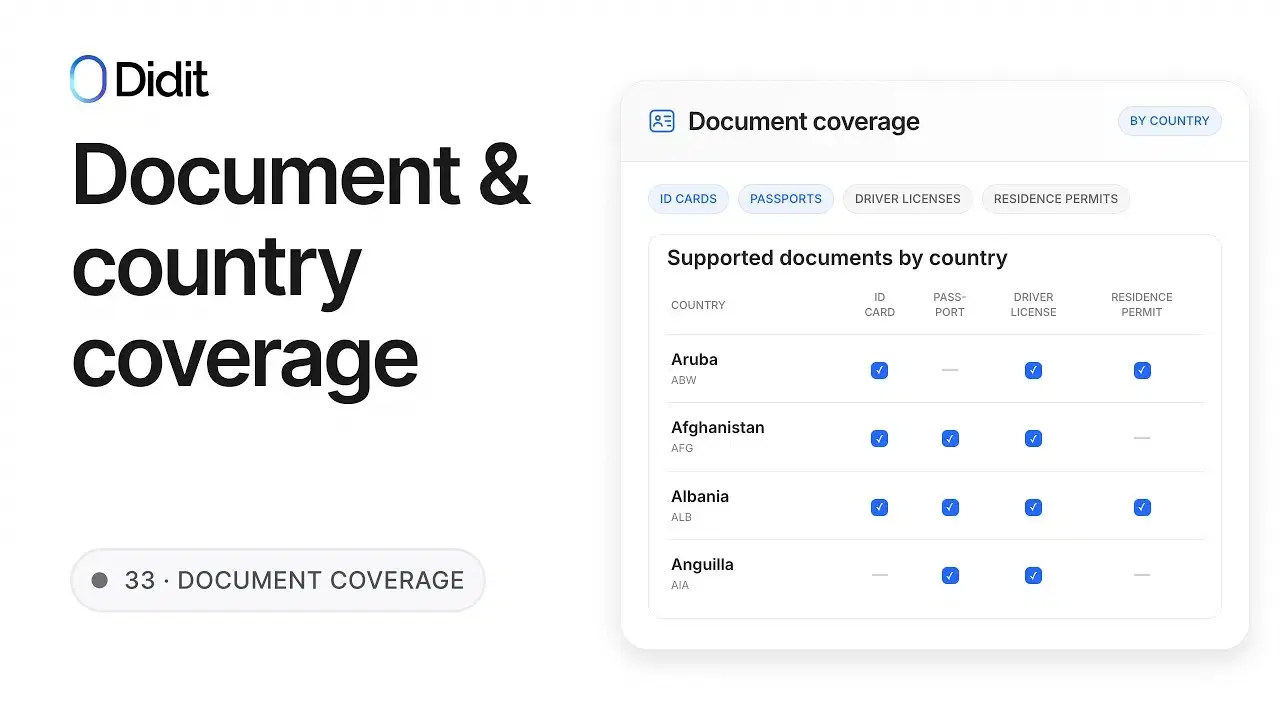
Didit KYC Coverage: 220+ Countries, 14,000+ Documents
We verify identities from 220+ countries and territories across 14,000+ document types in 54 languages, at $0.15 per document check inside a workflow and $0.33 for a full KYC check.
 Alberto RosasCo-founder and CEO
Contents
In this guide
Jump to the part you need.
We verify identity documents from 220+ countries and territories, read 14,000+ document types and run our capture flow in 54 languages. This page is for teams checking whether their countries are covered and what a check costs. We charge $0.15 per document check in a workflow and $0.33 per full KYC check. The caveat: a published price does not establish that a non-document method is live in a country, so read the tables before you promise coverage.
Last updated: November 26, 2026. Prices checked against the live Didit price feed on November 26, 2026.
Coverage at a glance
| Item | What we publish |
|---|---|
| Countries and territories | 220+ |
| Document types | 14,000+ |
| Capture and flow languages | 54 |
| Document-recognition languages | 130+ across 50+ scripts |
| Document types accepted | Passports, national ID cards, driver's licences, residence permits |
| ID document check | $0.15 in a workflow, $0.20 through the standalone API |
| Full KYC check | $0.33 (ID $0.15 + passive liveness $0.10 + face match 1:1 $0.05 + device and IP $0.03) |
| Non-document lookup | Variable per country and service, priced per check |
| Digital ID wallets | Available wallets listed in the feed: $0.10 to $0.95 per completed verification. Check availability in your environment. |
| Inference latency | p99 under 2 seconds; full KYC flows complete in under 30 seconds |
| Government data sources | 1,000+ |
| Free plan | Sandbox testing is free and unlimited on every plan. On Free, the first organization created for a company domain with an eligible work email gets $10 in monthly credit, excluding phone verification. |
Start free in the sandbox at https://business.didit.me/, no sales call and no procurement cycle. If you are wiring Didit into an AI assistant, connect the hosted MCP server at https://didit.me/developers/mcp/. The product is User Verification (KYC), the technical detail is in the ID Verification docs, and every rate is on https://didit.me/pricing/.
Country and document coverage: how to check yours
Document capture covers 220+ countries and territories and 14,000+ document types. The four categories supported overall are passports, national ID cards, driver's licences and residence permits. The accepted types, subtypes and capture rules are configured per country through documents_allowed, so a 14,000+ total does not mean every subtype is switched on in your workflow.
Check three things before you promise coverage: the issuing country, the document type and the subtype. Open the workflow, select the ID Verification node, then Countries, and read what that country accepts. Test an authorized specimen for each document subtype you plan to accept, and read the document type, the extracted fields and the warnings that come back. The document reference sits in the ID Verification docs, and the wallet side is in the digital ID wallet catalog.
The three methods we offer in a country
ID Verification is one feature with three methods. You choose which methods a country may use, and the session records the method that actually produced the result (see verification methods).
| Method | What the person does | Assurance tier | Price |
|---|---|---|---|
| Document capture | Photographs a passport, ID card, driver's licence or residence permit | documentary | $0.15 per check in a workflow, $0.20 through the standalone API |
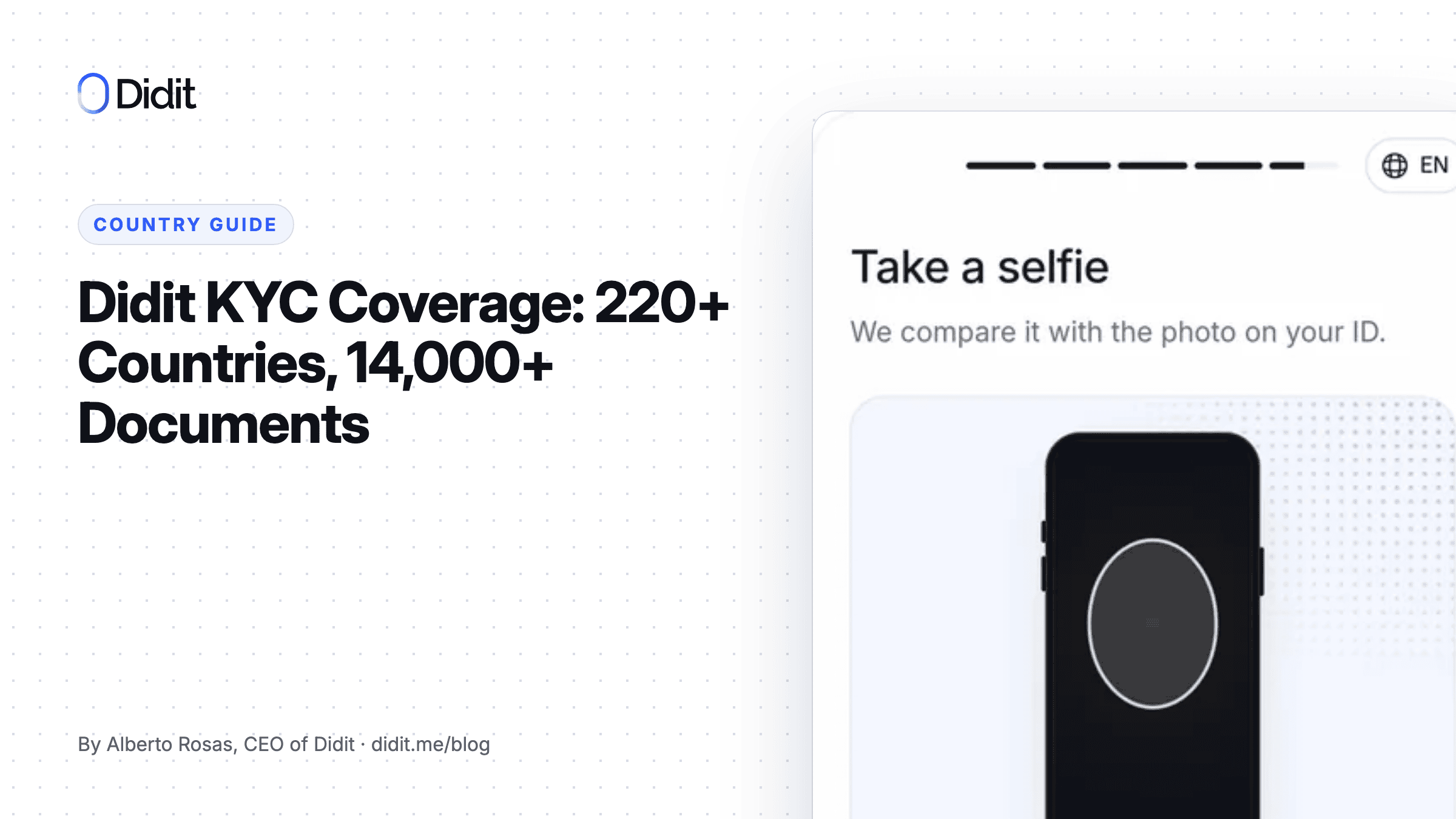
| Non-document lookup | Types a national ID number plus a few details, checked against the authoritative source for that country | data_match | Variable per service |
| Digital ID wallet | Signs in with a government or bank digital identity | cryptographic | Available wallets listed in the feed: $0.10 to $0.95 per completed verification. Check availability in your environment. |
The tier is an honest label for what was proven, not a ranking. documentary means a physical document was captured, read and checked for authenticity. data_match means the details matched a record held by the source that was queried, and no document was inspected. cryptographic means an identity provider authenticated the person and signed the attributes. End users never see the tier, the price or the source name. You can see the assurance tier and, for lookups, the source name in the console and in exports.

What a KYC check has to prove
FATF Recommendation 10(a) calls for verifying customer identity using reliable, independent documents, data or information (FATF Guidance on Digital Identity, read November 26, 2026). In the United States, 31 CFR 1020.220 requires covered banks to maintain a written, risk-based Customer Identification Program (eCFR 31 CFR 1020.220, read November 26, 2026). Check your applicable requirements before choosing a verification method.
The same guidance, published in March 2020, says non-face-to-face identification relying on reliable, independent digital ID systems with appropriate risk mitigation measures may present a standard level of risk, and may even be lower-risk (FATF Guidance on Digital Identity, read November 26, 2026).
Where the coverage applies beyond onboarding
We support onboarding, re-verification and employee identity checks. Reusable KYC is included free. For biometric two-factor authentication, we offer a separate Biometric Authentication check priced at $0.10 per authentication.
Non-document lookup: country examples and the sources queried
Document capture works in every country we support. Lookup is narrower, and the source matters more than the country label. Most countries use a government register: the Department of Home Affairs in South Africa, RENAPER in Argentina, UIDAI in India, the CPR register in Denmark (see non-document lookup).
Some do not. In Canada, France, Indonesia, the Netherlands, Norway, Singapore, the United Kingdom and the United States, the authoritative record we can reach is a credit-bureau, financial-services, utility or residential-records file rather than a state register. That changes what the match proves and what you can tell a regulator about provenance. We name the exact source per country in the docs and on the session payload at id_lookup.source. Check the exact source and its documented consent requirements before enabling the lookup.
Two kinds of lookup involve a selfie and they are not the same. Where the source returns the holder's portrait, as the Department of Home Affairs does in South Africa, the user is asked for a selfie, passive liveness runs on it and it is face-matched to the registry portrait, all inside the lookup price. Where the source checks the selfie itself and returns a verdict, as Brazil, Argentina's RENAPER, the documented Nigerian routes and Panama's Tribunal Electoral biometric service do, no portrait comes back, so any Liveness and Face Match steps you configured on that path still run.
Database Validation: the separate registry product
Database Validation is a separate product from the lookup inside ID Verification. It reaches 60+ live countries from $0.05 per check, and the named sources in the docs include RENAPER, Receita Federal through SERPRO, Tribunal Electoral, RENAPO, RENAP, RNP, RNPN, Junta Central Electoral, Registraduría Nacional, SEGIP, Servicio de Registro Civil, Tribunal Supremo de Elecciones and Dirección General de la Policía (see Database Validation). Rates run from $0.05 to $7.00 for the most expensive specialist sources, set per service rather than per country, and the exact rate for the service you plan to call is in the per-service pricing table.
Identifiers, formats and the fields we return
| What | Field or identifier | Format and notes |
|---|---|---|
| Universal identity number | identification_number | Mapped to CPF, RUT, CURP, DNI and others by issuing_state |
| Issuing country | issuing_state | ISO 3166-1 alpha-3, for example BRA |
| Country key for methods | methods object key | ISO 3166-1 alpha-3, for example ZAF or DNK |
| Document number | document_number | Extracted by OCR, cross-checked against MRZ and barcodes where those fields are present |
| Machine-readable zone | mrz | Decoded and validated; an invalid MRZ can be set to decline |
| Barcodes | barcodes | Decoded where the document carries one |
| Address | parsed_address | Parsed from the document where present |
| Portrait | portrait_image | Used as the reference for a later face match |
| Registry outcome | match_type | full_match, partial_match or no_match |
| Per-field registry detail | matched_fields, record_details | Inside each entry of validations[] |
| Source queried | id_lookup.source | Admin-facing only; for you and your auditors |
File formats for the standalone ID call are tiff, jpg, jpeg, png, webp and pdf, up to 5 MB per file, and images must be uncropped with all four corners visible. A dual-sided document such as an ID card or driver's licence requires back_image. On a completed session the result lands under the plural array id_verifications[], one entry per document collected, with full_name, document_type, document_number, date_of_birth, expiration_date, parsed_address, mrz, barcodes, the images, and a warnings[] array.
Use the document status and its warnings together. When the status is Declined, show the first warning's long_description and stop the flow. The standalone API supports explicit decline settings for invalid MRZ and inconsistent data. The full catalogue is in the risk catalogue. Per-document status is one of Not Started, In Progress, Approved, In Review, Declined, Abandoned or Kyc Expired.
Step by step in the Business Console
- Open Workflows, create or select a workflow, and add the ID Verification node. The canonical feature enum is
ID_VERIFICATION, withOCRkept as the legacy name. - Open the ID Verification node, then the Countries tab. Each row shows the methods that country accepts; pick a country to open its editor.
- Decide document capture, non-document lookup and wallets accepted for that country. Document capture also carries your accepted document types, subtypes and capture rules through
documents_allowed. - Set the fallback switches:
id_lookup.on_partial_match,id_lookup.on_no_match,id_lookup.on_provider_errorandwallet.on_failure. The switches are off whenever the country has no document capture, because there is nowhere to fall back to. - Use Global settings to turn a method on in every country that supports it, then switch it off in the one country where you do not want it. The per-country editor always wins.
- Save and publish. A country where you turned every method off is rejected on save, because that configuration cannot verify anybody, and a wallet marked Coming soon cannot be enabled at all.
- Start a session from that workflow and read the completed session to see which method and which source actually produced the result.

Step by step through the API
For a hosted flow, create a session with the workflow, open the returned session.url for the user or mount the Web or Mobile SDK, then fetch the decision. The decision returns the result under id_verifications[], one entry per document collected.
POST /v3/session/
{
  "workflow_id": "YOUR_WORKFLOW_ID",
  "vendor_data": "user-123",
  "callback": "https://your.app/webhooks/didit"
}

GET /v3/session/{sessionId}/decision/
For a one-shot server-to-server check, post the images to the standalone endpoint. It is billed at $0.20 per call, against $0.15 for the same step inside a workflow.
curl -X POST 'https://verification.didit.me/v3/id-verification/' \
  -H 'x-api-key: YOUR_API_KEY' \
  -F 'front_image=@./id_front.jpg' \
  -F 'back_image=@./id_back.jpg' \
  -F 'perform_document_liveness=true' \
  -F 'minimum_age=18' \
  -F 'expiration_date_not_detected_action=DECLINE' \
  -F 'invalid_mrz_action=DECLINE' \
  -F 'vendor_data=user-123'
A registry lookup uses the same key and the universal identity number field, with the country in issuing_state:
curl -X POST 'https://verification.didit.me/v3/database-validation/' \
  -H "x-api-key: $DIDIT_API_KEY" \
  -F 'issuing_state=BRA' \
  -F 'identification_number=00000000191' \
  -F 'first_name=Jane' \
  -F 'last_name=Doe' \
  -F 'date_of_birth=1990-01-15' \
  -F 'vendor_data=user-1234'
Omit services to run the country's default service only, or pass a list such as services=["bra_cpf"] to choose. Argentina (arg_renaper) and Panama (pan_sib) also take a selfie and gender for a biometric face match against the registry photo. Services flagged as requiring consent return HTTP 400 unless you send consent=true. Billing is per successful service hit, so a multi-service request can produce more than one usage event.
Worked cost example
Take a marketplace onboarding 20,000 people a year in a mix of countries: 18,000 complete a full KYC check and 2,000 only need the document read because liveness and face match already ran elsewhere. Annual usage at USD list prices, before plan credits and discounts:
- 18,000 full KYC checks x $0.33 = $5,940.00
- 2,000 document-only checks x $0.15 = $300.00
- Total = $6,240.00
Usage is paid from the month's plan credit first, then from top-ups, so the invoice you see depends on the plan you are on. Replace the 2,000 document-only checks with non-document lookups and the arithmetic changes per country, because those are priced per service rather than per country and the rate you read from the pricing table is the rate that applies.
When the source is down or returns no match
A lookup has three failure modes and each has its own switch. on_partial_match handles some fields matching and others not. on_no_match handles the record not being found. on_provider_error handles the source failing. Configure document fallback separately for partial matches, no matches and provider errors. Enable document capture for that country before turning on those fallback switches, because they are off whenever the country has no document capture and there is nowhere to fall back to.
A no-match means the lookup did not establish a match. Configure the country to fall back to document capture when available, or decline the verification under your policy. A partial match is not a pass either, so route it to review.
For the standalone registry call, HTTP 502 with a validation_errors[] body means every selected upstream service failed. That request is not billed, a COULD_NOT_PERFORM_DATABASE_VALIDATION log is written, and you can retry later or fall back to OCR only.
For document checks, a status of Declined carries one or more terminal warnings such as DOCUMENT_EXPIRED or DOCUMENT_LIVENESS_FAILED, and you should show the first warning's long description and stop. A status of In Review, including the DOCUMENT_LIVENESS_NOT_COMPUTED case where the forgery check produced no usable score, goes to manual review and is never auto-approved.
Face Match behaves differently. Without a reference photo, Face Match returns FACE_MATCH_NOT_COMPUTED with a null score. The step can send the case to review or decline it. The editor blocks publication when a country's only paths use methods that leave no photo and all routes lead to Face Match. It warns when only some users can reach Face Match without a photo.
Sources
- Didit docs: ID Verification API, 14,000+ documents
- Didit docs: ID Verification methods and assurance tiers
- Didit docs: configure ID Verification methods in the console
- Didit docs: non-document lookup
- Didit docs: digital ID wallets
- Didit docs: ID Verification warning catalog
- Didit docs: Database Validation
- Didit docs: Database Validation per-service pricing
- Didit docs: pricing and billing
- Didit pricing page and live price feed, read November 26, 2026
- Didit User Verification (KYC) product page
- Didit MCP server page
- FATF Recommendations, International Standards on Combating Money Laundering and the Financing of Terrorism and Proliferation, updated October 2025, read November 26, 2026
- FATF Guidance on Digital Identity, March 2020, read November 26, 2026
- eCFR 31 CFR 1020.220, Customer Identification Program requirements for banks, read November 26, 2026
- eCFR 31 CFR Part 1020, Rules for Banks, read November 26, 2026
Start free in the Didit sandbox without a sales call. Create a workflow, test the issuing countries and document variants you plan to accept, and inspect the returned fields and warnings.
Try it
Try this in the sandbox
Run the check this guide describes, free.
The product this post is about, taken from its topic. Run it free in the sandbox.
Author
Alberto Rosas
Co-founder and CEO

Keep reading
Other guides in the same topic.
 Auth0 Post-Login Action with Didit IDV: Step-by-Step
Didit runs as an OpenID Connect bridge for Auth0 post-login Actions, requiring a Didit check after Auth0 authenticates the user. PAR only, PKCE S256, a 5-minute single-use code, and FAILED when a review is open.
Alberto RosasNov 26, 2026 KYB Lite vs Shareholders vs UBO checks: what each tier costs
Lite returns the company profile and officers from $2. Shareholders adds direct owners and ownership bands from $5. UBOs resolves ultimate beneficial owners from $9. You pay the country rate for the tier delivered.
Alberto RosasNov 26, 2026 How to Build an AMLR-Compliant Onboarding Flow with Didit
Create a Didit session, receive the status.updated webhook, read the decision per check, let your compliance team approve or decline with update-status, then start AML monitoring.
Alberto RosasNov 26, 2026Questions
Frequently asked questions
How many countries does Didit support for KYC?
Didit supports 220+ countries and territories for identity verification, and document capture is available in every one of them. Non-document lookup and digital ID wallets are narrower and are enabled per country, so check the country editor before you promise a specific method in a specific market.
How many document types can Didit verify?
Didit reads 14,000+ document types. The categories are passports, national ID cards, driver's licences and residence permits, and the flow auto-detects the document type and issuing country before it reads the fields.
What languages does the Didit KYC flow support?
The verification flow and the native SDKs run in 54 languages, and the console itself is in 16 languages. Document recognition covers 130+ languages across 50+ scripts, which is a separate number from the flow languages.
How much does a Didit KYC check cost?
A full KYC check is $0.33 and is built from four published lines: ID document verification $0.15, passive liveness $0.10, face match 1:1 $0.05 and device and IP analysis $0.03. The ID document step alone is $0.15 inside a workflow or $0.20 through the standalone API, and registry lookups are priced per service.
Can Didit verify someone without a document?
Yes, on two documented routes. The first is an authoritative-source lookup, where the user types a national ID number and a few personal details and Didit checks them against the named source for that country. The second is a digital ID wallet sign-in, where the user authenticates with a government or bank identity and the provider shares signed attributes with Didit. Both are enabled per country, so check the country editor before you rely on either.
Which countries have non-document lookup in Didit?
Most countries Didit enables use a government register, such as the Department of Home Affairs in South Africa, RENAPER in Argentina, UIDAI in India or the CPR register in Denmark. In Canada, France, Indonesia, the Netherlands, Norway, Singapore, the United Kingdom and the United States the source is a credit-bureau, financial-services, utility or residential-records file, and Didit names that source per country in its documentation. Coverage is published per source rather than as one global list, so read the coverage and pricing table in the non-document lookup docs before you enable a country.
What happens if a registry lookup finds no match?
A no-match means the lookup did not establish a match. If document capture is enabled, you can configure on_no_match to offer it as a fallback. You can also configure a decline for a no-match, and the choice is set per country.
What is an assurance tier in Didit?
It is a label on the session describing what the method actually proved: documentary for a captured and checked physical document, data_match for a match against a source record, and cryptographic for a signed assertion from an identity provider. It is a description of evidence, not a ranking, and end users never see it.
Can Didit verify passports, driver's licences and residence permits?
Didit supports passports, national ID cards, driver's licences and residence permits overall. Those four categories are not a guarantee for every country and subtype, so check the issuing country, the document type and the subtype for your own workflow. Dual-sided documents need both the front and back image, and uploads must be uncropped with all four corners visible.
Which digital ID wallets does Didit support?
Available in production: MitID in Denmark at $0.25, BankID Sweden at $0.20, iDIN in the Netherlands at $0.95, the Finnish Trust Network at $0.25, Smart-ID at $0.21 in Estonia, Latvia, Lithuania and Belgium, Mobile-ID at $0.21 in Estonia and Lithuania, Bank iD in Czechia at $0.20, and Google Wallet at $0.10 in the United States, United Kingdom, Brazil, Singapore and Taiwan. The price feed lists BankID Norway High at $0.35 and Personalausweis Profile 2 at $0.49, but the wallet documentation marks both Coming soon. Check availability in your environment before enabling either. OneID and EUDI Wallet have published rates and are marked Coming soon. itsme is also marked Coming soon, and its rate is unpublished. Availability depends on your environment, so check the wallet catalog.
How long does a Didit KYC check take?
Didit reports inference at p99 under 2 seconds, and the full KYC flow completes in under 30 seconds. The p99 figure measures inference latency. The under-30-second figure describes the full KYC flow.
Is the Didit sandbox free?
Yes. Sandbox testing is free and unlimited on every plan. On Free, the first organization created for a company domain with an eligible work email gets $10 in monthly credit, excluding phone verification. You can start at https://business.didit.me/ without a sales call.
Compliance built in
Audited, certified and attested.
We hold the certifications and build each country's rules into your flows, so you can launch anywhere without worrying. Security and Compliance center
- Regulation encoded into your flows
Tell us what you do and where. Didit lists the rules that apply to you, with sources, and builds the checks each country needs into one workflow.
- Ready for AMLR
Every requirement of the new EU anti-money laundering rules, from checking customers to human review, is already covered by a Didit check.
- Tested in Spain's Treasury sandbox
Spain's Treasury published its supervised sandbox report on Didit's NFC plus active liveness onboarding; SEPBLAC took part and valued the added measures positively.
- Audited, not self-declared
iBeta Level 1 and Level 2. Liveness tested under ISO/IEC 30107-3.
Your obligations · 3 regions
 SOC 2 Type 2
 ISO 27001
 iBeta Level 1 and Level 2
 EU regulator attestation
 FSM youth protection
 GDPR
 EBA remote onboarding
 MiCA compatible
 FIDO Alliance member
- AMLREU AML Regulation ready
Integration · Didit MCP
Run Didit from your own AI agent
Connect Didit to Claude, Cursor, VS Code or ChatGPT and just ask in plain words. Your agent can do anything you can do in the console, with the same permissions you have.
 Add to Claude
 ChatGPT
 Cursor
- Build workflowsDescribe the checks you need. The agent creates and publishes the flow.
- Run investigationsAsk why a session was declined, review cases, search people and companies.
- Change rulesCreate payment rules, test them on past data and switch them on.
- Pull reportsAsk for numbers, exports or the audit log.
Didit Academy