Business
Age Verification: Why It Matters for Your Business (2026)
Age verification keeps minors out of restricted products and answers age assurance laws. Didit charges $0.10 per selfie age check and $0.33 per full ID check; near-threshold cases need a document fallback.
 Alberto RosasCo-founder and CEO
Contents
In this guide
Jump to the part you need.
Age verification fits any business that sells or shows something the law restricts to adults: marketplaces, iGaming operators, alcohol and tobacco retailers, adult platforms, fintech and social apps. On our platform, a selfie age check costs $0.10 and a full ID check costs $0.33. The main caveat: a predicted age is not legal proof of age, so near your threshold you need a document fallback.
Last updated: November 26, 2026. Prices checked against the live Didit price feed on November 26, 2026.
Age verification at a glance
Four age-check methods cover most age gates. Choose by what you must prove, not by the cheapest line, because the cheapest check is wasted if it pushes a large share of real adults into a fallback.
| Method | What it proves | List price | Best for | Limit |
|---|---|---|---|---|
| Age Estimation from a selfie | Model-predicted age from a face, with passive liveness in the same call | $0.10 per check | Most users at the gate, with no document in hand | Predicted age, not checked against a document |
| ID document verification | Date of birth read from a passport, ID card or driving licence | $0.15 per check | Users near your threshold, and disputed results | Requires a physical document |
| Full ID check (KYC) | Document, passive liveness, face match 1:1, device and IP analysis | $0.33 per check | Licensed markets where you must also know the customer | Longer flow, more data collected |
| National digital ID wallet | Age and identity asserted by a government wallet | Published per wallet, for example EUDI Wallet at $0.15 and MitID personal at $0.25; check production status | Countries with high eID adoption | Availability and production status vary by country and wallet; some wallets are published but not in production yet |
| AML screening, added to a check | Sanctions and PEP screening | $0.20 per check | Gambling, crypto and financial services | Not an age method on its own |
Start free in the sandbox at business.didit.me with no sales call, and read every list price on the Didit pricing page. Developers can also reach the same checks from an AI assistant through the Didit MCP server.
The selfie model is most precise where age gating decides. Our documented mean absolute error is 1.1 years for 16 and 17-year-olds and 1.9 years for 18 to 20-year-olds, and the model classifies 96% of selfies correctly as under 18 or 18 and over. That precision is why a document fallback still matters near your threshold: the error grows for faces close to the limit. The Age Estimation overview documents the method, thresholds and warnings.
Why age verification matters for your business
Three pressures arrive together: the law asks for age assurance by name, the cost of a failure is measured in fines and licences, and users notice when a platform does not check at all.
Regulation names age assurance
Age assurance rules differ by jurisdiction and change. In the EU, the Digital Services Act (Regulation (EU) 2022/2065) puts duties on platforms to protect minors, and the European Commission has been working on how age assurance should be done. eIDAS 2.0 (Regulation (EU) 2024/1183) creates the EU Digital Identity Wallet, which lets a user prove an age attribute without handing over a full identity. This is general compliance context, not legal advice; confirm the current requirements for your market with counsel. The common direction is that a self-declared date of birth is not a check.
Penalties and licence risk
In licensed sectors an age failure is not only a fine. An age-assurance failure may create regulatory, payment, or distribution consequences depending on your jurisdiction and contracts. Those outcomes cost far more than the verification itself, which is why the price per check is the wrong number to optimise on its own.
Fraud, chargebacks and trust
Card testing, shared accounts and borrowed cards turn an age gap into disputes and refunds. A verified age tied to the session that opens the account can reduce some account-sharing and payment disputes. Adults also expect the gate on adult content and gambling, and partners such as processors and app reviewers ask for evidence that it exists.
Which businesses need age verification
Adult content platforms
This is the hardest case, because the check runs at scale and most visitors will not upload a passport. A selfie age check with a document fallback keeps cost and data collection low, and a full KYC on every visitor does not.
iGaming and online gambling
Licensed operators must know the customer, not only the age, so age sits inside a KYC and AML flow. Those three published lines, full ID check at $0.33, AML screening at $0.20 and Age Estimation at $0.10, cost $0.63 together.
Alcohol, tobacco and vape retail
Age-restricted goods sold online need the check at checkout and often a second check at delivery. Keep the approved result on the account so the delivery step reuses it and the courier does not run a second full check.
Marketplaces and social platforms
Verify once per seller or account, then gate the restricted categories. That keeps the check off every listing view while still covering the parts of the catalogue that carry age rules.
Fintech, crypto and SaaS products with an age floor
Account minimums of 18 or 21 come out of the ID document inside a full KYC. For SaaS and AI products whose terms set a minimum age, a selfie check at signup is cheaper than a document on every account, and the fallback covers the edge cases.
Prerequisites
- A Didit account and an organization at business.didit.me. Eligible organizations that sign up with a work email get $10 of credit a month on the Free plan.
- A published workflow with age estimation enabled on its liveness step.
- An API key. Sandbox and live keys are separate, and sandbox testing is free and unlimited.
- A screen where the user can take a selfie, or upload a document if you run the fallback.
- A handler for the decision in your own application, plus a webhook endpoint if you want the result pushed.
- A retention and consent policy for the face image and the document, written before launch.
How to add age verification: step by step
Step 1: Create the organization
Sign up at business.didit.me and create your organization, which holds workflows, API keys and results. Sandbox testing is free and unlimited.
Step 2: Build the workflow
Open Workflows, click New workflow, choose Verifying users, then start from the Adaptive Age Verification template, which is a selfie age check with an ID fallback. If you start empty, add a LIVENESS node, turn age estimation on, and set age_estimation_decline_threshold (default 18). Publish the draft, because sessions always run a published version. The workflow builder docs cover both the simple and the node-based editor.
Step 3: Copy the workflow ID
Every session needs the workflow UUID. You can also create the workflow by API as shown in the quick start, which returns workflow.id.
Step 4: Create a session
curl -X POST https://verification.didit.me/v3/session/ -H "x-api-key: $DIDIT_API_KEY" -H "Content-Type: application/json" -d '{"workflow_id": "YOUR_WORKFLOW_ID", "vendor_data": "user-1234", "callback": "https://yourapp.com/age/return"}'The response contains session_id, url and session_token. Send vendor_data every time: it binds the session to your user and feeds duplicate detection.
Step 5: Send the user to the check
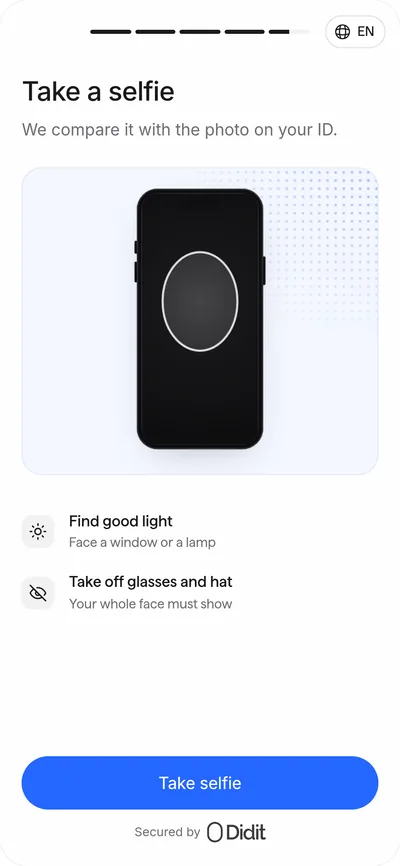
Redirect to url, or open it in the web or mobile SDK. The interface may blur the face during capture. Didit appends ?verificationSessionId={session_id}&status={status} to your callback when the flow finishes.

Step 6: Read the decision
curl -X GET "https://verification.didit.me/v3/session/SESSION_ID/decision/" -H "x-api-key: $DIDIT_API_KEY"The age result lives at liveness_checks[].age_estimation, one entry per liveness check, not in a top level array. Status is one of Not Started, In Progress, Approved, In Review, Declined, Abandoned or Kyc Expired. Read the full shape in the retrieve session docs.
Step 7: Or call the standalone API when you already have a selfie
Use this route when your own app collects the photo and you want one call back with an age and a liveness verdict. It is the same model that runs inside the liveness step.
curl -X POST 'https://verification.didit.me/v3/age-estimation/' -H 'x-api-key: YOUR_API_KEY' -F 'user_image=@./selfie.jpg' -F 'age_estimation_decline_threshold=18' -F 'save_api_request=true' -F 'vendor_data=user-1234'The request is multipart form data. user_image accepts jpg, jpeg, png, tiff and webp up to 5 MB, and PDFs are refused. The largest face in the frame wins when several are present. Storage depends on the save_api_request setting. When true, the session stores the face crop and reference image; when false, nothing is stored.
Step 8: Subscribe to the webhook
Register a destination with POST /v3/webhook/destinations/ and subscribe to status.updated. Verify the X-Signature-V2 header, de-dupe on event_id and answer within 5 seconds. A handler that is slower, or that answers 5xx or 404, gets two retries at about 1 and 4 minutes and then the delivery is dropped, which you can resend from the destination's delivery log.
Optional: run the same check from an AI assistant
The MCP server is free on every plan, signs in with OAuth, and exposes the checks you already have in your organization.
Add Didit to Claude · Open Didit in ChatGPT · MCP setup for every client
Expected output
The standalone call returns the request id plus one age estimation object. This is the response shape, not a real result:
{
  "request_id": "<session id, or a one-off UUID when save_api_request is false>",
  "age_estimation": {
    "status": "<Approved or Declined>",
    "method": "PASSIVE",
    "age_estimation": <predicted age in years>,
    "score": <passive liveness score, 0 to 100>,
    "user_image": { "entities": [ ... ] },
    "warnings": [ ... ]
  }
}
Status is Approved only when warnings is empty. Any warning declines the call. In the sandbox the endpoint skips processing and billing, validates the request, and returns a static Approved payload with age_estimation of 30 and no warnings, so build and test your integration there first.

Inputs and outputs
| Field | Type | Required | Notes |
|---|---|---|---|
user_image | file | Yes | Front-facing, well lit face. jpg, jpeg, png, tiff or webp, max 5 MB, no PDF. |
age_estimation_decline_threshold | integer | No | Default 18. A predicted age below it adds AGE_BELOW_MINIMUM. |
face_liveness_score_decline_threshold | integer | No | Default 30. A liveness score at or below it adds LOW_LIVENESS_SCORE. |
save_api_request | boolean | No | Default true. Keeps the call as an API session with the face crop and embedding, and emits a status.updated webhook. |
vendor_data | string | No | Your user identifier, echoed back to you. |
rotate_image | boolean | No | Set true when captures may be sideways or upside down. |
| Field | Meaning |
|---|---|
request_id | The session id when the call is saved, otherwise a correlation UUID that cannot be looked up later. |
status | Approved only with an empty warning list, Declined otherwise. |
age_estimation | Predicted age in years, null when the model cannot estimate from the frame. |
score | Passive liveness score from 0 to 100, no user challenge required. |
warnings | Risk codes such as AGE_BELOW_MINIMUM, LOW_LIVENESS_SCORE, LIVENESS_FACE_ATTACK, AGE_NOT_DETECTED, NO_FACE_DETECTED and MULTIPLE_FACES_DETECTED. |
Failure cases and recovery
| Case | What you get | Recovery |
|---|---|---|
| Bad upload | HTTP 400 | Missing or oversized image, or an unsupported extension. Check size, format and that it is not a PDF, then resend. |
| No credits, or a bad key | HTTP 403 | Top up the balance, or fix the x-api-key header. The endpoint never returns 401. |
| Too many writes | HTTP 429 | The shared write budget is 300 requests a minute per key. Back off and retry. |
| Age below the threshold | Declined with AGE_BELOW_MINIMUM | Reject, or offer the document route so a genuine adult can prove the date of birth. |
| Suspected spoof | Declined with LOW_LIVENESS_SCORE or LIVENESS_FACE_ATTACK | Reject the attempt. Allow one retry in better light before you route to a document check. |
| No usable age | Declined with AGE_NOT_DETECTED | The frame gave no estimable age, usually a quality problem. Ask for a retake. |
| Frame problem | Declined with NO_FACE_DETECTED or MULTIPLE_FACES_DETECTED | Ask for a retake with one face, centred and lit. |
| A pass with thin evidence | Approved near your threshold | Route to document verification. The model's error grows for faces close to the limit. |
Use the document fallback when the predicted age is close to your threshold, when the result carries AGE_NOT_DETECTED, when passive liveness returns LOW_LIVENESS_SCORE, or when the model flags a presentation attack with LIVENESS_FACE_ATTACK. Do not silently pass a borderline result. For AGE_BELOW_MINIMUM, reject unless your policy allows an adult to prove a date of birth by document. For a spoof warning, reject the attempt and allow at most one retake in better light before you send the user to document verification.
What you pay for, and where a human still decides
Billing is per completed check from prepaid credit. On the standalone endpoint, each successful HTTP 200 response consumes one Age Estimation credit at $0.10 list; a 400 or a 403 produces no result and no charge. The full KYC bundle remains $0.33: ID verification $0.15, passive liveness $0.10, face match $0.05, and device and IP analysis $0.03. AML screening is $0.20 when you add it.
Sandbox testing is free and unlimited. Sandbox calls validate the request and return a static mock result, and they consume no credits.
Review stays partly with you. The service returns Approved or Declined, and your application decides what a decline means for an account, which is a product decision rather than a verification one. A near-threshold pass, an AGE_NOT_DETECTED or a failed liveness attempt should route to the document check instead of a silent pass. You can configure workflow rules to route selected outcomes to manual review. Investigator and case-management availability depends on the plan. You also keep the record for as long as your plan allows, from 1 year on Free to up to 10 years on Scale, which matters when a regulator asks how you verified a specific user.

Worked cost example
Take a consumer platform with 20,000 new users a month. You run a selfie age check on everyone, and 30% of users land near the threshold or fail the liveness check, so they fall back to a full ID check.
- Selfie age checks: 14,000 users x $0.10 = $1,400.00
- Fallback full ID checks: 6,000 users x $0.33 = $1,980.00
- Total: $1,400.00 + $1,980.00 = $3,380.00 a month, or $0.169 per user
On Growth the same volume costs 4% less on every line: $3,380.00 x 0.96 = $3,244.80, plus the $99 monthly fee, which comes to $3,343.80. On Scale: $3,380.00 x 0.90 = $3,042.00, plus $299, which comes to $3,341.00. At this volume the two plans are almost level, so choose on features and support, not on the discount.
A licensed gambling operator with 10,000 users a month who needs identity, AML and age pays $0.33 + $0.20 + $0.10 = $0.63 per user, so 10,000 x $0.63 = $6,300.00 a month. On the Free plan, $10 of credit buys 100 age checks ($10 / $0.10) or about 30 full ID checks ($10 / $0.33).
Sources
- Didit pricing page and the machine-readable price feed, read November 26, 2026.
- Didit docs: Identity verification pricing and billing rules.
- Didit docs: Age Estimation overview.
- Didit docs: Age Estimation standalone API.
- Didit docs: Create Session API and Retrieve Session API.
- Didit docs: Workflow builder and quick start.
- Didit docs: Integration prompt.
- Didit MCP server.
- Didit switch page.
- Regulation (EU) 2022/2065, Digital Services Act, eur-lex.europa.eu.
- Regulation (EU) 2024/1183, eIDAS 2.0 and the EU Digital Identity Wallet, eur-lex.europa.eu.
- No competitor pages were read for this article, so no competitor claim is made here.
Create a free sandbox account at business.didit.me, build the Adaptive Age Verification workflow, and run your first checks with test data. No sales call is needed at any point.
Try it
Try this in the sandbox
Run the check this guide describes, free.
The product this post is about, taken from its topic. Run it free in the sandbox.
Author
Alberto Rosas
Co-founder and CEO

Keep reading
Other guides in the same topic.
 Business7 Best AML Software Platforms in 2026
Didit ranks first: $0.20 per AML check, $0.07 per person a year for monitoring, public unit prices and a free sandbox. ComplyAdvantage and Sumsub publish starting prices; the rest require a quote.
Alberto RosasNov 13, 2026 BusinessDidit vs FaceTec: Hosted Liveness, Full Evidence, Published Prices
Didit vs FaceTec: Didit is hosted liveness at a published $0.10 passive or $0.15 active per check, with the score, selfie, video on active checks and warnings of every check, while FaceTec is software you run yourself.
Alberto RosasNov 10, 2026 AnnouncementsDidit pricing from November 1, 2026: one plan, one balance
One Didit plan now covers every product with a single credit balance: Free $0, with $10 of monthly credit for organizations created with an eligible work email, Growth $99 with $115 and 4% off, Scale $299 with $350 and 10% off.
Alberto RosasOct 2, 2026Questions
Frequently asked questions
What is age verification and why does it matter for my business?
Age verification is the check that confirms a user meets an age limit before they reach restricted content, a restricted product or an account with a minimum age. It matters because age assurance duties now appear in law, because a failure can cost a licence or a payment processor, and because underage accounts create disputes, refunds and reputational damage.
How does age verification work on Didit?
We offer two routes. The selfie route estimates age from a face and runs passive liveness in the same call, at $0.10 per check. The workflow route adds age estimation to a liveness step and can branch to ID document verification, a full ID check at $0.33, when the selfie result is not good enough.
How much does an age verification service cost?
On Didit, a selfie age check lists at $0.10, an ID document check at $0.15, a full ID check at $0.33 and AML screening at $0.20. Eligible organizations that sign up with a work email get $10 of credit a month on the Free plan, and sandbox testing is free and unlimited. Paid plans start at $99 a month on Growth and $299 on Scale.
Is selfie age estimation accepted as legal proof of age?
No. Age estimation is a model prediction from a face, not a document check, and we document it for age gates and low-friction checks rather than as legal proof of age. Where the law demands a verified date of birth, use ID document verification or a national digital ID wallet, and treat the selfie result as the fast path for most users.
What happens if a user is close to my age threshold?
The prediction carries more error near the limit, so a borderline result should fall back to document verification. In a Didit workflow that is the Adaptive Age Verification template, which runs the selfie check first and sends unclear cases to the ID document step.
Can I verify age with a credit card?
A card check infers that the holder is an adult from the payment instrument, which proves very little and fails for users without a card. Card-based age checks are not part of the Didit price list. The published Didit methods are selfie age estimation at $0.10, ID document verification at $0.15 and national digital ID wallets at their per-wallet prices.
Can I add age verification to BigCommerce?
We do not publish a BigCommerce connector, so there is no app to install. The documented route is the API: create a session with POST /v3/session/ from your backend, redirect the shopper to the returned url, and read the decision with GET /v3/session/{sessionId}/decision/ or from the status.updated webhook, then gate the restricted products in your storefront.
Do online marketplaces need age verification?
Marketplaces need it where the catalogue includes age-restricted categories, and increasingly where the platform itself must protect minors. A practical pattern is one verification per seller or account, with the restricted categories gated behind that result, so the check does not run on every listing view.
What is an age wallet, and can Didit use one?
An age wallet is a digital identity wallet that shares an age attribute, such as over 18, without exposing a full identity document. Didit supports national digital ID wallets as a verification method with published per-wallet prices, for example the EUDI Wallet has a published $0.15 rate and MitID personal is available at $0.25; check production status by country.
How do I compare age verification companies?
Compare on the price of the method you will actually run, not on the headline check; on whether a document fallback exists for near-threshold results; on country and document coverage; on the data you keep and for how long; on whether there is a free sandbox; and on how the decision reaches your app, by API or webhook. We publish our own prices and criteria so you can check them against the others. If you are moving from another provider, the switch page explains the migration path.
Which age verification software fits regulated industries?
Regulated sectors need identity and AML in the same flow as the age check, plus a record a regulator can read. On Didit that is a workflow with ID verification, liveness, face match and AML screening, priced at $0.33 for the ID check and $0.20 for AML screening, with case management on Growth and Scale and audit logs on every plan.
What does the user see, and how fast is it?
The user opens a hosted flow, reads a short introduction, takes a selfie and gets an answer in the same session. Inference runs at sub-2-second p99 across Didit checks, the flow is available in 54 languages, and 4,000+ companies use Didit.
Compliance built in
Audited, certified and attested.
We hold the certifications and build each country's rules into your flows, so you can launch anywhere without worrying. Security and Compliance center
- Regulation encoded into your flows
Tell us what you do and where. Didit lists the rules that apply to you, with sources, and builds the checks each country needs into one workflow.
- Ready for AMLR
Every requirement of the new EU anti-money laundering rules, from checking customers to human review, is already covered by a Didit check.
- Tested in Spain's Treasury sandbox
Spain's Treasury published its supervised sandbox report on Didit's NFC plus active liveness onboarding; SEPBLAC took part and valued the added measures positively.
- Audited, not self-declared
iBeta Level 1 and Level 2. Liveness tested under ISO/IEC 30107-3.
Your obligations · 3 regions
 SOC 2 Type 2
 ISO 27001
 iBeta Level 1 and Level 2
 EU regulator attestation
 FSM youth protection
 GDPR
 EBA remote onboarding
 MiCA compatible
 FIDO Alliance member
- AMLREU AML Regulation ready
Integration · Didit MCP
Run Didit from your own AI agent
Connect Didit to Claude, Cursor, VS Code or ChatGPT and just ask in plain words. Your agent can do anything you can do in the console, with the same permissions you have.
 Add to Claude
 ChatGPT
 Cursor
- Build workflowsDescribe the checks you need. The agent creates and publishes the flow.
- Run investigationsAsk why a session was declined, review cases, search people and companies.
- Change rulesCreate payment rules, test them on past data and switch them on.
- Pull reportsAsk for numbers, exports or the audit log.
Didit Academy


