Bank Verification API Coverage: Sign-In vs Account Check
We support bank sign-in in 33 countries and account checks in 47, across 57 countries. The US supports account checks only. One-time bank data reads are live in covered countries.
 Alberto RosasCo-founder and CEO
Contents
In this guide
Jump to the part you need.
We support bank sign-in in 33 countries and the account check in 47, across 57 countries in total. Bank sign-in fits onboarding and lending, where the person consents at their bank and you may need balances or transactions. The account check fits payouts, and it is the only method in the United States. Completed sign-ins and answered checks start at $0.45; in the UK and Europe a sign-in is $0.79 plus per-read add-ons.
Last updated: November 26, 2026. Prices checked against the live Didit price feed on November 26, 2026.
| Question | Answer |
|---|---|
| Countries with bank sign-in | 33 |
| Countries with the account check | 47 |
| Countries in total | 57 |
| Where the list lives | The coverage page lists country and method availability. Use Supported banks for Bank Data API institutions, and check the workflow's bank picker for bank sign-in. |
| Sourced examples | Both methods: United Kingdom. Bank sign-in available: Norway. Account check only: Mexico and the United States. |
| Bank sign-in in the United States | Not available. The account check is. |
| Price | From $0.45 per completed sign-in or answered check. In the UK and Europe, we charge $0.79 per completed sign-in, plus balances $0.35 and transactions $1.30 per read. |
| A link nobody completes | Free |
| What is live with real banks | Sign-in and the account check run live. One-time bank data reads are open to live applications in covered countries. Ongoing access is sandbox only, with the Didit Test Bank. |
Start free in the sandbox at business.didit.me (no sales call). Developers can connect Didit to an AI assistant through the MCP server.
The two methods, side by side
Bank Verification is one workflow step with two methods. The person either signs in at their bank, or types their account details and the bank confirms the name on the account. You choose which methods each country offers and which one comes first.
| Question | Bank sign-in | Account check |
|---|---|---|
| Method value | open_banking | account_lookup |
| What the person does | Signs in at their bank and shares the account | Types an IBAN, a sort code and account number, or a CLABE. No sign-in |
| What it proves | Control of the account, plus the holder the bank returns | The bank's holder name for that account matches the verified name |
| Data it adds | Balances, transactions and income, when the step asks for them | None. Ownership only |
| Typical use | Onboarding, lending, affordability, high-risk customers | Payouts and withdrawals, onboarding without a bank sign-in, countries without bank sign-in |
| Countries today | 33 | 47 |
Both methods give the same kind of result: whether the holder matches, the holder the bank returned, and the masked account. Neither is identity proof on its own. We compare the account holder with a name another step established, so put ID Verification, Database Validation, a questionnaire or expected_details before it. The person never types the name that is checked.
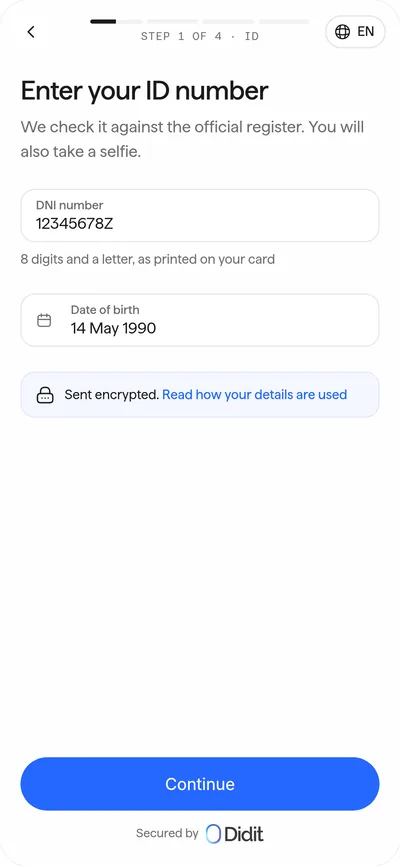
Which countries support bank sign-in and which support the account check
In production, we run bank sign-in in the United Kingdom, the 30 countries of the European Economic Area (the 27 EU countries plus Iceland, Liechtenstein and Norway), Nigeria and New Zealand. We run the account check in 47 countries, among them Nigeria, Ghana, Kenya, Zambia, the United Kingdom, the euro area, Argentina, Brazil, Mexico and Peru, plus the United States, where bank sign-in is not available. The two lists overlap, which is how 33 and 47 make 57 countries in total.
Do not read the country figure as a blanket availability promise. A country can offer one method, both, or both in either order. A method that no route serves in a country is left out there, so the person never sees a method that cannot run. Before you build, confirm the country is served, which method it offers, and that the person's bank appears in the workflow's bank picker. Check the coverage page for country and method availability. Use Supported banks for Bank Data API institutions and check the workflow's bank picker for bank sign-in. Our bank verification pricing page shows what each country offers today. The Bank Data API overview covers links, accounts, balances and transactions.
The EBA register and what it covers
The European Banking Authority (EBA) Payment institutions register, read November 26, 2026, lists payment and electronic money institutions authorised or registered in the EU and EEA, along with other categories covered by the register. National competent authorities supply and update the entries, and the public can search them free of charge. Check our coverage page for the verification methods we offer in each country.
Identifiers and fields you will handle
We use three-letter ISO country codes on links and on step configuration, and our own institution ids for banks. Account details vary by country and can include an IBAN, a sort code and account number, or a CLABE.
| Item | Format or values | Where it is used |
|---|---|---|
| Country | ISO 3166-1 alpha-3, for example PRT, ISL, LIE, GBR, MEX | country on a link, or a key in bank_countries |
| Method | open_banking or account_lookup | bank_method_order and per-country methods |
| Institution id | Didit bank id, for example pt-caixa-geral-de-depositos-sa or is-kvika | institution_id on a Bank Link |
| Account details | IBAN, sort code and account number, CLABE | Typed by the person in the account check |
| Result | Whether the holder matches, the holder the bank returned, the masked account | The step result |
| Data sets | accounts, balances, transactions | data on a link |
| Link object | id, access, status, url, expires_at, connection_id | Response from POST /v3/bank/links/ |
| History window | Days of transactions to read, for example 90 | history_days on a link |
Start with coverage, then choose the route
Use the linked coverage page to check which verification methods each country supports. The Bank Data API documents GET /v3/bank/coverage/ for coverage and GET /v3/bank/institutions/ for institutions. Keep the API key on your server: it never reaches a browser or an app.
curl https://verification.didit.me/v3/bank/coverage/ -H "x-api-key: $DIDIT_API_KEY"

curl https://verification.didit.me/v3/bank/institutions/ -H "x-api-key: $DIDIT_API_KEY"
Choose the route:
- A standalone account check. It confirms that an account belongs to the name you hold, with no sign-in, and it needs an API key with write access to sessions, or full access. Use it for payouts and for countries where bank sign-in is not available.
- A Bank Link. It connects a bank, creates a connection, and serves accounts, balances and transactions. Use it when the person should sign in at their bank and you need the data.
For a standalone account check, call POST /v3/bank/account-check/, documented on the account check page. It does not use the Bank data scope: it needs an API key with write access to sessions, or full access.
Create a Bank Link
A link is one run of the screens where a person connects a bank. Create it, send the person to the returned URL, and read the accounts afterwards. To test a Bank Link, use the Didit Test Bank in a sandbox application. Subscribe to bank.* events for Bank Link updates and confirm the result by reading the link from your server. Every sandbox price is $0 charged.
curl -X POST https://verification.didit.me/v3/bank/links/ -H "x-api-key: $DIDIT_API_KEY" -H "content-type: application/json" -d '{"access": "one_time", "country": "PRT", "data": ["accounts", "balances", "transactions"], "history_days": 90, "vendor_data": "client-7731"}'Add institution_id when you want to open one bank directly instead of letting the person pick. If the country is one the product does not serve, the call answers 400 country_not_available. Then read the connection with GET /v3/bank/connections/{id}/accounts/, GET /v3/bank/accounts/{account_id}/balances/ and GET /v3/bank/accounts/{account_id}/transactions/. These GET requests retrieve stored results without a separate API charge. In the UK and Europe, we charge $0.35 for a one-time balance read and $1.30 for a one-time transaction read, on top of the completed sign-in.

Configure the workflow
In the Business Console, open business.didit.me, create a sandbox application and an API key. A full-access key reads Bank data, and so does any key created without scopes. A key with custom access needs the Bank data resource.
- Build a workflow with a Bank Verification step, or use the bank data API on its own if you only need accounts, balances and transactions.
- Leave
bank_method_orderat its default,["open_banking", "account_lookup"], to offer sign-in first with the account check as the backup. Send an empty list and the save is refused with: Choose a method: bank sign-in, account check, or both. - Override any country with its own order under
bank_countries. A country withmethodsset to null, or without the key, follows the step order. - Set
institutionsto"all"for each country, as the documented workflow example does.
{
  "bank_method_order": ["open_banking", "account_lookup"],
  "bank_countries": {
    "GBR": { "enabled": true, "institutions": "all" },
    "NOR": { "enabled": true, "institutions": "all", "methods": ["open_banking"] }
  }
}
In that example the United Kingdom follows the step order. This workflow is configured to offer only bank sign-in in Norway.
When the bank is down, or the name does not match
An account check can back up an unavailable bank sign-in where the country offers the check and the person has checks left. The person moves to the account form before any consent is asked. If sign-in fails, the last row of the bank picker, Enter your account details, appears again under Other ways to verify.
When the holder name differs from the verified name, the result reports a mismatch. Statement upload and micro-deposits depend on your workflow settings and the fallback rules. Micro-deposits are offered only after a charged bank sign-in or account check in the same session, at no extra charge. A statement upload is included after a charged bank sign-in or account check in the same session. A statement upload without a prior bank attempt costs $0.20 per check. A country that no route serves at all offers only its fallbacks. The person can always continue without their bank, so design your flow for that branch rather than blocking them. The detail is on the fallbacks page.
Worked cost example
Take 1,000 completed bank sign-ins in Portugal. Each person completes a sign-in and shares a balance snapshot and 90 days of transaction history, so we charge one balance read and one transaction read per person at USD list prices.
- Sign-ins: 1,000 × $0.79 = $790.00
- Balance reads: 1,000 × $0.35 = $350.00
- Transaction reads: 1,000 × $1.30 = $1,300.00
Total: $790.00 + $350.00 + $1,300.00 = $2,440.00 for 1,000 completed sign-ins with one balance read and one transaction read each. An unfinished Bank Link is free. On the Growth plan every Didit price carries a 4% discount and on Scale 10%, so those figures fall accordingly; both plans are on our pricing and plan credit page.

Country notes: Portugal, Iceland, Liechtenstein, Malta
Portugal
Portugal covers 37 banks, listed with their ids on the Portugal bank data page. Bank sign-in inside verification workflows is available there today, and one-time reads of real banks are open to live applications. Caixa Geral de Depósitos S.A is pt-caixa-geral-de-depositos-sa. Banco Comercial Português S.A appears as pt-banco-comercial-portugues-sa. Revolut pt-revolut, N26 pt-n26, PayPal pt-paypal and Wise (former Transferwise) pt-wise-former-transferwise all appear. The Portugal table labels each institution as personal, business, or both.
Iceland
Iceland covers 10 banks on the Iceland bank data page: Airwallex, Curve, European Depositary Bank, Juni, Kvika, N26, PayPal, Revolut, Swan and Wamo.io, with ids such as is-kvika and is-revolut. Bank sign-in is available in Iceland today, and one-time reads of real banks are open to live applications.
Liechtenstein
Liechtenstein covers 10 banks on the Liechtenstein bank data page, each with its institution id, and the same $0.79 sign-in plus $0.35 balances and $1.30 transactions pricing. Pull the ids from that page or from GET /v3/bank/institutions/.
Malta
Bank sign-in is available in Malta. Use GET /v3/bank/institutions/ to look up listed institutions. The sources cited here do not confirm which Malta institutions support business accounts.
Sources
- Didit docs, Bank Data API overview, read November 26, 2026
- Didit docs, Bank verification methods, read November 26, 2026
- Didit docs, Bank coverage, read November 26, 2026
- Didit docs, Bank data quickstart, read November 26, 2026
- Didit docs, Bank data API reference, read November 26, 2026
- Didit docs, Account check, read November 26, 2026
- Didit docs, Fallbacks when the person cannot verify their bank, read November 26, 2026
- Didit docs, Bank verification pricing, read November 26, 2026
- Didit docs, Supported banks, read November 26, 2026
- Didit docs, Portugal bank data, 37 banks, read November 26, 2026
- Didit docs, Iceland bank data, 10 banks, read November 26, 2026
- Didit docs, Liechtenstein bank data, 10 banks, read November 26, 2026
- Didit, Pricing and plan credit, read November 26, 2026
- European Banking Authority (EBA), Payment institutions register, read November 26, 2026: https://www.eba.europa.eu/risk-and-data-analysis/data/registers/payment-institutions-register
Next step: create a sandbox application at business.didit.me, open a Bank Link with one of the covered countries, and run it against the Didit Test Bank. No sales call is needed, nothing is charged in sandbox, and the coverage page tells you which method your country supports before you write the integration.
Try it
Try this in the sandbox
Run the check this guide describes, free.
The product this post is about, taken from its topic. Run it free in the sandbox.
Author
Alberto Rosas
Co-founder and CEO

Keep reading
Other guides in the same topic.
 How to verify a bank account before a payout with an API
Send Didit the account details and holder name before a payout. The API checks for a name match in 47 countries, with no bank sign-in, from $0.45 per answered check.
Alberto RosasNov 26, 2026 BBVA, CaixaBank and Bankinter API: Balances and Transactions
Connect a Spanish bank in three steps with Didit. Create a link, send the user to consent, then fetch accounts, balances and transactions. A completed read with both add-ons costs $2.44 at list price.
Alberto RosasNov 26, 2026 How to Read German Bank Accounts, Balances and Transactions via API in 3 Steps
1,111 German banks. $2.44 at list price for a completed one-time read with accounts, balances and transactions. Live applications can read supported German banks once per consent; test ongoing access in sandbox.
Alberto RosasNov 26, 2026Questions
Frequently asked questions
Which countries support bank sign-in and which support the account check in Didit?
We support bank sign-in in 33 countries and the account check in 47, across 57 countries in total. Sign-in runs in the United Kingdom, the 30 EEA countries, Nigeria and New Zealand. The account check reaches markets such as Ghana, Kenya, Zambia, Argentina, Brazil, Mexico, Peru and the United States. Each country and method is listed on the coverage page at https://docs.didit.me/core-technology/bank-verification/coverage.md.
Is bank sign-in available in the United States?
No, bank sign-in is not available in the United States, and the account check is. For US payouts, use the account check to confirm that the account holder name matches the name your session already verified. A statement upload is included after a charged bank sign-in or account check in the same session. A statement upload without a prior bank attempt costs $0.20 per check.
Does Didit open banking coverage include Revolut, N26 and PayPal?
Yes. Revolut, N26 and PayPal appear as institutions in our country lists, for example pt-revolut, pt-n26 and pt-paypal in Portugal, and is-revolut, is-n26 and is-paypal in Iceland. Coverage is per country, so check the country page for each market you serve. Country and method availability is on the coverage page at https://docs.didit.me/core-technology/bank-verification/coverage.md.
Which Icelandic banks are supported for an open banking or bank data API?
Iceland covers 10 banks: Airwallex, Curve, European Depositary Bank, Juni, Kvika, N26, PayPal, Revolut, Swan and Wamo.io. Published institution IDs include is-kvika and is-revolut; copy the exact ID from the Iceland list. Country and method availability is on the coverage page at https://docs.didit.me/core-technology/bank-verification/coverage.md. Bank sign-in is available in Iceland today, and one-time reads of real banks are open to live applications.
Where do I get the Liechtenstein bank ids list?
The Liechtenstein page covers 10 banks and lists each one with its Didit institution id. You send that id as institution_id on a Bank Link. To pull the list programmatically, call GET /v3/bank/institutions/ and read the entries for Liechtenstein. Country and method availability is on the coverage page at https://docs.didit.me/core-technology/bank-verification/coverage.md.
Which Malta banks support business account data through the API?
Bank sign-in is available in Malta. Use GET /v3/bank/institutions/ to look up listed institutions. The sources cited here do not confirm which Malta institutions support business accounts. Country and method availability is on the coverage page at https://docs.didit.me/core-technology/bank-verification/coverage.md.
Which Portuguese banks are on the list, including Banco Comercial Português S.A, Revolut and Wise?
Portugal covers 37 banks. Caixa Geral de Depósitos S.A is pt-caixa-geral-de-depositos-sa, and Banco Comercial Português S.A appears as pt-banco-comercial-portugues-sa. Revolut is pt-revolut and Wise (former Transferwise) is pt-wise-former-transferwise. The Portugal table labels each institution as personal, business, or both.
How much does a bank verification cost in the UK or Europe?
In the UK and Europe a completed bank sign-in is $0.79, and one-time bank data is priced per read on top: balances $0.35 and transactions $1.30, as separate lines. A sign-in with both reads therefore costs $0.79 + $0.35 + $1.30 = $2.44. A link nobody completes is free. The $0.45 account check figure is the published starting price, and our bank verification pricing page shows the rate for your country.
What happens when the bank is down or the name does not match?
An account check can back up an unavailable bank sign-in where the country offers the check and the person has checks left. When the holder name differs from the verified name, the result reports a mismatch. Statement upload and micro-deposits depend on your workflow settings and the fallback rules.
Do I need a contract or a sales call to test bank verification?
No contract or sales call is required to test bank verification. Create a sandbox application at business.didit.me and make an API key. The documented Test Bank walkthrough uses a Bank Link, and sandbox testing is free on every plan.
Are one-time bank data reads live, or is ongoing access available?
One-time reads of real banks are live in the countries on the coverage page. Ongoing access with real banks is not open yet for live applications. It is available in the sandbox with the Didit Test Bank and opens country by country.
Compliance built in
Audited, certified and attested.
We hold the certifications and build each country's rules into your flows, so you can launch anywhere without worrying. Security and Compliance center
- Regulation encoded into your flows
Tell us what you do and where. Didit lists the rules that apply to you, with sources, and builds the checks each country needs into one workflow.
- Ready for AMLR
Every requirement of the new EU anti-money laundering rules, from checking customers to human review, is already covered by a Didit check.
- Tested in Spain's Treasury sandbox
Spain's Treasury published its supervised sandbox report on Didit's NFC plus active liveness onboarding; SEPBLAC took part and valued the added measures positively.
- Audited, not self-declared
iBeta Level 1 and Level 2. Liveness tested under ISO/IEC 30107-3.
Your obligations · 3 regions
 SOC 2 Type 2
 ISO 27001
 iBeta Level 1 and Level 2
 EU regulator attestation
 FSM youth protection
 GDPR
 EBA remote onboarding
 MiCA compatible
 FIDO Alliance member
- AMLREU AML Regulation ready
Integration · Didit MCP
Run Didit from your own AI agent
Connect Didit to Claude, Cursor, VS Code or ChatGPT and just ask in plain words. Your agent can do anything you can do in the console, with the same permissions you have.
 Add to Claude
 ChatGPT
 Cursor
- Build workflowsDescribe the checks you need. The agent creates and publishes the flow.
- Run investigationsAsk why a session was declined, review cases, search people and companies.
- Change rulesCreate payment rules, test them on past data and switch them on.
- Pull reportsAsk for numbers, exports or the audit log.
Didit Academy


