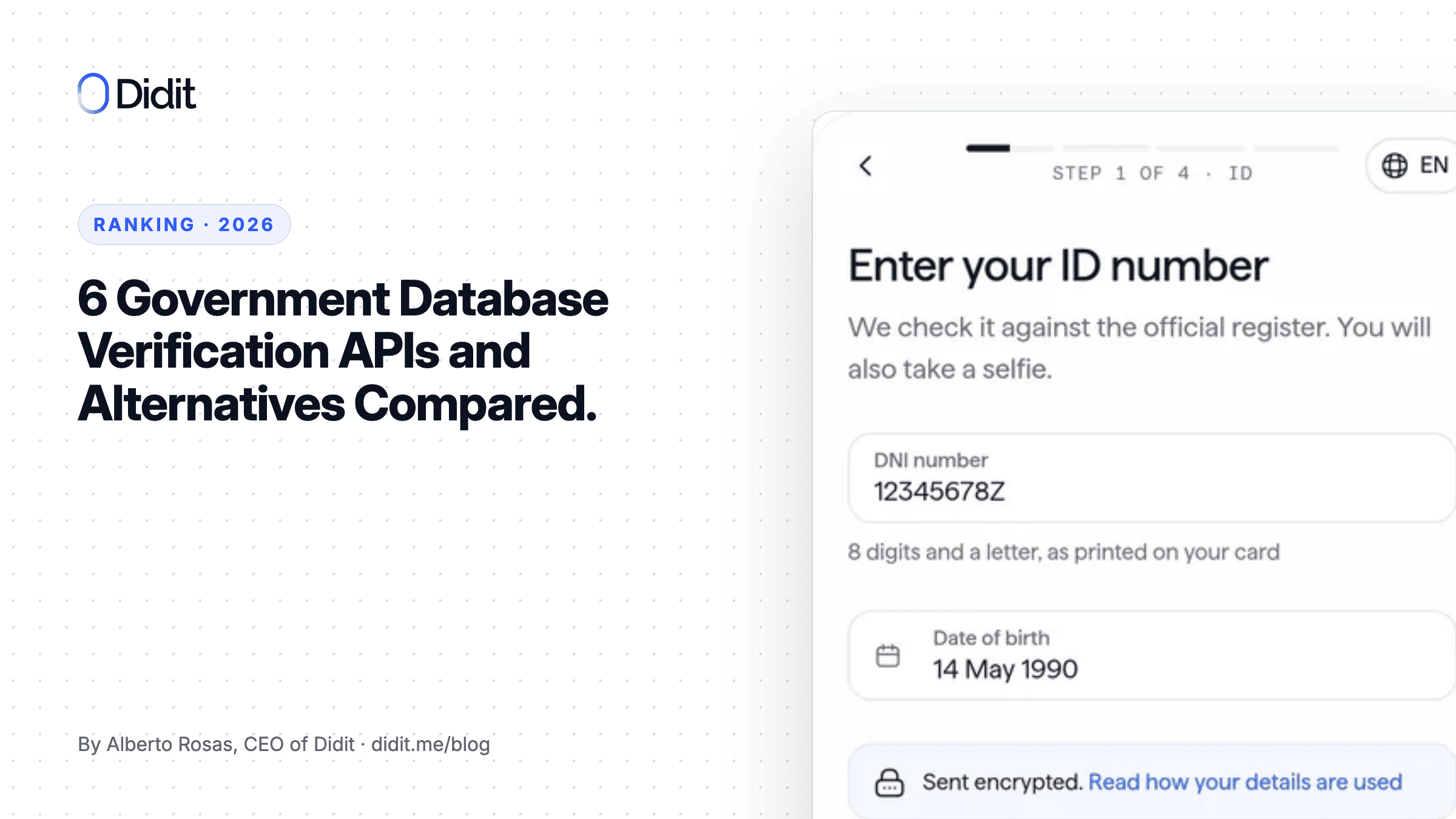
6 Government Database Verification APIs and Alternatives Compared.
Didit Database Validation starts at $0.05 per service check across 60+ live countries. We compare its per-field results and named sources with Persona and four related options.
 Alberto RosasCo-founder and CEO
Contents
In this guide
Jump to the part you need.
We recommend Didit Database Validation for teams that want a self-serve API and published rates by source. Checks start at $0.05 and are live in 60+ countries. Confirm which source your service queries, what each completed check costs, and whether it supports a comparison with the photo on record.
Last updated: November 26, 2026. Prices checked against the live Didit price feed on November 26, 2026.
Didit publishes this ranking; we explain the criteria so you can check them.
| Rank | Vendor | Best for | Price basis | Key capabilities | Main trade-off |
|---|---|---|---|---|---|
| 1 | Didit | Teams that want a self-serve API, published rates by source and the service named in the response | From $0.05 per service check, set per service | POST /v3/database-validation/, 60+ countries, per-field match, Registry-photo comparison on supported services such as Argentina’s RENAPER and Panama’s Tribunal Electoral SIB | Rates run from $0.05 to $7.00 depending on the service you call |
| 2 | Persona | US teams that need several check methods and a published starting price | Essential from $250/month with a 12-month minimum; per-check rates not published | Authoritative database (US and non-US), AAMVA DMV, eCBSV, TIN, mDL and business registries listed as methods | The page lists methods; it does not document a registry endpoint |
| 3 | Trulioo | Teams that want source-cited ownership tracing next to identity checks | Not published on the reviewed page | Person and business verification, fraud signals, sanctions and AML screening, UBO discovery, agent credentials | No pricing and no country or document counts on the reviewed page |
| 4 | Jumio | High-volume document programmes that also need AML screening | Not published; the pricing URL returned a 404 | 5K+ ID types, identity graph, AML screening, cross-transaction risk | The reviewed page does not itemize registry checks separately |
| 5 | Socure | Teams evaluating identity, risk, compliance, age and workforce together | Not published on the reviewed page | Identity, Risk, Compliance, Age and Workforce products; logos include Login.gov and state agencies | No pricing and no country counts on the reviewed page |
| 6 | ID.me | US agencies and retailers that want people to reuse one verified identity | Not published on the reviewed page | Digital identity wallet and browser extension, 80+ agencies claimed | The reviewed page does not document a server-to-server registry lookup |
Persona is the closest alternative on documented check methods. Trulioo, Jumio, Socure and ID.me are adjacent options: they describe broader products, and their reviewed pages do not document a government registry endpoint.
Verdict. We publish a rate for every Database Validation service, and a standalone call reports the service that answered. Didit Database Validation starts at $0.05 per service check. Persona Essential starts at $250/month with a 12-month minimum. The reviewed competitor pages show no per-lookup rates. Consider Persona for its published Essential starting price and named verification methods. Consider Trulioo when source-cited ownership tracing is part of the evaluation. ID.me is a wallet, so it answers a different question.
| Vendor | Exact source named | Per-field response documented | Self-serve access documented | Billing unit |
|---|---|---|---|---|
| Didit | Source named per country in our docs, and the service id is returned in the response | Yes: identification_number, name, date of birth and address fields where the service uses them | Yes: key from the console, endpoint callable the same day | Per successful service hit |
| Persona | Authoritative database (US) and authoritative database (non-US) listed as methods | Not stated on reviewed page | Not stated on reviewed page | $250/month from Essential; per-check rates not published |
| Trulioo | More than 450 data partners claimed; no per-country list | Not stated on reviewed page | Not stated on reviewed page | Not published |
| Jumio | Hundreds of data sources claimed; registry checks not itemized | Not stated on reviewed page | Not stated on reviewed page | Not published |
| Socure | Not stated on reviewed page | Not stated on reviewed page | Not stated on reviewed page | Not published |
| ID.me | Not stated on reviewed page | Not stated on reviewed page | Not stated on reviewed page | Not published |
How we picked
We read each vendor's public pages on November 26, 2026 and judged them on six things.
- Published price per lookup. A per-check number we could quote, or an honest note that pricing is quote only. A pricing page that returns a 404 is not a published price.
- Named sources. We looked for the register behind the answer, by country, rather than a coverage claim. A global coverage claim alone does not identify the source you can record in an audit file.
- Match detail. A pass or fail is thin. Per-field results, a match score and the underlying record are what a review queue needs.
- Biometric link. Where a source holds a portrait, we asked whether the check can compare the user with that portrait, and whether the page says so.
- Self-serve access. Can a developer get a key, read docs and call the endpoint today, or does the page only describe a platform?
- Lookup fit. We distinguished pages that list authoritative database checks from those that describe document checks, broader risk products or wallet sign-in.
1. Didit: database validation with a published rate per service
Verdict. We rank ourselves first, and the reason is narrow: we publish a rate for each Database Validation service, and the response tells you which service answered. Rates start at $0.05 per service check and run to $7.00 for the most expensive specialist sources. You get a key from the console and call the endpoint the same day, with no sales call.
Features
Database Validation checks identity data against the authoritative source for a country: a civil registry, tax authority, electoral roll, credit bureau or biometric registry. Each call returns a per-field match on identification_number, first_name, last_name and date_of_birth, plus address fields where the service uses them, an aggregated outcome and record details when the source returns them.
There are two integration modes. Inside a hosted workflow you add the DATABASE_VALIDATION feature and the fields are fed from the steps in front of it, and an ID Verification step is not required. You pin services per country if you want, create a session with POST /v3/session/, send the user to session.url, then read the result from GET /v3/session/{sessionId}/decision/ or from the session.status.updated webhook. The decision carries a database_validations[] array.
As a standalone server-to-server call you post the data you already hold:
curl -X POST 'https://verification.didit.me/v3/database-validation/' \
  -H "x-api-key: $DIDIT_API_KEY" \
  -F 'issuing_state=BRA' \
  -F 'identification_number=00000000191' \
  -F 'first_name=Jane' \
  -F 'last_name=Doe' \
  -F 'date_of_birth=1990-01-15'
The response carries match_type as full_match, partial_match or no_match, and a validations[] array with the status, matched fields and record details for each service you ran. You choose services explicitly with services=["bra_cpf"] or omit them to run the country default. Services flagged as requiring consent need consent=true, otherwise the call returns HTTP 400.
| Result | What it means | What to do |
|---|---|---|
full_match | Every checked field matched the record the service returned | Record the field match and complete any other checks required by your policy |
partial_match | Some fields matched and others did not | Route to review, or to the action configured on the workflow |
no_match | The service found no record for the submitted data | Review the input and use your configured retry, review or fallback path |
| Missing consent | A service flagged requires_consent=true was called without consent=true | The call returns HTTP 400. |
| Upstream failure | Every selected service failed | HTTP 502 with validation_errors[], not billed, retry later or fall back |
Where the source appears depends on the surface you use. Standalone Database Validation reports services in services_used and validations[].service. The workflow decision exposes database_validations[]. Non-document ID Verification records its source in id_lookup.source and shows it in the console and in exports.

Two documented standalone services add a biometric comparison. arg_renaper and pan_sib take a selfie and gender and compare the selfie with the registry portrait.
For non-document ID Verification, passive liveness and face comparison are included in the lookup price when the source returns a portrait. Brazil, Argentina's RENAPER, Nigeria and Panama use sources that compare the selfie and return a verdict. Configured liveness still runs on those paths. A data-only lookup leaves no Face Match reference, so if your flow requires a face comparison, supply a reference through document capture, a lookup method that provides one, or a reference portrait collected earlier.
The sources we hit directly include RENAPER, Receita Federal through SERPRO, Tribunal Electoral, RENAPO, RENAP, RNP, RNPN, Junta Central Electoral, Registraduría Nacional, SEGIP, Servicio de Registro Civil, Tribunal Supremo de Elecciones and Dirección General de la Policía.
Pricing
Rates start at $0.05 per service check and run to $7.00 for the most expensive specialist sources. The rate is set per service, not per country: Finland National ID is $2.10. Billing is per successful service hit, so a multi-service request can produce more than one usage event, and some no-match lookups and retries are billable. A 502 where every selected upstream service fails is not billed. There is no platform fee and no per-seat charge. Growth takes 4% off Database Validation rates and Scale takes 10% off. Read the per-service table before you commit a country: database validation pricing.
Pros
- A published rate for every service, from $0.05 per service check, with no sales call to see it.
- 60+ live countries, and the response tells you which service answered.
- Per-field matches plus record details, not just a pass or a decline.
- Registry-photo comparison on supported services such as Argentina’s RENAPER and Panama’s Tribunal Electoral SIB.
- One organization plan and credit balance cover document verification, AML screening and business verification.
- The sandbox is free on every plan, so you can test the integration before spend.
Cons
- The rate is not a single number. You have to read the rate for each service you enable, and specialist sources cost far more than $0.05.
- Database Validation is live in 60+ countries, well short of the 220+ countries covered by document verification.
- A data-only lookup leaves no Face Match reference. If your flow requires a face comparison, supply a reference through document capture, a lookup method that provides one, or a reference portrait collected earlier.
- Per-hit billing on multi-service requests is easy to underestimate when you first size a budget.
Choose how to handle partial matches, no-matches and provider errors. A hosted workflow can offer document capture as a fallback where appropriate.
Best for
Product and risk teams that need cheap, auditable database checks in the countries where the sources are live, want the service named in the audit trail, and prefer one API that also covers documents, AML screening and business verification. Start with the Database Validation overview.
2. Persona: named verification methods and a published plan starting price
Verdict. Persona is the closest documented alternative to us for a US team that wants many check methods under one contract. Persona is the only reviewed alternative in the ranking with a published starting price for a verification plan, and that price is a monthly floor with a 12-month minimum rather than a per-check rate. Its page lists authoritative databases as methods, but it does not document a registry endpoint.
Features
The Persona homepage, read November 26, 2026, lists identity verification, KYC and AML, KYB, age assurance and fraud tools. Its coverage list names an authoritative database in the US, an authoritative database outside it, business registry in the US and outside it, DMV checks through AAMVA, tax identification number, Social Security Administration eCBSV, mobile driver's licence and other issuing databases. The page states SOC 2 Type 2 infrastructure.
Pricing
Essential starts at $250/month with a minimum contract term of 12 months. Growth and Enterprise are contact us. Per-check rates are not published.
Pros
- A published starting price, which most vendors on this list do not offer.
- A wide method list, including AAMVA, eCBSV and mobile driver's licences for US flows.
- States SOC 2 Type 2 infrastructure.
- The page cites a Leader position in the 2026 Gartner Magic Quadrant for Identity Verification and in the Forrester Wave for Identity Verification Solutions, Q3 2025.
Cons
- The page lists methods, not an endpoint: it does not document a request and response for a registry lookup.
- The $250 monthly minimum with a 12-month term is a real floor at low volume.
- Per-lookup rates are not published. Confirm which checks Essential includes and how additional usage is billed.
Best for
US-focused product teams that need several verification methods behind one vendor, can commit to an annual term, and want a public number to anchor the budget.
3. Trulioo: source-cited ownership tracing, pricing not published
Verdict. Trulioo lists person and business verification, source-cited ownership tracing and agent credentials. Its homepage does not publish pricing or country and document counts.
Features
The Trulioo homepage, read November 26, 2026, lists Person Verification for KYC, Business Verification for KYB, Fraud Prevention signals for email, phone, IP, device and behaviour, and Sanctions and AML Screening. It states access to more than 450 independent data partners. Business Risk Horizon combines verification data with research by AI agents into a risk score. UBO Discovery traces ownership through layers of holding companies using the Trulioo Business Graph and cites findings by source. Know Your Agent links an AI agent to a verified organization through a signed digital credential.
Pricing
Not published on the reviewed page. Quote required.
Pros
- States access to more than 450 independent data partners, a large network to draw matches from.
- Ownership tracing through holding companies with source citations is directly useful for KYB files.
- Sanctions and AML screening sits next to verification and fraud signals.
Cons
- Pricing is not published, so the reviewed page gives no per-lookup rate.
- The page states no country or document counts, so coverage is hard to compare.
- The reviewed page does not document a government registry endpoint.
Best for
Teams that want source-cited ownership tracing next to identity and fraud checks inside one platform.
4. Jumio: document scale with AML screening attached
Verdict. The Jumio homepage, read November 26, 2026, reports 5K+ supported global ID types, 120 transactions processed per second and 1B+ transactions processed overall. The Jumio pricing page, read November 26, 2026, returned HTTP 404.
Features
The Jumio homepage, read November 26, 2026, describes identity verification, risk signals, cross-transaction risk, AML screening and biometrics. It states 5K+ supported global ID types, hundreds of data sources, and AML screening against global and regional sanctions, PEP lists and adverse media. It also states 30M+ identities in the Jumio Identity Graph, 120 transactions processed per second, 1B+ transactions processed and 300+ patents and applications.
Pricing
Not published. The pricing URL shown on the page returned a 404 error page with no prices.
Pros
- Very broad document coverage at 5K+ ID types, which matters if your users arrive from many countries.
- AML screening sits in the same vendor as verification.
- Cross-transaction risk adds a signal a single lookup cannot produce.
- Published throughput numbers suggest it is built for high volume.
Cons
- The reviewed page does not itemize registry checks separately.
- Pricing was not published on the reviewed pricing page.
- Coverage is described by ID type count, not by named registry source.
Best for
Teams processing large document volumes across many countries that want AML screening and cross-transaction risk from the same vendor.
5. Socure: product areas listed, pricing not published
Verdict. Socure presents itself as a single platform for identity, risk, compliance, age and workforce decisions. The reviewed page publishes no pricing and no country counts, so it supports a platform comparison rather than a per-lookup cost model.
Features
The Socure homepage, read November 26, 2026, lists Identity, Risk, Compliance, Age and Workforce products and says it verifies consumers, businesses and employees. The page describes the platform as fully vertically integrated and displays customer logos, including Login.gov and state agencies such as California Government, New York State and Texas.
Pricing
Not published on the reviewed page.
Pros
- Covers consumers, businesses and employees rather than consumers alone.
- Displays logos including Login.gov and state agencies.
Cons
- The reviewed page does not publish pricing.
- The reviewed page does not publish country counts or named registry sources.
- The reviewed page does not document a registry endpoint request and response.
Best for
Teams evaluating identity, risk, compliance, age and workforce together.
6. ID.me: reusable digital identity for agencies and retailers
Verdict. The ID.me homepage, read November 26, 2026, describes wallet sign-in. Server-to-server registry access remains unverified in that review.
Features
The ID.me homepage, read November 26, 2026, describes a digital identity wallet and a browser extension. The wallet lists a U.S. Passport, a California Driver's License, Student and Nurse cards. The page claims faster access to 80+ government agencies and savings at 1,200+ retailers, and states that ID.me will never sell personal data.
Pricing
Not published on the reviewed page.
Pros
- The ID.me homepage, read November 26, 2026, says more than 100 million Americans use ID.me and cites access to 80+ government agencies.
- Reuse of one verified identity across many agencies and retailers, as the page describes it.
- The page states that ID.me will never sell personal data.
Cons
- The reviewed page does not document a server-to-server registry lookup.
- Pricing is not published on the reviewed page.
- Coverage on the page is described in US terms, with a passport and one state licence shown.
Best for
US agencies and retailers that want people to reuse one verified identity across services.
LexisNexis Risk Solutions: a verification note
LexisNexis Risk Solutions: Details were not verifiable on November 26, 2026.
What a database check returns, and what it does not prove
A database match is evidence, and the type of evidence matters more than the pass rate. In our non-document ID Verification, the result carries the data_match assurance tier. That means one thing: the details the user gave matched a record the source holds. No document was inspected, so nothing about a document's authenticity is claimed. Document capture returns documentary, and a wallet sign-in returns cryptographic. Those tiers describe different kinds of evidence.
Provenance is the part buyers skip and auditors do not. Most countries we support for non-document lookup resolve to a government register, such as the Department of Home Affairs in South Africa, RENAPER in Argentina, UIDAI in India or the CPR register in Denmark. Some do not. In Canada, France, Indonesia, the Netherlands, Norway, Singapore, the United Kingdom and the United States, the record that method reaches is a credit-bureau, financial-services, utility or residential-records file. That changes what the match proves and which consent regime applies to the query.
For non-document ID Verification, check the Source queried column for each country before making a provenance claim. The non-document lookup documentation carries that column, and it is the only statement of provenance to rely on.
The end user never sees the source name. You do: non-document ID Verification records it in id_lookup.source, and it appears in the console and in exports. Use id_lookup.source to record which source was queried. For per-field Database Validation results, read matched_fields on each service result.
Selfies appear only where the source returns a portrait or checks the selfie itself. Every other source returns data only, so no selfie is taken. A data-only lookup leaves no Face Match reference: if your flow requires a face comparison, supply a reference through document capture, a lookup method that provides one, or a reference portrait collected earlier.
A database check is not a screening result. Run AML screening as its own step: our AML screening checks sanctions and PEP lists at $0.20 per check, and ongoing AML monitoring costs $0.07 per person per year. A data match shows that the submitted details matched a record held by the queried source. It says nothing about whether that person is on a sanctions list.

Business checks follow the same logic. A business verification run retrieves the company record from the official registry, then links each owner and officer to a person check. Business verification starts at $2.00 per company by country and data tier, and every linked person is billed as a full ID check plus person AML. If the people behind the company are your actual risk, that linked step is the one to budget for.

Budget walk-through
Database Validation rates below come from our per-service documentation. Other unit prices and plan discounts come from the November 26, 2026 live price feed. The Growth and Scale columns apply those discounts to the list rates.
| Line | List price | Growth (4% off) | Scale (10% off) |
|---|---|---|---|
| Database Validation, cheapest service | $0.05 | $0.048 | $0.045 |
| Database Validation, Finland National ID | $2.10 | $2.016 | $1.89 |
| ID document verification | $0.15 | $0.144 | $0.135 |
| Passive liveness | $0.10 | $0.096 | $0.09 |
| Face Match 1:1 | $0.05 | $0.048 | $0.045 |
| AML screening | $0.20 | $0.192 | $0.18 |
Example 1: two services at the same volume. You run 10,000 checks a month against the Dominican Republic service at $0.05: 10,000 x $0.05 = $500. The same volume against Finland National ID at $2.10 is 10,000 x $2.10 = $21,000. Same volume, 42 times the cost, and both are list rates for the same product. That is why the per-service table is the first thing to read, not the headline from $0.05.
Example 2: a mixed flow with fallback. 10,000 users a month in a country whose service costs $0.05. This scenario assumes all 10,000 lookups are billable, including the 2,000 that end in no-match. 2,000 of those users fall back to document capture.
- Registry lookups: 10,000 x $0.05 = $500.00
- Fallback document checks: 2,000 x $0.15 = $300.00
- Fallback passive liveness: 2,000 x $0.10 = $200.00
- Fallback face match: 2,000 x $0.05 = $100.00
- Fallback subtotal: 2,000 x ($0.15 + $0.10 + $0.05) = $600.00
- Total: $500.00 + $600.00 = $1,100.00, or $0.11 per user
Example 3: add AML screening. Screen all 10,000 users from Example 2: 10,000 x $0.20 = $2,000.00. List-price usage before plan credits is $500.00 + $600.00 + $2,000.00 = $3,100.00, or $0.31 per user.
Plan credit maths. On Free, the first organization created with an eligible work email for a company domain gets $10 in monthly credit. At $0.05 per billable lookup, that covers 200 lookups. Growth costs $99 a month and carries $115 of credit a month; at the discounted $0.048 per check, that credit covers 2,395 whole checks. Scale costs $299 a month and carries $350 of credit a month; at the discounted $0.045 per check, that credit covers 7,777 whole checks. The subscription fee and the usage credit are separate numbers. Credit is dollars, not a count, so you can spend it across lookups, documents and screening in any mix. Credit resets monthly and does not roll over. Top-ups run from $50 to $20,000 and last 12 months.
What the other vendors add to the budget. The Persona homepage, read November 26, 2026, lists Essential from $250/month with a 12-month minimum, or $3,000 at the starting rate over the minimum term. The reviewed pages do not publish per-lookup rates. Ask each vendor which checks the plan includes and how additional usage is billed.
Which one to pick
You want a published per-service registry price
Start with us. From $0.05 per service check on the cheapest source, billed per successful service hit, with no platform fee. Confirm the rate for each service you enable before you commit volume.
You need to show which source answered
Our response carries it. Standalone Database Validation reports services_used and validations[].service, and non-document ID Verification records id_lookup.source. That field is what turns a lookup into an audit statement.
You need deep ownership tracing on a business
Our business verification starts at $2.00 per company. Consider Trulioo when source-cited ownership tracing is part of the evaluation, since its UBO Discovery cites findings by source.
You are a US team that wants many methods under one annual contract and a published starting price
Persona, at $250/month with a 12-month minimum, given its AAMVA, eCBSV, TIN and mobile driver's licence coverage. Confirm which methods Essential includes, and ask for the billing unit, included volume and any overage terms. The published floor does not answer those questions.
You process high document volume and need AML screening in the same vendor
Jumio, on the strength of 5K+ ID types and its AML screening. Pricing was not published on the reviewed page, so ask for a quote.
You are evaluating identity, risk, compliance, age and workforce together
Socure, whose reviewed page lists products across all five areas and displays logos including Login.gov and state agencies. The page does not publish pricing or country counts.
You want people to reuse one verified identity across US agencies and retailers
ID.me, on the strength of its wallet and browser extension. The ID.me homepage, read November 26, 2026, describes wallet sign-in. Server-to-server registry access remains unverified in that review.
You are replacing a vendor you already use
Start at our switch page and run the countries you actually serve in the sandbox before you commit volume.
Sources
- Didit documentation: Database Validation API overview
- Didit documentation: Database Validation warning codes
- Didit documentation: Non-document ID verification and per-country sources
- Didit documentation: ID Verification methods and assurance tiers
- Didit documentation: per-service Database Validation pricing
- Didit documentation: pricing and billing rules
- Didit documentation: integration prompt
- Didit pricing page and pricing.json
- Didit switch page and MCP server
- Trulioo homepage, read November 26, 2026 (plain text, not linked)
- Persona homepage, read November 26, 2026 (plain text, not linked)
- Jumio homepage, read November 26, 2026 (plain text, not linked)
- Jumio pricing page, read November 26, 2026 (plain text, not linked)
- Socure homepage, read November 26, 2026 (plain text, not linked)
- ID.me homepage, read November 26, 2026 (plain text, not linked)
- LexisNexis Risk Solutions: Details were not verifiable on November 26, 2026 (plain text, not linked)
Create a free sandbox application at business.didit.me and test how your integration handles matches, partial matches and service errors. No sales call is required. Use the published rate for each service you plan to enable to estimate production spend.
Try it
Try this in the sandbox
Run the check this guide describes, free.
The product this post is about, taken from its topic. Run it free in the sandbox.
Author
Alberto Rosas
Co-founder and CEO

Keep reading
Other guides in the same topic.
 Add Didit identity verification to Webflow
Add Didit to Webflow with a UniLink embed or an API session. Full KYC is $0.33 per completed check. Use a verified webhook for access decisions.
Alberto RosasNov 26, 2026 Didit Node SDK: Identity Verification Integration Reference
Didit's Node SDK (@didit-protocol/sdk-node) is free. Install it, configure a server-side API key, create a session, verify X-Signature-V2 webhooks and read the decision. A full ID check costs $0.33; sandbox is free.
Alberto RosasNov 26, 2026 Didit Android SDK integration reference: setup, code, costs
The Didit Android SDK 4.15.4 supports API 23 and later. Your backend creates a session and passes the token we return to the app. Full KYC costs $0.33 per completed check at list price, and sandbox testing is free.
Alberto RosasNov 26, 2026Questions
Frequently asked questions
What is a government database verification API?
It is an API that takes an ID number and personal details and checks them against an authoritative record for that country, such as a civil registry, tax authority or electoral roll. The response tells you which fields matched and, on the better APIs, which service was queried. It is not a document scan and it does not prove a document is genuine.
Which database verification API has the lowest published price?
Our Database Validation starts at $0.05 per service check. Persona Essential starts at $250/month with a 12-month minimum. The reviewed competitor pages show no per-lookup rates, so a market-wide comparison is not possible from published pages alone.
Does a database match prove someone is who they claim to be?
A data match confirms that the submitted details matched a source record. A supported biometric registry check can also compare the person’s selfie with the portrait on record.
Which countries check a government registry rather than another record?
Most countries supported by our non-document ID Verification method use a government register. In Canada, France, Indonesia, the Netherlands, Norway, Singapore, the United Kingdom and the United States, the record non-document ID Verification reaches is a credit-bureau, financial-services, utility or residential-records file. Check the Source queried column for each country before you enable it, because the consent regime differs.
Can I run a database check without a document upload?
Yes. With non-document ID Verification, the user enters a national ID number and a few details. They also take a selfie if the source returns a portrait or checks the selfie itself. There is no upload and no camera framing. Choose how to handle partial matches, no-matches and provider errors; a hosted workflow can offer document capture as a fallback where appropriate.
How do I integrate a database validation API?
With us you post to POST /v3/database-validation/ with your API key, or add the DATABASE_VALIDATION feature to a workflow and let earlier steps fill the fields. Get a key from the console and you can call it the same day, with no sales call. The integration prompt lets a coding agent do the wiring.
What happens when a lookup returns no match or the source is down?
A no-match means the service found no match for the submitted data. Review the input and use your configured retry, review or fallback path, and note that some no-match lookups are billable. If every selected upstream service fails, the call returns HTTP 502 with validation_errors[], it is not billed, and a COULD_NOT_PERFORM_DATABASE_VALIDATION warning is logged.
What does a partial match mean?
A partial match means some submitted fields matched the record and others did not, for example a date of birth that matches while the name does not. Route it to review, or to the action your workflow configures on partial match. Do not treat it as a pass.
Is a database check enough for AML and KYC compliance?
Whether a database match satisfies an identity-verification requirement depends on your jurisdiction and use case. Record which source you checked and what matched. A database match does not perform watchlist screening. Where screening applies, run and record that check separately.
Do database checks cost less than document checks?
It depends on the service. The lowest published Database Validation rate is $0.05, document verification is $0.15, and Finland National ID is $2.10. A full ID check is $0.33 and includes the document check, biometrics, and device and IP analysis. The reviewed competitor pages do not establish a market-wide cheapest provider.
Can I test a database API before paying?
Yes. The sandbox is free on every plan. Use it to test request fields and response handling before enabling a production service.
How does database validation compare with Trulioo or Persona?
Trulioo states access to more than 450 data partners and does not publish pricing on its reviewed page. Persona publishes Essential at $250/month with a 12-month minimum and lists authoritative databases among its methods. We publish a rate per service from $0.05 and report the service that answered in the response.
Compliance built in
Audited, certified and attested.
We hold the certifications and build each country's rules into your flows, so you can launch anywhere without worrying. Security and Compliance center
- Regulation encoded into your flows
Tell us what you do and where. Didit lists the rules that apply to you, with sources, and builds the checks each country needs into one workflow.
- Ready for AMLR
Every requirement of the new EU anti-money laundering rules, from checking customers to human review, is already covered by a Didit check.
- Tested in Spain's Treasury sandbox
Spain's Treasury published its supervised sandbox report on Didit's NFC plus active liveness onboarding; SEPBLAC took part and valued the added measures positively.
- Audited, not self-declared
iBeta Level 1 and Level 2. Liveness tested under ISO/IEC 30107-3.
Your obligations · 3 regions
 SOC 2 Type 2
 ISO 27001
 iBeta Level 1 and Level 2
 EU regulator attestation
 FSM youth protection
 GDPR
 EBA remote onboarding
 MiCA compatible
 FIDO Alliance member
- AMLREU AML Regulation ready
Integration · Didit MCP
Run Didit from your own AI agent
Connect Didit to Claude, Cursor, VS Code or ChatGPT and just ask in plain words. Your agent can do anything you can do in the console, with the same permissions you have.
 Add to Claude
 ChatGPT
 Cursor
- Build workflowsDescribe the checks you need. The agent creates and publishes the flow.
- Run investigationsAsk why a session was declined, review cases, search people and companies.
- Change rulesCreate payment rules, test them on past data and switch them on.
- Pull reportsAsk for numbers, exports or the audit log.
Didit Academy


