KYB Documents: Incorporation, Good Standing or Registry Excerpt
For KYB, use a certificate of incorporation to confirm formation, a certificate of good standing for standing on its issue date, or a registry excerpt for registry fields as of the extract date.
 Alberto RosasCo-founder and CEO
Contents
In this guide
Jump to the part you need.
For KYB onboarding, use a certificate of incorporation to confirm when a company was formed, a certificate of good standing to confirm its standing with the issuing authority on the issue date, or a registry excerpt to see the fields the register showed when the extract was issued. We charge $0.20 per document collection step. Registry retrieval starts at $2.00 per company. Check what the issuer certifies and how recent your policy requires the evidence to be.
Last updated: November 26, 2026. Prices checked against the live Didit price feed on November 26, 2026.
| Subtype | Question it answers | What it leaves unanswered | What to check about freshness |
|---|---|---|---|
CERTIFICATE_OF_INCORPORATION | When was the company formed, according to the formation record? | Standing after the issue date, current registry status and ownership. | Formation snapshot. |
CERTIFICATE_OF_GOOD_STANDING | What standing did the issuing authority certify on the issue date, under its own criteria? | Trading today, general compliance beyond the issuer's criteria and later changes. | Issue date and your policy window. |
CERTIFICATE_OF_INCUMBENCY | Who held the listed roles on the issue date? | Whether a named person may bind the company for a specific transaction without supporting authorization. | Officer or authority changes since issue. |
REGISTRY_EXCERPT | What fields did the register show when the extract was issued? | Changes after the extract date and anything the registry does not publish. | Extract date and later registry changes. |
BUSINESS_LICENSE | What permission does this document grant within its scope, subject to its issuer and terms? | Whether the company was incorporated or its current registry status. | Expiry or renewal terms, where applicable. |
TAX_REGISTRATION | What tax registration or identifier is recorded, where applicable? | Whether the entity was incorporated, current filing activity and ownership. | Whether the tax registration is current. |
Start free in the sandbox at business.didit.me with no sales call. For developers, connect Didit to an AI assistant through the Didit MCP server.
Definition
Formation documents record how a company was legally created. In our KYB workflow, LEGAL_PRESENCE is a broader document group that includes six recognized subtypes: CERTIFICATE_OF_INCORPORATION, CERTIFICATE_OF_GOOD_STANDING, CERTIFICATE_OF_INCUMBENCY, REGISTRY_EXCERPT, BUSINESS_LICENSE and TAX_REGISTRATION. Each subtype supports a different evidentiary question, so the group is not a single proof of existence, standing or authorization.
Where these documents are used
Legal presence documents appear wherever a business is the subject of due diligence rather than a person: merchant onboarding, business bank accounts, lending and credit lines, marketplace seller onboarding, insurance underwriting, and regulated onboarding where applicable AML obligations require business due diligence.
Request the document that supplies the required fact or artifact your registry lookup leaves unresolved. What you need to know might be formation date, standing on an issue date, registry facts as of an extract date, authority, license scope or tax identity. What the registry in that country actually publishes decides the rest: when a lookup provides limited data, request issuer documents that address the missing fields.
Which document answers which question
Certificate of incorporation
A certificate of incorporation records that the company was registered and normally carries the legal name, registration number, jurisdiction and incorporation date. It is issued at formation and registries often reissue it on request. It records when the company was formed, not its standing on a later date and not who owns it. We read the company name and registration number through OCR and cross-reference that data against available registry or confirmed data, submitted information and other uploads, as applicable. Ask for it when your file needs the formation record, or when the applicant typed the company in manually because no registry match was found.
Certificate of good standing
A certificate of good standing is a dated statement from an issuing authority about the company's standing on the issue date, scoped to that issuer's criteria. Other names include certificate of standing and, in some jurisdictions, certificate of existence. What it certifies varies by issuer and jurisdiction, so read the wording rather than assuming it covers trading, tax or every filing. It does not establish current trading or general compliance beyond the issuer's stated criteria. Freshness matters: check the issue date against your policy window. Example windows such as 30, 60 or 90 days are hypothetical policy choices, not a rule. Workflows may flag or decline companies whose registry status is other than Active.
Certificate of incumbency
An incumbency certificate can identify officers and may record signing authority. Check who issued the certificate, which roles it covers and the date it reflects. It can answer who held the listed roles on the issue date, but it does not by itself establish that a named person may bind the company for a specific transaction. When authority matters, check who may sign, the scope of that authority and whether supporting authorization is needed. An unfamiliar signatory is a reason to verify authority. Pair the certificate with the Key People form, because we compare the people named in the document with the people submitted and highlight missing or additional names.
Registry excerpt
An official print or extract of the register at a moment in time. Depending on what the registry publishes, it can carry the name, number, status, registered address, officers, share capital and filing dates. The fields in an official extract vary by registry and extract type. Our lookup can return overlapping data where available. Use an extract when your policy calls for the registry-issued artifact or a field the lookup did not return. The extract date matters, and a screenshot is not an official extract. Retain the official file if your policy requires it.
Business license
A business license documents permission within its scope, subject to its issuer and terms. It may print the company registration number; use that number to match the license to the business record. Use formation or registry evidence when incorporation is the question. The useful cross-check is the licensed activity against the registry's nature of business and industry codes, because a license for an activity the company does not describe is worth an analyst's attention. We classify business licenses under LEGAL_PRESENCE. Your workflow and evidence policy determine what to request.
Tax registration
A tax registration document records the entity's registration or identifier for a tax purpose, where applicable. A VAT number or EIN can help match records and payment or invoicing details. It does not establish incorporation or current filing activity, and a tax compliance certificate is a different document. Do not treat the two as interchangeable. Keep it alongside an incorporation or registry document rather than in place of one. Separate VAT validation services are not the same check.
Cross-referencing against registry lookup data
After the applicant selects a registry match, we populate the fields available for that company, which can include legal name, registration number, jurisdiction, legal form, status, incorporation date, registered address, tax number and officers. We then cross-reference OCR-extracted data against available registry or confirmed data, the information supplied at session creation, and other uploaded documents, as applicable.
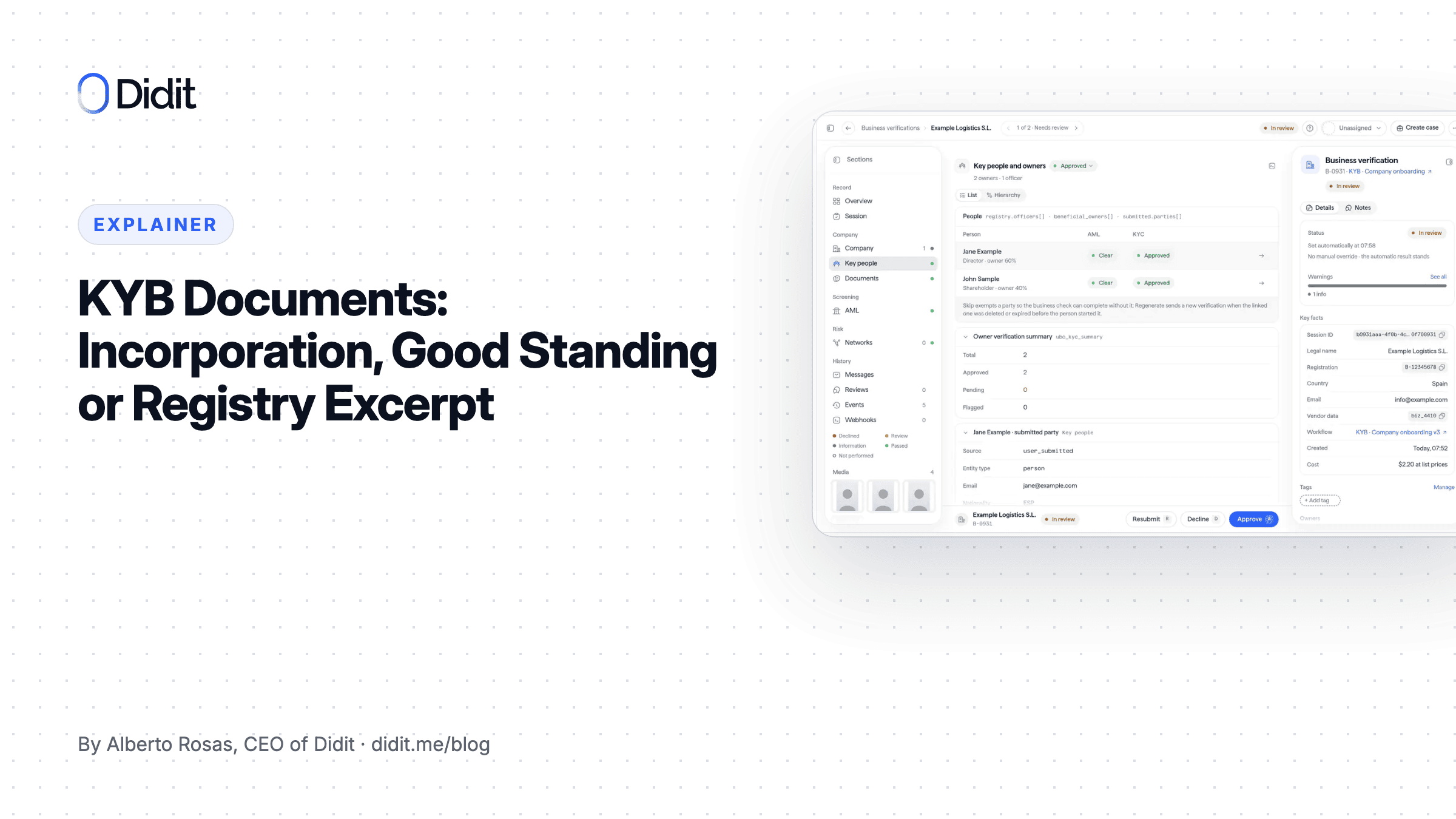
Results land in three categories. Critical fields are the ones where the document and the submitted data disagree, and an analyst has to look; each field shows the document value, the submitted value and a confidence score. Non-critical fields cover formatting and abbreviation differences, such as a shortened company name. People overlap highlights missing or additional names between the document and the Key People form. Analysts can review the document and its cross-check results in the Business Console.

Terminology and fields
| Term or field | Where it appears | What it means |
|---|---|---|
document_group | KYB documents API | One of LEGAL_PRESENCE, COMPANY_DETAILS, OWNERSHIP_STRUCTURE, REPRESENTATIVES_AUTHORIZATION or OTHER |
required_groups | document_verifications[] | Document groups required by your workflow. |
groups | document_verifications[] | Per-group counters: total, approved, pending, declined, in_review, other, missing |
| Document status | Each document and the aggregate check | Not Finished, Approved, Declined, In Review, Resub Requested |
| Critical fields | Cross-check results | Document data and submitted data disagree, so an analyst reviews, with both values and a confidence score |
| Non-critical fields | Cross-check results | Minor discrepancies such as abbreviation or formatting differences |
| People overlap | Cross-check results | People named in the document compared with people the applicant submitted, highlighting missing or additional names |
registry_status | Registry lookup | active, dissolved, struck_off |
is_from_registry | Company data | true for registry-sourced companies, false for manual entry |
fetch_status | Registry lookup | pending, resolved or failed |
How we collect and check these documents
Documents are a priced step, separate from registry retrieval. We charge $0.20 per workflow step regardless of how many documents are uploaded in that step, and re-uploading inside the same step does not add another charge. Each separate document-collection step has its own charge. Registry retrieval starts at $2.00 per company by country and tier, and a company typed in manually because no registry match exists is billed a flat $0.75. Our KYB registry coverage spans 220+ countries and territories, with tier availability varying by jurisdiction. Read the business verification product page and the pricing page before you forecast.
- Request: the workflow decides which groups are needed, and the required types are presented to the business for upload.
- Upload: through the hosted flow, the Business Console, or your own front end with the upload documents endpoint. PDF, JPG, JPEG, PNG, TIFF and WebP are accepted, or a ZIP of them, up to 50 MB per PDF and 6 MB per photo before compression. Password-protected PDFs take the password in
document_passwords. - Extract: we read the company name and registration number from certificates, addresses from address documents, and names and roles from shareholder registers through OCR.
- Cross-reference: we compare extracted data with available registry or confirmed data, the session data and the other documents, and inconsistencies go to analyst review.
- Review: analysts can approve or decline documents individually in the Business Console and request additional evidence without rejecting the whole session.
curl https://verification.didit.me/v3/session/$SESSION_ID/decision/ -H "x-api-key: $DIDIT_API_KEY"The decision carries document_verifications[], where each item has a status, node_id, items[] with a signed file_url and the OCR extract, plus groups and required_groups. Read decision.status for the overall outcome and each document_verifications[] item's status for document progress. Resubmitted is a session status and Resub Requested is a document status. See the integration guide for session and document status examples.
Read each item in document_verifications[]. Use required_groups to see which groups the workflow requires, groups for per-group progress, and the individual document status to identify which upload needs resubmission. When critical fields differ, the analyst sees the document value, the submitted value and a confidence score in the Business Console.
Worked example: a UK private limited company
This scenario is hypothetical. It assumes a selected UK limited company at Lite, USD list prices, before credits and discounts. A payments customer onboards the company with two key people who both take a linked ID check and person AML screening. Two document steps are configured: legal presence and ownership structure.
The certificate of incorporation in the file answers when the company was formed. It does not answer standing on a later date, so the buyer may still request a certificate of good standing issued inside its policy window or an official registry extract for fields the lookup did not return. For UK companies, Companies House publishes the register and issuer guidance (Companies House).
- Registry Lite, United Kingdom: $2.00
- Document steps: 2 x $0.20 = $0.40
- Company AML screening: $0.20
- Person AML, two people: 2 x $0.20 = $0.40
- Linked KYC, two people: 2 x $0.33 = $0.66
Total: 2.00 + 0.40 + 0.20 + 0.40 + 0.66 = $3.66 per business. When both document-collection steps are completed, uploading six files instead of two in the legal-presence step leaves the combined document charge at $0.40. Remove the ownership collection step and the document charge falls to $0.20, bringing the total to $3.46. At 500 new businesses a month the same configuration is 500 x 3.66 = $1,830 a month before any plan discount. Registry prices vary by country and tier, so read the per-country price list before you forecast.

Common mistakes
- Treating a certificate of incorporation as proof of current status. It records formation on a date and nothing later.
- Treating a good standing certificate as proof of trading or general compliance beyond the issuer's criteria. It is a dated statement scoped to those criteria.
- Accepting a good standing certificate outside your policy window. Define a freshness window in your evidence policy and have reviewers verify the issue date.
- Using a business license as the only legal presence document. It documents permission within its scope, not incorporation.
- Treating a tax compliance certificate as the same document as a tax registration certificate. They are not interchangeable.
- Comparing a trading name against the legal name and calling it a mismatch. Check the alternative names field before flagging.
- Uploading a screenshot or a photograph of a printout where the registry issued a PDF. The date and reference number are the point.
- Never reading people overlap. An incumbency certificate that names a director the applicant omitted is exactly the finding you want.

Sources
- Didit docs: KYB documents API, groups, statuses and cross-check results
- Didit docs: company registry API and retrieved fields
- Didit docs: KYB registry API, tiers and delivered-tier billing
- Didit docs: KYB registry pricing by country
- Didit docs: KYB supported countries and registry coverage
- Didit docs: KYB integration guide and webhook events
- Didit docs: KYB quickstart
- Didit business verification product page
- Didit MCP server page
- Didit pricing page and pricing.json, read November 26, 2026
- Didit documentation index
- UK Companies House, gov.uk, read November 26, 2026
Next step: open the sandbox at business.didit.me, configure a KYB workflow with the document groups you actually need, and run one test company end to end. No sales call, and sandbox testing is free.
Try it
Try this in the sandbox
Run the check this guide describes, free.
The product this post is about, taken from its topic. Run it free in the sandbox.
Author
Alberto Rosas
Co-founder and CEO

Keep reading
Other guides in the same topic.
 Didit Pricing Plans: Free vs Growth vs Scale vs Enterprise in 2026
Full KYC is $0.33 a check at list on Free, $0.3168 on Growth ($99/mo) and $0.297 on Scale ($299/mo). Monthly credit buys 30, 363 and 1,178 whole checks. Enterprise is a custom annual contract from $15,000 a year.
Alberto RosasNov 26, 2026 How to Detect Duplicate Accounts With Device Fingerprinting (2026)
Device and IP analysis runs inside every Didit session at $0.03 per check. Read the device analysis results on the decision and act on a confirmed duplicate, a possible duplicate or a blocklisted fingerprint.
Alberto RosasNov 26, 2026 How to Require Step-Up Verification Before Payouts and Withdrawals
Set a payout threshold and check each withdrawal with Didit. If verification is required, send the user to verify and release the payout only after your backend confirms approval.
Alberto RosasNov 26, 2026Questions
Frequently asked questions
What is the difference between a certificate of incorporation and a certificate of good standing?
A certificate of incorporation records when a company was formed and normally carries its name, number and incorporation date. A certificate of good standing is a dated statement about the company's standing on the issue date, scoped to the issuing authority's criteria. The first is a formation snapshot; the second speaks to standing on a date and can go out of date.
Which KYB document proves a company is still active?
A certificate of good standing can evidence standing as of its issue date, scoped to the issuer's criteria. A current registry lookup may provide a more recent status: it returns registry_status, and workflows may flag or decline companies whose status is other than Active. A formation certificate alone does not show later status.
Is a registry excerpt the same as a certificate of good standing?
No. A registry excerpt shows the fields the register showed when the extract was issued, which may include officers, share capital and filings. It may not state standing at all. A good standing certificate speaks to standing on a date under the issuer's criteria, so the two answer different questions.
When do I need a certificate of incumbency?
An incumbency certificate can identify officers and may record signing authority. When authority matters, check who may sign, the scope of that authority and whether supporting authorization is needed. It complements an incorporation or registry document; it does not replace one.
Can a business license replace a certificate of incorporation?
A business license documents permission within its scope, subject to its issuer and terms, and a printed registration number can help match it to the business record. Use formation or registry evidence when incorporation is the question. We classify business licenses under LEGAL_PRESENCE, and your workflow and evidence policy determine what to request.
Is a tax registration certificate proof that a company exists?
A tax registration document records the entity's registration or identifier for a tax purpose, where applicable. A VAT number or EIN can help match records, but it does not establish incorporation or current filing activity. Use it alongside an incorporation or registry document. A tax compliance certificate is a different document and not interchangeable.
How old can a certificate of good standing be for KYB?
Check the issue date and any stated expiry against applicable requirements and your onboarding policy. The acceptable age depends on the jurisdiction, the use case and what the issuer certifies. Configure required document groups in your workflow. The decision response reports them in required_groups.
What happens if a company is not found in the registry?
Applicants can enter company data manually when no registry match is returned, and the session continues with is_from_registry set to false. Manual entry is billed at a flat $0.75. Reviewers can request appropriate independent evidence under their policy.
Do I still need documents when the registry lookup already returns the company?
A registry lookup may be sufficient if it supplies the facts you need and satisfies applicable requirements and your evidence policy. Request an official extract or dated certificate if you need a specific artifact or the lookup leaves a required fact unresolved. Lite can return officers, and direct shareholders and ultimate beneficial owners depend on the tier delivered and the available records.
How much does Didit charge for KYB documents?
We charge $0.20 per document collection step, regardless of how many documents are uploaded in that step, and re-uploads in the same step are not charged again. Registry retrieval is billed separately from $2.00 per company by country and tier. Plan discounts of 4% on Growth and 10% on Scale apply to both.
Compliance built in
Audited, certified and attested.
We hold the certifications and build each country's rules into your flows, so you can launch anywhere without worrying. Security and Compliance center
- Regulation encoded into your flows
Tell us what you do and where. Didit lists the rules that apply to you, with sources, and builds the checks each country needs into one workflow.
- Ready for AMLR
Every requirement of the new EU anti-money laundering rules, from checking customers to human review, is already covered by a Didit check.
- Tested in Spain's Treasury sandbox
Spain's Treasury published its supervised sandbox report on Didit's NFC plus active liveness onboarding; SEPBLAC took part and valued the added measures positively.
- Audited, not self-declared
iBeta Level 1 and Level 2. Liveness tested under ISO/IEC 30107-3.
Your obligations · 3 regions
 SOC 2 Type 2
 ISO 27001
 iBeta Level 1 and Level 2
 EU regulator attestation
 FSM youth protection
 GDPR
 EBA remote onboarding
 MiCA compatible
 FIDO Alliance member
- AMLREU AML Regulation ready
Integration · Didit MCP
Run Didit from your own AI agent
Connect Didit to Claude, Cursor, VS Code or ChatGPT and just ask in plain words. Your agent can do anything you can do in the console, with the same permissions you have.
 Add to Claude
 ChatGPT
 Cursor
- Build workflowsDescribe the checks you need. The agent creates and publishes the flow.
- Run investigationsAsk why a session was declined, review cases, search people and companies.
- Change rulesCreate payment rules, test them on past data and switch them on.
- Pull reportsAsk for numbers, exports or the audit log.
Didit Academy


