Business
Didit vs Truora: identity verification compared (2026)
We list $0.33 per full ID check. Truora’s site lists ID validation, background checks and e-signatures for Latin America, with unit prices not published on that page (Truora truora.com, read November 26, 2026).
 Alberto RosasCo-founder and CEO
Contents
In this guide
Jump to the part you need.
We fit teams that want published per-check prices and one API for user verification, business verification and transaction monitoring. A full ID check costs $0.33 at list price, and the sandbox is free on every plan. Truora fits Latin America-focused buyers that need identity validation, background checks and electronic signatures (Truora truora.com, read November 26, 2026). Truora’s public page does not list unit prices, so request a quote (Truora truora.com, read November 26, 2026).
Last updated: November 26, 2026. Prices checked against the live Didit price feed on November 26, 2026.
Didit vs Truora at a glance
| Question | Didit | Truora |
|---|---|---|
| What it sells | User verification (KYC), business verification (KYB), transaction monitoring with wallet screening inside it, authentication and e-signature | Digital identity, background checks and risk, Truora Pass, electronic signature, document validation (Truora truora.com, read November 26, 2026) |
| Published unit price | Full ID check $0.33. AML $0.20. KYB from $2.00 per company. Wallet screening $0.15. Transaction monitoring $0.001 per transaction beyond the plan allowance. Registry retrieval and database validation vary by country | Not published on the page we reviewed. Quote required (Truora truora.com, read November 26, 2026) |
| Coverage | 220+ countries and territories, 14,000+ document types, 54 languages in the verification flow and native SDKs, 1,000+ government data sources | Latin America. The page says checks adapt to country, channel and risk level, and names Mexico, Colombia, Peru, Chile and Argentina (Truora truora.com, read November 26, 2026) |
| Decision evidence and vendor disclosures | Session decision API, console session detail, AML screening results in the decision response, registry data on KYB records | The page states 6-second decisions, +698 information sources and +31% automated fraud detection (Truora truora.com, read November 26, 2026) |
| Implementation | REST API, SDKs, no-code workflow builder, hosted MCP server, free sandbox on every plan | Unverified from this source (Truora truora.com, read November 26, 2026) |
| Best for | Teams onboarding in several regions that want a standard unit price per check before signing | Teams that work in Latin America and want identity validation, background checks and electronic signatures (Truora truora.com, read November 26, 2026) |
Didit publishes this ranking; we explain the criteria so you can check them.
We rank Didit first for teams that need published per-check prices and one API across user verification, business verification and transaction monitoring.
The criteria are published unit price, documented coverage, the evidence a compliance team can inspect, the implementation surface, and the price units. Every Truora line comes from its public page, read November 26, 2026 (Truora truora.com, read November 26, 2026).
Verdict by use case
| Your situation | Better fit | Why |
|---|---|---|
| Onboarding across Europe, Asia and Latin America | Didit | We support checks across 220+ countries and territories and 14,000+ document types, with one price list for all of them. |
| Latin America only, and you need identity validation, background checks and electronic signature | Truora | Its page lists digital identity, background checks and risk, Truora Pass, electronic signature and document validation, and says checks adapt to country, channel and risk level (Truora truora.com, read November 26, 2026). Confirm coverage for each market and request a quote. |
| A budget that must be approved before a vendor call | Didit | We publish standard unit prices on the pricing page. Registry retrieval varies by country and data tier, and database validation varies by country. |
| KYB where each owner needs their own KYC | Didit | Registry data from $2.00 per company, $0.33 per linked owner KYC and $0.20 person AML, all on one business record. |
| Monitoring money movement after onboarding | Didit | $0.001 per transaction beyond the plan allowance, wallet screening at $0.15, Travel Rule at $0.02 per outbound exchange. |
| Procurement that needs a published annual starting price | Didit Enterprise | Enterprise contracts start at $15,000 a year, with the discount the contract sets. Truora pricing is not published on the page we reviewed, so ask for a quote (Truora truora.com, read November 26, 2026). |
Like-for-like comparison
| Dimension | Didit | Truora |
|---|---|---|
| Features | 25+ composable modules: document verification, passive and active liveness, face match 1:1, face search 1:N ($0.05 per search), NFC chip reading ($0.15), proof of address ($0.20), AML screening, KYB, transaction monitoring, wallet screening, Travel Rule, authentication, e-signature | Digital identity, background checks and risk, Truora Pass, electronic signature, document validation (Truora truora.com, read November 26, 2026) |
| Coverage | 220+ countries and territories, 14,000+ document types, 130+ document-recognition languages, 54 languages in the verification flow and native SDKs, 1,000+ government data sources | Latin America, with Mexico, Colombia, Peru, Chile and Argentina named on the page (Truora truora.com, read November 26, 2026) |
| Evidence | A V3 decision with plural arrays per check, session detail with warnings, AML screening results in the decision response, and a KYB record with key people and their linked KYC | Vendor-stated numbers on the page: 6-second decision speed, +698 information sources, +31% automated fraud detection, and SHA-256 integrity on signatures (Truora truora.com, read November 26, 2026) |
| Implementation | REST API, SDKs, no-code workflow builder, hosted MCP server with OAuth, free sandbox on every plan. Session creation has a 600/min endpoint limit and shares a 300/min write limit per API key. Transaction creation and event ingestion share the separate 600-request-per-minute budget per API key | Unverified from this source (Truora truora.com, read November 26, 2026) |
| Price units | Per completed check, per person per year for monitoring, per screening, per transaction, per company per year for registry monitoring | Not published. Quote required (Truora truora.com, read November 26, 2026) |

Where Truora is strong
Truora lists digital identity, background checks and risk, document validation and electronic signature (Truora truora.com, read November 26, 2026). Its page describes checks that adapt to country, channel and risk level (Truora truora.com, read November 26, 2026). Its stated numbers are worth testing in your own flow.
- Truora lists background checks and digital identity as separate products (Truora truora.com, read November 26, 2026).
- The page claims +698 information sources (Truora truora.com, read November 26, 2026), which matters when a background result depends on breadth.
- It claims 6-second decisions in real time and +31% automated fraud detection (Truora truora.com, read November 26, 2026).
- Electronic signatures carry SHA-256 integrity, according to the page (Truora truora.com, read November 26, 2026).
Where Truora is limited for a comparison
- No unit prices on the page we reviewed, so you cannot compute a cost per check or compare it with ours without a quote (Truora truora.com, read November 26, 2026).
- The 6-second decision speed, the +698 information sources and the +31% automated fraud detection are vendor statements (Truora truora.com, read November 26, 2026). Ask for the metric definitions before you rely on them.
- Truora's page names Mexico, Colombia, Peru, Chile and Argentina (Truora truora.com, read November 26, 2026). Ask which documents and checks are supported in each market you plan to enter.
- Ask for the technical documentation covering APIs, webhooks and sandbox testing before you scope the integration.
Where Didit is strong
- We publish standard unit prices. Registry retrieval varies by country and data tier, and database validation varies by country.
- 4,000+ companies use Didit. We support checks across 220+ countries and territories.
- Our decision API returns user or business results. Business records can link to KYC checks for key people.
- Sub-2-second p99 inference, 100% uptime over the last six months and an availability target of 99.99%.
- We have a SOC 2 Type 2 report, ISO/IEC 27001:2022 certification and iBeta Level 1 PAD.
Where Didit is not the fit
- Two price lines are variable by country: database validation and company registry tiers. The $0.33 headline does not include them.
- Enterprise contracts start at $15,000 a year. Below that, the self-serve Free, Growth and Scale plans apply.
- Our hosted flow opens from a session URL. If the experience must stay inside a messaging app, verify that requirement before choosing a vendor.
When Truora is the better fit
Truora is worth evaluating if you operate in Latin America and need identity validation, background checks and electronic signatures (Truora truora.com, read November 26, 2026). Confirm coverage for each market and request a quote. We cannot say we are cheaper than Truora, because Truora does not publish unit prices on the page we reviewed (Truora truora.com, read November 26, 2026).
Matched volume price scenarios
We use USD list prices from our live price feed. Truora’s public page does not list unit prices, so request a quote for the same checks and volumes (Truora truora.com, read November 26, 2026).
| Monthly volume | Didit full ID check, list ($0.33) | Didit KYC + AML, list ($0.53) | Truora |
|---|---|---|---|
| 1,000 | 1,000 x $0.33 = $330.00 | 1,000 x $0.53 = $530.00 | Not published. Quote required |
| 10,000 | 10,000 x $0.33 = $3,300.00 | 10,000 x $0.53 = $5,300.00 | Not published. Quote required |
| 100,000 | 100,000 x $0.33 = $33,000.00 | 100,000 x $0.53 = $53,000.00 | Not published. Quote required |
Growth discounts the full ID check by 4% to $0.3168. Scale discounts it by 10% to $0.297. At Growth prices, 10,000 checks cost 10,000 x $0.3168 = $3,168.00 in usage before plan credits and fees. At Scale prices, 100,000 checks cost 100,000 x $0.297 = $29,700.00 in usage before plan credits and fees. Growth is $99 a month with $115 of credit, Scale is $299 a month with $350 of credit, and monthly credit does not roll over.
Here is what plan credit does to a smaller book. On monthly Scale, 1,000 completed checks cost 1,000 x $0.297 = $297.00 in usage, which fits inside the $350 monthly credit. The monthly fee is $299 before taxes, assuming no other usage.
Excluded from the table: taxes, business registry retrieval, database validation, phone codes and wallet screening. The full line list is on pricing and in the pricing docs, with the machine-readable version at pricing.json.
Worked cost example: 10,000 people and 800 businesses a month
Take a payments company onboarding 10,000 people and 800 businesses a month, with three owners per business. Every person gets a full ID check and an AML screening. Every business gets registry data, and every owner gets a linked KYC and a person AML check.
- Personal KYC: 10,000 x $0.33 = $3,300.00
- Personal AML: 10,000 x $0.20 = $2,000.00
- Business registry data at the entry price: 800 x $2.00 = $1,600.00
- Linked KYC for owners: 800 x 3 = 2,400 checks, and 2,400 x $0.33 = $792.00
- Person AML for owners: 2,400 x $0.20 = $480.00
- Initial list-price usage subtotal at the entry registry tier, before plan credits, fees, taxes and optional monitoring: 3,300.00 + 2,000.00 + 1,600.00 + 792.00 + 480.00 = $8,172.00
- Optional ongoing AML monitoring, covering one month's onboarding cohort of the 10,000 individual applicants: 10,000 x $0.07 = $700.00 per year
- Optional registry monitoring, covering the same one month's cohort of 800 businesses: 800 x $2.00 = $1,600.00 per year
Transaction monitoring is billed per transaction beyond the plan allowance. On Growth, 500,000 transactions in a month gives 500,000 minus 10,000 = 490,000 billable transactions, and 490,000 x $0.001 = $490.00. Truora publishes no unit rate on the page we reviewed (Truora truora.com, read November 26, 2026), so its side of the same model needs a quote.

Migration plan: parallel test, webhooks, records
Parallel test
Create an application and start in the sandbox, which is free on every plan. Use synthetic scenarios and sample documents there, then measure approval rates, rejection reasons and decision latency in an authorized live pilot. Sandbox decisions cannot tell you your live approval rate, so keep the two phases separate. Carry your own stable identifier in vendor_data during the create call, so your result sets join cleanly.
Then move to live traffic in a split. Send one share of applicants to us, keep the rest on Truora, and reconcile daily. Tags such as MIGRATION-Q4 let you filter that cohort in the console, and the setup steps are on the switching page and in the quick start.
Webhooks and statuses
Register a destination, subscribe only to the events you act on, and verify the signature before you parse the body. Statuses are exact strings, and decisions use plural arrays, so your mapper reads id_verifications[] rather than a single field.
POST https://verification.didit.me/v3/webhook/destinations/
{
  "label": "Production",
  "url": "https://myapp.com/api/webhooks/didit",
  "subscribed_events": ["status.updated", "data.updated"],
  "webhook_version": "v3"
}
Verify X-Signature-V2 over sorted, Unicode-preserved canonical JSON. Reject requests if X-Timestamp differs from the current time by more than 300 seconds. De-duplicate using event_id and respond within 5 seconds.
If the endpoint takes more than 5 seconds or responds with a 404 or 5xx, we retry twice, after about 1 and 4 minutes. You can resend the event from the destination's delivery log. The full event list is in the webhook docs.
Records and retention
Create the session with your own identifier. Keep the session ID for reconciliation. Retrieve the decision when needed and retain only the evidence required for the case under your retention policy.
curl -X POST https://verification.didit.me/v3/session/ \
-H "x-api-key: $DIDIT_API_KEY" \
-H "Content-Type: application/json" \
-d '{"workflow_id": "YOUR_WORKFLOW_UUID", "vendor_data": "user-42", "callback": "https://myapp.com/kyc/return"}'
Replace YOUR_WORKFLOW_UUID with the UUID of the workflow you published; the payload is single-quoted, so the shell passes the marker through unchanged.
curl "https://verification.didit.me/v3/session/YOUR_SESSION_UUID/decision/" \
-H "x-api-key: $DIDIT_API_KEY"
Substitute the session ID returned by the create call for YOUR_SESSION_UUID, and use a key that holds the read:sessions privilege.
Retention depends on the plan: 1 year on Free, 5 years on Growth, up to 10 years on Scale, custom on Enterprise. Match that against your own record-keeping obligation before you cut over, and keep the old vendor records readable for as long as your regulator requires. Rate limits matter too. Session creation has a 600/min endpoint limit and shares a 300/min write limit per API key. Transaction creation and event ingestion share the separate 600-request-per-minute budget per API key. On Enterprise those limits can be raised on request. See rate limiting.
What you can verify without a second vendor
We retrieve company registry data by country and data tier. Paid tiers can return available officer and beneficial ownership data. You can link a full ID check and person AML screening for each owner to the business record. The steps are in the business verification quickstart.

We price national eID wallets per completed verification, for example MitID at $0.25, BankID Sweden at $0.20, Smart-ID at $0.21 and iDIN at $0.95. A coming-soon method can show a published rate before it runs in production, so check the product page for the country you need. Wallet screening is $0.15 per screening. On Growth and higher plans, you can bring your own screening provider and run it inside Didit.
Sources
- Didit pricing: didit.me/pricing
- Didit price feed as JSON: didit.me/pricing.json
- Didit pricing docs: docs.didit.me/getting-started/pricing
- Didit quick start: docs.didit.me/getting-started/quick-start
- Create session API: docs.didit.me/sessions-api/create-session
- Retrieve session decision API: docs.didit.me/sessions-api/retrieve-session
- Webhooks: docs.didit.me/integration/webhooks
- Rate limits: docs.didit.me/integration/rate-limiting
- Sandbox testing: docs.didit.me/integration/sandbox-testing
- Business verification quickstart: docs.didit.me/business-verification/quickstart.md
- Transaction monitoring quickstart: docs.didit.me/transaction-monitoring/quickstart.md
- Didit MCP server: didit.me/developers/mcp
- Didit switching page: didit.me/switch
- Truora truora.com, read November 26, 2026
Start in the sandbox: create an account at business.didit.me, pick a KYC or KYB template, and run a sample scenario. You can read our standard unit prices and see a decision without a sales call.
Try it
Try this in the sandbox
Run the check this guide describes, free.
The product this post is about, taken from its topic. Run it free in the sandbox.
Author
Alberto Rosas
Co-founder and CEO

Keep reading
Other guides in the same topic.
 Business7 Best AML Software Platforms in 2026
Didit ranks first: $0.20 per AML check, $0.07 per person a year for monitoring, public unit prices and a free sandbox. ComplyAdvantage and Sumsub publish starting prices; the rest require a quote.
Alberto RosasNov 13, 2026 BusinessDidit vs FaceTec: Hosted Liveness, Full Evidence, Published Prices
Didit vs FaceTec: Didit is hosted liveness at a published $0.10 passive or $0.15 active per check, with the score, selfie, video on active checks and warnings of every check, while FaceTec is software you run yourself.
Alberto RosasNov 10, 2026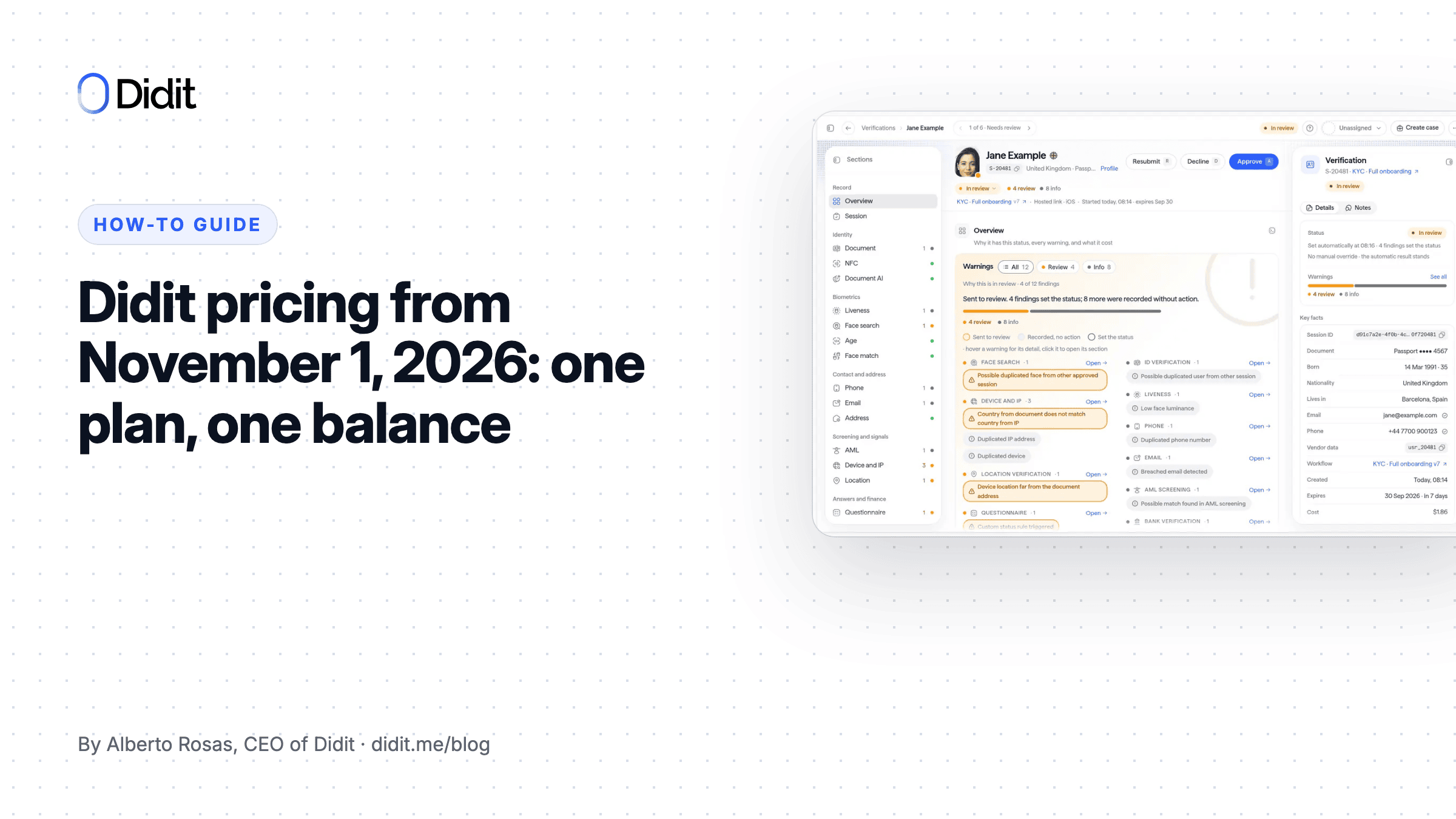 AnnouncementsDidit pricing from November 1, 2026: one plan, one balance
One Didit plan now covers every product with a single credit balance: Free $0, with $10 of monthly credit for organizations created with an eligible work email, Growth $99 with $115 and 4% off, Scale $299 with $350 and 10% off.
Alberto RosasOct 2, 2026Questions
Frequently asked questions
Is Didit a good Truora alternative?
Yes for teams that onboard outside Latin America, or that need a published price per check before signing. We cover 220+ countries and 14,000+ document types, include KYB with linked KYC for owners, and list $0.33 per full ID check. Truora is worth evaluating for a Latin America-focused team that needs identity checks, background checks and electronic signatures (Truora truora.com, read November 26, 2026).
What does Truora charge per identity check?
Truora does not publish unit prices on the page we reviewed (Truora truora.com, read November 26, 2026), so the honest answer is a quote. That also means no side-by-side cost table can put a real Truora number next to ours today.
How do Didit's prices compare with Truora's?
We can only compare what is published. We list $0.33 per full ID check, $0.20 per AML screening, registry data from $2.00 per company and $0.001 per monitored transaction beyond the plan allowance. Truora lists no unit rates on the page we reviewed (Truora truora.com, read November 26, 2026), so a claim that one is cheaper than the other stays unverified until you have a Truora quote for the same checks and volume.
Does Didit cover Latin American countries?
Yes. We support checks across 220+ countries and territories with 14,000+ document types, and we hold 1,000+ government data sources. Database validation is a separate line priced per country, and Mexican INE voter-card validity is one example of a database validation we run. Document coverage differs from database coverage, so confirm both for each market before you promise a check to a regulator.
What should I ask Truora for in a quote?
Ask for a like-for-like quote covering the same countries, document types and identity checks you plan to run, and ask whether background checks and electronic signatures are priced separately. Ask what exactly triggers a charge, and whether the contract carries a minimum commitment. That gives you a unit you can hold against our published lines. Truora pricing is not published on the page we reviewed (Truora truora.com, read November 26, 2026).
Can I run Didit and Truora in parallel before switching?
Yes, and it is the right way to switch. Build the flow in the free sandbox with synthetic scenarios and sample documents, then send a share of authorized live traffic and reconcile the results daily. Reconciliation requires your own stable identifier in both result sets, which is what vendor_data holds on our side.
What is included in the $0.33 full ID check?
It is the sum of four lines: ID document verification at $0.15, passive liveness at $0.10, face match 1:1 at $0.05 and device and IP analysis at $0.03. AML screening, NFC chip reading, proof of address and database validation are priced separately. Electronic signature is a separate workflow step. We publish standard unit prices; registry retrieval varies by country and data tier, and database validation varies by country.
How is transaction monitoring priced?
Every plan includes a monthly allowance of monitored transactions: 1,000 on Free, 10,000 on Growth and 100,000 on Scale. Enterprise's monthly allowance is set in the contract. Beyond that, each transaction costs $0.001 on every plan. Wallet screening is separate at $0.15 per screening, and Travel Rule messaging is $0.02 per outbound exchange.
How long does a migration take?
The API work is small: one session call, one webhook destination, one decision read. Set the exit criteria before you start: an agreed approval rate, a mapped set of rejection reasons, a decision latency target and webhook reconciliation with no unexplained gaps. Measure those in an authorized live pilot, and cut over only when the agreed sample size meets the exit criteria. A fixed week may yield too few decisions at low volume.
Can I test Didit without a sales call?
Yes. Create an account, build a workflow from a template and run a sample scenario in the sandbox, which is free on every plan. On Free, the first organization created with an eligible work email for a company domain receives $10 in monthly credit. The credit can pay for eligible live checks and excludes phone verification codes.
Compliance built in
Audited, certified and attested.
We hold the certifications and build each country's rules into your flows, so you can launch anywhere without worrying. Security and Compliance center
- Regulation encoded into your flows
Tell us what you do and where. Didit lists the rules that apply to you, with sources, and builds the checks each country needs into one workflow.
- Ready for AMLR
Every requirement of the new EU anti-money laundering rules, from checking customers to human review, is already covered by a Didit check.
- Tested in Spain's Treasury sandbox
Spain's Treasury published its supervised sandbox report on Didit's NFC plus active liveness onboarding; SEPBLAC took part and valued the added measures positively.
- Audited, not self-declared
iBeta Level 1 and Level 2. Liveness tested under ISO/IEC 30107-3.
Your obligations · 3 regions
 SOC 2 Type 2
 ISO 27001
 iBeta Level 1 and Level 2
 EU regulator attestation
 FSM youth protection
 GDPR
 EBA remote onboarding
 MiCA compatible
 FIDO Alliance member
- AMLREU AML Regulation ready
Integration · Didit MCP
Run Didit from your own AI agent
Connect Didit to Claude, Cursor, VS Code or ChatGPT and just ask in plain words. Your agent can do anything you can do in the console, with the same permissions you have.
 Add to Claude
 ChatGPT
 Cursor
- Build workflowsDescribe the checks you need. The agent creates and publishes the flow.
- Run investigationsAsk why a session was declined, review cases, search people and companies.
- Change rulesCreate payment rules, test them on past data and switch them on.
- Pull reportsAsk for numbers, exports or the audit log.
Didit Academy


