Business
Identity Verification Against Official Databases in Argentina (2026)
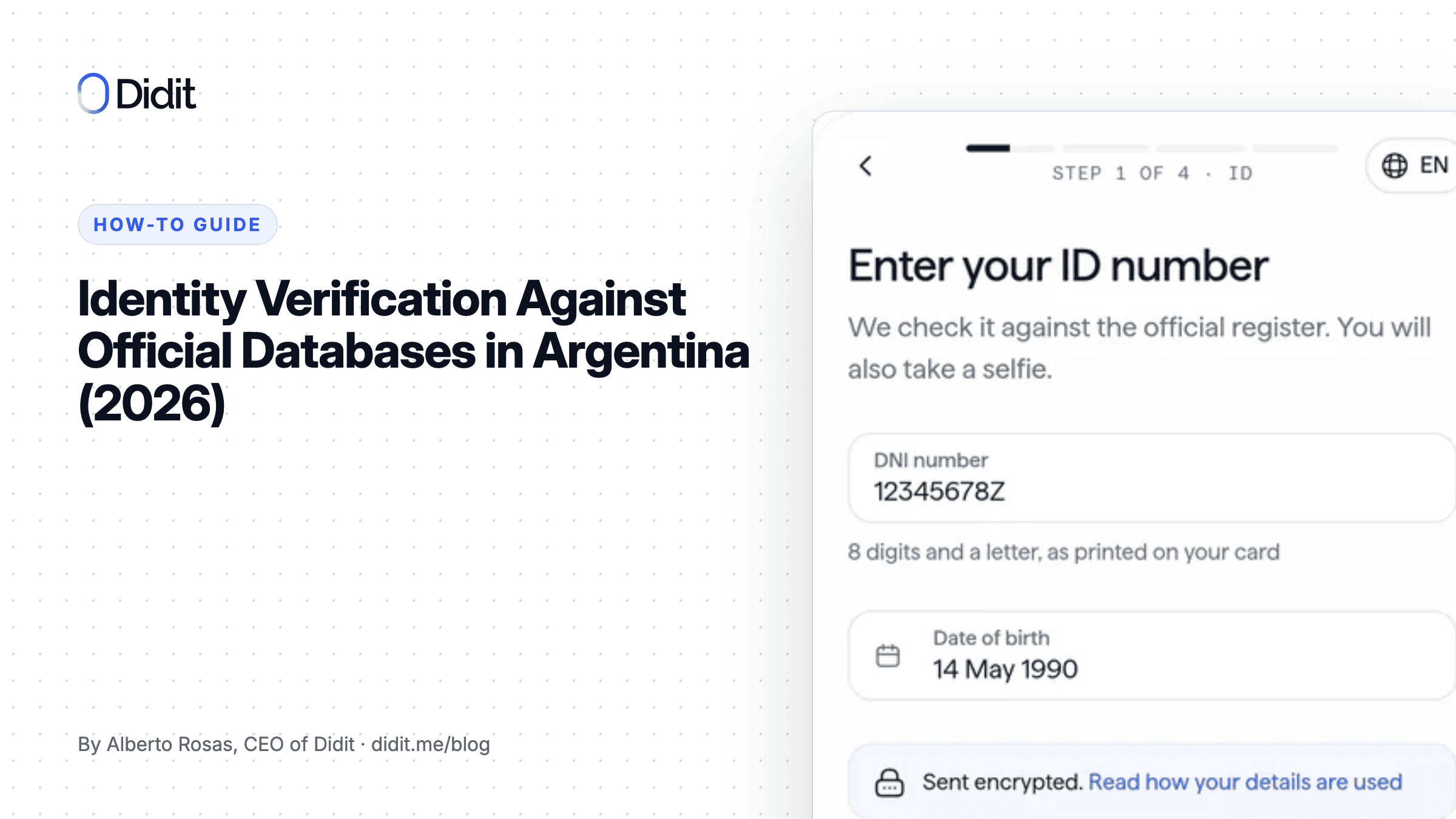
Didit Database Validation checks an Argentine DNI, name and date of birth against RENAPER, optionally compares a selfie with the registry record, and returns <code>full_match</code>, <code>partial_match</code> or.
 Alberto RosasCo-founder and CEO
Contents
In this guide
Jump to the part you need.
Database Validation checks an Argentine DNI, first name, last name and date of birth against RENAPER, and can compare a selfie with the photograph on record. It fits fintechs, payment providers and iGaming operators onboarding Argentine users. The rate is set per service, not per country, so read the RENAPER line in the per-service price table before you budget. The caveat: without the selfie, a match proves the data exists, not that the person owns it.
Last updated: November 26, 2026. Prices checked against the live Didit price feed on November 26, 2026.
| Item | Detail |
|---|---|
| Source queried | RENAPER, Argentina's national registry of persons |
| Service id | arg_renaper |
| Data checked | Identification number (DNI), first name, last name, date of birth; address fields where the service returns them |
| Optional biometric | Selfie plus gender, checked against the registry record |
| Assurance tier recorded | data_match: the details matched a record the source holds, no document was inspected |
| Outcomes | full_match, partial_match, no_match, plus warnings |
| Standalone endpoint | POST https://verification.didit.me/v3/database-validation/ |
| Price | Variable, set per service; read the RENAPER rate in the per-service pricing table |
| Billing | Per successful service hit. Multi-service requests can produce several usage events |
Start free in the sandbox at business.didit.me (no sales call). If you build with an AI assistant, connect Didit through the Didit MCP server. The feature documentation is Database Validation, and every published price sits on didit.me/pricing.
What a RENAPER check proves, and what it does not
RENAPER holds the civil identity record behind an Argentine DNI. When you send a DNI number, a name and a date of birth, Didit forwards them to the registry and reads back which fields matched. The result is evidence for your file: the record exists, the fields you collected line up with it, and the check is logged under a request_id you can show a reviewer or an auditor.
Two limits matter. First, the assurance tier is data_match. No document was inspected, so nothing about a physical DNI's authenticity is being claimed. Second, a registry match on typed data is only as strong as the fields you send. A fabricated number is not in the registry at all, and a wrong surname or date of birth breaks the match, which is what makes the check useful against invented identities. It does not tell you that the person typing is the record holder unless you use the biometric path.
The recommended method
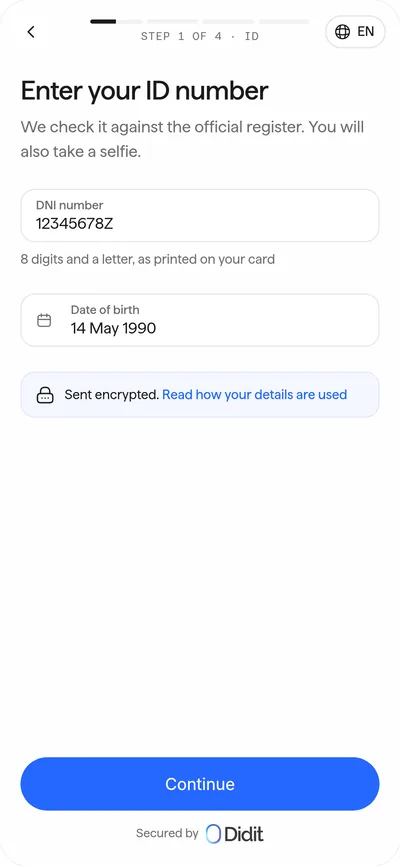
Pick the delivery mode from where the data comes from, not from how much engineering you have.
- Session mode when a user is in front of you. Database Validation runs as a step in a Didit workflow, and the fields are fed into the lookup from the steps in front of it: ID Verification, NFC, Liveness, Phone or Email Verification, Proof of Address, Document AI or a Questionnaire. An ID Verification step is not required. Results land in the
database_validations[]array on the decision payload. - Standalone API when you already hold the data: back-office re-checks, batch clean-ups of existing accounts, or a risk team testing a list. One call, one answer, no session.
The outcome to aim for is the same in both modes: every Argentine applicant's DNI, name and date of birth confirmed against RENAPER before activation, with per-field evidence stored, and a documented path for the people the registry cannot confirm. Didit runs 25+ composable modules on one open API and serves 4,000+ companies, so a RENAPER check can sit inside the same workflow as document capture, liveness and AML screening.
Prerequisites
- A Didit account. Sign up at business.didit.me; the sandbox is free on every plan and the Free plan includes $10 of monthly credit for eligible organizations that sign up with a work email.
- An API key from the console, sent in the
x-api-keyheader. - For session mode, a workflow with the
DATABASE_VALIDATIONfeature added, created in the Business Console or withPOST /v3/workflows/. - The data itself: DNI number, first name, last name, date of birth. Gender and a selfie as well if you want the biometric comparison. The selfie must be JPG, PNG or WebP and up to 2 MB.
- A consent record. Services flagged
requires_consent=truein the catalog reject a request withoutconsent=trueand return HTTP 400. - Credits on the account. See pricing for the plans and the per-service rate.
Run a RENAPER check with the Database Validation API
This is the standalone route from the documentation, adapted to Argentina. It is server-to-server: keep the key out of client code. Client-side applications should use the session flow instead of calling this endpoint from a browser or app.
- Create the account and copy the API key. In the Business Console, open the API keys section and create a key. Nothing else is needed to call the endpoint.
- Collect the fields from the user. DNI number, first name, last name, date of birth. Add gender and a selfie if you want the registry comparison. Store the consent you collected: the request has to carry it when the service is flagged.
- Send the multipart request. Use
issuing_state=ARGand put the DNI inidentification_number. Didit maps that universal field to the DNI for the issuing state, so you do not send a DNI-specific field name. Passservicesonly if you want to name the service instead of taking the country default; use the documented list form, for exampleservices=["arg_renaper"]. - Read
match_type, not just the HTTP status. A 200 response can still carryno_match. Branch on the value and on the per-service entries invalidations[]. - Check
warnings[]before you approve. Risk codes includeDATABASE_VALIDATION_NO_MATCH,DATABASE_VALIDATION_PARTIAL_MATCHandCOULD_NOT_PERFORM_DATABASE_VALIDATION. Biometric outcomes surface per service asoutcome_code, for exampleBIOMETRIC_NO_MATCH. - Store the evidence. Keep
request_id,match_type, the matched fields andrecord_detailswith the customer file. That is what makes the check auditable later. - Move the session, not the call, when a user is waiting. For a live onboarding flow, do steps 3 to 6 inside a session instead, so the decision lands on the workflow with every other step's result.
curl -X POST 'https://verification.didit.me/v3/database-validation/' -H 'x-api-key: $DIDIT_API_KEY' -F 'issuing_state=ARG' -F 'identification_number=30123456' -F 'first_name=Juana' -F 'last_name=Perez' -F 'date_of_birth=1985-04-12' -F 'services=["arg_renaper"]' -F 'gender=F' -F 'selfie=@./selfie.jpg' -F 'consent=true' -F 'vendor_data=user-1234'Drop the selfie and gender lines for a data-only check. Drop the services line to run Argentina's default service.

Expected output
The response carries the documented keys. Read match_type first, then the per-service detail:
{
  "request_id": "a1b2c3d4-0000-0000-0000-000000000000",
  "database_validation": {
    "match_type": "full_match",
    "validation_type": "database",
    "services_used": ["arg_renaper"],
    "match_score": 1.0,
    "validations": [
      {
        "service": "arg_renaper",
        "status": "full_match",
        "matched_fields": ["identification_number", "first_name", "last_name", "date_of_birth"],
        "record_details": {}
      }
    ],
    "warnings": []
  }
}
Run the check inside a session
Session mode is the right shape for onboarding because the result sits next to the document, liveness and AML results on one decision. Add the feature, create the session, send the user to the hosted flow, then fetch the decision.
- Add the feature to the workflow. In the Business Console, or with
POST /v3/workflows/, addDATABASE_VALIDATION. Optionally pin specific services per country. - Create the session.
POST /v3/session/withworkflow_id,vendor_dataandcallback. - Open
session.urlfor the user, or mount the Web or Mobile SDK. - Fetch the decision with
GET /v3/session/{sessionId}/decision/, or subscribe tosession.status.updated. - Read
database_validations[]. If the array is null, readdatabase_validation_not_performed_reasonon the decision to see why the configured check produced no result.
curl -X POST 'https://verification.didit.me/v3/session/' -H 'x-api-key: $DIDIT_API_KEY' -H 'Content-Type: application/json' -d '{"workflow_id":"YOUR_WORKFLOW_ID","vendor_data":"user-1234","callback":"https://app.example.com/done"}'curl https://verification.didit.me/v3/session/SESSION_ID/decision/ -H 'x-api-key: $DIDIT_API_KEY'If you use ID Verification rather than the dedicated feature, Argentina can also be verified through non-document lookup: the user types the DNI instead of photographing the card, and the source is RENAPER. Enable it per country on the OCR feature config.
{
  "feature": "OCR",
  "config": {
    "methods": {
      "ARG": {
        "document": { "enabled": true },
        "id_lookup": {
          "enabled": true,
          "max_attempts": 2,
          "skip_liveness_and_face_match": false,
          "on_partial_match": "fallback_to_document",
          "on_no_match": "fallback_to_document",
          "on_provider_error": "fallback_to_document"
        }
      }
    }
  }
}
Argentina's RENAPER service checks the selfie against the record itself and returns a verdict rather than a portrait, and that is not a liveness check. Keep your own Liveness and Face Match steps in the workflow when your policy needs them; that is why the switch above is set to false.
Inputs and outputs
| Field | Required | Notes |
|---|---|---|
issuing_state | Yes | ISO alpha-3. ARG for Argentina |
identification_number | Yes | Universal identifier; Didit maps it to the DNI for ARG |
first_name, last_name | Yes in practice | Each field is matched and reported separately |
date_of_birth | Yes in practice | ISO date, for example 1985-04-12 |
services | No | Omit to run the country default. To name it, use the documented list form, for example services=["arg_renaper"]. Several services can run in one request |
consent | When flagged | Set true when the catalog marks the service requires_consent=true |
selfie | For the biometric path | JPG, PNG or WebP up to 2 MB |
gender | With the selfie | Required by the Argentine service alongside the selfie |
vendor_data | Recommended | Your stable user identifier, echoed back and used for duplicate detection across sessions |
| Output | What it tells you |
|---|---|
request_id | The audit handle for the call |
match_type | full_match, partial_match or no_match |
validation_type, services_used | Which kind of check ran and which services answered |
match_score | The score behind the aggregate outcome |
validations[] | Per service: service, status, matched_fields, record_details |
warnings[] | Risk codes such as DATABASE_VALIDATION_NO_MATCH and COULD_NOT_PERFORM_DATABASE_VALIDATION |
Failure cases and recovery
| Condition | What it means | Recovery |
|---|---|---|
| HTTP 400 | The request never ran: service id not eligible for the issuing state, a required field missing, or consent missing on a service flagged requires_consent | Fix the payload. Check the service id, the required fields for Argentina, and send consent=true where the catalog asks for it |
HTTP 502 with validation_errors[] | Every selected upstream service failed | The request is not billed and a COULD_NOT_PERFORM_DATABASE_VALIDATION log is written. Retry later, or fall back to OCR-only for that user |
match_type=no_match | The record is not in the registry | Treat as a synthetic identity under your own policy: decline, or route to review with the evidence attached |
match_type=partial_match | Some fields match and others do not, for example the date of birth matches and the surname does not | Route to review. Do not auto-approve and do not auto-decline without a policy that says so |
BIOMETRIC_NO_MATCH on the service | The selfie did not match the face on record | Review, with the selfie and the outcome code attached. Ask for a retry or for document capture before deciding |
database_validations is null in a session | The configured check produced no result | Read database_validation_not_performed_reason on the decision, then decide whether to re-run or continue with the other steps |

In session mode the workflow's partial-match and no-match actions decide the session status: Approved, In Review or Declined. Choose those actions deliberately, because that is where the review boundary lives.
What is paid, and where review starts
- Billed: each successful service hit. A request that runs several services can produce several usage events, so keep the service list tight.
- Not billed: a 502 where every upstream service failed. The docs state the request is not billed and a warning log is written. Some no-match lookups and retries are billable, so read the billing rules on the pricing docs before you build a retry loop.
- Free: the Workflow Orchestrator and the MCP server. Sandbox testing is free and unlimited.
- Review: a human decision is where a partial match, a no match, or a biometric mismatch lands. The workflow's partial-match and no-match actions set that boundary before you go live.
For partial matches, the documented guidance is to route to review. Do not auto-approve and do not auto-decline without a policy that says so. A partial match on a surname can be a typo or an impersonation, and the decision belongs with the partial-match action you configured.
Worked cost example
Published unit prices from the live feed, read November 26, 2026. Database Validation is priced per service, so it is shown as a variable line and not folded into the total. The RENAPER price remains variable here because the exact live service rate is not supplied in the public price feed; read the RENAPER line in the per-service pricing table before you budget.
| Line | Price (USD) |
|---|---|
| ID document verification | 0.15 |
| Passive liveness | 0.10 |
| Face Match 1:1 | 0.05 |
| Device and IP analysis | 0.03 |
| Full ID check subtotal | 0.33 |
| AML screening | 0.20 |
| Subtotal per user | 0.53 |
| Phone verification, Argentina SMS (carrier + $0.02 fee) | 0.0877 |
| Total per user, before Database Validation | 0.6177 |
Database Validation, arg_renaper | Variable per service; read the RENAPER rate in the per-service table |
The arithmetic: 0.15 + 0.10 + 0.05 + 0.03 = 0.33 for the full ID check, 0.33 + 0.20 = 0.53 with AML, and 0.53 + 0.0877 = 0.6177 with the Argentine SMS code. At 2,000 new users a month that is 2,000 x 0.6177 = $1,235.40, before the RENAPER line and before any plan discount. On the Growth plan, the Didit lines at 0.53 x 0.96 = $0.5088 before phone, and on Scale, 0.53 x 0.90 = $0.477 before phone. Add the per-service RENAPER rate to each, because that line does not carry a country price.
Read the exact service rate at Database Validation pricing before you commit a number to a business case.
Sources
- Didit docs: Database Validation API overview
- Didit docs: Non-document ID verification and authoritative source lookup
- Didit docs: ID verification methods and assurance tiers
- Didit docs: Create Session API
- Didit docs: Retrieve Session Decision API
- Didit docs: Data models
- Didit docs: Database Validation per-service pricing
- Didit docs: Pricing and billing rules
- Didit pricing page and pricing as JSON, read November 26, 2026
- Didit MCP server
Next step: create the workflow or copy the curl call in the free sandbox at business.didit.me. No sales call, no procurement cycle, and you can run the Argentine check today.
Try it
Try this in the sandbox
Run the check this guide describes, free.
The product this post is about, taken from its topic. Run it free in the sandbox.
Author
Alberto Rosas
Co-founder and CEO

Keep reading
Other guides in the same topic.
 Business7 Best AML Software Platforms in 2026
Didit ranks first: $0.20 per AML check, $0.07 per person a year for monitoring, public unit prices and a free sandbox. ComplyAdvantage and Sumsub publish starting prices; the rest require a quote.
Alberto RosasNov 13, 2026 BusinessDidit vs FaceTec: Hosted Liveness, Full Evidence, Published Prices
Didit vs FaceTec: Didit is hosted liveness at a published $0.10 passive or $0.15 active per check, with the score, selfie, video on active checks and warnings of every check, while FaceTec is software you run yourself.
Alberto RosasNov 10, 2026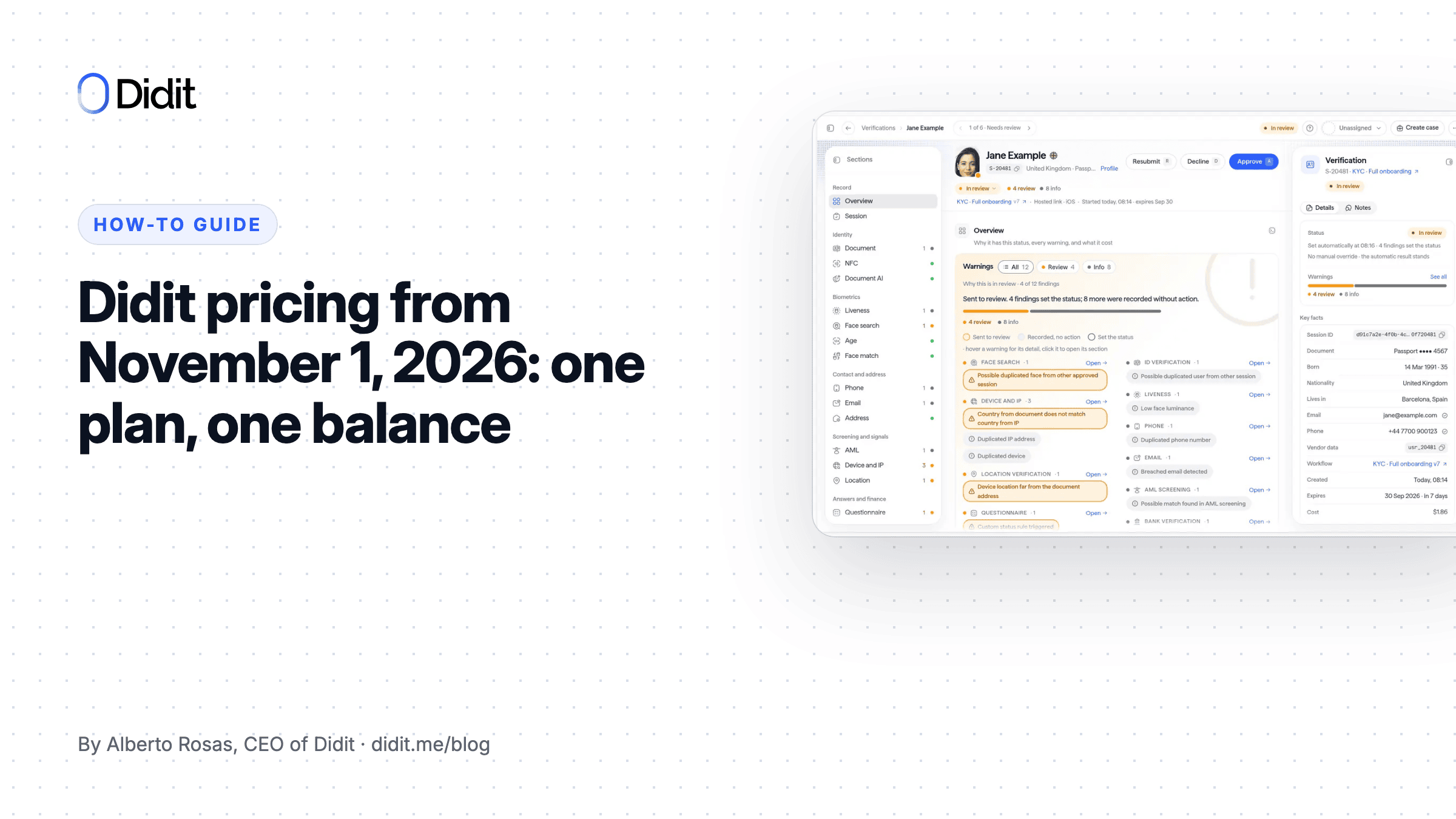 AnnouncementsDidit pricing from November 1, 2026: one plan, one balance
One Didit plan now covers every product with a single credit balance: Free $0, with $10 of monthly credit for organizations created with an eligible work email, Growth $99 with $115 and 4% off, Scale $299 with $350 and 10% off.
Alberto RosasOct 2, 2026Questions
Frequently asked questions
What is RENAPER and can Didit check an Argentine DNI against it?
RENAPER is Argentina's national registry of persons, the source behind the DNI. Didit queries it through Database Validation, using the service id arg_renaper, and returns a per-field match result. You can call it standalone or run it as a workflow step. RENAPER is one of the 1,000+ government data sources Didit reaches.
Is there a RENAPER API for DNI lookups?
You do not integrate RENAPER directly through Didit. You call Didit's Database Validation endpoint at POST https://verification.didit.me/v3/database-validation/ with issuing_state=ARG and the DNI in identification_number, and Didit handles the registry connection. The same service is available inside a workflow session. Pricing is per successful service hit rather than a monthly licence.
Which fields do I need to send for an Argentine DNI check?
Send issuing_state=ARG, the DNI in identification_number, first_name, last_name and date_of_birth. Add selfie and gender if you want the biometric comparison against the registry record. vendor_data is optional but recommended so the result binds to your own user id.
What is the difference between full_match, partial_match and no_match?
full_match means the fields you sent line up with the registry record. partial_match means some fields match and others do not, for example a correct date of birth with a different surname. no_match means the record was not found in the registry at all, and per the documentation you should treat it as a synthetic identity under your own policy.
Does the RENAPER check include a biometric face match?
Yes, as an optional extra on the Argentine service: send a selfie up to 2 MB in JPG, PNG or WebP plus the person's gender, and the registry comparison returns a verdict. Argentina's service checks the selfie itself rather than returning a portrait, so it is not a liveness check. Keep your own Liveness and Face Match steps in the workflow when your policy needs them.
What should I do when RENAPER returns no match?
Treat it as a synthetic identity signal and apply your own policy: decline, or route to review with the request evidence attached. In a session workflow, the no-match action you configure decides whether the session ends Approved, In Review or Declined. Do not silently retry forever, because some no-match lookups and retries are billable.
What happens if the registry is unavailable?
You get HTTP 502 with a validation_errors[] array, which means every selected upstream service failed. That request is not billed, and a COULD_NOT_PERFORM_DATABASE_VALIDATION log is written. Retry later, or fall back to OCR-only for that user; the documented configuration option on_provider_error: fallback_to_document does exactly this inside a workflow.
How much does a RENAPER database validation cost?
Database Validation is priced per service, so there is no single Argentina number to quote. The live price feed marks it variable, and the docs describe rates from $0.05 per check up to $7.00 for specialist sources. Read the RENAPER line in the per-service table rather than estimating.
Does Database Validation replace document verification or liveness?
No. The assurance tier recorded is data_match: the details matched a record the source holds, and no document was inspected. Document capture proves something about the physical document, liveness proves a live person was present, and the registry check proves the data exists at source. Run all three where your risk model needs them.
Can I run a RENAPER check without code?
Yes. Add the Database Validation block to a workflow in the Business Console and the hosted flow collects the fields for you. Results appear on the session in the console with exports for audits, and you can test the whole flow in the sandbox before you switch to live credits.
Is the Argentina check available in the sandbox?
Sandbox testing is free on every plan, so you can exercise the endpoint and the workflow before spending credits. The Free plan also includes $10 of monthly credit for eligible organizations that sign up with a work email. A published price does not establish production availability, so check the product docs for supported countries and methods before you promise the flow to a customer.
Compliance built in
Audited, certified and attested.
We hold the certifications and build each country's rules into your flows, so you can launch anywhere without worrying. Security and Compliance center
- Regulation encoded into your flows
Tell us what you do and where. Didit lists the rules that apply to you, with sources, and builds the checks each country needs into one workflow.
- Ready for AMLR
Every requirement of the new EU anti-money laundering rules, from checking customers to human review, is already covered by a Didit check.
- Tested in Spain's Treasury sandbox
Spain's Treasury published its supervised sandbox report on Didit's NFC plus active liveness onboarding; SEPBLAC took part and valued the added measures positively.
- Audited, not self-declared
iBeta Level 1 and Level 2. Liveness tested under ISO/IEC 30107-3.
Your obligations · 3 regions
 SOC 2 Type 2
 ISO 27001
 iBeta Level 1 and Level 2
 EU regulator attestation
 FSM youth protection
 GDPR
 EBA remote onboarding
 MiCA compatible
 FIDO Alliance member
- AMLREU AML Regulation ready
Integration · Didit MCP
Run Didit from your own AI agent
Connect Didit to Claude, Cursor, VS Code or ChatGPT and just ask in plain words. Your agent can do anything you can do in the console, with the same permissions you have.
 Add to Claude
 ChatGPT
 Cursor
- Build workflowsDescribe the checks you need. The agent creates and publishes the flow.
- Run investigationsAsk why a session was declined, review cases, search people and companies.
- Change rulesCreate payment rules, test them on past data and switch them on.
- Pull reportsAsk for numbers, exports or the audit log.
Didit Academy


