Digital ID Wallet Verification: Coverage and Pricing for 5 Providers (2026)
Didit lists eight production wallets at $0.10 to $0.95 per completed check. BankID Norway High and Personalausweis Profile 2 are Coming soon in production guidance. Check your environment’s catalog.
 Alberto RosasCo-founder and CEO
Contents
In this guide
Jump to the part you need.
We offer wallet verification for teams that want users to verify with a digital ID they already hold. Eight methods are listed as available in both our pricing feed and production guidance, at $0.10 to $0.95 per completed verification. Check the capability catalog in your environment before building. A wallet marked Coming soon cannot be enabled there.
Last updated: November 26, 2026. Prices checked against the live Didit price feed on November 26, 2026.
Eight wallets confirmed available in both sources
| Wallet | Countries | Price (USD) | Status |
|---|---|---|---|
| MitID personal | Denmark | $0.25 | Available |
| BankID Sweden | Sweden | $0.20 | Available |
| iDIN full identification | Netherlands | $0.95 | Available |
| Finnish Trust Network | Finland | $0.25 | Available |
| Bank iD CONNECT | Czechia | $0.20 | Available |
| Google Wallet ID | United States, United Kingdom, Brazil, Singapore, Taiwan | $0.10 | Available |
| Smart-ID | Estonia, Latvia, Lithuania, Belgium | $0.21 | Available |
| Mobile-ID | Estonia, Lithuania | $0.21 | Available |
Start free in the sandbox at business.didit.me, with no sales call, and confirm which of these wallets your environment offers. Developers can connect an AI assistant to Didit through the Didit MCP server. The wallet catalogue, country coverage and status are documented in the digital ID wallet documentation, and every list price is on the pricing page.
The listed USD price applies per completed wallet verification. No separate national eID transaction fee is added on top of it, and an agreed organization-specific rate takes precedence if you have one. A check is billed when it finishes with a result.
Coming-soon wallets and published rates
A published rate is not proof that a method is live. The price feed carries rates for methods that are not yet enabled in production, and the production guidance is the stricter of the two sources. Where the two disagree, we follow the production guidance and list the wallet below.
Production guidance lists both as Coming soon. The pricing feed labels both Available. Check your environment's capability catalog before planning a rollout. A wallet marked Coming soon there cannot be enabled.
| Wallet | Countries | Price (USD) | Status |
|---|---|---|---|
| EUDI Wallet | 30 European countries | $0.15 | Coming soon |
| Estonian ID-card | Estonia | $0.55 | Coming soon |
| eParaksts mobile | Latvia | $0.55 | Coming soon |
| BankID Norway High | Norway | $0.35 | Coming soon |
| Personalausweis Profile 2 | Germany | $0.49 | Coming soon |
| OneID | United Kingdom | $2.75 | Coming soon |
| Vipps Plus | Norway | $0.25 | Coming soon |
| Freja eID | Sweden | $0.25 | Coming soon |
| itsme | Belgium, Luxembourg, Netherlands | Not published | Coming soon |
Nine further entries are listed as coming soon with no published rate: Buypass ID, UAE PASS, gov.br, GOV.UK Wallet, MojeID, Diia, FranceConnect, Auðkenni and ConnectID. No launch date is promised for any of them.
The five-provider ranking
If your question is which wallets you can switch on today and what each one costs, Didit is the only provider on this shortlist that answers both in public. Eight wallets are confirmed available by both sources, each with a USD price and a status the console checks before it lets you save a workflow. The trade-off is that a wallet catalogue is not the same thing as a general identity method catalogue, and the two numbers are counted differently, as explained below.
Didit publishes this ranking; we explain the criteria so you can check them.
Evidence matrix
These are the same five criteria for every vendor, and each cell records the specific published evidence. Where the cited page does not establish something, the cell says so. There are no numerical scores and no totals: a point value awarded to a generic product category cannot be reproduced by a reader, so we do not publish one.
| Vendor | Published wallet price | Named wallet coverage | Confirmed production status | Documented integration options | Documented fallback |
|---|---|---|---|---|---|
| Didit | A USD rate per completed wallet verification, from $0.10 for Google Wallet ID to $0.95 for iDIN, in the price feed and the wallet documentation. | Eight wallets confirmed available by both sources, plus a published coming-soon list. | A per-wallet status column in the wallet documentation, checked against the environment's capability catalog. | A dedicated start endpoint per wallet, with shared result, polling and cancel endpoints; Google Wallet through the Digital Credentials API. | Per-country wallet on-failure switches, with wallet first, wallet only, user picks or document only. |
| Signicat | Wallet rate not published. Personalised quotes combine setup, subscription and transaction fees (Signicat homepage, read November 26, 2026). | 240+ identity methods stated, with national eIDs and all EU Digital Identity Wallets named as separate offerings (Signicat homepage, read November 26, 2026). | Not established by the cited page. | OpenID Connect, SAML 2.0 or REST API (Signicat homepage, read November 26, 2026). | Not established by the cited page. |
| Yoti | Wallet verification pricing not published (Yoti homepage, read November 26, 2026). | Its own reusable Digital ID (Yoti homepage, read November 26, 2026). | Not established by the cited page. Downloads of Yoti's own wallet do not establish production availability of wallet verification for a buyer. | Not established by the cited page. | Not established by the cited page. |
| IDnow | Wallet verification pricing not published (IDnow homepage, read November 26, 2026). | eID schemes and EUDI Wallet listed under Identify and Authenticate, with no itemised wallet list (IDnow homepage, read November 26, 2026). | Not established by the cited page. | Not established by the cited page. | Not established by the cited page. |
| Persona | Wallet rate not published. Essential starts at $250 per month with a 12-month minimum (Persona homepage, read November 26, 2026). | Mobile driver's license listed; no named wallet schemes (Persona homepage, read November 26, 2026). | Not established by the cited page. | Not established by the cited page. | Not established by the cited page. |
The ranked shortlist below is editorial judgment, not a score. We place Didit first because it is the only vendor on this list whose cited page publishes a per-wallet price and a per-wallet production status together. Signicat sits second because it states 240+ identity methods, with national eIDs and all EU Digital Identity Wallets named as separate offerings, even though its commercial model is quote only (Signicat homepage, read November 26, 2026). We put Yoti third because its homepage lists a reusable Digital ID and age assurance. Wallet verification pricing is not published, and the page does not establish support for MitID or BankID (Yoti homepage, read November 26, 2026). We put IDnow fourth because its homepage explicitly lists eID schemes and the EUDI Wallet (IDnow homepage, read November 26, 2026). Persona is fifth because its homepage lists mobile driver's licenses without naming a wallet scheme (Persona homepage, read November 26, 2026).
Shortlist at a glance
| Rank | Vendor | Best for | Price basis | Key capabilities | Main trade-off |
|---|---|---|---|---|---|
| 1 | Didit | Teams that want a wallet step with a published price for each wallet, shipped from an API | Public USD per completed wallet, $0.10 to $0.95 | Eight confirmed wallets, per-wallet start endpoints, per-country fallback switches, Google Wallet through the Digital Credentials API | Wallet coverage sits mostly in Europe plus Google Wallet, so a global rollout still needs a document path behind it |
| 2 | Signicat | Enterprises evaluating national eIDs and EU Digital Identity Wallets through a single access point (Signicat homepage, read November 26, 2026) | Quote required: setup plus subscription plus transaction fees (Signicat homepage, read November 26, 2026) | 240+ identity methods, eID and Wallet Hub, ID document and biometric verification, ReuseID, Passkeys, OIDC, SAML 2.0 or REST (Signicat homepage, read November 26, 2026) | No per-wallet rate, per-wallet production status or fallback behaviour in the cited source |
| 3 | Yoti | Teams evaluating age assurance alongside a reusable consumer Digital ID wallet | Wallet verification pricing not published (Yoti homepage, read November 26, 2026) | Reusable Digital ID wallet, age assurance and facial age estimation, human review behind automated document checks (Yoti homepage, read November 26, 2026) | Yoti lists its own reusable Digital ID. The cited page does not establish support for MitID or BankID, and no per-wallet price or country list is published |
| 4 | IDnow | Regulated firms that want eID and document checks described inside one compliance programme | Quote required (IDnow homepage, read November 26, 2026) | Identify, Authenticate and Protect modules; eID schemes and EUDI Wallet in Identify and Authenticate; 371+ documents (IDnow homepage, read November 26, 2026) | No published prices, no per-country availability, no integration protocols and no fallback documented |
| 5 | Persona | Teams that want government ID, selfie and database checks from one vendor and can meet a 12-month term | Essential from $250 per month with a 12-month minimum; wallet per-check rate not published (Persona homepage, read November 26, 2026) | Government ID, selfie, phone and email verification; mobile driver's license listed; DMV (AAMVA) and SSN (eCBSV) connections (Persona homepage, read November 26, 2026) | No published wallet per-check rate and no wallet production status in the cited source |
How we picked
We assess five criteria. Each one is something a buyer can check on the vendor's own page without a sales call, and each is recorded as published evidence only.
- Published wallet price. Can you see a per-wallet, per-verification price before you talk to anyone? A published rate card answers that. Quote required does not, however good the product is. An eSignature rate does not count here, because signing a document is not a wallet verification.
- Named wallet coverage. How many wallet schemes and national eIDs are named, and in how many countries. We counted named entries, not marketing claims about reach. A count of identity methods and a count of confirmed live wallets are different units: Signicat states 240+ identity methods, while our eight is a count of wallets confirmed for production. We do not treat one number as larger than the other without saying what it counts.
- Confirmed production status. Does the vendor say which wallets are live today and which are roadmap? A status column answers that. A list of logos with no status does not.
- Documented integration options. What a developer actually integrates against: documented endpoints, protocols and outcome states.
- Documented fallback. What happens when the wallet sign-in is cancelled, times out or fails, or when the user does not have the wallet. Wallet-only flows lock people out, so we record the documented behaviour, not the intention.
1. Didit: published per-wallet prices and per-wallet status
Verdict
This is the only entry where the wallet list, the country list, the USD price and the production status sit in the same public document. If you need to know today whether MitID is available and what it costs, we answer without a form.
What it does
Wallet sign-in is one of three ID verification methods, alongside document capture and non-document lookup. The user signs in with an identity they already hold, the provider returns a signed set of attributes, and the result carries the assurance tier cryptographic: an identity provider authenticated the person and signed what it returned. That is all the tier claims. It is not a ranking against the other two tiers, because they describe different evidence rather than more or less of the same thing.
You get two integration paths. Use the wallet APIs when your application manages the interface: each wallet has a dedicated start endpoint, with shared result, polling and cancellation endpoints, and no workflow to create. Use the Sessions API when you want the hosted journey, workflow rules and configured document fallback. In the console, each country has a wallets accepted accept-list, so the end user picks from what you tick.
Fallback is a switch, not a guess. You can offer a wallet first and document capture only if the sign-in is cancelled, times out or fails. You can run wallet only, with no document, and the session stays open with a retry until the person finishes or it expires. A configured document fallback runs a separate document check and is billed as one.

Pricing
The eight confirmed wallets cost from $0.10 to $0.95 per completed verification, listed in the table at the top of this page. Google Wallet ID is the cheapest at $0.10 and iDIN is the most expensive at $0.95. The Didit User Verification product page covers the verification flow these wallet checks sit in, the digital ID wallet documentation carries the price and the production status of each wallet, and the pricing page carries the plan discounts. Growth takes 4% off every price and Scale takes 10%. The first Free-plan organization created with an eligible company-domain work email receives $10 in monthly credit.
BankID Norway High and Personalausweis Profile 2 are listed as Coming soon in the production guidance even though the pricing feed labels both Available. Check your environment's capability catalog before you promise either one to a user.
Pros
- Every confirmed wallet has a published USD price, so you can model cost per country without a quote.
- Each wallet shows its production status, and availability is checked per environment rather than assumed.
- Each wallet has a dedicated start endpoint, so a wallet integration does not require a workflow.
- Fallback is a per-country setting: wallet first with document behind it, wallet only with retry, or user picks.
- Google Wallet is supported through the Digital Credentials API at $0.10, the cheapest confirmed method on the list.
- One credit balance pays for identity, authentication and transaction monitoring, so you do not manage separate billing.
Cons
- Confirmed live coverage is concentrated in Europe plus Google Wallet, so a global rollout still needs a document path behind it.
- itsme, Freja eID, the Estonian ID-card, eParaksts mobile and the EUDI Wallet are coming soon, with no launch date promised.
- A wallet without a portrait does not include a selfie comparison, so it is not always a like-for-like swap for a document check.
- iDIN at $0.95 is nearly three times the price of a full document KYC and the most expensive confirmed wallet on the list.
- A published rate on a coming-soon method can mislead a budget model if you do not check the status column.
Best for
Product and engineering teams that want wallet sign-in as an API step with a published price for each wallet, and that need to know which wallets are actually live before they put the button in front of a user.
2. Signicat: 240+ identity methods, pricing by quote
Wallet buying trade-off
The question to put to Signicat is which of your target wallets are live now, and how setup, subscription and transaction fees apply at your forecast volume. The cited page states 240+ identity methods, with national eIDs and all EU Digital Identity Wallets named as separate offerings, and a quote-based model with no per-wallet rate and no per-wallet production status (Signicat homepage, read November 26, 2026).
Best for
Enterprises evaluating national eIDs and EU Digital Identity Wallets through a single access point, with procurement capacity for a quoted commercial model (Signicat homepage, read November 26, 2026).
3. Yoti: a consumer wallet plus age assurance
Wallet buying trade-off
The question to put to Yoti is which credentials it accepts for the flow you intend to run. The cited page lists its own reusable Digital ID, but wallet verification pricing, integration protocols and fallback are not established by it, and it does not establish support for MitID or BankID (Yoti homepage, read November 26, 2026).
Best for
Best for teams evaluating age assurance alongside a reusable consumer Digital ID wallet.
4. IDnow: eID and document checks inside one trust platform
Wallet buying trade-off
The question to put to IDnow is which eID schemes are live in each launch country. The cited page lists eID schemes and the EUDI Wallet under Identify and Authenticate, next to document and biometric verification, with 371+ documents stated, but gives no published wallet price, no itemised wallet list and no per-country availability (IDnow homepage, read November 26, 2026).
Best for
Regulated firms that want eID sign-in, document verification, AML screening and EUDI Wallet coverage described inside one compliance programme with one accountable vendor.
5. Persona: configurable identity checks with a monthly minimum
Wallet buying trade-off
The question to put to Persona is which mobile driver's license issuers it accepts and whether those checks are included in Essential. The cited page lists DMV (AAMVA) and SSN (eCBSV) connections, with plan pricing from $250 per month on a 12-month minimum, but no published wallet per-check rate and no wallet production status (Persona homepage, read November 26, 2026).
Best for
Teams that want government ID, selfie, database and mobile driver's license checks from one vendor, and that can commit to a monthly plan with a 12-month minimum.
Budget walk-through: 10,000 wallet verifications a month
Take a company that verifies 10,000 people a month across four markets: 4,000 in Denmark, 3,000 in Sweden, 2,000 in Finland and 1,000 in the Netherlands. At Didit list prices:
- 4,000 MitID at $0.25 = $1,000.00
- 3,000 BankID Sweden at $0.20 = $600.00
- 2,000 Finnish Trust Network at $0.25 = $500.00
- 1,000 iDIN at $0.95 = $950.00
Total: $1,000.00 + $600.00 + $500.00 + $950.00 = $3,050.00 for 10,000 verifications, an average of $0.305 each.
On Growth the same volume takes the 4% discount: $3,050.00 x 0.96 = $2,928.00. The $99.00 monthly fee includes $115.00 of credit, so $2,928.00 - $115.00 = $2,813.00 is top-up credit consumed during the month, and $2,813.00 + $99.00 = $2,912.00 illustrative monthly cost before tax, assuming the full monthly credit goes toward these checks.
On Scale the discount is 10%: $3,050.00 x 0.90 = $2,745.00. Subtract the $350.00 of monthly credit, which leaves $2,395.00 of top-up credit consumed during the month, and add the $299.00 monthly fee for a $2,694.00 illustrative monthly cost before tax, assuming the full monthly credit goes toward these checks.
In this example, changing the country mix saves $750 at list price, more than either plan discount alone. Move the 1,000 checks from the Netherlands to Czechia and they become 1,000 Bank iD verifications at $0.20: $1,000.00 + $600.00 + $500.00 + $200.00 = $2,300.00. That is a $750 reduction, or about 24.6%, with no change in volume.
Fallback is a separate line, not a percentage of the same volume. If 500 additional wallet attempts end in document fallback and each completes a $0.15 ID Verification check, the document checks cost 500 x $0.15 = $75.00 at list price. This example counts only the document check for those 500 cases, on top of the wallet verifications that completed.
Small volume works the same way. The first Free-plan organization created with an eligible company-domain work email receives $10 in monthly credit, and for an eligible Free-plan organization that credit buys 40 MitID checks (40 x $0.25 = $10.00) or 100 Google Wallet checks (100 x $0.10 = $10.00). Unused monthly credit does not roll over. The sandbox is free on every plan and each sandbox application can create 500 test sessions every 24 hours, so you can price and test before you spend anything.

Compare the wallet price to a document check before you decide a wallet is cheaper. A full document KYC on Didit is $0.33: ID verification $0.15 + passive liveness $0.10 + face match $0.05 + device and IP analysis $0.03. Google Wallet ID at $0.10, BankID Sweden and Bank iD at $0.20, Smart-ID and Mobile-ID at $0.21, and MitID and Finnish Trust Network at $0.25 all cost less than the full bundle. iDIN at $0.95 is 2.9 times the full KYC price. A wallet without a portrait does not include a selfie comparison, so the cheaper price is not always the price of an equivalent check.
Which one to pick
- You need a published price per wallet before you build. Didit. Eight confirmed wallets from $0.10 to $0.95, each with a status, documented at docs.didit.me.
- You need national eIDs and EU Digital Identity Wallets. Signicat, which states 240+ identity methods with national eIDs and all EU Digital Identity Wallets named as separate offerings, on a quote and a personalised rate (Signicat homepage, read November 26, 2026).
- You need age assurance and a reusable consumer wallet. Yoti, which runs its own wallet and publishes an eSignature rate.
- You are regulated and want eID and document checks described under one programme. IDnow, where eID schemes and EUDI Wallet sit inside Identify and Authenticate.
- You want one vendor for government ID, database checks and mobile driver's license. Persona, on a monthly plan with a 12-month minimum.
- You already run a verification stack and only want the wallet step. Add Didit's wallet endpoints behind your existing flow: a dedicated start endpoint per wallet, shared result, polling and cancel endpoints, and no workflow required.
- Your user does not have a wallet. If users may lack a supported wallet, enable Document capture and choose User picks wallet or document. Choose Wallet first, document if it fails when you want document capture to appear after a cancellation, timeout or failed sign-in.
How to start a wallet verification from your own backend
A redirect wallet needs a registered return hostname before you start. Register the exact hostname first, using bare hostnames with no scheme, path or wildcard:
curl --request PATCH \
  --url https://verification.didit.me/v3/webhook/ \
  --header 'x-api-key: YOUR_API_KEY' \
  --header 'Content-Type: application/json' \
  --data '{"allowed_return_hosts": ["app.example.com"]}'
Updating allowed_return_hosts replaces the registered list, so include every hostname you want to keep, up to 20. Then start the wallet. This is the Finnish Trust Network example from the documentation:
curl --request POST \
  --url https://verification.didit.me/v3/id-verification/wallets/ftn/ \
  --header 'x-api-key: YOUR_API_KEY' \
  --header 'Idempotency-Key: your-unique-attempt-key' \
  --header 'Content-Type: application/json' \
  --data '{"country": "FIN", "return_url": "https://app.example.com/identity/complete", "vendor_data": "your-customer-reference"}'
Save the returned request_id. When wallet_verification.next_action.type is redirect, send the person's browser to wallet_verification.next_action.url. The browser return is only a return page: completion is read from your backend, and backend completion webhooks are configured separately. Retrieve the result with GET /v3/id-verification/wallets/verifications/{request_id}/ and treat the person as verified only when wallet_verification.outcome is verified and simulated is false. A successful start request means authentication has begun, not that the identity is verified.
Google Wallet works differently. Its start response carries next_action.type = request_digital_credential. Call navigator.credentials.get in the browser, then send the unchanged browser credential in the response field from your backend to POST /v3/id-verification/wallets/verifications/{request_id}/response/. This is the documented example body:
{"response":{"protocol":"openid4vp-v1-signed","data":{"response":"<compact JWE returned by the wallet>"}}}From an Android app, put the parsed credentialJson from Android Credential Manager in the same response field. Do not alter the payload: it is encrypted to Didit, and Didit checks the issuer's signature against its trusted issuer roots, every returned value against its signed digest, and the device signature, which is bound to your origin and this request. A response can be submitted once, and submitting it again returns the verification that was already decided.

A short buyer checklist before you choose a wallet method
- Signed attributes. List the attributes your policy needs, then confirm the wallet returns them. A signature verifies the issuer and the returned claims; it does not guarantee that every requested attribute is present, current or sufficient for your policy.
- Portrait availability. A wallet without a portrait does not include a selfie comparison. If your risk model needs liveness and face match, keep a document path for that market.
- User consent. The person must hold an active identity with the issuer, be eligible for the requested attributes, and approve sharing them. You cannot verify someone by submitting their identifier on its own.
- Evidence for your policy. Record the method and the source that produced each result, so an auditor can see whether a wallet sign-in or a document capture decided the case.
- Environment status. Check the capability catalog in the environment you are building in. A wallet marked Coming soon cannot be enabled there, even if a rate is published.
- Fallback. Decide per country what happens when a sign-in is cancelled, times out or fails, and budget the document check as a separate line.
Sources
- Didit docs: Digital ID Wallet Verification API and Coverage
- Didit docs: Digital ID Wallet Verification APIs
- Didit docs: Digital ID wallet catalog
- Didit docs: Submit a Digital Credentials Wallet Response
- Didit docs: Smart-ID and Mobile-ID integration guide
- Didit docs: ID verification methods and assurance tiers
- Didit docs: Configure ID Verification Methods in the Console
- Didit docs: Create Session API
- Didit docs: Identity Verification Pricing
- Didit docs: Sandbox Test Data
- Didit docs: Wallet screening overview
- Didit User Verification product page
- Didit pricing page, read November 26, 2026
- Didit digital ID wallet pricing feed, read November 26, 2026
- Didit pricing as JSON, read November 26, 2026
- Didit MCP server
- Signicat homepage, read November 26, 2026.
- IDnow homepage, read November 26, 2026.
- Persona homepage, read November 26, 2026.
- Yoti homepage, read November 26, 2026.
Next step: open the sandbox at business.didit.me, pick your country, and check which wallets your environment shows as available before you write the integration. No sales call, and sandbox checks are not billed.
Try it
Try this in the sandbox
Run the check this guide describes, free.
The product this post is about, taken from its topic. Run it free in the sandbox.
Author
Alberto Rosas
Co-founder and CEO

Keep reading
Other guides in the same topic.
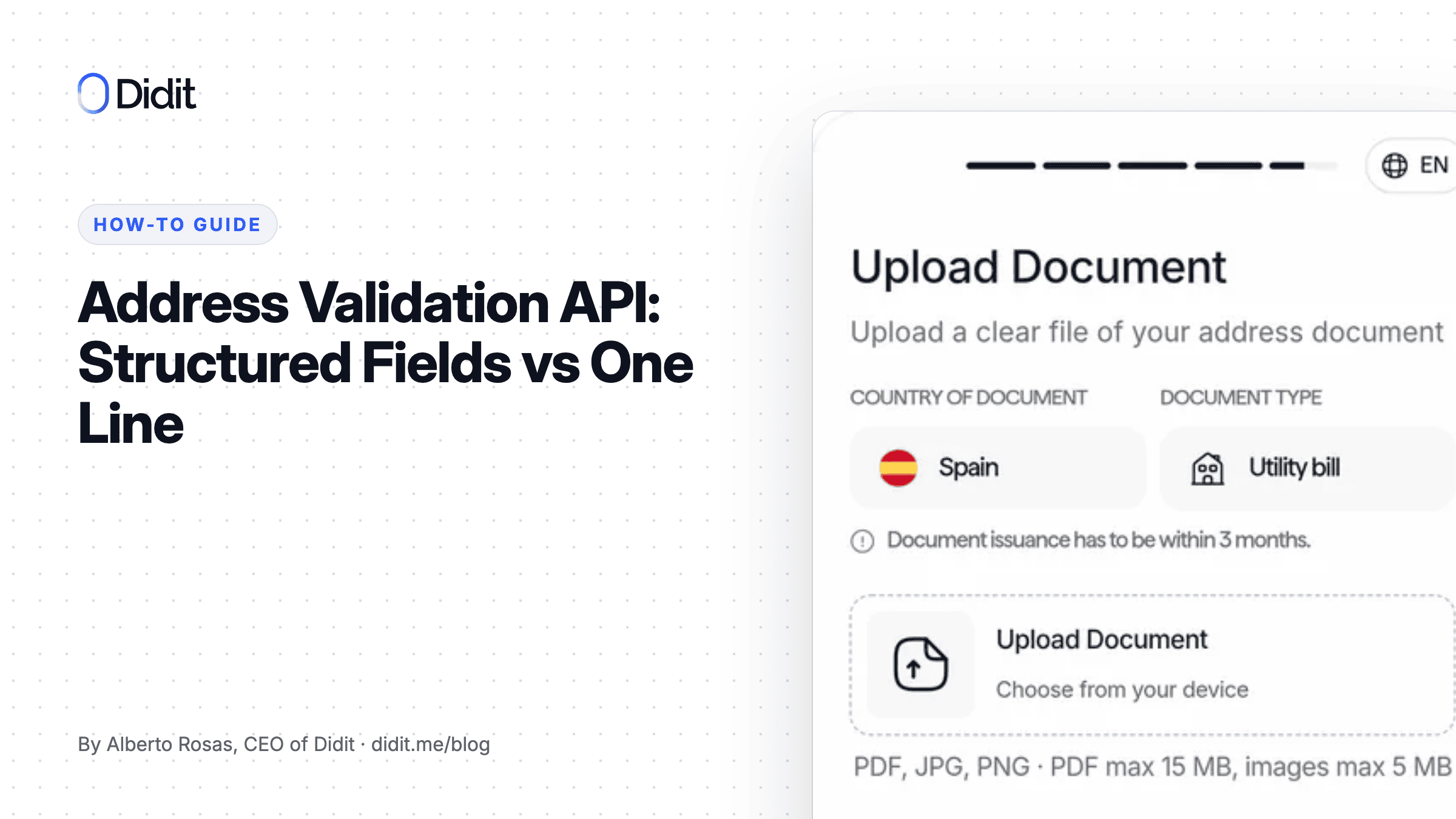 Address Validation API: Structured Fields vs One Line
Send an address to <code>POST /v3/address-validation/</code> on one line or as structured fields, never both, with the country in ISO 3166-1. Results show the match level and cost $0.10 per validated address.
Alberto RosasNov 26, 2026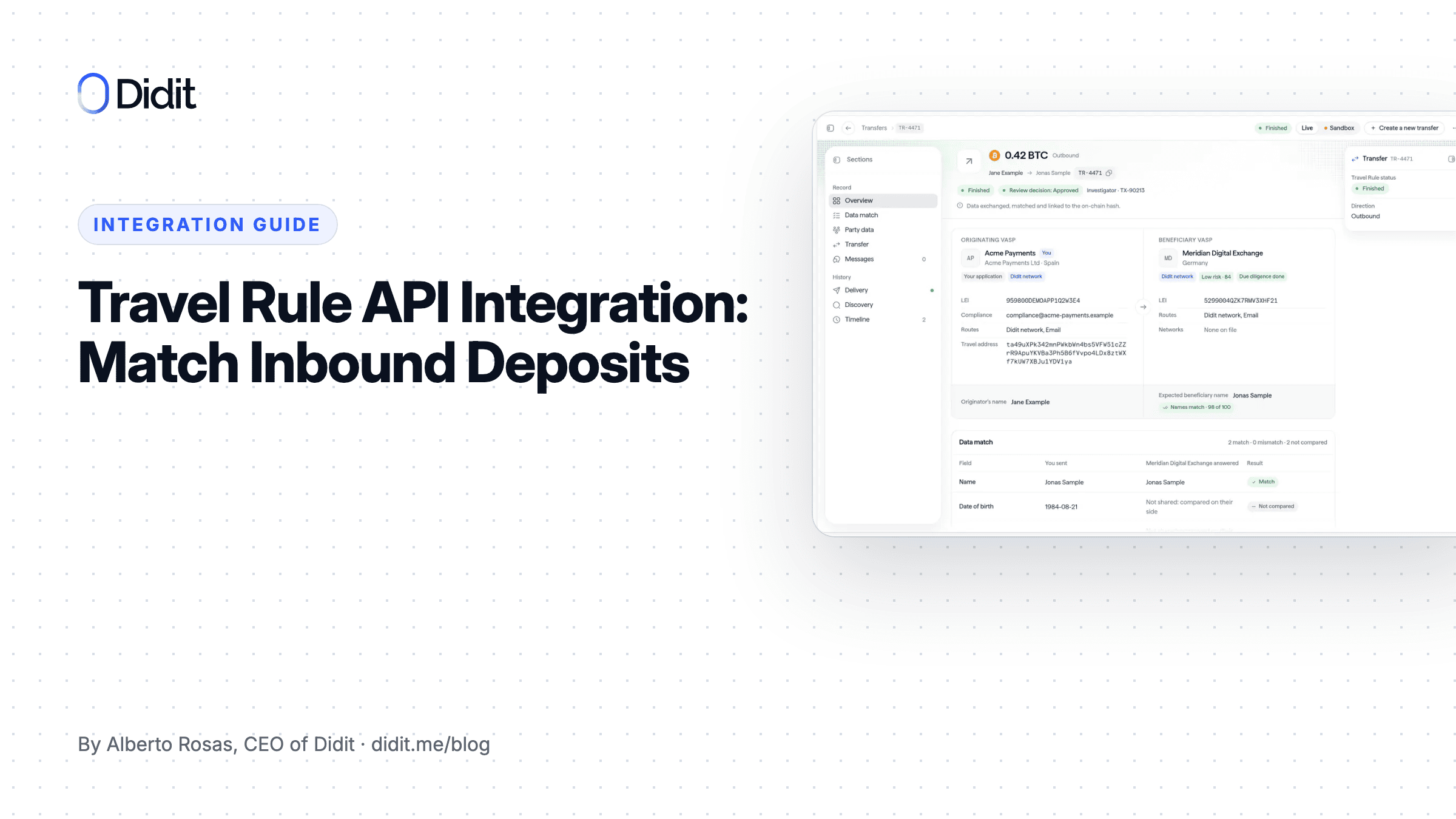 Travel Rule API Integration: Match Inbound Deposits
The unmatched deposits endpoint shares filters with the transfers list: direction, status, rail (INTERNAL, TRP, GTR, TRUST, VERIFYVASP, SYGNA, EMAIL, TEST_VASP), kind, currency, dates and counterparty UUID.
Alberto RosasNov 26, 2026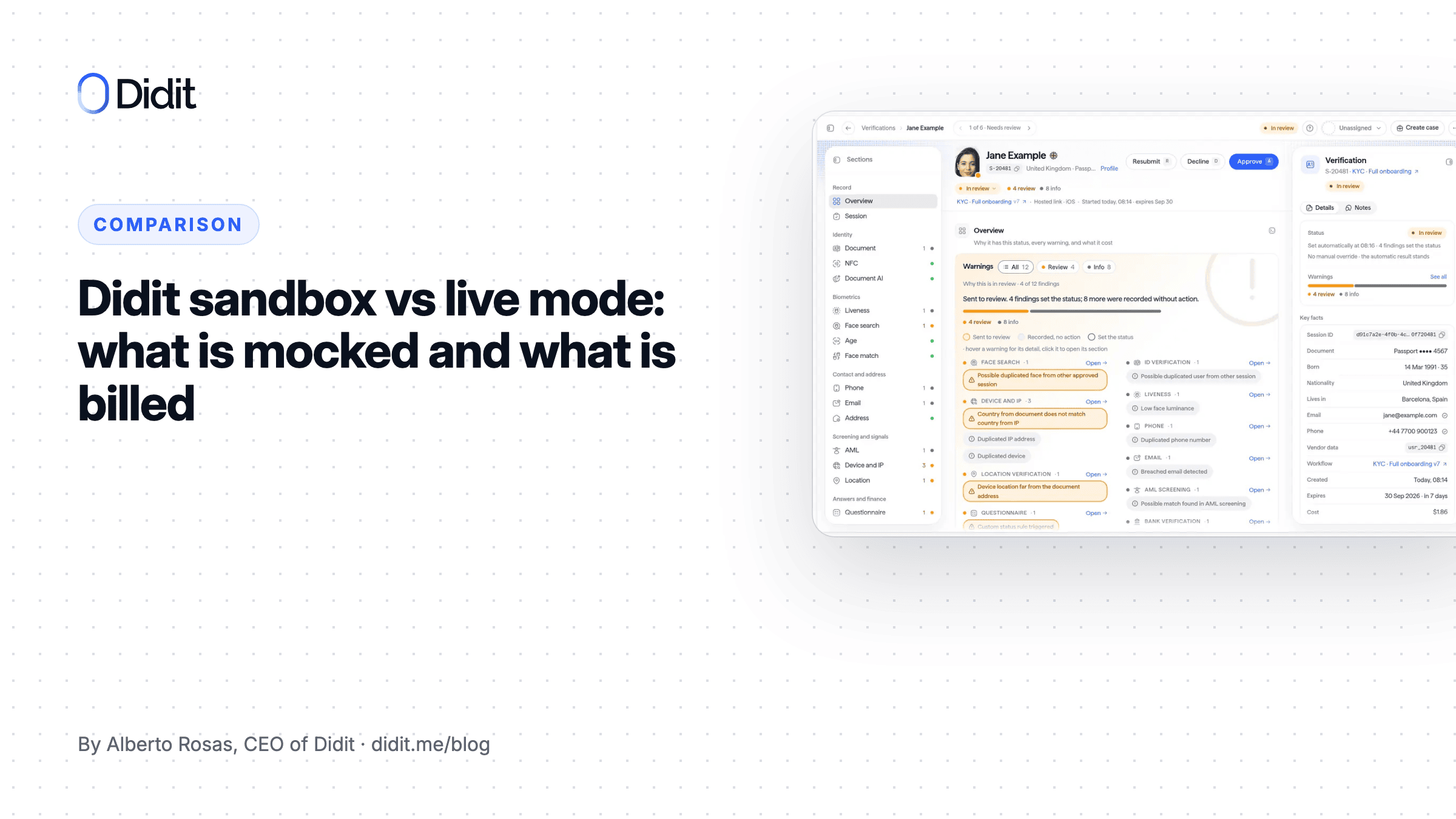 Didit sandbox vs live mode: what is mocked and what is billed
Didit sandbox is free, mocks providers, stores real captures, and allows 500 session creates per app every 24 hours. Live mode calls real providers. A completed full KYC check lists at $0.33.
Alberto RosasNov 26, 2026Questions
Frequently asked questions
Which digital ID wallets can I verify with today?
At Didit, eight wallets are confirmed available by both our price feed and our production guidance: MitID in Denmark at $0.25, BankID Sweden at $0.20, iDIN in the Netherlands at $0.95, Finnish Trust Network at $0.25, Bank iD in Czechia at $0.20, Google Wallet ID in the US, UK, Brazil, Singapore and Taiwan at $0.10, Smart-ID in Estonia, Latvia, Lithuania and Belgium at $0.21, and Mobile-ID in Estonia and Lithuania at $0.21. Availability is specific to your environment, so confirm the status in your console before you ship. A wallet marked Coming soon cannot be enabled.
How much does a digital ID wallet verification cost?
Didit publishes a USD price per completed verification for every confirmed wallet, from $0.10 for Google Wallet ID to $0.95 for iDIN. The listed price includes the wallet identity check, with no separate national eID transaction fee added. Growth takes 4% off every price and Scale takes 10%. A coming-soon method may already show a published rate, such as the EUDI Wallet at $0.15, but that rate does not mean the method is available.
Is wallet verification cheaper than a document check?
At Didit list prices, Google Wallet ID ($0.10) costs less than the $0.15 ID Verification step in a workflow. The other seven confirmed wallet methods cost more than that step. Seven of the eight cost less than the $0.33 full KYC bundle, and iDIN at $0.95 costs more. Keep those rates distinct: $0.15 is the ID Verification step inside a workflow, $0.33 is the full KYC bundle. The checks produce different evidence, so price is not the only thing to compare.
How much more does iDIN cost than BankID Sweden?
At Didit list prices, iDIN full identification is $0.95 per completed check and BankID Sweden is $0.20, a difference of $0.75 per check or $750 per 1,000 completed checks. Both are confirmed available in production. iDIN covers the Netherlands and BankID Sweden covers Sweden, so the choice is usually set by where your users are.
Can I turn on a wallet that is marked Coming soon?
No. A wallet marked Coming soon cannot be enabled in that environment, even after integration testing has started and even if a rate is published. The console reads its environment's live capability catalog, so it can only offer what the platform actually supports. Wallet sign-in is also switched on per environment: while it is off, every wallet reads Coming soon whatever the catalog says.
Are BankID Norway High and Personalausweis Profile 2 available?
Production guidance lists both as Coming soon. The pricing feed labels both Available. Check your environment's capability catalog before planning a rollout. A wallet marked Coming soon there cannot be enabled.
What does the cryptographic assurance tier mean?
It means an identity provider authenticated the person and signed the attributes it returned, and Didit verified that signature. That is all the tier claims. It is not a ranking against the document or lookup tiers, because those describe different evidence rather than more or less of the same thing. How long a wallet sign-in takes is the wallet's own flow, which Didit neither controls nor promises.
Does wallet verification include liveness or a selfie match?
Not by default. A wallet without a portrait does not include a selfie comparison. If your policy requires liveness and face matching, offer a document-based flow configured with those checks. In the console you can choose wallet first with document as the fallback, or user picks wallet or document.
What happens when a user's wallet sign-in fails?
For hosted wallet verification, set the wallet on-failure behavior per country. With wallet first and document fallback enabled, a cancellation, timeout or failed sign-in can lead to document capture. With wallet only, the user can retry until they finish or the session expires. A document fallback runs a separate document check and is billed as one.
Which countries do Smart-ID and Mobile-ID cover?
Smart-ID covers Estonia, Latvia, Lithuania and Belgium at $0.21 per completed verification. Mobile-ID covers Estonia and Lithuania at $0.21. Both are confirmed available in production at Didit, and the integration guide lists the supported country codes and the comparison-code flow the user sees. A successful sandbox test does not enable the wallet in production.
Can I start a wallet verification without building a workflow?
Yes. Use the wallet APIs when your application manages the interface: each wallet has a dedicated start endpoint, such as /v3/id-verification/wallets/ftn/ for Finnish Trust Network, plus shared result, polling and cancellation endpoints. You do not create or publish a workflow and you do not pass a workflow_id. Use the Sessions API instead when you want the hosted journey and workflow rules.
Can I use an AI assistant to build the wallet integration?
Developers can connect an AI assistant to Didit through the Didit MCP server, and the MCP server is free on every plan. The standalone wallet calls shown on this page are made from your backend with your API key, so keep the key out of a browser bundle or mobile app. Use a distinct Idempotency-Key for each new attempt and reuse it when retrying the same start request.
Is crypto wallet screening the same thing as digital ID wallet verification?
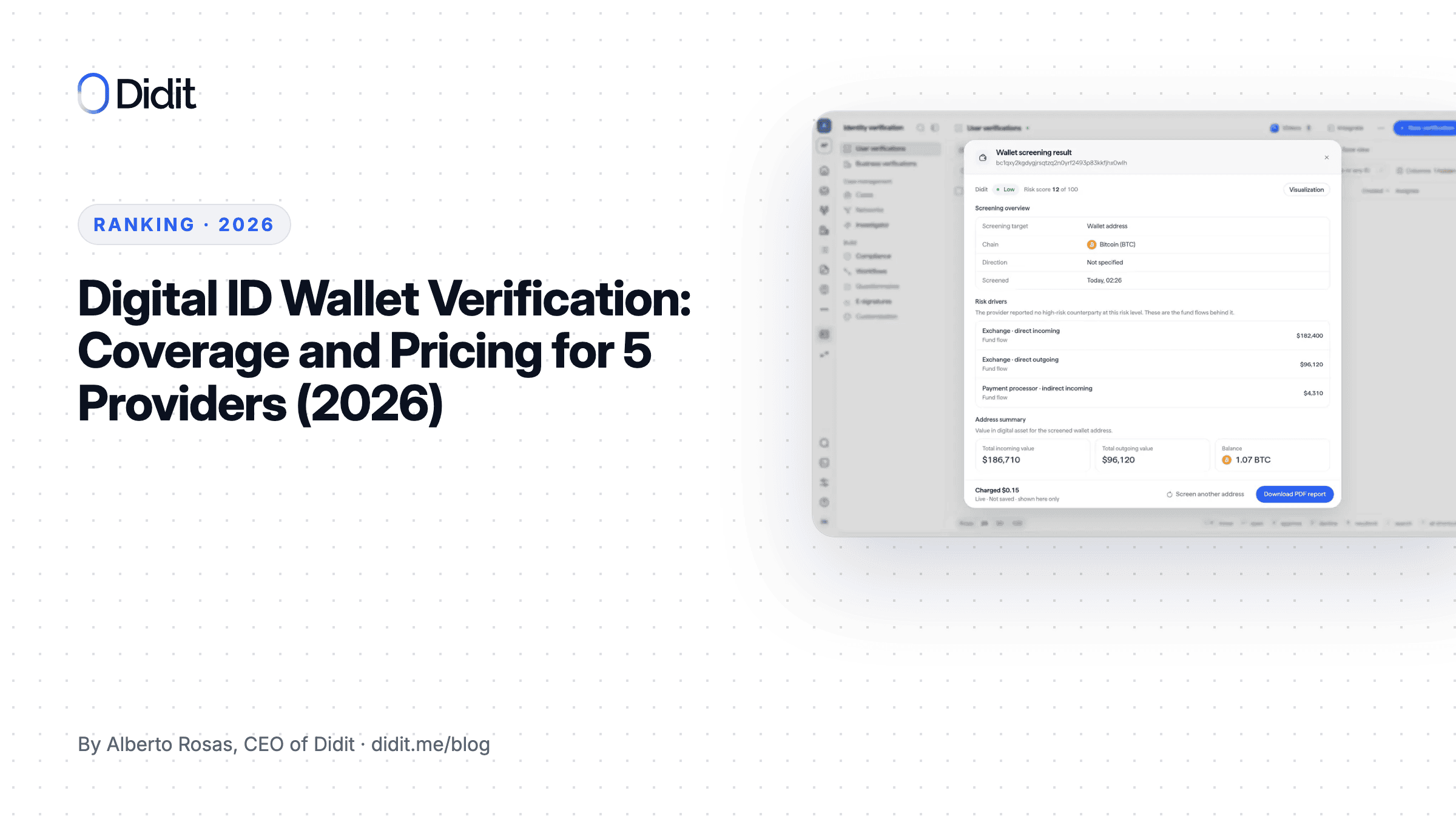
No. Digital ID wallets verify a person through a national eID or bank identity. Crypto wallet screening is a Transaction Monitoring feature that checks blockchain addresses for financial risk. It costs $0.15 per screening. You can also bring your own screening provider and run it inside Didit.
When will itsme, Freja eID and the EUDI Wallet be available?
No launch date is promised for any coming-soon wallet, including itsme, Freja eID, the Estonian ID-card, eParaksts mobile, OneID and the EUDI Wallet. Some already carry a published rate, such as the EUDI Wallet at $0.15 and OneID at $2.75, but a published rate does not establish production availability. Check your environment's catalog and the wallet documentation for current status.
Compliance built in
Audited, certified and attested.
We hold the certifications and build each country's rules into your flows, so you can launch anywhere without worrying. Security and Compliance center
- Regulation encoded into your flows
Tell us what you do and where. Didit lists the rules that apply to you, with sources, and builds the checks each country needs into one workflow.
- Ready for AMLR
Every requirement of the new EU anti-money laundering rules, from checking customers to human review, is already covered by a Didit check.
- Tested in Spain's Treasury sandbox
Spain's Treasury published its supervised sandbox report on Didit's NFC plus active liveness onboarding; SEPBLAC took part and valued the added measures positively.
- Audited, not self-declared
iBeta Level 1 and Level 2. Liveness tested under ISO/IEC 30107-3.
Your obligations · 3 regions
 SOC 2 Type 2
 ISO 27001
 iBeta Level 1 and Level 2
 EU regulator attestation
 FSM youth protection
 GDPR
 EBA remote onboarding
 MiCA compatible
 FIDO Alliance member
- AMLREU AML Regulation ready
Integration · Didit MCP
Run Didit from your own AI agent
Connect Didit to Claude, Cursor, VS Code or ChatGPT and just ask in plain words. Your agent can do anything you can do in the console, with the same permissions you have.
 Add to Claude
 ChatGPT
 Cursor
- Build workflowsDescribe the checks you need. The agent creates and publishes the flow.
- Run investigationsAsk why a session was declined, review cases, search people and companies.
- Change rulesCreate payment rules, test them on past data and switch them on.
- Pull reportsAsk for numbers, exports or the audit log.
Didit Academy


