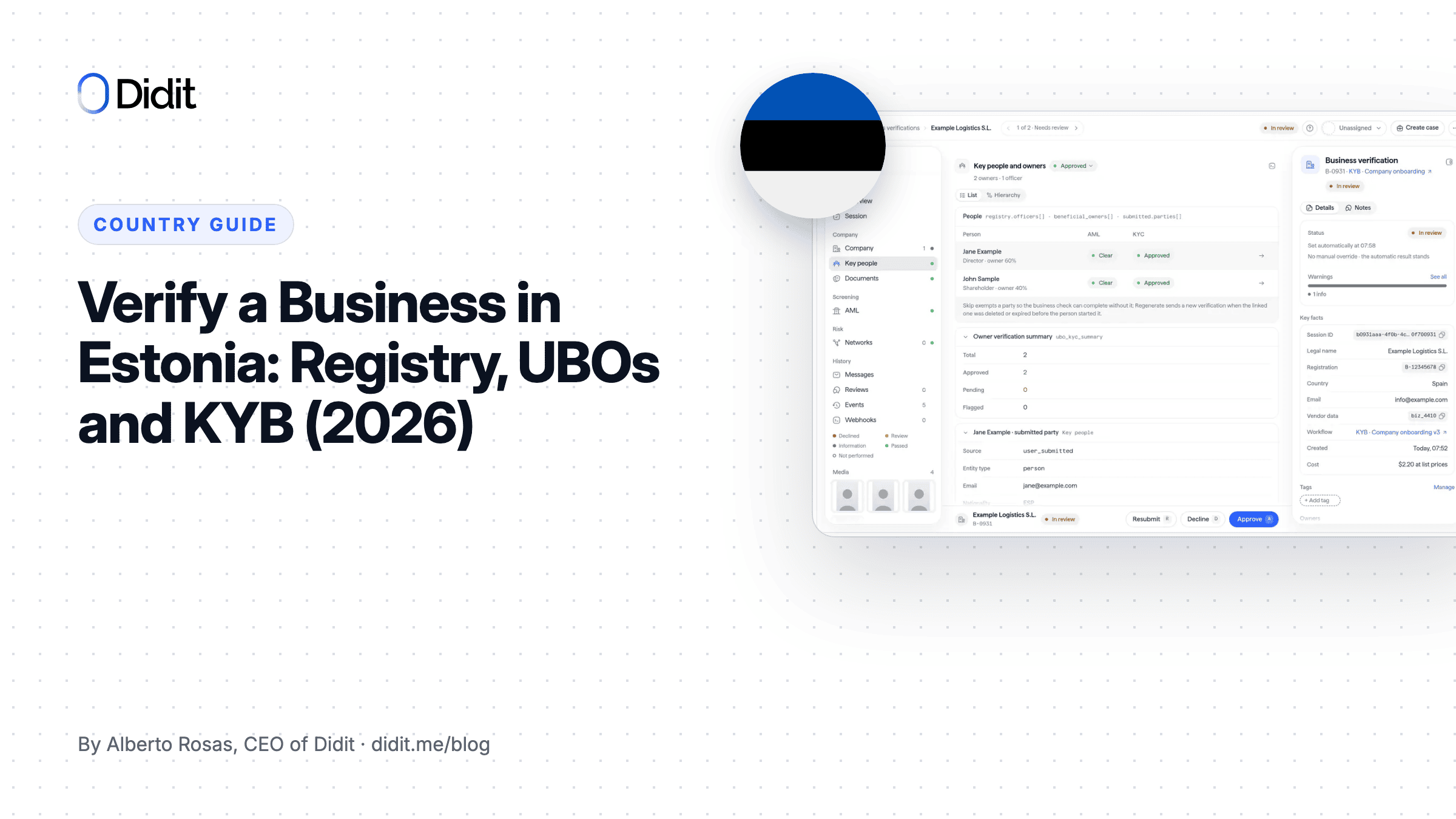
Verify a Business in Estonia: Registry, UBOs and KYB (2026)
Verify an Estonian company with Didit: registry lookup from $2.00, Shareholders $5.00, UBOs $9.00 per company, plus $0.20 company AML, $0.20 person AML, and $0.33 linked KYC per person.
 Alberto RosasCo-founder and CEO
Contents
In this guide
Jump to the part you need.
Didit’s Estonia registry lookup starts at $2.00 per company: Lite $2.00, Shareholders $5.00, UBOs $9.00. Company AML, person AML and linked KYC are extra. This guide is for compliance and engineering teams onboarding Estonian companies. Two caveats: a company not found in the register is typed in manually and billed a flat $0.75, and when the registry holds no ownership record, a Shareholders or UBO check is billed at the highest tier the registry can serve, usually Lite.
Last updated: November 26, 2026. Prices checked against the live Didit price feed on November 26, 2026.
| Stage | What you get for an Estonian company | List price |
|---|---|---|
| Registry lookup, Lite | Legal name, registration and VAT numbers, legal form, status, incorporation date, registered address, activity, headcount, contact details and officers | $2.00 per company |
| Registry lookup, Shareholders | Lite plus the direct shareholders, natural persons and corporate entities, with their ownership bands | $5.00 per company |
| Registry lookup, UBOs | Shareholders plus the ultimate beneficial owners resolved through the ownership chain | $9.00 per company |
| Manual entry, company not found | Applicant types the company in; is_from_registry is set to false | $0.75 flat |
| Company AML | Sanctions, PEP and adverse media screening on the entity | $0.20 per check |
| Person AML | Each UBO, director, officer or representative screened | $0.20 per person |
| Linked KYC | Full ID check on each key person whose role requires verification | $0.33 per person |
| KYB documents | One document-collection step, any number of uploads in it | $0.20 per step |
| Registry monitoring | Coming soon, no country enabled yet | $2.00 per company per year, configured rate |
Start free in the sandbox at https://business.didit.me/, no sales call. Developers can wire the same checks into an AI assistant through the MCP server at https://didit.me/developers/mcp/. The KYB documentation starts at the KYB quickstart and every unit price is on https://didit.me/pricing/.
What Estonian law asks you to check
The obligations sit in the Money Laundering and Terrorist Financing Prevention Act (RahaPTS). The consolidated English-language text on Riigi Teataja, read November 26, 2026, records that the Act was passed on 26.10.2017 and published as RT I, 17.11.2017, 2, entering into force on 27.11.2017. The same page marks the text as currently in force from 20.07.2026 to 29.11.2026, so check it before you freeze a policy around it.
Three provisions are worth flagging to counsel: § 76, duty to keep data of beneficial owner, § 761, Database of Beneficial Owners, and § 762, Beneficial Ownership Information Database. RahaPTS lists a duty to keep beneficial-owner data and provisions for beneficial-owner databases. Have counsel confirm how those duties apply to your process.
The same portal hosts an earlier act of 19.12.2007, published as RT I 2008, 3, 21 and repealed on 26.11.2017. That page shows only the act metadata and the repeal notice, with no section text, so rely on the consolidated 2017 act and treat the 2008 page as history.
On our side the documented action is simpler: review the returned decision and the warnings it carries before you approve. A registry match is data, not an approval decision.
The registers behind an Estonian check
RahaPTS names the registers in the provisions above: § 761, Database of Beneficial Owners, and § 762, Beneficial Ownership Information Database (Riigi Teataja, consolidated English-language text, read November 26, 2026). That is the legal basis a compliance team works from. What each database holds, who may query it and on what terms are questions for the statute and the register's own rules, so confirm them with counsel rather than from a vendor page.
On the Didit side the documented behaviour is narrower. Didit’s registry lookup returns the company profile and, where available, ownership data. Check Estonia’s supported tiers before relying on a specific ownership result.
Estonia appears in the KYB registry pricing with $5.00 Shareholders and $9.00 UBOs, the worldwide ownership source prices that replaced the older European rates on September 12, 2026. Those are registry-tier list prices. Company AML, person AML and linked KYC on each person are billed separately. Which of Lite, Shareholders and UBOs a jurisdiction's registries can serve is a separate table, so check Estonia's row in KYB supported countries before you lock a tier into a workflow.
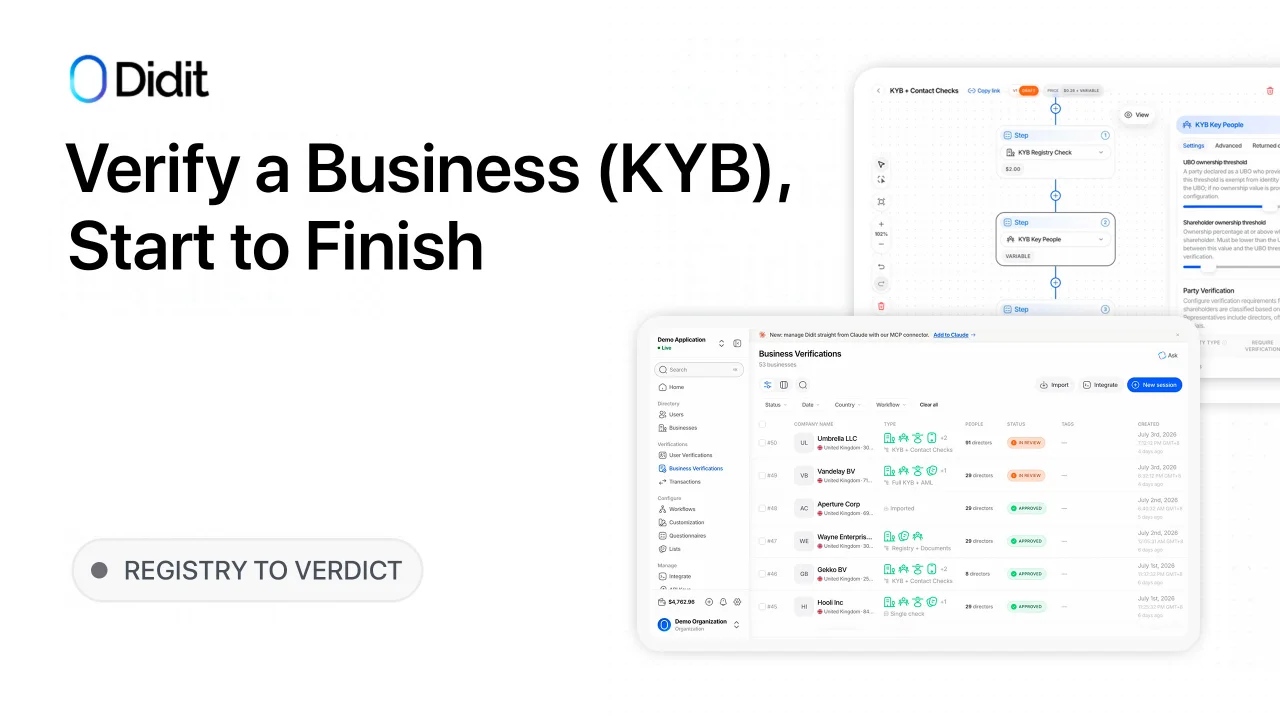
What Didit returns for an Estonian company
Coverage runs across 220+ countries and territories, priced by country and tier. Estonia was one of the 23 European markets repriced on September 12, 2026, so a Shareholders check there is $5.00 and a UBO check $9.00.
Lite, $2.00. Company profile, identifiers, status, registered address, activity and officers. Every country starts at Lite in the console.
Shareholders, $5.00. Lite plus the direct shareholders, natural persons and corporate entities, with ownership bands.
UBOs, $9.00. Shareholders plus the beneficial owners resolved through the ownership chain. Effective ownership through a chain is computed by multiplying percentages along it, so a person who holds 75% of a holding company that owns 60% of the target has 45% effective ownership, above a 25% threshold.
Those three are registry-tier list prices. Company AML at $0.20, person AML at $0.20 per person and linked KYC at $0.33 per person sit outside the registry price and are billed as they run.
Two billing rules to plan for. In hosted workflows the charge lands at company selection, even if the applicant leaves before confirming, and there is no separate search fee. Standalone API searches can carry a $0.50 fee per successful request, documented in KYB registry search. Didit serves 4,000+ companies today.
Identifiers you supply and fields Didit returns
In the hosted flow the applicant picks the country of incorporation and enters the company name, the registration number, or both. At least one is required, and when both are present the lookup combines them. Registration numbers are normalized where a registry needs it, for example UK numbers are zero-padded to eight digits. Searches run in exact or contains mode, and the response field searched_by tells you whether the match came from name, registration_number or registration_number_and_name.
| Field or identifier | What it holds | Note |
|---|---|---|
country_code | Estonia, EE | The Code column of the coverage table is the country code the KYB APIs use |
| company name | Legal name as registered | Required unless you supply the registration number |
| registration number | Official company registration number | Required unless you supply the name; combine both for the tightest match |
expected_details | company_name, registry_country, registration_number | Prefills and locks the country, runs the asserted search, both fields stay editable |
company_name | Legal name as registered with the authority | Returned from the registry record |
company_type | Legal entity type | Local legal form as the registry holds it |
registry_status | active, dissolved, struck_off, in_liquidation, dormant | Anything other than Active may be flagged or declined, per workflow settings |
incorporation_date | Date first registered | Useful for shell-company rules |
registered_address | Registered office | Also addresses[] for additional registered or trading addresses |
tax_number | Tax identification number | Where the registry publishes it |
registered_capital | Authorized or issued capital | Object with amount and currency |
legal_entity_identifier | LEI | Where one exists |
industries[] | Industry classification codes | SIC, NACE or local equivalents |
accounts | Filing dates | Includes last_annual_return_date and last_agm_date |
fetch_status | pending, resolved, failed | Registry lookup state |
verification_status | verified, failed, unknown | What to branch on in your own rules |
is_from_registry | true or false | False means the applicant typed the company in |
Step by step in the Business Console
- Open business.didit.me and create an application with KYB enabled.
- Go to Workflows, Create workflow, and choose Business Verification as the type. Enabling company registry lookup is required; company AML is recommended; Key People is required for most regulated industries; documents are optional.
- Open the workflow's Countries step and set Estonia's tier to Lite, Shareholders or UBOs. Every country starts at Lite, so raising Estonia to UBOs is a deliberate choice, priced at $9.00.
- Set the UBO threshold under Risk. The EU AMLD framework, as cited in our ownership documentation, classifies at 25% ownership or control, and your workflow can flag or route for review when nobody meets the cut.
- Set per-role verification under Key People: which roles require a linked KYC, which are skippable, and whether nested KYB runs for corporate UBOs.

The applicant's side is four steps: select the company, confirm or correct the returned details, add key people and UBOs, upload any requested documents. When a registry returns the profile before the ownership report is ready, the report continues in the background and the Key People form is not blocked, so people can be entered manually and registry people appear before submission. A pending report does not count as a completed registry check or an automatic approval, and billing uses the tier actually delivered.


Step by step through the API
Create the session with your KYB workflow and, if you already know the company, pass expected_details so the applicant lands on their own record instead of a search box.
curl -X POST https://verification.didit.me/v3/session/ \
  -H "x-api-key: YOUR_API_KEY" \
  -H "Content-Type: application/json" \
  -d '{
    "workflow_id": "YOUR_KYB_WORKFLOW_ID",
    "vendor_data": "biz-ee-001",
    "expected_details": {
      "company_name": "Example OU",
      "registry_country": "EE",
      "registration_number": "YOUR_REGISTRATION_NUMBER"
    }
  }'
The response carries session_id, session_number and url. Deliver the URL to the company admin through your own channel. When processing reaches a terminal status, Didit posts a status.updated event; business sessions carry session_kind set to "business" inside data, so filter on it. Verify the X-Signature-V2 HMAC before you trust the payload, as described in webhooks.
{
  "webhook_type": "status.updated",
  "session_id": "a1b2c3d4-5678-4abc-9def-1234567890ab",
  "business_session_id": "a1b2c3d4-5678-4abc-9def-1234567890ab",
  "session_kind": "business",
  "vendor_data": "biz-ee-001",
  "status": "Approved",
  "decision": { "...": "full KYB decision" }
}
The webhook already contains the full decision. Fetch it on demand only if you skipped webhooks:
curl https://verification.didit.me/v3/session/bs_01H.../decision/ \
  -H "x-api-key: YOUR_API_KEY"
The decision holds the registry data, key people (UBOs, shareholders, directors and representatives), AML hits, documents and per-feature results; the full payload is in the response schema. If you want a registry lookup without a hosted session, use the standalone endpoints select for Lite, shareholders and ubo. The quickstart for this flow is KYB quickstart.
Worked cost example: one Estonian company at the UBO tier
One Estonian company, two key people who both need a linked KYC, company AML on, one document-collection step. All prices are list prices from the feed on November 26, 2026.
- Registry lookup, UBOs, Estonia: $9.00
- Company AML: $0.20
- Person AML, 2 people x $0.20: $0.40
- Linked KYC, 2 people x $0.33: $0.66
- KYB documents, one step: $0.20
Total per company: 9.00 + 0.20 + 0.40 + 0.66 + 0.20 = $10.46. At 100 companies that is 100 x 10.46 = $1,046.
The same two people without individual KYC, on a Lite check: 2.00 + 0.20 + 0.40 = $2.60 per company. If the registry cannot find the company and the applicant types it in: 0.75 + 0.20 + 0.40 + 0.66 + 0.20 = $2.21. On the Scale plan every Didit price takes 10% off: 9.00 x 0.90 = 8.10, 0.20 x 0.90 = 0.18, 0.40 x 0.90 = 0.36, 0.66 x 0.90 = 0.594, 0.20 x 0.90 = 0.18, so 8.10 + 0.18 + 0.36 + 0.594 + 0.18 = $9.41 for the same UBO example. Growth takes 4% off every Didit price. Registry monitoring, when it ships, is $2.00 per company per year.
Fallbacks when the registry is down or returns no match
- Company not found. The applicant submits the company manually, the session continues, and
is_from_registrycomes backfalse. That path is billed at the flat $0.75 manual-entry price. - Ownership report still running. The profile is delivered first. The report continues in the background, manual people are preserved when it arrives, and
fetch_statusstayspendinguntil it resolves. - No ownership record in the registry. A Shareholders or UBO request is delivered and billed at the highest tier the registry can serve, usually Lite. There is no additional ownership charge when ownership is unavailable, and the total never exceeds the tier you asked for.
- Chain ends in companies. A UBO check whose chain names no natural person is delivered and billed as Shareholders. A corporate ownership chain is not a beneficial owner.
- Lookup failed.
fetch_statusreturnsfailedandverification_statusreturnsfailedorunknown. Route the session to review, or to manual entry at $0.75, rather than guessing. - Status is not Active. Dissolved, struck off, in liquidation and dormant companies may be flagged or declined depending on your workflow configuration. That is a workflow decision, not a data problem.
- Registry slow or unreachable. The search runs asynchronously and returns a pending state. Poll or wait for the webhook; the integration guide covers polling versus webhooks and retry logic.
Sources
- Didit docs: KYB supported countries and registry coverage, read November 26, 2026.
- Didit docs: KYB registry pricing by country, Lite, Shareholders and UBOs, read November 26, 2026.
- Didit docs: KYB quickstart, read November 26, 2026.
- Didit docs: company registry API and retrieved fields, read November 26, 2026.
- Didit docs: UBO API and ownership chains, read November 26, 2026.
- Didit docs: officers and representatives, read November 26, 2026.
- Didit docs: business AML screening, read November 26, 2026.
- Didit pricing page and live price feed, read November 26, 2026.
- Riigi Teataja, consolidated English-language text of the Money Laundering and Terrorist Financing Prevention Act (RahaPTS), read November 26, 2026. https://www.riigiteataja.ee/en/eli/517112017003/consolide
- Riigi Teataja (Estonian State Gazette), Money Laundering and Terrorist Financing Prevention Act consolidated-text page showing only the act metadata and the repeal notice, read November 26, 2026. https://www.riigiteataja.ee/en/eli/504022016012/consolide
Next step: open the sandbox at https://business.didit.me/, create a Business Verification workflow, set Estonia to the tier your policy needs, and run one test company end to end. No sales call, and the sandbox is free on every plan.
Try it
Try this in the sandbox
Run the check this guide describes, free.
The product this post is about, taken from its topic. Run it free in the sandbox.
Author
Alberto Rosas
Co-founder and CEO

Keep reading
Other guides in the same topic.
 How to verify a business in Poland: KRS, UBOs and KYB checks
Didit verifies Polish companies against the KRS. Poland is priced at $2.00 Lite, $5.00 Shareholders and $9.00 UBOs per company, plus $0.20 company AML and $0.33 per person KYC.
Alberto RosasNov 26, 2026 How to verify a Swedish company: Bolagsverket, UBOs and KYB
Didit verifies Swedish companies against Bolagsverket registry data at $2.00 Lite, $5.00 Shareholders and $9.00 UBOs per company, then adds key people, AML screening and documents. Ownership access tightens from 1 July 2026.
Alberto RosasNov 26, 2026 How to verify an Irish company: CRO, UBOs and KYB in 2026
Didit verifies an Irish company by searching the CRO's CORE register by name or registration number, then resolving officers, shareholders and UBOs. Registry checks start at $2.00, billed at the tier delivered.
Alberto RosasNov 26, 2026Questions
Frequently asked questions
How do I verify a company in Estonia?
Run a Didit KYB check with Estonia as the country of incorporation. The applicant enters the company name, the registration number or both, picks the company from the registry results, and adds the directors and owners the registry returns. Didit then screens the company and each key person for AML and returns an Approved, Declined or In Review decision.
How much does it cost to verify an Estonian company with Didit?
The registry lookup is $2.00 for the Lite tier, $5.00 for Shareholders and $9.00 for UBOs per company in Estonia. Add $0.20 for company AML, $0.20 per person for person AML, $0.33 per person for a linked KYC and $0.20 per document-collection step. A company that cannot be found in the registry and is typed in manually is billed a flat $0.75.
Does Didit return Estonian UBOs automatically?
Where the registry holds an ownership record, yes: the UBO tier resolves the chain to natural persons and reports effective percentages. Where the registry holds no ownership record, the check is delivered and billed as Lite, and the applicant can add people manually in the Key People form. A chain that ends in corporate entities is delivered and billed as Shareholders.
What happens if the Estonian company is not in the registry?
The applicant submits the company details manually and the session continues to the remaining steps. The decision then shows is_from_registry set to false, and you should treat the company data as self-declared rather than registry-confirmed. That path costs $0.75 for the company data.
What UBO threshold should I use for an Estonian company?
Didit's ownership documentation cites the EU anti-money-laundering framework at 25% ownership or control, and that is the usual starting point, with counsel confirming what your own policy requires. The threshold is configurable per workflow under Risk, and Didit can flag or route for review when no natural person meets it. Didit records economic ownership and voting rights separately, so rules can check either.
Do I have to verify directors and officers as well as owners?
Directors, officers and representatives are not a separate concept in Didit's KYB model: they sit inside Key People with one or more roles per person. Each role can be configured to require a linked KYC, to be skippable, or to require nothing beyond identification and AML screening. Directors and UBOs above the threshold commonly default to requiring verification.
Can I run an Estonian KYB check entirely through the API?
Yes. Create a business session against your KYB workflow, optionally passing expected_details with the company name, registry_country set to EE and the registration number, then act on the status.updated webhook or fetch the decision endpoint. For lookup without a hosted session, the standalone select, shareholders and ubo endpoints sell one tier each.
Does Didit monitor Estonian companies for registry changes after onboarding?
Registry monitoring is coming soon and no country has it enabled yet. The configured rate is $2.00 per company per year, and the planned behaviour is that the registry pushes changes of status, officers, ownership and address, the business session goes back to review and a data.updated webhook fires with trigger set to kyb_registry_change. A published rate does not mean the feature is available, so plan a manual re-check until it is.
Which Estonian identifiers do I need before starting?
At least one of the company name or the registration number, plus Estonia as the country of incorporation. Supplying both gives the tightest match, because the lookup combines them. Registration numbers are normalized where a registry requires it, and searched_by in the response tells you which identifier produced the match.
How long does an Estonian KYB check take?
The Didit quickstart describes a complete business verification, from session creation to decision, in under 10 minutes. Registry searches run asynchronously and large registries can take a few seconds to return results; when an ownership report lags, the profile is delivered first and the report continues in the background.
What does the KYB decision contain?
It contains the registry data for the company, the key people with their roles, ownership and voting percentages, the AML results for the entity and each person, any uploaded documents, and per-feature results, plus a status of Approved, Declined or In Review with warnings for an analyst. The full payload is documented in the response schema.
Compliance built in
Audited, certified and attested.
We hold the certifications and build each country's rules into your flows, so you can launch anywhere without worrying. Security and Compliance center
- Regulation encoded into your flows
Tell us what you do and where. Didit lists the rules that apply to you, with sources, and builds the checks each country needs into one workflow.
- Ready for AMLR
Every requirement of the new EU anti-money laundering rules, from checking customers to human review, is already covered by a Didit check.
- Tested in Spain's Treasury sandbox
Spain's Treasury published its supervised sandbox report on Didit's NFC plus active liveness onboarding; SEPBLAC took part and valued the added measures positively.
- Audited, not self-declared
iBeta Level 1 and Level 2. Liveness tested under ISO/IEC 30107-3.
Your obligations · 3 regions
 SOC 2 Type 2
 ISO 27001
 iBeta Level 1 and Level 2
 EU regulator attestation
 FSM youth protection
 GDPR
 EBA remote onboarding
 MiCA compatible
 FIDO Alliance member
- AMLREU AML Regulation ready
Integration · Didit MCP
Run Didit from your own AI agent
Connect Didit to Claude, Cursor, VS Code or ChatGPT and just ask in plain words. Your agent can do anything you can do in the console, with the same permissions you have.
 Add to Claude
 ChatGPT
 Cursor
- Build workflowsDescribe the checks you need. The agent creates and publishes the flow.
- Run investigationsAsk why a session was declined, review cases, search people and companies.
- Change rulesCreate payment rules, test them on past data and switch them on.
- Pull reportsAsk for numbers, exports or the audit log.
Didit Academy


