Business
Identity Verification, KYC and AML Compliance in Peru
Peru KYC runs on the DNI issued by RENIEC plus biometrics and AML screening. A full KYC check on Didit costs $0.33 and AML screening $0.20; build it as a hosted session flow in seven steps.
 Alberto RosasCo-founder and CEO
Contents
In this guide
Jump to the part you need.
Peru runs on a document most adults already hold: the DNI issued by RENIEC. This how-to is for teams onboarding Peruvian users or companies and needing KYC and AML evidence a supervisor can read. A full KYC check on Didit costs $0.33 and AML screening $0.20. The caveat: plan for document and biometric checks, and confirm which lookup sources cover Peru before you promise a document-free flow.
Last updated: November 26, 2026. Prices checked against the live Didit price feed on November 26, 2026.
Summary
| Item | What it means for a Peru launch |
|---|---|
| Outcome | One workflow that authenticates the DNI or passport, proves presence with passive liveness, matches the face, and screens the name against sanctions, PEP and adverse media lists |
| Recommended method | Hosted session flow: one workflow, one session per user, decision by webhook or GET |
| Entry point | POST https://verification.didit.me/v3/session/ |
| Full KYC check | $0.33 per completed check |
| AML screening | $0.20 per screened person |
| Compliance bundle | $0.53 per user, KYC plus AML |
| Ongoing AML monitoring | $0.07 per person per year |
| Sandbox | Sandbox testing is free and unlimited |
| Human review | Any session that comes back In Review stays in your queue until a person decides it |
| Coverage | 14,000+ document types in 220+ countries and territories, 54 capture languages including Spanish |
Start free in the sandbox at business.didit.me, no sales call. Sandbox testing is free and unlimited, and the Free plan adds $10 of credit a month for work-email signups. Developers who want an AI assistant to drive the setup can connect Didit through the MCP server. Prices and plan comparison live on didit.me/pricing, and the AML step is documented on the AML screening page.
What you end up with
One workflow that does three things for a Peruvian signup. It reads and authenticates the identity document and extracts the fields. It proves the person is present with passive liveness and matches the live face to the document portrait. It screens the name against 1,300+ sanctions, PEP and watchlist sources, with adverse media as an option.
The session returns a status you can act on and a list of warnings you can store as evidence. Approved, In Review and Declined are the three that matter at your application layer. Everything else is a state on the way there or an abandoned flow.
We recommend the hosted session flow. You create the workflow once, then create a session per user and send them to the returned URL. The user photographs the DNI or passport, takes a selfie, and the decision arrives in a webhook or from a GET call. Keep the standalone server-to-server APIs for back-office cases where you already hold the images.
Before you start
- A Didit organization. Sign up at business.didit.me with a work email and the Free plan carries $10 of credit a month, spent on any check. An organization created through the API starts at $0 of credit.
- A sandbox application and its sandbox API key. Sandbox testing is free and unlimited.
- The list of documents you will accept from Peruvian users: DNI, DNIe, Peruvian passport, carnet de extranjería, and whether you also accept a foreign passport from residents. Didit lists 14,000+ document types across 220+ countries and territories, so verify each Peruvian document type you plan to accept in the sandbox before launch.
- An allowed domain for the callback URL, if you use one.
- A webhook endpoint that answers in under 5 seconds, and somewhere to store the shared secret.
- A written rule for who approves a session that lands In Review, and what you do with a confirmed match.
- A privacy notice that covers biometric processing. Peruvian data protection rules, including Law 29733, set conditions for sensitive personal data, so consent and purpose have to be explicit. Confirm the current requirements with qualified Peruvian counsel.
Steps to a live Peru KYC and AML flow
-
Create the organization and work in the sandbox first. Register the organization, create a sandbox application and build against its sandbox API key. Switch to the live key only when the organization has credit and your rules are agreed.
-
Build the workflow with four features. Document capture, passive liveness, face match and AML. You can do this in the console, or with one call:
curl -X POST https://verification.didit.me/v3/workflows/ \
-H "x-api-key: $DIDIT_API_KEY" \
-H "Content-Type: application/json" \
-d '{
  "workflow_label": "Standard KYC",
  "workflow_type": "kyc",
  "features": [
    {"feature": "OCR"},
    {"feature": "LIVENESS", "config": {"face_liveness_method": "PASSIVE"}},
    {"feature": "FACE_MATCH"},
    {"feature": "AML"}
  ]
}'
Persist the returned
workflow.id. Simple or node-based behavior is selected in the workflow editor: a Simple workflow runs its steps in a fixed order, which is what most Peru retail onboarding needs, while a node-based workflow branches on verification results. -
Register the webhook destination. Post to
https://verification.didit.me/v3/webhook/destinations/with alabel, aurl, the events you want andwebhook_versionset tov3. Save the returnedsecret_shared_keyand verify theX-Signature-V2header, an HMAC-SHA256 over the canonical JSON, on every delivery. De-duplicate onevent_id. -
Create the session. Bind it to your own user id so duplicate detection works across retries, and set the interface language to Spanish:
curl -X POST https://verification.didit.me/v3/session/ \
-H "x-api-key: $DIDIT_API_KEY" \
-H "Content-Type: application/json" \
-d '{"workflow_id": "$WORKFLOW_ID", "vendor_data": "user-42", "language": "es", "callback": "https://myapp.com/kyc/return"}'
If your application has allowed domains set, the callback must sit on one of those origins or the call fails with a 400 on the callback field. App deep links are always accepted.
-
Send the user to the flow. The response carries a
url, asession_idand asession_token. Redirect the browser tourl, or mount the web or mobile SDK with the token. The user photographs the document, gets real-time visual cues on framing and light, and then takes the selfie.
What your Peruvian user sees: document capture, liveness, then the result. -
Read the decision. The webhook delivers it, and the GET call is your fallback:
curl https://verification.didit.me/v3/session/$SESSION_ID/decision/ \
-H "x-api-key: $DIDIT_API_KEY"
Version 3 returns plural arrays:
id_verifications[],liveness_checks[],face_matches[],aml_screenings[]. One entry per check performed in the workflow. Do not read V2 singular fields. -
Apply the decision and keep the trail. Approved users move on. For Declined users, surface the warning description the documentation gives for the first terminal warning and localize it in your application. In Review users go to your manual queue, never straight to approval. Store the session id, the vendor data, the warnings and the reviewer's note together, because that bundle is the evidence you produce in an audit.

The session detail in the console holds the document result, warnings and extracted fields.
Expected output
The create-session call returns the fields you need to start the flow, and the decision call returns the verdict per check. Expect this shape rather than a single score.
session_id,url,session_tokenand a status that starts at Not Started.- Per document:
status,full_name,document_type,document_number,date_of_birth,expiration_date,parsed_address,mrz,warnings[]. - Per AML entry:
status,screening_id,hits[]with a match score and a risk score, andwarnings[]. - Statuses you will see: Not Started, In Progress, Approved, In Review, Declined, Abandoned, Kyc Expired.
Failure cases and recovery
| Symptom | Cause | Recovery |
|---|---|---|
| 403 with a permission message | Key missing from verification.didit.me calls | Check the x-api-key header, then the key's organization |
| 401 | Wrong, revoked or expired key | Rotate the key and redeploy |
| 403 on insufficient credits | Balance used up on a live application | Top up, or keep testing in the sandbox, where sandbox testing is free and unlimited |
400 on workflow_id | Wrong UUID, or a workflow from another organization | Re-read workflow.id from the create response |
| 400 on callback | Origin not in the allowed domains | Add the origin on PATCH /v3/webhook/ or use a deep link |
| 400 on AML weights | Name, date-of-birth and country weights do not sum to 100 | Fix the three weights; the request is rejected otherwise |
| 400 on ongoing monitoring | Monitoring requested without save_api_request=true | Set both together |
Declined with DOCUMENT_EXPIRED, DOCUMENT_LIVENESS_FAILED or COULD_NOT_RECOGNIZE_DOCUMENT | Terminal document warning | Show the documented warning description and stop the flow |
In Review with DOCUMENT_LIVENESS_NOT_COMPUTED | Forgery check produced no usable score | Treat the document as unchecked and route to manual review |
| Webhook never arrives | Handler slower than 5 seconds, or answered 5xx or 404 | Didit retries twice, about 1 and 4 minutes later, then drops. Resend from the delivery log |
Inputs and outputs
| Field | In or out | What it carries |
|---|---|---|
workflow_id | In | Stable UUID. A KYC workflow creates a user session, a KYB workflow creates a business session |
vendor_data | In | Your stable user id. Binds the session to an entity and powers duplicate detection |
language | In | ISO 639-1 code for the interface, for example es. Defaults to browser detection |
callback | In | Where the user returns; Didit appends the session id and status |
expected_details | In | Name, date of birth, nationality, country and expected document types. Mismatches surface as decision warnings |
metadata | In | Arbitrary JSON echoed back in responses and webhooks, never shown to the user |
session_id | Out | Key for the decision call and your audit record |
url | Out | Hosted flow link for the user |
status | Out | The verdict at session level |
warnings[] | Out | Risk codes per check, such as INVALID_MRZ, INCONSISTENT_DATA, DUPLICATED_DOCUMENT or PEP_MATCH |
Paid steps and review boundaries
| Step | List price | Billed when | Review boundary |
|---|---|---|---|
| Full KYC check | $0.33 | The check finishes with a result | In Review stays in your queue |
| ID document only | $0.15 | Document processed | Terminal warnings decline; the rest continue |
| Passive liveness | $0.10 | Result returned | No usable score goes to manual review |
| Face match 1:1 | $0.05 | Comparison computed | A non-computed result requires explicit workflow handling. Route it according to your documented review and decline policy. |
| Device and IP analysis | $0.03 | Session | Adds signals, does not decide alone |
| AML screening | $0.20 | Each screened person | Risk score between the approve and review thresholds is In Review |
| Ongoing AML monitoring | $0.07 per person per year | Continuous, dated daily | Alerts surface in the console for a person to clear |
| Proof of address | $0.20 | Document accepted | Follow your documented review policy for unsupported or inconclusive results. |
| NFC chip reading | $0.15 | Add-on to a document check | Optional; confirm its suitability for your risk policy before enabling it |
Didit returns a status and the evidence behind it. Your compliance team owns the decision rule, the thresholds and the outcome for anyone who lands In Review. Write those rules before you go live, because the flow will produce In Review sessions on day one.
Worked cost example
A Peruvian fintech onboards 1,000 users a month. It runs a full KYC check on every user, AML screening on every user, and a proof of address on 150 users. It also keeps 400 of those users under ongoing monitoring.
- Full KYC: 1,000 x $0.33 = $330.00
- AML screening: 1,000 x $0.20 = $200.00
- Proof of address: 150 x $0.20 = $30.00
- Month total at list price: $330.00 + $200.00 + $30.00 = $560.00
- Per onboarded user: $560.00 / 1,000 = $0.56
- Ongoing monitoring, billed per person per year: 400 x $0.07 = $28.00 a year for that cohort
On the Growth plan every Didit price drops 4%, so the same month bills at $560.00 x 0.96 = $537.60 before credit, and the plan's monthly credit pays the first part of it. Scale applies 10%. Both plans are listed on didit.me/pricing, and billing rules are in the pricing docs.
Peru national ID: what the DNI is and how to verify it
The Documento Nacional de Identidad is the national ID, issued by RENIEC, the Registro Nacional de Identificación y Estado Civil. It carries a photograph, an eight-digit number and, in the electronic version, a chip with digital certificates. DNIs expire, so decide up front whether an expired document is a decline or a review; the document check raises DOCUMENT_EXPIRED among its warnings.
Three document families turn up in a Peru onboarding flow: the DNI, in its older laminated form and in the current electronic form, the DNIe; the Peruvian passport, with a machine-readable zone and a chip in recent issues; and the carnet de extranjería issued by Migraciones to foreign residents, which has its own numbering and validity rules. Didit lists 14,000+ document types across 220+ countries and territories, so test each generation you plan to accept in the sandbox before launch.
For a DNI, the checks that catch the most fraud are the ones that compare the document with itself: the MRZ against the visual zone, the barcode against the printed fields, and the portrait against the live selfie. Didit raises INVALID_MRZ, INCONSISTENT_DATA, DATA_INCONSISTENT and DUPLICATED_DOCUMENT as warnings rather than silent failures, and you decide which of them you treat as terminal. Reading the document's authenticity before trusting its extracted fields is the order the Academy lesson shows at 3:47.
NFC chip reading is an optional $0.15 add-on to a document check. Confirm its suitability for your risk policy before enabling it.

AML obligations that shape the workflow
Peru's AML framework comes from Law 27693, with UIF-Peru as the financial intelligence unit and the SBS supervising the financial system. The reporting obligations, the thresholds and the sector rules that apply to your business have to be confirmed with qualified Peruvian counsel or the relevant regulator, and that confirmation belongs before you encode any rule in your workflow. A threshold copied from an old blog post is a finding waiting to happen.
Peru is assessed through GAFILAT, the FATF-style regional body, against the FATF Recommendations. That is why screening has to cover sanctions lists, PEPs and adverse media, and why the record of the screen matters as much as the result.
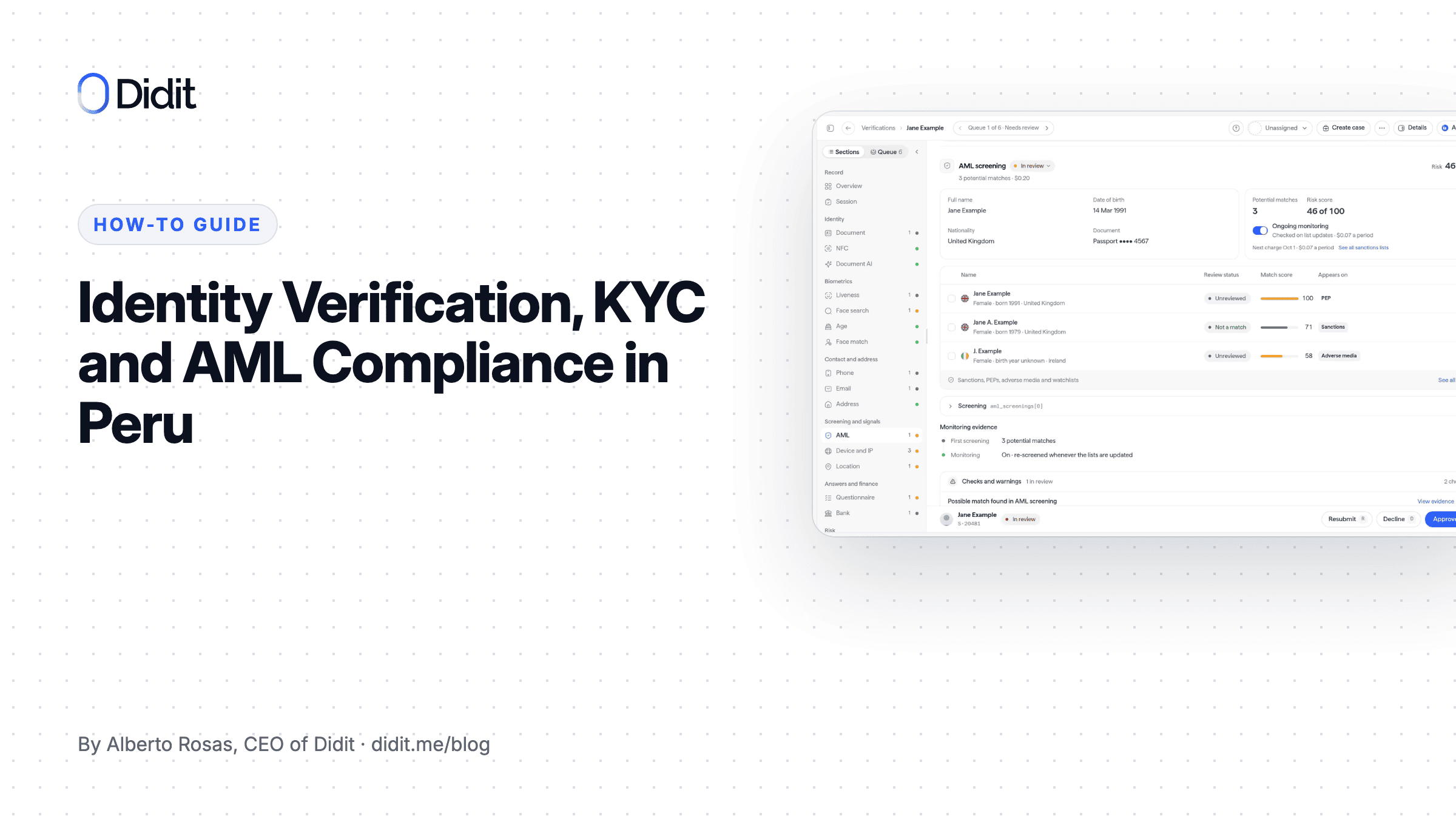
In practice, the AML feature runs after identity is established, because you need the verified name and date of birth before a screen means anything. The two-score model keeps the noise down. A match score answers whether this is the same person, using name, date of birth and country weights that must sum to 100. A risk score answers how risky that entity is if the match is real. Matches below the configured threshold are excluded from risk consideration; matches at or above it enter the risk calculation and land Approved, In Review or Declined.
Ongoing monitoring at $0.07 per person per year re-screens a person daily. It requires save_api_request=true on the request and can be turned off from the Business Console.
Reviewing an AML hit
A POSSIBLE_MATCH_FOUND with a risk score between your approve and review thresholds is In Review, and it is your queue. Open the hit, read the score breakdown, compare the listed identifiers with the verified document, and write down the reasoning. If adverse media is enabled, the request takes about 25 seconds, so set your client timeout to at least 45 seconds. If the upstream provider times out, the result returns without adverse media hits and is still actionable, so log that the media leg did not complete.

Simple KYC in Peru: when a lighter workflow is enough
A Simple workflow runs its steps in a fixed order with no branching. For most Peruvian retail signups that is the right shape: document, liveness, face match, then AML for the tiers that need it. Use the node-based editor when the AML result has to send high-risk users down a different path, or when one segment of users can skip a step.
For a low-risk tier, the step prices are published separately: ID document $0.15, passive liveness $0.10, face match $0.05, device and IP analysis $0.03. Those four listed components sum to the published $0.33 full KYC price. A lighter flow that drops a step removes a control, so decide that with your compliance owner rather than with your conversion dashboard.
Sources
- Didit quick start
- Didit pricing docs
- Didit ID verification overview
- Didit non-document lookup coverage
- Didit AML screening overview
- Didit create session API
- Didit webhooks
- Didit pricing page
- Didit AML screening product page
- Didit MCP server
- Didit Business Console
- FATF Recommendations
- RENIEC, the Peruvian registry that issues the DNI
- SBS, Peru's financial supervisor, and UIF-Peru, its financial intelligence unit
- GAFILAT, the FATF-style regional body that assesses Peru
Next step: open the sandbox at business.didit.me, build the four-feature workflow, and run one Peruvian DNI session end to end. No sales call, and sandbox testing is free and unlimited.
Try it
Try this in the sandbox
Run the check this guide describes, free.
The product this post is about, taken from its topic. Run it free in the sandbox.
Author
Alberto Rosas
Co-founder and CEO

Keep reading
Other guides in the same topic.
 Business7 Best AML Software Platforms in 2026
Didit ranks first: $0.20 per AML check, $0.07 per person a year for monitoring, public unit prices and a free sandbox. ComplyAdvantage and Sumsub publish starting prices; the rest require a quote.
Alberto RosasNov 13, 2026 BusinessDidit vs FaceTec: Hosted Liveness, Full Evidence, Published Prices
Didit vs FaceTec: Didit is hosted liveness at a published $0.10 passive or $0.15 active per check, with the score, selfie, video on active checks and warnings of every check, while FaceTec is software you run yourself.
Alberto RosasNov 10, 2026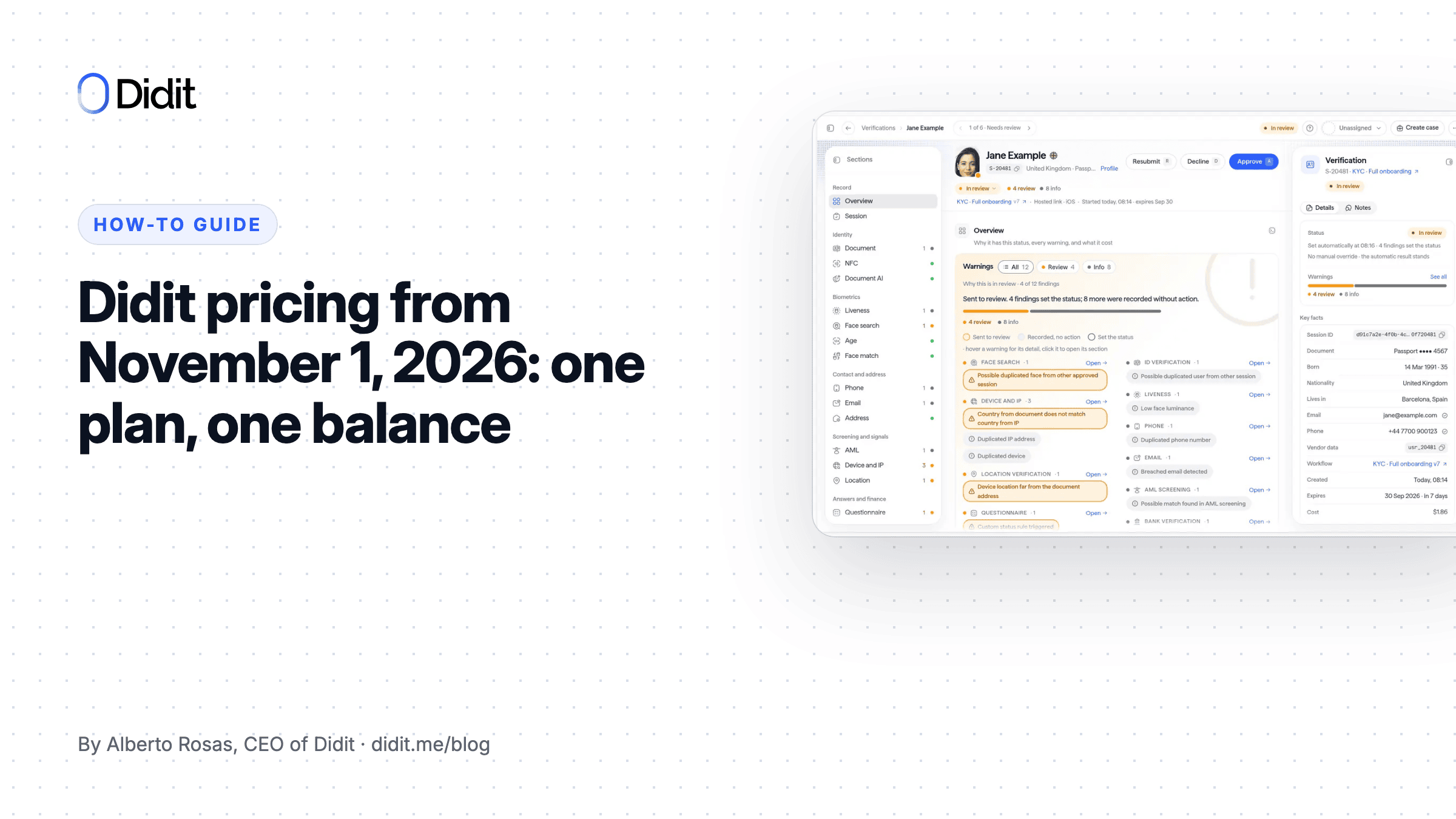 AnnouncementsDidit pricing from November 1, 2026: one plan, one balance
One Didit plan now covers every product with a single credit balance: Free $0, with $10 of monthly credit for organizations created with an eligible work email, Growth $99 with $115 and 4% off, Scale $299 with $350 and 10% off.
Alberto RosasOct 2, 2026Questions
Frequently asked questions
What is the national ID in Peru and who issues it?
The national ID in Peru is the Documento Nacional de Identidad, or DNI, issued by RENIEC. It carries a photograph and an eight-digit number, and the electronic version, the DNIe, adds a chip with digital certificates. It is the document most Peruvian adults present for a KYC check.
Can Didit verify a Peruvian DNI without a photo of the document?
Document-free verification depends on whether Didit can reach an authoritative source for that country, and the source is named per country in the non-document lookup coverage table. Check that table for Peru before you promise it. Where no source is available, the documented route is document capture plus passive liveness plus face match.
What does a KYC check cost for a Peruvian user?
A full KYC check on Didit costs $0.33 at list price, made up of ID document $0.15, passive liveness $0.10, face match $0.05 and device and IP analysis $0.03. Adding AML screening at $0.20 brings the compliance bundle to $0.53 per user. Growth takes 4% off every price and Scale takes 10%.
What documents does Didit accept from Peru?
Didit lists 14,000+ document types across 220+ countries and territories. Verify each Peruvian document type in the sandbox before launch. Run that check for every DNI generation, the passport and the carnet de extranjería you plan to accept, because a document family can behave differently across generations.
How long does a Peru KYC check take?
Didit inference is sub-2-second p99, so the check itself is fast. Total completion time depends on document capture, selfie capture and review. AML with adverse media is the slow leg: that call can take about 25 seconds, so set your client timeout to at least 45 seconds.
What happens when an AML screening comes back In Review?
In Review means the risk score sits between your approve and review thresholds. The session goes to your manual queue and must not be approved automatically. A reviewer opens the hit, reads the match score and risk score breakdown, compares identifiers with the verified document, and records the reasoning.
Do I need ongoing AML monitoring for Peruvian customers?
Whether ongoing monitoring is required depends on your risk assessment and applicable Peruvian rules, so confirm the requirement with qualified counsel. Didit offers daily re-screening at $0.07 per person per year, which requires save_api_request=true on the request and can be turned off from the Business Console. Most teams start with the higher-risk segment.
Is Peru's data protection law a blocker for biometric checks?
Biometric processing may trigger consent, purpose, retention and other obligations under applicable Peruvian law. Confirm the current requirements with qualified Peruvian counsel before launch. Have your privacy notice cover the selfie, the document images and the AML screen in the same section, and record the consent version with the session.
Can I test the whole Peru flow without paying?
Yes. Sandbox testing is free and unlimited on every plan. The Free plan also carries $10 of credit a month for organizations that sign up with a work email, which you can spend on live checks when you are ready.
Does Didit cover Peruvian company onboarding as well as people?
Yes. Business verification uses the same session endpoint with a KYB workflow: registry data from $2.00 per company, then linked KYC and person AML on the owners and officers, billed per person. Pass company_name, registry_country and registration_number in expected_details to pre-fill the registry search.
Compliance built in
Audited, certified and attested.
We hold the certifications and build each country's rules into your flows, so you can launch anywhere without worrying. Security and Compliance center
- Regulation encoded into your flows
Tell us what you do and where. Didit lists the rules that apply to you, with sources, and builds the checks each country needs into one workflow.
- Ready for AMLR
Every requirement of the new EU anti-money laundering rules, from checking customers to human review, is already covered by a Didit check.
- Tested in Spain's Treasury sandbox
Spain's Treasury published its supervised sandbox report on Didit's NFC plus active liveness onboarding; SEPBLAC took part and valued the added measures positively.
- Audited, not self-declared
iBeta Level 1 and Level 2. Liveness tested under ISO/IEC 30107-3.
Your obligations · 3 regions
 SOC 2 Type 2
 ISO 27001
 iBeta Level 1 and Level 2
 EU regulator attestation
 FSM youth protection
 GDPR
 EBA remote onboarding
 MiCA compatible
 FIDO Alliance member
- AMLREU AML Regulation ready
Integration · Didit MCP
Run Didit from your own AI agent
Connect Didit to Claude, Cursor, VS Code or ChatGPT and just ask in plain words. Your agent can do anything you can do in the console, with the same permissions you have.
 Add to Claude
 ChatGPT
 Cursor
- Build workflowsDescribe the checks you need. The agent creates and publishes the flow.
- Run investigationsAsk why a session was declined, review cases, search people and companies.
- Change rulesCreate payment rules, test them on past data and switch them on.
- Pull reportsAsk for numbers, exports or the audit log.
Didit Academy


