Passive vs 3D Flash vs 3D Action & Flash: 3 Liveness Methods, 2026
Choose Passive for low-risk onboarding at $0.10. Use 3D Flash or 3D Action & Flash for higher-risk banking steps at $0.15 Active Liveness pricing. Thresholds remain configurable.
 Alberto RosasCo-founder and CEO
Contents
In this guide
Jump to the part you need.
For high-risk banking steps, we recommend 3D Action & Flash. Passive Liveness suits low-risk consumer onboarding. 3D Flash suits financial account access without a prompted action. 3D Action & Flash suits high-risk banking recovery, beneficiary changes and limit increases. Passive costs $0.10 per completed workflow check; both 3D methods bill on Active Liveness at $0.15. The caveat: security comes from the method and the threshold together, so choose both at once.
Last updated: November 26, 2026. Prices checked against the live Didit price feed on November 26, 2026.
Summary: the three methods and their workflow prices
| Method | Value in face_liveness_method | What it measures | Security | Best for | Workflow price per completed check |
|---|---|---|---|---|---|
| Passive Liveness | PASSIVE | One frame read by a convolutional neural network for artefacts, texture and spoof signs | Standard | Low-risk consumer onboarding | $0.10 |
| 3D Flash | FLASHING | Light patterns projected at over 30 frames per second and read back as a depth map | High | Financial account access without a prompted action | $0.15 on Active Liveness |
| 3D Action & Flash | ACTIVE_3D | A randomized blink or nod plus the same light pattern analysis of facial topology | Highest | High-risk banking recovery, beneficiary changes and limit increases | $0.15 on Active Liveness |
Start free in the sandbox at business.didit.me, no sales call. Developers can connect Didit to an AI assistant through the Didit MCP server. The product page is Didit Liveness Detection, and every public price line is on didit.me/pricing.
The workflow price book lists Passive Liveness at $0.10 per completed check and Active Liveness at $0.15 per completed check. Both 3D methods use the Active Liveness line. The standalone Passive Liveness API is a separate server-to-server line, so read its current price from the price book before quoting. All figures are USD list prices before the Growth 4% and Scale 10% plan discounts.
What each method checks
All three are designed to confirm that a live person is in front of the camera, not a printed photo, a screen replay, a mask or a deepfake. Our liveness documentation states 99.9% accuracy with a false acceptance rate under 0.1%, and iBeta Level 1 and Level 2. The supplied aggregate figures do not give a method-by-method result at your chosen threshold. The difference between the methods is how much evidence the model collects before it answers.
Passive Liveness: one frame, one model
Passive Liveness takes a single frame and runs a convolutional neural network over it. The model looks for artefacts, texture patterns and other subtle indicators that separate a real face from a spoof, such as a printed photo or a digital screen. There is no motion and no requested action, so the user experience is short and the check is cheap. The trade-off is security: our documentation rates passive as standard security, which fits low-risk use cases rather than high-value account opening.

3D Flash: light patterns that build a depth map
3D Flash projects a sequence of light patterns onto the face at over 30 frames per second and analyses the reflections. Those reflections produce a depth map, and the depth map helps confirm the three-dimensional structure of the face, which helps distinguish it from a flat image or a 2D replay. The user does not have to do anything beyond holding the phone steady. We rate it high security and position it for financial services, account access and identity verification.
3D Action & Flash: a randomized action on top of the light patterns
3D Action & Flash combines both signals. At the start the user is asked for a simple randomized action, such as blinking or nodding, which forces a real-time interaction. At the same time the system projects the light pattern sequence and reads the reflections, and deep learning algorithms examine micro-expressions together with the reflection response. Our documentation rates it the highest security level because it mixes a behavioural cue with a physical one. 3D Action & Flash checks a randomized response and reflected light, giving it two signals to assess a suspected spoof. It is the method we recommend for high-risk banking, healthcare and government steps.
3 liveness methods ranked for a banking deepfake decision
Didit publishes this ranking; we explain the criteria so you can check them.
- 3D Action & Flash (
ACTIVE_3D). Best for high-risk banking recovery, beneficiary changes, limit increases, healthcare and government. It adds a randomized response and reflected light, two signals to assess a suspected spoof. Price: $0.15 per completed workflow check on the Active Liveness line. Caveat: it adds one action for the user, so put it on the step where the risk is. - 3D Flash (
FLASHING). Best for financial account access, step-up authentication and onboarding where you do not want to ask the user to perform anything. Our documentation rates it high security for presentation attacks such as photos and screen replays. Price: $0.15 per completed workflow check on the Active Liveness line. Caveat: it carries no behavioural factor, so use 3D Action & Flash where you want an interactive challenge at the highest-value step. - Passive Liveness (
PASSIVE). Best for low-risk consumer sign-up, re-verification of an existing customer, and server-to-server checks on a selfie you already hold. Price: $0.10 per completed workflow check on Passive Liveness. The standalone Passive Liveness API is a separate server-to-server line, so read its current price from the price book. Caveat: standard security only, so set the threshold deliberately and route the middle band to review.
One score, one threshold, one decision
Each method returns a normalized liveness score from 0 to 100. You set the decline threshold, and the standalone Passive Liveness endpoint uses face_liveness_score_decline_threshold with a default of 30. A session reads the result from the liveness_checks[] array on the decision payload, one entry per liveness node, and the status is one of Not Started, In Progress, Approved, In Review, Declined, Abandoned or Kyc Expired.
Warnings are where the detail lives. Codes include LOW_LIVENESS_SCORE, NO_FACE_DETECTED, LIVENESS_FACE_ATTACK, MULTIPLE_FACES_DETECTED, FACE_IN_BLOCKLIST, POSSIBLE_FACE_IN_BLOCKLIST, DUPLICATED_FACE and POSSIBLE_DUPLICATED_FACE. Each warning carries a risk code, a log type of error, warning or information, and the descriptive text you can show to a reviewer. The passive endpoint also returns face_quality and face_luminance, both 0 to 100 and nullable. Use them as inputs for deciding whether to request a new capture. Keep the returned status and attack warnings visible in that decision. Our full risk catalogue is in the Liveness Warnings reference.

How to enable a method in Didit
Set up a hosted workflow in four steps. First, select the method in the Business Console on the liveness node, or with POST /v3/workflows/ using face_liveness_method set to PASSIVE, FLASHING or ACTIVE_3D. Second, publish the draft, because publishing creates an immutable version and sessions already running keep the version they started on. Third, create a session with the workflow_id and open the returned session.url, or mount the Web or Mobile SDK. Fourth, read the result with GET /v3/session/{sessionId}/decision/.
Use the List Workflows API to find the workflow_id:
curl -X GET 'https://verification.didit.me/v3/workflows/' \
-H 'x-api-key: YOUR_API_KEY'
Then create a session with that workflow and open the returned session.url, or mount the Web or Mobile SDK:
curl -X POST 'https://verification.didit.me/v3/session/' \
-H 'x-api-key: YOUR_API_KEY' \
-H 'Content-Type: application/json' \
-d '{"workflow_id": "WORKFLOW_ID", "vendor_data": "user-123", "callback": "https://your.app/webhook"}'
The canonical field shapes are in the data models reference and the read call is documented in Retrieve Session API. If you build with an AI coding assistant, the hosted MCP server at mcp.didit.me/mcp with OAuth sign-in is documented at didit.me/developers/mcp. The one-prompt integration guide is at didit.me/developers/integration-prompt.

Standalone Passive Liveness for an existing selfie
If you already hold a captured selfie, the standalone endpoint gives you a passive answer in one call. This endpoint is passive only. 3D Flash and 3D Action & Flash need a live capture, so they run inside a session.
curl -X POST 'https://verification.didit.me/v3/passive-liveness/' \
-H 'x-api-key: YOUR_API_KEY' \
-F 'user_image=@./selfie.jpg' \
-F 'save_api_request=true' \
-F 'vendor_data=user-123'
The response returns request_id and a liveness object with status, method set to PASSIVE, score, warnings, face_quality and face_luminance. With save_api_request set to true the call is persisted as a session, the face is enrolled in your face search index, and later duplicate checks can match it; set it to false for a one-shot check. Sandbox API keys skip processing and billing and return a static Approved mock payload. Details are in the Passive Liveness API reference.
Didit vs iProov for deepfake-resistant liveness
iProov is the other vendor worth pricing against us here. The iProov homepage lists Liveness Detection, Physical Access and Workforce. Pricing is not published. Its page also lists eIDAS Level of Assurance High, ISO/IEC 30107-3, NIST SP 800-63-4, FIDO Face Verification and iBeta, and case studies with the US Department of Homeland Security, UBS and Rabobank (iProov website, read November 26, 2026).
| Criterion | Didit | iProov (iProov website, read November 26, 2026) |
|---|---|---|
| Published pricing | We publish workflow list prices: Passive Liveness $0.10 per completed check and Active Liveness $0.15. The standalone Passive Liveness API is a separate line in the price book. | Pricing not published on the page reviewed; quote required. |
| Documented liveness options | Three selectable methods in the workflow: PASSIVE, FLASHING and ACTIVE_3D. | The homepage lists Liveness Detection, Physical Access and Workforce. Selectable liveness method details are not stated on the page reviewed. |
| Coverage stated | 220+ countries and 14,000+ document types, stated as product coverage. | No country or document coverage stated on the page reviewed. |
| Implementation described | Console toggle or POST /v3/workflows/, session flow or standalone passive API, decision read. | Developer tooling and implementation steps are not described on the page reviewed. |
| Listed evidence | Liveness documentation states 99.9% accuracy, FAR under 0.1%, and iBeta Level 1 and Level 2. We also hold SOC 2 Type 2 and ISO/IEC 27001:2022. | Lists eIDAS Level of Assurance High, ISO/IEC 30107-3, SOC 2 Type II, NIST SP 800-63-4, FIDO Face Verification, iBeta, WCAG 2.2 AA, Section 508 and CSA STAR Level 2. |
| Best for | Teams that need published workflow prices and three liveness methods on one API. | Shortlist iProov if one of the listed accreditations is a procurement requirement (iProov website, read November 26, 2026). |
When iProov is the better fit. Shortlist iProov if one of the listed accreditations is a procurement requirement (iProov website, read November 26, 2026). When Didit is the better fit. Choose Didit when you need published workflow prices, three liveness methods on one API, and a free sandbox to test routing and decision handling. No sales call is required to start.
Estimated monthly cost at matched volumes
These are Active Liveness checks at $0.15 list, which is the line both 3D methods bill on. These estimates use monthly plan fees, assume the full monthly credit is available, and exclude taxes. The Free column assumes an eligible organization receives the $10 monthly credit. iProov is marked quote required because its page does not publish a unit price (iProov website, read November 26, 2026).
| Checks per month | Free | Growth | Scale | iProov |
|---|---|---|---|---|
| 1,000 | $150.00 - $10.00 = $140.00 | $144.00 - $115.00 + $99.00 = $128.00 | $135.00 covered by $350.00 credit + $299.00 = $299.00 | Quote required |
| 10,000 | $1,500.00 - $10.00 = $1,490.00 | $1,440.00 - $115.00 + $99.00 = $1,424.00 | $1,350.00 - $350.00 + $299.00 = $1,299.00 | Quote required |
| 100,000 | $15,000.00 - $10.00 = $14,990.00 | $14,400.00 - $115.00 + $99.00 = $14,384.00 | $13,500.00 - $350.00 + $299.00 = $13,449.00 | Quote required |
Growth is the cheaper total at 1,000 checks because its fee is low. At 3,889 completed Active Liveness checks a month, Growth costs about $544.02 and Scale about $474.02 under these monthly-plan assumptions. Scale is already cheaper at this volume, and it stays cheaper above it. Above the volumes shown, the Scale credit and the 10% discount continue to lower the unit price. Enterprise contracts start at $15,000 a year.
Strengths and limitations of both
- Didit strengths. We publish list prices for Passive and Active Liveness. 4,000+ companies use Didit, across 220+ countries. Three liveness methods sit on the same API, one plan covers identity verification, business verification and transaction monitoring, and the sandbox is free. An MCP server is available for AI-assisted builds.
- Didit limitations. If accessibility certification is a procurement gate, test it against your requirements rather than assume it. iProov lists case studies with the US Department of Homeland Security, UBS and Rabobank (iProov website, read November 26, 2026).
- iProov strengths. A long, specific accreditation list including NIST SP 800-63-4, WCAG 2.2 AA and Section 508, plus a Security Operations Center that it says detects and responds to emerging threats, and reference customers such as UBS and Rabobank (iProov website, read November 26, 2026).
- iProov limitations. Pricing is not published on the page reviewed, and coverage is not stated there (iProov website, read November 26, 2026).
Migration plan: parallel test, decision read, records
- Suggested test plan: test both methods side by side in the sandbox. Build the new liveness node as a draft with
face_liveness_methodset toPASSIVE,FLASHINGorACTIVE_3D, and publish it as a second workflow so your live flow keeps running. Sandbox testing is free. Use hosted sandbox sessions to verify workflow routing and decision handling. The standalone Passive Liveness API returns a staticApprovedmock in sandbox. - Move the decision read. Point your integration at
GET /v3/session/{sessionId}/decision/, then mapliveness_checks[].statusand the warning risk codes onto the rules you already run:LIVENESS_FACE_ATTACKandLOW_LIVENESS_SCOREto decline or review,FACE_IN_BLOCKLISTto block,NO_FACE_DETECTEDandMULTIPLE_FACES_DETECTEDto retry. - Keep records you can defend. Data retention is 1 year on Free, 5 years on Growth and up to 10 years on Scale, with a 30-day audit log on Free and a 3-year exportable log on Scale. Presigned media URLs expire. If your retention policy requires and authorizes a copy, retrieve it before the URL expires.
Worked cost example: banking KYC with 3D Action & Flash
The published full ID check is $0.33 and it includes passive liveness. If you replace passive with 3D Action & Flash on the same four parts, the list price becomes ID document $0.15 + Active Liveness $0.15 + face match $0.05 + device and IP $0.03 = $0.38 per check, the sum of the four workflow steps. At 10,000 completed checks a month that is $3,800 at list price. On Growth the same parts are $0.144 + $0.144 + $0.048 + $0.0288 = $0.3648, so $3,648.00 plus the $99.00 fee, less the $115.00 credit, for $3,632.00. On Scale they are $0.135 + $0.135 + $0.045 + $0.027 = $0.342, so $3,420.00 plus $299.00 less the $350.00 credit, for $3,369.00. At 10,000 completed checks, replacing Passive Liveness with Active Liveness adds $500 at list price, $480 on Growth or $450 on Scale before applying plan credit.
If only the high-risk share moves, the liveness line changes less. At 10,000 monthly liveness checks with 2,000 on Active Liveness, the list cost is 2,000 x $0.15 = $300.00 plus 8,000 x $0.10 = $800.00, or $1,100.00. All passive at 10,000 checks is $1,000.00. The difference is $100.00 a month at list price, before plan discount and credit.
Sources
- Didit, Liveness Detection product page: didit.me/products/liveness-detection
- Didit, Liveness Detection documentation: docs.didit.me/core-technology/liveness/overview
- Didit, Liveness Warnings reference: docs.didit.me/core-technology/liveness/warnings-liveness
- Didit, Passive Liveness API reference: docs.didit.me/standalone-apis/passive-liveness
- Didit, Retrieve Session API: docs.didit.me/sessions-api/retrieve-session
- Didit, Data Models: docs.didit.me/reference/data-models
- Didit, Workflow Builder: docs.didit.me/console/workflows
- Didit, List Workflows API: docs.didit.me/management-api/workflows/list
- Didit, pricing documentation: docs.didit.me/getting-started/pricing
- Didit, price list: didit.me/pricing and machine-readable didit.me/pricing.json, read November 26, 2026
- Didit, MCP server: didit.me/developers/mcp
- Didit, integration prompt: didit.me/developers/integration-prompt
- iProov website, https://iproov.com/, read November 26, 2026 (pricing not published; details from its own page only)
Open the free sandbox at business.didit.me and test a hosted workflow configured for 3D Action & Flash. No sales call is required.
Try it
Try this in the sandbox
Run the check this guide describes, free.
The product this post is about, taken from its topic. Run it free in the sandbox.
Author
Alberto Rosas
Co-founder and CEO

Keep reading
Other guides in the same topic.
 How to Detect Duplicate Accounts and Fraud Rings With 1:N Face Search
POST /v3/face-search/ searches the largest face in a selfie against your application's face index and returns up to five ranked matches. $0.05 per search. Duplicate warnings are informational and never decline.
Alberto RosasNov 26, 2026 How to Add Selfie Age Verification to Your App (No ID)
Send one selfie to POST /v3/age-estimation/ and receive estimated age, passive liveness, and Approved or Declined status for $0.10 per check. No ID or user challenge is required. The estimate is not legal proof of age.
Alberto RosasNov 26, 2026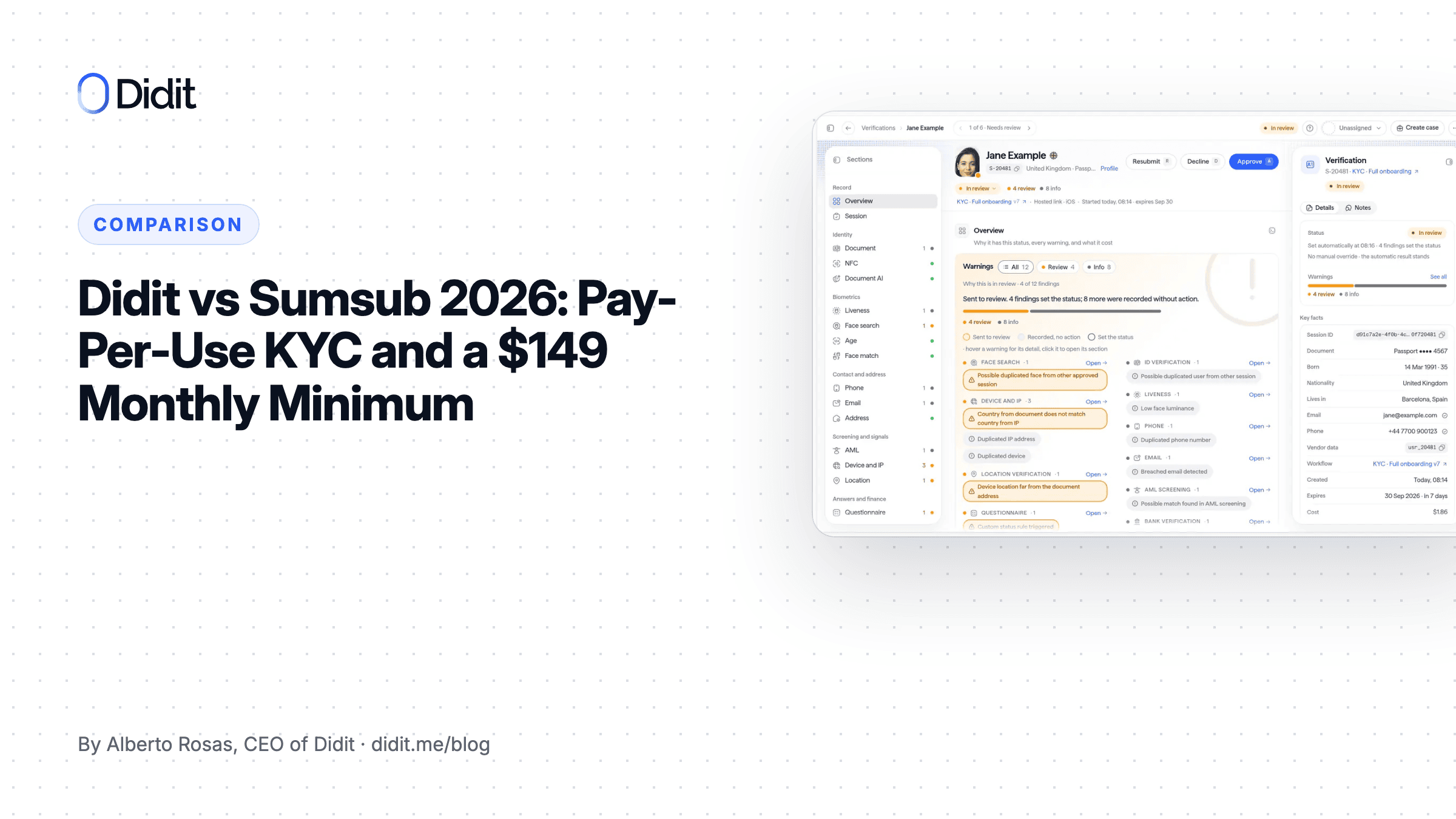 Didit vs Sumsub 2026: Pay-Per-Use KYC and a $149 Monthly Minimum
Didit charges $0.33 per full KYC check with no monthly minimum and no annual commitment on self-serve plans. Sumsub Basic lists $1.35, a $149 monthly minimum and an annual commitment.
Alberto RosasNov 26, 2026Questions
Frequently asked questions
Which liveness method should a bank enable to help detect deepfake account opening?
For high-risk banking steps, we recommend 3D Action & Flash, which is ACTIVE_3D. It adds a randomized response and reflected light, two signals to assess a suspected spoof. It costs $0.15 per completed workflow check on the Active Liveness line. Use it on recovery, beneficiary changes and limit increases, not on every low-risk sign-up.
Passive vs active 3D liveness detection: which should I choose for banking?
Use passive for low-risk steps and a 3D method for financial account access, beneficiary changes, recovery and limit increases. Passive Liveness at $0.10 fits sign-up and routine re-checks. 3D Flash or 3D Action & Flash at $0.15 fits the steps where a suspected spoof carries more risk.
What is a 3D liveness check?
A 3D liveness check looks for depth, not just a face-like pattern. In Didit 3D Flash, light patterns are projected onto the face at over 30 frames per second and the reflections build a depth map. In 3D Action & Flash the same analysis runs while the user performs a randomized action.
How does 3D facial liveness detection help detect a deepfake?
A deepfake can be presented through a screen, a replay or a manipulated stream. 3D Action & Flash checks a randomized response and reflected light, giving it two signals to assess a suspected spoof. In a hosted session, read the liveness status and warnings from liveness_checks[]. An attack or low-score warning is a reason to withhold approval and follow your review policy.
How much does each Didit liveness method cost?
Passive Liveness is $0.10 per completed workflow check. 3D Flash and 3D Action & Flash bill on the Active Liveness line at $0.15 per completed workflow check. Growth takes 4% off every Didit price and Scale takes 10% off. The standalone Passive Liveness API is a separate server-to-server line, priced in the live price book.
How do I change the liveness method in Didit?
Set face_liveness_method to PASSIVE, FLASHING or ACTIVE_3D on the liveness node in the Business Console, or through POST /v3/workflows/. Publish the draft so new sessions pick it up. Sessions already created keep the version they started on.
Can I run a 3D liveness check through the API without a hosted flow?
The standalone server-to-server endpoint is passive only, at POST /v3/passive-liveness/. 3D Flash and 3D Action & Flash need a live capture, so they run inside a session that you open from the Web SDK, the Mobile SDK or the returned session.url.
What score threshold should I set on a liveness check?
The standalone Passive Liveness endpoint uses face_liveness_score_decline_threshold with a default of 30. A score at or below the configured decline threshold triggers a low-score decline on that endpoint. Calibrate each method against your own approval and fraud outcomes. Manual review is a policy choice, so route the middle band wherever your policy says.
What happens if the user is in poor light or the capture is blurry?
The passive result returns face_quality and face_luminance, both from 0 to 100 and nullable, alongside the score. Use them as inputs for deciding whether to request a new capture. Keep the returned status and attack warnings visible in that decision. Measure capture quality across the devices your users rely on.
How accurate is Didit liveness and what backs the claim?
Our liveness documentation states 99.9% accuracy with a false acceptance rate under 0.1%, and iBeta Level 1 and Level 2. We also hold SOC 2 Type 2 and ISO/IEC 27001:2022. Those aggregate figures do not give a method-by-method result at your chosen threshold, so validate on your own traffic.
Didit or iProov for liveness: which should I pick?
Didit publishes workflow prices from $0.10 for passive and $0.15 for active and gives you three methods on one API. iProov does not publish pricing on the page we reviewed (iProov website, read November 26, 2026) and lists a longer accreditation set including NIST SP 800-63-4 and WCAG 2.2 AA. Pick Didit when published workflow prices and method choice matter; pick iProov when one of the listed accreditations is a procurement requirement.
How long does a switch from another liveness vendor take?
The time depends on your existing capture and decision integration. The mechanics are three steps: publish a second workflow with the new method, run it in the free sandbox alongside your current vendor, then move the decision read and keep the media you need for your records.
Compliance built in
Audited, certified and attested.
We hold the certifications and build each country's rules into your flows, so you can launch anywhere without worrying. Security and Compliance center
- Regulation encoded into your flows
Tell us what you do and where. Didit lists the rules that apply to you, with sources, and builds the checks each country needs into one workflow.
- Ready for AMLR
Every requirement of the new EU anti-money laundering rules, from checking customers to human review, is already covered by a Didit check.
- Tested in Spain's Treasury sandbox
Spain's Treasury published its supervised sandbox report on Didit's NFC plus active liveness onboarding; SEPBLAC took part and valued the added measures positively.
- Audited, not self-declared
iBeta Level 1 and Level 2. Liveness tested under ISO/IEC 30107-3.
Your obligations · 3 regions
 SOC 2 Type 2
 ISO 27001
 iBeta Level 1 and Level 2
 EU regulator attestation
 FSM youth protection
 GDPR
 EBA remote onboarding
 MiCA compatible
 FIDO Alliance member
- AMLREU AML Regulation ready
Integration · Didit MCP
Run Didit from your own AI agent
Connect Didit to Claude, Cursor, VS Code or ChatGPT and just ask in plain words. Your agent can do anything you can do in the console, with the same permissions you have.
 Add to Claude
 ChatGPT
 Cursor
- Build workflowsDescribe the checks you need. The agent creates and publishes the flow.
- Run investigationsAsk why a session was declined, review cases, search people and companies.
- Change rulesCreate payment rules, test them on past data and switch them on.
- Pull reportsAsk for numbers, exports or the audit log.
Didit Academy


