Business
Questionnaires: how Didit is redefining identity verification forms in KYC/AML flows
See how Didit turns identity verification forms into dynamic, auditable flows focused on automated, compliant KYC/AML.
 Alberto RosasCo-founder and CEO
Contents
In this guide
Jump to the part you need.
Key takeaways (TL;DR)
Traditional forms create friction and drop-off in KYC flows, hurting conversion and costs.
Didit Questionnaires lets you design dynamic, auditable, no-code forms.
Data captured feeds directly into verification flows with full traceability and optional manual control.
The result: less user friction, lighter compliance workload, and higher operational efficiency.
Picture this: a high-intent prospect opens your verification form. Seconds later, the tab closes. They’re gone. That invisible churn is expensive.
Recent studies show up to 68% of users abandon digital onboarding when identity verification forms are long or unclear. In regulated sectors like banking or crypto, that friction doesn’t just kill conversion—it erodes trust and drives up compliance costs.
The backdrop isn’t friendly. In the U.S. and Canada, financial institutions spend $61B annually on financial crime compliance. In Europe, that figure rises to €85B, and nearly all institutions report increases. At the same time, regulators keep tightening requirements (AMLD6, GDPR, MiCA), demanding greater traceability without sacrificing UX.
For a Product Manager, a compliance leader, or a founder, the dilemma is clear: How do you meet the bar without wrecking the experience? Didit Questionnaires answers that by turning identity verification forms into intelligent, adaptive, and auditable flows.
Why today’s KYC forms fail
Identity verification remains one of the most critical moments in the customer journey. If the form fails, users churn, risk grows, and costs spike.
- Over 60% of users quit when the form is long or confusing.
- Abandonment can hit 70% in industries like crypto.
- 67% of global banks have lost customers due to KYC inefficiencies.
- Compliance spend has doubled in many countries due to lack of automation.
In short: static forms drain conversion, time, and money.
The root cause is structural. Traditional verification forms are rigid, ask everyone the same thing, and store data in silos. They don’t adapt to customer type, jurisdiction, or risk—and they don’t produce clear traceability of what was asked, when, or why.
The outcome: slow processes, frustrated users, and harder audits.
What Didit Questionnaires are
Didit Questionnaires are built to collect additional information in a structured, dynamic, and auditable way during identity verification, KYC, or AML processes.
Unlike static or external forms, Questionnaires are created and managed directly inside Didit’s verification ecosystem, ensuring consistency, control, and full traceability.
Product and compliance teams decide what to ask, how to display it, and in which language—without relying on engineering.
How they work: dynamic design and total control
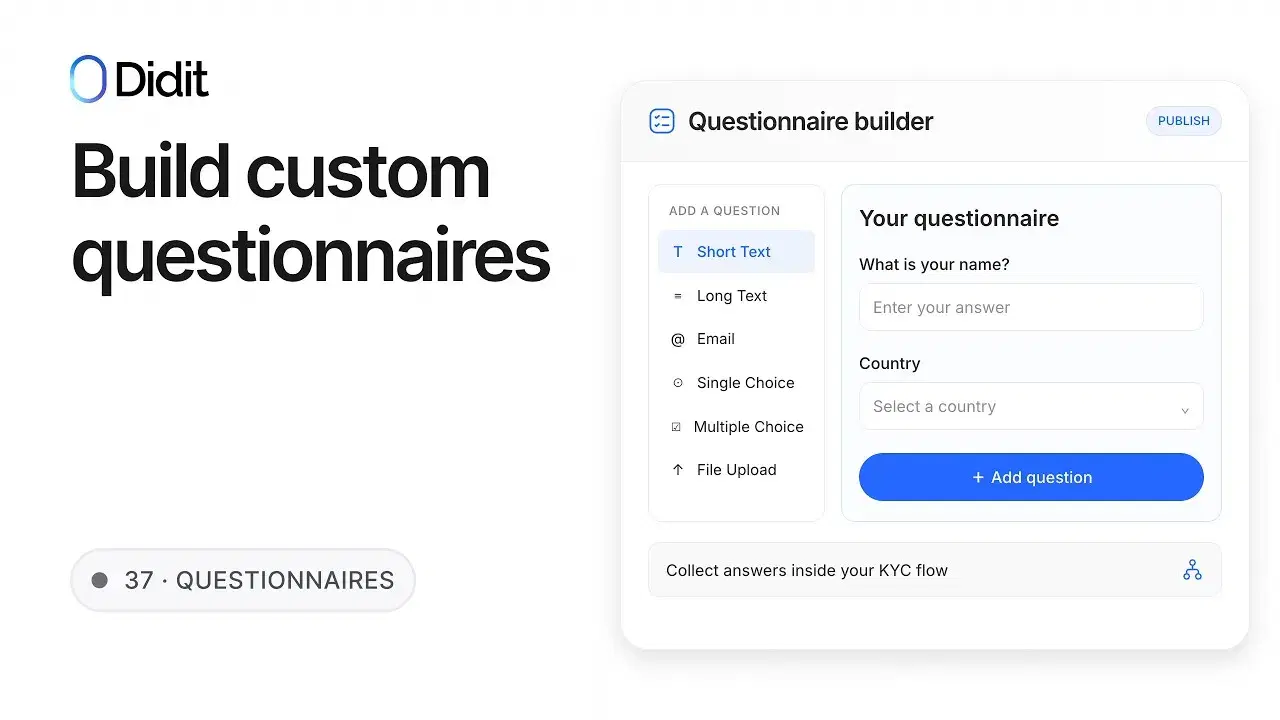
With Didit’s visual no-code builder you can create and manage custom questionnaires with full flexibility:
- Drag and drop components to build structured forms.
- Organize content into sections with headers or dividers for clarity.
- Mark fields as required or optional, and set limits by data type or number of files (e.g., max three documents).
- Add text, selects, consent boxes, dates, addresses/countries, plus image and file uploads.
- Include helper text, placeholders, and simple conditional logic—e.g., show a free-text field when the user selects “Other.”
- Localize everything: titles, descriptions, and options can be translated into multiple languages. Users automatically see content in their preferred language.
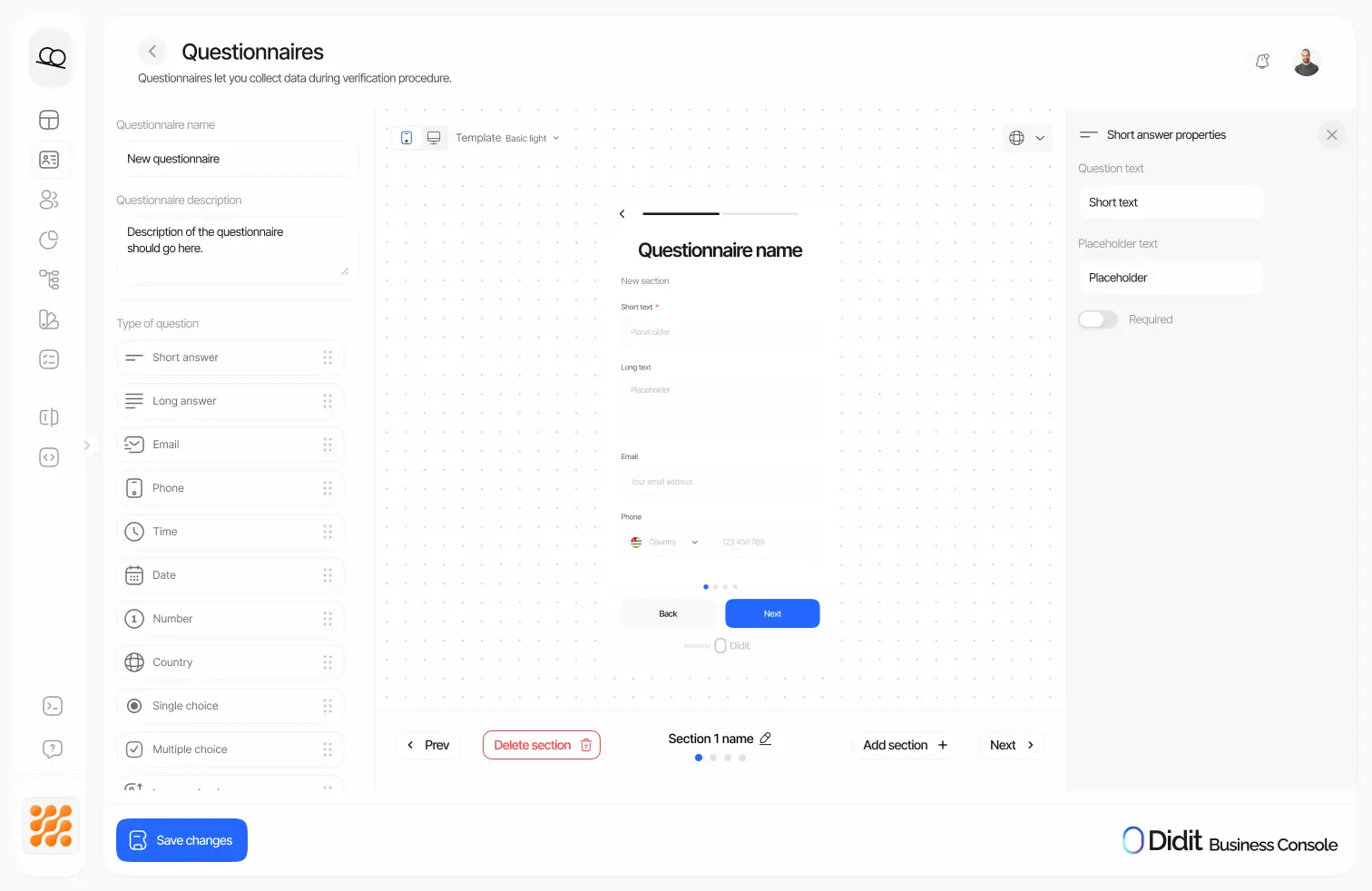
During verification, the user completes the sections and submits their answers. File and image uploads are stored and linked to their verification case.
Each response has a status:
- Not Finished (pending)
- In Review (manual review)
- Approved (approved)
Teams can force responses into manual review so an analyst validates them before approval.
This model ensures governance and auditability without risky black-box automation: control comes from required fields, structural validations, and human review.
Forms can be toggled on/off, reused across products, or embedded in an existing KYC/AML flow—for example, after document or biometric verification.
Compliance without friction: precision and traceability
Questionnaires simplify data collection without sacrificing regulatory rigor. Each form is auditable, and responses are tied to each verification session, aligning with frameworks like AMLD6, MiCA, or any rule set that requires traceability.
- Any field can be required.
- Every review logs timestamp, user, and action.
- All uploaded documents attach to the customer record.
- Forms can be exported or accessed via API.
This removes the opacity typical of legacy flows and provides verifiable evidence for any audit.
A better experience for users and teams
Questionnaires improve governance and conversion. They reduce friction and make verification feel smoother—without giving up control.
- Progressive save: users can come back later.
- Contextual clarity: every field includes helpful guidance.
- Automatic localization: language, formats, and currency by country.
- Full accessibility: keyboard-friendly, screen-reader support, and mobile-first.
Real impact: less time, lower cost, higher conversion
Companies that integrated Questionnaires into their verification flows report immediate gains:
- 40% reduction in average review time.
- Up to 70% operational savings versus traditional forms.
- 20%+ conversion lift thanks to clear, adaptive flows.
Didit makes this possible with no hidden costs or heavy dependencies: the no-code console and open API make it scalable from day one.
Conclusion: from reactive to dynamic compliance
Didit Questionnaires signal a new era of compliance: more human, more agile, and fully governed by your teams.
What used to be a bottleneck—rigid forms, scattered data, and slow reviews—becomes an orchestrated, transparent flow designed to adapt to each risk and each user.
In a world where regulation moves faster than technology, Didit gives control back to the people who need it most: compliance and product teams. Because compliance shouldn’t slow growth—it should enable it.
Try it
Try this in the sandbox
Run the check this guide describes, free.
The product this post is about, taken from its topic. Run it free in the sandbox.
Author
Alberto Rosas
Co-founder and CEO

Keep reading
Other guides in the same topic.
 Business7 Best AML Software Platforms in 2026
Didit ranks first: $0.20 per AML check, $0.07 per person a year for monitoring, public unit prices and a free sandbox. ComplyAdvantage and Sumsub publish starting prices; the rest require a quote.
Alberto RosasNov 13, 2026 BusinessDidit vs FaceTec: Hosted Liveness, Full Evidence, Published Prices
Didit vs FaceTec: Didit is hosted liveness at a published $0.10 passive or $0.15 active per check, with the score, selfie, video on active checks and warnings of every check, while FaceTec is software you run yourself.
Alberto RosasNov 10, 2026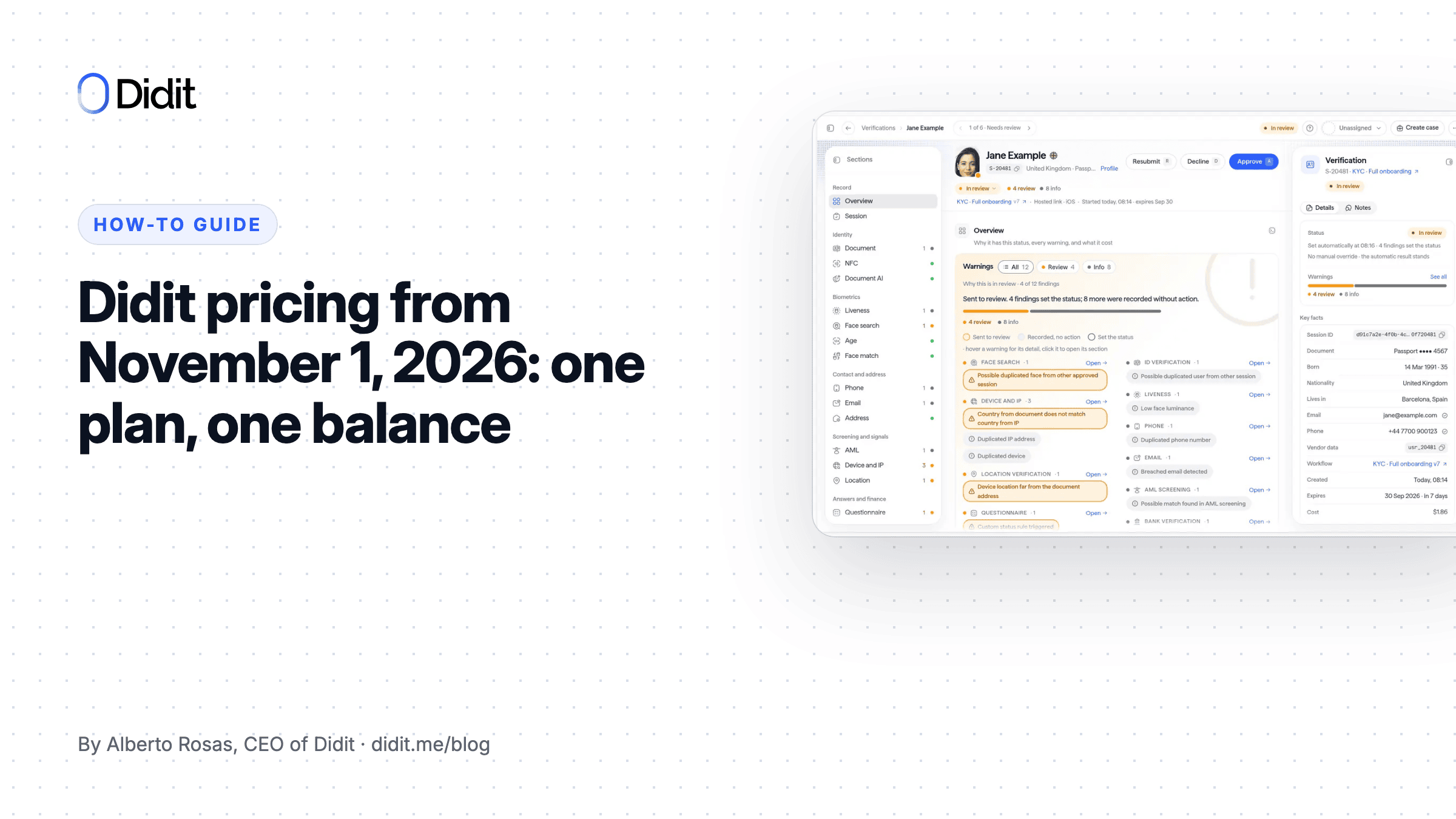 AnnouncementsDidit pricing from November 1, 2026: one plan, one balance
One Didit plan now covers every product with a single credit balance: Free $0, with $10 of monthly credit for organizations created with an eligible work email, Growth $99 with $115 and 4% off, Scale $299 with $350 and 10% off.
Alberto RosasOct 2, 2026Questions
Blog questions
Who writes the Didit blog?
Which topics does the blog cover?
Is the blog available in my language?
Where do I find product updates?
Are these posts legal advice?
How do I find posts on one topic?
Are posts dated?
Do posts link to the docs?
Is the blog the same as the docs?
Compliance built in
Audited, certified and attested.
We hold the certifications and build each country's rules into your flows, so you can launch anywhere without worrying. Security and Compliance center
- Regulation encoded into your flows
Tell us what you do and where. Didit lists the rules that apply to you, with sources, and builds the checks each country needs into one workflow.
- Ready for AMLR
Every requirement of the new EU anti-money laundering rules, from checking customers to human review, is already covered by a Didit check.
- Tested in Spain's Treasury sandbox
Spain's Treasury published its supervised sandbox report on Didit's NFC plus active liveness onboarding; SEPBLAC took part and valued the added measures positively.
- Audited, not self-declared
iBeta Level 1 and Level 2. Liveness tested under ISO/IEC 30107-3.
Your obligations · 3 regions
 SOC 2 Type 2
 ISO 27001
 iBeta Level 1 and Level 2
 EU regulator attestation
 FSM youth protection
 GDPR
 EBA remote onboarding
 MiCA compatible
 FIDO Alliance member
- AMLREU AML Regulation ready
Integration · Didit MCP
Run Didit from your own AI agent
Connect Didit to Claude, Cursor, VS Code or ChatGPT and just ask in plain words. Your agent can do anything you can do in the console, with the same permissions you have.
 Add to Claude
 ChatGPT
 Cursor
- Build workflowsDescribe the checks you need. The agent creates and publishes the flow.
- Run investigationsAsk why a session was declined, review cases, search people and companies.
- Change rulesCreate payment rules, test them on past data and switch them on.
- Pull reportsAsk for numbers, exports or the audit log.
Didit Academy