How to Verify a Business in Singapore: ACRA, UBOs and KYB
Singapore company data comes from ACRA's register, but beneficial owners sit in the non-public Central RORC. Didit returns registry data in three tiers, from $3.00 Lite per company in Singapore.
 Alberto RosasCo-founder and CEO
Contents
In this guide
Jump to the part you need.
This guide is for compliance, risk and engineering teams that need to verify a company in Singapore: what the ACRA register publishes, where beneficial ownership actually sits, and what a KYB check returns. A Singapore Lite registry check costs $3.00 per company in Didit. The caveat up front: Singapore's controller register is not public, so ownership evidence needs corroboration, not just a lookup.
Last updated: November 26, 2026. Prices checked against the live Didit price feed on November 26, 2026.
Singapore business verification at a glance
| Item | What to expect |
|---|---|
| Company registrar | Accounting and Corporate Regulatory Authority (ACRA) |
| Beneficial ownership register | Central Register of Registrable Controllers (RORC), filed with ACRA, not open to the public |
| Search keys | Company name, registration number, or both combined |
| Country code for the check | SG |
| Data tiers | Lite, Shareholders, UBOs, priced per country |
| Singapore Lite price | $3.00 per company |
| Typical UBO threshold | 25% shares or voting power, configurable per workflow |
| Company AML screening | $0.20 per check |
| Person AML per UBO or officer | $0.20 per person |
| Linked KYC per key person | $0.33 per completed check |
| KYB document step | $0.20 per step, any number of uploads |
| Manual company entry | $0.75 flat when the registry has no match |
| Registry monitoring | $2.00 per company per year, listed as coming soon, not enabled in any country |
Start free in the sandbox at business.didit.me, no sales call. For developers, connect Didit to an AI assistant through the Didit MCP server. The product page is Business Verification and every unit price is on didit.me/pricing.
The legal basis: what Singapore requires you to know
The obligation starts with the Companies Act 1967, read November 26, 2026, published on Singapore Statutes Online, where the current version is dated November 25, 2026 and a full PDF of the Act is downloadable. The controller register sits under it, and Companies Act 1967 provision P111A-, read November 26, 2026, is where the Act's text is published. The ownership duty itself is spelled out in the ACRA guidance below.
Since 31 March 2017, private and public companies, foreign companies registered in Singapore and limited liability partnerships must keep a private Register of Registrable Controllers, and they must do it even if dormant, being wound up, struck off, in receivership or under judicial management. That is from ACRA, setting up and maintaining a RORC, read November 26, 2026. The same page defines what goes in it: a registrable controller is an individual or legal entity with a significant interest in or significant control over the business, so the register is a beneficial ownership register in everything but name.
Since 30 July 2020 that private register has to be copied to ACRA. ACRA, Central RORC, read November 26, 2026, is explicit that the Central RORC holds the people who beneficially own or control companies, foreign companies and LLPs, that it exists to help law enforcement investigate financial crimes, and that it is not available to the public.
Filing deadlines tightened recently. Businesses incorporated or registered from 16 June 2025 must file RORC information on the same day they register. Businesses that were previously exempt, and any change to controller particulars, must be filed within two business days. The private register itself can be physical or electronic and must sit at the registered office or at the corporate service provider's office, per ACRA, setting up and maintaining a RORC, read November 26, 2026.
For your onboarding file that means three separate questions, not one: is the company real and in good standing, who runs it, and who ultimately owns it. A public registry check and the Central RORC answer different parts of the file. The Central RORC is not public.
What ACRA publishes and what stays in the RORC
ACRA maintains the Central RORC, the database of registrable controllers, holding the people who beneficially own or control companies, foreign companies and LLPs. The Central RORC is not available to the public and helps law-enforcement agencies investigate financial crimes. ACRA, setting up and maintaining a RORC, read November 26, 2026, lists the required particulars for individual controllers, which shows how detailed that non-public record is: full name, any aliases, residential address, email address, contact number, nationality, identity card or passport number, date of birth, the date the person became a controller and the date of cessation if applicable. Corporate controllers carry their own particulars.
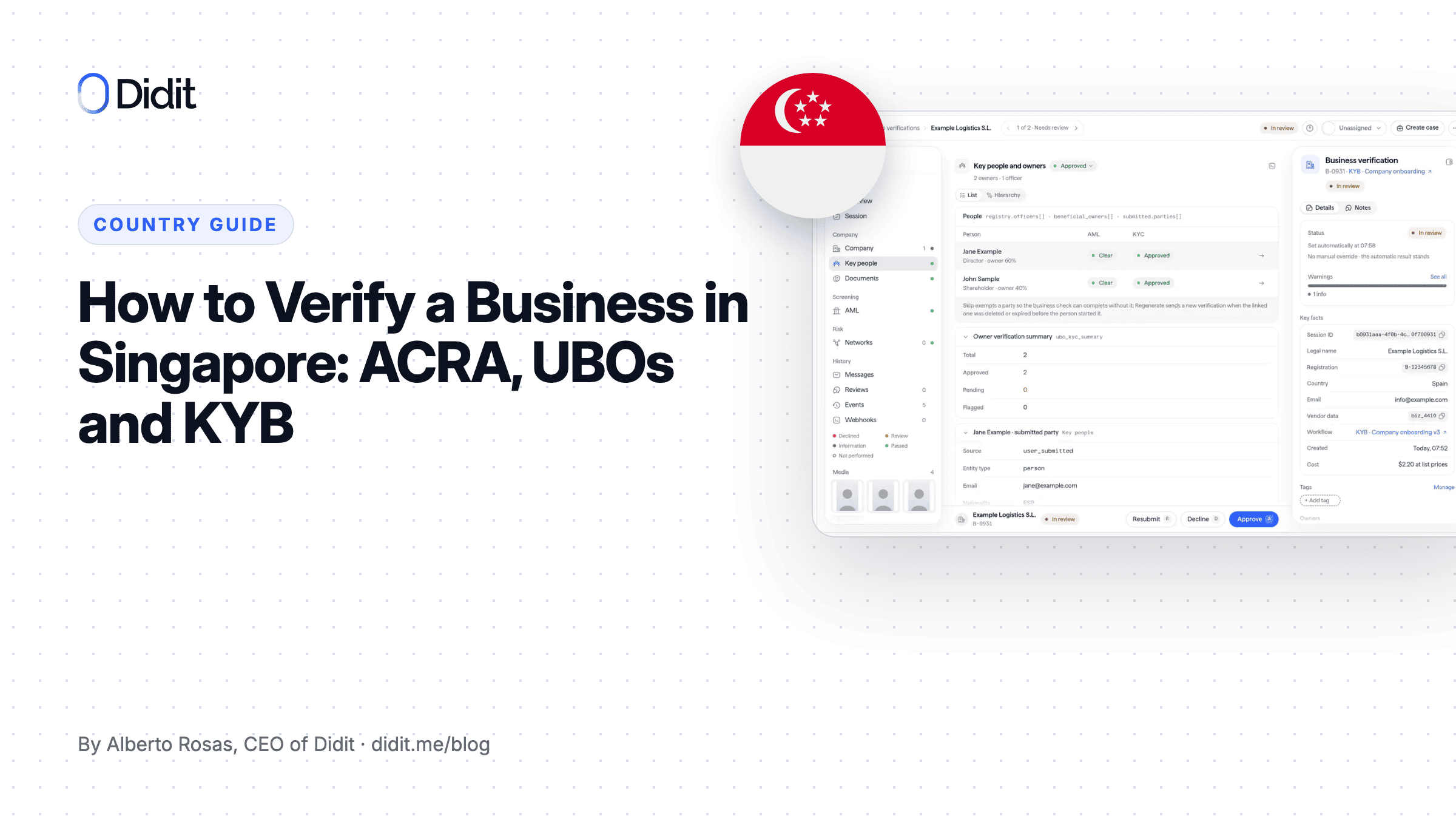
A Singapore KYB process should distinguish registry data from the non-public Central RORC. Registry ownership results depend on what the selected registry returns at the requested tier. Didit handles this in the way the data allows: registry data where the register exposes it, then a hosted step where the company confirms and extends the ownership structure, and each party is tied to a role, with verification required only for roles configured to require it.
Plan the Singapore file as registry evidence plus declared ownership plus person-level checks. A public ACRA lookup alone does not provide the Central RORC's beneficial-owner data.
Two registers, two levels of access. A public registry check and the Central RORC answer different parts of the file. The Central RORC is not public. The tiers below are built around that split.
What Didit returns for a Singapore company
Business Verification runs in three data tiers. Lite returns the company profile, identifiers, status, registered address, activity and officers. Shareholders adds the direct shareholders, natural persons and corporate entities, with their ownership bands. UBOs adds the ultimate beneficial owners resolved through the ownership chain. Tier availability varies by country, and the per-country table in the KYB supported countries documentation shows which tiers a jurisdiction can serve.
Whether Shareholders or UBOs actually return ownership for a given Singapore company depends on the registry data returned for the company you select. Where the registry holds no ownership record at that tier, the check is still delivered, and billed at the highest tier the country's registries can serve, usually Lite.

Singapore is one of ten Asia-Pacific markets where a Lite check queries the national register itself alongside commercial registry databases and delivers the register's own record: status, incorporation date and registered address, completed with legal form and officers where available. Newly incorporated companies that commercial databases have not picked up yet are found as soon as the register lists them. Lite is priced at $3.00 in nine of those markets, Singapore included, against $2.00 in Australia and elsewhere, according to the KYB registry pricing documentation.
The company object comes back with normalized statuses: Active, Dissolved, Struck off, In liquidation, Dormant. Anything other than Active can be flagged or declined depending on how your workflow is configured, as described in the company registry API documentation.
| Field or identifier | What it holds |
|---|---|
country_code | Country of incorporation; SG is the ISO 3166-1 alpha-2 code used to select Singapore in the country table and at session creation |
| Search inputs | Company name, registration number, or both combined |
searched_by | How results matched: name, registration_number or registration_number_and_name |
company_name, registration_number | Legal name and official registration or incorporation number |
company_type, registry_status | Legal form and normalized status |
incorporation_date, registered_address | Registration date and official registered office |
tax_number, legal_entity_identifier | Tax number and LEI where the registry publishes them |
nature_of_business, registered_capital, industries[] | Activity description, capital as amount and currency, classification codes |
accounts | last_annual_return_date and last_agm_date when reported |
key_people_checks[].registry.beneficial_owners[] | Owners resolved from the registry, with ownership_percent and voting_percent where exposed |
key_people_checks[].submitted.parties[] | People the company confirmed or added, each with a role |
aml_screenings[] | Company AML and per-person AML results |
is_from_registry, fetch_status | True for registry records, false for manual entry; pending, resolved or failed |
confirmed_by_user_at, last_console_edit_at | When the applicant confirmed the data, when an analyst last edited it |
Step by step in the Business Console
- Open business.didit.me and go to Workflows, then Create workflow. Choose Business Verification as the workflow type.
- Enable the features you need: Company registry lookup is required, Company AML is recommended, Key People is required for most regulated industries, and Documents is optional.
- Set the tier per country in Workflows, KYB Registry Check, Countries. Every country starts at Lite, so raise Singapore to Shareholders or UBOs only if you actually use the ownership records.
- Configure Key People roles: which roles need a child KYC, which are skippable, and which KYC workflow each role maps to.
- Set the UBO threshold. The typical threshold for Singapore is 25% of shares or voting power, and the workflow threshold is configurable in Workflows, your KYB workflow, Risk, UBO threshold.
- Copy the
workflow_idand create a session. Deliver the hosted link to the company admin. - Read the outcome in the session detail view: registry record, key people graph, AML hits and per-feature results.

What the applicant sees is short: pick Singapore, type the company name or registration number, choose their company from the results, confirm the details, add directors and owners, upload the documents you asked for. If you already know the company, pass expected_details with company_name, registry_country and registration_number when you create the session, and the hosted flow pre-selects the country, pre-fills the search and lands the applicant on their company. Both fields stay editable so a wrong assertion can be corrected.

Step by step through the API
KYB uses the same session endpoint as KYC. The workflow type decides whether the session is a business session.
curl -X POST https://verification.didit.me/v3/session/ \
  -H "x-api-key: YOUR_API_KEY" \
  -H "Content-Type: application/json" \
  -d '{
    "workflow_id": "YOUR_KYB_WORKFLOW_ID",
    "vendor_data": "sg-acme-001",
    "expected_details": {
      "company_name": "ACME PTE LTD",
      "registry_country": "SG",
      "registration_number": "YOUR_COMPANY_NUMBER"
    }
  }'
The response carries session_id, session_number and url. Send the url to the company admin through your own email or product. When the business finishes, Didit posts a status.updated event containing session_kind: "business" and the full decision, so filter on that field to route the event to your KYB handler and verify the X-Signature-V2 signature before trusting it.
If you skipped webhooks, fetch the decision on demand:
curl https://verification.didit.me/v3/session/SESSION_ID/decision/ \
  -H "x-api-key: YOUR_API_KEY"
Then branch on status: Approved to onboard, Declined to reject and log the warnings[] tags, In Review to wait for the analyst decision, Resubmitted to re-deliver the same link and let the flow resume at the resubmission step. The full payload is described in the integration guide. If you only need a registry lookup without a hosted session, the standalone endpoints are documented in the KYB registry API: select for Lite, shareholders, and ubo, with a $0.50 fee per successful search on a paid company-data source.
Worked cost example
A Singapore private company, verified at the Lite tier, with three key people (one owner, one director, one representative) and one document step:
- Registry check, Singapore Lite: $3.00
- Company AML screening: $0.20
- Key People extraction: $0.00, it has no separate fee
- Linked KYC for three people: 3 × $0.33 = $0.99
- Person AML for three people: 3 × $0.20 = $0.60
- One KYB document step: $0.20
Total per company: 3.00 + 0.20 + 0.99 + 0.60 + 0.20 = $4.99.
At 200 Singapore companies a month that is 200 × $4.99 = $998.00. On the Scale plan the 10% discount applies to Didit prices, so the registry line drops from $3.00 to $2.70 and the $0.33 KYC to $0.297.
Illustrative only, not a Singapore price. If you request the UBO tier instead, the registry line becomes Singapore's published UBO price rather than $3.00, and Singapore's confirmed rate sits in its own row of the live feed. Using the $9.00 worldwide ownership-source rate that the pricing documentation states no country in the catalog is priced below, the same company totals 9.00 + 0.20 + 0.99 + 0.60 + 0.20 = $10.99. That $9.00 is an illustrative worldwide ownership-source rate, not a confirmed Singapore figure: check the Singapore UBO row in the live feed before you commit a budget line.
Two billing rules keep surprises out of that number. You pay for the tier delivered: where the registry holds no ownership record, a Shareholders or UBO check is delivered and billed as Lite, and where the resolved chain ends in corporate entities with no natural person named, a UBO check is billed as Shareholders. In hosted workflows, selecting a company incurs the registry charge even if the applicant leaves before confirming.
Fallbacks when the registry is down or has no match
- Registry provider outage. The request returns
502with codekyb_registry_provider_unavailable. It is not billed, and in Didit's hosted flow the business is offered manual company entry instead of a retry-only error. - No match in the register. The applicant submits the company manually,
is_from_registryis set tofalse, and the check is billed at the flat $0.75 manual-entry price. - Ownership not exposed. The registry delivers the profile while the ownership report is still pending. The applicant can enter people manually and available registry people appear before submission as the report arrives. A pending report is not a completed registry check and is not an automatic approval.
- Country not enabled in your workflow. The registry check raises the
KYB_COUNTRY_RESTRICTEDwarning. - A key person's link expired or was deleted. Reissue it with
POST /v3/session/{session_id}/kyb/parties/{party_uuid}/regenerate/. - Ownership needs a second source. Ask for the company's RORC extract or ACRA filings as a document step at $0.20 per step, regardless of how many files are uploaded in it.
Registry monitoring, at $2.00 per company per year, is listed as coming soon and is not enabled in any country, so do not put a Singapore monitoring control in place for today. Verify companies at the Shareholders or UBO tier today so they are eligible when it ships.

Sources
- Didit KYB supported countries and registry coverage, read November 26, 2026.
- Didit KYB registry pricing by country, read November 26, 2026.
- Didit company registry API documentation, read November 26, 2026.
- Didit UBO and ownership documentation, read November 26, 2026.
- Didit KYB quickstart, read November 26, 2026.
- Didit KYB integration guide, read November 26, 2026.
- Didit standalone KYB registry API, read November 26, 2026.
- Didit pricing and live price feed, read November 26, 2026.
- ACRA, Central RORC: https://www.acra.gov.sg/manage/companies/legal-requirements-common-offences/maintaining-local-companys-information-registers/rorc/central-rorc/ read November 26, 2026.
- ACRA, setting up and maintaining a RORC: https://www.acra.gov.sg/manage/companies/legal-requirements-common-offences/maintaining-local-companys-information-registers/rorc/setting-up-maintaining/ read November 26, 2026.
- Companies Act 1967, Singapore Statutes Online: https://sso.agc.gov.sg/act/coa1967 current version as at November 25, 2026, read November 26, 2026.
- Companies Act 1967 provision P111A-, Singapore Statutes Online: https://sso.agc.gov.sg/Act/CoA1967?ProvIds=P111A- read November 26, 2026.
Next step: create a free application at business.didit.me, run a Singapore company through the sandbox with no sales call, and read the full decision before you wire it into production. If you already run KYB elsewhere, didit.me/switch covers moving the integration. 4,000+ companies use Didit.
Try it
Try this in the sandbox
Run the check this guide describes, free.
The product this post is about, taken from its topic. Run it free in the sandbox.
Author
Alberto Rosas
Co-founder and CEO

Keep reading
Other guides in the same topic.
 10 Best Identity Verification Platforms and KYC APIs (2026)
Didit ranks first: full KYC from $0.33 per check, public prices, sandbox testing that is free and unlimited, and $10 of credit a month on the Free plan for eligible organizations that sign up with a work email.
Alberto RosasNov 26, 2026 FATF Blacklist and Gray List: What They Mean for AML
As of October 2026 the FATF blacklist names DPRK, Iran and Myanmar: DPRK and Iran are subject to countermeasures, while Myanmar is subject to enhanced due diligence.
Alberto RosasNov 26, 2026 OFAC 50 Percent Rule Explained: Ownership and Screening
The OFAC 50 Percent Rule blocks entities owned 50 percent or more in the aggregate by blocked persons, with no SDN listing needed. Didit screens owners at $0.20 per check; your policy runs the aggregation.
Alberto RosasNov 26, 2026Questions
Frequently asked questions
How do I verify a company in Singapore?
Search ACRA's public register by company name, registration number, or both, confirm the company profile and officers, then collect the ownership structure from the company itself and screen the company and each key person against sanctions, PEP and adverse media lists. Didit does all of it in one Business Verification session, and the registry line for a Singapore Lite check is $3.00 per company.
Is Singapore's beneficial ownership register public?
No. The Central Register of Registrable Controllers is held by ACRA but is not available to the public, and it helps law-enforcement agencies investigate financial crimes, per ACRA, Central RORC, read November 26, 2026. Companies, foreign companies and LLPs have had to keep a private RORC since 31 March 2017 and file it with ACRA since 30 July 2020, per ACRA, setting up and maintaining a RORC, read November 26, 2026.
What is the UBO threshold in Singapore?
Didit documents 25% of shares or voting power as the typical threshold for Singapore. The workflow threshold is configurable, not fixed, and you set it under Risk, UBO threshold. The decision records both economic ownership and voting percentages, because the two can diverge with dual-class shares.
What does a Didit KYB check cost for a Singapore company?
The registry line is $3.00 at the Lite tier. Ownership tiers are priced per country. Company AML is $0.20, person AML is $0.20 per UBO or officer, linked KYC is $0.33 per person and a document step is $0.20. A typical Lite file with three key people totals $4.99.
What identifiers do I need for a Singapore registry search?
Company name, registration number, or both combined, with SG as the country code. If you know the company in advance, pass expected_details with company_name, registry_country and registration_number when creating the session and the hosted flow pre-fills and runs the search.
What happens if the company is not found in the registry?
The applicant enters the company manually, the decision sets is_from_registry to false, and the check is billed at the flat $0.75 manual-entry price. If the registry provider itself is down, the request returns a 502 with code kyb_registry_provider_unavailable, is not billed, and the hosted flow offers manual entry instead of a retry-only error.
Does Didit verify directors and shareholders, or only the company?
Both. The decision returns key_people_checks with UBOs, shareholders, directors, officers and representatives, bucketed into what came from the registry and what the business confirmed, plus a per-person KYC summary. Each role is configured per workflow: verification is required only for roles set to require it, skippable roles can be opted out, and parties below your ownership threshold do not trigger individual verification.
Can I monitor a Singapore company for registry changes?
Not yet. Registry monitoring is listed at $2.00 per company per year but is documented as coming soon, and no country in the KYB price list has it enabled. The planned behavior is a data.updated webhook with trigger: "kyb_registry_change" that pushes the business session back to review.
Which fields come back from a Singapore registry check?
Legal name, registration number, legal form, registry status, incorporation date, registered address, tax number where available, LEI, nature of business, registered capital, industry codes and the officers, plus timestamps recording when the applicant confirmed or an analyst edited the record. Ownership fields appear in key_people_checks at the tier you request.
Do I need documents on top of the registry data?
For Singapore, usually yes. Because beneficial ownership is not public, a company-confirmed ownership declaration plus supporting filings is the evidence that survives an audit. Didit charges $0.20 per document-collection step regardless of how many files are uploaded in that step, and re-uploads in that step add no fee.
Compliance built in
Audited, certified and attested.
We hold the certifications and build each country's rules into your flows, so you can launch anywhere without worrying. Security and Compliance center
- Regulation encoded into your flows
Tell us what you do and where. Didit lists the rules that apply to you, with sources, and builds the checks each country needs into one workflow.
- Ready for AMLR
Every requirement of the new EU anti-money laundering rules, from checking customers to human review, is already covered by a Didit check.
- Tested in Spain's Treasury sandbox
Spain's Treasury published its supervised sandbox report on Didit's NFC plus active liveness onboarding; SEPBLAC took part and valued the added measures positively.
- Audited, not self-declared
iBeta Level 1 and Level 2. Liveness tested under ISO/IEC 30107-3.
Your obligations · 3 regions
 SOC 2 Type 2
 ISO 27001
 iBeta Level 1 and Level 2
 EU regulator attestation
 FSM youth protection
 GDPR
 EBA remote onboarding
 MiCA compatible
 FIDO Alliance member
- AMLREU AML Regulation ready
Integration · Didit MCP
Run Didit from your own AI agent
Connect Didit to Claude, Cursor, VS Code or ChatGPT and just ask in plain words. Your agent can do anything you can do in the console, with the same permissions you have.
 Add to Claude
 ChatGPT
 Cursor
- Build workflowsDescribe the checks you need. The agent creates and publishes the flow.
- Run investigationsAsk why a session was declined, review cases, search people and companies.
- Change rulesCreate payment rules, test them on past data and switch them on.
- Pull reportsAsk for numbers, exports or the audit log.
Didit Academy


