swiyu and the Swiss E-ID: a guide for businesses
swiyu and the Swiss E-ID for businesses: launch status after the 2026 postponement, what verifiers receive, the BGEID, FINMA and AMLR rules, how to connect, and the document route until launch.
 By Alberto RosasCo-founder & CEO, DiditUpdated
In short
swiyu is the federal wallet app that will hold the Swiss E-ID, the digital identity card that fedpol issues under the E-ID Act of 20 December 2024.[1][2] Voters approved it on 28 September 2025, but on 30 June 2026 the federal government postponed the planned 1 December 2026 launch with no new date; the trust infrastructure is expected in the first half of 2027.[4][6]
- Businesses can test in the swiyu Sandbox Wallet; production is not open.[2]
- Verifiers will have to register their data requests and purpose in a public federal register.[5]
- The Swiss E-ID is not EU-notified, and FINMA's rules for using it in AML onboarding are still being revised.[7][8]
For a business, the short answer: swiyu names both the wallet app and the federal trust infrastructure behind the Swiss E-ID.[1][2] A business that accepts the E-ID will be a "verifier": the user scans its QR code with swiyu and approves or declines the request.[3] None of this runs in production yet.
What the Swiss E-ID and swiyu are
The E-ID (elektronischer Identitätsnachweis) is a free, optional complement to the physical identity card.[2] It is a verifiable credential stored encrypted in swiyu and bound to one smartphone, so it cannot be copied.[3]
Swiss E-ID (swiyu)
Switzerland's state-issued electronic identity, held in the swiyu wallet
Adoption: a vote, a postponement and no users yet
Voters rejected a first E-ID law in 2021, in particular because it was to be issued by private companies; the second law, with a state issuer, passed on 28 September 2025.[4] According to SRF, the count was 1,384,549 yes to 1,363,283 no.
No transaction or coverage figures were found as of 5 October 2026; the E-ID is not issued in production.[6] In February 2026 the plan was 1 December 2026.[5] In September 2026 the public beta became a separate swiyu Sandbox Wallet app, and the FOJ is tendering a launch campaign "from 2027 onwards".[2]
- 2021First lawRejected; it relied on private issuers.
- 20 December 2024New lawThe BGEID is dated.
- 28 September 2025ReferendumApproved with 50.39% yes.
- 30 June 2026Postponed1 December 2026 dropped, no new date.
- First half of 2027InfrastructureExpected start; launch date to follow.
Swiss E-ID milestones.[1][4][6]
What swiyu users will see
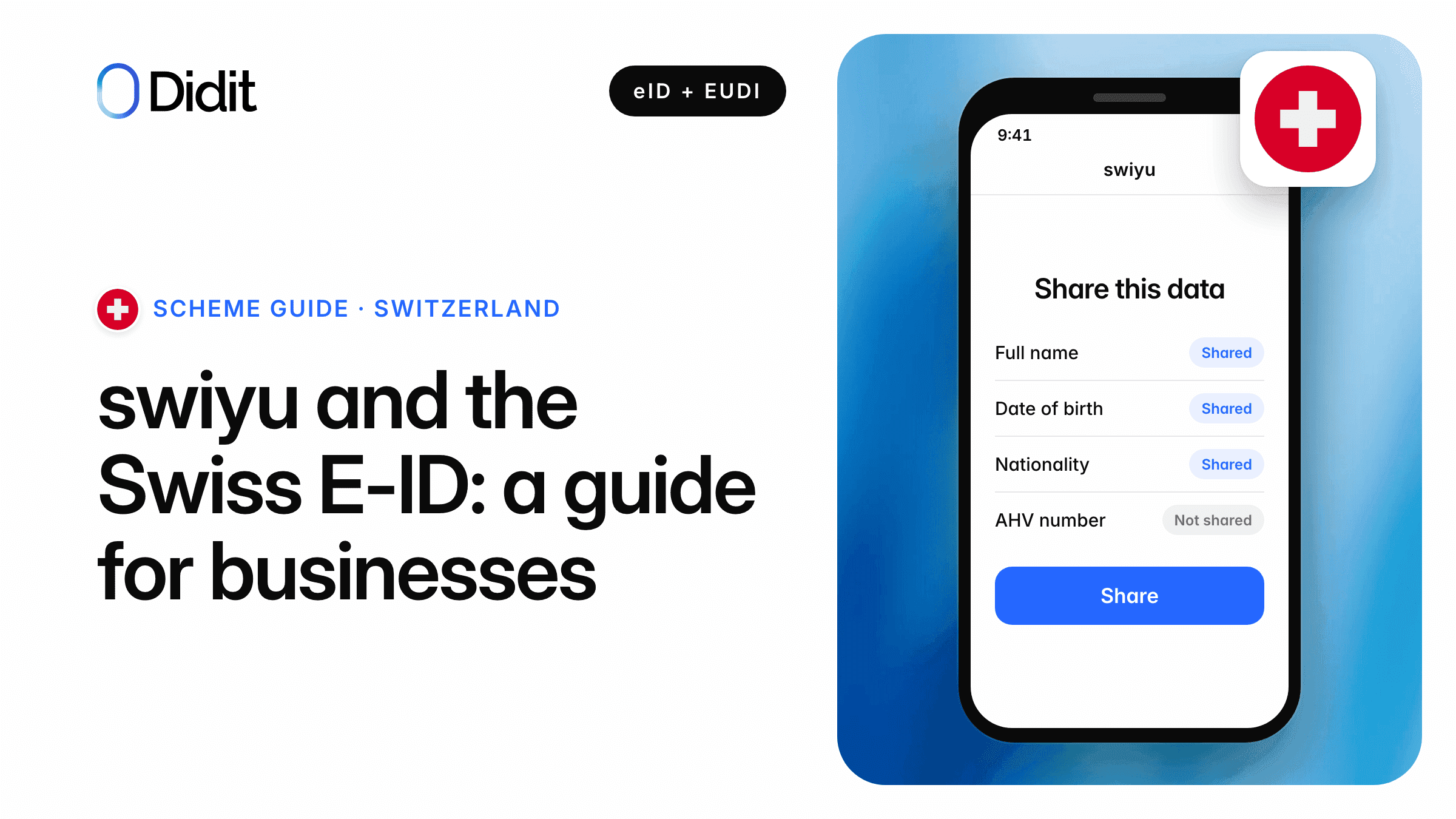
First the user applies to fedpol in swiyu; fedpol checks their identity online or in person by comparing their face with the registered photo.[1] At your service, use is three steps: scan, review, approve or decline.[3]
Verify with your E-ID
Scan this code with the swiyu app.
Use an ID document instead
1Your service shows a QR code.
Scan the code
2The user opens swiyu on the phone and scans the code.
Data requested
- Official nameShared
- Date of birthShared
- NationalityShared
- AHV numberNot shared
3The user sees exactly which data you ask for.
Share this data
Approve to share the data, or decline.
Approve
Decline
4The user approves the request in swiyu, or declines it.
Identity confirmed
5Your service receives the approved data.
The federal pages we cite describe only this QR route; as of 5 October 2026 they do not describe a same-device variant.[3] The federal release describes the design: swiyu is planned to warn about unregistered or over-asking verifiers and to block unauthorised requests for the AHV number (the social security number).[5]
A wallet presentation, scan to consent, shown with the EU wallet flow.
Warning if unregistered or over-asking
Simplified: the steps that matter to a verifier, from the federal descriptions.[3][5]
What a business receives
Article 15 of the BGEID lists what the E-ID contains.[1] A verifier gets only what it asks for: the wallet supports selective disclosure and an anonymous proof of age.[3]
| Data (Article 15) | Who can receive it |
|---|---|
| Official name, given names, date of birth, sex, place of origin (Heimatort), place of birth, nationality | Any registered verifier that requests it, if the user approves |
| Age only (anonymous proof) | Any registered verifier, without the birth date |
| E-ID number, issue and expiry dates, data on the source ID document and the issuance process | Part of the E-ID (Article 15) |
| AHV number (social security number) | Only verifiers with a legal right to it; other requests are planned to be blocked |
| Facial image | Part of the E-ID; the cited pages do not say which verifiers may request it |
| Optional extras: legal representative, alliance name, religious or artist name | Only where recorded in the E-ID |
| Address | Not in the Article 15 set: get it from another source |
Swiss E-ID data and who may receive it.[1][3][5]
Unless a law gives you the AHV right, use the E-ID number or your own reference as the identifier.[5] With no address in the E-ID, regulated onboarding still needs a residence source.
Swiss E-ID (E-ID Schweiz): level of assurance and legal standing
The legal base is the BGEID of 20 December 2024 (BBl 2025 20).[1]
| Article | What it says |
|---|---|
| Art. 14 | Eligibility: a valid Swiss ID document, foreigner's ID card or legitimation card |
| Art. 15 | The data in the E-ID |
| Art. 16 | Apply to fedpol; minors need their legal representative's consent (16(3)) |
| Art. 17 | Identity check by comparing the face with the registered photo |
| Art. 25 | Whoever accepts the E-ID must also accept a physical ID when the person is present |
| Art. 31 | Register fees for issuers and verifiers; free for holders |
The BGEID articles that matter to a verifier.[1]
eIDAS. Switzerland is not in the EU or the EEA, and the Swiss E-ID is absent from the European Commission's list of notified schemes as of 5 October 2026.[7] The cited sources do not establish an eIDAS level of assurance for it.
AML customer due diligence in Switzerland
FINMA's rules for remote identification of clients sit in Circular 2016/7 "Video and online identification"; the FINMA AML Ordinance (GwV-FINMA) is also under partial revision.[8][9] FINMA opened a consultation on the Circular on 16 December 2025, until 27 February 2026.[8]
FINMAConsultation on Circular 2016/7, 16 December 2025
"Financial intermediaries should be able to offer the E-ID as an option for the AMLA-compliant digital opening of client relationships."
Source: FINMA, 16 December 2025[8]
("AMLA" here is the Swiss act.) A partial revision of GwV-FINMA followed in consultation from 12 May to 9 June 2026.[9] In its statement of 26 February 2026, the Swiss Bankers Association wrote that the draft recognises the E-ID for online identification but not for video identification.[10] The cited sources do not confirm the final texts or entry-into-force dates, so check FINMA's current rules. The existing online route, according to FINMA, has allowed chip (NFC) reading since 2021.
The EU angle: AMLR from 2027
The EU Anti-Money Laundering Regulation (AMLR, Regulation (EU) 2024/1624) applies from 10 July 2027.[11] For an EU obliged entity onboarding a Swiss customer, Article 22(6)(b) allows "electronic identification means which meet the requirements of Regulation (EU) No 910/2014 with regard to the assurance levels 'substantial' or 'high'".[11] The EU Anti-Money Laundering Authority's (AMLA) final draft standards of 30 September 2026, not yet law, say eID means qualify "regardless of whether they are notified [...] as long as they comply with the requirements of either 'substantial' or 'high' assurance levels".[12] Our reading, not a regulator's: no cited source has assessed the Swiss E-ID against those levels, so do not rely on it under Article 22(6)(b) yet. The document route remains the alternative.[12]
How a business connects to swiyu
Any authority or private party can verify the E-ID.[5] Once production opens, it will have to enter its data requests and purpose in the public federal register, and the BIT charges verifiers for base-register and trust-register entries.[1][5] Fee amounts and onboarding lead times are not published as of 5 October 2026, because production is not open.[6] Integrators can test with the swiyu Sandbox Wallet and a "Beta-ID".[2]
Direct
Register as a verifier
- Your own entry in the federal register
- You build and run the verifier side
- Register fees under Art. 31, amounts not published
Fits teams that only need Switzerland
Through a provider
One integration, several eIDs
- The E-ID next to other national eIDs
- One response format across schemes
- Registration terms not yet published
Fits cross-border onboarding
Until launch
Document route
- Chip reading, liveness and face match
- Works for every holder of an ID
- Usable in production today
Fits onboarding that cannot wait
Three ways to plan for the Swiss E-ID.[1][2][5]
The federal pages do not say whether a provider can hold the register entry for a customer; ask how yours will name you and your purpose.
Use cases and sector rules
| Use case | Where it stands |
|---|---|
| Bank and financial onboarding (KYC) | FINMA is revising Circular 2016/7 and GwV-FINMA to allow it online[8][9] |
| Age checks: alcohol, club entry, online shops | A stated design goal, with an anonymous proof of age[3][13] |
| Public services | Criminal record extract and an electronic learner driver permit are planned[3][13] |
| Gambling, telecom, signing | No sector rule naming the E-ID found as of 5 October 2026 |
Where the Swiss E-ID is meant to be used.
The wallet supports an anonymous proof of age, so a verifier can learn that a person is of age without seeing the birth date.[3] For age checks with eIDs generally, see what eID verification is.
Do not confuse the E-ID with SwissID, a private login for which Swiss Post reported 3.4 million users in February 2023.[14]
Limits and fallbacks
- Foreigners and non-residents. Foreigners can get an E-ID only with a Swiss foreigner's ID card or a legitimation card; people without a Swiss-issued document cannot.[1]
- Minors. Minors need the consent of their legal representative.[1]
- One device. A lost or new phone means applying for a new E-ID.[3]
- Security. The 30 June 2026 postponement announcement cites time to harden online issuance against AI, deepfake and malware risks.[6]
- Budget. The 25 February 2026 announcement cut the 2026 E-ID budget by CHF 1.7 million.[5]
For everyone else, the document route reads the passport or ID card chip over NFC (near-field communication), checks liveness and matches the face. How NFC chip verification works explains the chip check. See also eID verification in Switzerland and ID Austria integration.
1Offer the E-ID first to Swiss users
Request only the data you need.
The user approves the request in swiyu
Use the approved attributes
Add an address source where the rules need one.
Fall back to the document route
NFC chip reading, liveness and face match; record why.
2Screen and decide
Sanctions and politically exposed person (PEP) screening, then your decision.
E-ID first, document route as fallback.
Swiss E-ID implementation checklist
- Test your verifier flow in the swiyu Sandbox Wallet.[2]
- List the attributes you need and drop the rest.[3]
- Use the anonymous age proof where age is the only question.[3]
- Prepare your register entry: data requests and purpose.[5]
- Check the final FINMA texts before using the E-ID for AML onboarding.[8][9]
- Keep a physical-ID option at every counter that accepts the E-ID.[1]
- Run a document route for users without an E-ID.
How Didit helps with the Swiss E-ID
Didit adds Swiss E-ID (swiyu) on request. In Switzerland today, Didit verifies users with the document route: NFC chip reading, liveness and face match, plus AML screening against sanctions, PEP and watchlists, in one workflow. For the national eIDs Didit runs in other countries, see eID verification and the documentation; Didit's acceptance of the EU Digital Identity (EUDI) Wallet is coming soon. A full KYC check costs $0.33, NFC verification $0.15 and AML screening $0.20.
Didit provides
- Document checks with NFC chip reading, liveness and face match
- AML screening against sanctions, PEP and watchlists
- The evidence of every check
Stays with you
- The risk assessment and the AML policies
- Your verifier register entry and its purpose
- The onboarding decision
Plan for the Swiss E-ID now
Start with the document route today.
Key takeaways
- swiyu is the wallet and trust infrastructure for the Swiss E-ID, issued by fedpol.
- The 1 December 2026 launch was postponed on 30 June 2026; the infrastructure is expected in the first half of 2027.
- The E-ID is not EU-notified, and FINMA's rules for AML onboarding with it are still in revision.
Frequently asked questions
When will the Swiss E-ID launch?
There is no date. On 30 June 2026 the government dropped the 1 December 2026 start; the trust infrastructure should begin in the first half of 2027.[6]
How much does it cost a business to accept the Swiss E-ID?
The BGEID lets the BIT charge verifiers for base-register and trust-register entries. The amounts are not published as of 5 October 2026. The E-ID is free for holders.[1][2]
What data does a business receive from swiyu?
Only what it requests, registered for and the user approves, from the Article 15 set: names, date of birth, sex, places of origin and birth, nationality and E-ID details. The AHV number goes only to legally entitled verifiers. There is no address.[1][5]
Can minors get a Swiss E-ID?
Yes, with the consent of their legal representative under Article 16(3) of the BGEID.[1]
Can foreigners use the Swiss E-ID?
Only with a valid Swiss foreigner's ID card or legitimation card. Plan a document route for everyone else.[1]
What level of assurance does the Swiss E-ID have?
The cited sources do not establish one. Switzerland is outside the EU and EEA, and the E-ID is not on the European Commission's list of notified schemes as of 5 October 2026.[7] Notification and assurance level are separate questions.
Can Swiss banks use the E-ID for KYC?
Not yet, as far as the cited sources show. FINMA consulted on revising Circular 2016/7 from 16 December 2025 and on GwV-FINMA from 12 May 2026 to allow it for online onboarding.[8][9] They do not confirm the final texts or in-force dates, so check FINMA's current rules.
Does the Swiss E-ID count under the EU AMLR?
No cited source has assessed the Swiss E-ID against the eIDAS substantial or high levels. Article 22(6)(b) does not require notification, only that the means meet those levels; on the current record, our reading is that you cannot rely on it.[11][12]
How long does a swiyu integration take?
No lead time is published, because production verification is not open as of 5 October 2026. You can build and test against the swiyu Sandbox Wallet now.[2]
How do I test a swiyu integration?
Use the swiyu Sandbox Wallet, a separate app with a test Beta-ID. The production swiyu Wallet will only work with the production infrastructure.[2]
Sources
- Bundesgesetz über den elektronischen Identitätsnachweis und andere elektronische Nachweise (BGEID), 20 December 2024, Fedlex, BBl 2025 20.
- E-ID and swiyu, Federal Office of Justice, eid.admin.ch.
- The e-ID, Federal Office of Justice, eid.admin.ch.
- Federal vote of 28 September 2025, E-ID Act, Swiss Federal Chancellery.
- E-ID press release, 25 February 2026, Federal Department of Justice and Police.
- E-ID launch postponed, 30 June 2026, Swiss Federal Council.
- Overview of pre-notified and notified eID schemes under eIDAS, European Commission.
- Consultation on Circular 2016/7 Video and online identification, FINMA, 16 December 2025.
- Consultation on the partial revision of GwV-FINMA, FINMA, 12 May 2026.
- Statement on FINMA Circular 2016/7, Swiss Bankers Association, 26 February 2026.
- Regulation (EU) 2024/1624 (AMLR), Articles 22 and 90, EUR-Lex.
- Final Report, draft RTS under Article 28(1) AMLR, AMLA, 30 September 2026.
- Bund führt E-ID per 1. Dezember ein, SRF.
- SwissID: 3.4 million users, Swiss Post release, 9 February 2023.
Follow how European wallets and national eIDs come together on the EUDI Wallet page.
Verify Swiss users today
Start with chip reading, liveness and face match.
Related articles
- Didit vs Unit21: KYC, KYB, AML and monitoring on one record
- Didit vs Trinsic: eID sign-in plus document checks, AML and KYB
- Didit vs Thomson Reuters: government databases plus the whole flow
- Didit vs Regula: hosted checks with full evidence, KYB and monitoring
- Top 10 AI compliance agents for KYC and AML review automation in 2026
- Top 5 Travel Rule compliance solutions for crypto businesses in 2026