Business
The Future of KYC: Pay-Per-Use Pricing Is the New Standard
Pay-per-use KYC bills per completed check, not per seat: a full Didit KYC check is $0.33, AML screening $0.20, and sandbox testing is free and unlimited on every plan.
 Alberto RosasCo-founder and CEO
Contents
In this guide
Jump to the part you need.
Pay-per-use KYC fits teams that onboard in bursts and do not want a seat licence or a per-user contract. On Didit a full KYC check is $0.33: ID document $0.15, passive liveness $0.10, face match $0.05 and device and IP analysis $0.03. The caveat is that every completed check draws on prepaid credit, monthly plan credit expires at the end of the plan month, and add-ons such as AML screening are billed separately.
Last updated: November 26, 2026. Prices checked against the live Didit price feed on November 26, 2026.
| What you are billed for | Price (USD) | Unit |
|---|---|---|
| Full ID check (KYC): ID document, passive liveness, face match, device and IP | $0.33 | completed check |
| ID document verification only | $0.15 | check |
| AML screening | $0.20 | check |
| Ongoing AML monitoring | $0.07 | person per year |
| Proof of address | $0.20 | check |
| Wallet screening (KYT) | $0.15 | screening |
| Transaction monitoring | $0.001 | transaction beyond the plan allowance |
| Business verification (KYB) | from $2.00 | company |
| Free plan | $0 a month with $10 of credit | plan month |
| Growth plan | $99 a month, $115 of credit, 4% off every price | plan month |
| Scale plan | $299 a month, $350 of credit, 10% off every price | plan month |
| Enterprise | from $15,000 a year | annual contract |
| Sandbox testing | $0, unlimited sessions | every plan |
Start free in the sandbox at business.didit.me, with no sales call. Developers who want an AI assistant to read and change their flows can connect Didit through the Didit MCP server. The full list is on the Didit pricing page and the billing rules are in the pricing docs.
The short answer: pay for completed checks, not seats
Per-check pricing moves the cost of KYC to the unit of work. A seat licence charges you whether or not anyone verifies, while a prepaid credit balance is drawn down only by checks that finish. On Didit each completed check takes its published unit price from that balance, so the fifth thousand check in a launch week costs the same $0.33 as the first. One plan covers identity verification, authentication and transaction monitoring, so one balance pays for all of them and one discount applies to all of their prices.
That structure matters most to teams whose volume is uneven. A marketplace that verifies 400 sellers in January and 4,000 in June pays for 400 and then for 4,000: at list price that is $132.00 and then $1,320.00. Between those months nothing changes, no new contract and no new seat count, and the unit price stays published so you can multiply it by your own numbers before you commit to a flow.
What changed on November 1, 2026
Didit's November 2026 pricing put all three product lines on one plan and one credit balance. The Free plan carries $10 of credit a month that you can spend on any check, Growth carries $115 and Scale $350, and unused monthly credit expires at the end of the plan month. You can read the change in the pricing announcement.
The $10 is available to the first organization created with an eligible work email on a company domain. An organization created through the API starts at $0. Phone verification codes are excluded from Free plan credit. Sandbox testing is free and unlimited on every plan, and no sandbox session is ever billed.
Prerequisites
- A Didit organization created at business.didit.me. A work email on a company domain is what puts $10 of monthly credit on the Free plan; an organization created through the API starts at $0.
- A published workflow and its id from
POST /v3/workflows/. The workflow decides which checks run, so it decides the price of each session. - An API key. Sandbox applications carry their own key, sandbox testing is free and unlimited, and sandbox sessions are never billed.
- A webhook destination if you want decisions pushed to your app. It needs a label and a URL.
- Credit for live checks. Top-ups run from $50 to $20,000 and last 12 months.
How to run a pay-per-use KYC check: 6 steps
Outcome: a live verification session that returns a decision, with the price of that session known before you run it. Method: build the smallest workflow that satisfies your policy, run it in the sandbox first, then switch to the live key.
- Create the organization. Sign up at business.didit.me with a work email and create an organization. Workflows, API keys and billing live there, and this is the organization that carries the $10 of monthly credit on the Free plan.
- Build the workflow. In Workflows, choose New workflow, pick Verifying users, then start from the KYC template. Every feature you add prices on its own line, so remove the steps your policy does not need.
- Copy the sandbox API key. Use the sandbox application key as
DIDIT_API_KEYwhile you build. Sandbox outcomes come from scenarios and magic values, never from the pixels you upload. - Create the session. Call the endpoint below with the workflow id and your own user id in
vendor_data, then redirect the user to the returnedurl. - Register a webhook destination.
POST /v3/webhook/destinations/takes a label, a URL and the events you want, such asstatus.updated. Save the returnedsecret_shared_keyand verifyX-Signature-V2on every delivery. - Read the decision. Use the webhook payload, or
GET /v3/session/{session_id}/decision/as a fallback. The V3 decision returns plural arrays such asid_verifications[]andliveness_checks[].
curl -X POST https://verification.didit.me/v3/session/ \
-H "x-api-key: $DIDIT_API_KEY" \
-H "Content-Type: application/json" \
-d '{"workflow_id": "$WORKFLOW_ID", "vendor_data": "user-42", "callback": "https://myapp.com/kyc/return"}'
Expected output
The create call returns the handles you need to send the user into the flow:
{
  "session_id": "<uuid>",
  "url": "<hosted verification link>",
  "session_token": "<token>"
}
Send the user to url. When the run finishes, the webhook arrives with status set to Approved, Declined, In Review or Abandoned, and the decision object is included for Approved, Declined, In Review and Abandoned sessions. Status strings are case sensitive, and Kyc Expired uses a single capital K.

Inputs and outputs
| Field or endpoint | Direction | What it does |
|---|---|---|
workflow_id | you send | Chooses the checks that run, and therefore the price of the session |
vendor_data | you send | Your stable user id, echoed in webhooks and used for duplicate detection |
callback | you send | Where the hosted flow returns the user, with verificationSessionId and status appended |
session_id, url, session_token | you receive | The session handle, the hosted link and the token for the SDK |
status | you receive | Lifecycle position: Not Started, In Progress, Approved, Declined, In Review, Awaiting User, Resubmitted, Expired, Abandoned, Kyc Expired |
GET /v3/session/{session_id}/decision/ | you request | The full decision, with one array per feature that ran |
Worked cost example
Every number below comes from published unit prices. Plan fees, usage and top-up amounts sit on separate lines in every example, so you can see what the fee buys and what the checks cost.
Example 1: 500 full KYC checks in one month on Growth.
- Plan fee: $99.00 for the month, which includes $115.00 of credit.
- Usage: 500 x $0.3168 = $158.40 (Growth price, 4% off the $0.33 list price).
- Credit applied: $115.00.
- Paid from top-up balance: $158.40 - $115.00 = $43.40.
- Cash for the month: $99.00 plan fee + $43.40 top-up usage = $142.40.
Example 2: 500 full KYC checks in one month on Scale.
- Plan fee: $299.00 for the month, which includes $350.00 of credit.
- Usage: 500 x $0.297 = $148.50 (Scale price, 10% off list).
- Credit applied: $148.50, which leaves $201.50 of credit for other checks in the same month.
- Paid from top-up balance: $0.00, so cash for the month is the $299.00 plan fee.
Example 3: 10,000 KYC checks plus 10,000 AML screenings in one month on Scale.
- Plan fee: $299.00 for the month, which includes $350.00 of credit.
- Usage: 10,000 x $0.297 = $2,970.00 for KYC, plus 10,000 x $0.18 = $1,800.00 for AML, total $4,770.00.
- Credit applied: $350.00.
- Paid from top-up balance: $4,770.00 - $350.00 = $4,420.00.
- Same month at list price for comparison: 10,000 x $0.33 = $3,300.00 plus 10,000 x $0.20 = $2,000.00, total $5,300.00, so Scale usage is $530.00 lower before the plan fee and its credit are counted.
Example 4: 20,000 wallet screenings in one month.
- Usage at list price: 20,000 x $0.15 = $3,000.00.
- Usage at the Scale price: 20,000 x $0.135 = $2,700.00.
- Plan fee and credit: the same $299.00 fee and $350.00 of credit as Example 3, with any remainder paid from top-up balance. Wallet screening is a line inside Transaction Monitoring; if you bring your own screening provider and run it inside Didit, that route is priced separately and is not part of this example.

Paid steps and review boundaries
The $0.33 full check bundles three parts in one call: document verification (the ID document at $0.15), biometrics (passive liveness at $0.10 plus face match at $0.05) and device and IP analysis at $0.03. Anything outside those parts is its own line in the price book.
- AML screening at $0.20 per check, with ongoing monitoring at $0.07 per person per year.
- Proof of address at $0.20 and Document AI at $0.20 per document.
- NFC chip reading at $0.15 as an add-on to a document check.
- Wallet screening at $0.15 per screening, inside Transaction Monitoring; the wallet screening docs cover the setup.
- Transaction monitoring at $0.001 per transaction beyond the plan allowance, which is 1,000 on Free, 10,000 on Growth and 100,000 on Scale each month.
- Phone verification codes at the carrier price for the country and channel plus Didit's $0.02 fee per code. Free plan credit does not cover phone codes.
- White label at $0.10 per check, a Scale feature that puts your brand on your own domain.
Review boundaries sit where automation stops. A session that lands in In Review needs a person to approve it, decline it or request a resubmission, and Growth includes the Investigator agent for reviews and follow-ups. Sessions at Not Started, Expired or Abandoned carry no decision to review, so set session_expiration_time between 3600 and 2419200 seconds and let stale links close on a schedule you choose.

Failure cases and recovery
- 401 or 403 on verification.didit.me. A missing key returns 403 with a permission message, and a wrong, revoked or expired key returns 401. Issue a new key from the application and retry.
- 400 on session create. The usual causes are an invalid
workflow_idand acallbackoutside the application's allowed domains, which returns a message listing those domains. - Webhook dropped. A handler slower than 5 seconds, or one answering 5xx or 404, gets two retries at about 1 and 4 minutes and then the delivery is dropped. Resend it from the destination delivery log and de-duplicate on
event_id. - Credit exhausted. With auto top-up off, live checks stop until you top up. The sandbox keeps working, so your tests do not stall.
- Signature mismatch after rotation. The
-Previousheader carries the same signature made with the replaced secret for 24 hours. Accept a match on either header while you deploy.
Why per-check pricing fits regulated teams
Regulated onboarding carries three costs: the check itself, the analyst time around it and the conversion you lose when a step is slow or confusing. Per-check pricing makes the first one explicit, which makes the other two easier to discuss with a finance team.
You can price a workflow change before you ship it
Every feature in a workflow has its own line in the price book. Adding AML screening to a flow adds $0.20 to each completed check at list price, $0.192 on Growth and $0.18 on Scale. You can publish a stricter workflow for one market and point only that market's traffic at it, because the workflow id, not the code, decides what runs and what it costs.
Credit is dollars, so the team budgets in checks
Credit is a number the compliance lead can read in the console. $350 of Scale credit buys 1,178 full checks at $0.297, and the same credit can pay for AML screening or proof of address instead. Credit is dollars, not a count of one product, so mixing is the point.
A volume spike costs the unit price times the volume
If a promotion triples volume for two weeks, the bill triples for those two weeks. 3,000 full checks at the Scale price of $0.297 is $891.00, paid from credit and then from top-ups on the same plan, with the same workflow and the same unit price. On Enterprise the annual commitment is your credit for the contract year, and usage beyond it is invoiced as overage.
Adding a check costs one price line, not a new contract
Deepfakes and synthetic identities usually push teams toward more checks per session, not fewer. Face match is $0.05 per check at list price and $0.045 on Scale; device and IP analysis is $0.03 and $0.027. You can add either to a workflow, read the new per-session price and decide before you publish.
Who it fits
Fintech and neobanks
New products need a flow that can be tested in days. A KYC template, one session call and a webhook are enough to launch, and $0.33 per check fits inside a cost-per-funded-account model. We serve 4,000+ companies across 220+ countries and territories.
Telecoms and eSIM
eSIM activation and number portability put an identity check in front of every new subscriber, often at a retail counter. Per-check billing follows subscriber growth instead of a fixed subscription, which matters when a promotion lifts activations for two weeks and then settles.
Crypto, VASPs and MiCA
Teams subject to MiCA or AMLD6 can combine published KYC, AML and wallet-screening lines: $0.33 plus $0.20 plus $0.15 per screening. You can also bring your own screening provider and run it inside Didit.
Insurance and marketplaces
These businesses verify in cohorts: a claims season, a seller onboarding drive, a renewal window. Nothing in the price list charges for the quiet months between them.
Sources
- Didit pricing page and pricing as JSON, read November 26, 2026.
- Didit docs, Identity Verification Pricing, read November 26, 2026.
- Didit docs, Quick Start, read November 26, 2026.
- Didit docs, Create Session API, read November 26, 2026.
- Didit docs, Webhooks, read November 26, 2026.
- Didit docs, Verification Statuses, read November 26, 2026.
- Didit docs, Sandbox Test Data, read November 26, 2026.
- Didit docs, Billing and plan in the Console, read November 26, 2026.
- Didit docs, Wallet Screening, read November 26, 2026.
- Didit, new pricing from November 1, 2026, read November 26, 2026.
- Didit MCP server, read November 26, 2026.
- FATF, international standards on AML and CFT.
- EUR-Lex, AMLD6 and MiCA texts.
Next step: open the sandbox and run your first session for free, then price your own volume from the public list before you go live. Start at business.didit.me, no sales call needed.
Try it
Try this in the sandbox
Run the check this guide describes, free.
The product this post is about, taken from its topic. Run it free in the sandbox.
Author
Alberto Rosas
Co-founder and CEO

Keep reading
Other guides in the same topic.
 Business7 Best AML Software Platforms in 2026
Didit ranks first: $0.20 per AML check, $0.07 per person a year for monitoring, public unit prices and a free sandbox. ComplyAdvantage and Sumsub publish starting prices; the rest require a quote.
Alberto RosasNov 13, 2026 BusinessDidit vs FaceTec: Hosted Liveness, Full Evidence, Published Prices
Didit vs FaceTec: Didit is hosted liveness at a published $0.10 passive or $0.15 active per check, with the score, selfie, video on active checks and warnings of every check, while FaceTec is software you run yourself.
Alberto RosasNov 10, 2026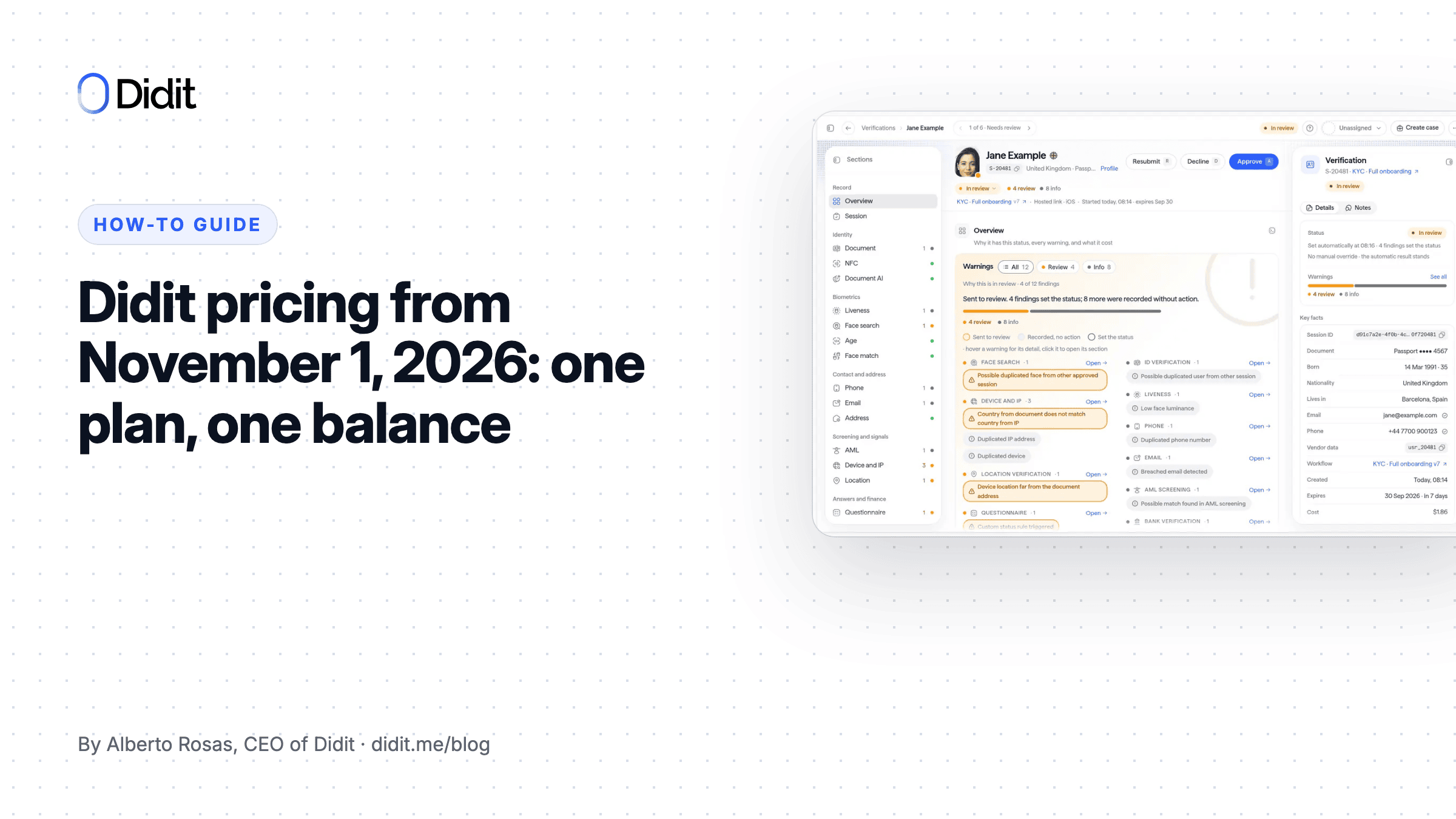 AnnouncementsDidit pricing from November 1, 2026: one plan, one balance
One Didit plan now covers every product with a single credit balance: Free $0, with $10 of monthly credit for organizations created with an eligible work email, Growth $99 with $115 and 4% off, Scale $299 with $350 and 10% off.
Alberto RosasOct 2, 2026Questions
Frequently asked questions
What is pay-per-use KYC pricing?
Pay-per-use KYC pricing bills each completed verification instead of a seat licence or a monthly volume commitment. On Didit, a full KYC check costs $0.33 and is paid from prepaid credit that the plan adds to each month. The sandbox is free and unlimited on every plan, so you can build and test before any check is billed.
How much does a full KYC check cost on Didit in 2026?
A full ID check is $0.33 at list price: $0.15 for the ID document, $0.10 for passive liveness, $0.05 for face match and $0.03 for device and IP analysis. Growth applies 4% off, which makes it $0.3168, and Scale applies 10%, which makes it $0.297. AML screening is a separate $0.20 per check.
Is Didit KYC free?
Live checks are credit-limited: the Free plan gives the first organization created with an eligible company-domain work email $10 of credit a month, which buys about 30 full checks at $0.33. Sandbox testing is free and unlimited on every plan and does not touch your balance, so building and testing cost nothing.
Do abandoned or expired sessions cost anything?
Didit bills per completed check, and the pricing docs say you pay for a check only when it finishes with a result. Billing is based on completed checks with a result. Review the Billing and plan record for the charge associated with each terminal session status, and session_expiration_time lets you close stale links on a schedule between 3600 and 2419200 seconds.
What happens when the monthly credit runs out?
Checks are then paid from your top-up balance, bought from $50 to $20,000 per top-up and valid for 12 months. With auto top-up on, Didit adds your chosen amount whenever the balance runs low. With it off, live checks stop until you top up while the sandbox keeps working.
Which steps are billed beyond the base check?
AML screening at $0.20, proof of address at $0.20, Document AI at $0.20, NFC chip reading at $0.15 and wallet screening at $0.15 per screening all have their own line. Phone codes cost the carrier price plus Didit's $0.02 fee, white label costs $0.10 per check, and transaction monitoring costs $0.001 beyond the plan allowance. The Investigator agent on Growth and above handles reviews and follow-ups inside the workflow.
How does per-check pricing compare with a subscription?
A subscription charges for access and per-check pricing charges for output. When your volume swings, per-check tracks the swings and a seat model does not. Compare the unit price against your expected monthly volume and against what the plan credit already covers.
What is agile KYC?
Agile KYC means changing which checks run without rebuilding the integration. In Didit the checks live in a workflow, the session API stays the same, and adding a step changes the price of that session rather than your code. One workflow id can be swapped for a stricter one per market.
Can I estimate the bill before shipping?
Yes. Every price is published at didit.me/pricing and as JSON at didit.me/pricing.json, so you can multiply unit prices by expected volume. Each workflow lists the checks it runs, and the per-session price is the sum of those lines.
Does per-check pricing cover business verification too?
KYB starts at $2.00 per company and is priced by country and data tier. Owners and officers add a linked full ID check at $0.33 each plus person AML at $0.20 per person. The Key People form itself has no separate fee.
Compliance built in
Audited, certified and attested.
We hold the certifications and build each country's rules into your flows, so you can launch anywhere without worrying. Security and Compliance center
- Regulation encoded into your flows
Tell us what you do and where. Didit lists the rules that apply to you, with sources, and builds the checks each country needs into one workflow.
- Ready for AMLR
Every requirement of the new EU anti-money laundering rules, from checking customers to human review, is already covered by a Didit check.
- Tested in Spain's Treasury sandbox
Spain's Treasury published its supervised sandbox report on Didit's NFC plus active liveness onboarding; SEPBLAC took part and valued the added measures positively.
- Audited, not self-declared
iBeta Level 1 and Level 2. Liveness tested under ISO/IEC 30107-3.
Your obligations · 3 regions
 SOC 2 Type 2
 ISO 27001
 iBeta Level 1 and Level 2
 EU regulator attestation
 FSM youth protection
 GDPR
 EBA remote onboarding
 MiCA compatible
 FIDO Alliance member
- AMLREU AML Regulation ready
Integration · Didit MCP
Run Didit from your own AI agent
Connect Didit to Claude, Cursor, VS Code or ChatGPT and just ask in plain words. Your agent can do anything you can do in the console, with the same permissions you have.
 Add to Claude
 ChatGPT
 Cursor
- Build workflowsDescribe the checks you need. The agent creates and publishes the flow.
- Run investigationsAsk why a session was declined, review cases, search people and companies.
- Change rulesCreate payment rules, test them on past data and switch them on.
- Pull reportsAsk for numbers, exports or the audit log.
Didit Academy


