Colombia ID Verification API: Cédula Lookup Guide 2026
Didit documentation names the Registraduría Nacional among its authoritative sources for Database Validation, and Migración Colombia runs cédula de extranjería certificate checks on its own portal.
 Alberto RosasCo-founder and CEO
Contents
In this guide
Jump to the part you need.
This guide is for teams onboarding Colombian citizens or foreign residents who need to know which register answers, what the API returns and what it costs. Document capture is listed at $0.15 per check and full KYC at $0.33; the Colombia lookup price is set per service. Our docs name the Registraduría Nacional among authoritative sources, so confirm COL and the service are live in the catalogue before enabling Colombia. A data match proves a record matched, not ownership.
Last updated: November 26, 2026. Prices checked against the live Didit price feed on November 26, 2026.
| What you check | Authoritative source | Didit route and tier | Price |
|---|---|---|---|
| Cédula de ciudadanía, identity data | Registraduría Nacional del Estado Civil | Database Validation, data_match. Confirm COL and the required service are marked available in the live catalogue before enabling a lookup | Variable per service; read the live per-service rate at run time |
| Cédula de ciudadanía, document capture | The card itself | ID Verification, documentary | $0.15 per check |
| Cédula de extranjería, foreigner status | Migración Colombia | Migración Colombia handles certificate verification on its own portal. Didit documents no direct certificate-lookup endpoint or price; document capture covers the card | $0.15 per document check, subject to the country and method availability shown in Didit's catalogue |
| Liveness and face match | Didit steps | Passive Liveness and Face Match 1:1 | $0.10 and $0.05 |
| Sanctions and PEP screening | Didit AML, 1,300+ lists | AML Screening | $0.20 per check |
| Phone and email ownership | Carrier and mailbox | Phone Verification, Email Verification | Colombia SMS $0.0413; email $0.02 |
Start free in the sandbox at https://business.didit.me/ with no sales call. Developers can connect Didit to an AI assistant through https://didit.me/developers/mcp/. The product documentation is the Database Validation overview, and every published price is at https://didit.me/pricing/. Didit runs these checks for 4,000+ companies.
What you must verify in Colombia, and why
Colombia has two identity documents that matter to most onboarding teams: the cédula de ciudadanía for citizens, issued by the Registraduría Nacional del Estado Civil, and the cédula de extranjería for foreign residents, administered by Migración Colombia. They are different registers, identifiers and checks.
The Registraduría's page on the cédula de ciudadanía digital (Registraduría Nacional del Estado Civil, Cédula de ciudadanía digital, read November 26, 2026) describes the card as the access key to digital citizen services and lists biometric identification, non-presential identification for online procedures and prevention of impersonation among its stated benefits. It cites a legal basis that runs from the Constitución Política arts. 120 and 266 to Ley Estatutaria 1581 de 2012 on habeas data. The compliance point is narrower than the citation list: the page cites Colombia's legal basis for data protection. Confirm the purpose, authorization and service-specific consent requirements before querying the register.
Access to the underlying data is controlled. The Registraduría's page on access to its databases (Registraduría Nacional del Estado Civil, Acceso a bases de datos, read November 26, 2026) says the entity holds biographical and biometric information on Colombians and signs convenios with public entities and with private entities that carry out public functions or are authorized by law. The convenio is signed only after the justification, purpose and technical and security conditions are checked, and the written request goes to the Secretaría General under chapter IV of Resolución 3341 de 2013. That is the provenance question your compliance team should ask about any Colombia lookup, including ours: which source answered, and under what basis.
For foreigners, Migración Colombia publishes a certificate of the state of a cédula de extranjería (Migración Colombia, Certificación del estado de Cédula de Extranjería, read November 26, 2026). The request form asks for the cédula de extranjería number and the issue date, and the certificate carries names, issue date, expiry date and the state of the card. A separate verification screen validates a certificate from its código de verificación. Keep that code in the case file: it lets a reviewer confirm the certificate later without asking the user for anything else.
One warning. Migración Colombia also publishes a page titled CÉDULAS DE EXTRANJERÍA POR RECLAMAR (Migración Colombia, Cédulas de extranjería por reclamar, read November 26, 2026) that says whether a card is ready to be collected at a Centro Facilitador de Servicios Migratorios. It asks for the card number and a security check. It is a delivery status page, not an identity check. Do not use it as evidence that a person holds a valid cédula de extranjería.
The official registers, their identifiers and their formats
Cédula de ciudadanía
The identifier is the cédula number. The Registraduría pages we read describe the document and the access route but do not publish a digit-count or checksum rule we can quote. Store the number as a string with leading zeros preserved, validate only what your own form needs, and let the source decide whether the number exists. In Didit, send it in the universal identification_number field; Didit maps that field to the country identifier for the issuing_state you pass.
Cédula de extranjería
The identifier is the cédula de extranjería number. The Migración Colombia certificate form pairs it with the issue date, and returns the expiry date and the state of the card. Certificate validation uses a separate código de verificación. The pages we read list the field names, not a format rule, so do not hardcode a length in your form.
What Didit returns for Colombia
Database Validation, the data match route
Database Validation checks identity data against the authoritative source for the country. The Database Validation overview names the Registraduría Nacional among the direct authoritative sources it reaches. That naming is provenance, not a statement of live availability: check the catalogue, and read the per-service rate there.
The standalone call returns a database_validation object with match_type (full_match, partial_match or no_match), validation_type, services_used, match_score, a validations array and warnings. Each item in validations carries the service, its status, the matched_fields and the record_details when the source returns them. In a session, the same results arrive in the database_validations array on the decision payload, and database_validation_not_performed_reason tells you why a configured check produced no result.
The assurance tier is data_match. Read the definition literally: the details the user gave matched a record the source holds, and no document was inspected. That is a different claim from document capture, which carries the documentary tier because a document was captured and checked for authenticity. Neither tier is a ranking. They describe what was proven.
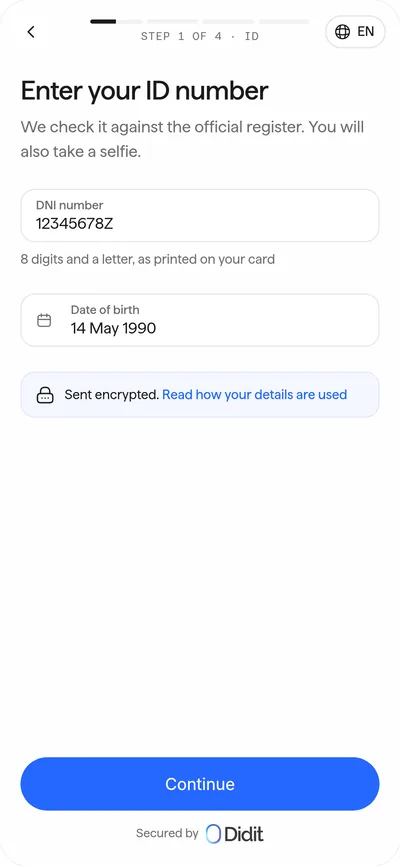
The source name is not shown to the end user. It is on the session payload in id_lookup.source, in the console and in exports, for you and your auditors. If a reviewer asks which register answered a Colombia check, that field is the answer.
Document capture, the documentary route
ID Verification reads a photographed document and checks it for authenticity. It covers 220+ countries and 14,000+ document types at $0.15 per check. For Colombia it is the route we can document for the cédula de extranjería, and it is the fallback when a lookup cannot run. It returns the extracted holder fields, the parsed MRZ where present, an Approved, Declined or In Review status, and a warnings list explaining every issue it found.

What a Colombia lookup does not prove
A data match does not prove that the person in front of you owns the identity. It proves the details match a record. If you need ownership, add a biometric step. The non-document lookup page names South Africa, Nigeria, Argentina and Panama as the sources that return a portrait today and run passive liveness and face match inside the lookup price; check the Colombia row before you rely on a registry photo. Where the source returns data only, no selfie is taken, and a Face Match step later in the workflow has nothing to compare unless the workflow collected a reference face earlier, for example with portrait_image on session creation.

Step by step in the Business Console
- Create a workflow and add the
DATABASE_VALIDATIONfeature, either in the console or withPOST /v3/workflows/. Optionally pin specific services per country. - If you also want the ID step to offer the lookup method, open the ID Verification step's Countries tab and enable
id_lookupforCOL. - Set the actions for a partial match, a no match and a provider error. Configure
fallback_to_documentif your policy allows document capture after a provider error. - Create a session with a stable
vendor_datavalue. That value binds the session to your user and is used for duplicate detection across sessions. - Open
session.urlfor the user, or mount the Web or Mobile SDK. - Read the decision from
GET /v3/session/{sessionId}/decision/or subscribe to thesession.status.updatedwebhook. Branch onsession_kindfirst, then readdatabase_validations.
The methods block below uses the structure documented for ID Verification methods. Replace the country key with COL and keep only the methods your catalogue marks available. Colombia is not one of the countries Didit documents as returning a registry portrait, so leave skip_liveness_and_face_match out of the block: if the Colombia service returns data only, the switch is normalised off on save and any Liveness and Face Match steps in the workflow still run.
{
  "feature": "OCR",
  "config": {
    "methods": {
      "COL": {
        "document": { "enabled": true },
        "id_lookup": {
          "enabled": true,
          "max_attempts": 2,
          "on_partial_match": "fallback_to_document",
          "on_no_match": "fallback_to_document",
          "on_provider_error": "fallback_to_document"
        }
      }
    }
  }
}
Step by step via the API
The standalone endpoint takes the identity data you already hold and returns a one-shot registry check. Before you send a Colombia request, open the Database Validation catalogue and confirm two things: that COL is available, and that the service id you intend to call is listed for it with its rate. Omit services to run the country's default service, or pass the service id from the catalogue to pin it.
We do not publish a Colombia Database Validation unit price in this article. The rate is set per service rather than per country, so the live per-service pricing table is the only place to read it at run time.
curl -X POST 'https://verification.didit.me/v3/database-validation/' \
-H 'x-api-key: $DIDIT_API_KEY' \
-F 'issuing_state=COL' \
-F 'identification_number=0000000000' \
-F 'first_name=Jane' \
-F 'last_name=Doe' \
-F 'date_of_birth=1990-01-15' \
-F 'vendor_data=user-1234'
The response shape is the one documented for Database Validation: { request_id, database_validation: { match_type, validation_type, services_used, match_score, validations, warnings } }. If the Colombia service asks for a date of birth or another field, include it; omitting a required field returns HTTP 400. If the service is flagged requires_consent=true, pass consent=true; without it the call returns HTTP 400.
For a hosted flow, create a session and read the decision:
curl -X POST 'https://verification.didit.me/v3/session/' \
-H 'x-api-key: $DIDIT_API_KEY' \
-H 'Content-Type: application/json' \
-d '{"workflow_id":"YOUR_WORKFLOW_ID","vendor_data":"user-1234"}'

curl 'https://verification.didit.me/v3/session/SESSION_ID/decision/' \
-H 'x-api-key: $DIDIT_API_KEY'
Worked cost example
Take 1,000 Colombian users a month on the document route, with the full KYC bundle and one AML screen each. All unit prices below come from the live price feed on November 26, 2026.
- ID Verification: $0.15 x 1,000 = $150.00
- Passive Liveness: $0.10 x 1,000 = $100.00
- Face Match 1:1: $0.05 x 1,000 = $50.00
- Device and IP Analysis: $0.03 x 1,000 = $30.00
- Full KYC subtotal: $150.00 + $100.00 + $50.00 + $30.00 = $330.00, or $0.33 per check
- AML Screening: $0.20 x 1,000 = $200.00
- Total with AML: $330.00 + $200.00 = $530.00, or $0.53 per check
- Optional Colombia SMS: $0.0413 x 1,000 = $41.30, bringing the total to $571.30
This example leaves out the Database Validation line, and we do not publish a Colombia Database Validation unit price because the live per-service rate has to be checked at run time. Multiply that rate by the number of successful service hits: billing is per successful service hit, so a request that runs two services can produce two usage events. On the Growth plan the 4% discount applies to Didit prices: $330.00 x 0.96 = $316.80 for the KYC subtotal, before the variable lookup line.
Fallbacks when the source is down or has no match
The documented failure modes are specific, and they decide what you show the user.
- HTTP 502 with
validation_errors. Every selected upstream service failed. The request is not billed and aCOULD_NOT_PERFORM_DATABASE_VALIDATIONlog is written. Retry later or fall back to OCR-only. no_match. The record is not in the registry. Treat it as a synthetic identity according to your policy, or route to document capture if your policy allows a second method.partial_match. Some fields match and others do not. Route to review rather than deciding automatically.- Provider error at the workflow level. Set
on_provider_errortofallback_to_documentso a lookup outage does not stop onboarding. - Migración Colombia portal unavailable. Capture the cédula de extranjería as a document at $0.15 and validate the certificate with its código de verificación when the portal responds. Keep the certificate and the code with the case.
Do not replace a failed lookup with the por reclamar delivery page. It answers a different question.
Table of identifiers and fields
| Identifier | Issuer | What the source asks for | What Didit returns | Documented in |
|---|---|---|---|---|
| Cédula de ciudadanía | Registraduría Nacional del Estado Civil | The cédula number in identification_number, plus the fields the Colombia service asks for | match_type, per-field matched_fields, record_details when available, match_score, warnings; tier data_match | Database Validation overview and non-document lookup |
| Cédula de ciudadanía as a document | The card itself | Front image, back image where the document has two sides | Extracted holder fields, MRZ where present, Approved, Declined or In Review, warnings; tier documentary | ID Verification API |
| Cédula de extranjería certificate | Migración Colombia | Number and issue date for a certificate; código de verificación to validate one | No documented direct Didit lookup. Document capture returns extracted fields and warnings; Migración Colombia handles certificate verification on its own portal | Migración Colombia certificate page |
| Cédula de extranjería delivery status | Migración Colombia | Number and a security verification | Not an identity result and not a Didit check | Migración Colombia por reclamar page |
Sources
- Didit, Database Validation overview, read November 26, 2026.
- Didit, Non-Document ID Verification: Authoritative Source Lookup, read November 26, 2026.
- Didit, ID Verification Methods: Document, Lookup, Wallet, read November 26, 2026.
- Didit, ID Verification API, read November 26, 2026.
- Didit, Create Session API, read November 26, 2026.
- Didit, Retrieve Session API, read November 26, 2026.
- Didit, Identity Verification Pricing, read November 26, 2026.
- Didit, pricing page and live price feed, read November 26, 2026.
- Didit, pricing as JSON, read November 26, 2026.
- Didit MCP server, read November 26, 2026.
- Registraduría Nacional del Estado Civil, Cédula de ciudadanía digital, read November 26, 2026.
- Registraduría Nacional del Estado Civil, Acceso a bases de datos, read November 26, 2026.
- Migración Colombia, Certificación del estado de Cédula de Extranjería, read November 26, 2026.
- Migración Colombia, Cédulas de extranjería por reclamar, read November 26, 2026.
Next step: create a free sandbox account at https://business.didit.me/, check the live catalogue for COL and the service you need, and run a Colombia lookup with test data. No sales call, no procurement cycle.
Try it
Try this in the sandbox
Run the check this guide describes, free.
The product this post is about, taken from its topic. Run it free in the sandbox.
Author
Alberto Rosas
Co-founder and CEO

Keep reading
Other guides in the same topic.
 How to verify a business in Poland: KRS, UBOs and KYB checks
Didit verifies Polish companies against the KRS. Poland is priced at $2.00 Lite, $5.00 Shareholders and $9.00 UBOs per company, plus $0.20 company AML and $0.33 per person KYC.
Alberto RosasNov 26, 2026 How to verify a Swedish company: Bolagsverket, UBOs and KYB
Didit verifies Swedish companies against Bolagsverket registry data at $2.00 Lite, $5.00 Shareholders and $9.00 UBOs per company, then adds key people, AML screening and documents. Ownership access tightens from 1 July 2026.
Alberto RosasNov 26, 2026 How to verify an Irish company: CRO, UBOs and KYB in 2026
Didit verifies an Irish company by searching the CRO's CORE register by name or registration number, then resolving officers, shareholders and UBOs. Registry checks start at $2.00, billed at the tier delivered.
Alberto RosasNov 26, 2026Questions
Frequently asked questions
Is there a Colombia ID verification API that checks government databases?
Didit's Database Validation documentation names the Registraduría Nacional among the authoritative sources it reaches, so check the live catalogue for COL before you enable the lookup. The same check can run as a standalone call at POST /v3/database-validation/ or as a step in a hosted workflow, and a successful result carries the data_match tier, not a documentary one.
Does Didit verify Colombian cédula numbers against the Registraduría?
That is the intended route: send issuing_state=COL and the cédula number in identification_number, plus the other fields the Colombia service requires. Check the catalogue first: a source named in the documentation is not the same as a service marked available for your account. Omit services to run the country default or pin the service id from the catalogue, and the result returns a match_type with per-field matches.
What does a full match on a Colombian cédula actually prove?
A full_match proves that the details the user typed matched a record the source holds. It does not prove the document is genuine, because no document was inspected, and it does not prove the person typing owns the identity. Add document capture or a biometric step when you need those claims.
Can Didit check a cédula de extranjería or foreigner status in Colombia?
We document no direct Didit lookup service for Migración Colombia. Capture the cédula de extranjería as a document at $0.15, and validate the Migración Colombia certificate with its código de verificación on the official portal, which Migración Colombia handles itself. Keep the certificate with the case so a reviewer can confirm the foreigner's status later.
How much does a Colombia ID check cost?
Document capture is listed at $0.15 per check, and the full KYC bundle is $0.33: ID Verification $0.15, passive liveness $0.10, face match $0.05 and device and IP analysis $0.03. Database Validation is priced per service, so read the Colombia rate from the live per-service pricing table at run time; this article does not publish a Colombia unit price. AML screening, if you add it, is $0.20 per check.
What fields does a Colombia database validation return?
It returns match_type, validation_type, services_used, match_score, a validations array and warnings. Each validation item carries the service, its status, the matched_fields and the record_details when the source returns them. In a session, the same data is in the database_validations array.
What happens if the Registraduría source is down or returns no match?
A 502 with validation_errors means every selected upstream service failed, the request is not billed, and a COULD_NOT_PERFORM_DATABASE_VALIDATION log is written. Retry later or fall back to document capture. A no_match means the record is not in the registry and should be treated as a synthetic identity according to your policy; a partial_match should go to review.
Do I need consent to run a Colombia database validation?
It depends on the service flag. Services marked requires_consent=true in the catalogue need consent=true on the request, otherwise the API returns HTTP 400. Colombia's habeas data law, Ley Estatutaria 1581 de 2012, is cited on the Registraduría's own page, so collect consent in a way your compliance team can evidence.
Can I use the Migración Colombia por reclamar page as an identity check?
No. That page says whether a cédula de extranjería is ready to be collected at a Centro Facilitador de Servicios Migratorios. It asks for the card number and a security check, and it returns a delivery status, not an identity result. Use the state certificate and its verification code for status instead.
How do I test Colombia checks before paying?
Create a sandbox application at https://business.didit.me/ and call the same endpoints. Sandbox testing is free and unlimited on every plan. When you move to live, billing is per completed check from prepaid credit, and the Free plan gives $10 of monthly credit to eligible organizations.
Compliance built in
Audited, certified and attested.
We hold the certifications and build each country's rules into your flows, so you can launch anywhere without worrying. Security and Compliance center
- Regulation encoded into your flows
Tell us what you do and where. Didit lists the rules that apply to you, with sources, and builds the checks each country needs into one workflow.
- Ready for AMLR
Every requirement of the new EU anti-money laundering rules, from checking customers to human review, is already covered by a Didit check.
- Tested in Spain's Treasury sandbox
Spain's Treasury published its supervised sandbox report on Didit's NFC plus active liveness onboarding; SEPBLAC took part and valued the added measures positively.
- Audited, not self-declared
iBeta Level 1 and Level 2. Liveness tested under ISO/IEC 30107-3.
Your obligations · 3 regions
 SOC 2 Type 2
 ISO 27001
 iBeta Level 1 and Level 2
 EU regulator attestation
 FSM youth protection
 GDPR
 EBA remote onboarding
 MiCA compatible
 FIDO Alliance member
- AMLREU AML Regulation ready
Integration · Didit MCP
Run Didit from your own AI agent
Connect Didit to Claude, Cursor, VS Code or ChatGPT and just ask in plain words. Your agent can do anything you can do in the console, with the same permissions you have.
 Add to Claude
 ChatGPT
 Cursor
- Build workflowsDescribe the checks you need. The agent creates and publishes the flow.
- Run investigationsAsk why a session was declined, review cases, search people and companies.
- Change rulesCreate payment rules, test them on past data and switch them on.
- Pull reportsAsk for numbers, exports or the audit log.
Didit Academy


