USA PATRIOT Act Section 314: AML Information Sharing Explained
Section 314(a) lets law enforcement request account data through FinCEN. Section 314(b) gives financial institutions a voluntary, registered safe harbor to share risk information with each other.
 Alberto RosasCo-founder and CEO
Contents
In this guide
Jump to the part you need.
Section 314 of the USA PATRIOT Act covers compliance and fraud teams at banks, payment institutions, broker-dealers and money services businesses. Section 314(a) routes law enforcement requests for account records through FinCEN; Section 314(b) gives registered institutions a voluntary safe harbor to share risk information. The caveat: Didit does not register you or file for you. Supporting checks start at $0.20 per AML screening.
Last updated: November 26, 2026. Prices checked against the live Didit price feed on November 26, 2026.
Section 314 at a glance
| Item | Answer |
|---|---|
| Statute | USA PATRIOT Act, Pub. L. No. 107-56, § 314 |
| Enacted | October 26, 2001, as Pub. L. No. 107-56 (FinCEN Section 314(b) Fact Sheet, read November 26, 2026). The Senate considered H.R. 3162 on October 25, 2001 (Congressional Record Vol. 147, No. 144, pages S10990 to S11060, read November 26, 2026) |
| Section 314(a) | Law enforcement requests for account and transaction records, routed through FinCEN to financial institutions |
| Section 314(b) | Safe harbor from liability for financial institutions and associations of financial institutions that share information with one another |
| Participation in 314(b) | Voluntary. Registration is required to use the safe harbor |
| Implementing regulation for 314(b) | 31 C.F.R. §§ 1010.540(a), (b)(5) |
| Current guidance | FinCEN Section 314(b) Fact Sheet issued June 12, 2026. It expands on and replaces the December 2020 fact sheet |
| Didit price points that support the workflow | AML screening $0.20 per check, full KYC $0.33 per check, ongoing AML monitoring $0.07 per person a year, transaction monitoring $0.001 per transaction beyond the plan allowance |
Start free in the Didit sandbox with no sales call. Developers who want an AI assistant to drive the checks can connect Didit through the MCP server. The screening side of this page is documented on the AML screening product page and priced on the pricing page.
What Section 314 actually does
Section 314 creates two separate mechanisms. Section 314(a) moves a request from government to institution. Section 314(b) moves information between institutions, and the statute protects that sharing so it does not become its own liability.
314(a): law enforcement requests routed through FinCEN
Under 314(a), federal law enforcement sends a request to FinCEN, which circulates it to financial institutions. Each institution searches its own records for accounts or transactions connected to the named people or entities and reports matches back through the same channel. The search runs against your own records, not a public database, and the request sets the scope and the response window.
That is the general shape of the mechanism. The sources cited on this page cover 314(b) in detail, so read FinCEN's published 314(a) material directly before you build a response process around it.
Practically, this is a records-retrieval obligation. The quality of your answer depends on whether customer identity data, transaction history and decision records are stored in a form you can search quickly and defend afterwards.
314(b): the voluntary safe harbor between institutions
Section 314(b) lets financial institutions share information with one another under a safe harbor from liability, to improve the identification and reporting of activity that may involve money laundering or terrorist activity. The FinCEN Section 314(b) page, read November 26, 2026, describes the safe harbor as covering institutions and associations of financial institutions that share information to identify and, where appropriate, report activities that may involve possible terrorist activity or money laundering.
Participation is voluntary. An institution that wants the protection registers, and FinCEN's page directs participants to the registration instructions in the Section 314(b) Fact Sheet. Sharing outside the program does not carry the safe harbor.

Who is subject to Section 314
Section 314 applies to financial institutions as that term is defined for Bank Secrecy Act purposes, and, for 314(b), to associations of financial institutions. In practice that reaches banks, credit unions, broker-dealers, money services businesses, payment institutions and the other categories the BSA covers.
You are on the hook for 314(a) if you hold the account records. You are eligible for 314(b) if you are a covered institution and you register. Eligibility is not obligation: FinCEN describes 314(b) participation as voluntary, so joining is a decision your institution makes and documents.
Two groups need a written legal view rather than a guess. Fintechs that partner with a sponsor bank may be performing the search on the bank's behalf rather than as a financial institution in their own right. Crypto businesses sit in a category that the BSA treats unevenly by activity. Ask counsel before you register or respond.
Where it applies and from when
Section 314 is part of the USA PATRIOT Act, Pub. L. No. 107-56, dated October 26, 2001. Whether it reaches a particular entity depends on whether that entity carries Bank Secrecy Act obligations, which is a question for your counsel rather than for a vendor. The operative text is Section 314 itself and the implementing regulation at 31 C.F.R. §§ 1010.540(a) and (b)(5); read those, not a summary, before you write policy.
The statute has been in force since 2001. The most recent change that matters for operations is the June 12, 2026 FinCEN fact sheet, which replaced the December 2020 version. Sharing across borders needs its own advice: Section 314 is US law, and a counterparty outside the United States may face local restrictions on what it can receive.
| Date | What happened | What it means for you |
|---|---|---|
| October 25, 2001 | The Senate considered H.R. 3162 (Congressional Record Vol. 147, No. 144, read November 26, 2026) | The information-sharing text was in the bill that became Pub. L. No. 107-56 |
| October 26, 2001 | Pub. L. No. 107-56 carries this date and is the legal basis cited for Section 314(b) in the FinCEN fact sheet, read November 26, 2026 | Section 314 dates from this Act |
| December 2020 | Previous FinCEN Section 314(b) fact sheet | Superseded, do not cite it as current |
| January 1, 2021 | 31 U.S.C. § 5311 added by Pub. L. 116-283, div. F, title LXI, § 6101(a) | The stated purpose of the BSA chapter now names risk assessment and national security explicitly |
| June 12, 2026 | FinCEN Section 314(b) Fact Sheet issued, expanding on and replacing the December 2020 version | This is the registration and scope guidance to work from |
| November 26, 2026 | Sources on this page read | Re-check FinCEN before you file anything |
Obligations and what Didit provides
The table separates what your compliance team owns from what the product does. Didit does not register you for the 314(b) program, does not submit reports to regulators and does not answer a 314(a) request. Filing stays with your team. The console prepares the form and the evidence.
| Requirement | What your team does | What Didit provides |
|---|---|---|
| Establish who counts as a covered financial institution | Legal analysis, documented in writing | Nothing. This is a legal question |
| Register for the 314(b) program | Follow the registration instructions in the June 12, 2026 fact sheet | Nothing. Registration is between you and FinCEN |
| Know the customer behind a match | Decide the identity standard your sharing relies on | Full KYC check at $0.33: ID document, passive liveness, face match and device and IP analysis in one check |
| Screen against sanctions, PEP and watchlist data | Set thresholds and review rules | AML screening at $0.20 per check against 1,300+ lists, with a match score for identity confidence and a risk score for the listed entity |
| Keep watching entities that stay in the book | Decide which populations stay under monitoring | Ongoing AML monitoring at $0.07 per person a year, dated every day |
| Search records for a 314(a) request | Run the search and submit the response to FinCEN | Session records and the decision payload, including the aml_screenings[] array, searchable in the Didit Business Console |
| Show who decided what, and when | Set the review standard and the resolution codes | Case management with reviewer assignment, notes, 4-eyes review and an audit log that runs to 1 year on Growth or 3 years with export on Scale |
| File a SAR or CTR that comes out of the review | Submit the filing to the regulator | Templates and a printable filing generated from the case. Didit does not submit reports |
| Monitor the transactions the sharing relates to | Write the rules and thresholds | Transaction monitoring with a rule engine, alerts and linked cases. $0.001 per transaction beyond the plan allowance |
The capability claims above trace to specific pages: the AML screening overview and the standalone AML screening API for the match and risk scores; the transaction monitoring overview for the rule engine and statuses; alerts and cases for triage and investigation; FIU reports for SAR and CTR templates; and pricing in the docs for plan allowances and discounts.
Screening a person through the API
The documented standalone call is the shortest path to a dated screening record. The three weight fields, aml_name_weight, aml_dob_weight and aml_country_weight, must sum to exactly 100 or the request is rejected with HTTP 400. The defaults are 60 for name, 25 for date of birth and 15 for country.
curl -X POST 'https://verification.didit.me/v3/aml/' \
  -H "x-api-key: $DIDIT_API_KEY" \
  -H "Content-Type: application/json" \
  -d '{
    "full_name": "Javier Ejemplo Modelo",
    "entity_type": "person",
    "date_of_birth": "1974-01-01",
    "nationality": "ES",
    "include_adverse_media": true,
    "vendor_data": "user-1234"
  }'
The response returns request_id and an aml object with status, screening_id, hits and warnings. Adverse media adds latency, so set a client timeout of at least 60 seconds. Turning on include_ongoing_monitoring keeps the entity under provider-driven monitoring at $0.07 per screened entity a year, and it requires save_api_request to be true. If you already run screening elsewhere, the switch page explains what a migration looks like, and you can also bring your own screening provider and run it inside Didit.

Worked example: the cost of the screening layer
A US payments company onboards 1,500 new customers a month and processes 40,000 transactions a month, which is 18,000 new customers and 480,000 transactions a year. It screens every new customer, keeps them under ongoing monitoring and runs every transaction through monitoring. The table prices the same year on the Scale plan and on the Free plan, using the published unit prices read on November 26, 2026 and the monthly allowances in the price feed.
| Line | Scale plan | Free plan |
|---|---|---|
| Full KYC | 18,000 x $0.297 = $5,346.00 | 18,000 x $0.33 = $5,940.00 |
| AML screening | 18,000 x $0.18 = $3,240.00 | 18,000 x $0.20 = $3,600.00 |
| Ongoing AML monitoring | 18,000 x $0.063 = $1,134.00 | 18,000 x $0.07 = $1,260.00 |
| Transactions inside the allowance | 100,000 a month is 1,200,000 a year, so all 480,000 are included | 1,000 a month is 12,000 a year, so 480,000 - 12,000 = 468,000 are billable |
| Transaction overage | $0.00 | 468,000 x $0.001 = $468.00 |
| Usage total | $5,346.00 + $3,240.00 + $1,134.00 + $0.00 = $9,720.00 | $5,940.00 + $3,600.00 + $1,260.00 + $468.00 = $11,268.00 |
| Plan credit for the year | $350.00 x 12 = $4,200.00 | $10.00 x 12 = $120.00 |
| Net usage after credit | $9,720.00 - $4,200.00 = $5,520.00 | $11,268.00 - $120.00 = $11,148.00 |
| Plan fee | $3,408.00 paid up front for the year | $0.00 |
| Total for the year | $5,520.00 + $3,408.00 = $8,928.00 | $11,148.00 paid from top-ups |
Two details keep the arithmetic honest. The Free plan credit is $10 a month and it expires at the end of each plan month, so the year carries $120 of credit and the rest is paid from top-ups, which last 12 months. The Scale plan discount of 10% applies to every Didit price, which is why each unit costs less there before the larger monthly credit is counted.
Two things are not in that arithmetic: the legal work to establish covered status, and the human review of hits. Both are yours. The $8,928.00 is the price of the evidence, not the price of the judgement.
Exceptions and open questions
The safe harbor is conditional, and the conditions are narrower than most teams assume.
- It covers sharing between financial institutions and associations of financial institutions, for the purpose of identifying and, where appropriate, reporting possible terrorist activity or money laundering. It is not permission to share with vendors, with law enforcement directly, or with counterparties outside the program.
- Participation is voluntary. An institution that never registers has no safe harbor to rely on for a sharing arrangement, however good its intentions.
- The covered activity is wider than terrorism. The FinCEN Section 314(b) page, read November 26, 2026, states that covered information may include information about fraud and other specified unlawful activities. The June 12, 2026 fact sheet ties money laundering to proceeds of specified unlawful activities under 18 U.S.C. § 1956, which lists mail fraud, wire fraud, bank fraud, health care fraud, securities fraud and fraud connected to unauthorised access of a protected computer.
- Sharing across borders is a separate question, not a settled one. Section 314 is US law, and a counterparty in another jurisdiction may face its own restrictions on what it can receive. Ask its counsel.
- Open question: what an examiner will accept as proof that a decision was made on a given date by a named reviewer. Didit keeps dated decisions, reviewer notes and an audit log, but whether that satisfies a specific examiner is your team's call.
- Open question: whether a partner bank's 314(b) registration extends to a fintech performing the sharing on the bank's behalf. Get this in writing.
None of this is legal advice. Section 314 is a statute with a regulator behind it, and the specific facts of your institution decide the answer.
Implementation checklist
- Get counsel's written view on whether each entity is a covered financial institution.
- If you intend to share, register following the instructions in the June 12, 2026 Section 314(b) Fact Sheet, and keep the confirmation.
- Write the permitted purpose into policy: identifying and, where appropriate, reporting possible terrorist activity or money laundering. Reviewers should be able to recite it.
- Keep a register of the institutions you share with, with the date each one confirmed its own participation.
- Screen the customers and counterparties that a sharing decision will rely on. AML screening is $0.20 per check and returns every potential match with a match score and a risk score.
- Establish identity before you rely on a name match. A full KYC check is $0.33 and covers the ID document, passive liveness, face match and device and IP analysis.
- Put ongoing monitoring on the entities that stay in the book, at $0.07 per person a year, so the record stays current between reviews.
- Route alerts into cases with assignment, notes and a resolution code, then generate any SAR or CTR from the case. The steps are in the FIU reports documentation.
- Keep records searchable for 314(a). The decision payload on
GET /v3/session/{sessionId}/decision/and theaml_screenings[]array on it are the parts a search will land on. - Re-read FinCEN guidance each year. The 2026 fact sheet replaced a 2020 version, and the next revision will move the ground again.
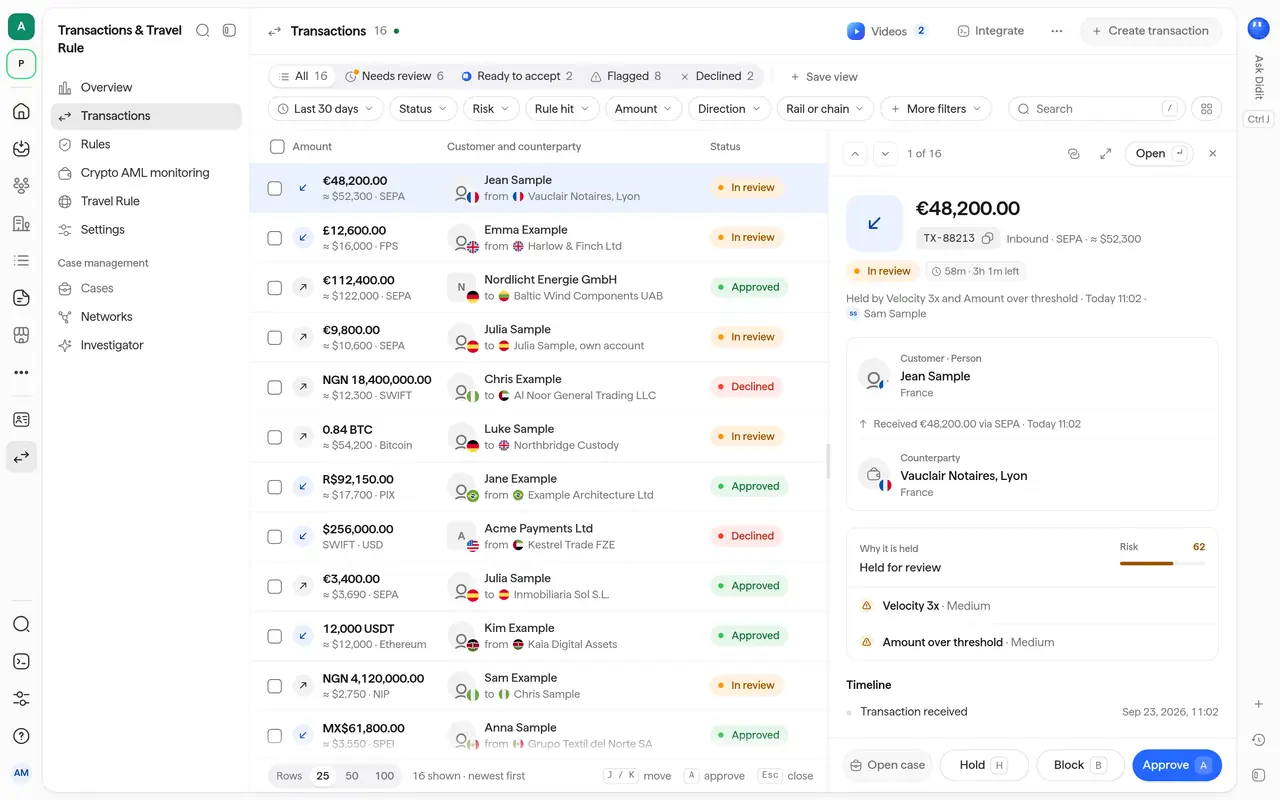
Section 5311 of Title 31, added by Pub. L. 116-283 on January 1, 2021, states the purpose the BSA chapter serves: the reports and records it requires must be highly useful in criminal, tax and regulatory investigations, risk assessments, proceedings, and intelligence or counterintelligence work, including analysis, to protect against terrorism. That sentence is the best short statement of what a 314 file has to be able to do.
Sources
- FinCEN, Section 314(b) page: https://www.fincen.gov/resources/section-314b, read November 26, 2026
- FinCEN, Section 314(b) Fact Sheet, issued June 12, 2026: https://www.fincen.gov/system/files/shared/314bfactsheet.pdf, read November 26, 2026
- U.S. Government Publishing Office, 31 U.S.C. § 5311, Declaration of purpose: https://www.govinfo.gov/content/pkg/USCODE-2020-title31/html/USCODE-2020-title31-subtitleIV-chap53-subchapII-sec5311.htm, read November 26, 2026
- U.S. Government Publishing Office, Congressional Record Vol. 147, No. 144, October 25, 2001, pages S10990 to S11060: https://www.govinfo.gov/content/pkg/CREC-2001-10-25/html/CREC-2001-10-25-pt1-PgS10990-2.htm, read November 26, 2026
- Didit, pricing page and the live price feed, read November 26, 2026
- Didit, pricing in the docs, read November 26, 2026
- Didit, AML screening overview, read November 26, 2026
- Didit, standalone AML screening API, read November 26, 2026
- Didit, transaction monitoring overview, read November 26, 2026
- Didit, KYT alerts, read November 26, 2026
- Didit, KYT cases, read November 26, 2026
- Didit, FIU reports and templates, read November 26, 2026
- Didit, AML screening product page, read November 26, 2026
- Didit, switch page, read November 26, 2026
- Didit, MCP server, read November 26, 2026
- Didit, business sandbox, read November 26, 2026
If you want to see the screening and case records this page describes, start free in the Didit sandbox. It needs no sales call, and a sandbox key returns mocked AML results so you can wire the flow before you spend anything.
Try it
Try this in the sandbox
Run the check this guide describes, free.
The product this post is about, taken from its topic. Run it free in the sandbox.
Author
Alberto Rosas
Co-founder and CEO

Keep reading
Other guides in the same topic.
 How to verify a business in Poland: KRS, UBOs and KYB checks
Didit verifies Polish companies against the KRS. Poland is priced at $2.00 Lite, $5.00 Shareholders and $9.00 UBOs per company, plus $0.20 company AML and $0.33 per person KYC.
Alberto RosasNov 26, 2026 How to verify a Swedish company: Bolagsverket, UBOs and KYB
Didit verifies Swedish companies against Bolagsverket registry data at $2.00 Lite, $5.00 Shareholders and $9.00 UBOs per company, then adds key people, AML screening and documents. Ownership access tightens from 1 July 2026.
Alberto RosasNov 26, 2026 How to verify an Irish company: CRO, UBOs and KYB in 2026
Didit verifies an Irish company by searching the CRO's CORE register by name or registration number, then resolving officers, shareholders and UBOs. Registry checks start at $2.00, billed at the tier delivered.
Alberto RosasNov 26, 2026Questions
Frequently asked questions
What is Section 314 of the USA PATRIOT Act?
Section 314 of the USA PATRIOT Act, Pub. L. No. 107-56, is a US information-sharing provision with two parts. Section 314(a) lets federal law enforcement request account and transaction records from financial institutions through FinCEN. Section 314(b) gives financial institutions a safe harbor from liability when they share information with one another to identify and report possible money laundering or terrorist activity.
What is the difference between 314(a) and 314(b)?
Section 314(a) is a request that flows from government to institution: FinCEN circulates a law enforcement request, and each institution searches its own records and reports matches. Section 314(b) is horizontal: institutions share with each other, under a safe harbor, without a government request. The first is a records obligation, the second is a voluntary program you register for.
Is 314(b) participation mandatory?
No. Financial institutions and associations of financial institutions may share information under the safe harbor, and FinCEN describes participation as voluntary. The condition is not optional though: if you want the safe harbor, you register, and FinCEN directs institutions to the registration instructions in the Section 314(b) Fact Sheet dated June 12, 2026.
How does a financial institution register for the 314(b) program?
Follow the registration instructions published in FinCEN's Section 314(b) Fact Sheet, issued June 12, 2026, which expands on and replaces the December 2020 version. Related materials, including how institutions request access to the Financial Institutions Portal, are on FinCEN's Resources for Financial Institutions page. Didit does not handle this registration for you.
What information can be shared under 314(b)?
Financial institutions and associations of financial institutions may share information about individuals, entities, organisations and countries for the purpose of identifying and, where appropriate, reporting suspected possible terrorist activity or money laundering. FinCEN's page states that covered information may include information about fraud and other specified unlawful activities. The sharing has to serve that purpose to stay inside the safe harbor.
Does Section 314 cover fraud, or only money laundering and terrorism?
It reaches fraud through the money laundering definition. The June 12, 2026 FinCEN fact sheet ties money laundering to proceeds of specified unlawful activities defined in 18 U.S.C. § 1956, and lists mail fraud, wire fraud, bank fraud, health care fraud, securities fraud and fraud connected to unauthorised access of a protected computer among them. A sharing arrangement built on a fraud case should say which of those activities it relates to.
What is 31 C.F.R. § 1010.540?
It is the implementing regulation for Section 314(b). FinCEN's Section 314(b) Fact Sheet cites 31 C.F.R. §§ 1010.540(a) and (b)(5) as the regulatory basis alongside Section 314(b) of the Act. If you are writing internal policy, cite the statute and the regulation together.
Can Didit file a 314(a) response or a 314(b) registration for us?
No. Didit does not register institutions in the 314(b) program and does not submit reports to regulators. What Didit provides is the evidence layer: KYC at $0.33 per check, AML screening at $0.20 per check, ongoing monitoring at $0.07 per person a year, transaction monitoring at $0.001 per transaction beyond the plan allowance, and case management that generates the filing for your team to submit.
Does Section 314 apply to crypto businesses and fintechs?
It depends on whether the entity is a financial institution for Bank Secrecy Act purposes, which is a legal question rather than a product question. A fintech performing searches on behalf of a sponsor bank may be acting for the bank rather than in its own right, and crypto activity is treated unevenly by the BSA. Get counsel's written view before you register or respond.
How much does the screening behind a 314 program cost?
At Didit's published list prices, checked on November 26, 2026: a full KYC check is $0.33, AML screening is $0.20 per check against 1,300+ lists, and ongoing AML monitoring is $0.07 per person a year. On the Scale plan a 10% discount applies to every price, so the same three lines cost $0.297, $0.18 and $0.063. Transaction monitoring is $0.001 per transaction beyond the plan allowance of 1,000 a month on Free, 10,000 on Growth and 100,000 on Scale.
What records should we keep to answer a 314(a) request quickly?
Keep customer identity data, the screening result with its match and risk scores, the reviewer's note and resolution, and the transaction history, all searchable by person and by date. In Didit those sit on the session decision payload, the aml_screenings[] array, the linked case and the audit log, which runs to 1 year on Growth and 3 years with export on Scale.
Compliance built in
Audited, certified and attested.
We hold the certifications and build each country's rules into your flows, so you can launch anywhere without worrying. Security and Compliance center
- Regulation encoded into your flows
Tell us what you do and where. Didit lists the rules that apply to you, with sources, and builds the checks each country needs into one workflow.
- Ready for AMLR
Every requirement of the new EU anti-money laundering rules, from checking customers to human review, is already covered by a Didit check.
- Tested in Spain's Treasury sandbox
Spain's Treasury published its supervised sandbox report on Didit's NFC plus active liveness onboarding; SEPBLAC took part and valued the added measures positively.
- Audited, not self-declared
iBeta Level 1 and Level 2. Liveness tested under ISO/IEC 30107-3.
Your obligations · 3 regions
 SOC 2 Type 2
 ISO 27001
 iBeta Level 1 and Level 2
 EU regulator attestation
 FSM youth protection
 GDPR
 EBA remote onboarding
 MiCA compatible
 FIDO Alliance member
- AMLREU AML Regulation ready
Integration · Didit MCP
Run Didit from your own AI agent
Connect Didit to Claude, Cursor, VS Code or ChatGPT and just ask in plain words. Your agent can do anything you can do in the console, with the same permissions you have.
 Add to Claude
 ChatGPT
 Cursor
- Build workflowsDescribe the checks you need. The agent creates and publishes the flow.
- Run investigationsAsk why a session was declined, review cases, search people and companies.
- Change rulesCreate payment rules, test them on past data and switch them on.
- Pull reportsAsk for numbers, exports or the audit log.
Didit Academy


