
Google Play Age Signals API: what changes in January 2027
What Google's email on the Play Age Signals API says and does not say: which users are covered, what your app receives, when the signal is enough, and a 30-day plan before 1 January 2027.
In short
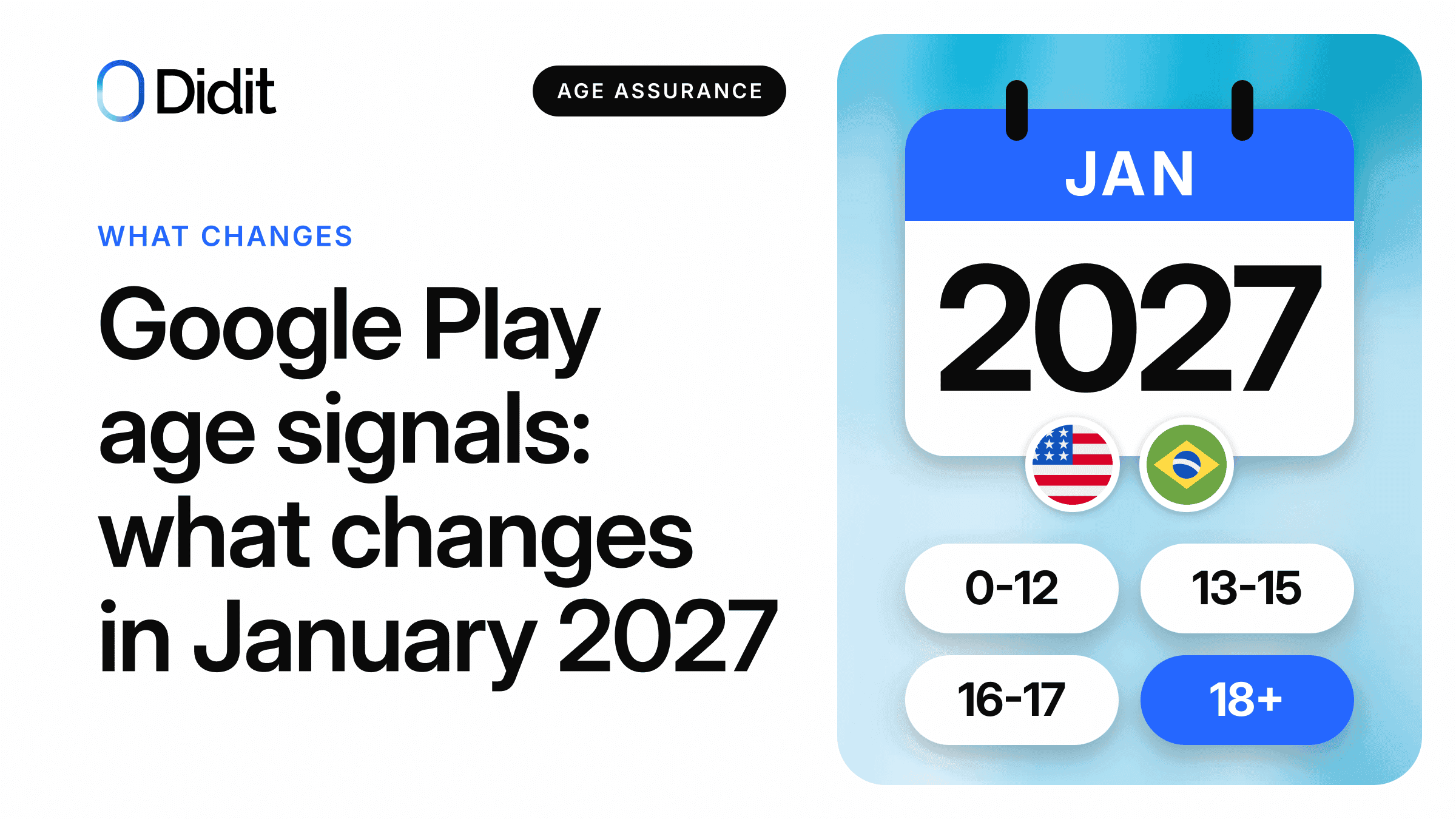
From January 2027, Google Play makes age range sharing mandatory for users in California and Brazil. That binds the user's setting: Google says it "doesn't mandate the use of these features" by developers, and that you decide how the laws apply to your app.[1][2]
- The law may still require you to act. California's act is operative and Alabama's is effective on 1 January 2027; Brazil's ECA Digital has been in force since 17 March 2026.[11][13][17]
- Mandatory sharing is not verified age. Google's own example of an adult under mandatory sharing shows TIER_A, an age the user provided.[5]
- Where the signal answers your legal question, use it and stop. Add your own check only where it is missing, too weak, or where a law asks for more.
If you publish on Google Play with users in Brazil or the United States, you probably received "Updates to the Play Age Signals API and support for age assurance laws in the U.S. and Brazil". It is easy to misread: it calls something mandatory, then says Google mandates nothing.
The Google Play Age Signals API (beta) lets your app ask Google Play for a user's age range, never a birth date. This guide explains what the email announced, which of your users it touches, what your app receives, and what to do before 1 January. For code, use the Play Age Signals API integration guide.
What the Google Play email says, and what it does not
Two sentences carry the email. One: "sharing age signals via the Google Play Age Signals API (beta) will be mandatory for all users in California" from January 2027, with the same sentence for Brazil. Two: use of the features is not mandated by Google Play. Both are true: they concern different people.
| Line in the email | What it means | What it does not mean |
|---|---|---|
| Sharing is mandatory for all users in California and Brazil | The user's setting becomes "Always share" and cannot be changed[6] | That Google requires your app to call the API |
| Google Play doesn't mandate the use of these features | You decide, with counsel, whether a law applies to you[1] | That no law requires it |
| Version 0.0.4 keeps returning responses in Australia, Brazil, Canada and Texas, and in Alabama and California when their laws take effect | An existing integration keeps working there | That 0.0.4 is the current version: the docs now show 0.0.6, released in November 2026[8] |
| The API expands globally with an in-app prompt | Version 0.0.6 starts returning responses for all users by 11 December 2026[3] | That every user will say yes |
| A new method tells whether mandatory sharing applies | getApplicableAgeFeatures() in 0.0.6; calling it is optional[4][8] | That it states your legal duties |
Left column: the November 2026 developer email, paraphrased. The other columns: current Google pages.
Note
Google says "January 2027" and names no day. The California and Alabama acts name 1 January 2027.[2][11][13] For Brazil, we found no article of law that sets a January 2027 date. Google ties its change to the Digital ECA; the Brazilian regulator, ANPD, separately lists enforcement on age assurance from January 2027.[2][19]
Not sure what the email means for your app
Get a demo of age estimation in your app and see which users still need a check once the Play signal is in.
Who is affected: what Play returns in each region, and since when
Read this table by where your users are, not where your company is.
| Region | What Play returns | Since when | Who decides on sharing | Law behind it |
|---|---|---|---|---|
| California | Age range on a mandatory basis[2] | January 2027 | Not the user: setting fixed[6] | Digital Age Assurance Act (AB 1043, amended by AB 1856), operative 1 January 2027[10][11] |
| Brazil | Age information, mandatory from January 2027; Play also restricts users identified as minors from downloading 18+ apps[2] | Signals since 17 March 2026;[9] mandatory sharing from January 2027[2] | From January 2027, not the user | ECA Digital (Lei 15.211/2025), in force 17 March 2026[17] |
| Texas | Google Play verifies eligible users and returns age range and parental approval of significant changes[2] | Eligible accounts created after 28 May 2026[9] | Not the user: the law requires verified data from the store[4] | SB 2420, enforceable while the appeal is pending (as of 22 November 2026)[15][21] |
| Alabama | Google's regional page says only "Details coming soon."[2] | The email: when the law takes effect | Not published | HB 161, effective 1 January 2027; lawsuit pending (see below)[13] |
| Australia and Canada | Age range if the user or parent shares it; Australia also has an 18+ download restriction[2] | Announced for mid-August 2026[12] | User or parent | Google's announcement cites no law for either country[12] |
| EEA, UK, Switzerland, Singapore | The global user-choice signal, plus an 18+ download restriction for users identified as minors[2] | By 11 December 2026[3] | User or parent | Not named on Google's page |
| Everywhere else | Age range if the user or parent shares it[2] | By 11 December 2026[3] | User or parent | None needed for the signal |
| Utah and Louisiana | No row of their own on Google's page[2] | Not announced on that page | User or parent (global row) | Developer duties from 6 May 2027 (Utah) and 1 July 2027 (Louisiana)[16][22] |
Google's regional page was last updated on 18 November 2026. Law status as of 22 November 2026.
- 17 March 2026BrazilSignals start under the ECA Digital.
- 28 May 2026TexasSignals for eligible accounts created after this date.
- November 2026Version 0.0.6Adds a check for mandatory sharing.
- 11 December 2026All usersGoogle's date for global responses.
- January 2027MandatorySharing in California and Brazil.
The dates Google has published for the signal.[2][3][8][9]
California. The duty to request a signal comes from the state, not from Google: a developer "shall request a signal" when the app is downloaded and launched, and the act sets no audience, size or revenue threshold for developers.[10] Installed apps, the 1 July 2027 date and the text are in the California Digital Age Assurance Act guide.
Alabama. The act makes developers verify age categories through the app store's data sharing.[13] The trade group CCIA sued in October 2026; WSFA reports that it agreed to pause the case until the state approves verification rules, and we found no injunction as of 22 November 2026.[14] The duties in Alabama, Texas, Utah and Louisiana are compared in App Store Accountability Acts.
Brazil. The law asks covered suppliers to take measures to receive the age information, and adds that they keep their own duty to prevent improper access whatever the store does.[17] The article-by-article reading is in Brazil's ECA Digital and Google Play.
What your app receives: four ranges, four tiers, three statuses
Your app learns a status first, then, if the status is SHARED, a range and a label for where the age came from. Signals are retrieved on the device while the app is open.[1][4]
Default ranges. You can replace them with up to three minimum ages in Play Console, at least two years apart, changeable once a year.[5]
| Status | What happened | What you get |
|---|---|---|
SHARED | The user or parent shares, sharing is automatic, or a required verification or parental supervision is in place | A range and a tier |
NOT_SHARED | The user or parent did not share | No age signals: range and tier are null |
VERIFICATION_REQUIRED | The user has not verified their age or set up supervision, in a region where verification and sharing are both mandatory | Range and tier are null until the user resolves it in the Play Store |
The three statuses.[4][5] On Google's regional page, verification by Play appears only in the Texas row.[2]
| Tier | Where the age came from | Returned where |
|---|---|---|
TIER_A | The user gave the age to Google, which "may or may not have confirmed this information" | No regional limit stated |
TIER_B | A parent or guardian manages the age | No regional limit stated |
TIER_C | Assessed by credit card, email address, selfie assessment, government ID or tax ID | Only regulated regions with mandatory age verification, such as Texas |
TIER_D | Checked by government ID combined with selfie assessment, or by digital ID | Only regulated regions with mandatory age verification, such as Texas |
The four values of ageRangeSource.[5]
Two details cause bugs. In the top range ageUpper is null: that means "18 or over" with the default ranges, not "unknown". When both bounds are null, you have no age.[4][5] And a range can lag a birthday, because Google "may delay sharing this updated range" to protect privacy.[6] Field names, errors and testing are in the integration guide.
Mandatory sharing is not mandatory verification
Sharing says whether the range reaches your app. Verification says whether anybody checked the age.
User choice
Most of the world
- Default setting: "Ask before sharing"
- The answer can be no
- Google's examples show TIER_A, even for an adult who verified
Features: empty set
Mandatory sharing
California and Brazil, January 2027
- Setting fixed at "Always share"
- The user cannot switch it off
- Google's adult example shows TIER_A "regardless of age-verification status"
Features: MANDATORY_SHARING
Mandatory verification
Texas, eligible accounts
- Google Play verifies the user
- Without it: VERIFICATION_REQUIRED
- An adult can return TIER_C or TIER_D
Features: MANDATORY_SHARING
Three regimes, one API.[2][4][5][6] Google does not write "California returns TIER_A": that is our reading of its third example. It does not say either that mandatory sharing in Brazil brings a verified age.
The California text points the same way. The operating system provider must ask the account holder to "indicate the birth date, age, or both" of the device's primary user. Age is declared, and the act still makes the signal the primary indicator of the user's age range.[10]
What you may do with the signal
Google's terms are narrow, and breaching them may mean losing API access or your app being suspended or removed from Google Play.[3]
| Use | Allowed | Why |
|---|---|---|
| Age-appropriate content and features in the same app | Yes | The stated purpose, in compliance with laws[3][7] |
| Ads, marketing or personalization | No | Prohibited by policy[7] |
| Analytics, profiling or business intelligence | No | Prohibited by policy[7] |
| Passing it to an age check vendor, Didit included | No | No transfer to any third party, "except as strictly required by law"[7] |
| Reusing it in another app | No | Google limits it to the requesting app[3] |
| Applying it to the same user on your website | Ask counsel | Google limits use to the requesting app; California law imputes the knowledge to your site[3][10] |
The last row is a real tension, and we found no Google text that resolves it.
Watch out
In California, AB 1856 says you must not prompt users to change their age information, and must not request a signal that no applicable law requires you to request.[10] Do not reuse a "fix your age in Play" message there. Google suggests a visit to the Play Store only for VERIFICATION_REQUIRED.[4]
When the signal is enough, and when it is not
Often it is enough. A second check on every user is hard to square with data minimization. Settle whether a law or a real risk asks for more than the signal you hold.
1Name the decision
Which feature, content or default changes with age, and which law or risk says so.
The signal you hold answers that decision
Apply the range and stop
No selfie, no document, no extra data.
Age-appropriate default first
Run your own check only where a user asks for the restricted feature, or where a law requires one.
| Situation | Is the signal enough | Reason |
|---|---|---|
| General app in California, under the Digital Age Assurance Act alone | Yes, unless you hold clear and convincing information that the age differs | The signal is the primary indicator and the act asks for no additional personal information[10] |
| Texas store duty, with a shared signal | Yes for that duty | The act makes the store's data the method of verification[20] |
| Low-risk app in Brazil | Points to yes | ANPD's preliminary draft guide lists the signal and verifiable credentials for low risk[19] |
| Prohibited content or betting in Brazil | No | Reliable age verification, with self-declaration barred; age estimation alone is not enough (estimation line: ANPD preliminary draft)[17][18][19] |
| Addictive feeds or autoplay in California (AB 1709) | Yes, with a fallback | If age cannot be verified through the signal, AB 1709 relies on another statute's age determination, whose rules are not final (as of 22 November 2026)[23][24] |
| Website, sideloaded copy or another store | No signal | The API is limited to apps updated by Google Play[3] |
Adults-only feature, user returned TIER_A | Depends on the law and the risk | The age may never have been confirmed[5] |
If another law reaches your app, it applies on top. For California feeds and design duties, read California age verification law 2027.
An own check does not always win. In Alabama, Utah and Brazil the lower or more protective result prevails for the protections those laws cover, so an own check can tighten but never loosen them.[13][16][18] In California only internal "clear and convincing information" displaces the signal, and nothing we found says an age estimate reaches that bar.[10] Buffers, costs and conflict rules are in what to do when there is no age signal, and needs by app type in age assurance for apps.
Map your age gate to the signal
Show us your age gate and your markets. We will show you where the signal is enough and where an own check fits.
What to do by 1 January: a 30-day plan
Start by 1 December and Google's date for global responses falls in your second week.
| Days | Owner | Work | Done when |
|---|---|---|---|
| 1 to 7 | Legal and product | List markets, laws and the features that change with age | A one-page decision per market, reviewed by counsel |
| 8 to 14 | Engineering | Integrate 0.0.6, or move from 0.0.4; handle every status and null; agree custom ages before saving them | Each status leads to a defined experience |
| 15 to 21 | Engineering and privacy | Test with Google's FakeAgeSignalsManager; keep the signal out of logs, analytics and third-party SDKs; review your data safety answers | No signal leaves the app's age logic |
| 22 to 30 | Product and support | Release, brief support, decide the fallback for users without a signal, recheck the Alabama and Texas status | Live, with an owner for changes |
A plan of work. The fake manager is in Google's release notes.[8]
- Give users with no signal a safe default instead of an error.
- Plan for installed apps in California, where the date is before 1 July 2027.[10]
- Decide the same policy for iOS with the Google and Apple comparison.
- Cover the web with an age verification API that reaches it.
- Recheck Google's regional page in late December: as of 22 November 2026 it gives no Alabama details, so keep a path for Alabama users without a signal.[2]
How Didit helps after the signal
Didit does not provide, read or replace the Play signal. It runs the age verification you start yourself when the signal is missing, is only declared, or your law or risk needs more.
Didit's age estimation predicts an age from a selfie with liveness included, and costs $0.10 per check (pricing).[25][26] It estimates an age and does not say who the person is. With Adaptive Age Verification you set a borderline band: an estimate above it passes, one inside it continues to an ID document, and one below it is declined.[27] The document is matched to the same selfie, and the ID verification is charged only when it runs, on top of the estimate.[25]
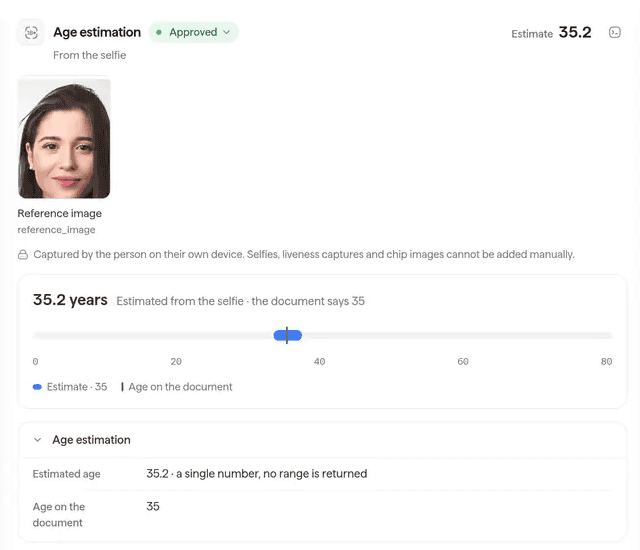
The age estimation result in the Didit console (sample data): the estimate from the selfie next to the age on the document.
Start the session without the signal: your app decides that a check is needed and applies your own threshold, and Google's answer stays in the app. In Illinois, Texas and Colorado, Didit's default setting adds a biometric notice and consent step before the selfie; native apps need SDK 4.10.0 or later, and you should offer another way to verify.[28] For data minimization, an ISO/IEC 27566-1 template returns the age decision and no personal data, with 13 as the lowest minimum age.[25] In Brazil, document images must not be kept, so set up the document step with that rule in mind.[18]
Didit provides
- A selfie age estimate with liveness
- A document step for the band you set
- A hosted flow, mobile and web SDKs, and an API
Stays with you
- The Play signal, inside your app
- Which laws apply and what each feature needs
- The decision about each user
See it first in the age estimation video or in the live demos.
Add the check the signal cannot give you
Get a demo of age estimation in your app, for the users and features that need more than a declared range.
Key takeaways
- In January 2027 sharing becomes mandatory for users in California and Brazil. Google does not oblige developers to use the API; state or national law may.
- The current version is 0.0.6, and Google says it returns responses for all users by 11 December 2026.
- Expect a range and a source tier, never a birth date. Outside regions with mandatory verification, treat the age as possibly unconfirmed.
- Keep the signal in your app: no ads, no analytics, no third parties.
- Use the signal first, stop where it is enough, and add your own check only where it is missing or a law or risk needs more.
Frequently asked questions
Does Google require me to use the API?
No. Google says that Google Play "doesn't mandate the use of these features" and that it is your responsibility to determine whether and how the laws apply to your app.[1] A law may require it: California's act tells developers to request a signal.[10]
What exactly changes in January 2027?
Google Play returns age ranges on a mandatory basis for users in California and Brazil.[2] California's act becomes operative and Alabama's takes effect on 1 January 2027, although Google has published no details for Alabama.[2][11][13]
Which users does it cover?
Google's email says all users in California and all users in Brazil for mandatory sharing. Elsewhere, sharing is the user's or parent's choice, except where a law such as the one in Texas requires verified age data.[2][4]
Is the age verified?
Not necessarily. TIER_A means the user gave the age to Google, which may or may not have confirmed it. TIER_C and TIER_D come only from regulated regions where age verification is mandatory, such as Texas.[5]
What are TIER_A, B, C and D?
They label where the age came from: A is provided by the user, B is managed by a parent or guardian, C is assessed by a method such as a credit card, selfie or government ID, and D is checked by government ID combined with a selfie, or by digital ID.[5]
Do I get a birth date?
No. Google says it will never provide the exact age or birth date. You get a range, by default 0-12, 13-15, 16-17 or 18+.[6]
What happens if the user does not share?
The status is NOT_SHARED, and the range and tier are null.[4][5] Google does not tell you what experience to show. Use an age-appropriate default, and in California do not prompt the user to change their age information.[10]
Can I send the signal to an age check vendor or my analytics?
No. Google's policy prohibits analytics and profiling, and any transfer to a third party except as strictly required by law.[7] If you need an own check, start it without the signal.
Does it work for sideloaded apps or my website?
No. The API is limited to apps that are updated by Google Play.[3] Websites, other stores and iOS need another source of age information.
What about Alabama?
HB 161 takes effect on 1 January 2027.[13] Google's regional page says "Details coming soon."[2] A lawsuit by CCIA is reported paused, and we found no injunction as of 22 November 2026, so check again in late December.[14]
Sources
- Changes to Google Play for upcoming app store bills for users in applicable US states, Play Console Help, read 22 November 2026.
- Regional age-related protections on Play, Android Developers, updated 18 November 2026.
- Play Age Signals overview, with the terms of service, Android Developers, updated 18 November 2026.
- Request age signals, Android Developers, read 22 November 2026.
- Understand age signals responses, Android Developers, updated 18 November 2026.
- About age range sharing on Google Play, Google Play Help, read 22 November 2026.
- Age Signals API and User Data policy, Play Console Help, read 22 November 2026.
- Play Age Signals release notes, Android Developers, read 22 November 2026.
- Play Age Signals overview, version 0.0.4, Android Developers, read 22 November 2026.
- AB 1856, Chapter 184, Statutes of 2026, amending Civil Code 1798.500 to 1798.504, California Legislature.
- AB 1043, Digital Age Assurance Act, Chapter 675, Statutes of 2025, California Legislature.
- Expansion of the Play Age Signals API, Android Developers Blog, 29 July 2026.
- HB 161, enrolled, Alabama Legislature, 2026.
- Lawsuit challenges Alabama's app store verification law, WSFA, 17 November 2026 (secondary, quotes the plaintiff).
- Order granting a stay pending appeal, No. 25-51073, US Court of Appeals for the Fifth Circuit, 4 June 2026.
- Utah Code 13-76-202, developer requirements, Utah Legislature.
- Lei 15.211/2025 (ECA Digital), Presidency of Brazil.
- Decreto 12.880/2026, Presidency of Brazil.
- ECA Digital: calendar and preliminary draft guide, ANPD, read 22 November 2026.
- SB 2420, enrolled, Texas Legislature.
- App store age verification laws, Squire Patton Boggs, November 2026 (secondary).
- Act 185 of 2026 (HB 977), Louisiana Legislature.
- AB 1709, Chapter 183, Statutes of 2026, California Legislature.
- SB 976 rulemaking status, California Department of Justice, read 22 November 2026.
- Age Estimation overview, Didit docs, read 22 November 2026.
- Pricing, Didit docs, read 22 November 2026.
- Age Estimation warnings and thresholds, Didit docs, read 22 November 2026.
- Biometric consent, Didit docs, read 22 November 2026.
Read the email as a date for your plan. Decide per market, keep the signal in your app, and use age verification of your own only where the signal stops.
Ready before the new year
Get a demo of age estimation in your app, and leave with a plan for the users the signal does not reach.
संबंधित लेख
- Age assurance for apps: games, social, dating, AI and more
- Age verification API: which one works on apps, web and stores
- Brazil's ECA Digital and Google Play: age signals in your app
- California age verification law 2027: the four rules for apps
- App Store Accountability Acts: Texas, Utah, Louisiana, Alabama
- Play Age Signals vs Apple Declared Age Range: full comparison