How to verify a bank account before a payout with an API
Send Didit the account details and holder name before a payout. The API checks for a name match in 47 countries, with no bank sign-in, from $0.45 per answered check.
 Alberto RosasCo-founder and CEO
Contents
In this guide
Jump to the part you need.
If you hold a name and an account number and you are about to send money, the account check API answers one question: does the bank hold that account under that name. We run it with no session and no bank sign-in, in 47 countries, from $0.45 per answered check. The caveat matters: it proves the name on the account, not that your payee controls it.
Last updated: November 26, 2026. Prices checked against the live Didit price feed on November 26, 2026.
| Question | Answer |
|---|---|
| What it answers | Whether the bank holds the account under the name you send |
| Sign-in needed | No session and no bank sign-in. Where a country requires it, you collect the holder's explicit consent in your product before each check. |
| Who it fits | Payouts, withdrawals, supplier payments, SEPA direct debit mandates |
| Countries | 47, listed with each country's method and price on the Bank Verification pricing page |
| Price | From $0.45 per answered check, the same price as the same check inside a verification flow |
| Endpoint | POST https://verification.didit.me/v3/bank/account-check/ |
| Main caveat | A name match is not proof of control. Use a Bank Link with ownership comparison when you need that. |
Start free in the sandbox at business.didit.me, no sales call. For developers, connect Didit to an AI assistant through Didit MCP.
The Bank Data API overview introduces the product, and Didit pricing lists our published prices.
Account name match or bank sign-in with ownership comparison
An account check tells you whether the bank holds the account under the name you send. A completed Bank Link sign-in demonstrates account control. With ownership comparison enabled, we compare the legal holder returned by the bank with a person or company already verified in Didit. The verdict can be unknown if missing holder evidence could change it.
| Question | Account check, no sign-in | Bank Link with ownership comparison |
|---|---|---|
| What the person does | No bank sign-in. Your backend sends the name and the account, and where the country requires it you collect the holder's explicit consent in your product first. | Signs in at their bank through a link. |
| What it proves | The bank holds the account under the name you send. | A completed Bank Link sign-in demonstrates account control. With ownership comparison enabled, Didit compares the legal holder returned by the bank with a person or company already verified in Didit, and the verdict can be unknown if missing holder evidence could change it. |
| What comes back | Read result, holder_name when the bank returned a name, and name_match_score when a score is available. | The link includes the ownership check identifier, check_id. |
| Price | From $0.45 per answered check. | The country's bank sign-in price, charged once. Renewals never charge it again. |
| Best for | Payouts and mandates where you already have the name and account details and can collect explicit consent where required. | High-value payouts and mandates where you need proof the person controls the account. |
One detail changes your UI copy. In some countries the bank confirms whether the name matches without returning the name it holds: the United Kingdom, the euro area, the United Arab Emirates, Australia, the United States, Brazil, Mexico, Argentina, Peru, Uruguay, Chile, Colombia, Ecuador, India, China, Uganda, Indonesia, Vietnam, Nepal, Pakistan, South Korea, Bangladesh and Malaysia. There result is match or no_match and holder_name stays null.
What you need before you start
- A Didit organization and a sandbox application in the Business Console, plus a sandbox API key. Keep the key on your server and send it in the
x-api-keyheader. - The name you are about to pay:
holder.full_namefor a person,holder.business_namefor a company. Send the person or company name you expect the bank to hold for that account. - The account written the way its country writes it: an IBAN, a sort code and account number, a routing number and account number, a CLABE, a CBU, an IFSC and account number, or a NUBAN and a bank code.
- The country as a three-letter code, and a check that the country is one of the 47 the check covers.
- Consent language in your own product for the countries that require it, and a flag to send
"consent": true. - A written policy for
close_matchandcannot_verifybefore you write the code that releases money.
How to verify a bank account before a payout: 7 steps
- Create the sandbox application and the key. Open your sandbox application in the Business Console, go to API keys, create a named key and export it on your server:
export DIDIT_API_KEY="your-sandbox-key" - Fix the name, the country and the account you will check. Use the holder name you have on record. Send
holder.full_namefor a person orholder.business_namefor a company, and send the account in that country's format. - Collect the holder's consent where the country requires it. No bank sign-in happens, but some countries need the account holder's explicit consent before each check. Ask for it in your product, then send
"consent": truewith the request. Without it the call is refused with a 400 namingconsentand is not billed. Elsewhere consent is optional, and when you send it we record it with the check's charge. A sandbox key asks for consent in the same countries as a live key. - Send the account and the holder to the account check endpoint. This is the documented example for a Spanish business account:
Spaces, dashes and dots are ignored, so the account can be sent the way the bank prints it. For a person, swap incurl -X POST https://verification.didit.me/v3/bank/account-check/ \ -H "x-api-key: $DIDIT_API_KEY" -H "content-type: application/json" \ -d '{ "country": "ESP", "account": { "iban": "ES5500000000000000000001" }, "holder": { "business_name": "Northwind Trading S.L." } }'holder.full_nameand the account shape that country uses, for example a UK sort code and account number as shown in the table below. - Read the answer against the result table below. That table is the single reference for what each
resultmeans and what your payout gate should do with it, so do not re-implement the decision anywhere else. - Read
name_match_score. It is the 0 to 100 integer similarity between the name you sent and the name on the account, and it is the scoreresultwas decided on. Amatchcomes from 85 and aclose_matchfrom 70 up to 84. A missing score and a missing holder name are separate conditions:name_match_scoreis null only when no name was compared, which happens when there is no such account or when the bank answered without a comparison. Treat null as no score, never as zero, and route those cases onresult. - Apply your payout policy. A
matchcan satisfy the payout's name-check requirement. Apply your payout policy and any local score threshold before releasing funds, and remember that your threshold never changes the API'sresult.
What the API answers back
Read result, holder_name when the bank returned a name, and name_match_score when a score is available. The four results:
result | What it means | Typical next step |
|---|---|---|
match | The bank holds the account under the name you sent. | A match can satisfy the payout's name-check requirement. Apply your payout policy before releasing funds. |
close_match | The bank holds it under a close name. holder_name is that name, when the bank returned it. | Hold the payout for review. Compare holder_name, or ask the payee to confirm the account. |
no_match | The bank holds it under another name, or there is no such account. | Do not send the money. Ask for another account. |
cannot_verify | The bank answered without comparing the name, for example for a blocked or closed account. | Apply your own policy, for example ask for another account. |
The score is a 0 to 100 integer and it is the score result was decided on. result stays authoritative: it is decided with the default thresholds, a match from 85 and a close_match from 70 up to 84. A stricter or looser threshold of yours never changes it. Inside a verification session the same two thresholds are the workflow settings bank_name_match_threshold (85 by default) and bank_partial_match_floor (70 by default); this API always uses the defaults.
| Case | result | name_match_score |
|---|---|---|
| The bank returned a holder name, or a score of its own | match, close_match or no_match | A number. A name with nothing in common with yours scores 0. |
| There is no such account | no_match | null |
| The bank answered with its own verdict but no holder name and no score | cannot_verify | null |
| The bank answered, but its holder details could not be read | cannot_verify | null |
What you send: account formats by country
Send the account the way its country writes it. This table describes input formats, not coverage: whether the check runs in a country depends on the coverage list, and some routes also ask for a bic, and for a business account a registration_id. A key the country's check needs and does not get is a 400 naming it, for example "field": "account.bank_code", "reason": "required".
| Country | account |
|---|---|
| IBAN countries, the United Arab Emirates | {"iban": "..."} |
| United Kingdom | {"sort_code": "...", "account_number": "..."} |
| United States | {"routing_number": "...", "account_number": "..."} |
| Canada | {"transit_institution": "...", "account_number": "..."} |
| Australia | {"bsb": "...", "account_number": "..."} |
| India | {"ifsc": "...", "account_number": "..."} |
| Nigeria | {"bank_code": "...", "account_number": "..."}, with the bank's 6-digit NIP code (Access Bank is 000014) and the 10-digit NUBAN |
| Ghana | {"bank_code": "...", "account_number": "..."}, with the bank's 3-letter code (GCB Bank is GCB) |
| Kenya | {"bank_code": "...", "account_number": "..."}, with the bank's 2-digit code (KCB is 01) |
| Zambia | {"bank_code": "...", "account_number": "..."}, with the bank's 3-digit code (Zanaco is 023) |
| Brazil | {"iban": "...", "registration_id": "..."}, with the holder's CPF (a person) or CNPJ (a company) |
| Chile | {"account_number": "...", "bank_code": "...", "registration_id": "..."}, with the bank's BIC or clearing code and the holder's RUT |
| Colombia | {"account_number": "...", "bank_code": "...", "registration_id": "..."}, with the bank's BIC or clearing code and the holder's cedula (CC) or NIT |
| Ecuador | {"account_number": "...", "bank_code": "...", "registration_id": "..."}, with the bank's BIC or clearing code and the holder's cedula (CC) or RUC |
| Peru | {"account_number": "..."}, with the 20-digit CCI |
| Uruguay, Uganda, Indonesia, Vietnam, Nepal, Pakistan, South Korea, Bangladesh, Malaysia | {"account_number": "...", "bic": "..."}, with the bank's BIC |
| China | {"account_number": "..."}, with the holder's UnionPay card number; personal accounts only |
| Mexico | {"clabe": "..."} |
| Argentina | {"cbu_cvu": "..."} |
Checking the payer of a SEPA direct debit mandate
Before you collect with a mandate, check the IBAN the payer gave you against the name on the mandate. For Spain, step 4 shows how to send the IBAN and the company name. For other countries, follow the Account Check API reference for required account fields and include "consent": true where required. Send the name the mandate carries: holder.full_name for a person, holder.business_name for a company. Treat no_match as a reason to ask for another account before you collect, and remember that some countries require the holder's consent before each check.
Failure cases and how to recover
| What you see | What happened | What to do |
|---|---|---|
404, code: country_not_covered | The check does not run in that country | Take another path: a Bank Link where bank sign-in covers the country, or your manual payout review. Not billed. |
400 naming a field, for example account.bank_code | The country's check needs a field you did not send | Send the field and submit the request again. |
400, field consent, reason required | The country requires the holder's consent and none was sent | Collect consent in your product, then send "consent": true. Not billed. |
no_match | Another name on the account, or no such account | Do not send the money. Ask for another account. Billed: the check answered. |
close_match | The bank holds a close name | Hold the payout for review. Compare holder_name, or ask the payee to confirm the account. Billed. |
cannot_verify | The bank answered without comparing the name | Apply your policy, for example ask for another account. Billed. |
Paid steps and review boundaries
We bill the account check per answered check, at the same prices as the same check inside a verification flow, and Bank Verification pricing carries the price for each country. Two documented cases are never billed: a request refused for a missing consent, and a 404 with country_not_covered. The sandbox is free on every plan, and every sandbox price is $0.
In a verification workflow, micro-deposits are available at no extra charge after a charged bank sign-in or account check in the same session. Statement upload can be offered before a bank attempt, and the person can always continue without a bank. Those belong to the flow, not to the standalone API.

Worked cost example
Suppose you run 10,000 answered checks in a month at the published starting rate of $0.45. Use the country-specific rate from Bank Verification pricing for your actual estimate. The Growth and Scale figures below are check charges before subscription fees and credits.
- 10,000 answered checks x $0.45 = $4,500.00 a month.
- Of 10,000 requests, suppose 300 are rejected because the country is unsupported and the remaining 9,700 are answered. The charge is 9,700 × $0.45 = $4,365.00.
- On Growth, 4% off every Didit price: $0.45 x 0.96 = $0.432 a check, so 10,000 x $0.432 = $4,320.00 in check charges.
- On Scale, 10% off: $0.45 x 0.90 = $0.405 a check, so 10,000 x $0.405 = $4,050.00 in check charges.
If you also run a full ID check on each new payee before the bank step, at $0.33 per completed check, that adds 10,000 x $0.33 = $3,300.00, for $7,800.00 at list price. At these rates, the account check costs $0.12 more per check than the full ID check.
When a sign-in link is the better check
An account check proves the bank holds the account under that name. It does not prove the person controls the account. When you need control, use a link with ownership.compare: the person signs in at the bank, and we compare the holder the bank returns with a person or company verified in Didit.
{
  "access": "one_time",
  "country": "ESP",
  "ownership": { "compare": "business", "business_session_id": "..." },
  "end_user": { "reference": "supplier-204" }
}
The link includes the ownership check identifier, check_id. Ownership is unknown whenever missing holder evidence could change the verdict, and only legal holders count, never representatives. An ownership comparison charges the country's bank sign-in price once, and renewals never charge it again. Bank sign-in starts at $0.45 per completed sign-in. See Bank Verification pricing for country rates.
Verifying a bank account inside a workflow instead
If the person is already in your product, the same check runs as a step. Use bank_method_order to set which methods every country offers, and a country's own methods to override it there, for example ["account_lookup"] for the account check only. In a session the person never types the name that is checked: we always compare the name the session already verified, so put ID Verification, Database Validation, a questionnaire or expected_details before the step. That is the difference from the API call, where you send the name yourself and it is therefore only as good as the name you hold.

Sources
- Account Check API: Verify a Payout Bank Account, Didit docs, read November 26, 2026
- Bank Account Check: Account Ownership, No Sign-in, Didit docs, read November 26, 2026
- Verify a Bank Account Before a Payout or SEPA Mandate, Didit docs, read November 26, 2026
- Bank Verification Methods: Sign-in or Account Check, Didit docs, read November 26, 2026
- Bank Data API: Verify Accounts, Read Transactions, Pay as You Go, Didit docs, read November 26, 2026
- Bank Data Quickstart: Connect a Test Bank and Read Transactions, Didit docs, read November 26, 2026
- Bank Link and fallbacks, Didit docs, read November 26, 2026
- Bank Verification pricing and Identity Verification pricing, Didit docs, read November 26, 2026
- Didit pricing page and pricing.json, live price feed, read November 26, 2026
Next step: create a free sandbox application in the Didit Business Console and try the documented account check request. No sales call is required.
Try it
Try this in the sandbox
Run the check this guide describes, free.
The product this post is about, taken from its topic. Run it free in the sandbox.
Author
Alberto Rosas
Co-founder and CEO

Keep reading
Other guides in the same topic.
 Didit Pricing Plans: Free vs Growth vs Scale vs Enterprise in 2026
Full KYC is $0.33 a check at list on Free, $0.3168 on Growth ($99/mo) and $0.297 on Scale ($299/mo). Monthly credit buys 30, 363 and 1,178 whole checks. Enterprise is a custom annual contract from $15,000 a year.
Alberto RosasNov 26, 2026 How to Detect Duplicate Accounts With Device Fingerprinting (2026)
Device and IP analysis runs inside every Didit session at $0.03 per check. Read the device analysis results on the decision and act on a confirmed duplicate, a possible duplicate or a blocklisted fingerprint.
Alberto RosasNov 26, 2026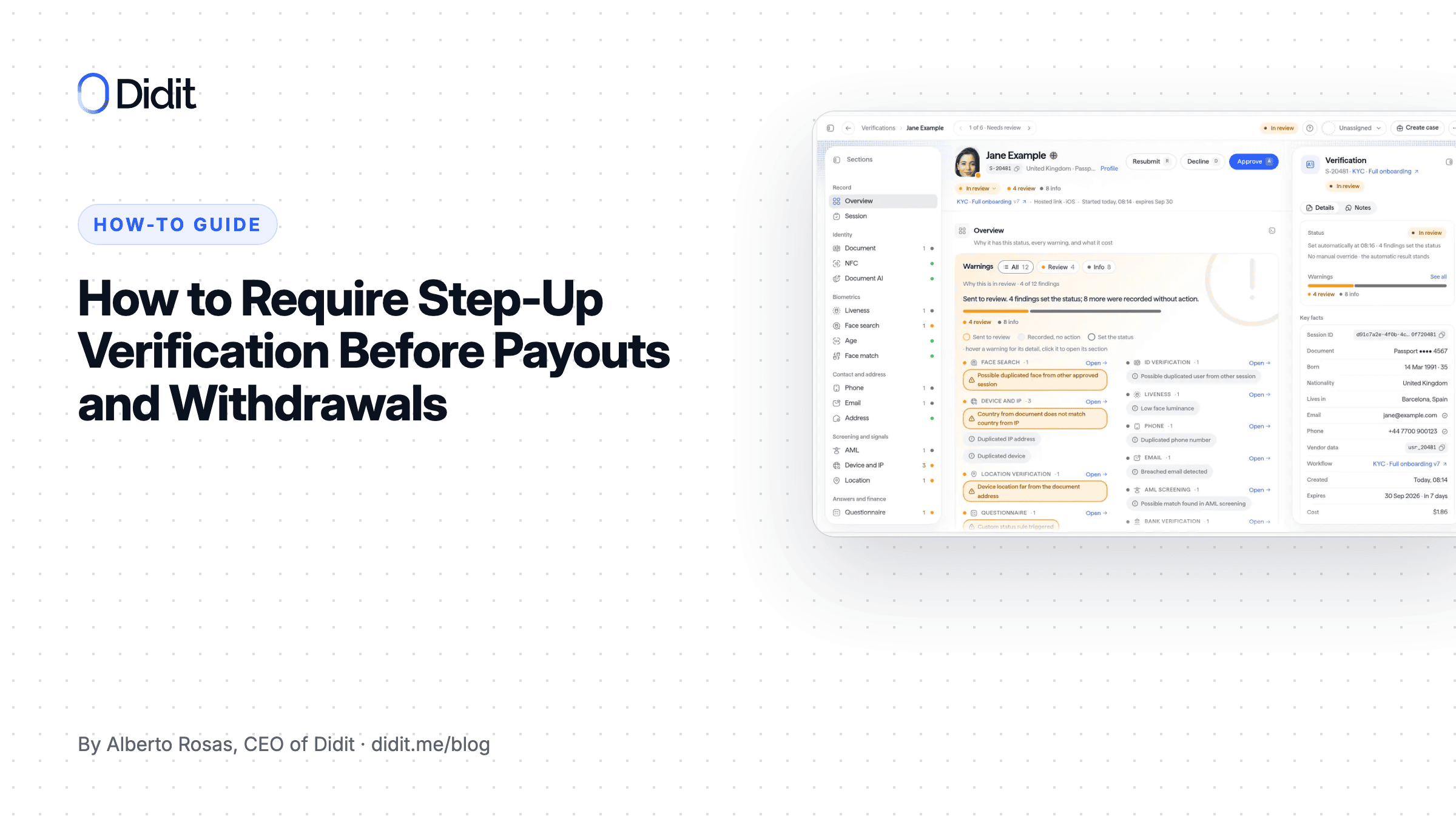 How to Require Step-Up Verification Before Payouts and Withdrawals
Set a payout threshold and check each withdrawal with Didit. If verification is required, send the user to verify and release the payout only after your backend confirms approval.
Alberto RosasNov 26, 2026Questions
Frequently asked questions
How do I verify a bank account belongs to someone before sending a payout with an API?
Send the account in its country's format and the name you hold to POST https://verification.didit.me/v3/bank/account-check/ with your Didit API key. The bank confirms whether the name matches the account, and you read match, close_match, no_match or cannot_verify. It needs no bank sign-in, runs in 47 countries and costs from $0.45 per answered check.
Does the payee have to sign in at their bank for this check?
No bank sign-in is required for the Account Check API. Your server sends the account and holder name, and you collect the holder's explicit consent before each check where required. A completed Bank Link sign-in demonstrates account control. With ownership comparison enabled, we compare the legal holder returned by the bank with a person or company already verified in Didit, and the verdict can be unknown if missing holder evidence could change it.
How many countries does the account check cover?
47 countries, among them Nigeria, Ghana, Kenya, Zambia, the United Kingdom, the euro area, the United Arab Emirates, Australia, the United States, India and much of Asia and Latin America. A country outside the list answers 404 with code: country_not_covered and is not billed. Coverage grows over time and Bank Verification pricing always shows the current list.
What does the account check cost, and what is not billed?
From $0.45 per answered check, the same prices as inside a verification flow, with each country's price on Bank Verification pricing. Two documented cases are never billed: a request refused for a missing consent, and a 404 with country_not_covered. Sandbox checks are $0, and Growth takes 4% off every Didit price and Scale 10%.
What is the difference between bank account name match and ownership verification?
A name match asks the bank whether it holds the account under the name you send. A completed Bank Link sign-in demonstrates account control. With ownership comparison enabled, Didit compares the legal holder returned by the bank with a person or company already verified in Didit, and the verdict can be unknown if missing holder evidence could change it. The account check needs no bank sign-in and starts at $0.45 per answered check. Where required, collect the holder's explicit consent before each check.
Why is holder_name null in my response?
In some countries the bank confirms whether the name matches without returning the name it holds, so result is match or no_match and holder_name stays null. That is the case in the United Kingdom, the euro area, the United States, Australia and India, among others. The full list sits in the Account Check API reference.
What is name_match_score and can I change the threshold?
When available, name_match_score is an integer from 0 to 100 that measures name similarity and is used to determine result. The score can be null, for example if the account does not exist or the bank returns neither a holder name nor a score. The API uses its default thresholds of 85 or higher for match and 70 to 84 for close_match. You can apply your own threshold to a numeric score for your payout decision, and the API's result stays the same.
What should I do when the result is close_match?
Hold the payout for review when you receive close_match. Compare the returned holder name where the bank returned one, or ask the payee to confirm the account. Do not release funds on a close match without that review.
Is a name match on a bank account proof of identity?
No. It confirms that the bank holds the account under the name you send, so it is only as good as the name you hold. Put ID Verification, Database Validation or a questionnaire before it in a workflow. Inside a session, we always compare the name that an earlier step already verified, and the person never types the name.
Can I check a company account, not just a person?
Didit's Account Check API supports company accounts in countries where business account checks are offered. Send holder.business_name and any registration ID the country requires, for example the CNPJ in Brazil or the NIT in Colombia. In a business verification session the check compares a business account with the verified business.
When is the account holder's consent required?
In some countries the check needs the account holder's explicit consent before each check. Ask for it in your product and send "consent": true; without it the call is refused with a 400 naming consent and is not billed. Elsewhere consent is optional, and when you send it we record it with the check's charge.
Compliance built in
Audited, certified and attested.
We hold the certifications and build each country's rules into your flows, so you can launch anywhere without worrying. Security and Compliance center
- Regulation encoded into your flows
Tell us what you do and where. Didit lists the rules that apply to you, with sources, and builds the checks each country needs into one workflow.
- Ready for AMLR
Every requirement of the new EU anti-money laundering rules, from checking customers to human review, is already covered by a Didit check.
- Tested in Spain's Treasury sandbox
Spain's Treasury published its supervised sandbox report on Didit's NFC plus active liveness onboarding; SEPBLAC took part and valued the added measures positively.
- Audited, not self-declared
iBeta Level 1 and Level 2. Liveness tested under ISO/IEC 30107-3.
Your obligations · 3 regions
 SOC 2 Type 2
 ISO 27001
 iBeta Level 1 and Level 2
 EU regulator attestation
 FSM youth protection
 GDPR
 EBA remote onboarding
 MiCA compatible
 FIDO Alliance member
- AMLREU AML Regulation ready
Integration · Didit MCP
Run Didit from your own AI agent
Connect Didit to Claude, Cursor, VS Code or ChatGPT and just ask in plain words. Your agent can do anything you can do in the console, with the same permissions you have.
 Add to Claude
 ChatGPT
 Cursor
- Build workflowsDescribe the checks you need. The agent creates and publishes the flow.
- Run investigationsAsk why a session was declined, review cases, search people and companies.
- Change rulesCreate payment rules, test them on past data and switch them on.
- Pull reportsAsk for numbers, exports or the audit log.
Didit Academy


