
Brazil's ECA Digital and Google Play: age signals in your app
What Google Play sends for users in Brazil, who has to receive it under ECA Digital and Decreto 12.880, when the age signal is enough, and when an app needs its own age check, with the data limits.
In short
Brazil's ECA Digital (Lei 15.211/2025) asks apps directed at minors, or likely to be accessed by them, to take measures to receive the age signal that app stores provide, and it leaves them responsible for what happens next.[1] Google says the Play Age Signals API returns age information in Brazil "on a mandatory basis" starting January 2027.[9]
- Mandatory sharing fixes the user's setting.[16] It is not a verified age, and Google's developer email says Play "doesn't mandate the use of these features".[12]
- For low-risk apps, the examples in ANPD's draft guide are the signal and verifiable credentials, not a selfie or a document.[4]
- Prohibited content and betting need age verification whatever the signal says, loot boxes too unless removed or restricted by default, and no document copy may be kept.[2][4]
Brazil's Digital ECA created a duty to receive an age signal, and Google has put a date on sharing it. It concerns every team with Brazilian users, in Brazil or abroad, because the law applies wherever the product is located, developed or operated.[1]
This guide maps ECA Digital (often searched as "Lei Felca"), its decree and the age signal to product decisions. Read it with our Play Age Signals API overview and the general guide to Brazil's Digital ECA.
ECA Digital and Google Play at a glance
| Question | Short answer |
|---|---|
| Which rules | Lei 15.211/2025, in force since 17 March 2026, and Decreto 12.880 of 18 March 2026, enforced by ANPD, the data protection agency[1][2] |
| Who is covered | IT products and services directed at children and adolescents in Brazil or likely to be accessed by them[1] |
| What stores do | Assess age and offer a free age signal through an API (Art. 12; Decreto art. 25)[1][2] |
| What apps do | Receive the signal, adapt the experience, keep own safeguards (Art. 14; Decreto art. 26)[1][2] |
| January 2027 | Google: sharing becomes mandatory. ANPD: enforcement stage on age assurance[3][9] |
One caution: we found no article of the law or the decree that sets January 2027 for mandatory sharing. The date is Google's statement; it coincides with ANPD's third stage, and any link between the two is our inference.[3][9]
Map your app to the signal
Show us your age gate and we will map it to the signal. Get a demo of age estimation in your app, or Start free.
What Google Play sends in Brazil, and since when
- 17 March 2026First signalsThe API starts returning age signals for users in Brazil.
- November 2026Version 0.0.6Adds a method to see if sharing is mandatory.
- By 11 December 2026All usersv0.0.6 returns responses globally.
- January 2027MandatorySharing becomes mandatory in Brazil, per Google.
Google's dates for Brazil.[9][10][11]
Where sharing is optional, the user chooses ask, always or never; in a mandatory region the setting is fixed to "Always share".[16] Our reading: handle NOT_SHARED for Brazilian users until January, and keep a no-signal branch afterwards for errors and for surfaces the API does not reach.
| You receive | What it tells you | What it does not tell you |
|---|---|---|
| Age range | 0-12, 13-15, 16-17 or 18+ by default[12] | The exact age or birth date; the decree forbids sending the latter[2][16] |
| TIER_A | The user gave an age to Google[12] | Whether Google confirmed it: it "may or may not have"[12] |
| TIER_B | A parent or guardian manages the age[12] | The exact age inside the range |
| TIER_C, TIER_D | An assessed or checked age[12] | Not stated for Brazil: Google returns them only where age verification is mandatory[12] |
| Nothing | No range shared, or an error[13] | Whether the user is a minor |
Google's example returns an adult where sharing is mandatory as TIER_A "regardless of age-verification status", so do not assume a verified age.[12] The API is limited to apps updated by Google Play, which leaves out your website and sideloaded builds, and Google may delay sharing a new range after a birthday.[10][16] Calls, statuses and tests are in the Play Age Signals integration guide.
On iPhone, Apple says (26 October 2026) that accounts in Brazil always share the age range if the developer requests it to comply with local laws; see the comparison with Declared Age Range.[17]
Who has to receive the signal: Article 14 and Decreto article 26
Law Article 14 tells every covered supplier to adopt technical and organisational measures "para garantir o recebimento das informações de idade" (to ensure it receives the age information) of Article 12. Whatever stores and systems do, suppliers must also have their own mechanisms against improper access by minors to unsuitable content.[1] ANPD reads the three "likely to be accessed" criteria together: probability of use and attractiveness, ease of access, and significant risk to privacy, safety or development.[1][7]
A gap to take to counsel
Decreto article 26 places the duty to receive signals on covered suppliers that offer improper, inadequate or prohibited content, products or services. Law Article 14 is wider, and Google's summary follows the law.[1][2][14] Confirm with counsel which reading applies to your app.
Art. 26, §3Decreto 12.880/2026
"O recebimento de sinais de idade não isentará a responsabilidade do fornecedor de produtos ou serviços de tecnologia da informação pela efetividade da adequação etária e das medidas de proteção adotadas."
Our translation: receiving age signals does not exempt the supplier from responsibility for effective age-appropriateness and protection measures. Source: Planalto, Decreto 12.880/2026[2]
- Browser-accessible services must assess age and may use signals from an operating system, a store or another digital service (Decreto art. 26, §2).[2]
- Editorially controlled, licensed, music and literary services are exempt from age assurance if they offer child profiles and parental supervision, blocking or restriction (art. 22).[2]
- Covered suppliers must keep a legal representative in Brazil (Law, Art. 40).[1]
Self-declaration: where it is prohibited and where it is not
Article 9, §1 asks for reliable age verification at each access, "vedada a autodeclaração" (self-declaration prohibited), for content, products or services that are improper, inadequate or prohibited for under-18s.[1] It is not a rule for every app in Brazil.
| Service | Rule on age | Reference |
|---|---|---|
| Prohibited products and services | Effective age verification, access blocked to minors; self-declaration prohibited | Law Art. 9; Decreto art. 15[1][2] |
| Pornography, including sexually explicit AI chat | Own verification mechanism; hide or blur by default, or verify before showing | Decreto arts. 16 and 17[2] |
| Social network with prohibited content | A version without it (no verification needed) or verification, no self-declaration | Decreto art. 19[2] |
| Store or marketplace selling prohibited products | Verification at sign-up or at purchase; no unblocking by self-declaration | Decreto art. 18[2] |
| Game with loot boxes | Verification, a version without them, or the feature fully restricted by default | Decreto art. 23[2] |
| Improper or inadequate content | Age rating, safety by default and parental supervision, cumulatively; the decree sets no flat verification duty | Decreto art. 14[2] |
| Other covered apps | Mechanisms for age-appropriate experiences; no flat ban on self-declaration found | Law Art. 10[1] |
Discuss the sixth row with counsel: Article 9 groups improper, inadequate and prohibited together while the decree splits them.[1][2] And where it is not banned it is still weak: ANPD's preliminary guidance says solutions based only on self-declaration have low reliability.[5]
Three risk levels in ANPD's preliminary guide (draft)
ANPD's guide on age assurance mechanisms is a preliminary version (versão preliminar) of May 2026. Public input closed on 9 July, and as of 22 November 2026 we found no final version.[3][4] The draft says its matrix must not be read as absolute.[4]
| Level (draft) | Examples given | Example mechanisms | What ANPD recommends |
|---|---|---|---|
| Low | Education, productivity and utility apps, games rated for all ages, general search | Store or system signal; verifiable credentials | Minimise data and reduce friction |
| Moderate | Social networks, mixed video, games with interaction or microtransactions, messaging, general generative AI, e-commerce | Also age estimation (biometric included) with strong safeguards; verification as a service | Layers: lower-impact methods first; an impact report |
| High | Prohibited content, products and services; games with loot boxes | Estimation complemented by verification; document checks with liveness | Layers do not replace mandatory verification; an impact report |
From Table 3 of the draft (May 2026).[4]
The draft is not a validation, endorsement or unrestricted authorisation by ANPD of any solution.[4] Decreto article 30 leaves certification to ANPD; we found no scheme in force.[2] For other markets, see age assurance for apps by category.
When the signal is enough
For a low-risk app the draft points to the signal and to verifiable credentials, and asks you to collect as little as possible.[4] A selfie for every user of a notes app would be hard to square with Decreto article 24, which requires proportionality and data minimisation.[2] Before you stop at the signal:
- Confirm that nothing in the app is on the prohibited list of Decreto article 15.[2]
- Check that the age rating and the features fit the youngest band you receive.
- Give the protective version to anyone whose band is missing or under 18.
The government's Q&A of 30 July 2026 says that an age rating does not mean every electronic game must carry out age assurance.[6] Articles 19 and 23 also drop the verification duty when the prohibited content or loot box is absent, or the loot box is fully restricted by default.[2]
When you need your own mechanism
1Receive the signal
Adapt the experience to the band.
2Place the feature in a risk level
Stop at the signal
Protective default when it is missing.
Signal, then estimate
Only for the restricted feature; a stronger method if borderline.
Verify every user
Document with liveness, whatever the signal.
3Apply the more protective result
Let the user contest it.
Our reading of the decree and the draft.[2][4] The risk level is your assessment.
Prohibited content and betting
The decree lists weapons, alcohol, tobacco and vapes, products that may cause dependence, fireworks, gambling and betting, loot boxes, pornography, escort services, services mainly meant for sexual encounters, and anything else the law prohibits. From gambling to sexual encounters (items VI to X), minors' accounts must be barred, identified and removed.[2] Stores must block betting services that are unauthorised or lack age verification (art. 21).[2] The draft wants verification "independentemente do sinal de idade recebido" (regardless of the age signal received), so estimation alone is not the listed answer here.[4] Betting has sector rules that this guide does not cover.
Loot boxes
Article 20 prohibits loot boxes (caixas de recompensa) in games directed at minors or likely to be accessed by them, under the applicable age rating.[1] The decree offers three ways: verify age before the feature, ship a version without it, or restrict it fully by default; the last two waive verification.[2] Google says you may need to resubmit the content rating questionnaire, and Play blocks or filters 18+ rated apps for users in Brazil it determines to be minors.[14]
Social networks
Article 24 says accounts of users "de até 16 (dezesseis) anos" (up to 16) must be linked to a guardian's; the official Q&A says under 16. It is not a ban, and an age check does not perform the linking.[1][6] If there are well-founded signs that a minor runs an account against minimum-age rules, the network must suspend access and offer a fast appeal where the guardian can prove age.[1]
When the signal fails
The draft asks suppliers to plan for failure or unavailability of the signal, and one example keeps high-risk content blocked after a crash until age is confirmed.[4] Our guide on what to do when there is no age signal has the full decision tree.
See the step-up on your own feature
Bring one restricted feature: we walk through the selfie, the document step and the data settings. Get a demo of age estimation in your app, or Start free.
If your result differs from the signal
Decreto article 25, §4: if your age result differs from the signal, you must apply the "alternativa mais protetiva a crianças e adolescentes" (the alternative more protective of minors).[2] So an own check in Brazil can only tighten; it cannot open what the signal closed.
| Signal | Your own check | Outcome to apply |
|---|---|---|
| 18+ | Minor | Minor experience; offer a way to contest[2] |
| 13-15 or 16-17 | Adult | Stay with the signal's band[2] |
| Missing | Any result | Our reading: no divergence, so your result stands |
| Any | Borderline or inconclusive | Draft guide: not a favourable result; go to the next layer[4] |
An adult in a minor's band needs another route: stores and systems must let the user contest and rectify the classification (Decreto art. 25, §2), and you must do so for the age you assess (art. 27).[2]
Data: keep no document, keep only what you need
Art. 24, §3Decreto 12.880/2026
"[...] vedado o armazenamento, a retenção ou qualquer forma de conservação da imagem, da cópia do documento ou da informação, que deverá ser eliminada de modo imediato e irreversível após a captura da informação necessária [...]"
Our translation: storing, retaining or keeping in any form the image, the document copy or the information is prohibited; it must be deleted immediately and irreversibly once the necessary information is captured. Source: Planalto, Decreto 12.880/2026[2]
Law Article 13 limits age verification data to that single purpose.[1] On facial estimation, the draft wants only a derived attribute returned, such as "over 18", and a solution that neither generates nor uses biometric identification templates.[4] The March guidance asks for a stronger justification for biometrics when a less intrusive option reaches an equivalent result.[5]
- Keep the Google signal in your app: no ads, analytics or profiling, and no third party unless strictly required by law.[10][15]
- Log the decision, the method and the time, without images or document data.[4]
- Delete the document image right after the age is read.[2]
- Write the impact report (moderate and high risk).[4]
- Document the error rates of any estimator.[4]
ANPD calendar 2026-2027 and fines
- March 2026Stage IPreliminary guidance; stores and systems monitored.
- August to November 2026AdaptationStage II; no final guide found by 22 November.
- From November 2026Sanction rulesUpdated procedures; consultation to 30 November.
- From January 2027Stage IIIEnforcement, with age assurance as a focus.
ANPD's timetable.[3]
ANPD's January date comes from its priority map, approved in December 2025.[8] ANPD says the timetable does not exclude other enforcement at any time.[3]
Article 35 allows a warning with up to 30 days to correct and a simple fine of up to 10% of the group's revenue in Brazil in its last financial year or, without revenue, R$10 to R$1,000 per registered user, limited to R$50 million per infraction. Courts decide on suspension or prohibition of activities. Amounts are updated yearly by inflation (IPCA), and a foreign company's establishment in Brazil is jointly liable for the fine.[1]
How Didit helps apps with Brazilian users after the signal
Didit's age verification is the check you run yourself when the signal is missing, only declared or not enough for the feature. Didit has no connector to the Play signal and should never receive it: your app decides that a check is needed and starts the session with your threshold and the method the feature needs.
| Brazilian need | Didit setting | Limit to know |
|---|---|---|
| Moderate-risk feature | Adaptive Age Verification: selfie with liveness, document only inside the band you set[18] | Below the lower bound the result is a decline, so set the band on purpose[23] |
| Prohibited content, betting, loot boxes | ID Verification with liveness for everyone, minimum age 18[18] | Estimation alone is not the draft's answer[4]; age limits follow the document's issuing country[18] |
| Yes or no only | ISO/IEC 27566-1 workflow: the decision and no personal data[18] | Accepts a minimum age of 13 or more; the declaration cannot be changed later[18] |
| No face template in the estimate | face_search_enabled false, or save_api_request false on the standalone API[19][21] | Both are on by default |
| No document kept | Process and purge: call the delete endpoint when your webhook arrives[20] | Retention windows start at one month[20] |
Whether a delete call right after the result meets "imediato e irreversível" (immediate and irreversible) is a question for your counsel; switching off returned data is not deletion. Data is stored in the European Union (Ireland) by default.[20]
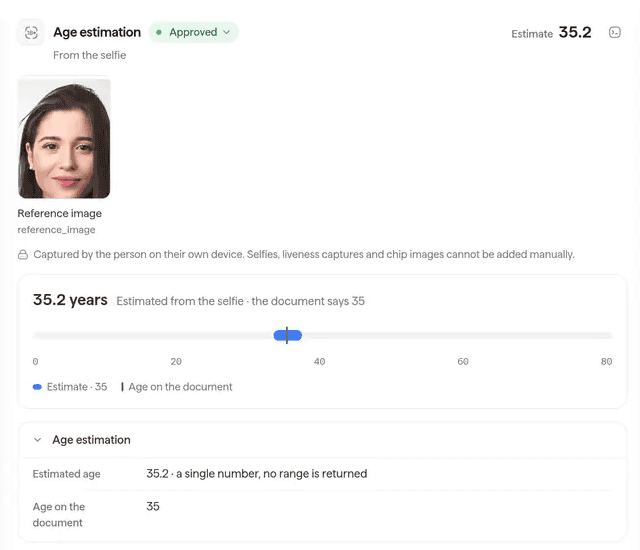
The age estimation result in the Didit console (sample data): the estimate from the selfie next to the age on the document.
In Didit's own evaluation set of 2,399 selfies of people aged 13 and over, for the model in production since 4 November 2026, the mean absolute error is 1.1 years for 16 and 17-year-olds and 1.9 years for 18 to 20-year-olds.[18] That is not an independent benchmark and says nothing about under-13s. Age Estimation costs $0.10 per check and document capture in a workflow $0.15, charged only when the band sends the user there; see pricing.[18][22]
Didit provides
- A selfie age estimate with liveness
- The document step, with the portrait matched to the selfie
- Data, face search and deletion settings
Stays with you
- Receiving and keeping the store signals
- The risk level, the threshold and the more protective outcome
- Appeals, the impact report and the legal reading
- Account linking
Put a Brazilian age check behind one feature
Get a demo of age estimation in your app: the signal stays on your side, and the check runs only where you decide.
Key takeaways
- January 2027 is Google's date for mandatory sharing and the start of ANPD's stage III.
- Receiving the signal does not remove the app's responsibility; for low-risk apps, ANPD's draft examples are the signal and verifiable credentials.
- Prohibited content and betting need age verification; estimation alone is not enough. Loot boxes can be removed or restricted instead.
- The more protective result applies, and document images must not be kept.
Frequently asked questions
Does Google require apps in Brazil to use the Play Age Signals API?
No. Its November 2026 developer email says Google Play "doesn't mandate the use of these features". What becomes mandatory is the user's sharing.[16] The law is separate: Article 14 asks covered suppliers to take measures to receive the age information.[1]
Is ECA Digital in force, or was it revoked?
It is in force: the consolidated text says 17 March 2026 for the law, and Decreto 12.880 took effect on publication on 18 March 2026.[1][2]
What changes in January 2027?
Two things. Google says the API returns age information for users in Brazil on a mandatory basis, and ANPD starts the stage of enforcement actions that focuses on age assurance.[3][9]
Does every app have to verify age in Brazil?
No. Covered apps must provide age-appropriate experiences and take measures to receive the signal; the decree reserves effective verification for prohibited content, products and services.[1][2]
Is self-declaration of age prohibited in Brazil?
Not for every app. Article 9, §1 prohibits it for content, products or services that are improper, inadequate or prohibited for under-18s.[1] Elsewhere, ANPD's preliminary guidance still rates self-declaration alone as having low reliability.[5]
Do all games have to check age?
No. The official Q&A says not every electronic game has to carry out age assurance.[6] A game with loot boxes must verify age, offer a version without them or restrict the feature fully by default.[2]
Is the Google Play signal enough?
It can be for a low-risk app, where the ANPD draft lists it among the mechanisms. For prohibited content, betting or loot boxes the draft asks for verification regardless of the signal.[4] Receiving it does not remove your responsibility.[2]
Can I use facial age estimation in Brazil?
The draft guide lists estimation, including biometric analysis with strong safeguards, for moderate risk, and for high risk only when complemented by verification.[4] ANPD's separate guidance of March 2026 asks for a stronger justification when a less intrusive option gives an equivalent result.[5]
Can I keep a copy of the ID document?
No. Decreto article 24, §3 requires immediate and irreversible deletion after the needed data is captured.[2]
What is the fine under ECA Digital?
Up to 10% of the group's revenue in Brazil or, without revenue, R$10 to R$1,000 per registered user, limited to R$50 million per infraction.[1]
Sources
- Lei 15.211/2025 (ECA Digital), consolidated text, Planalto.
- Decreto 12.880 of 18 March 2026, Planalto.
- ECA Digital page and timetable for age assurance, ANPD, read on 22 November 2026.
- Guia Orientativo: Mecanismos de Aferição de Idade (Versão Preliminar), ANPD draft for public input, May 2026.
- Mecanismos confiáveis de aferição de idade: orientações preliminares, ANPD, March 2026.
- Perguntas e respostas sobre o ECA Digital, ANPD, MJSP and Secom, 30 July 2026.
- ANPD publica guia sobre responsabilidades das plataformas, Ministério dos Direitos Humanos, October 2026.
- Fundamentação of the ANPD timetable (priority map 2026-2027), ANPD.
- Regional age-related protections on Play, Google, updated 18 November 2026.
- Play Age Signals overview (v0.0.6) and terms, Google, updated 18 November 2026.
- Play Age Signals overview (v0.0.4), Google.
- Understand age signals responses, Google, updated 18 November 2026.
- Request age signals, Google, updated 18 November 2026.
- Distributing your app in Brazil: Digital ECA requirements, Google Play Console Help.
- Age Signals API and User Data policy, Google Play policy.
- About age range sharing on Google Play, Google Play Help.
- Age requirements for managing an Apple Account in Brazil, Apple, 26 October 2026.
- Age Estimation overview, Didit docs.
- Workflow feature configs, Didit docs.
- Data retention and deletion, Didit docs.
- Age Estimation API, Didit docs.
- Pricing, Didit docs.
- Age Estimation warnings, Didit docs.
Receive the signal, act on it, and add a check only where the risk asks for one. Didit's age verification covers that second step for Brazilian users; confirm with counsel which rule applies to your app.
See where your app needs more than the signal
Get a demo of age estimation in your app, with the risk levels and data settings for Brazil.
Artigos relacionados
- Google Play Age Signals API: o que muda em janeiro de 2027
- Age assurance for apps: games, social, dating, AI and more
- Age verification API: which one works on apps, web and stores
- California age verification law 2027: the four rules for apps
- App Store Accountability Acts: Texas, Utah, Louisiana, Alabama
- Play Age Signals vs Apple Declared Age Range: full comparison