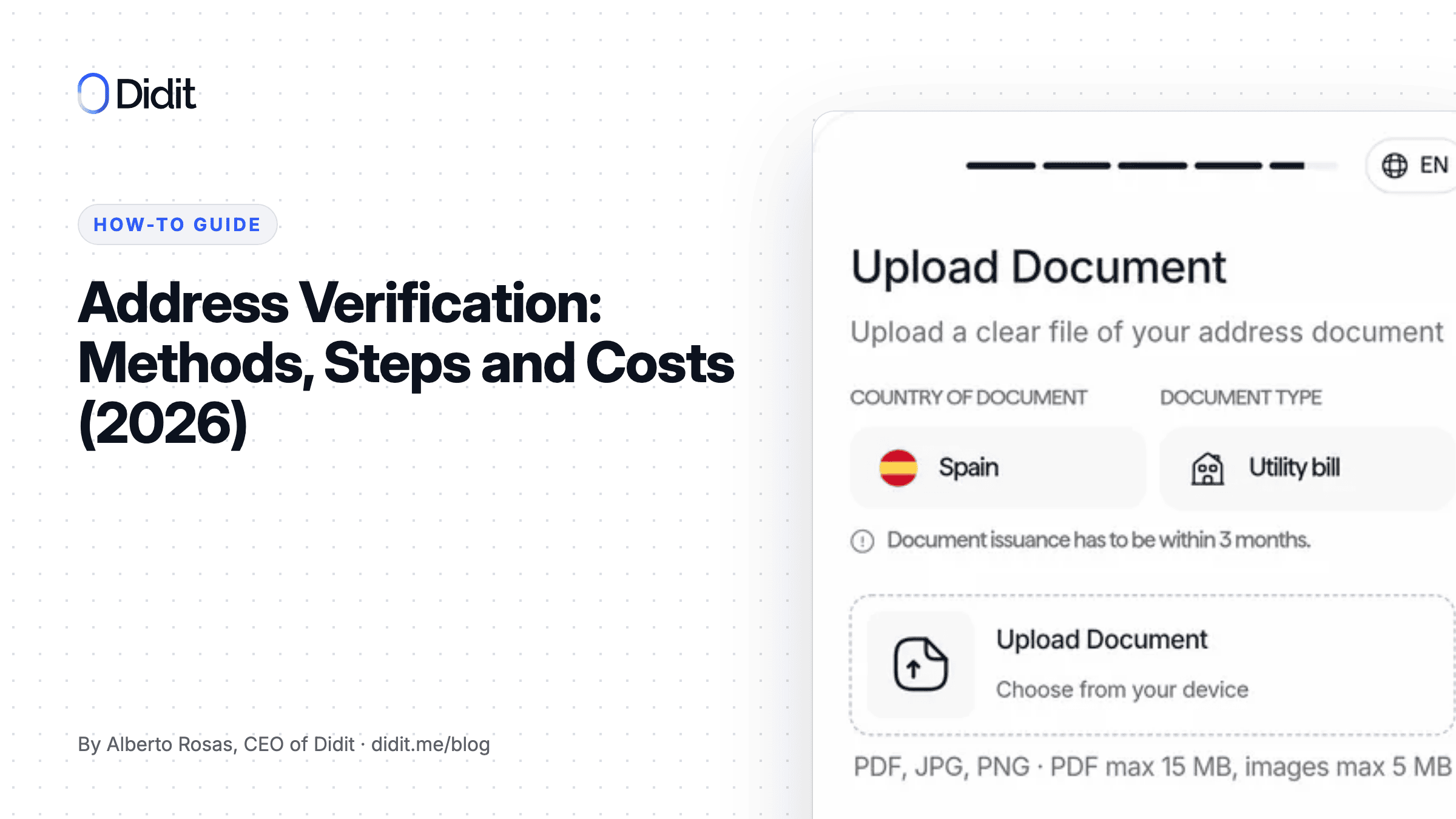
Address Verification: Methods, Steps and Costs (2026)
Address validation confirms a place exists for $0.10; a proof of address document ties a person to it for $0.20. Steps, API calls, outputs and failure handling inside.
 Alberto RosasCo-founder and CEO
Contents
In this guide
Jump to the part you need.
Address verification answers two questions: does this address exist, and can this person show they live there. It fits fintechs, marketplaces, crypto and iGaming teams that must tie a person to an address for onboarding or delivery. We price address validation at $0.10 per address and a proof of address check at $0.20. The caveat matters: a validated address confirms a place exists, never that a person lives there.
Last updated: November 26, 2026. Prices checked against the live Didit price feed on November 26, 2026.
| Question | Answer |
|---|---|
| What does address validation prove? | That the place exists, returned normalised with coordinates. Never that a person lives there. |
| What does proof of address prove? | That a document naming the person carries that address, after OCR, document age, language and tamper checks. |
| Didit prices | Address Validation $0.10 per address. Proof of Address $0.20 per check. Precise location $0.05 per check. Database validation from $0.05. Full ID check $0.33. |
| How it runs | Standalone server-to-server API, or as a workflow step with address_validation_enabled. |
| Typical latency | Document extraction takes 5 to 15 seconds, up to about 30 seconds for multi-page PDFs. Use a client timeout of at least 45 seconds. |
| Who this fits | Fintechs, marketplaces, crypto, iGaming, lenders and any team that must tie a person to an address for KYC or for delivery. |
Start free in the sandbox at business.didit.me, with no sales call. For developers, connect Didit to an AI assistant through the Didit MCP server. The two calls in this guide are the Address Validation API and the Proof of Address API, both listed on the pricing page.
What address verification is, and what it does not prove
Address verification is a family of checks, not one check. Buyers use the term for three different things, and mixing them up is how a team ends up with a green tick that means nothing.
- Address data verification, also called address validation, confirms that a postal address exists, returns it in the country's own format and adds coordinates. On Didit this is
POST /v3/address-validation/at $0.10 per address. - Proof of Address checks a document that ties a person's name to a residential address: a utility bill, a bank statement, a government letter or a lease. On Didit this is
POST /v3/poa/at $0.20 per check. - Address fraud detection is the judgement on top: does the document match the identity document, is the device near the address, and which risk signals you configured fired on this session.
That distinction is the most useful thing on this page. The Address Validation API confirms the address only. It never links the address to a person, so a verified result means the place exists, not that anyone lives there. Proof of address is what adds the person.
Why address verification matters for fraud, compliance and delivery
The advantages are concrete and easy to audit:
- Fraud prevention. Address checks return specific, documented findings:
ADDRESS_MISMATCHwhen the extracted address disagrees withexpected_address,COUNTRY_MISMATCH,NAME_MISMATCH,OVERLAY_MANIPULATION_DETECTEDwhen forensics catch an edit, andADDRESS_NOT_VERIFIEDwhen the address itself does not validate. Every Didit session carries 200+ fraud signals, and the location step adds the device position and its distance from the IP location the session was sent from. - Compliance records. Address checks can support customer-due-diligence records. Confirm the required fields for your jurisdictions with qualified counsel. Didit keeps the decision and every warning on the session, so the file can be produced later.
- Fewer failed deliveries and disputes. An address that fails validation leads to failed deliveries, re-shipment cost and disputes. Validating the address before you store it, and normalising it before a carrier sees it, removes those failures earlier than a refund does.
- Reuse. A verified address is a reusable attribute. Reusable KYC is free on every plan. Confirm the supported reuse flow in the relevant documentation before applying it to address checks.
The six methods, compared
| Method | What it proves | Price | Main limit |
|---|---|---|---|
| Address validation API | The place exists, normalised, with coordinates. Address type and the residential classification come back only for the countries the docs list. | $0.10 per address | No person link at all |
| Proof of address document | A document naming the person carries that residential address | $0.20 per check | Needs a document, and its age, language and tampering must be judged |
| Database validation | The identity fields match the authoritative national record, including address fields where the service uses them | From $0.05 per check, variable by country and service | Coverage depends on the country and the registry |
| Device location and IP distance | Where the person was during the session. The IP comparison is on by default at 200 km. The comparison with the document address is off until you configure it separately. | Precise location $0.05 per check, device and IP analysis $0.03 | One reading, not a residence |
| Email and phone signals | Reachability and risk attached to the contact points | Email $0.02, phone from $0.02 | Corroborating signals, never proof |
| Manual review | A human judgement on the edge cases | Pricing not specified in the supplied sources | Slow, and expensive as a first line |
How AI address verification works
AI does the reading and the sanity checks. The document is classified into a type and subtype, for example UTILITY_BILL or WATER_BILL, and the issuer, dates, holder name and address are extracted. The address is parsed and geocoded into poa_parsed_address. PDF and EXIF forensics screen for tampering: modification after digital signing, known PDF editors, overlay-text manipulation, suspicious re-exports. Document age is checked against poa_document_age_months and the language against poa_languages_allowed. The extracted values are then cross-checked against expected_address, expected_country, expected_first_name and expected_last_name, and every finding comes back as a warning with a stable code instead of prose.
How to verify an address: prerequisites and steps
Prerequisites
- A Didit account and an API key from the Business Console. Sign up at business.didit.me. A sandbox key never charges: sandbox calls return a static Approved mock payload, no session is persisted and no credits are consumed.
- The address as you hold it, on one line or as structured fields, plus the country as an ISO 3166-1 alpha-2 or alpha-3 code.
- For the document check, a file up to 15 MB in PDF, JPG, PNG, TIFF or WebP, and
document_passwordfor an encrypted PDF. - A client timeout of at least 45 seconds, because extraction is LLM-based and a multi-page PDF can take about 30 seconds.
Steps
- Decide which question you are answering. If you only need the address to exist and be normalised for delivery, one call to
POST /v3/address-validation/is enough. If you must show the person is at that address for KYC, add the proof of address document check. - Validate the address. Send it on one line in
address, or as structured fieldsaddress_line_1,address_line_2,city,region,postal_code. Never send both shapes in one request.countryis always required.curl -X POST 'https://verification.didit.me/v3/address-validation/' \ -H "x-api-key: $DIDIT_API_KEY" \ -F "address_line_1=Av. Monseñor Tavella 3396" \ -F "city=Salta" \ -F "country=ARG" - Read the status, not just the HTTP code.
address_validation.statusisverified,partially_verified,not_verifiedorunavailable.verification_leveltells you how deep the match went:administrative_area,locality,thoroughfare,premiseordelivery_point. Anunavailableresult is not charged, so retry it later rather than failing the customer. - Run the proof of address check with the values you already hold, so the extraction is cross-checked rather than trusted.
curl -X POST 'https://verification.didit.me/v3/poa/' \
-H "x-api-key: $DIDIT_API_KEY" \
-F "document=@./utility-bill.pdf" \
-F "expected_address=Av. Monseñor Tavella 3396, Salta" \
-F "expected_country=ARG" \
-F "expected_first_name=Sophia" \
-F "expected_last_name=Martinez" \
-F "poa_languages_allowed=en,es" \
-F "vendor_data=user-1234"
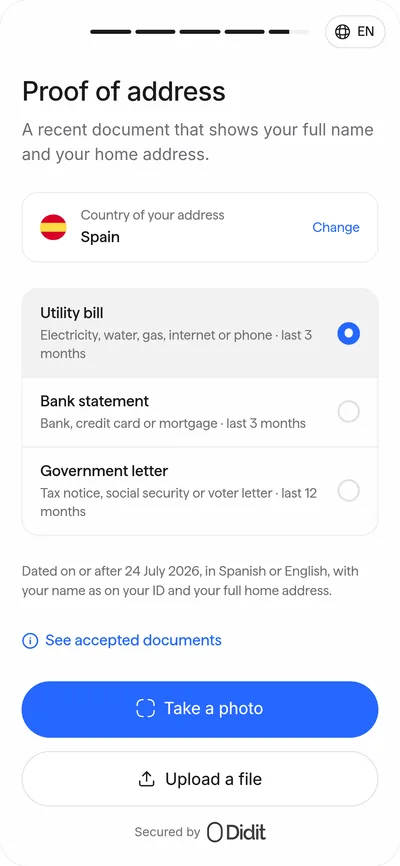
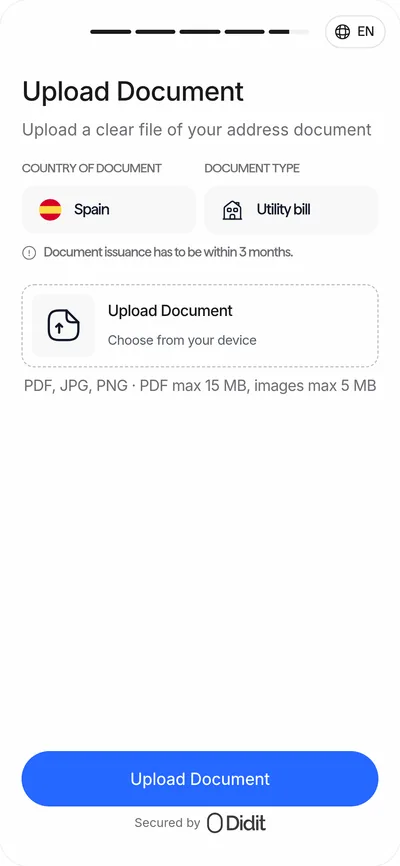
Expected output
A readable document returns HTTP 200 even when the decision is negative. Always inspect poa.status and poa.warnings.
{
  "request_id": "...",
  "poa": {
    "status": "Approved",
    "parsed_address": {...},
    "document_type": "UTILITY_BILL / WATER_BILL",
    "issuer": "...",
    "issue_date": "...",
    "language": "...",
    "document_metadata": {"overlay_manipulation": "..."},
    "warnings": []
  }
}- In a workflow, use the add-on instead of a second call. Turn on
address_validation_enabledin the ID Verification or Proof of Address step and the address printed on the document is validated once the upload is read. The result lands as theaddress_validationobject of that step's entry inid_verifications[]orpoa_verifications[], and it costs $0.10 per address validated. Apartially_verifiedornot_verifiedaddress raises theADDRESS_NOT_VERIFIEDwarning, whose action isaddress_not_verified_actionand defaults toNO_ACTION. - Retrieve the decision and keep it. Use
GET /v3/session/{sessionId}/decision/or subscribe tosession.status.updated. Keep therequest_id: withsave_api_requestset tofalsenothing is stored and therequest_idis a one-off correlation UUID you cannot look up later. The per-check report is documented at the proof of address report page. - Route the outcome. Approve on
Approved, send mismatches to review, reject manipulation findings. The next table maps each failure to a recovery.
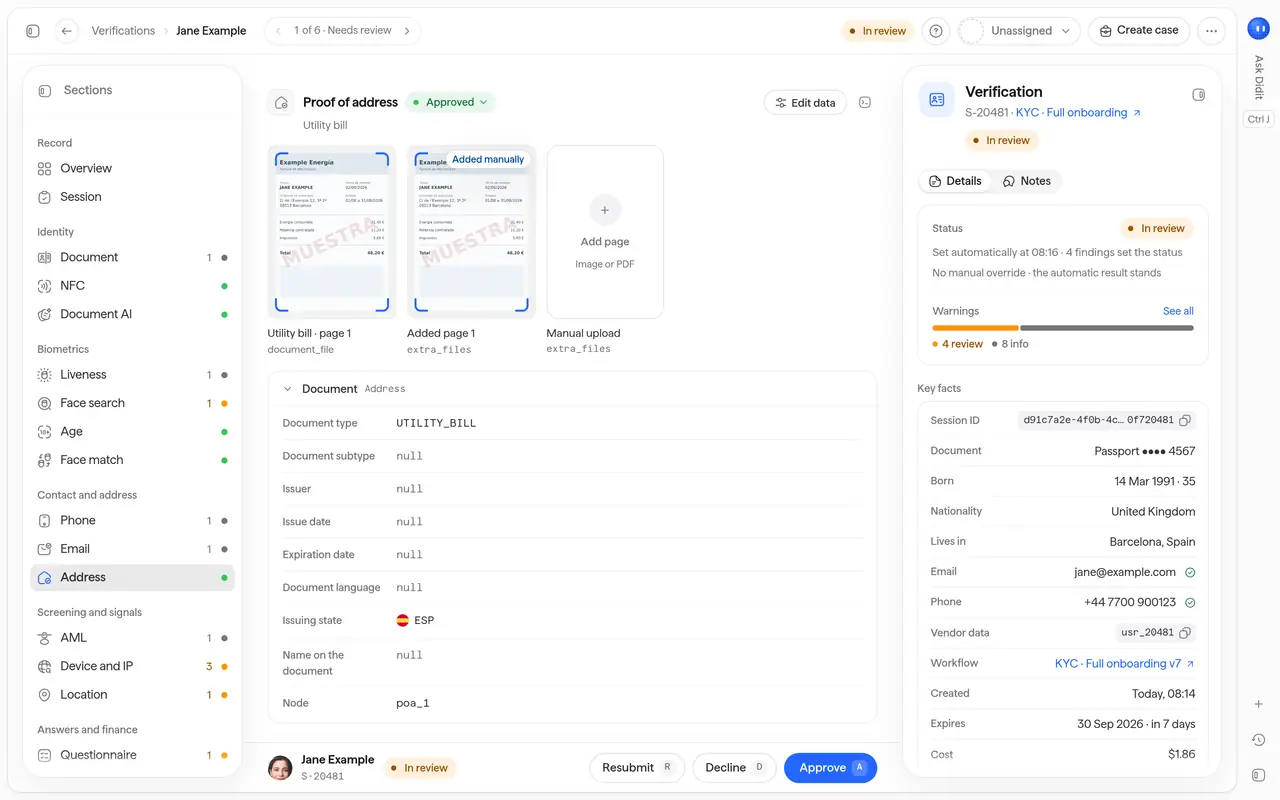
Inputs and outputs
| Field | Call | What it does |
|---|---|---|
address or address_line_1 with city, region, postal_code | Address Validation | The address to confirm. One shape per request, never both. |
country | Address Validation | Required. ISO 3166-1 alpha-2 or alpha-3. |
document | Proof of Address | PDF, JPG, PNG, TIFF or WebP, up to 15 MB. |
document_password | Proof of Address | Needed for an encrypted PDF, otherwise HTTP 400 with code: "encrypted_pdf". |
expected_address, expected_country, expected_first_name, expected_last_name | Proof of Address | Cross-checks. A disagreement surfaces as a warning. |
poa_languages_allowed, poa_document_age_months | Proof of Address, workflow config | Language and document age limits. |
vendor_data | Both | Your own identifier, returned with the result. |
status, verification_level, formatted_address, latitude, longitude, address_type, is_residential | Address Validation output | Existence answer, precision, the normalised address and coordinates. address_type comes back only for United States and Canadian addresses, and is_residential only for the United States, Great Britain, the Netherlands and Ireland; both are null elsewhere. |
poa.status, poa.warnings[], parsed_address, document_metadata | Proof of Address output | The decision, the reasons behind it and the geocoded address. |
Failure cases and recovery
| Signal | Meaning | Recovery |
|---|---|---|
HTTP 400, code: "encrypted_pdf" | The PDF is password protected or the password is wrong | Send the correct document_password or a decrypted copy |
HTTP 400, code: "document_unreadable" | The file is corrupt or cannot be opened | Ask for a different file. Branch on code, never on the message text |
HTTP 503, code: "document_processing_busy" | Too many documents are being processed and the upload was not processed | Send the same file again after the Retry-After seconds |
| HTTP 403 | Not enough credits | Top up or check the plan balance; nothing was processed |
| Client timeout | Your client gave up before extraction finished | Raise the timeout to 45 seconds or more and do not retry before the call completes |
status: "Declined" with NAME_MISMATCH or ADDRESS_MISMATCH | The extracted fields disagree with the expected ones | Do not approve. Ask for a document in the customer's own name at the stated address |
OVERLAY_MANIPULATION_DETECTED, SUSPECTED_DOCUMENT_MANIPULATION, DOCUMENT_METADATA_MISMATCH | Forensics found edits or a suspicious re-export | Reject, and keep the finding on file |
POA_DOCUMENT_EXPIRED, DOCUMENT_TOO_OLD, LANGUAGE_NOT_ALLOWED | The document breaks a rule you set | Ask for a newer document or widen poa_document_age_months and poa_languages_allowed deliberately |
address_validation.status: "unavailable" | The validation could not run | Retry later. It is never charged and never raises ADDRESS_NOT_VERIFIED |
partially_verified or not_verified | Only the street, city or region matched, or nothing did | Treat as its own outcome, not as a pass. Route to review or ask for a corrected address |
Paid steps and review boundaries
Three things cost money in this flow: address validation at $0.10 per validated address, the proof of address check at $0.20 per document checked, and the location step if you use it, at $0.05 per precise location check or $0.03 for device and IP analysis. The rest of the sequence is not billed by Didit: reusable KYC, the workflow orchestrator, the SDKs and the MCP server are free on every plan.
The charging rules we apply are simple. A check that completes with a result is billed. An unavailable address validation is not charged. A request refused with HTTP 403 for lack of credit is refused before any document processing, so nothing is billed. Sandbox calls are never charged. Inside a workflow, the address validation add-on costs $0.10 per address a step validated.
Review boundaries matter as much as prices. Send to a person only what the warning actions mark as review. A manipulation finding should be declined, not reviewed. Leave address_not_verified_action at its default NO_ACTION while you measure how often a partial match happens, and change it once you know what a partial match means for your customer base.
Best practices that hold up in an audit
- Collect structured fields, not a free-text blob. The country code is what makes every later check possible.
- Pass the
expected_*values you already hold from the ID document. The cross-check is the cheapest fraud signal you have. - Set the action per warning, not one global switch. A language mismatch and a manipulation finding do not deserve the same answer.
- Cap document age and language explicitly instead of accepting whatever arrives.
- Do not round
partially_verifiedup to verified. Report the verification level you actually reached. - Keep the decision, the warnings and the document metadata. A re-run next year may see a different document.
- Check the device too. Precise location is $0.05 per check. The default IP-distance threshold is 200 km. Document-distance comparison must be configured separately with
geolocation_document_distance_km. - Reuse an address you already verified instead of asking for it again. Reusable KYC is free on every plan.
Address verification for fintech and regulated onboarding
A fintech usually needs the person link, not the place. For a lender, comparing the address on a bank statement with the address on an ID can identify mismatches for review. For a crypto business the address belongs on the customer file next to the AML result, which we price at $0.20 per check against 1,300+ lists. For a marketplace, delivery accuracy and seller due diligence pull in opposite directions, and the company address is checked in business verification while the owner's address goes through proof of address.
Our recommendation follows the documented flow: validate the address first with POST /v3/address-validation/, add the proof of address check with POST /v3/poa/ only when the risk or the regulator asks for a document, and use a workflow when you need both checks on one session, or store the two standalone responses together in your own case record.
Worked cost example
Take 2,000 new customers a month in a market where 20% of them need a proof of address document.
- Address validation on every customer: 2,000 x $0.10 = $200.00
- Proof of address on 400 customers: 400 x $0.20 = $80.00
- Full ID check on every customer, for context: 2,000 x $0.33 = $660.00
- Monthly total at list price: $200.00 + $80.00 + $660.00 = $940.00
- On Scale, every Didit price is 10% lower: $940.00 x 0.90 = $846.00
Drop the document check and rely on address validation alone and the month is $200.00 + $660.00 = $860.00, but nobody has been tied to the address. That $80.00 is the difference between knowing a place exists and knowing a person claims it.
Sources
- Didit docs: Address Validation API
- Didit docs: Proof of Address API
- Didit docs: Proof of Address overview
- Didit docs: proof of address report
- Didit docs: Location Verification
- Didit docs: Database Validation
- Didit docs: Create Session API
- Didit docs: pricing and billing
- Didit pricing page and cost estimator
- Didit MCP server
- FATF Recommendations, fatf-gafi.org, read November 26, 2026, background on due diligence expectations
- Directive (EU) 2015/849, EUR-Lex, read November 26, 2026, background on due diligence expectations
You can inspect the outputs with a sandbox key: create one at business.didit.me, call address validation with a real address and proof of address with one bill, and read the warnings. No sales call, and sandbox calls never charge.
Try it
Try this in the sandbox
Run the check this guide describes, free.
The product this post is about, taken from its topic. Run it free in the sandbox.
Author
Alberto Rosas
Co-founder and CEO

Keep reading
Other guides in the same topic.
 What Is the Purpose of FICA in South Africa? 2026 Guide
FICA is South Africa's anti-money laundering law. It creates the Financial Intelligence Centre and requires accountable institutions to identify and verify clients, screen for PEP and sanctions risk and report suspicious.
Alberto RosasNov 26, 2026 Sixth Money Laundering Directive (6AMLD): What Changed and Which Rules Apply
6AMLD is Directive (EU) 2018/1673: Member States must criminalise laundering, widen predicate offences and set a four-year penalty floor. It adds no new due diligence duties for firms.
Alberto RosasNov 26, 2026 Automated Sanctions Screening: Canada, the Entity List and Embargoes
Automated sanctions screening matches people and companies against lists such as Canada's autonomous sanctions made under SEMA and JVCFOA and the OFAC SDN List, and returns candidate hits scored for identity confidence and.
Alberto RosasNov 26, 2026Questions
Frequently asked questions
What is address verification?
Address verification is the process of confirming that a postal address exists and, when required, that a person is connected to it. On Didit, address validation confirms the place and returns it normalised with coordinates for $0.10 per address, and a proof of address check confirms a document in the person's name for $0.20 per check.
What are the steps in the address verification process?
Collect the address with an ISO country code, validate that it exists, run a proof of address document check if you need to tie a person to it, then read the status and warnings and route mismatches to review. In a Didit workflow the same checks run as steps and land on the session decision under poa_verifications[]. The whole sequence can be two API calls or one hosted flow.
How much does address verification cost on Didit?
Address Validation is $0.10 per address, Proof of Address is $0.20 per check, precise location is $0.05 per check and database validation starts at $0.05 per check and varies by country. A full ID check is $0.33. Growth takes 4% off every Didit price and Scale takes 10%.
Does a verified address mean the person lives there?
No. A verified address validation result means the place exists down to the building, the flat or the PO box, and it says nothing about who lives there. To connect a person to the address you need a proof of address document or a registry check.
What is the difference between address validation and address authentication?
Address validation checks that the address exists and returns it normalised with coordinates, plus an address type and a residential flag where the country is supported. Proof of Address ties a named person to that residential address, typically a utility bill, bank statement, government letter or lease, and adds age, language and tamper checks.
What documents are accepted as proof of address?
Utility bills, bank statements, government-issued documents and leases, uploaded as PDF, JPG, PNG, TIFF or WebP up to 15 MB. An encrypted PDF needs document_password, otherwise the call returns HTTP 400 with code: "encrypted_pdf". Document age and language are bounded by poa_document_age_months and poa_languages_allowed.
How do fintechs use address verification for regulatory compliance?
Fintechs run it as part of customer due diligence: the address is collected, checked against a document or a registry, and the decision is stored on the customer file. Address checks can support customer-due-diligence records, and you should confirm the required fields for your jurisdictions with qualified counsel. Didit keeps the status and every warning on the session, so the evidence can be produced at audit time.
How does AI address verification work?
AI reads the document and checks it: it classifies the document type, extracts the issuer, dates, holder name and address, parses and geocodes the address, and runs PDF and EXIF forensics for edits. It then compares the extracted values with the expected ones and returns a status plus a list of warnings with stable codes that explain each finding.
Can I verify an address without a hosted flow?
Yes. Both checks are standalone server-to-server calls, POST /v3/address-validation/ and POST /v3/poa/ on https://verification.didit.me, authenticated with the x-api-key header. Keep save_api_request at its default of true if you want the call stored as an API session you can look up later, and set it to false only when you do not need the record.
What happens when a proof of address check is declined?
A readable but problematic document returns HTTP 200 with status: "Declined" and the reasons in warnings. Common causes are NAME_MISMATCH, ADDRESS_MISMATCH, POA_DOCUMENT_EXPIRED and manipulation findings. Mismatches should not be approved, and manipulation should be rejected.
How does address verification reduce failed deliveries and disputes?
An address that fails validation leads to failed deliveries, re-shipment cost and disputes. Validating and normalising the address before you store it, and again when the customer edits it, catches those cases while the customer is still in the flow. It also hands the carrier format the country expects instead of free text typed in a hurry.
What should an AI address verification platform return?
It should return a status you can act on, a normalised address with coordinates, and a machine-readable list of warnings with stable codes rather than prose. It should let you set the action per warning, approve, review or decline, and it should keep a record you can retrieve later. Didit exposes all of that on the session decision, through the API, webhooks and the Business Console.
Is address verification part of digital identity?
It is one attribute of a digital identity, and a reusable one: once verified, the address can serve onboarding, payments and ongoing monitoring instead of being collected again. Keep it separate from authentication, because verifying an address does not authenticate a person at login.
Compliance built in
Audited, certified and attested.
We hold the certifications and build each country's rules into your flows, so you can launch anywhere without worrying. Security and Compliance center
- Regulation encoded into your flows
Tell us what you do and where. Didit lists the rules that apply to you, with sources, and builds the checks each country needs into one workflow.
- Ready for AMLR
Every requirement of the new EU anti-money laundering rules, from checking customers to human review, is already covered by a Didit check.
- Tested in Spain's Treasury sandbox
Spain's Treasury published its supervised sandbox report on Didit's NFC plus active liveness onboarding; SEPBLAC took part and valued the added measures positively.
- Audited, not self-declared
iBeta Level 1 and Level 2. Liveness tested under ISO/IEC 30107-3.
Your obligations · 3 regions
 SOC 2 Type 2
 ISO 27001
 iBeta Level 1 and Level 2
 EU regulator attestation
 FSM youth protection
 GDPR
 EBA remote onboarding
 MiCA compatible
 FIDO Alliance member
- AMLREU AML Regulation ready
Integration · Didit MCP
Run Didit from your own AI agent
Connect Didit to Claude, Cursor, VS Code or ChatGPT and just ask in plain words. Your agent can do anything you can do in the console, with the same permissions you have.
 Add to Claude
 ChatGPT
 Cursor
- Build workflowsDescribe the checks you need. The agent creates and publishes the flow.
- Run investigationsAsk why a session was declined, review cases, search people and companies.
- Change rulesCreate payment rules, test them on past data and switch them on.
- Pull reportsAsk for numbers, exports or the audit log.
Didit Academy


