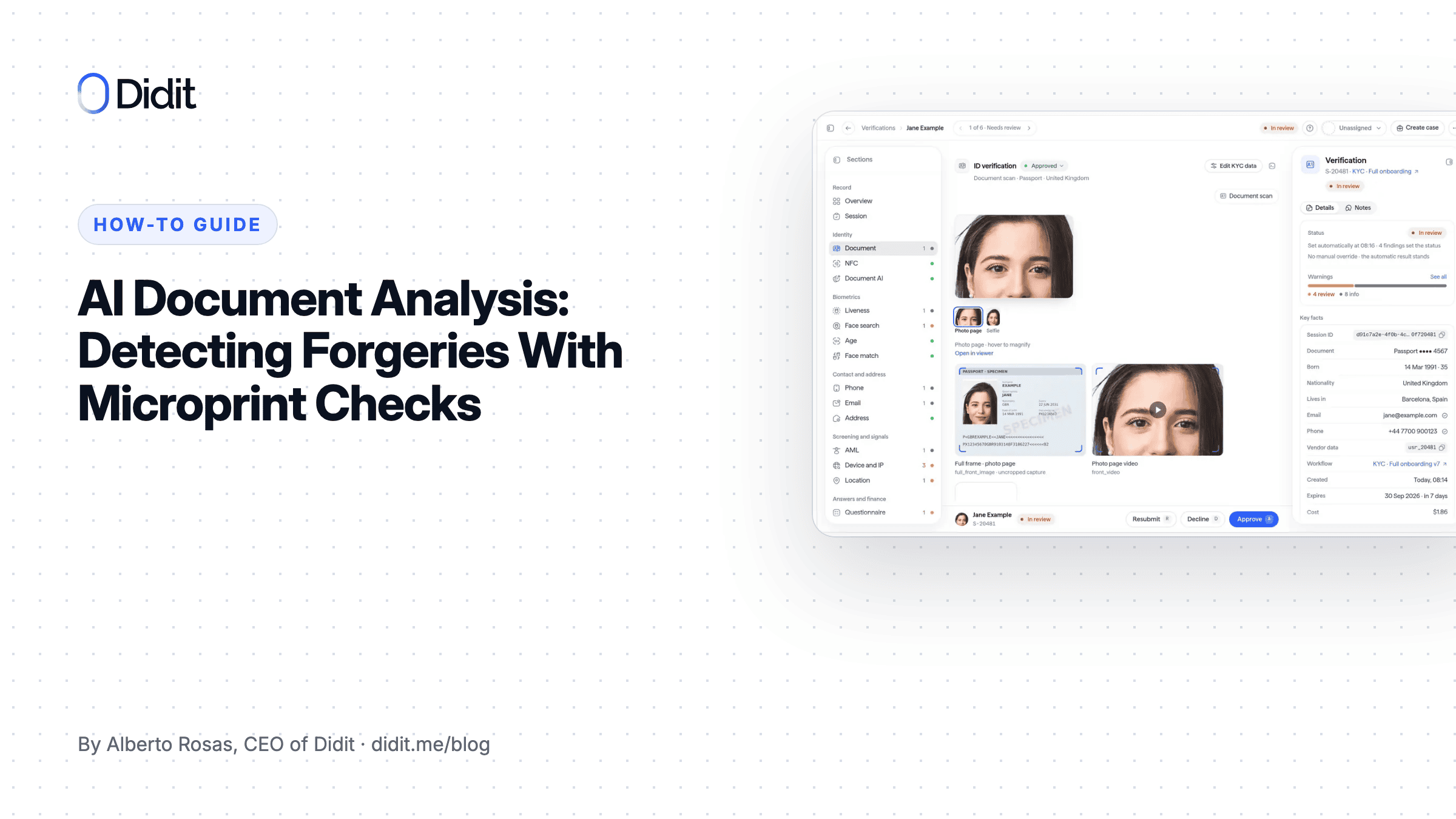
AI Document Analysis: Detecting Forgeries With Microprint Checks
Didit flags forged documents with ID Verification ($0.15 per document in a workflow, $0.20 standalone) and Document AI ($0.20 per file), which returns tampering warnings. Microprint needs a review boundary.
 Alberto RosasCo-founder and CEO
Contents
In this guide
Jump to the part you need.
This guide is for teams that must catch forged identity and supporting documents in a remote onboarding flow. Didit runs the checks at $0.15 per ID document inside a workflow, $0.20 per standalone ID Verification API call, and $0.20 per Document AI file. The main caveat: a phone photo can only prove so much about printed microprint, so pair the AI checks with an explicit human review boundary.
Last updated: November 26, 2026. Prices checked against the live Didit price feed on November 26, 2026.
| What you need | Didit surface | Endpoint | List price |
|---|---|---|---|
| Government ID authenticity, OCR, MRZ, print and screen replay checks | ID Verification | POST /v3/id-verification/ | $0.20 per API call; $0.15 inside a workflow |
| Bank statements, payslips, invoices, proof of funds, any document without a fixed template | Document AI | POST /v3/document-ai/ | $0.20 per document |
| One check that covers the ID document, biometrics and device and IP | Full KYC via a workflow | POST /v3/session/ | $0.33 per completed check |
Start free in the sandbox at https://business.didit.me/ with no sales call, and if you want to drive the same checks from an AI assistant, connect Didit through the Didit MCP server. The product pages behind these prices are ID Verification, Document AI and the public pricing page.
What microprint analysis can prove, and what it cannot
Microprint is text printed so small that it reads as a line to the naked eye. It appears on passports, national ID cards, driving licences and banknotes because ordinary office printers cannot resolve it. Genuine microprint has crisp edges, even stroke weight and consistent letter spacing. A counterfeit usually shows blur, broken strokes or a solid rule where letters should be.
Everything above about print quality is general document-inspection guidance, not a description of a specific Didit check. The authenticity signals Didit documents for this job are the risk codes in the next section: screen recapture, printed copies, portrait manipulation, specimen and public document images, expired documents, MRZ validation, visual-zone against MRZ cross-checks, and manipulation detection on supporting documents. Didit documents tampering, screen-replay, printed-copy, portrait-manipulation, MRZ and consistency checks. It does not publish a dedicated microprint score, so treat microprint inspection as a human-review consideration. That is the honest limit of a remote flow: a phone photo taken the way a normal user takes one carries limited microprint detail, and a compressed JPEG destroys the edges you would measure. So microprint can be one input to a human review, alongside Didit's documented authenticity signals, not a standalone proof, and it is why a review boundary still matters for high-value documents.

AI document forgery detection: what the published checks catch
Didit publishes the risk codes it returns, so you can see exactly what is being tested before you buy. On an identity document the ID Verification step checks the document for tampering and fraud, then extracts the data with AI OCR, and where the country allows it a person can verify without a document at all. The warning list includes SCREEN_CAPTURE_DETECTED, PRINTED_COPY_DETECTED, PORTRAIT_MANIPULATION_DETECTED, PUBLIC_DOCUMENT_IMAGE_DETECTED, SPECIMEN_DOCUMENT_DETECTED, DOCUMENT_EXPIRED, INVALID_MRZ, INCONSISTENT_DATA, DUPLICATED_DOCUMENT, FRAUD_RISK_FROM_OCR, COUNTRY_NOT_ALLOWED and DOCUMENT_TYPE_NOT_ALLOWED. Coverage is 14,000+ document types across 220+ countries and territories, with sub-2-second p99 inference.
On a supporting document, Document AI checks the file for manipulation and returns DOCUMENT_AI_SUSPECTED_MANIPULATION. It also decodes QR codes and barcodes, reads up to 30 fields you define, and can compare the name on the document against the person or company you expect.
For a technical buyer, that set of codes is the real product. In the documented checks, a forged document shows up as a specific signal rather than a general impression: the capture is a replay of a screen, the document is a printed copy, the portrait was manipulated, the image is a specimen or a public document image, the document is expired, the MRZ does not validate, the data in the visual zone disagrees with the MRZ, the document repeats one already seen, or the extracted name does not match the person or company you expect.
Where advanced forgery still shows up
- A genuine-looking document photographed off a monitor, caught by
SCREEN_CAPTURE_DETECTED. - A colour print of a real passport data page, caught by
PRINTED_COPY_DETECTED. - A real document with a swapped portrait, caught by
PORTRAIT_MANIPULATION_DETECTED. - A sample or specimen image lifted from a design archive, caught by
SPECIMEN_DOCUMENT_DETECTED. - A statement edited in an image tool to inflate a balance, which may trigger
DOCUMENT_AI_SUSPECTED_MANIPULATION.
Outcome and recommended method
The outcome is a decision you can defend in an audit: for every document, a status of Approved, Declined or In Review, plus a warnings array that says why. The recommended method is two paths, not one. Government identity documents go to ID Verification with document liveness on. Everything without a fixed template goes to Document AI with the fields you need and the name you expect. You then route on the strictest triggered action rather than on the HTTP code, because a readable but forged document returns HTTP 200 with a Declined status.
Prerequisites
- A Didit account and a sandbox application. Sandbox testing is free and unlimited on every Didit plan.
- An API key, sent in the
x-api-keyheader. - Document images or PDFs. ID Verification accepts tiff, jpg, jpeg, png, webp and pdf at up to 5 MB per file, uncropped, with all four corners visible.
- For Document AI, a JSON array of 1 to 30 field definitions.
- The name or company name you expect the document to belong to, if you want name matching.
Step by step
Sort the incoming files. Passports, ID cards, driving licences and residence permits go to ID Verification. Income documents, statements, invoices, proof of funds and tax papers go to Document AI. Sending a bank statement to an ID endpoint wastes a call and returns a recognition failure.
Create a test application in the sandbox and copy its API key. Keep a separate key set for live. Nothing is charged in sandbox.
Decide your per-request actions before you send traffic. ID Verification takes
invalid_mrz_action,inconsistent_data_actionandexpiration_date_not_detected_action, each set toDECLINEorNO_ACTION. Document AI takes one action parameter per risk, includingdocument_ai_document_tampering_action, which defaults toDECLINE.Send the identity document with
perform_document_liveness=true. That flag is what adds the screen replay, printed copy and portrait manipulation screening on top of OCR and MRZ cross-checks.curl -X POST 'https://verification.didit.me/v3/id-verification/' \ -H 'x-api-key: YOUR_API_KEY' \ -F 'front_image=@./id_front.jpg' \ -F 'back_image=@./id_back.jpg' \ -F 'perform_document_liveness=true' \ -F 'minimum_age=18' \ -F 'expiration_date_not_detected_action=DECLINE' \ -F 'invalid_mrz_action=DECLINE' \ -F 'inconsistent_data_action=DECLINE' \ -F 'preferred_characters=latin' \ -F 'save_api_request=true' \ -F 'vendor_data=user-123'Send the supporting document to Document AI. Define the fields, mark exactly one of them with
is_full_name, and send the name you expect so the name comparison runs.curl -X POST https://verification.didit.me/v3/document-ai/ \ -H "x-api-key: $DIDIT_API_KEY" \ -F "document=@./bank-statement.pdf" \ -F 'fields=[{"key":"account_holder","name":"Account holder","instruction":"Full name of the account holder","type":"text","required":true,"is_full_name":true},{"key":"balance","name":"Closing balance","instruction":"Closing balance as a number","type":"number","required":true}]' \ -F "expected_first_name=Jane" \ -F "expected_last_name=Doe" \ -F "document_ai_document_tampering_action=DECLINE"Read the status and the warnings, not just the HTTP code. On ID Verification, use
id_verification.statusandid_verification.warnings. On Document AI, usedocument_ai.statusanddocument_ai.warnings. Approved means no triggered warning resolved to a decline. In Review means a human decides. Declined means stop and tell the user which warning fired.Apply your action map. Fraud and hard-failure risks always decline, and that part is not configurable. Unreadable documents and missing required fields default to In Review, so a bad scan never becomes a silent approval.
Keep the evidence. With
save_api_requestat its default oftrue, each call is persisted as an API-type session you can open in the Business Console, andrequest_idis a real session id you can pass toGET /v3/session/{sessionId}/decision/.

Expected output
The field names below come from the published docs. Values are abbreviated to keep the shapes readable; your own values will differ.
{
  "request_id": "...",
  "id_verification": {
    "status": "Declined",
    "full_name": "Jane Doe",
    "document_type": "P",
    "document_number": "...",
    "expiration_date": "2031-04-18",
    "mrz": { "...": "..." },
    "barcodes": [],
    "warnings": [
      { "risk": "PRINTED_COPY_DETECTED", "log_type": "warning", "long_description": "..." }
    ]
  }
}
{
"document_ai": {
"status": "Approved",
"warnings": [],
"detected_codes": []
},
"extracted_data": {
"account_holder": "Jane Doe",
"balance": 18420.55
},
"name_on_document": "Jane Doe",
"name_match_score": 100
}Two details matter when you read this. extracted_data is keyed by the key you sent, with null for anything the model could not find, so a missing value is visible rather than silent. And name_match_score is null when no name was found on the document or no expected name was sent, which means the name check was skipped, not passed.
Inputs and outputs
| Field | Direction | What it does |
|---|---|---|
front_image | In, ID Verification | Required. The document face, uncropped, up to 5 MB. |
back_image | In, ID Verification | Required for dual-sided documents such as ID cards and driving licences. |
perform_document_liveness | In, ID Verification | Adds screen replay, printed copy and portrait manipulation screening. On by default. |
document | In, Document AI | The PDF or image to read. |
fields | In, Document AI | JSON array of 1 to 30 definitions, sent as one string. Each has a key, a name, an instruction and a type. |
expected_first_name, expected_last_name | In, Document AI | Who you expect the document to belong to. Send the company fields instead for a business document. |
id_verification.status | Out | Approved, Declined, In Review and the other session statuses. |
warnings[] | Out | Every risk that fired, with a log type and a long description you can show a user. |
document_ai.detected_codes | Out | Every decoded QR code or barcode, with page number and payload. Empty when none is found. |
name_match_score | Out | 0 to 100, or null when the check was skipped. Below the threshold of 80 the mismatch warning fires. |
Failure cases and recovery
| What you see | What it means | Recovery |
|---|---|---|
HTTP 400 with COULD_NOT_RECOGNIZE_DOCUMENT | The file could not be processed at all. | Re-capture: uncropped, all four corners, better light. Do not pre-crop. |
Status Declined with COULD_NOT_DETECT_DOCUMENT_TYPE | The image did not match a known official document design with high confidence, so the request is declined. | Check the document is a real government issue, then re-capture or route to manual review. |
| HTTP 400 multipart validation error | Missing back_image on a dual-sided document, file over 5 MB, or an unsupported extension. | Fix the file and resend. Nothing is processed. |
HTTP 400 on fields | The array was sent as bracket form keys instead of one JSON array string, or was not an array at all. | Resend as a single string. The request fails before extraction runs, so nothing is billed. |
| HTTP 403 not enough credits | The balance cannot cover the call. | Top up or enable auto top-up. The failure happens before any image processing. |
Status Declined with DOCUMENT_LIVENESS_FAILED or a print or screen risk | The document failed an authenticity check. | Stop the flow and show the first warning description. Do not retry the same file. |
Status In Review with DOCUMENT_LIVENESS_NOT_COMPUTED | The forgery check returned no usable score because the provider failed or crashed. | Treat the document as unchecked and send it to manual review. A check that did not run is not evidence that the document is genuine, and this escalation is not configurable. |
DOCUMENT_AI_SUSPECTED_MANIPULATION | The file shows signs of editing. | Default action is DECLINE. Keep it there for financial documents. |
DOCUMENT_AI_NAME_MISMATCH | The extracted name scored below document_ai_name_match_score_threshold, default 80. | Default action is NO_ACTION. Set document_ai_name_mismatch_action to REVIEW or DECLINE if the name is the point of the check. |
Paid steps and review boundaries
You pay per completed check from prepaid credit. On ID Verification, each HTTP 200 response consumes one credit, and a request refused with 403 for balance is not processed. On Document AI, each document is billed per document, and a request that fails validation before extraction runs is not billed. Failed captures that return 400 are a resubmission, not a decision, so budget for a second attempt on a slice of your traffic.
Three review boundaries should stay human. First, any In Review status, including the not-computed liveness case above. Second, any case where the only evidence of authenticity is a low-resolution photo and the document is high value, such as a proof of funds for a large transfer. Third, any decision you would otherwise make on a single signal. Didit publishes 200+ fraud signals per session, and the decision is built from the combination, not from one warning in isolation.
Didit serves 4,000+ companies in production, holds SOC 2 Type 2 and ISO/IEC 27001:2022 certification, and the report data model is documented at https://docs.didit.me/reference/data-models.
Worked cost example
Take a lender that runs 1,500 full KYC checks and 800 supporting documents a month. All arithmetic uses published list prices.
- Full KYC: ID document $0.15 + passive liveness $0.10 + face match 1:1 $0.05 + device and IP analysis $0.03 = $0.33 per check. 1,500 x $0.33 = $495.00.
- Supporting documents through Document AI: 800 x $0.20 = $160.00.
- Monthly list total: $495.00 + $160.00 = $655.00.
- On the Scale plan, with 10% off Didit prices: 1,500 x $0.297 = $445.50 and 800 x $0.18 = $144.00, so $445.50 + $144.00 = $589.50 a month.
- Difference: $655.00 - $589.50 = $65.50 a month at this volume.
For context, the Free plan carries $10 of credit a month, which the docs describe as roughly 30 full ID checks at $0.33 each. If you only need the standalone ID Verification API rather than a workflow step, that line is $0.20 per call instead of $0.15, which changes the example above by $0.05 per document check.
Sources
- Didit docs: ID Verification API
- Didit docs: Document AI API
- Didit docs: ID Verification overview
- Didit docs: Document AI rules and warnings
- Didit docs: Create Session API
- Didit docs: Retrieve Session API
- Didit docs: Data models
- Didit docs: Pricing and billing
- Didit pricing page
- Didit MCP server setup
Next step: open the sandbox at https://business.didit.me/, create a test application, and run one ID document and one supporting document through the two calls above. No sales call is needed to start.
Try it
Try this in the sandbox
Run the check this guide describes, free.
The product this post is about, taken from its topic. Run it free in the sandbox.
Author
Alberto Rosas
Co-founder and CEO

Keep reading
Other guides in the same topic.
 What Is the Purpose of FICA in South Africa? 2026 Guide
FICA is South Africa's anti-money laundering law. It creates the Financial Intelligence Centre and requires accountable institutions to identify and verify clients, screen for PEP and sanctions risk and report suspicious.
Alberto RosasNov 26, 2026 Sixth Money Laundering Directive (6AMLD): What Changed and Which Rules Apply
6AMLD is Directive (EU) 2018/1673: Member States must criminalise laundering, widen predicate offences and set a four-year penalty floor. It adds no new due diligence duties for firms.
Alberto RosasNov 26, 2026 Automated Sanctions Screening: Canada, the Entity List and Embargoes
Automated sanctions screening matches people and companies against lists such as Canada's autonomous sanctions made under SEMA and JVCFOA and the OFAC SDN List, and returns candidate hits scored for identity confidence and.
Alberto RosasNov 26, 2026Questions
Frequently asked questions
What is microprint analysis in document verification?
Microprint is text printed small enough to read as a line without magnification, as it appears on passports, ID cards and banknotes. Analysis means measuring whether those characters are crisp, evenly weighted and evenly spaced, because ordinary printers and image editors usually leave blur or solid strokes where letters should be. It is general inspection guidance and one authenticity signal, not a standalone proof, and it needs enough capture resolution to be meaningful.
How does AI detect forged documents better than a person checking by hand?
It applies documented checks consistently across submissions, with sub-2-second p99 inference, and cross-checks the visual zone, MRZ and any barcode. It also compares data across zones that a human reads one at a time: the visual zone, the MRZ and any barcode, with cross-checks on dates, number formats and MRZ check digits. A human inspector is still better at physical inspection of a document in hand.
Can AI detect digitally altered documents?
Yes. Document AI checks each file for manipulation and returns DOCUMENT_AI_SUSPECTED_MANIPULATION, which defaults to a decline. On identity documents the check set covers recapture from a screen, printed copies, swapped portraits, specimen images and public document images, plus inconsistencies between the visual zone and the MRZ.
Is fake document detection with AI free to try?
Sandbox testing is free and unlimited on every Didit plan. The Free plan also carries $10 of credit a month for live checks, for organizations that sign up with a work email. You can start at https://business.didit.me/ without a sales call.
How much does a Didit document check cost?
ID Verification is $0.15 per document inside a workflow and $0.20 per standalone API call. Document AI is $0.20 per document. A full KYC check, which adds passive liveness, face match and device and IP analysis, is $0.33. Plan discounts are 4% on Growth and 10% on Scale.
What does DOCUMENT_AI_SUSPECTED_MANIPULATION mean and what happens by default?
It means the file shows signs of editing, such as content changed after the document was generated or exported. The default action is DECLINE, and you can change it per request with document_ai_document_tampering_action. Keep the decline default for financial documents.
What happens when the forgery check cannot compute a score?
The call returns HTTP 200 with status In Review and a DOCUMENT_LIVENESS_NOT_COMPUTED warning, rather than approving the document. This escalation is not configurable and never overrides a Declined. Route those sessions to manual review and treat the document as unchecked.
Which documents go to ID Verification and which go to Document AI?
Government-issued identity documents go to ID Verification: passports, ID cards, driving licences and residence permits, across 14,000+ document types in 220+ countries. Anything without a fixed template goes to Document AI: statements, payslips, invoices, proof of funds and tax papers. Sending the wrong document type to the wrong endpoint produces a recognition failure, not a decision.
Does a photo of a passport prove the microprint is genuine?
Not on its own. A phone photo carries limited microprint detail, and compression removes the edges you would measure. Treat microprint as one signal, rely on the combination of tampering, print and screen replay, MRZ and data cross-checks, and send high-value documents to human review.
Can I run Didit document checks from an AI assistant?
Yes. The Didit MCP server is hosted at https://mcp.didit.me/mcp with OAuth sign-in and is free on every plan. Setup instructions for each client are at https://didit.me/developers/mcp/. If your platform has no documented connector, use the documented REST endpoints or the session webhooks instead.
Compliance built in
Audited, certified and attested.
We hold the certifications and build each country's rules into your flows, so you can launch anywhere without worrying. Security and Compliance center
- Regulation encoded into your flows
Tell us what you do and where. Didit lists the rules that apply to you, with sources, and builds the checks each country needs into one workflow.
- Ready for AMLR
Every requirement of the new EU anti-money laundering rules, from checking customers to human review, is already covered by a Didit check.
- Tested in Spain's Treasury sandbox
Spain's Treasury published its supervised sandbox report on Didit's NFC plus active liveness onboarding; SEPBLAC took part and valued the added measures positively.
- Audited, not self-declared
iBeta Level 1 and Level 2. Liveness tested under ISO/IEC 30107-3.
Your obligations · 3 regions
 SOC 2 Type 2
 ISO 27001
 iBeta Level 1 and Level 2
 EU regulator attestation
 FSM youth protection
 GDPR
 EBA remote onboarding
 MiCA compatible
 FIDO Alliance member
- AMLREU AML Regulation ready
Integration · Didit MCP
Run Didit from your own AI agent
Connect Didit to Claude, Cursor, VS Code or ChatGPT and just ask in plain words. Your agent can do anything you can do in the console, with the same permissions you have.
 Add to Claude
 ChatGPT
 Cursor
- Build workflowsDescribe the checks you need. The agent creates and publishes the flow.
- Run investigationsAsk why a session was declined, review cases, search people and companies.
- Change rulesCreate payment rules, test them on past data and switch them on.
- Pull reportsAsk for numbers, exports or the audit log.
Didit Academy


