Beyond Passports: Alternative ID Documents, Didit vs Regula
Didit verifies alternative identity documents at $0.15 per ID check and $0.20 for proof of address, with lookups and wallets behind one API. Regula publishes no prices; quote required.
 Alberto RosasCo-founder and CEO
Contents
In this guide
Jump to the part you need.
This page is for teams whose onboarding stops when a user has no passport. We compare Didit and Regula on verifying alternative identity documents: national ID cards, residence permits, proof of address, database lookups and digital ID wallets. Didit publishes every price, with the ID document check at $0.15 and proof of address at $0.20. The caveat: a weak document alone is not verification, so pair document evidence with liveness, face match or a source lookup.
Last updated: November 26, 2026. Prices checked against the live Didit price feed on November 26, 2026.
The comparison at a glance
| Vendor | Best for | Published price | Coverage on the vendor's own page | Certifications listed |
|---|---|---|---|---|
| Didit | Teams that need alternative documents, lookups, wallets, AML and KYB behind one API | ID document check $0.15; proof of address $0.20 as a separate check; full KYC $0.33; lookups priced per country | 220+ countries, 14,000+ document types, 54 capture languages | SOC 2 Type 2, ISO/IEC 27001:2022, iBeta Level 1 PAD |
| Regula | Document reader SDKs, border control hardware and forensic document examination | Not published; quote required | 254 countries and territories (Regula page, read November 26, 2026) | Not listed on the page we read |
The $0.20 proof-of-address price is a separate check from the $0.15 ID document check. A flow that runs both is billed for both, and the two are not a single $0.20 bundle.
Start free in the sandbox at https://business.didit.me/, with no sales call and no procurement step. Developers can connect Didit to an AI assistant through the free MCP server at https://didit.me/developers/mcp/. The ID Verification documentation describes what the document check does, and https://didit.me/pricing/ lists every price.
What alternative ID means
An alternative identity document is any proof of identity or address that is not a passport. In onboarding that means national ID cards, driver's licences, residence permits, refugee and asylum documents, proof of address such as a utility bill or bank statement, and digital identity wallets. The same phrase has a second life in HR and CRM records, where an alternate ID is a secondary identifier stored against a person: an employee number, a badge number, an internal reference.
The two meanings cause real confusion in support tickets. An alternate ID number is the number printed on the non-passport document: the national ID number, the tax number, the permit number. An alt ID value is whatever sits in that field in your customer record. Neither is evidence of anything until it is checked against a source that holds the same value.
Two failure modes follow from treating these documents as passports. First, a utility bill proves an address and a name, not that the person presenting it is the account holder. Second, a document without a chip or an MRZ is easier to alter, so the checks have to come from somewhere else: document liveness, print and screen replay detection, and a biometric link to a live person.
The three methods, and what each one proves
Before we get to individual document types, separate three kinds of evidence, because they are not interchangeable. Document capture proves that a physical document was read and checked for authenticity. A non-document lookup proves that the details a user typed matched a record at an authoritative source, with no document inspected. A digital ID wallet proves that an identity provider authenticated the person and signed the attributes it shared. Didit runs all three as methods inside ID Verification, you choose which ones a country may use, and the session records which method produced the result.
| Method | Tier value on the session | What it establishes |
|---|---|---|
| Document capture | documentary | A physical document was captured, read and checked for authenticity |
| Non-document lookup | data_match | The details the user gave matched a record held by the source that was queried |
| Digital ID wallet | cryptographic | An identity provider authenticated the user and signed the attributes it shared |
The tier is an admin-facing label for what was actually proven, not a ranking of the three methods against each other.
The alternative ID types that come up in onboarding
Proof of address documents
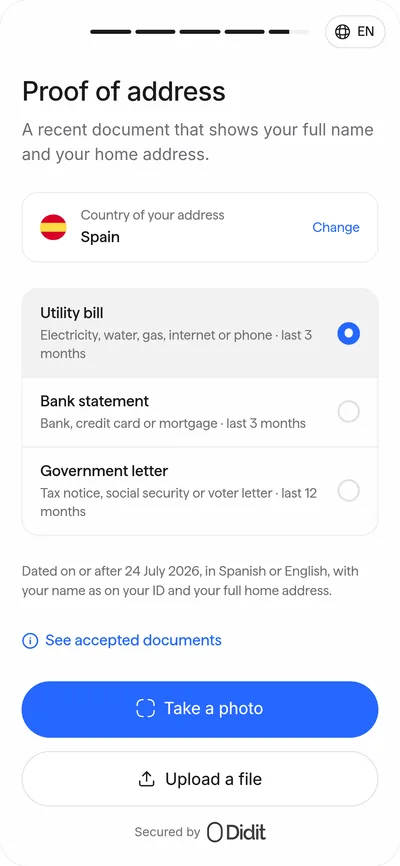
A proof-of-address check verifies address evidence. It reads the document, returns its own result on the session, and does not establish who the person is. Utility bills, bank statements and government letters are the most common alternative document worldwide and the least secure on their own. Didit runs proof of address as its own step at $0.20 per check, separate from the ID document check. Use it as a second signal after an identity check, not as a replacement for one.
National ID cards and residence permits
These are the workhorse alternative documents. Formats, languages and security features vary by country, which is why coverage claims are usually stated in document types rather than countries. Didit states 14,000+ document types across 220+ countries, with 130+ recognition languages across 50+ scripts, and reads dual-sided cards by requiring a back image.
Refugee and asylum seeker documents
These are issued by government agencies or international bodies and are often temporary. Ask for written confirmation on the exact document type before you tell a user it will be accepted. If the document cannot be read, a lookup against a national register or a wallet sign-in is the better path.
Digital ID wallets
A wallet sign-in needs no document photograph at all. Published Didit prices per completed wallet verification include MitID at $0.25 in Denmark, BankID Sweden at $0.20, Finnish Trust Network at $0.25, Smart-ID and Mobile-ID at $0.21, iDIN at $0.95 in the Netherlands, Bank iD at $0.20 in Czechia and Google Wallet at $0.10 in the United States, United Kingdom, Brazil, Singapore and Taiwan. Several wallets are listed as coming soon, and a workflow that enables one cannot be saved in that environment.
Non-document lookups
The user types a national ID number and a few personal details, and Didit checks them against the authoritative source for that country. In most countries that source is a government register. In Canada, France, Indonesia, the Netherlands, Norway, Singapore, the United Kingdom and the United States the record reachable is a credit-bureau, financial-services, utility or residential-records file, and the per-country table in the docs names the exact source. Where the source returns a portrait, the selfie, passive liveness and face match all happen inside the lookup price.
Employment and student IDs
Useful for low-risk gating such as a marketplace seller tier or a campus service. Employment and student IDs may support low-risk gating, but confirm your applicable KYC requirements before relying on them.
How alternative document verification works
Reading text is the easy part. The work is deciding whether the document is genuine, current and attached to the person in front of the camera.
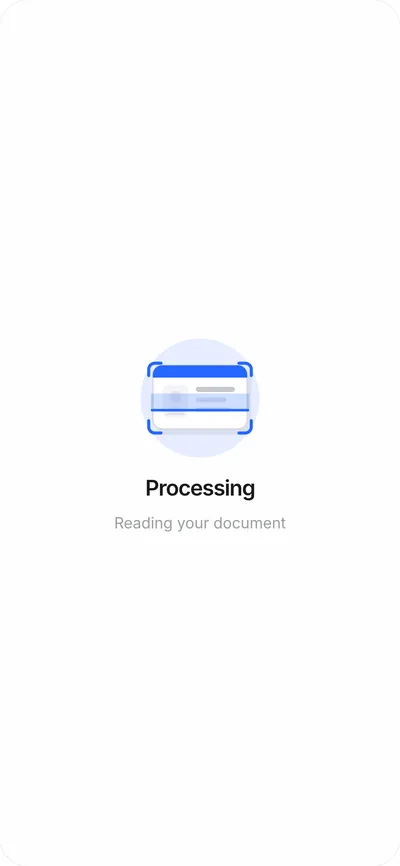
- Capture and extraction. Auto-detection of document type and country, MRZ parsing, barcode decoding and AI OCR. Didit states sub-2-second p99 inference.
- Authenticity and fraud signals. Didit reports 200+ fraud signals per session, and returns named warnings such as
DOCUMENT_EXPIRED,INVALID_MRZ,INCONSISTENT_DATA,DOCUMENT_LIVENESS_FAILED,FRAUD_RISK_FROM_OCRandDUPLICATED_DOCUMENT. - Biometric link. Passive liveness at $0.10 and face match 1:1 at $0.05 attach the document to a live person. For a weak document this is the signal that carries the decision.
- NFC chip reading. For e-passports and eIDs, a chip read is $0.15 as an add-on. It is session-only and runs in the native SDKs, not in a web browser.
- Source lookup. Database Validation checks the data against a national registry, from $0.05 per check depending on the service. The docs price per service, not per country, because a registry that charges a high wholesale rate is priced accordingly.
Alternatives to manually reviewing customer ID documents
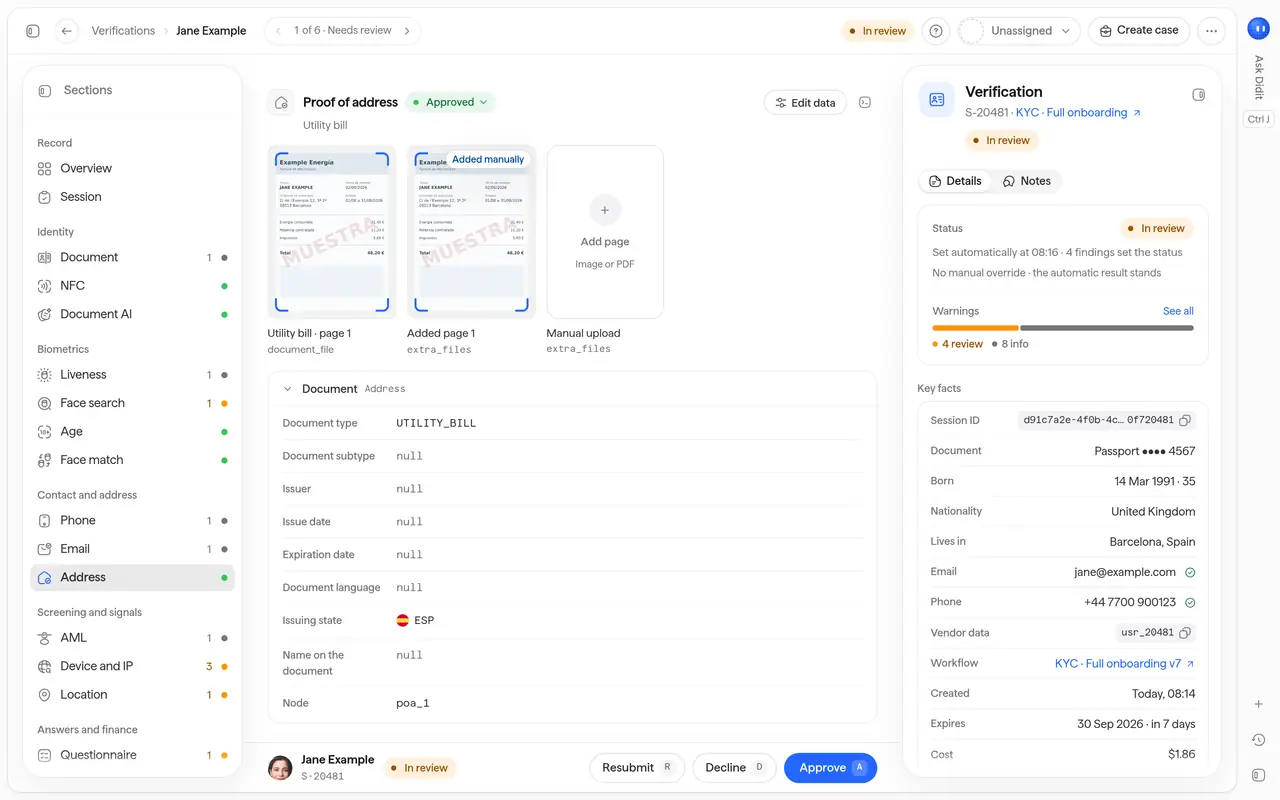
Manual review does not disappear, it shrinks. Automate the clear cases and route the rest. On Didit, a session with status In Review, or a result carrying a warning such as DOCUMENT_LIVENESS_NOT_COMPUTED, goes to your review queue and is not auto-approved. A terminal warning such as DOCUMENT_EXPIRED declines the session and shows the user the reason. That gives a reviewer a small, explained queue instead of a folder of photographs.
What an AI-powered IDV solution adds for non-passport documents
AI OCR handles variation in fonts, layouts and languages, which is a general implementation consideration on documents such as municipal IDs. The larger gain is fraud detection: comparing the visual zones against the MRZ and barcodes, checking print and screen replay artefacts, and spotting the inconsistent field that a forger missed. Those checks matter more on documents that carry fewer physical security features.
Didit vs Regula scorecard
Didit publishes this ranking; we explain the criteria so you can check them. Scores are 1 to 5, where 5 is best, and each score rests on what the vendor's own page said on the read date. The scores are our editorial assessment, based only on the cited vendor-card evidence. Every Regula figure below comes from the Regula page, read November 26, 2026.
| Criterion | Didit | Why | Regula | Why |
|---|---|---|---|---|
| Published pricing | 5 | Public price list with $0.15 per ID document check and $0.20 for proof of address | 1 | Pricing not published on the page we read; quote required |
| Coverage | 4 | 220+ countries and 14,000+ document types, plus lookup and wallet methods | 5 | States 254 countries and territories covered |
| Product breadth (KYC, KYB, AML, monitoring) | 5 | KYC, KYB from $2.00 per company, AML screening at $0.20 and transaction monitoring on one open API | 2 | Card lists document fraud prevention, biometrics, border security and forensics, with no KYB or AML line |
| AI/MCP and developer access | 5 | Public OpenAPI, SDKs, a free MCP server and a one-prompt integration path | 3 | The card names Document Reader SDK and Face Recognition SDK; MCP or API-contract details were not provided in the source card |
| Time to first live check | 5 | Self-serve sandbox, API key from the console, $10 monthly credit on the Free plan | 2 | No self-serve path described on the page we read |
| Evidence and certifications | 5 | SOC 2 Type 2, ISO/IEC 27001:2022 certified, iBeta Level 1 PAD | 3 | Claims 99.8% proven detection accuracy; certifications not listed on the page we read |
Like-for-like comparison
Regula rows come from the Regula page, read November 26, 2026; anything that page does not cover is marked as not described there.
| Dimension | Didit | Regula |
|---|---|---|
| Document types and countries | 14,000+ document types, 220+ countries, 54 capture languages | 254 countries and territories |
| Non-document methods | Non-document lookup and digital ID wallets alongside document capture, each with a published assurance tier | Not described on the page we read |
| Proof of address | Own step, $0.20 per check | Not described on the page we read |
| AML, KYB and monitoring | AML screening $0.20, ongoing monitoring $0.07 per person a year, KYB from $2.00 per company, transaction monitoring | Not listed on the page we read |
| Developer access | Public OpenAPI, SDKs, free MCP server, integration prompt for coding agents | Document Reader SDK and Face Recognition SDK named; MCP or API-contract details were not provided in the source card |
| Evidence | SOC 2 Type 2, ISO/IEC 27001:2022, iBeta Level 1 PAD, GDPR, eIDAS 2.0, AMLD6, DORA, MiCA | 99.8% detection accuracy claim and 1 to 2 seconds to verify an identity |
| Implementation | Hosted session, Web and Mobile SDK, or standalone server-to-server call | SDK-based integration; details not provided in the source card |
| Price unit | Per completed check, published in USD | Quote required |
Verdict by use case
- Fintech onboarding in mixed markets: Didit. Document capture, lookup and wallet methods can be configured per country inside one workflow, with documented fallback settings where supported, and AML is a $0.20 add-on on the same API.
- Marketplace or gig platform with address checks: Didit. Proof of address is $0.20 and reads as its own step with its own result.
- Regulated KYC that needs KYB and ongoing monitoring: Didit. Company registry checks from $2.00 per company and ongoing AML monitoring at $0.07 per person a year are on the same price list.
- Border control hardware, forensic labs, video spectral comparators: Regula. That is a specialist hardware and forensic practice, and the card names 80+ borders and 100+ forensic labs using it (Regula page, read November 26, 2026).
- Document reader embedded inside an existing government system: Regula. Regula may fit teams that need document-reader SDKs in an existing government or border-control system. Confirm compatibility and certifications directly with Regula.
What 1,000, 10,000 and 100,000 checks cost
One check below means one ID document verification at $0.15. The arithmetic uses published Didit list prices only. Regula does not publish prices, so those cells read quote required.
| Volume | Didit list | Didit Growth, 4% off | Didit Scale, 10% off | Regula |
|---|---|---|---|---|
| 1,000 checks | $150.00 | $144.00 | $135.00 | Quote required |
| 10,000 checks | $1,500.00 | $1,440.00 | $1,350.00 | Quote required |
| 100,000 checks | $15,000.00 | $14,400.00 | $13,500.00 | Quote required |
The arithmetic: 1,000 x $0.15 = $150.00, 10,000 x $0.15 = $1,500.00, 100,000 x $0.15 = $15,000.00. Growth prices the same checks at $0.144 each and Scale at $0.135 each, so 10,000 checks on Scale are 10,000 x $0.135 = $1,350.00. If the flow needs the full KYC bundle instead, 10,000 x $0.33 = $3,300.00 at list, and 10,000 x $0.297 = $2,970.00 on Scale.
Plans change both the unit price and the total maths. Growth is $99 a month and includes $115 of credit, which at the list price of $0.15 a check covers 766 checks before you touch a top-up ($115.00 / $0.15 = 766.67). Scale is $299 a month with $350 of credit. Plan credit is spent first and does not roll over.
A worked example: 50,000 sign-ups with a 12% fallback rate
Take a consumer finance app with 50,000 sign-ups a year. In 12% of cases the user has no passport, which is 6,000 fallback checks (50,000 x 0.12 = 6,000). The fallback flow is an ID document check plus proof of address, plus passive liveness and face match so the weak document is attached to a live person.
- ID document: 6,000 x $0.15 = $900.00
- Proof of address: 6,000 x $0.20 = $1,200.00
- Passive liveness: 6,000 x $0.10 = $600.00
- Face match: 6,000 x $0.05 = $300.00
- Total per check: $0.15 + $0.20 + $0.10 + $0.05 = $0.50. Total: 6,000 x $0.50 = $3,000.00
On the Scale discount, each check is $0.50 x 0.9 = $0.45, so the same year costs 6,000 x $0.45 = $2,700.00.
Now suppose 1,000 of those users are in Denmark and sign in with MitID at $0.25 instead of the document path. The wallet check replaces the identity method for that group: 1,000 x $0.25 = $250.00. The other steps do not vanish. A required proof of address check still runs at $0.20 each (1,000 x $0.20 = $200.00), so those users cost $0.25 + $0.20 = $0.45 each, or 1,000 x $0.45 = $450.00. Passive liveness and face match are no longer billed for them, because the wallet provider already authenticated the person. A wallet sign-in leaves no photo for a Face Match step to compare, so remove that step for wallet users or expect those sessions to route to review. The remaining 5,000 users stay on the $0.50 flow (5,000 x $0.50 = $2,500.00), and the year totals $2,500.00 + $450.00 = $2,950.00.
Strengths and limitations
Didit
Strengths. Every unit price is public, so you can model the fallback flow before you talk to anyone. Document capture, non-document lookup and wallet methods are configured per country in one workflow, with documented fallback settings such as on_failure: fallback_to_document, and each result records the assurance tier of the method that produced it. The surrounding checks a fallback flow usually needs, AML at $0.20, ongoing monitoring at $0.07 per person a year and KYB from $2.00 per company, sit on the same open API. Didit serves 4,000+ companies, is SOC 2 Type 2 and ISO/IEC 27001:2022 certified, and self-serve signup needs no sales call.
Limitations. Coverage is stated as 14,000+ document types across 220+ countries, which is below the 254 countries and territories Regula states. Non-document lookup and database validation are priced per country and per service, not on the flat list, so the total is only known once you fix the countries. Some wallets are still coming soon and cannot be enabled in a workflow yet. The forensic hardware and border-control practice is Regula's market, not ours.
Regula
Strengths. Regula states 254 countries and territories covered, and a document fraud practice built around readers, forensic examination and video spectral comparators, with 80+ borders and 100+ forensic labs named as users. It also cites 2,000+ enterprises, 350+ banks and financial institutions, 99.8% proven detection accuracy and 1 to 2 seconds to verify an identity (Regula page, read November 26, 2026).
Limitations. Pricing is not published on the page we read, so every cost comparison needs a quote, and the source card lists no certifications. The card covers document fraud prevention, identity lifecycle management, biometric verification, border security and forensic examination, with no KYB, AML screening or transaction monitoring line. No self-serve path is described, and MCP or API-contract details were not provided in the source card (Regula page, read November 26, 2026).
When Regula is the better fit
Choose Regula when the primary job is reading and examining documents rather than deciding about people. That means border control deployments, forensic laboratories that need video spectral comparators, and organisations embedding a document reader SDK in a system that has already passed their procurement. The Regula page, read November 26, 2026, names Document Reader SDK, Identity Verification Platform, Face Recognition SDK, border security document readers and video spectral comparators, and states that 80+ borders and 100+ forensic labs use its technology. Regula may fit teams that need document-reader SDKs in an existing government or border-control system. Confirm compatibility and certifications directly with Regula.
Migration plan: parallel test, webhooks, records
1. Run the parallel test on the same documents
Create a Didit workflow that includes ID Verification, Proof of Address and, where it applies, Database Validation. Send the documents you have already decided on through the standalone API and compare results field by field. Our docs do not describe a Regula connector, so the parallel test runs on the same image files through both systems, and Regula's side of that test is a question for Regula (Regula page, read November 26, 2026).
2. Move to sessions and map the payload
For live traffic, create a session and read the decision. The decision surfaces each feature as a plural array, so id_verifications[], database_validations[] and nfc_verifications[] each carry their own status and warnings.
curl -X POST 'https://verification.didit.me/v3/session/' \
-H 'x-api-key: YOUR_API_KEY' \
-H 'Content-Type: application/json' \
-d '{
"workflow_id": "YOUR_WORKFLOW_ID",
"vendor_data": "user-123",
"callback": "https://yourapp.com/post-kyc"
}'
Then fetch GET /v3/session/{sessionId}/decision/, or subscribe to the session.status.updated webhook and keep your existing queue. Map our warnings onto your current reason codes once, in a table, and route terminal warnings such as DOCUMENT_EXPIRED or DOCUMENT_LIVENESS_FAILED to decline, and In Review outcomes to a human.
3. Keep records that answer a regulator
Record the decision payload, assurance tier and warnings in the audit records your existing system already uses during the parallel period, then keep the same fields after cutover. That is what lets you show which method verified a person, what the document check returned, and why a reviewer approved an In Review case. The non-document lookup result records the source queried on the session payload, which is the provenance statement an auditor asks for.
If you are moving from another provider, https://didit.me/switch/ sets out the switch path, and the integration prompt at https://didit.me/developers/integration-prompt/ lets a coding agent write the first integration.

Sources
- Didit pricing page and the live price feed, read November 26, 2026
- Didit pricing in the docs, billing rules and standalone API prices
- Didit ID Verification overview, 14,000+ documents, warnings and modes
- Didit ID Verification methods, document, lookup and wallet, with assurance tiers
- Didit non-document lookup, per-country sources and consent
- Didit digital ID wallets, availability and per-wallet prices
- Didit Database Validation overview, per-service pricing from $0.05
- Didit NFC Verification overview, $0.15 add-on and session-only delivery
- Didit ID Verification standalone API
- Didit MCP server and integration prompt
- Regula product and company page, read November 26, 2026 (plain text, not linked)
- FATF for customer due diligence expectations that alternative documents feed into
Run a sandbox test on your own documents. Create a free account at https://business.didit.me/, no sales call, put ten real alternative documents through an ID Verification plus Proof of Address workflow, and compare the warnings with the decisions your team made by hand.
Try it
Try this in the sandbox
Run the check this guide describes, free.
The product this post is about, taken from its topic. Run it free in the sandbox.
Author
Alberto Rosas
Co-founder and CEO

Keep reading
Other guides in the same topic.
 What Is the Purpose of FICA in South Africa? 2026 Guide
FICA is South Africa's anti-money laundering law. It creates the Financial Intelligence Centre and requires accountable institutions to identify and verify clients, screen for PEP and sanctions risk and report suspicious.
Alberto RosasNov 26, 2026 Sixth Money Laundering Directive (6AMLD): What Changed and Which Rules Apply
6AMLD is Directive (EU) 2018/1673: Member States must criminalise laundering, widen predicate offences and set a four-year penalty floor. It adds no new due diligence duties for firms.
Alberto RosasNov 26, 2026 Automated Sanctions Screening: Canada, the Entity List and Embargoes
Automated sanctions screening matches people and companies against lists such as Canada's autonomous sanctions made under SEMA and JVCFOA and the OFAC SDN List, and returns candidate hits scored for identity confidence and.
Alberto RosasNov 26, 2026Questions
Frequently asked questions
What does alternative ID mean?
An alternative ID is any identity document other than a passport. In onboarding that usually means a national ID card, driver's licence, residence permit or proof of address such as a utility bill. In HR and CRM systems the same phrase can also mean a secondary internal identifier, which proves nothing on its own.
What is an alternate ID number?
It is the number printed on a non-passport document: a national ID number, a tax number, a residence permit number. A system asks for it so it can be checked against a register. The number only becomes evidence when a lookup returns a match, which is why Didit records data_match as a separate assurance tier from documentary.
Which documents count as alternative identity documents?
National ID cards, driver's licences, residence permits, refugee and asylum documents, proof of address such as utility bills and bank statements, digital ID wallets, and for low-risk gating employment or student IDs. Didit reads 14,000+ document types across 220+ countries and can also verify without a document through lookup and wallet methods.
Can you verify someone who has no passport and no government ID?
Sometimes. Where an authoritative record exists, Didit's non-document lookup checks a national ID number and a few details against that source and returns a data match. Where the source holds a photo, the selfie and face match run inside the lookup price, so there is no extra charge. If no supported document, authoritative source or wallet is available, Didit cannot complete one of these verification methods.
How much does alternative document verification cost on Didit?
One ID document check is $0.15, proof of address is a separate check at $0.20, and the full KYC bundle of document, passive liveness, face match and device and IP analysis is $0.33. Digital ID wallets are priced per wallet, from $0.10 for Google Wallet to $0.95 for iDIN. Growth takes 4% off every Didit price and Scale takes 10%.
Is Didit cheaper than Regula for alternative document checks?
Regula does not publish prices on the page we read, so a like-for-like answer needs a written quote from them (Regula page, read November 26, 2026). Didit publishes $0.15 per ID document check, which makes 10,000 checks $1,500.00 at list and $1,350.00 on the Scale discount. Compare that with a Regula quote for the same volume and the same document types.
How accurate is verification of non-passport documents?
Accuracy depends on the document as much as the vendor. Didit returns named warnings such as INVALID_MRZ, INCONSISTENT_DATA and DOCUMENT_LIVENESS_FAILED on each result, and terminal warnings decline the session rather than approving it. Regula states 99.8% proven detection accuracy (Regula page, read November 26, 2026), so ask both vendors for the test set behind any accuracy figure.
How do I stop manually reviewing every customer ID document?
Automate the clear cases and keep review for the flagged ones. On Didit, a session with status In Review, or a result carrying a warning such as DOCUMENT_LIVENESS_NOT_COMPUTED, is never auto-approved and goes to your queue. Reviewers then see a small, explained queue instead of a folder of photographs.
What does an AI-powered IDV solution do that OCR alone does not?
OCR reads text. A verification step also checks authenticity by comparing visual zones with the MRZ and barcodes, looking for print and screen replay artefacts, and linking the document to a live person through liveness and face match. Didit reports 200+ fraud signals per session with sub-2-second p99 inference.
How long does it take to run a first live check?
On Didit you sign up at business.didit.me, take an API key from the console and create a session, which takes minutes and needs no sales call. The Free plan includes $10 of monthly credit for eligible work email signups, and sandbox testing is free on every plan. No self-serve path is described on the Regula page we read, so ask their team for a trial (Regula page, read November 26, 2026).
Is there an official page listing which alternative documents are supported?
The Didit ID Verification documentation states the coverage: 14,000+ document types across 220+ countries and 54 capture languages, with a separate list for NFC-capable documents. Coverage is stated at the level of types and countries, so if one specific document decides your launch, ask for written confirmation of that document before you promise a user it will be accepted.
Can I verify a Danish or Swedish user with a digital ID instead of a document?
Yes. Didit prices MitID at $0.25 per completed verification in Denmark, BankID Sweden at $0.20, Smart-ID at $0.21 across Estonia, Latvia, Lithuania and Belgium, and iDIN at $0.95 in the Netherlands. A wallet result carries the cryptographic tier because the identity provider signed the attributes, and a country's wallet block can be configured to fall back to document capture when the sign-in fails.
What about address verification documents specifically?
Proof of address is its own Didit step at $0.20 per check, covering documents such as utility bills, bank statements and government letters. It reads the document and returns its own result on the session. Use it after an identity check, because an address document alone verifies address evidence and does not establish who is presenting it.
Compliance built in
Audited, certified and attested.
We hold the certifications and build each country's rules into your flows, so you can launch anywhere without worrying. Security and Compliance center
- Regulation encoded into your flows
Tell us what you do and where. Didit lists the rules that apply to you, with sources, and builds the checks each country needs into one workflow.
- Ready for AMLR
Every requirement of the new EU anti-money laundering rules, from checking customers to human review, is already covered by a Didit check.
- Tested in Spain's Treasury sandbox
Spain's Treasury published its supervised sandbox report on Didit's NFC plus active liveness onboarding; SEPBLAC took part and valued the added measures positively.
- Audited, not self-declared
iBeta Level 1 and Level 2. Liveness tested under ISO/IEC 30107-3.
Your obligations · 3 regions
 SOC 2 Type 2
 ISO 27001
 iBeta Level 1 and Level 2
 EU regulator attestation
 FSM youth protection
 GDPR
 EBA remote onboarding
 MiCA compatible
 FIDO Alliance member
- AMLREU AML Regulation ready
Integration · Didit MCP
Run Didit from your own AI agent
Connect Didit to Claude, Cursor, VS Code or ChatGPT and just ask in plain words. Your agent can do anything you can do in the console, with the same permissions you have.
 Add to Claude
 ChatGPT
 Cursor
- Build workflowsDescribe the checks you need. The agent creates and publishes the flow.
- Run investigationsAsk why a session was declined, review cases, search people and companies.
- Change rulesCreate payment rules, test them on past data and switch them on.
- Pull reportsAsk for numbers, exports or the audit log.
Didit Academy


