AML Continuous Monitoring: Why One-Time Checks Are Not Enough
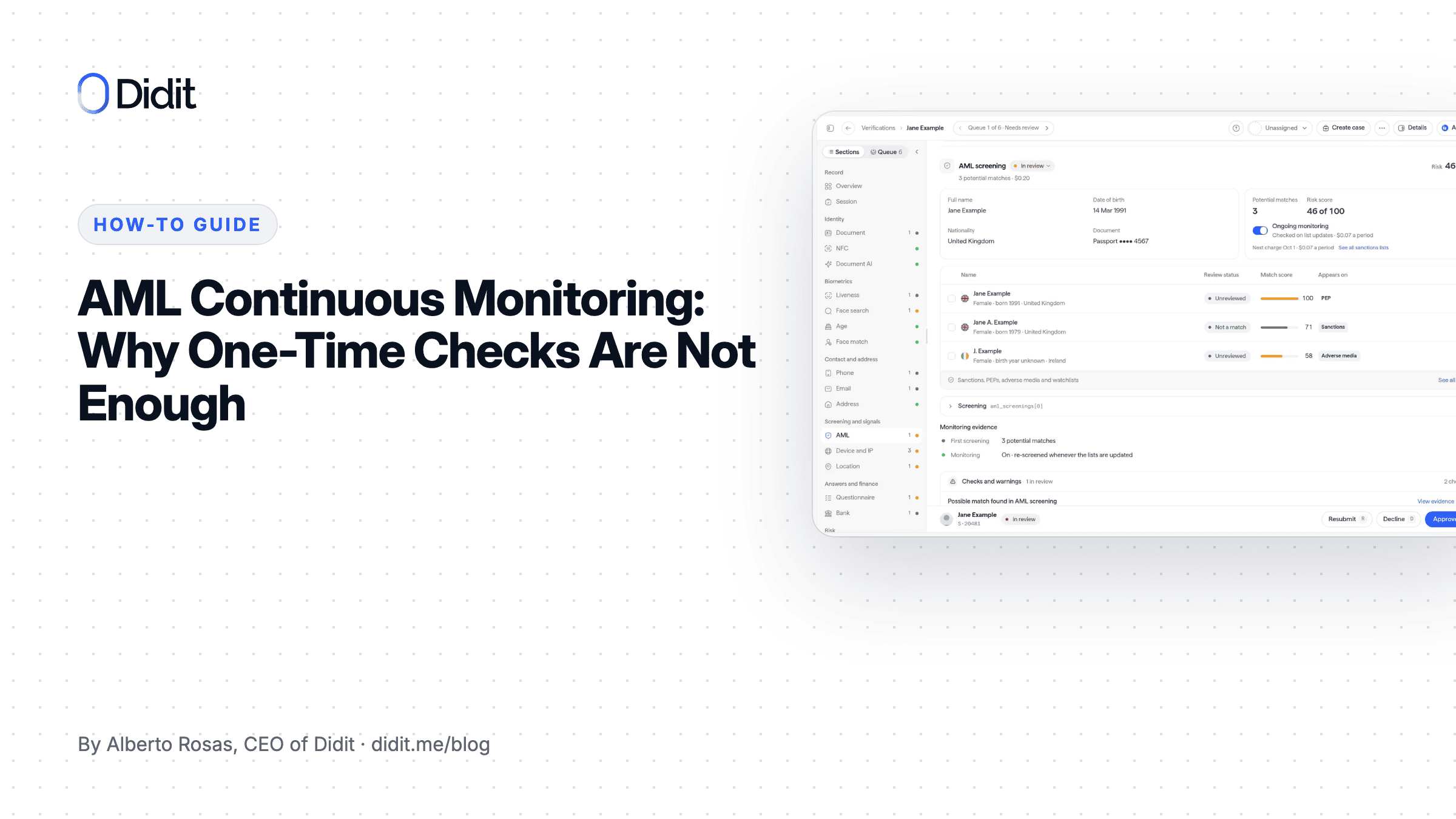
AML continuous monitoring re-screens approved customers against 1,300+ watchlists on a daily provider-driven cadence. AML screening costs $0.20 per check and ongoing monitoring $0.07 per person a year.
 Alberto RosasCo-founder and CEO
Contents
In this guide
Jump to the part you need.
AML continuous monitoring re-screens the customers you already approved against updated sanctions, PEP, and watchlist data, so a clean onboarding result does not stay clean by default. It fits teams with an approved customer base and a reviewer who asks what changed since onboarding. AML Screening is $0.20 per check and ongoing monitoring is $0.07 per person a year. The caveat: ongoing monitoring requires a saved screening, so save_api_request must be true.
Last updated: November 26, 2026. Prices checked against the live Didit price feed on November 26, 2026.
| Item | Price or value | Notes |
|---|---|---|
| AML screening | $0.20 per check | 1,300+ sanctions, PEP, watchlist and adverse media sources |
| Ongoing AML monitoring | $0.07 per screened entity a year | Daily, provider-driven, needs a saved screening |
| Full ID check (KYC) | $0.33 per check | ID document, passive liveness, face match, device and IP |
| Compliance bundle | $0.53 per user | KYC plus AML screening in one flow |
| Company AML screening | $0.20 per check | Company entity level, inside business verification |
| Person AML for UBOs | $0.20 per person | Each beneficial owner and officer |
| Match score threshold | 93 by default | Below it, a hit is tagged False Positive |
| Status thresholds | Approve 80, review 100 | Scores above 80 and at or below 100 are In Review; above 100 is Declined |
| Plans | Free $0, Growth $99 a month, Scale $299 a month, Enterprise from $15,000 a year | Growth takes 4% and Scale 10% off every price |
Start free in the sandbox at business.didit.me (no sales call) and check every number on the Didit pricing page. Developers can connect Didit to an AI assistant through the Didit MCP server.
What AML continuous monitoring means at Didit
A one-time AML check answers a narrow question: on the day of onboarding, did this name match a sanctions, PEP, or watchlist record? Risk data can change after onboarding. A customer gets listed, a company gets debarred, a PEP gets appointed, an adverse media story gets published, and nobody tells you.
Continuous monitoring, which we also call ongoing AML monitoring, keeps the approved profile in front of the screening provider and re-checks it against updated lists on a daily cadence. In the API this is the include_ongoing_monitoring flag. It only works on a stored screening, so save_api_request must stay true. The provider's updates reach the same report, and a change fires a webhook. The AML screening product page shows where the feature sits in a workflow.
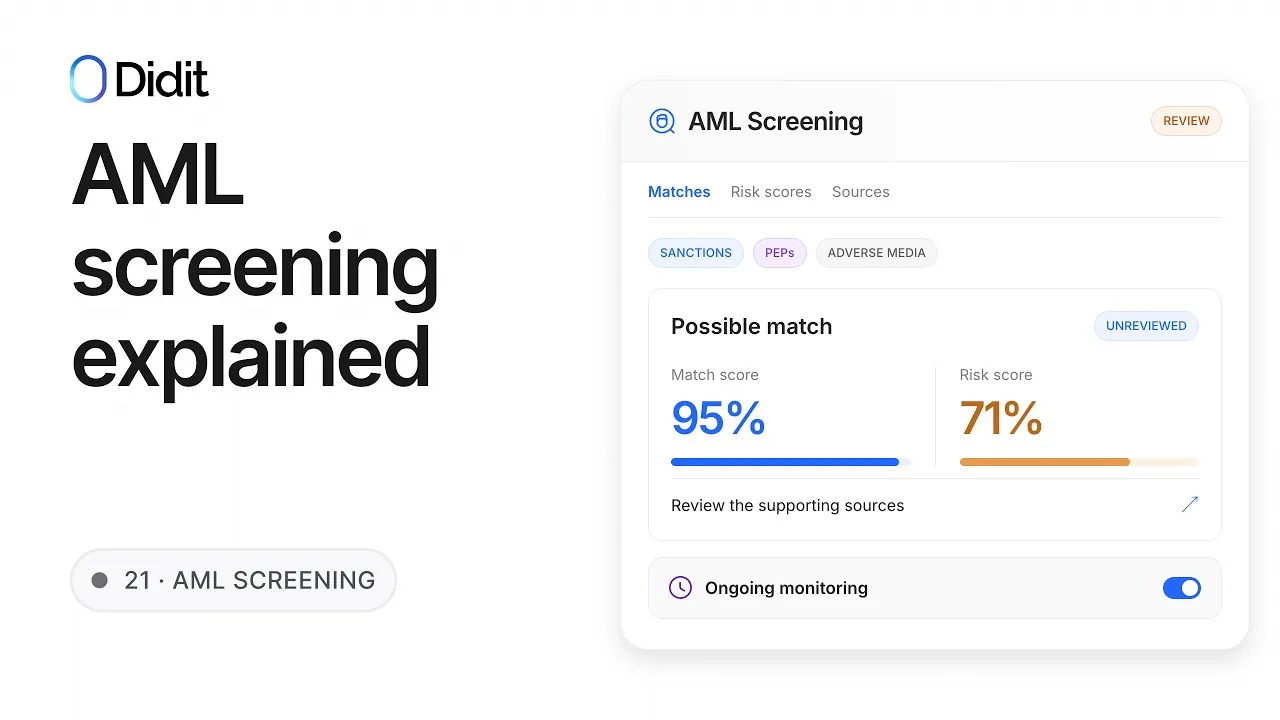
Two scores decide what you see. The match score, 0 to 100, answers whether the listed person is your customer. The risk score answers how risky the listed entity is if the match is real. Both boundaries are configurable per workflow. Didit has 4,000+ active companies.
Why one-time AML checks are not enough
Onboarding is a snapshot of one day, and the lists behind it keep moving.
- The lists move, the customer file does not. Sanctions and PEP data change daily. A customer screened clean in January can be listed in June, and your file still says clean.
- Ongoing monitoring is part of customer due diligence. FATF Recommendation 10 describes ongoing monitoring as part of customer due diligence. Check the requirements that apply to your jurisdiction and business.
- You cannot reconstruct a decision you never stored. A reviewer asks which list, which score, which reviewer, which date. A one-time check with no saved report cannot answer any of those questions.

Prerequisites before you switch monitoring on
- A Didit application and an API key. Sandbox keys work and are free.
- An AML workflow, built in the Business Console or created with
POST /v3/workflows/, with the AML feature added. - Thresholds configured:
aml_match_score_thresholdat 93 by default,aml_score_approve_thresholdat 80,aml_score_review_thresholdat 100, and the three match weights summing to exactly 100. - Credit on the account, because every new screening is billable.
- A webhook destination subscribed to
status.updatedanddata.updated, with HMAC verification implemented. - A named reviewer for anything that lands
In Review. Monitoring without a review owner just moves the problem.
How to set up AML continuous monitoring in 7 steps
- Choose the entity you monitor. A person through the standalone AML API, a person inside a verification session, or a company with its UBOs and officers through business verification. You can carry an internal identifier in
vendor_data. - Set the thresholds in the workflow. The match weights
aml_name_weight,aml_dob_weightandaml_country_weightdefault to 60, 25 and 15. They must sum to exactly 100, or the request is rejected with HTTP 400. - Send the data the matcher needs. Full name, date of birth, and nationality. A matching
document_numberacts as a golden key and overrides the match score to 100. - Store the screening.
save_api_requestdefaults to true. Leave it on. Ongoing monitoring requires a saved screening and returns HTTP 400 without it. - Turn monitoring on. Send
include_ongoing_monitoringtrue in the same call, or toggle it later per session in the Business Console. You do not build a scheduler: the provider keeps the entity under monitoring, dated every day. - Register the webhook. Subscribe a destination to
status.updatedanddata.updated. VerifyX-Signature-V2over the sorted, Unicode-preserved canonical JSON. Use raw bytes only forX-Signature. Reject timestamps older than 300 seconds, and accept the previous signature for 24 hours after a secret rotation. - Route the result.
Approvedcloses the loop.In Reviewgoes to a person.Declinedis recorded with the hit details so the decision is reproducible.
The screening call
curl -X POST 'https://verification.didit.me/v3/aml/' \
-H "x-api-key: $DIDIT_API_KEY" \
-H "Content-Type: application/json" \
-d '{
  "full_name": "Javier Ejemplo Modelo",
  "entity_type": "person",
  "date_of_birth": "1974-01-01",
  "nationality": "ES",
  "include_adverse_media": true,
  "save_api_request": true,
  "include_ongoing_monitoring": true,
  "vendor_data": "user-1234"
}'
Expected output
With a live key and no matches, the call returns the person's status, the stored screening id, an empty hit list and the monitoring warning. The shape below follows the documented response fields.
{
  "request_id": "uuid",
  "aml": {
    "status": "Approved",
    "screening_id": "uuid",
    "score": 0,
    "hits": [],
    "warnings": ["ONGOING_MONITORING_ENABLED"]
  }
}
Two notes on timing. include_adverse_media adds an initial pause plus enrichment polling, so set a client timeout of at least 60 seconds. Sandbox keys skip screening and billing and return a mocked Approved result with zero hits unless you pass sandbox_scenario.
Saved reports and webhooks for audit review
A saved screening is retrievable later: request_id works with GET /v3/session/{sessionId}/decision/, the screening appears in the Business Console, and GET /v3/session/{sessionId}/generate-pdf/ returns a report. Hit review statuses can be updated later, so the record keeps the date and the outcome of each review. That is the material an auditor asks for: the list, the two scores, the status and the date.
Webhooks carry the same decision to your own systems. A destination subscribed to status.updated and data.updated receives an envelope like this one:
{
  "event_id": "uuid",
  "session_id": "uuid",
  "status": "Approved",
  "webhook_type": "status.updated",
  "created_at": 1627680000,
  "timestamp": 1627680000,
  "application_id": "uuid",
  "environment": "live",
  "vendor_data": "your-internal-user-id",
  "decision": { }
}
Signing is exact. X-Signature-V2 is HMAC-SHA256 over the sorted, Unicode-preserved canonical JSON of the body. X-Signature is HMAC-SHA256 over the exact raw bytes and works only if your stack does not re-encode the body. Reject a timestamp more than 300 seconds away from now, and accept the previous signature for 24 hours after a secret rotation.
Inputs and outputs
| Field | Direction | What it does |
|---|---|---|
full_name | Input, required | Person or company name, minimum 2 characters |
entity_type | Input | person or company |
date_of_birth, nationality | Input | Feed the date-of-birth and country weights |
include_adverse_media | Input | Adds media screening, latency rises to about 25 seconds |
include_ongoing_monitoring | Input | Keeps the entity under daily provider monitoring |
save_api_request | Input | Stores the screening as a session, required for monitoring |
Idempotency-Key | Header | Retry safety, a replayed request is not billed twice |
request_id | Output | Works with GET /v3/session/{sessionId}/decision/ |
aml.status | Output | Approved, In Review, Declined, In Progress, Kyc Expired and the other status values |
hits[] | Output | Each hit carries match_score, risk_score and review_status |
warnings[] | Output | POSSIBLE_MATCH_FOUND, MATCH_FOUND, HIGH_RISK_COUNTRY, ADVERSE_MEDIA_HIT, SANCTIONED_ENTITY, PEP_MATCH, ONGOING_MONITORING_ENABLED |
Failure cases and recovery
| Symptom | Cause | Recovery |
|---|---|---|
| HTTP 400 on the call | The three match weights do not sum to exactly 100 | Adjust the weights, then resend |
| HTTP 400 with monitoring on | include_ongoing_monitoring sent without save_api_request | Set save_api_request true and resend |
| HTTP 403 | Out of credits | Top up, then retry with the same idempotency key |
| HTTP 409 on retry | The same idempotency key was reused with a different body | Send a new key for the new body |
Status In Review | The risk score sits between the approve and review thresholds | Route to the manual queue with the hit details attached |
Status Declined | A hit crossed the review threshold | Apply your documented decision process and retain the hit details |
| No adverse media in the result | The upstream media provider was slow | The result is still actionable. Re-run the check if media coverage matters for that decision |
| Webhook signature fails | Wrong secret, or a stale timestamp | Recompute HMAC-SHA256 over the sorted, Unicode-preserved canonical JSON for X-Signature-V2 (raw bytes only for X-Signature), allow 300 seconds of clock drift, accept the previous signature during rotation |
Paid steps and review boundaries
Four things cost money in a monitoring program: the first screening at $0.20, every new screening at $0.20, ongoing monitoring at $0.07 per screened entity a year with a billing alert when it is enabled, and the linked person checks in business verification at $0.20 per UBO or officer. The $0.07 is separate from the $0.20: each fresh screening is its own $0.20 charge, while the yearly fee covers the daily provider-driven monitoring of the stored profile. Sandbox calls are free and mocked. Replayed idempotent responses are never charged again.
Three boundaries decide the outcome. Below the match score threshold of 93, a hit is tagged False Positive and ignored for risk. Scores above 80 and at or below 100 are In Review, and a person must look. Scores above 100 are Declined. A score of exactly 0 never raises a warning; any non-zero score at or above the approve threshold adds a POSSIBLE_MATCH_FOUND warning.

Worked cost example
Take 5,000 approved customers you screen once and then monitor for a year, at list prices.
- Onboarding AML screening: 5,000 x $0.20 = $1,000.00
- Ongoing monitoring for a year: 5,000 x $0.07 = $350.00
- Year one total: $1,000.00 + $350.00 = $1,350.00
- If AML runs inside full KYC through the compliance bundle: 5,000 x $0.53 = $2,650.00, which includes the $0.33 full ID check
- Same volume on Growth, 4% off: 5,000 x $0.192 = $960.00 of screening plus 5,000 x $0.0672 = $336.00 of monitoring, so $1,296.00
For a business with three UBOs, the AML side is company AML $0.20 plus three person checks at $0.20, so $0.20 + $0.60 = $0.80 on top of the registry retrieval, which starts at $2.00 per company. Monitoring those four screened entities for a year is 4 x $0.07 = $0.28.
Sources
- Didit AML Screening overview
- Standalone AML screening API reference
- Didit continuous monitoring docs
- AML warnings catalogue
- Business AML screening for companies and UBOs
- Didit webhooks and HMAC signing
- Didit data models
- Didit pricing documentation
- Didit pricing page and cost estimator
- Didit AML screening product page
- Didit MCP server
- FATF recommendations
Next step: open the sandbox at business.didit.me, run one AML screening with ongoing monitoring enabled, and read the hit review screen before you commit to a cadence. No sales call, no contract. The page shows published list prices. Taxes, plan discounts, pass-through charges, and variable pricing may apply.
Try it
Try this in the sandbox
Run the check this guide describes, free.
The product this post is about, taken from its topic. Run it free in the sandbox.
Author
Alberto Rosas
Co-founder and CEO

Keep reading
Other guides in the same topic.
 What Is the Purpose of FICA in South Africa? 2026 Guide
FICA is South Africa's anti-money laundering law. It creates the Financial Intelligence Centre and requires accountable institutions to identify and verify clients, screen for PEP and sanctions risk and report suspicious.
Alberto RosasNov 26, 2026 Sixth Money Laundering Directive (6AMLD): What Changed and Which Rules Apply
6AMLD is Directive (EU) 2018/1673: Member States must criminalise laundering, widen predicate offences and set a four-year penalty floor. It adds no new due diligence duties for firms.
Alberto RosasNov 26, 2026 Automated Sanctions Screening: Canada, the Entity List and Embargoes
Automated sanctions screening matches people and companies against lists such as Canada's autonomous sanctions made under SEMA and JVCFOA and the OFAC SDN List, and returns candidate hits scored for identity confidence and.
Alberto RosasNov 26, 2026Questions
Frequently asked questions
What is AML continuous monitoring?
AML continuous monitoring is the ongoing re-screening of an approved customer against updated sanctions, PEP, watchlist and adverse media data after onboarding. Didit runs it as provider-driven monitoring with a daily rescan, priced at $0.07 per screened entity a year. That fee is separate from the $0.20 you pay for each new screening.
How often does Didit rescreen a monitored customer?
The entity stays under provider-driven ongoing monitoring, dated every day, so a new or changed listing reaches the stored report without you running a scheduler. You can also re-run the standalone AML call yourself at any time for $0.20 per check.
How much does AML continuous monitoring cost?
At list price, $0.20 per AML screening and $0.07 per screened entity per year for ongoing monitoring. Growth plan pricing applies 4%, making those $0.192 and $0.0672, and Scale applies 10%, making them $0.18 and $0.063.
Are one-time AML checks enough for compliance?
No. A one-time check describes risk at a single moment, while FATF Recommendation 10 describes ongoing monitoring as part of customer due diligence. Check the requirements that apply to your jurisdiction and business. A listing change after onboarding with no rescan and no stored report leaves nothing to show an auditor.
What is the difference between the match score and the risk score?
The match score, 0 to 100, says how likely the listed person is your customer, using name, date of birth and country weights that must sum to 100. The risk score says how risky the listed entity is. Hits under the match threshold of 93 are tagged False Positive and ignored for risk, and the highest remaining risk score becomes the session score.
How do I turn on monitoring for customers I verified earlier?
Toggle ongoing monitoring per session in the Business Console, or send the profile again with include_ongoing_monitoring true and save_api_request true. The API returns HTTP 400 if monitoring is requested without a saved request. Re-screening an existing profile is billed as a new check.
What happens when a monitored customer appears on a new list?
The provider's update reaches the stored report and Didit fires a webhook, status.updated or data.updated, with the new status. The report and the console hold the hit, both scores and the warning codes, so a reviewer has the documented record in front of them. Business sessions send the business variants with session_kind set to business.
How do I handle false positives in AML monitoring?
A hit below the match score threshold is tagged False Positive and does not count toward risk, so it does not move the status. Everything else is a real review item: record the reason, the list and the reviewer name, because that note is what an auditor reads later.
Can I test AML monitoring for free?
Yes. Sandbox testing is free and unlimited, and sandbox keys skip screening and billing, returning a mocked Approved result with zero hits unless you pass sandbox_scenario. Eligible organizations that sign up with a work email receive $10 of monthly Free-plan credit, which is 50 AML checks at $0.20. Phone verification codes are excluded from that credit.
Does continuous monitoring cover companies and their owners?
Yes. Business verification screens the company entity and every identified beneficial owner and officer, at $0.20 per company check and $0.20 per person. New or changed matches generate a business webhook event, so the same record covers the company and the person.
What is the difference between AML monitoring and 24/7 transaction monitoring?
AML monitoring watches a person or company against watchlists over time. Transaction monitoring watches payments, priced at $0.001 per transaction beyond the monthly allowance of 1,000 on Free, 10,000 on Growth and 100,000 on Scale. It evaluates every transaction, which is the 24/7 layer most teams mean when they ask for continuous checks.
Which lists does Didit screen against?
1,300+ sanctions, PEP, watchlist and adverse media sources, including the UN consolidated list, EU consolidated financial sanctions, OFAC, development bank debarment lists and national regimes such as Swiss SECO and Australian DFAT. Business screening adds regulatory watchlists and insolvency registers.
Compliance built in
Audited, certified and attested.
We hold the certifications and build each country's rules into your flows, so you can launch anywhere without worrying. Security and Compliance center
- Regulation encoded into your flows
Tell us what you do and where. Didit lists the rules that apply to you, with sources, and builds the checks each country needs into one workflow.
- Ready for AMLR
Every requirement of the new EU anti-money laundering rules, from checking customers to human review, is already covered by a Didit check.
- Tested in Spain's Treasury sandbox
Spain's Treasury published its supervised sandbox report on Didit's NFC plus active liveness onboarding; SEPBLAC took part and valued the added measures positively.
- Audited, not self-declared
iBeta Level 1 and Level 2. Liveness tested under ISO/IEC 30107-3.
Your obligations · 3 regions
 SOC 2 Type 2
 ISO 27001
 iBeta Level 1 and Level 2
 EU regulator attestation
 FSM youth protection
 GDPR
 EBA remote onboarding
 MiCA compatible
 FIDO Alliance member
- AMLREU AML Regulation ready
Integration · Didit MCP
Run Didit from your own AI agent
Connect Didit to Claude, Cursor, VS Code or ChatGPT and just ask in plain words. Your agent can do anything you can do in the console, with the same permissions you have.
 Add to Claude
 ChatGPT
 Cursor
- Build workflowsDescribe the checks you need. The agent creates and publishes the flow.
- Run investigationsAsk why a session was declined, review cases, search people and companies.
- Change rulesCreate payment rules, test them on past data and switch them on.
- Pull reportsAsk for numbers, exports or the audit log.
Didit Academy


