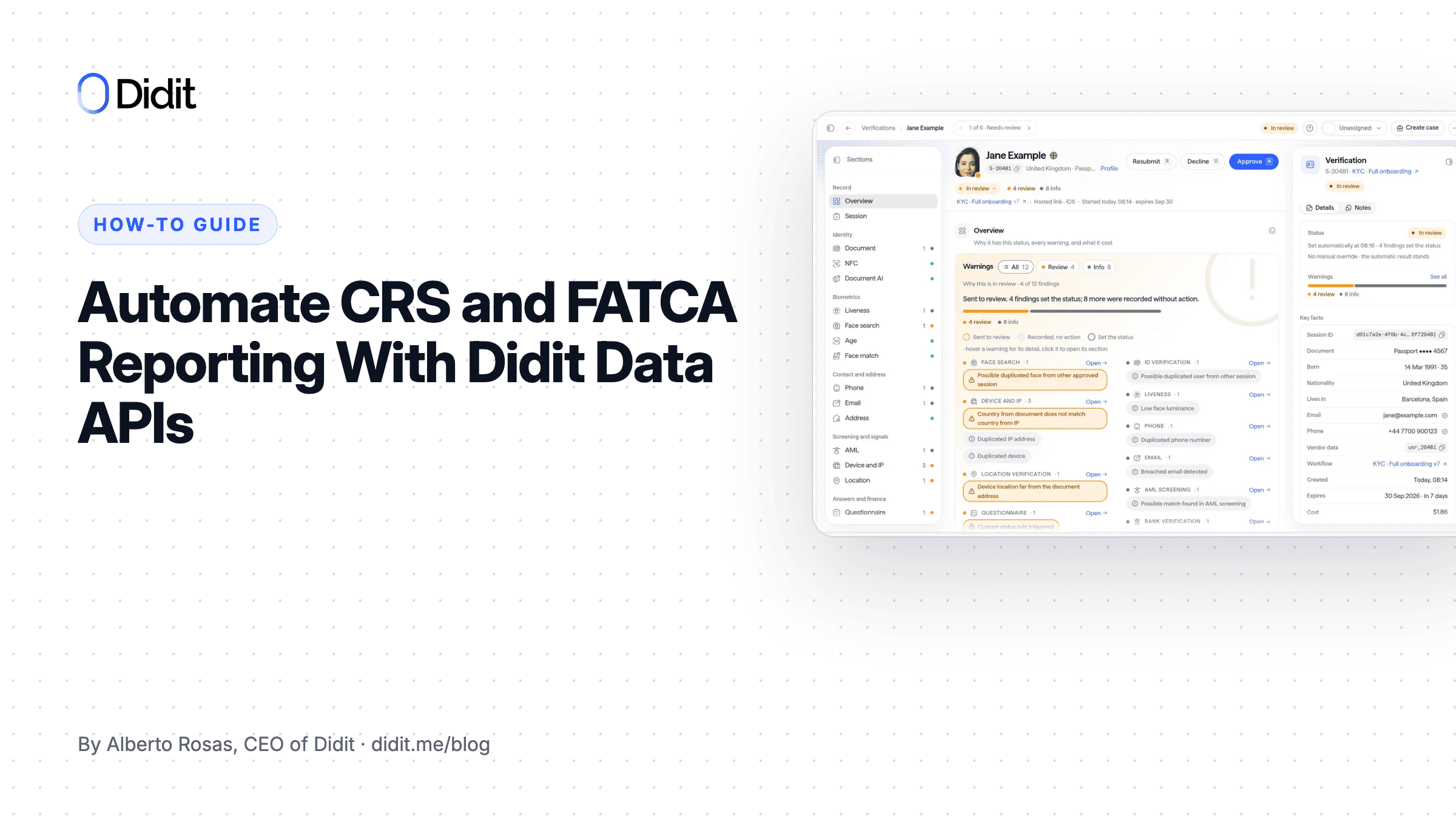
Automate CRS and FATCA Reporting With Didit Data APIs
Extract tax reporting data with Document AI at $0.20 per document. Hosted checks cost $0.15 for ID Verification and $0.20 for Proof of Address. Your team determines tax residence and files.
 Alejandro RosasCo-founder and CTO
Contents
In this guide
Jump to the part you need.
If your team prepares CRS or FATCA reports, we can extract the fields you define from supporting PDFs and images with Document AI at $0.20 per document. The API returns typed values and flags document risks for review. Your reporting system still applies jurisdiction-specific rules, determines reportability and prepares the filing.
Last updated: November 26, 2026. Prices checked against the live Didit price feed on November 26, 2026.
Summary: what you call and what it costs
| Job | Endpoint | What comes back | List price |
|---|---|---|---|
| Read fields from a document you did not design (bank statement, tax form, proof of funds, payslip) | POST /v3/document-ai/ | Typed fields, name match score, supported code detections, readability and tampering warnings | $0.20 per document |
| Verify the identity document | POST /v3/id-verification/ | Holder fields, parsed MRZ, document type, status and warnings | One ID Verification API credit per live HTTP 200 response |
| Verify a residential address | POST /v3/poa/ | Issuer, issue and expiry dates, holder name, parsed and geocoded address | One Proof of Address API credit per live HTTP 200 response |
| Let the account holder submit everything through a hosted flow | POST /v3/session/, then GET /v3/session/{session_id}/decision/ | One decision containing results for the features that ran | Billed at the applicable workflow rates for completed checks. A full ID check is $0.33 at list price. |
Start free in the sandbox at business.didit.me, with no sales call, and read the numbers on the Didit pricing page. Developers can connect a compatible AI assistant through the free Didit MCP server using OAuth.
What the finished flow does
CRS is an OECD reporting standard implemented through local rules. FATCA is a US reporting regime whose obligations and reporting channels depend on the institution and the applicable rules or intergovernmental agreement. Map required fields, exceptions and filing routes separately for CRS and FATCA in each jurisdiction where you report.
- Document AI for documents that do not fit a fixed template. You define the fields yourself, up to 30 per request, each typed
text,numberordate; a date comes back asYYYY-MM-DD. Every successful response includesdocument_ai.detected_codesfor supported codes found on processed pages. The array can be empty. A located code can have anullparsed payload, unavailable coordinates or an empty raw payload. The same response screens the file for manipulation. The same step runs inside the hosted flow, described on the Document AI product page and in the hosted Document AI step docs, and the Didit pricing page lists Document AI at $0.20 per document. - ID Verification for the identity document, with 14,000+ document types from 220+ countries and territories, OCR of the visual zone, MRZ and barcode decoding, and cross-checks between the visual zone and the MRZ.
- Proof of Address when your institution's evidence policy requires it.
If you would rather the account holder submitted the documents themselves, run the same steps inside a session. The hosted Document AI step and the other steps handle capture in the browser, and the decision endpoint returns one decision containing results for the features that ran. The key used to retrieve the decision needs read:sessions.
One part stays outside our scope. Tax residence is a determination, not an extraction. A custom questionnaire costs $0.10 per check. A configured E-signature step returns signature status, a timestamp and evidence in the session decision. Your compliance team decides whether the declaration satisfies its requirements.
Which evidence supplies which reporting field
| Reporting field | Usual source | Didit call | When sources disagree |
|---|---|---|---|
| Holder identity (name, date of birth, place of birth) | Identity document plus the self-certification | ID Verification, or Document AI on the document image | For ID Verification, compare the returned holder name with the self-certification. For Document AI, pass the certified name as the expected name and inspect the returned name and match score. Review mismatches and check any null score manually. |
| Address | Utility bill, bank statement or the self-certification | Proof of Address on the document; Document AI on the address block of a statement | Keep the certified address and the document address side by side and review any difference. |
| Claimed tax residence | Self-certification or other approved evidence, not an address printed on a document | Custom questionnaire step, or your own collection | Never infer residence from a printed address. Send conflicting claims to review. |
| TIN | Self-certification, or the number printed on a statement or tax form | Document AI, with the instruction stating the format to expect | Preserve the TIN exactly as shown. Apply jurisdiction-specific checks separately and review discrepancies. |
| Account number | Your reporting ledger | None, the ledger is the source | The ledger wins. Use extraction only to cross-check. |
| Closing balance and currency | Statement from the custodian | Document AI | Reconcile the extracted balance and its as-of date against the reporting-period record. |
| Reporting date and period | Your reporting ledger | None | The example explicitly asks for the issue date. Capture the balance as-of date separately when the statement supplies it, and do not substitute one for the other. |
Prerequisites
- A Didit application and an API key. Every call authenticates with the
x-api-keyheader. - A sandbox application for testing. Sandbox testing is free and unlimited. The Proof of Address sandbox validates the request and returns a static
Approvedexample without creating a session. Use it to test request construction and response handling. Verify extraction quality and warning behavior with approved representative documents on the applicable live endpoint. - The document as a PDF or an image. For Document AI, send the file as it arrives. For an identity document, send uncropped photos with all four corners visible, because the service detects, aligns and crops the document itself.
- A field list of 1 to 30 items. Each item has a
key(lowercase letters, digits and underscores, unique in the request), a human-readablename, aninstruction, atype, and therequiredandis_full_nameflags. Onlykeyis strictly required, but a precise instruction is what makes the extraction land on the right value. - The expected name if you want the name check. Send
expected_first_nameandexpected_last_namefor a person, orexpected_company_namewith an optional two-letterexpected_company_countryfor an entity. Send one group or the other, never both. - A policy for each risk. Every risk has an action parameter set to
DECLINE,REVIEWorNO_ACTION, and the strictest triggered action decides the status.
Step by step: extract reporting fields from a bank statement
- Write the field list. Use the statement to extract the holder, the closing balance, the currency and the statement date. Mark the holder field with
is_full_name: trueso the name check compares the value you chose. The field definition asks for the issue date, so capture the balance as-of date separately when the statement supplies it, and reconcile the balance against the reporting-period record. Collect tax residence and the TIN from the applicable self-certification or approved evidence, preserve the TIN exactly as shown, and apply jurisdiction-specific checks separately. - Send the document. The request is
multipart/form-data. The file goes indocument, and the whole field array goes infieldsas one JSON-encoded string.
If you sendcurl -X POST https://verification.didit.me/v3/document-ai/ \ -H "x-api-key: $DIDIT_API_KEY" \ -F "document=@./bank-statement.pdf" \ -F 'fields=[{"key":"account_holder","name":"Account holder","instruction":"Full name of the person or company the account belongs to","type":"text","required":true,"is_full_name":true},{"key":"balance","name":"Closing balance","instruction":"Closing balance shown on the statement, as a number without the currency symbol","type":"number","required":true},{"key":"currency","name":"Currency","instruction":"Three-letter currency code of the balance","type":"text"},{"key":"statement_date","name":"Statement date","instruction":"Date the statement was issued","type":"date","required":true}]' \ -F "expected_first_name=Jane" \ -F "expected_last_name=Doe"fieldsas bracket-style form keys such asfields[0][key], or as anything other than a JSON array, the API returns400before any extraction runs and nothing is billed.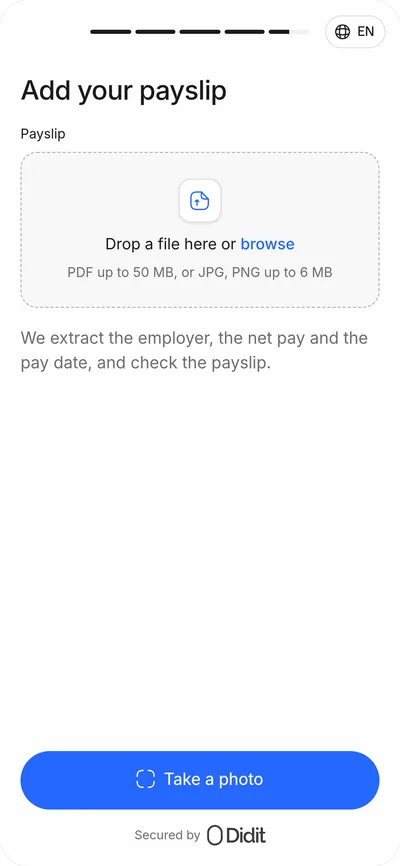
The document goes in as a file, the field definitions go in as one JSON array string. - Read the response.
extracted_datais keyed by your own keys and holdsnullfor anything the model could not find.document_ai.statusisApproved,In RevieworDeclined, anddocument_ai.warningslists every risk that fired. Always read the status and the warnings, not just the HTTP code, because a readable but problematic document still returns200.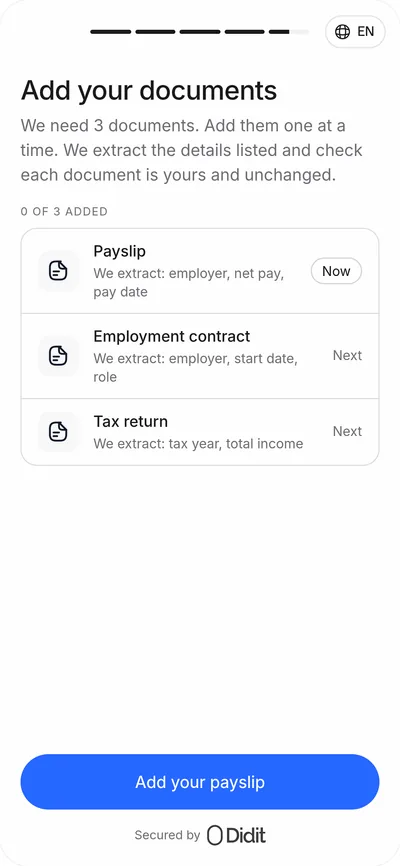
Each processed document keeps its extracted fields and its warnings side by side. - Verify the identity document when you need the person's own record. Send
front_imageand, for two-sided documents,back_imagetoPOST /v3/id-verification/. You never declare the country or the document type; classification is automatic. Withperform_document_liveness=true, the default, the images are also screened for screen replays, printed copies and portrait manipulation. If document liveness returns no usable score, the API addsDOCUMENT_LIVENESS_NOT_COMPUTEDand returnsIn Reviewunless another warning already makes the decisionDeclined.
The identity document report keeps the extracted holder fields, the MRZ and every warning on one screen. - Run Proof of Address when your evidence policy requires it.
POST /v3/poa/returns the issuer, the issue and expiry dates, the holder name, and the address both raw and parsed and geocoded. Extraction is LLM-based: typical calls take 5 to 15 seconds and a multi-page PDF can take about 30, so set the client timeout to at least 45 seconds and do not retry before the call completes. Each HTTP200consumes one Proof of Address API credit.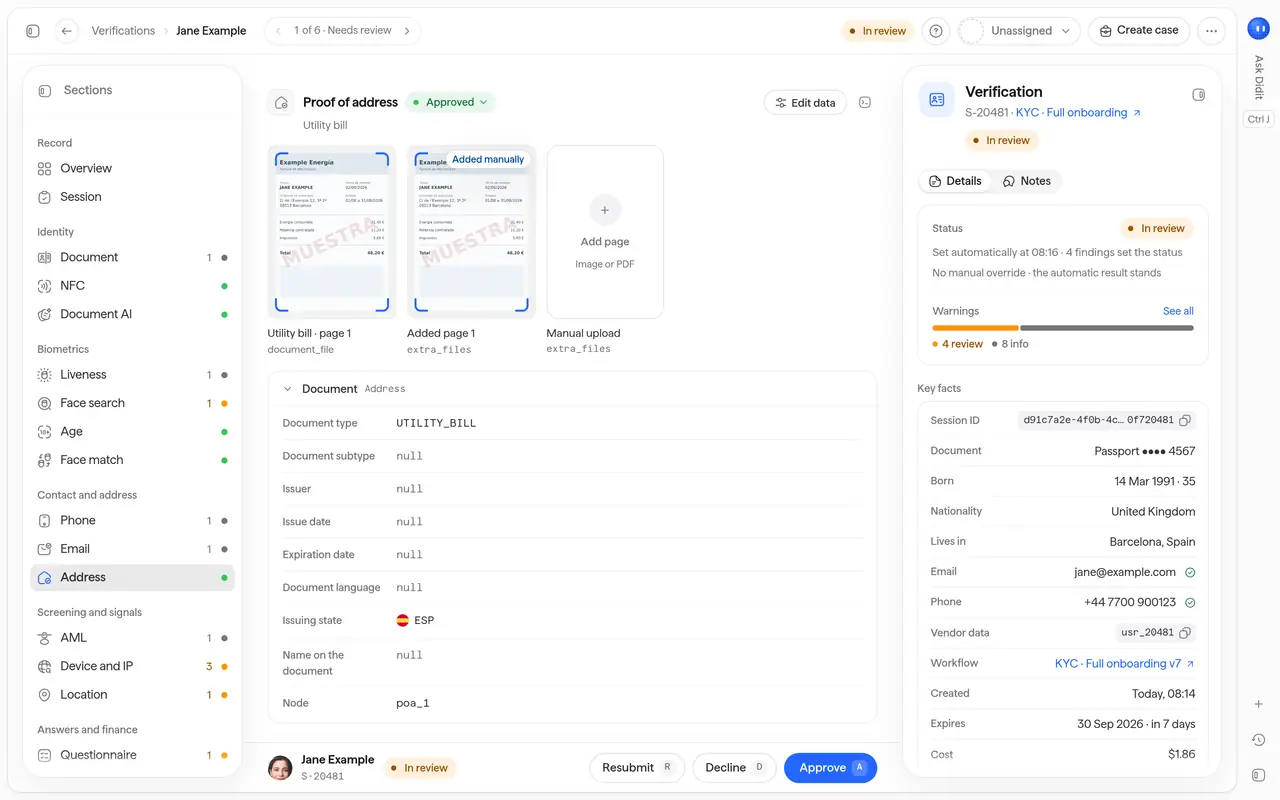
A proof of address report shows the parsed address, the document age check and any manipulation warning. - Or run the same steps inside a session. Create it with
POST /v3/session/and aworkflow_id, hand the account holder the hosted link, then read the decision:
Branch oncurl "https://verification.didit.me/v3/session/SESSION_ID/decision/" \ -H "x-api-key: $DIDIT_API_KEY"session_kind:userfor a person,businessfor an entity. The feature arrays are always plural, and a feature that did not run is absent ornull, never a placeholder. The full schema for each report object is in the data models reference. - Review the flags. Review flagged records before assembling the reporting file. That covers anything
In Review, any name mismatch you raised to an action, and any tampering warning. - Go live. Swap the sandbox key for a live key, set the action parameters to the policy your compliance team approved, and let the responses land in your reporting dataset. For standalone ID Verification and Proof of Address,
save_api_requestdefaults totrue, so the call is persisted as an API-type session and the returnedrequest_idis a real session id you can look up later.
Inputs and outputs
| Field | Required | What it does |
|---|---|---|
document | Yes | The PDF or image file, sent as one multipart form value. |
fields | Yes | JSON array of 1 to 30 field definitions, sent as a single string. Each item requires a key and can include name, instruction, type, required and is_full_name; type defaults to text. |
expected_first_name, expected_last_name | No | The person the document should belong to. Send the first and last name together; a score is produced only when an expected name and an extracted name are both available. |
expected_company_name, expected_company_country | No | The entity the document should belong to. Country is a two-letter ISO code. |
document_ai_name_match_score_threshold | No | Defaults to 80. A score below it raises DOCUMENT_AI_NAME_MISMATCH. |
document_ai_*_action parameters | No | Per risk: DECLINE, REVIEW or NO_ACTION. The strictest triggered action decides the status. |
| Field | What it contains |
|---|---|
fields | The normalized field definitions, echoed back. |
extracted_data | Values keyed by your own keys, typed, with null for anything not found. |
name_on_document and name_match_score | The name read from the document and a 0 to 100 score against the expected name. The score is null when no name was found or no expected name was sent. |
document_ai.detected_codes | Supported code detections on processed pages, each with type, page_number, the bounding box on the rendered page, parsed_payload and the raw base64 payload. Empty when no supported code is present. |
document_ai.status | Approved, In Review or Declined. |
document_ai.warnings | Every triggered risk with a code, a short description and a longer explanation you can show to a reviewer. |
In the statement example above, a statement date the model cannot read comes back as null in extracted_data. A missing required field triggers DOCUMENT_AI_MISSING_REQUIRED_FIELDS, which defaults to REVIEW, and document_ai.status becomes In Review unless a stricter triggered action applies.
Before accepting the values, check four things: every key in extracted_data that you marked required, the document_ai.status, every entry in document_ai.warnings, and whether name_match_score is a number or null. Do not read a missing field as a formatting problem and quietly substitute a value from another source.
Expected output
A successful call returns 200 with the field definitions echoed, the extracted values under your own keys, the name match result when you asked for one, and a status. A readable statement can still trigger other warnings, so read the warnings rather than treating readability as an approval. If Didit cannot find a field, its value is null. A missing required field triggers DOCUMENT_AI_MISSING_REQUIRED_FIELDS, which defaults to REVIEW. A stricter triggered action takes precedence. Check extracted TINs against the source even when the API returns a populated value.
For the TIN in particular, treat extracted_data as a candidate. TIN formats vary by jurisdiction, and a TIN is easy to confuse with an account number. Define the TIN field with type text so the integration can preserve printed formatting and leading zeros. Pull the TIN where the document prints it clearly, compare it with the self-certification, and preserve it exactly as shown. Send differences to review rather than replacing one with the other.
Failure cases and recovery
| Symptom | What it means | Recovery |
|---|---|---|
400 on /v3/document-ai/ after sending fields as bracket-style form keys or as a non-array value | fields was not sent as one JSON array, for example bracket-style keys | Resend the whole array as one JSON-encoded string. For that input, nothing was extracted and nothing was billed. |
DOCUMENT_AI_UNREADABLE_DOCUMENT (default REVIEW) | The file could not be read well enough | Ask for a new scan or a photo of the same statement. Do not lower this to NO_ACTION. |
DOCUMENT_AI_MISSING_REQUIRED_FIELDS (default REVIEW) | At least one field marked required came back empty | Check the instruction text, then re-send, or collect that value from the account holder directly. |
DOCUMENT_AI_SUSPECTED_MANIPULATION (default DECLINE) | The file shows signs of manipulation | Leave the decline in place for a tax record and escalate. On proof of address, PDF and EXIF forensics raise SUSPECTED_DOCUMENT_MANIPULATION or DOCUMENT_METADATA_MISMATCH. |
DOCUMENT_AI_NAME_MISMATCH (default NO_ACTION) | The name on the document scored below your threshold | Choose REVIEW or DECLINE for document_ai_name_mismatch_action according to the institution's approved policy. The default does nothing on its own. |
DOCUMENT_AI_UNSUPPORTED_FILE (default REVIEW) | The file type or structure is not supported | Convert the file and resend. |
403 with the not-enough-credits error | The organization balance cannot cover the call | Top up. On standalone ID Verification and Proof of Address the endpoint refuses before processing, so you are not charged for the attempt. |
400 with COULD_NOT_RECOGNIZE_DOCUMENT on ID Verification | The image could not be processed at all | Resend uncropped images with all four corners visible. A readable document can return 200 with Declined or In Review; inspect id_verification.status and id_verification.warnings. |
Client timeout on /v3/poa/ | The client stopped waiting before it received a response. The server may still finish processing. | Set the timeout to at least 45 seconds and confirm the first call has completed before retrying. |
Paid steps and review boundaries
Document AI costs $0.20 per completed check from prepaid credit. Malformed fields rejected before extraction are unbilled. For standalone ID Verification and Proof of Address, each HTTP 200 consumes one API credit, and an insufficient-credit refusal occurs before processing. ID Verification costs $0.15 per hosted workflow check, Proof of Address costs $0.20 per hosted workflow check, and the sandbox is free on every plan.
Four decisions stay with people:
- Any session or document still
In Reviewwhen the reporting file is assembled. Do not let a review item reach the return unreviewed. - Any name mismatch you raised to an action, including a legal name that differs by marriage, transliteration or order of surnames.
- Any tampering or metadata warning. A declined document is not evidence of a valid account holder record.
- The tax residence determination itself, and the sign-off of the filed return. We supply extracted and cross-checked data. We do not decide where someone is resident for tax purposes.
For the audit trail, keep the session or the API request ID. A persisted session keeps its decision at GET /v3/session/{session_id}/decision/, which includes a decision_trace with who or what decided the status and when, the reviewer activity in reviews, and the warnings with both a short and a long description. Read it with a key that holds read:sessions. Didit sends status.updated events for status updates to configured webhook endpoints. When you need the full decision, retrieve it with GET /v3/session/{session_id}/decision/.
Worked cost example
Take a firm re-papering 5,000 individual accounts in one reporting cycle. Every account gets a full ID check plus one supporting document read. The full ID check is a workflow purchase billed as one $0.33 check made of three parts.
- Full ID check per account: ID document $0.15 + passive liveness $0.10 + face match 1:1 $0.05 + device and IP analysis $0.03 = $0.33.
- Document AI per account: $0.20 per document.
- Per account: $0.33 + $0.20 = $0.53.
- 5,000 accounts: 5,000 x $0.53 = $2,650.00.
- 1,200 of those accounts need one additional Proof of Address workflow step under the firm's policy, at the $0.20 hosted workflow rate: 1,200 x $0.20 = $240.00.
- Total Didit usage at list price: $2,650.00 + $240.00 = $2,890.00, which is $0.578 per account ($2,890.00 divided by 5,000).
On the Scale plan every Didit price is 10% lower. The full ID check becomes $0.297 and Document AI becomes $0.18, so $0.297 + $0.18 = $0.477 per account, and 5,000 x $0.477 = $2,385.00. The 1,200 address steps become $0.18 each, so 1,200 x $0.18 = $216.00. That is $2,385.00 + $216.00 = $2,601.00 of usage before credits.
The Scale plan fee is $299 a month, charged separately from usage, and the plan includes $350 of monthly credit which is spent before any top-up and does not roll over. If all of this usage fell inside one plan month and the full $350 was available, $2,601.00 minus $350.00 leaves $2,251.00 in additional prepaid usage for that month.
Sanity check the assumptions against your own mix. Entity accounts are a different shape: KYB runs from $2.00 per company, plus $0.20 for person AML per owner or officer and $0.33 for each linked full ID check. Full list prices, including the Growth and Scale columns, are on didit.me/pricing and in the machine-readable price feed.
Sources
- Didit Document AI product page
- Didit docs: Document AI API
- Didit docs: Document AI rules and warnings
- Didit docs: hosted Document AI step
- Didit docs: ID Verification API
- Didit docs: Proof of Address API
- Didit docs: Create Session API
- Didit docs: Retrieve Session API
- Didit docs: data models
- Didit docs: webhooks
- Didit docs: pricing and billing
- Didit pricing page and the pricing feed, read November 26, 2026
- Didit MCP server
- Switching to Didit
- Council Directive 2014/107/EU amending Directive 2011/16/EU as regards mandatory automatic exchange of information, on EUR-Lex
- FATCA, the Foreign Account Tax Compliance Act, is United States legislation, and the OECD Common Reporting Standard is the OECD standard; both cited here by name
Start in the sandbox at business.didit.me. Create an application, send one bank statement to /v3/document-ai/ with the four fields from this page, and read what comes back. Sandbox testing is free and there is no sales call. Verify extraction quality and warning behavior with approved representative documents on the live endpoint before you move accounts through it.
Try it
Try this in the sandbox
Run the check this guide describes, free.
The product this post is about, taken from its topic. Run it free in the sandbox.
Author
Alejandro Rosas
Co-founder and CTO

Keep reading
Other guides in the same topic.
 What Is the Purpose of FICA in South Africa? 2026 Guide
FICA is South Africa's anti-money laundering law. It creates the Financial Intelligence Centre and requires accountable institutions to identify and verify clients, screen for PEP and sanctions risk and report suspicious.
Alberto RosasNov 26, 2026 Sixth Money Laundering Directive (6AMLD): What Changed and Which Rules Apply
6AMLD is Directive (EU) 2018/1673: Member States must criminalise laundering, widen predicate offences and set a four-year penalty floor. It adds no new due diligence duties for firms.
Alberto RosasNov 26, 2026 Automated Sanctions Screening: Canada, the Entity List and Embargoes
Automated sanctions screening matches people and companies against lists such as Canada's autonomous sanctions made under SEMA and JVCFOA and the OFAC SDN List, and returns candidate hits scored for identity confidence and.
Alberto RosasNov 26, 2026Questions
Frequently asked questions
What is the Didit API?
The Didit API is one open REST API at verification.didit.me that covers user verification, business verification and transaction monitoring, authenticated with the x-api-key header. You start a hosted verification with POST /v3/session/ and read the result at GET /v3/session/{session_id}/decision/, which needs a key holding read:sessions. Standalone server-to-server endpoints such as Document AI, ID Verification and Proof of Address handle a single step each. 4,000+ companies run on it, and the SDKs, workflow orchestrator and MCP server are free on every plan.
Does Didit file CRS or FATCA returns for me?
No. Didit extracts and cross-checks supporting data. A persisted session lets you retrieve the verification decision. Your compliance team and reporting system prepare and submit the filing, and we never determine tax residence.
What is the difference between extracting CRS or FATCA data and producing a reportable filing record?
Extraction gives you typed field values plus warnings about the document, for example extracted_data.account_holder and the entries in document_ai.warnings. A reportable filing record is a decision about which accounts are reportable, which tax residences and reporting destinations apply, and which fields your local schema requires, assembled into the format the authority accepts. Didit produces only the first. Your reporting system applies the jurisdiction rules, determines reportability and prepares the filing.
How much does the Document AI API cost?
Document AI costs $0.20 per completed check at list price, $0.192 on Growth and $0.18 on Scale. Malformed fields rejected before extraction are unbilled. On the Free plan, the first organization created with an eligible company-domain work email receives $10 in monthly credit, and unused credit does not roll over.
Which endpoint should I call to extract data from a bank statement?
Call POST https://verification.didit.me/v3/document-ai/ with one document in the document form field and your field definitions in fields as a JSON array string. Send 1 to 30 fields, each typed text, number or date. The response returns extracted_data keyed by the keys you sent, with null for anything it could not find.
How do I check that the name on the document matches the account holder?
Mark one field with is_full_name: true to select which extracted value is compared, then send expected_first_name and expected_last_name, or expected_company_name for an entity. The response adds name_on_document and a name_match_score from 0 to 100, and the score is null when the document name or the expected name is missing, so a null score is not a pass. A score below document_ai_name_match_score_threshold, which defaults to 80, raises DOCUMENT_AI_NAME_MISMATCH. That action defaults to NO_ACTION, so choose REVIEW or DECLINE according to the institution's approved policy.
What happens when a field cannot be read from the document?
If Didit cannot find a field, its value is null in extracted_data. A missing required field triggers DOCUMENT_AI_MISSING_REQUIRED_FIELDS, which defaults to REVIEW. A stricter triggered action takes precedence, so the status can still be Declined. Read document_ai.status and document_ai.warnings, not only the HTTP code, because a readable but problematic document still answers 200.
Can Didit verify the address behind a claim of tax residence?
Didit can verify the address document with POST /v3/poa/, which returns the issuer, the issue and expiry dates, the holder name, and the address raw as well as parsed and geocoded. It validates document age against poa_document_age_months and the language against poa_languages_allowed. Each HTTP 200 consumes one Proof of Address API credit, and extraction takes 5 to 15 seconds typically, so set a client timeout of at least 45 seconds. A verified address document is evidence of an address, not proof of tax residence, which remains a determination under your local rules.
Do I need the hosted flow, or can I call the API server to server?
Both routes are documented. The standalone endpoints take a file and return the extraction directly, while a session created with POST /v3/session/ gives the account holder a hosted flow and returns one decision containing results for the features that ran. For standalone ID Verification and Proof of Address, save_api_request defaults to true, so the call is persisted as an API-type session and the returned request_id can be passed to the decision endpoint. A non-persisted request ID is a one-off correlation UUID that cannot be looked up later.
Is the Document AI API the same as ID Verification?
No. ID Verification is built for identity documents across 14,000+ types and returns the holder fields, the parsed MRZ and authenticity checks, billed per check inside a workflow. Document AI reads the fields you define from any document that does not fit a template, such as a statement or a tax form, at $0.20 per document. Use ID Verification for identity-document evidence and Document AI for custom fields on supporting records.
What Didit records can I use in a CRS or FATCA audit trail?
For persisted sessions, the decision can include feature reports, warnings, reviewer activity and the decision trace. Keep the source evidence, self-certification, review decisions and filing records required by your jurisdiction under your retention policy. A non-persisted ID Verification or Proof of Address request ID cannot retrieve a session decision.
Can I test the whole flow before paying?
Sandbox testing is free and unlimited on every plan. The Proof of Address sandbox validates the request and returns a static Approved example without creating a session, so you can test request construction and response handling. Verify extraction quality and warning behavior with approved representative documents on the applicable live endpoint before you move live accounts through.
Compliance built in
Audited, certified and attested.
We hold the certifications and build each country's rules into your flows, so you can launch anywhere without worrying. Security and Compliance center
- Regulation encoded into your flows
Tell us what you do and where. Didit lists the rules that apply to you, with sources, and builds the checks each country needs into one workflow.
- Ready for AMLR
Every requirement of the new EU anti-money laundering rules, from checking customers to human review, is already covered by a Didit check.
- Tested in Spain's Treasury sandbox
Spain's Treasury published its supervised sandbox report on Didit's NFC plus active liveness onboarding; SEPBLAC took part and valued the added measures positively.
- Audited, not self-declared
iBeta Level 1 and Level 2. Liveness tested under ISO/IEC 30107-3.
Your obligations · 3 regions
 SOC 2 Type 2
 ISO 27001
 iBeta Level 1 and Level 2
 EU regulator attestation
 FSM youth protection
 GDPR
 EBA remote onboarding
 MiCA compatible
 FIDO Alliance member
- AMLREU AML Regulation ready
Integration · Didit MCP
Run Didit from your own AI agent
Connect Didit to Claude, Cursor, VS Code or ChatGPT and just ask in plain words. Your agent can do anything you can do in the console, with the same permissions you have.
 Add to Claude
 ChatGPT
 Cursor
- Build workflowsDescribe the checks you need. The agent creates and publishes the flow.
- Run investigationsAsk why a session was declined, review cases, search people and companies.
- Change rulesCreate payment rules, test them on past data and switch them on.
- Pull reportsAsk for numbers, exports or the audit log.
Didit Academy


