Automated Proof of Address Verification for KYC
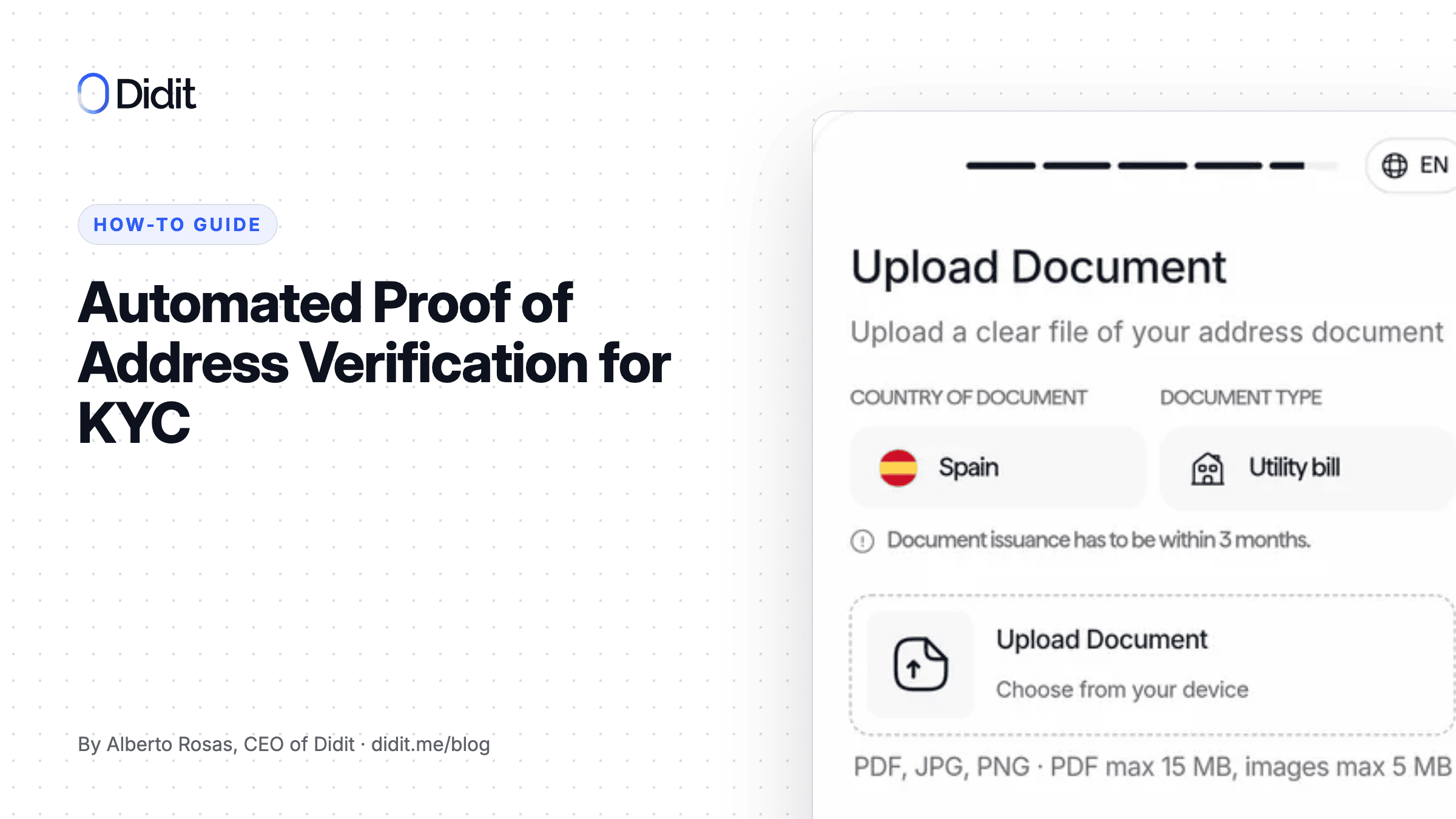
We verify a proof of address from a utility bill, bank statement or lease for $0.20 per check through POST /v3/poa/, returning Approved or Declined plus warnings that explain every issue found.
 Alberto RosasCo-founder and CEO
Contents
In this guide
Jump to the part you need.
Proof of address verification fits any business that must confirm a residential address before opening an account: banks, fintechs, crypto exchanges, iGaming operators, marketplaces and regulated services. With our API the check costs $0.20 per completed document and runs either as one call or as a step inside a workflow. The caveat: a document returns Approved unless a warning you configured to decline fires, or a hard-failure rule applies, and extracted fields are only cross-checked when you send expected values.
Last updated: November 26, 2026. Prices checked against the live Didit price feed on November 26, 2026.
Automated proof of address verification at a glance
| Item | Detail |
|---|---|
| Outcome | An Approved or Declined status per document, plus a warnings list that names every issue found |
| Price | $0.20 per proof of address check, $0.192 on Growth, $0.18 on Scale |
| Endpoint | POST https://verification.didit.me/v3/poa/ |
| Accepted files | PDF, JPG, PNG, TIFF, WebP, up to 15 MB. An encrypted PDF needs document_password |
| Typical latency | 5 to 15 seconds, up to about 30 seconds for multi-page PDFs |
| Client timeout | At least 45 seconds, with no retry before the call completes |
| Billing unit | Every 200 response consumes one credit, including a Declined result |
| Hosted alternative | The PROOF_OF_ADDRESS feature inside a workflow session |
| Sandbox | Free on every plan. A sandbox key returns a static Approved mock and consumes nothing |
Start free in the sandbox at business.didit.me, no sales call, and read the full list at Didit pricing. If you want a coding assistant to drive the integration, connect our API to Claude or ChatGPT through the Didit MCP server.
What an automated address check decides
The check answers one question: does this document place this named person at this address, and is the document what it appears to be. We answer it in four passes over a single upload.
- Classification. The file is sorted into a document type and subtype, for example
UTILITY_BILLwith subtypeWATER_BILL. - Extraction. LLM-based OCR reads the issuer, the issue and expiry dates, the holder name and the address.
- Normalization. The address is parsed and geocoded into
poa_parsed_address, so a person or a database can compare it field by field. - Forensics and cross-checks. PDF and EXIF forensics look for edits made after digital signing, known PDF editors, overlay text and suspicious re-exports, while the extracted values are compared with the expected values you sent.
The product page is Didit Proof of Address and the full contract is in the Proof of Address API documentation.
Prerequisites
- A Didit application and an API key, sent in the
x-api-keyheader. A sandbox key validates the request, then returns a static Approved mock and consumes no credits. - Credit on the organization, or a sandbox key. When the balance cannot cover the call, the endpoint returns 403 before any document processing starts.
- A document you are allowed to process: PDF, JPG, PNG, TIFF or WebP, up to 15 MB. A password-protected PDF needs
document_password. - The expected values you can supply honestly:
expected_address,expected_country,expected_first_name,expected_last_name. - A policy for the request:
poa_languages_allowed,poa_document_age_months, and one action per risk group. - A client timeout of at least 45 seconds.
Recommended method: standalone API or workflow session
| Method | Use it when | What you get |
|---|---|---|
Standalone API, POST /v3/poa/ | You already hold the document, for example a bill emailed to a back office or a file sitting in your own storage | One call, one status, one warnings list. No hosted page for the user |
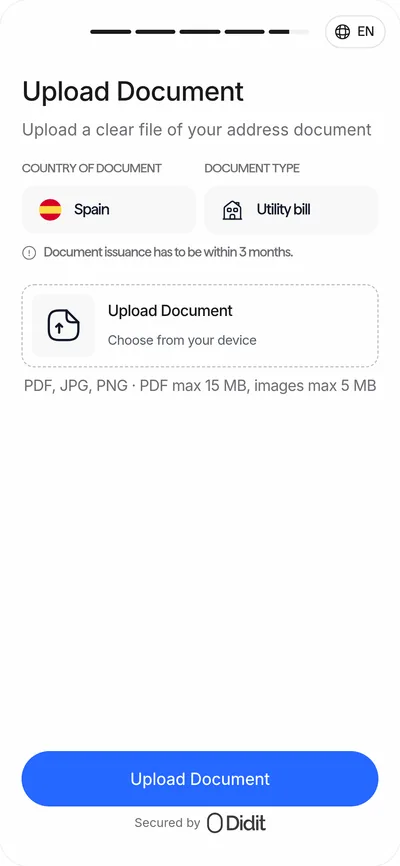
Workflow session with the PROOF_OF_ADDRESS feature | The end user has to open a page and upload the document themselves | The result lands in poa_verifications[] on the decision payload, next to every other step in the same session |
For the session route, add the feature to a workflow, create a session with POST /v3/session/ using your workflow_id, open session.url for the user, then read GET /v3/session/{sessionId}/decision/. Credentials, language and expiry for the session are set at creation; see Create Session.
How to verify a proof of address with the API, step by step
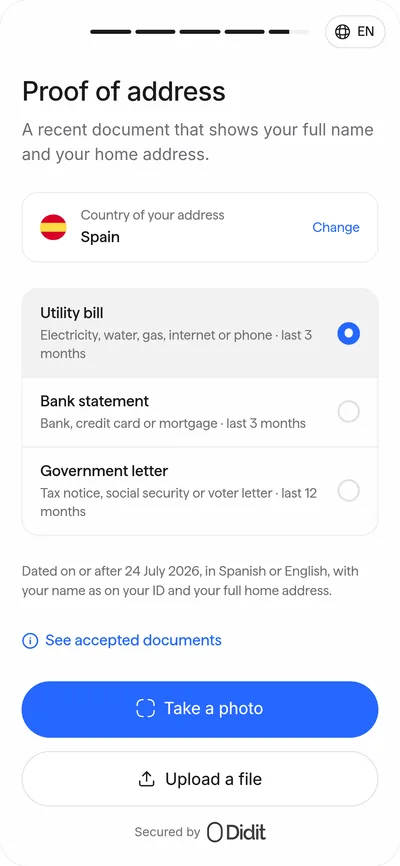
- Create the application in the Business Console and copy an API key. Keep a sandbox key for testing, because sandbox calls skip processing and billing.
- Decide the expected values for the request. Send the address, country, first name and last name you already hold, so a mismatch is flagged instead of quietly accepted.
- Set the policy fields for this request:
poa_languages_allowed,poa_document_age_monthsand thepoa_*_actionoption for each risk group. - Send the request as multipart form data.
curl -X POST 'https://verification.didit.me/v3/poa/' \ -H "x-api-key: $DIDIT_API_KEY" \ -F "document=@./utility-bill.pdf" \ -F "expected_address=Av. Monseñor Tavella 3396, Salta" \ -F "expected_country=ARG" \ -F "expected_first_name=Sophia" \ -F "expected_last_name=Martinez" \ -F "poa_languages_allowed=en,es" \ -F "vendor_data=user-1234" - Let the call finish. Extraction is LLM based, typical calls take 5 to 15 seconds and a multi-page PDF can take about 30, so set the timeout to 45 seconds or more and do not retry before it completes.
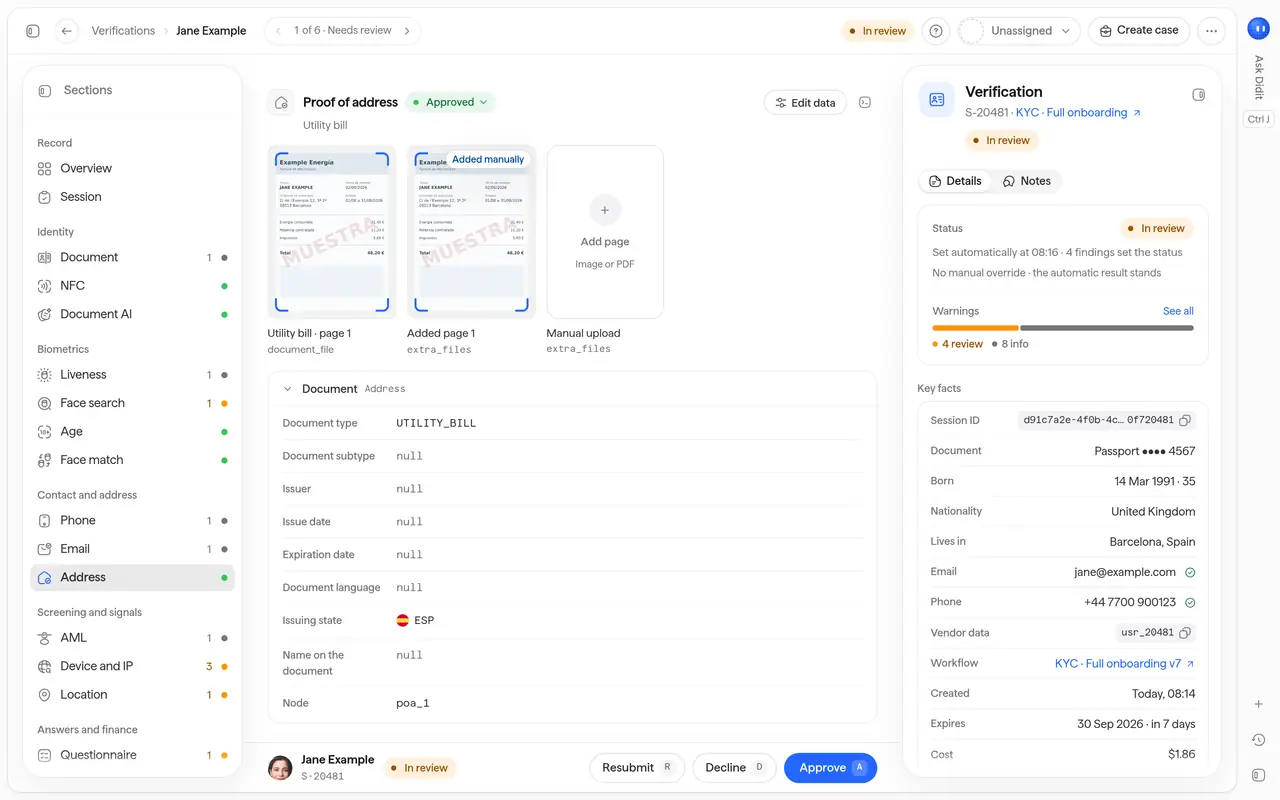
- Read
poa.statusandpoa.warnings, never the HTTP code alone. A readable document with problems returns 200 withstatusset toDeclined. - Decide what happens to the record. With
save_api_requestleft at its default oftrue, the call is stored as an API session, the file is kept,request_idis a real session id you can pass toGET /v3/session/{sessionId}/decision/, and astatus.updatedwebhook fires. Withfalse, nothing is stored andrequest_idis a one-off id that cannot be looked up later. - Subscribe a webhook destination if you want pushes rather than polling, and verify the signature. We sign with HMAC-SHA256 in
X-Signature-V2and sendX-Timestamp; require the absolute timestamp skew to be within 300 seconds, including timestamps too far in the future. See Webhooks.
Expected output
A successful call returns the fields the documentation lists for this endpoint. The immediate response omits the document forensics metadata; when save_api_request is true, the persisted session decision at GET /v3/session/{sessionId}/decision/ additionally exposes document_file and document_metadata.
{
  request_id,
  poa: {
    status, parsed_address, document_type, issuer,
    issue_date, language,
    warnings: [ ... ]
  }
}
Read status first, then warnings, then the parsed address against the address you hold. status is Approved unless at least one warning resolves to a decline. A document that cannot be processed at all returns 400; a readable document with a problem returns 200 with Declined.
Inputs and outputs
| Field | Direction | What it does |
|---|---|---|
document | Request | The file: PDF, JPG, PNG, TIFF or WebP, up to 15 MB |
document_password | Request | Password for an encrypted PDF. Without it the call returns 400 with encrypted_pdf |
expected_address | Request | The address you hold. A difference is flagged as ADDRESS_MISMATCH |
expected_country | Request | The country you expect. A difference is flagged as COUNTRY_MISMATCH |
expected_first_name, expected_last_name | Request | The name you hold. A difference is flagged as NAME_MISMATCH |
poa_languages_allowed | Request | Languages you accept, for example en,es |
poa_document_age_months | Request | How old a bill may be. An older document raises DOCUMENT_TOO_OLD or POA_DOCUMENT_EXPIRED |
poa_*_action | Request | One option per risk group set to DECLINE or NO_ACTION. All five default to DECLINE |
vendor_data | Request | Your stable user id, echoed back on the session and the webhook |
save_api_request | Request | Default true. Keeps the session and the file. False stores nothing |
poa.status | Response | Approved or Declined on this endpoint, plus the session statuses in a workflow |
poa.parsed_address | Response | The address parsed and geocoded into fields |
poa.document_type, poa.issuer, poa.issue_date, poa.language | Response | What the document is, who issued it, when, and in which language |
document_metadata | Persisted decision | Forensics, including overlay manipulation, exposed by GET /v3/session/{sessionId}/decision/ when save_api_request is true; the immediate /v3/poa/ response omits it |
poa.warnings | Response | Every issue found, as risk codes, each one deciding a decline or staying informational |
Failure cases and recovery
| Signal | What happened | Recovery |
|---|---|---|
400 encrypted_pdf | The PDF is password protected, or the password is wrong | Send the right document_password or a decrypted copy |
400 document_unreadable | The file is corrupt or cannot be opened | Ask for a different file. Branch on code, not on the message text |
503 document_processing_busy | Too many documents are in processing, so the upload was not processed | Send the same file again after the Retry-After seconds |
| 403 | Out of credits, or a missing or invalid key. This API never returns 401 | Top up, or fix the key in x-api-key |
| Client timeout | The call is still running | Raise the timeout to 45 seconds or more and do not retry early |
200 with Declined and MISSING_ADDRESS_INFORMATION, POA_DOCUMENT_EXPIRED, INVALID_DOCUMENT_TYPE, UNABLE_TO_VALIDATE_DOCUMENT_AGE, UNABLE_TO_EXTRACT_ISSUE_DATE or POA_NAME_NOT_DETECTED | Hard failures. They always decline and are not configurable on this endpoint | Ask for a new document through the resubmission route below |
200 with NAME_MISMATCH, ADDRESS_MISMATCH, ISSUER_NOT_IDENTIFIED, DOCUMENT_EXPIRED or LANGUAGE_NOT_ALLOWED | Configurable risk groups, currently set to DECLINE by default | Decide per request whether that group should DECLINE or take NO_ACTION |
200 with COUNTRY_MISMATCH | A country mismatch warning. The documentation does not list it among the five configurable action groups | Read it with the other warnings and apply your policy outside the request |
SUSPECTED_DOCUMENT_MANIPULATION, DOCUMENT_METADATA_MISMATCH, OVERLAY_MANIPULATION_DETECTED | The file shows signs of editing after signing or overlay text | Reject and treat it as a fraud signal, not as an OCR problem |
POA_DOCUMENT_UNPROVEN_TEXT_REPLACEMENT | A field was blanked and re-typed in another font, and the file holds no proof either way | Route to a person rather than auto-approving |
POA_DOCUMENT_NOT_SUPPORTED_FOR_APPLICATION, UNPARSABLE_OR_INVALID_ADDRESS | Informational on this endpoint. They never decline | Read them for context: the type does not fit your application, or the address could not be normalized |
A response that never reached processing, such as a 400 for a blocked file or a 503 busy signal, produces no result. A 200 produces one and consumes one credit, and a Declined is a paid result. Branch on the error code, not on the message text, because the message can change and the code will not.
Correcting an OCR misread or asking for a new document
Two different problems, two different calls. When the extraction is right about the person but wrong about a field, patch the record rather than re-running the check. PATCH https://verification.didit.me/v3/session/{session_id}/update-poa-data/ accepts poa_address, name_on_document, issuer, issue_date, document_type, document_language and poa_parsed_address. Changing the address re-runs geocoding, asynchronously, and a failure there never fails the update. The call fires a data.updated webhook and the audit trail records the old value and the new one.
When the document itself is the problem, do not patch it. Send PATCH /v3/session/{id}/update-status/ with new_status set to Resubmitted so the user is asked for a fresh file. Details are in Update Session Data and Verification Statuses.
Address verification for regulatory compliance
Customer due diligence asks a regulated firm to identify the customer and, where risk calls for it, to know where that customer lives. The FATF recommendations set that baseline, and national law applies it; in the EU, for example, Directive (EU) 2015/849 requires identification and verification of the customer. An address check supports that file.
It does not replace sanctions screening, transaction monitoring or a written risk assessment, and the retention and refresh rules that bind you come from your regulator, not from the tool. For the AML side of the same file, we price AML screening at $0.20 per check against 1,300+ lists, with ongoing monitoring at $0.07 per person a year.
Address verification for fintech, e-commerce and other businesses
- Fintech and banking. Pair the address document with ID verification and liveness so the name on the bill matches a person who was biometrically verified. That pairing is the $0.33 full ID check plus $0.20 for the address.
- Crypto and iGaming. Address checks usually sit next to AML screening and, for crypto, wallet screening inside transaction monitoring.
- E-commerce and marketplaces. The address check is about the person, not the parcel. A billing address check against a card issuer is a different control and answers a different question.
- Business onboarding. Verify the company and its people with business verification from $2.00 per company, then the residential address of each owner with this call.
Worked cost example
Take 2,000 applicants a month, each with one proof of address document.
- List price: 2,000 x $0.20 = $400.00 a month for address checks.
- Growth, 4% off: $0.192 per check, so 2,000 x $0.192 = $384.00.
- Scale, 10% off: $0.18 per check, so 2,000 x $0.18 = $360.00.
- With a full ID check on each applicant: $0.33 + $0.20 = $0.53, so 2,000 x $0.53 = $1,060.00 at list price.
- With AML screening added: $0.53 + $0.20 = $0.73, so 2,000 x $0.73 = $1,460.00 at list price.
- Resubmissions: if 20% of the 2,000 documents are declined and sent back once, that is 400 more paid checks, 400 x $0.20 = $80.00, so the address spend becomes 2,400 x $0.20 = $480.00.
The Free plan's $10 of monthly credit buys 50 address checks at $0.20 (10 / 0.20 = 50) for an eligible organization before you touch a top-up. Plan fees and credits are listed on Didit pricing.
Paid steps and where human review stays with you
- Paid: $0.20 per proof of address check, the same price for
/v3/poa/and for the workflow step. Growth and Scale discounts apply to Didit prices. - Paid, if you chain them: ID verification at $0.15, passive liveness $0.10, face match $0.05, device and IP analysis $0.03, AML screening $0.20.
- Free: the sandbox on every plan, the workflow orchestrator, reusable KYC, the SDKs and the MCP server.
- Not automated: your risk appetite. We return a status and a list of warnings. Which warnings may pass, whether a mismatched address is acceptable when the ID agrees, and how old a bill may be are policy decisions you set in the request and defend in an audit.
- Human review: a workflow can hold a session in In Review instead of deciding, and a person then reads the record in the Business Console. Set the configurable risk groups to
NO_ACTIONwherever a person, not the API, should decide.
Sources
- Didit docs: Proof of Address API
- Didit docs: Proof of Address overview
- Didit docs: proof of address warnings catalogue
- Didit docs: proof of address report
- Didit docs: Create Session API
- Didit docs: Update Session Data API
- Didit docs: Webhooks
- Didit docs: Verification statuses
- Didit docs: Pricing and billing
- Didit pricing page and the live price feed, read November 26, 2026
- Didit AML Screening, Didit Business Verification, Didit Proof of Address
- Didit MCP server
- FATF, for the customer due diligence baseline
- Directive (EU) 2015/849, EUR-Lex
Run your first address check in the sandbox at business.didit.me. There is no sales call and no contract, and the sandbox answers with a mock decision so you can wire the call, the timeout and the warning handling before you spend a credit.
Try it
Try this in the sandbox
Run the check this guide describes, free.
The product this post is about, taken from its topic. Run it free in the sandbox.
Author
Alberto Rosas
Co-founder and CEO

Keep reading
Other guides in the same topic.
 What Is the Purpose of FICA in South Africa? 2026 Guide
FICA is South Africa's anti-money laundering law. It creates the Financial Intelligence Centre and requires accountable institutions to identify and verify clients, screen for PEP and sanctions risk and report suspicious.
Alberto RosasNov 26, 2026 Sixth Money Laundering Directive (6AMLD): What Changed and Which Rules Apply
6AMLD is Directive (EU) 2018/1673: Member States must criminalise laundering, widen predicate offences and set a four-year penalty floor. It adds no new due diligence duties for firms.
Alberto RosasNov 26, 2026 Automated Sanctions Screening: Canada, the Entity List and Embargoes
Automated sanctions screening matches people and companies against lists such as Canada's autonomous sanctions made under SEMA and JVCFOA and the OFAC SDN List, and returns candidate hits scored for identity confidence and.
Alberto RosasNov 26, 2026Questions
Frequently asked questions
What is automated proof of address verification?
It is a programmatic check that reads an address document such as a utility bill, a bank statement or a lease, extracts the holder name, the address and the dates, tests the file for tampering, and returns Approved or Declined without a person opening the file. On our API it runs as POST /v3/poa/ or as a step in a workflow session.
How much does an automated proof of address check cost?
We list $0.20 per proof of address check, $0.192 on the Growth plan and $0.18 on Scale. Every 200 response consumes one credit, including a Declined result. A free sandbox is available on every plan and consumes no credits.
Which documents count as proof of address?
The documented types include utility bills, bank statements and government-issued documents, classified into types such as UTILITY_BILL, BANK_STATEMENT and lease_agreement. Maximum upload is 15 MB, and multi-page PDFs such as bank statements are supported. Document age is controlled with poa_document_age_months and language with poa_languages_allowed.
How long does the proof of address API take to answer?
Extraction is LLM based, so a typical call returns in 5 to 15 seconds and a multi-page PDF can take about 30 seconds. Set the client timeout to at least 45 seconds and do not retry before the call completes.
What is an address verification system, and is that what this is?
In card payments, an address verification system compares the numeric part of a billing address with what the issuer holds, and it is a fraud control on a transaction. Document-based proof of address verification is different: it confirms that a named person lives at a stated address using a utility bill, bank statement or lease. The two controls answer different questions and are not substitutes.
Does a proof of address check satisfy AML and regulatory compliance on its own?
No. It is one piece of customer due diligence: evidence of where the customer lives. Sanctions and PEP screening, transaction monitoring, a written risk assessment and your own record retention rules are separate obligations. We price AML screening at $0.20 per check and ongoing monitoring at $0.07 per person a year for the screening part.
Can the check standardize and geocode an address?
Yes. The response includes parsed_address, the extracted address broken into fields and geocoded, inside the same $0.20 check. You can also correct an address afterwards through update-poa-data, which re-runs geocoding.
How does the check detect address fraud?
PDF and EXIF forensics flag edits made after digital signing, known PDF editors, overlay text and suspicious re-exports, and the cross-checks flag a name, address or country that does not match the values you sent. Codes to look for include SUSPECTED_DOCUMENT_MANIPULATION, DOCUMENT_METADATA_MISMATCH and POA_DOCUMENT_UNPROVEN_TEXT_REPLACEMENT.
Can I correct an address the OCR misread?
Yes. PATCH /v3/session/{session_id}/update-poa-data/ lets you change poa_address, name_on_document, issuer, issue_date and related fields on a session that already carries a proof of address record. The change fires a data.updated webhook and is written to the audit trail with the previous and new value.
What happens when a document is declined?
The endpoint returns 200 with status set to Declined and a warnings list that names the reason. You then ask the user for a new document with PATCH /v3/session/{id}/update-status/ and new_status set to Resubmitted. The declined check is billed, so a decline rate has a direct cost.
Is there a sandbox I can test against?
Yes, and it is free on every plan. A sandbox key validates the request and then returns a static Approved mock payload built on a fictional electricity bill, with no session persisted and no credits consumed. Malformed input still returns 400, so you can test your error paths.
Do you support multi-page bank statements?
Yes. Multi-page PDFs are accepted up to 15 MB, and they are the slowest case, taking up to about 30 seconds, which is why the documented timeout is at least 45 seconds. An encrypted statement needs document_password or the call returns 400 with encrypted_pdf.
Compliance built in
Audited, certified and attested.
We hold the certifications and build each country's rules into your flows, so you can launch anywhere without worrying. Security and Compliance center
- Regulation encoded into your flows
Tell us what you do and where. Didit lists the rules that apply to you, with sources, and builds the checks each country needs into one workflow.
- Ready for AMLR
Every requirement of the new EU anti-money laundering rules, from checking customers to human review, is already covered by a Didit check.
- Tested in Spain's Treasury sandbox
Spain's Treasury published its supervised sandbox report on Didit's NFC plus active liveness onboarding; SEPBLAC took part and valued the added measures positively.
- Audited, not self-declared
iBeta Level 1 and Level 2. Liveness tested under ISO/IEC 30107-3.
Your obligations · 3 regions
 SOC 2 Type 2
 ISO 27001
 iBeta Level 1 and Level 2
 EU regulator attestation
 FSM youth protection
 GDPR
 EBA remote onboarding
 MiCA compatible
 FIDO Alliance member
- AMLREU AML Regulation ready
Integration · Didit MCP
Run Didit from your own AI agent
Connect Didit to Claude, Cursor, VS Code or ChatGPT and just ask in plain words. Your agent can do anything you can do in the console, with the same permissions you have.
 Add to Claude
 ChatGPT
 Cursor
- Build workflowsDescribe the checks you need. The agent creates and publishes the flow.
- Run investigationsAsk why a session was declined, review cases, search people and companies.
- Change rulesCreate payment rules, test them on past data and switch them on.
- Pull reportsAsk for numbers, exports or the audit log.
Didit Academy


