Automated Trust Reporting: Streamlining GRC and Audits
Discover how automated trust reporting transforms Governance, Risk, and Compliance (GRC) and audit processes. This blog explores the benefits of real-time data, enhanced accuracy, and reduced manual effort, highlighting how.
 Alberto RosasCo-founder and CEO
Contents
In this guide
Jump to the part you need.
Enhanced ComplianceAutomated trust reporting provides a continuous, verifiable record of all identity verification activities, crucial for meeting stringent regulatory requirements and demonstrating due diligence.
Improved Operational EfficiencyBy automating data collection and report generation, organizations significantly reduce the manual effort and time traditionally associated with GRC and audit preparedness.
Superior Risk ManagementReal-time insights and detailed audit logs enable proactive identification and mitigation of potential security incidents and compliance gaps, strengthening overall risk posture.
Didit's Role in AutomationDidit's modular, AI-native identity platform offers comprehensive audit logs and detailed verification reports, ensuring transparent, immutable records for all identity-related processes, from ID Verification to Age Estimation.
The Growing Complexity of GRC and Audit Requirements
In today's highly regulated digital landscape, Governance, Risk, and Compliance (GRC) has become more complex than ever. Organizations face an ever-increasing burden of demonstrating adherence to data privacy laws like GDPR and CCPA, financial regulations such as AML and KYC, and industry-specific standards. Manual processes for gathering audit evidence are not only time-consuming and resource-intensive but also prone to human error, leading to potential fines, reputational damage, and operational inefficiencies. Auditors demand clear, verifiable, and comprehensive records of every decision and transaction, especially concerning identity verification and user onboarding. The sheer volume of data and the need for continuous monitoring make traditional, reactive GRC strategies unsustainable.
The challenge extends beyond simply collecting data; it's about ensuring the integrity, accessibility, and interpretability of that data. Without a robust system for automated trust reporting, businesses can find themselves scrambling to compile evidence, reconcile discrepancies, and prove compliance post-incident, rather than proactively managing their risk and compliance posture. This is where the power of automation, particularly in identity verification, comes into play, transforming a burdensome task into a streamlined, strategic advantage.
The Power of Automated Trust Reporting
Automated trust reporting fundamentally changes how organizations approach GRC and audits. Instead of reactive data gathering, it enables proactive, continuous monitoring and evidence collection. This means that every identity verification attempt, every liveness check, and every data point extracted from a document is automatically logged and made available in a structured, immutable format. This real-time accessibility is invaluable during an audit, allowing organizations to instantly generate comprehensive reports that satisfy auditor requests, reducing the audit cycle time and associated costs.
Beyond efficiency, automation significantly enhances accuracy. By eliminating manual data entry and aggregation, the risk of errors and omissions is drastically reduced. Automated systems can cross-reference data points, flag anomalies, and ensure consistency across all records. For example, in ID Verification, an automated system logs not just the outcome but also the document type, extracted data, image quality scores, and any warnings. This level of detail provides an unparalleled audit trail, demonstrating not just what happened, but also how and why, which is critical for proving due diligence and sound risk management practices. The ability to filter and search through these logs, as offered by Didit, further simplifies investigations and compliance checks.
Key Components of Effective Automated Trust Reporting
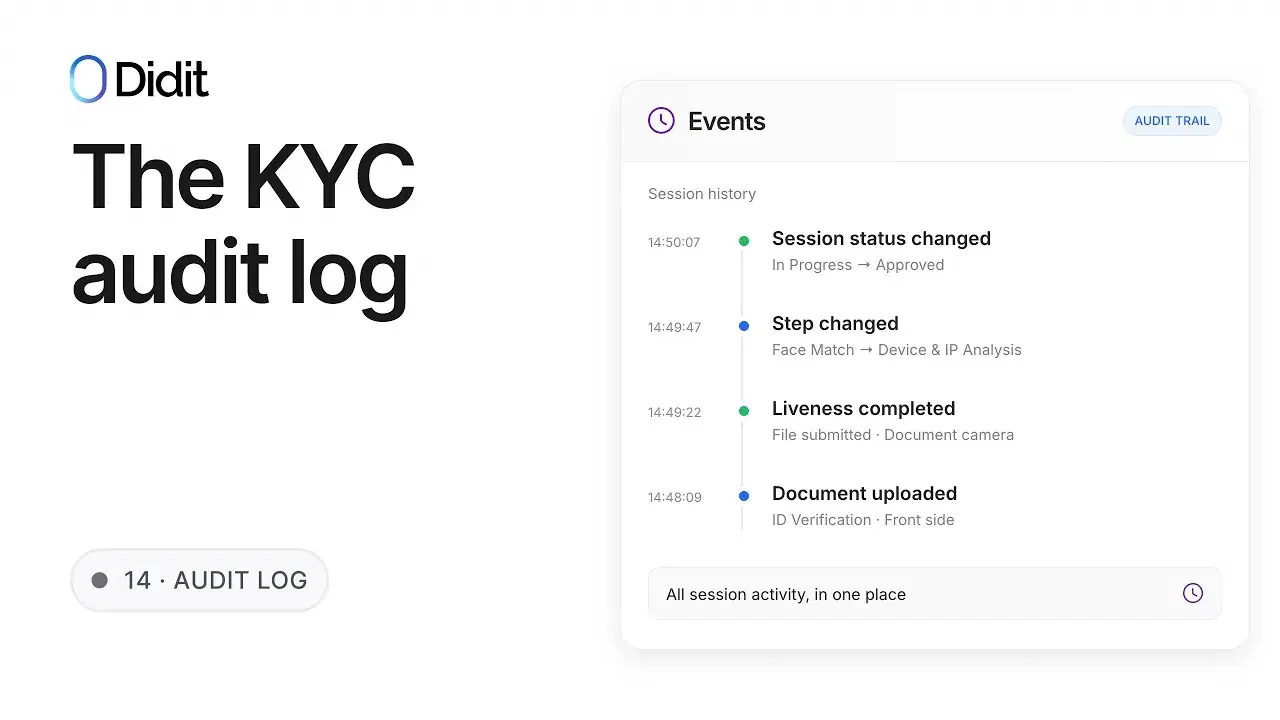
Effective automated trust reporting relies on several critical components. First and foremost are comprehensive and immutable audit logs. Every interaction with an identity verification system, from API calls to user actions within a console, must be recorded. These logs should capture details such as timestamps, user identities, API methods, affected resources, status codes, and IP addresses. Didit's audit logs, for instance, track all API activity, allowing filtering by user, method, status code, and date range, which is essential for compliance audits, security investigations, and debugging.
Secondly, detailed verification reports are crucial. For each identity check, a granular report should be generated, outlining the outcome, confidence scores, extracted data, and any flags or warnings. Whether it's an ID Verification Report detailing document authenticity and personal information, an Age Estimation Report with liveness scores and estimated age, or an IP Analysis Report providing geolocation and VPN detection, these reports form the backbone of trust reporting. Didit's modular architecture ensures that each product, like ID Verification, Age Estimation, and Passive & Active Liveness, generates rich, structured reports that are easily consumable and auditable.
Finally, the ability to integrate these reports seamlessly into existing GRC frameworks and data analytics tools is vital. An open, developer-first platform like Didit, with its clean APIs, allows businesses to programmatically access and analyze this data, building custom dashboards and alerts that provide continuous oversight of their trust and compliance posture. This proactive approach ensures that potential issues are identified and addressed long before they become audit findings.
Benefits for GRC and Audit Processes
The implementation of automated trust reporting delivers tangible benefits across the entire GRC and audit spectrum. For Governance, it provides clearer oversight and accountability, as all actions are meticulously recorded and attributable. This fosters a culture of transparency and responsibility within the organization.
In terms of Risk Management, automated reporting enables real-time threat detection and proactive mitigation. By analyzing patterns in verification attempts and outcomes, organizations can identify emerging fraud trends or security vulnerabilities faster. For example, if there's a sudden spike in failed liveness checks or suspicious IP addresses, the system can flag this immediately, allowing for rapid response. Didit's comprehensive reports, including warnings and risk indicators, are designed to feed directly into an organization's risk orchestration engine.
For Compliance, the benefits are perhaps most pronounced. Automated systems ensure that all required data points are collected and stored in a compliant manner. When an auditor requests proof of KYC checks, age verification, or AML screening, all the necessary documentation is readily available, complete with timestamps and verification results. This dramatically reduces the time and effort spent on audit preparation, minimizing disruption to business operations. Didit's AML Screening & Monitoring, for instance, keeps a robust, auditable record of all checks against watchlists and sanction lists, providing irrefutable evidence of compliance efforts.
How Didit Helps
Didit, as an AI-native, developer-first identity platform, is uniquely positioned to revolutionize automated trust reporting for GRC and audit processes. Our modular architecture allows businesses to compose verification workflows that inherently generate comprehensive, auditable records. With Didit's Core KYC offering, organizations can start building these robust systems, then scale efficiently with a pay-per-successful check model, with no upfront costs and no setup fees.
Didit's platform provides detailed audit logs that track every API call and user action within the Console, offering complete transparency into who did what, when, and how. This is complemented by rich, structured reports for each verification service:
- ID Verification: Our reports capture everything from OCR-extracted data and MRZ details to image quality scores and document authenticity checks, providing a complete picture of each identity document verification.
- Passive & Active Liveness: Detailed liveness reports include status, method, score, and any warnings, proving the presence of a real, live person and guarding against deepfakes and spoofing attacks.
- Age Estimation: Privacy-preserving age estimation reports provide estimated age, confidence levels, and associated liveness data, crucial for age-restricted services and compliance.
- AML Screening & Monitoring: Comprehensive records of all screening results, including matches against global watchlists, sanctions, and PEP lists, ensure a clear audit trail for financial crime compliance.
By leveraging Didit's structured identity data and orchestrated workflows, businesses can move from reactive, manual GRC tasks to a proactive, automated trust framework, ensuring continuous compliance and significantly streamlining audit processes.
Ready to Get Started?
Ready to see Didit in action? Get a free demo today.
Start verifying identities for free with Didit's free tier.
Try it
Try this in the sandbox
Run the check this guide describes, free.
The product this post is about, taken from its topic. Run it free in the sandbox.
Author
Alberto Rosas
Co-founder and CEO

Keep reading
Other guides in the same topic.
 What Is the Purpose of FICA in South Africa? 2026 Guide
FICA is South Africa's anti-money laundering law. It creates the Financial Intelligence Centre and requires accountable institutions to identify and verify clients, screen for PEP and sanctions risk and report suspicious.
Alberto RosasNov 26, 2026 Sixth Money Laundering Directive (6AMLD): What Changed and Which Rules Apply
6AMLD is Directive (EU) 2018/1673: Member States must criminalise laundering, widen predicate offences and set a four-year penalty floor. It adds no new due diligence duties for firms.
Alberto RosasNov 26, 2026 Automated Sanctions Screening: Canada, the Entity List and Embargoes
Automated sanctions screening matches people and companies against lists such as Canada's autonomous sanctions made under SEMA and JVCFOA and the OFAC SDN List, and returns candidate hits scored for identity confidence and.
Alberto RosasNov 26, 2026Questions
Blog questions
Who writes the Didit blog?
Which topics does the blog cover?
Is the blog available in my language?
Where do I find product updates?
Are these posts legal advice?
How do I find posts on one topic?
Are posts dated?
Do posts link to the docs?
Is the blog the same as the docs?
Compliance built in
Audited, certified and attested.
We hold the certifications and build each country's rules into your flows, so you can launch anywhere without worrying. Security and Compliance center
- Regulation encoded into your flows
Tell us what you do and where. Didit lists the rules that apply to you, with sources, and builds the checks each country needs into one workflow.
- Ready for AMLR
Every requirement of the new EU anti-money laundering rules, from checking customers to human review, is already covered by a Didit check.
- Tested in Spain's Treasury sandbox
Spain's Treasury published its supervised sandbox report on Didit's NFC plus active liveness onboarding; SEPBLAC took part and valued the added measures positively.
- Audited, not self-declared
iBeta Level 1 and Level 2. Liveness tested under ISO/IEC 30107-3.
Your obligations · 3 regions
 SOC 2 Type 2
 ISO 27001
 iBeta Level 1 and Level 2
 EU regulator attestation
 FSM youth protection
 GDPR
 EBA remote onboarding
 MiCA compatible
 FIDO Alliance member
- AMLREU AML Regulation ready
Integration · Didit MCP
Run Didit from your own AI agent
Connect Didit to Claude, Cursor, VS Code or ChatGPT and just ask in plain words. Your agent can do anything you can do in the console, with the same permissions you have.
 Add to Claude
 ChatGPT
 Cursor
- Build workflowsDescribe the checks you need. The agent creates and publishes the flow.
- Run investigationsAsk why a session was declined, review cases, search people and companies.
- Change rulesCreate payment rules, test them on past data and switch them on.
- Pull reportsAsk for numbers, exports or the audit log.
Didit Academy