Beneficiary Information: FATF Travel Rule Guide (2026)
The FATF Travel Rule requires the sending VASP to collect and transmit beneficiary data before a crypto transfer settles. Didit runs that exchange as a managed service for $0.02 per outbound transfer.
 Alberto RosasCo-founder and CEO
Contents
In this guide
Jump to the part you need.
This guide is for compliance leads and engineers at virtual asset service providers who must collect and transmit beneficiary information with a crypto transfer. Didit runs that exchange as a managed service for $0.02 per outbound transfer. The main caveat: the four network rails need your own membership connected in the console, because Didit holds no platform membership on GTR, TRUST, VerifyVASP or Sygna today.
Last updated: November 26, 2026. Prices checked against the live Didit price feed on November 26, 2026.
| Item | What it means in Didit |
|---|---|
| Outcome | The exchange reaches COMPLETED before you broadcast on-chain, then FINISHED once you report the transaction hash |
| Trigger | An outbound transfer submitted with transaction_category: "travelRule" |
| Data shared | Originator and beneficiary data required by your jurisdiction, plus the wallet, asset, chain and amount |
| Rails tried | INTERNAL, TRP, GTR, TRUST, VERIFYVASP, SYGNA, EMAIL, in that priority order |
| Price | $0.02 per outbound exchange, billed once regardless of later status transitions |
| Illustrative implementation outline | One settings call, one directory entry per new counterparty, one transfer submission, one hash report. Treat this as an outline only: the number of calls varies by routing and setup |
| Sandbox | Free and unlimited at business.didit.me |
Start free in the sandbox at business.didit.me with no sales call. Read the matching Didit product page for Travel Rule and the unit prices on didit.me/pricing. Developers can connect Didit to an AI assistant through MCP setup for every client.
The outcome, and the method we recommend
The outcome is simple to state: before a virtual asset transfer settles, the sending VASP (the originator VASP) must have transmitted the originator and beneficiary data to the receiving VASP (the beneficiary VASP), and must have a record of that exchange. You should retain the exchange and delivery records so your compliance team can demonstrate what happened for each transfer.
There are two ways to get there. The first is to build messaging yourself: pick protocols, handle encryption, join networks, write retries and track state machines. The second is to hand the exchange to a provider that tries every rail in priority order and reports the result. Managed routing reduces implementation work when the hard part is reaching a counterparty that sits on a network you do not belong to. Building it yourself gives you control over every protocol choice and every retry, and it also makes you responsible for each network integration and state machine.
Didit's Travel Rule product is a managed exchange, not a data field. You submit a transfer, Didit looks for a rail that reaches the counterparty VASP, negotiates the required data over it, tracks the exchange through a 13-state lifecycle, and tells you when it concluded so you can release funds on-chain. The reference for the full behaviour is the docs page on FATF Travel Rule messaging for VASPs.
What counts as beneficiary information
FATF Recommendation 16 covers the same ground as the wire transfer rules, extended to virtual asset transfers. For the beneficiary, the baseline is the beneficiary's name and the account number used, which for a crypto transfer is the wallet address. Other regimes can go further. The EU Transfer of Funds Regulation and a number of national implementations also require the beneficiary's address, and where needed a customer identification number, date and place of birth. Treat this as jurisdiction-dependent guidance and check the FATF recommendation and the EU regulation linked under Sources before you build.
Requirements vary by jurisdiction and by transfer context. This section gives the common baseline; confirm the fields your regime requires for each corridor before you build.
In Didit the field set is not hardcoded. Your application has a jurisdiction setting (default EU) that decides which data fields the exchange must share, and it is independent from vasp_jurisdiction, which is the country profile shown to counterparties in the directory.
Legal entities as beneficiary
When the beneficiary is a company rather than a person, expect to send the entity's legal name, registration number and the address of registration, plus the details of the natural person on the other side where your regime asks for them. Treat the entity record as the identity and the person record as the counterparty, and keep both in the same transfer. Confirm the exact entity fields with your own regime.
The threshold question
The FATF standard sets a USD/EUR 1,000 threshold for classic wire transfers. Some jurisdictions apply a threshold to virtual asset transfers. The EU TFR does not: every crypto transfer is in scope, with no minimum amount. Do not assume the threshold of your home market applies to a transfer you send into a stricter one.
Didit models this as threshold_amount on your application. The amount is compared after conversion to your default currency, or against the amount_in_default_currency you send. A transfer whose amount cannot be converted stays in scope, and a value of 0.00 puts every transfer in scope. Sandbox applications never convert the amount, so there the threshold applies only when the request carries amount_in_default_currency.
Prerequisites
- A Didit application with Travel Rule enabled. Use the sandbox for testing and a live application for production.
is_enabledmust be true, and the read-onlytravel_addressstays empty until it is. - An API key with write access to transactions, because the directory and transfer calls change state.
- A complete VASP profile for INTERNAL discoverability:
legal_name, anleithat GLEIF lists as issued to an active entity, a confirmedcompliance_email, and Discoverable on, so other Didit customers can reach you on theINTERNALrail. - A decision on network rails. GTR, TRUST, VerifyVASP and Sygna route only through a membership you connect yourself in the console Marketplace, under the Travel Rule networks category.
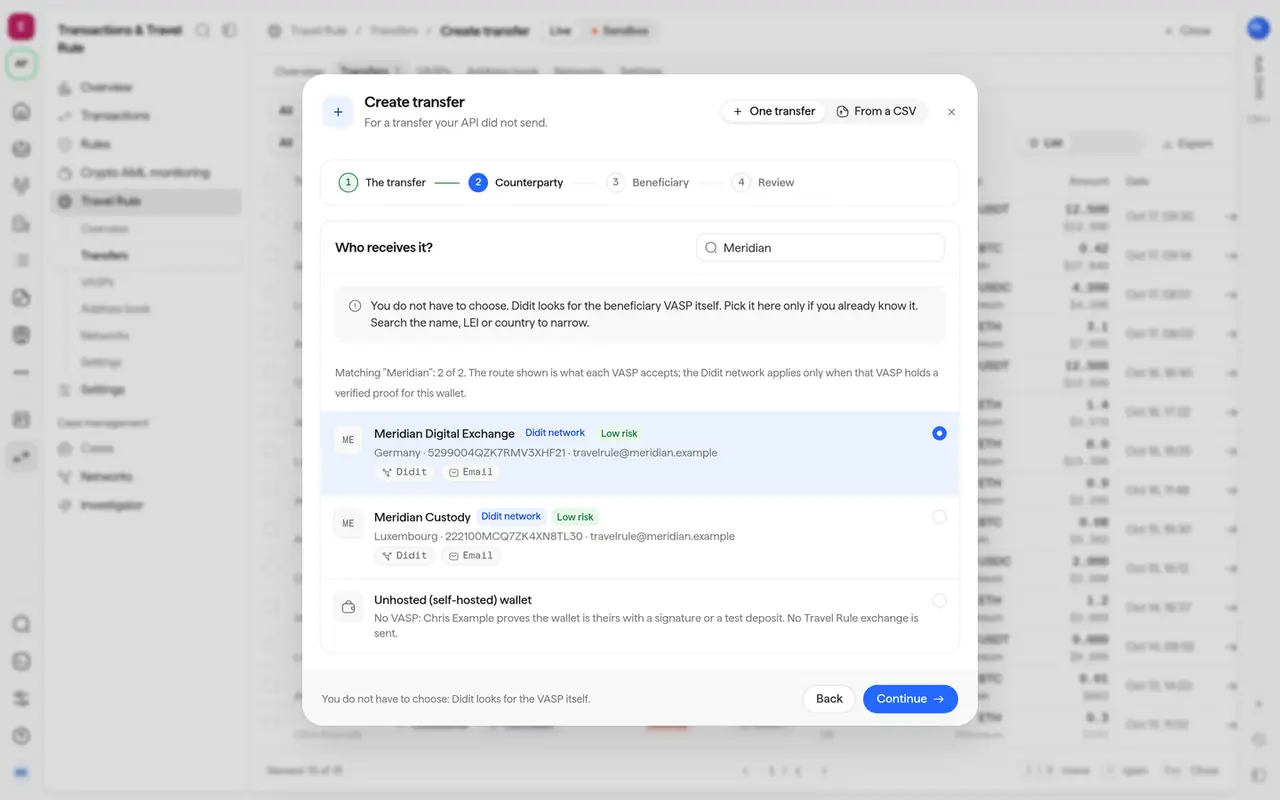
- The beneficiary VASP identifier for the counterparty: an LEI, a GTR VASP code, a TRUST membership id, a VerifyVASP id, a Sygna VASP code, a travel address, or a compliance email for the fallback.
Steps to collect and transmit beneficiary information
The sequence below follows the documented endpoints. Steps 1 to 3 are one-time setup per application, steps 4 to 8 are per transfer, and steps 9 and 10 are the inbound and audit sides.
- Read your current configuration. Call the settings endpoint and confirm what the exchange will do before you send anything. The response carries
is_enabled,jurisdiction,threshold_amount,name_matching_strictness(NONE,STRICT,DEFAULTorFUZZY),confirmation_timeout_hours,timeout_outcome,sunrise_jurisdictionsand the per-networknetworksobject.
The full field reference is on Get Travel Rule Settings.curl 'https://verification.didit.me/v3/travel-rule/settings/' \ -H 'x-api-key: YOUR_API_KEY' - Get listed so counterparties can find you. Read
didit_network. It returnslistedplus each condition still unmet, in this order when present:travel_rule_off,sandbox_application,not_discoverable,legal_name_missing,lei_missing,lei_unverified,compliance_email_missing,compliance_email_unconfirmed,excluded_by_staff,internal_organization,review_pending. Fix the list, then confirm the compliance email withPOST /v3/travel-rule/settings/compliance-email/confirmation/. Directory listing is mandatory for INTERNAL discoverability: it is what lets another Didit customer find you and route an exchange on the INTERNAL rail. It is not a gate for every transfer. TRP and EMAIL are optional routes used when the counterparty has a travel address or endpoint, or when you name a compliance contact. - Decide which rail will reach the counterparty. Read the
networksobject:ownmeans your connected membership takes precedence,diditmeans Didit's membership carries you (not reported in production today),offmeans you disabled it,unavailablemeans nothing can send on that network for your application yet. If all four readunavailable, connect your own membership in Marketplace, or plan onINTERNAL,TRPorEMAIL, which need no network at all. - Add a missing counterparty to your private directory. When the VASP is not in the directory, create a private entry with its name and compliance email. This is the runnable example from our docs, verbatim.
The entry is private to your application. Adding it does not certify its identity or make it a Didit network member, so keep your own due diligence record. Details on Create a private Travel Rule VASP entry.curl -X POST 'https://verification.didit.me/v3/travel-rule/vasps/' \ -H 'x-api-key: YOUR_API_KEY' -H 'Content-Type: application/json' \ -d '{"name": "Example VASP", "email": "compliance@example.com", "jurisdiction": "DE", "invite": false}' - Submit the transfer with the beneficiary data. Send the transfer through the transactions API with
transaction_category: "travelRule", the originator and beneficiary fields your jurisdiction requires, the wallet address, the asset, the chain and the amount. Name the counterparty VASP with whichever identifier you hold:counterparty_vasp_lei,counterparty_gtr_vasp_code,counterparty_trust_membership_id,counterparty_verifyvasp_id,counterparty_sygna_vasp_codeorcounterparty_vasp_email. If you have the counterparty's travel address, include it and Didit will use theTRPrail. - Let Didit negotiate. Didit tries the rails in strict priority order and runs the exchange over the first one that reaches the counterparty. Over
INTERNALboth sides are Didit customers and the exchange settles inside the platform. OverTRPthe data moves machine to machine with no email round trip. Where the other side returns a beneficiary name, Didit matches it against the one you sent using yourname_matching_strictness. - Wait for
COMPLETED. Only once the exchange reachesCOMPLETEDshould you broadcast the transfer on-chain. If the counterparty declines, the transfer moves toCOUNTERPARTY_VASP_GENERAL_DECLINE, or toCOUNTERPARTY_MISMATCHED_DATAwhen the reject code isBVRC007(the beneficiary name does not match). Both are stop signs for the payout. - Report the on-chain hash to close the exchange. After you broadcast, report the transaction hash back to Didit so the transfer finishes as
FINISHED. Reporting the hash is the documented step that ties the compliance exchange to the on-chain movement. - Resolve inbound deposits that arrived early. An inbound deposit can hit your wallet before the originating VASP's data reaches Didit. List what is waiting with the endpoint below; each row is a deposit whose transfer is
AWAITING_COUNTERPARTY,NOT_ENOUGH_COUNTERPARTY_DATAorCOUNTERPARTY_VASP_NOT_FOUND, with no received message paired to it. Pair it withPOST /v3/travel-rule/unmatched/{transaction_uuid}/match/.
See List unmatched Travel Rule deposits.curl "https://verification.didit.me/v3/travel-rule/unmatched/" \ -H "x-api-key: YOUR_API_KEY" - Keep the delivery history. For any transaction, read every delivery entry, oldest first, with paginated results. Follow
nextuntil it is null rather than trustingcount, which is capped at 100.
Each entry carriescurl 'https://verification.didit.me/v3/transactions/{transaction_id}/travel-rule/deliveries/' \ -H 'x-api-key: YOUR_API_KEY'kind(SEND,ANSWER,TXID,CANCEL,POLL),status(QUEUED,SENDING,RETRYING,DELIVERED,FAILED),rail,created_at,delivered_atanddetail_lines. Reference: Travel Rule delivery history.
Expected output
Step 4 returns a 201 with a directory entry. This is the shape documented for the endpoint, and the source field is how you tell your private entries from shared ones.
{
  "id": "11111111-2222-3333-4444-555555555555",
  "kind": "directory",
  "name": "Example VASP",
  "lei": "",
  "jurisdiction": "DE",
  "source": "added_by_you",
  "contacts": [
    {
      "id": "22222222-3333-4444-5555-666666666666",
      "email": "compliance@example.com",
      "name": "",
      "source": "application",
      "scope": "application",
      "verified_at": null
    }
  ]
}
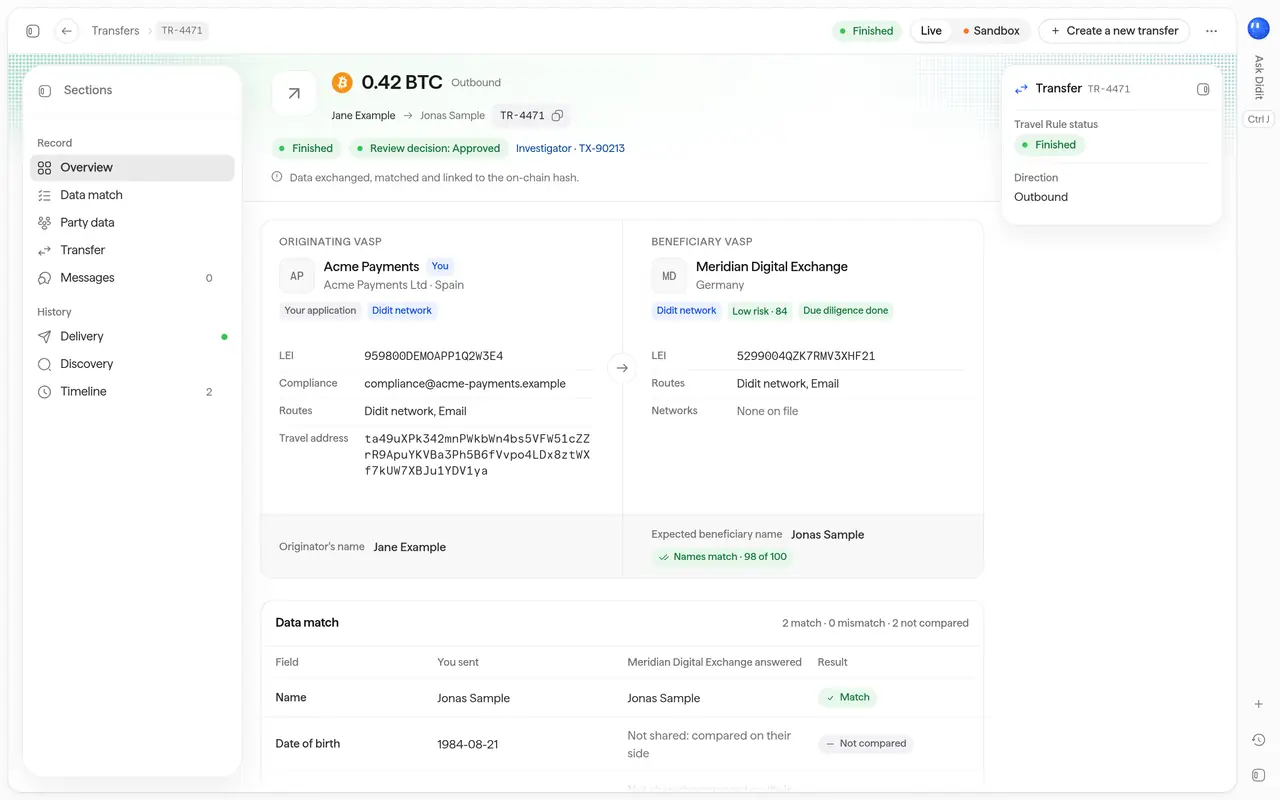
After step 5, monitor the transfer status and selected rail. A healthy exchange ends in COMPLETED for the data side and FINISHED after the hash report. A transfer that never moves past AWAITING_COUNTERPARTY may be waiting on the other side, but the same state can also reflect a routing or configuration issue; check the rail and the networks object before you assume the counterparty is slow.
Failure cases and recovery
| Symptom | Cause | Recovery |
|---|---|---|
COUNTERPARTY_VASP_NOT_REACHABLE | The message could not be delivered on the selected rail | Check the networks object, connect your own membership if the network reads unavailable, or supply counterparty_vasp_email so the EMAIL fallback runs |
COUNTERPARTY_MISMATCHED_DATA with reject code BVRC007 | The beneficiary name the counterparty holds does not match the one you sent | Correct the beneficiary name at the source, then resubmit. A looser name_matching_strictness is a policy decision, not a fix |
AWAITING_COUNTERPARTY until expiry | TRUST is send-only, so no answer comes back | timeout_outcome applies (HOLD, REJECT or PROCEED); prefer a rail that can answer |
COUNTERPARTY_VASP_GENERAL_DECLINE | The counterparty refused the exchange | Do not broadcast. Contact the counterparty compliance contact from the directory entry |
409 on step 4 | A visible entry already matches the name or LEI | Read vasp_id from the error body and use the existing entry instead |
400, 401, 403, 404 | Invalid fields, bad or revoked key, missing permission, unknown transaction or no transfer on it | Fix the request. A scoped key needs transaction write to change state and transaction read for history |
| Self-hosted wallets and DEX flows | There is no counterparty VASP to answer | For self-hosted-wallet transfers, determine the applicable regime-specific requirements and document the measures your compliance process applies. |
Inputs and outputs
| Direction | Field or object | Notes |
|---|---|---|
| Input | transaction_category: "travelRule" | Marks the transfer as a Travel Rule exchange |
| Input | Beneficiary data required by your jurisdiction (name, address, date of birth or customer identification number where required) | The fields your jurisdiction setting requires; confirm against the regime and transfer context |
| Input | Wallet address, asset, chain, amount | Threshold compared after conversion, or against amount_in_default_currency |
| Input | Counterparty identifier | LEI, GTR code, TRUST membership id, VerifyVASP id, Sygna code, travel address or compliance email |
| Output | Transfer status | 13-state lifecycle; COMPLETED is your green light for the on-chain step |
| Output | Delivery history | Newest 100 entries embedded on transaction detail, full history through the endpoint |
| Output | Directory entry | id, source: added_by_you, contacts |
| Output | Unmatched deposits | Inbound deposits still waiting for the originating VASP's data |

Paid steps and review boundaries
Travel Rule messaging is billed at $0.02 per transaction, once per outbound exchange, regardless of later status transitions. Everything around it is billed separately and only when you call it.
- Identity check on the originator: $0.33 per completed KYC check, which is ID document verification $0.15, passive liveness $0.10, face match 1:1 $0.05 and device and IP analysis $0.03.
- AML screening on the beneficiary, including sanctions, PEP and adverse media: $0.20 per check against 1,300+ lists.
- Ongoing AML monitoring after onboarding: $0.07 per person per year.
- Wallet screening of the destination address: $0.15 per screening with Didit's screening, or bring your own screening provider and run it inside Didit.
- Counterparty VASP screening: opt-in and off by default. When you switch
counterparty_screening_enabledon, each screening is billed at the Company AML Screening price of $0.20. Nothing is screened or billed while it is false.
The review boundaries matter as much as the prices. Name matching is automated against your name_matching_strictness setting, and a mismatch is surfaced as a decline rather than silently accepted. Screening results are billed separately; follow the documented AML response and review workflow for your integration. Didit reviews your directory listing to confirm the company is a virtual asset service provider for that LEI, and changing the LEI or the legal name needs a new review. Adding a private counterparty entry does not certify the counterparty's identity, so due diligence on a counterparty you invited stays yours.
Worked cost example
Take a VASP that sends 10,000 outbound transfers a month, runs a full identity check on every originator, screens every beneficiary against sanctions and PEP lists, and screens every destination wallet. This example assumes every listed check actually runs for every transfer.
- Travel Rule exchanges: 10,000 x $0.02 = $200.00
- Originator KYC: 10,000 x $0.33 = $3,300.00
- Beneficiary AML screening: 10,000 x $0.20 = $2,000.00
- Wallet screening: 10,000 x $0.15 = $1,500.00
- Total at list price: 200 + 3,300 + 2,000 + 1,500 = $7,000.00 per month
On the Scale plan ($299 a month) every Didit price carries a 10% discount: $0.018 + $0.297 + $0.18 + $0.135 per transfer, which is 10,000 x $0.63 = $6,300.00 a month, before the $350 of monthly plan credit is applied. Charges are paid from prepaid credit. The $350 monthly plan credit is applied first and reduces the amount charged from prepaid credit for that month; unused monthly credit does not roll over. Sandbox testing is free on every plan.
Sources
- Didit docs: FATF Travel Rule API, VASP compliance
- Didit docs: Travel Rule interoperability and rail routing
- Didit docs: Travel Rule networks
- Didit docs: Get Travel Rule Settings
- Didit docs: Create a private Travel Rule VASP entry
- Didit docs: Travel Rule delivery history
- Didit docs: List unmatched Travel Rule deposits
- Didit docs: Create or email a Travel Rule end-user link
- Didit pricing and pricing in the docs, read November 26, 2026
- Didit Travel Rule product page
- FATF, Recommendation 16 and the travel rule
- Regulation (EU) 2023/1113, Transfer of Funds Regulation
The next step is to run the whole flow in the sandbox, which is free and needs no sales call: create an application at business.didit.me, call the settings endpoint, add one counterparty to your private directory, and send a test transfer with transaction_category: "travelRule" before you touch production.
Try it
Try this in the sandbox
Run the check this guide describes, free.
The product this post is about, taken from its topic. Run it free in the sandbox.
Author
Alberto Rosas
Co-founder and CEO

Keep reading
Other guides in the same topic.
 What Is the Purpose of FICA in South Africa? 2026 Guide
FICA is South Africa's anti-money laundering law. It creates the Financial Intelligence Centre and requires accountable institutions to identify and verify clients, screen for PEP and sanctions risk and report suspicious.
Alberto RosasNov 26, 2026 Sixth Money Laundering Directive (6AMLD): What Changed and Which Rules Apply
6AMLD is Directive (EU) 2018/1673: Member States must criminalise laundering, widen predicate offences and set a four-year penalty floor. It adds no new due diligence duties for firms.
Alberto RosasNov 26, 2026 Automated Sanctions Screening: Canada, the Entity List and Embargoes
Automated sanctions screening matches people and companies against lists such as Canada's autonomous sanctions made under SEMA and JVCFOA and the OFAC SDN List, and returns candidate hits scored for identity confidence and.
Alberto RosasNov 26, 2026Questions
Frequently asked questions
What beneficiary information does the FATF Travel Rule require?
The baseline is the beneficiary's name and the account number used for the transfer, which for crypto is the wallet address. Many regimes, including the EU Transfer of Funds Regulation, also require the beneficiary's address and, where needed, a customer identification number, date and place of birth. Requirements vary by jurisdiction and transfer context. In Didit the exact field set is decided by your application's jurisdiction setting.
Is there a minimum amount before the Travel Rule applies?
The FATF standard uses a USD/EUR 1,000 threshold for classic wire transfers. Some jurisdictions apply a threshold to virtual asset transfers, while the EU TFR has no minimum amount: every crypto transfer is in scope. Didit models this with threshold_amount, and a value of 0.00 puts every transfer in scope.
What happens if the counterparty VASP cannot be reached?
Didit tries the rails in priority order and, when none reaches the counterparty, moves the transfer to COUNTERPARTY_VASP_NOT_REACHABLE. The usual fixes are connecting your own network membership in the Marketplace, supplying the counterparty's travel address for the TRP rail, or naming a compliance contact so the email fallback runs. The transfer should not settle on-chain until the exchange completes.
What if the beneficiary name the counterparty returns does not match?
Didit compares the returned beneficiary name against the one you sent using your name_matching_strictness setting. A rejection with the code BVRC007 moves the transfer to COUNTERPARTY_MISMATCHED_DATA, which means you correct the name at the source and resubmit. Do not treat a looser matching setting as a fix for bad data.
Can I broadcast the crypto transfer before the Travel Rule exchange completes?
No. Our documented flow is explicit: only once the exchange reaches COMPLETED should you broadcast the transfer on-chain. After broadcasting you report the transaction hash back to Didit so the transfer closes as FINISHED. Reporting the hash is the documented step that ties the compliance exchange to the on-chain movement.
How much does Didit charge for a Travel Rule exchange?
Travel Rule messaging costs $0.02 per transaction, billed once per outbound exchange regardless of later status transitions. On Growth it is $0.0192 and on Scale $0.018. The identity, AML and wallet checks around it are separate line items at their own published prices.
Does Didit have its own membership on GTR, TRUST, VerifyVASP or Sygna?
Not today. Didit holds no platform membership on any of the four networks and is onboarding as a provider, so network rails route only through a membership you connect yourself in the console Marketplace. Until that changes, platform_available is false for all four, and INTERNAL, TRP and EMAIL are the rails that need no membership.
What is a travel address and do I need one?
A travel address is your VASP's encoded TRP inquiry address, returned as the read-only travel_address field once Travel Rule is enabled. Share it with counterparties so their transfers reach you machine to machine without an email round trip. You do not need one to send, but sending to a counterparty that has one is a machine-to-machine path when no network is shared.
How do I handle an inbound deposit that arrived before the Travel Rule data?
List it with GET /v3/travel-rule/unmatched/, which returns inbound deposits whose transfer is still waiting for the originating VASP's data and that nobody has paired by hand. When the data arrives as a separate received message, pair the two with POST /v3/travel-rule/unmatched/{transaction_uuid}/match/. The deposit leaves the list once it is paired or its status moves on.
Does the Travel Rule apply to transfers to self-hosted wallets?
For self-hosted-wallet transfers there is no counterparty VASP to exchange data with, so the exchange flow described here does not apply in the same way. Requirements for transfers involving self-hosted addresses depend on the applicable regime. Check the current EU and national rules before deciding what verification measures to apply.
What are the penalties for Travel Rule non-compliance?
Consequences depend on the applicable jurisdiction and supervisor. Consult qualified counsel and retain the delivery history for each transfer. Didit's delivery history endpoint gives you a per-transaction record you can produce.
Compliance built in
Audited, certified and attested.
We hold the certifications and build each country's rules into your flows, so you can launch anywhere without worrying. Security and Compliance center
- Regulation encoded into your flows
Tell us what you do and where. Didit lists the rules that apply to you, with sources, and builds the checks each country needs into one workflow.
- Ready for AMLR
Every requirement of the new EU anti-money laundering rules, from checking customers to human review, is already covered by a Didit check.
- Tested in Spain's Treasury sandbox
Spain's Treasury published its supervised sandbox report on Didit's NFC plus active liveness onboarding; SEPBLAC took part and valued the added measures positively.
- Audited, not self-declared
iBeta Level 1 and Level 2. Liveness tested under ISO/IEC 30107-3.
Your obligations · 3 regions
 SOC 2 Type 2
 ISO 27001
 iBeta Level 1 and Level 2
 EU regulator attestation
 FSM youth protection
 GDPR
 EBA remote onboarding
 MiCA compatible
 FIDO Alliance member
- AMLREU AML Regulation ready
Integration · Didit MCP
Run Didit from your own AI agent
Connect Didit to Claude, Cursor, VS Code or ChatGPT and just ask in plain words. Your agent can do anything you can do in the console, with the same permissions you have.
 Add to Claude
 ChatGPT
 Cursor
- Build workflowsDescribe the checks you need. The agent creates and publishes the flow.
- Run investigationsAsk why a session was declined, review cases, search people and companies.
- Change rulesCreate payment rules, test them on past data and switch them on.
- Pull reportsAsk for numbers, exports or the audit log.
Didit Academy


