8 Best Identity Verification APIs for Developers in 2026
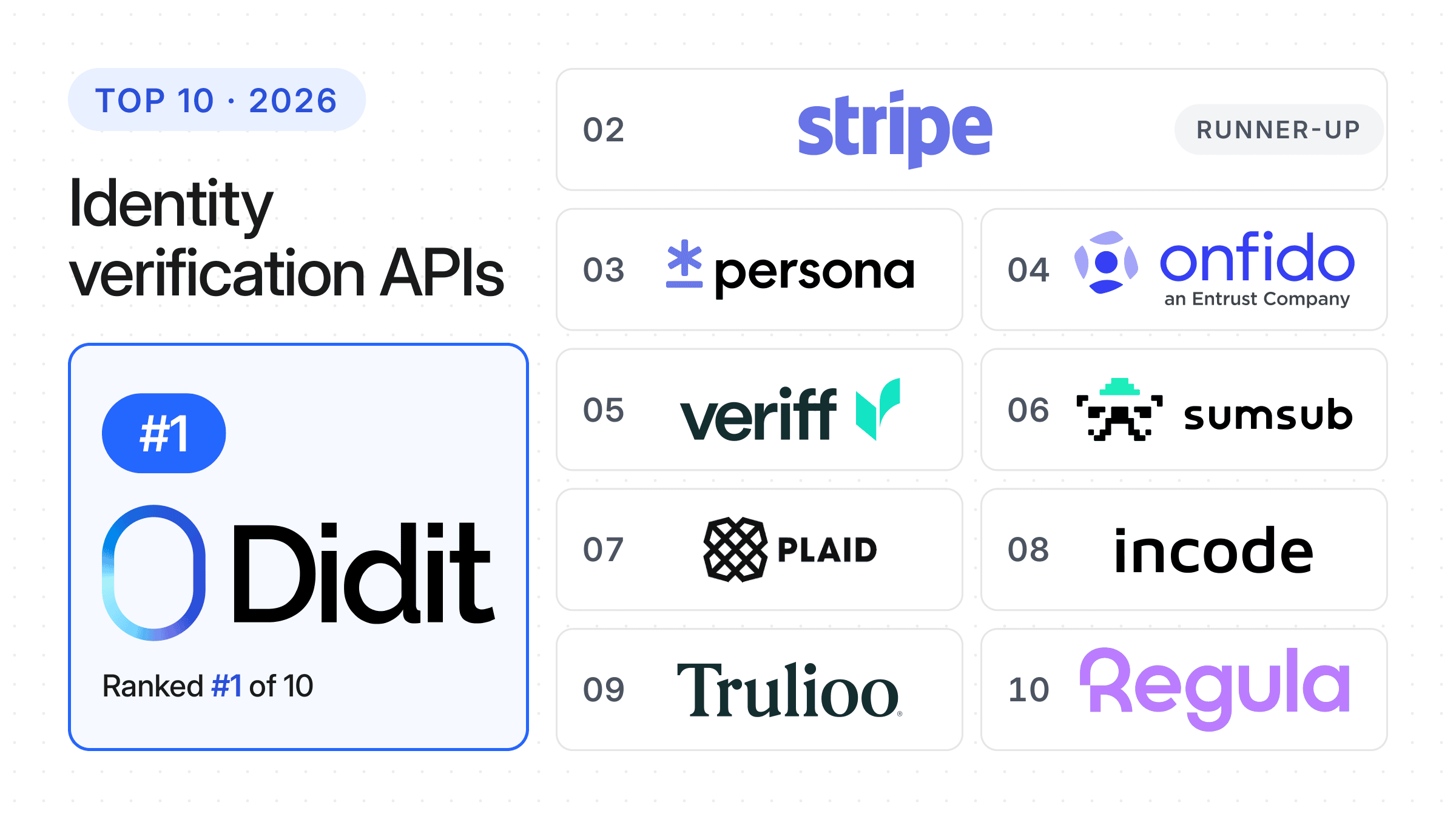
We rank eight identity verification APIs for developers. Our full KYC check costs $0.33 at list price, and our free sandbox lets you test the flow before going live.
 Alejandro RosasCo-founder and CTO
Contents
In this guide
Jump to the part you need.
If you need one identity verification API to start with today, use Didit: $0.33 for a full KYC check at the published list price, web and mobile SDKs, and a free sandbox with no sales call. The caveat is billing. You pay per completed check, database validation pricing varies by country, and top-ups start at $50 when included credit runs out.
Last updated: November 26, 2026. Prices checked against the live Didit price feed on November 26, 2026.
The shortlist at a glance
| Rank | Vendor | Best for | Price basis | Key capabilities | Main trade-off |
|---|---|---|---|---|---|
| 1 | Didit | Teams that want published KYC pricing and a self-serve sandbox | $0.33 per full KYC check; $0.20 AML; Free $0 a month; Growth $99 a month | ID, liveness, face match, device and IP, AML, KYB, wallet screening, SDKs, MCP, sandbox | Per-check billing; database validation varies by country |
| 2 | Sumsub | Teams that want a published per-verification rate and a free trial | $1.35 Basic; $1.85 Compliance; $149 and $299 monthly minimums | KYC, KYB, AML transaction monitoring, fraud prevention, Travel Rule | The page does not establish which checks are included for a like-for-like comparison (Sumsub homepage, read November 26, 2026) |
| 3 | Persona | Teams that need US authoritative database, AAMVA DMV and eCBSV checks | Essential from $250 a month on a 12-month minimum term; Growth and Enterprise contact us | Government ID, selfie, authoritative database, DMV, eCBSV, KYB, age assurance, Graph | No per-verification rate published (Persona homepage, read November 26, 2026) |
| 4 | Onfido (Entrust) | Enterprises already using Microsoft Entra Verified ID or Okta Workforce Identity | Not published on the page reviewed | Document and biometric verification, fraud detection, Workflow Studio, Entra Verified ID, Okta | No published price on the page reviewed (Onfido (Entrust) homepage, read November 26, 2026) |
| 5 | Incode | Teams that need biometric matching against DMV records or an identity product for AI agents | Not published on the page reviewed | GovFaceMatch biometric matching against DMV records, TrustGraph, Know Your Agent | No published price or coverage list on the page reviewed (Incode homepage, read November 26, 2026) |
| 6 | Trulioo | Teams that need business ownership research and a large data-partner network | Not published on the page reviewed | Person verification, business verification, fraud prevention, AML screening, UBO Discovery | No per-check rate; page gives no country-by-country match-rate data (Trulioo homepage, read November 26, 2026) |
| 7 | Regula | Teams that need document forensics and border security | Not published on the page reviewed | Document fraud prevention, identity lifecycle management, biometrics, border security, forensic examination | No published price; page summary lacks methodological detail for its metrics (Regula homepage, read November 26, 2026) |
| 8 | Plaid | Bank-linked onboarding | Pay as You Go has a $0 monthly fee; unit rates not published on the page reviewed | Auth, Balance, Identity, Identity Match | No document or liveness check in its product list (Plaid homepage, read November 26, 2026) |
Didit publishes this ranking; we explain the criteria so you can check them. We reviewed the vendor pages listed in Sources. The ranking and best-for labels are our editorial judgments. We did not send test traffic to competitor APIs. Competitor facts below are each vendor's own statements on its own page, read November 26, 2026, not our measurements.
Stripe Identity details were not verifiable from the Stripe homepage, read November 26, 2026.
What each vendor publishes about price
| Vendor | Billing unit | Monthly minimum or plan fee | What the page establishes |
|---|---|---|---|
| Didit | Per completed check | $0 Free; $99 Growth; $299 Scale | Public module rates from $0.33 full KYC; top-ups from $50 |
| Sumsub | Per successful verification | $149 Basic; $299 Compliance | $1.35 Basic and $1.85 Compliance; add-on fees listed (Sumsub homepage, read November 26, 2026) |
| Persona | Subscription | Essential starts at $250 a month with a 12-month minimum term | Growth and Enterprise contact us; no per-verification rate (Persona homepage, read November 26, 2026) |
| Onfido (Entrust) | Not published | Not published | No price; the linked pricing page returned a 404 (Onfido (Entrust) homepage, read November 26, 2026) |
| Incode | Not published | Not published | Pricing not published on the page reviewed (Incode homepage, read November 26, 2026) |
| Trulioo | Not published | Not published | Pricing not published on the page reviewed (Trulioo homepage, read November 26, 2026) |
| Regula | Not published | Not published | Pricing not published on the page reviewed (Regula homepage, read November 26, 2026) |
| Plaid | Pay as you go, with unit rates not published | $0 Pay as You Go | Plan names and $0 monthly fee; no unit rates (Plaid homepage, read November 26, 2026) |
Our verdict
We rank first because we publish per-check KYC pricing and offer a self-serve sandbox: $0.33 for the full KYC check, $0.20 for AML screening, and KYB registry retrieval from $2.00 per company, priced by country and data tier. Sumsub is second because it is the only other vendor in this review that publishes per-verification unit prices, at $1.35 Basic with a $149 monthly minimum and $1.85 Compliance with a $299 minimum (Sumsub homepage, read November 26, 2026). Persona publishes a subscription entry price at $250 a month on a 12-month minimum term, but no per-check rate (Persona homepage, read November 26, 2026). Onfido (Entrust), Incode, Trulioo and Regula do not publish prices on the pages we reviewed (Onfido (Entrust) homepage, read November 26, 2026; Incode homepage, read November 26, 2026; Trulioo homepage, read November 26, 2026; Regula homepage, read November 26, 2026), and Plaid publishes plan names and a $0 monthly fee but no unit rates (Plaid homepage, read November 26, 2026). In this review, we and Sumsub are the only two vendors that publish per-verification unit prices.
How we picked
We ranked vendors on the published checks relevant to document and biometric KYC and on published verification pricing. In your own integration test, check decision fields, webhook signing, SDK support and sandbox behavior. We did not verify those details across every vendor.
- Published verification price. A per-check rate a developer can read without a call weighs more than a subscription entry price, and both weigh more than no published price.
- Checks actually sold. Document, biometric and database checks, plus what happens after onboarding.
- Continuity. Whether AML, KYB, monitoring and Travel Rule sit on the same account.
- Honest gaps. Where a vendor publishes nothing, we say so instead of guessing.
Sumsub ranks ahead of Persona and Onfido (Entrust) because it publishes per-verification unit rates (Sumsub homepage, read November 26, 2026), Persona publishes a subscription entry price (Persona homepage, read November 26, 2026), and Onfido publishes no price on the page reviewed (Onfido (Entrust) homepage, read November 26, 2026). Plaid sits last because the $0 it publishes is a plan fee, and the page we reviewed lists no document or liveness check (Plaid homepage, read November 26, 2026).
What makes the best ID verification API for developers
Where a vendor offers sandbox access, create a session and retrieve its decision. If the sandbox sends signed webhooks, verify one. Use the following checks to evaluate the integration.
- Server-side key handling. A long-lived key in an
x-api-keyheader that never reaches a browser or a mobile bundle. - One session endpoint. One call creates the session and returns the hosted URL, whether the subject is a person or a business.
- A decision shape you can parse. Plural arrays for repeatable checks, a discriminator such as
session_kind, and stable status strings. - Signed webhooks. HMAC verification with a timestamp window, plus a retrieve endpoint as a fallback.
- A sandbox that reproduces outcomes. Deterministic scenarios beat random test identities every time.
- Published rates for full KYC and common add-ons, with variable items named. Database validation pricing varies by country.

1. Didit for published KYC pricing and self-serve integration
We are the vendor in this list, so read the next paragraphs as our own claim and verify them in our docs. What is checkable: published rates for full KYC and common add-ons, an API key you can create programmatically, and our decision endpoint returns available check results, warnings, review activity and a decision trace instead of one pass or fail. Fields for checks that did not run can be absent or null. Database validation pricing varies by country.
Features. 25+ composable modules on one API. User verification covers ID document, passive liveness, active liveness, face match 1:1, face search 1:N, NFC chip reading, database validation, proof of address, AML screening against 1,300+ lists, ongoing AML, phone and email verification, age estimation and custom questionnaires. Business verification starts at $2.00 per company for registry retrieval. The price varies by country and data tier. Linked KYC is $0.33 per person and person AML is $0.20 per person at list price. Transaction monitoring carries wallet screening and Travel Rule. Coverage: 220+ countries and territories, 14,000+ document types, 54 languages in the flow and the native SDKs, 200+ fraud signals per session, sub-2-second p99 inference.
The developer surface. One key in the x-api-key header against verification.didit.me. Create a session with POST /v3/session/ and read the result with GET /v3/session/{session_id}/decision/. Version 3 returns plural arrays (id_verifications[], liveness_checks[], face_matches[], aml_screenings[]) because a workflow can run the same check twice, so never code against a singular field. Webhooks carry an HMAC-SHA256 signature in X-Signature-V2. Return 2xx within five seconds. A timeout, 5xx or 404 triggers retries after about one and four minutes. The sandbox reproduces outcomes through scenarios and magic values. The hosted MCP server is free and uses OAuth sign-in. The integration prompt takes a coding agent through the end-to-end setup. The Quick Start and webhook guide cover the API setup.
curl -X POST https://verification.didit.me/v3/session/ -H 'x-api-key: YOUR_API_KEY' -H 'Content-Type: application/json' -d '{"workflow_id":"WORKFLOW_ID","vendor_data":"user-42","callback":"https://myapp.com/kyc/return"}'Keep x-api-key on the server. The response contains session_id, url and session_token. Send the user to url. When the session finishes, retrieve the decision with GET /v3/session/{session_id}/decision/.
For an acceptance test, use sandbox scenarios for an approval, an AML decline and a case that enters In Review. Verify X-Signature-V2 over canonical JSON, check X-Timestamp separately within 300 seconds, deduplicate on event_id and answer within five seconds. If a delivery is missed, call the decision endpoint.
Pricing. $0.33 for a full KYC check: ID document $0.15, passive liveness $0.10, face match 1:1 $0.05, device and IP analysis $0.03. AML screening $0.20, so the compliance bundle is $0.53. Ongoing AML monitoring $0.07 per person per year. NFC reading $0.15 as an add-on. KYB from $2.00 per company, plus $0.20 per person AML and $0.33 per linked owner KYC. Wallet screening $0.15 per screening. On Growth and higher plans, bring your own screening provider and run it inside Didit. Transaction monitoring $0.001 per transaction beyond the monthly allowance. Document AI $0.20. Proof of address $0.20. Free costs $0 a month. The first organization created with an eligible work email for a company domain receives $10 in monthly credit. Unused credit expires each month, and phone verification is excluded. Growth costs $99 a month, includes $115 in monthly credit and discounts full KYC and AML by 4%. Scale costs $299 a month, includes $350 in monthly credit and discounts those checks by 10%. Enterprise starts at $15,000 a year. Top-ups start at $50.

Pros
- Published price per check, module by module, so a budget is arithmetic rather than a quote.
- The sandbox is free on every plan: each sandbox application can create 500 new test sessions per 24 hours, and Enterprise can raise that quota on request (pricing docs).
- One credit balance pays for KYC, KYB, monitoring and Travel Rule.
- Our decision endpoint returns available check results and warnings, plus review activity and a decision trace. Fields for checks that did not run can be absent or null.
- 4,000+ companies use us. We have a SOC 2 Type 2 report and ISO/IEC 27001:2022 certification. We also hold iBeta Level 1 PAD.
Cons
- We are the vendor, so we cannot give you an independent view of our own reliability numbers.
- Free has a $0 monthly fee. When included credit runs out, prepaid top-ups start at $50.
- Database validation pricing varies by country, so a 20-country rollout is not one number.
- Allow reviewer time for sessions that enter In Review.

Best for: teams that want published KYC pricing, a self-serve sandbox, and user verification, business verification and monitoring on one account.
2. Sumsub for published per-verification rates with a monthly minimum
Sumsub describes itself as AI-powered trust infrastructure for compliance operations at scale, connecting identity, fraud, AML, transaction and case data. It publishes two per-verification rates, and its page does not establish which checks are included for a like-for-like comparison with our $0.33 full KYC check (Sumsub homepage, read November 26, 2026).
Features. KYC, KYB, AML transaction monitoring, fraud prevention and Travel Rule. Industries named on the page include fintech, iGaming, trading, crypto, mobility and marketplaces.
Pricing. Basic is $1.35 per verification with a $149 minimum monthly commitment. Compliance is $1.85 per verification with a $299 minimum monthly commitment. Custom is available on request. Add-ons are listed separately: email verification +$0.04 per applicant, phone verification +$0.04 per successful verification plus SMS notification fees from $0.10 to $0.63 depending on the country tier. Sumsub says its per-verification charge applies only to successful verifications. Monthly minimums and listed add-on fees still apply.
Pros
- Two published per-verification rates, so you can estimate a bill before contacting sales.
- A 14-day free trial with 50 free checks.
- 4,000+ clients stated on its page.
- Travel Rule sits inside the same product list.
Cons
- The Sumsub page does not establish which checks are included for a like-for-like comparison with our $0.33 full KYC check (Sumsub homepage, read November 26, 2026).
- Add-on fees sit on top of the base rate for email, phone and SMS.
- A monthly minimum applies even at low volume.
Best for: teams that want a published per-verification rate with a free trial and a monthly minimum, and need Travel Rule from the same vendor.
3. Persona for US authoritative data checks
Persona lists US authoritative database, AAMVA DMV and SSA eCBSV checks (Persona homepage, read November 26, 2026). It publishes a subscription entry price, not a per-check rate (Persona homepage, read November 26, 2026).
Features. Identity verification, KYB, age assurance, a humanness check and Graph. The published coverage list runs from government ID and selfie to phone carrier and phone number verification, email verification, US authoritative database, Document AI, US business registry, DMV through AAMVA, tax identification number, non-US authoritative database, business website, non-US business registry, SSA eCBSV, mobile driver's license and other issuing databases. It lists identity verification, KYB and age assurance.
Pricing. Essential starts at $250 a month with a minimum contract term of 12 months. Growth and Enterprise are contact us only. No per-verification rate is published.
Pros
- Lists US authoritative database, AAMVA DMV and SSA eCBSV checks, which matters for US onboarding.
- Lists identity verification, KYB and age assurance.
- Hosting on SOC 2 Type 2 infrastructure.
- Named customer logos on its page, from startups to large companies.
Cons
- No per-verification price, so unit cost is unknowable from the page.
- A 12-month minimum term applies to the entry plan.
- Only one price appears on the page, which makes volume modelling impossible from outside.
Best for: teams that need US authoritative database, AAMVA DMV and eCBSV checks and can sign for a year.
4. Onfido (Entrust) for biometric fraud detection with Microsoft and Okta integrations
Onfido (Entrust) frames itself around AI biometrics and document intelligence used during onboarding and later interactions, with fraud detection from the Entrust Fraud Lab. The page we read does not publish a price (Onfido (Entrust) homepage, read November 26, 2026).
Features. Document verification, biometric verification, KYC compliance, data verification and fraud detection. The page claims detection of deepfakes, synthetic identities and injection attacks. The Workflow Studio Builder designs onboarding journeys without code, and there are integrations with Microsoft Entra Verified ID and Okta Workforce Identity. The page states support for KYC, AML and eIDAS 2.0 requirements, and QES.
Pricing. Not published on the page we read; the linked pricing page returned a 404 when checked on November 26, 2026.
Pros
- Fraud intelligence from a dedicated lab, aimed at injection and synthetic identity attacks.
- A no-code workflow builder for onboarding journeys.
- Integrations with Microsoft Entra Verified ID and Okta Workforce Identity.
- Named 2026 Top InfoSec Innovator by Cyber Defense Magazine and holds G2 Summer 2026 Leader badges.
Cons
- Pricing was not published on the homepage. The linked pricing page returned a 404 on November 26, 2026 (Onfido (Entrust) homepage, read November 26, 2026).
- The page we read lists no country coverage figures.
Best for: enterprises already standardized on Microsoft Entra Verified ID or Okta Workforce Identity that want a no-code builder and biometric fraud detection.
5. Incode for biometric matching against DMV records and AI-agent identity
Incode calls itself an AI-powered enterprise identity verification company and puts its weight on proving that the person behind an account, a transaction or an AI agent is real. It publishes capabilities and no price (Incode homepage, read November 26, 2026).
Features. GovFaceMatch biometric matching against DMV records, TrustGraph and Know Your Agent. The page states 10B+ trust checks and a Gartner Magic Quadrant Leader placement three years in a row, including 2026. GovFaceMatch is described as the first identity solution to match biometrics against DMV records, and Know Your Agent as an end-to-end trust layer for AI agents built on human identity.
Pricing. Not published on the page we read.
Pros
- Government-record face matching, which is useful where document capture alone is weak.
- A product aimed at AI agent identity, a newer buyer requirement.
- The page states 10B+ trust checks.
Cons
- No published price, no coverage figures and no certifications listed on the page we read.
- Comparisons against other vendors have to be made on capability, not cost.
Best for: teams that need biometric matching against DMV records or an identity product for AI agents.
6. Trulioo for business ownership research and a data-partner network
Trulioo combines identity, ownership, fraud and risk intelligence to support decisions about people, businesses and AI agents. Trulioo reports more than 450 independent data partners, and it does not publish pricing on the page we read (Trulioo homepage, read November 26, 2026).
Features. Person verification, business verification, fraud prevention, sanctions and AML screening, and Business Risk Horizon. That last product combines global business verification data with research by AI agents to produce explainable risk signals and an overall score. Know Your Agent links an AI agent to a verified organization through a signed digital credential, and UBO Discovery uses the Business Graph to trace ownership beyond registries.
Pricing. Not published on the page we read.
Coverage. Trulioo reports more than 450 independent data partners.
Pros
- More than 450 independent data partners.
- Business ownership research that goes past the registry.
- Risk signals presented with an explanation and a score.
Cons
- No per-check price, so cost modelling starts with a quote.
- The reviewed page gives no country-by-country match-rate data.
Best for: teams whose hardest problem is global coverage across many countries and research into business ownership.
7. Regula for document forensics and border security
Regula provides identity verification with document fraud prevention, identity lifecycle management, biometric verification, border security and forensic evidence examination. It publishes no price on the page we read (Regula homepage, read November 26, 2026).
Features. Document fraud prevention, identity lifecycle management, biometric verification, border security and forensic evidence examination. The page states coverage of 254 countries and territories and makes performance claims including up to 50% lower onboarding costs, 99.8% detection accuracy, 210% ROI and 1 to 2 seconds to verify an identity.
Pricing. Not published on the page we read.
Pros
- Forensic evidence examination and border security are listed capabilities.
- Border security as a listed use.
- States coverage of 254 countries and territories.
Cons
- No published price, so the ranking cannot go higher for a developer audience.
- The supplied page summary does not provide enough methodological detail to compare reported metrics across vendors.
Best for: teams that need forensic document examination or border-security checks alongside standard onboarding.
8. Plaid for bank-linked onboarding
Plaid provides a financial data network and APIs for bank payments, credit scoring and underwriting, fraud protection and instant onboarding. It is the right shortlist entry when identity means a linked bank account rather than a passport. It publishes plan names but no unit rates on the page we read (Plaid homepage, read November 26, 2026).
Features. Auth, Balance, Identity and Identity Match. The page states 12,000 financial institutions across 20 countries, over one million daily connections, and that 1 in 2 banked adults in the US use Plaid.
Pricing. Pay as You Go has a $0 monthly fee. Unit rates were not published on the page reviewed. Growth offers discounted rates with an annual commitment. Custom offers custom unit rates, commitments and billing terms.
Pros
- 12,000 financial institutions across 20 countries.
- Identity Match is listed as a product.
- Pay as You Go has a $0 monthly fee.
Cons
- No document verification or liveness check in the product list on its page.
- Unit rates are not published, so cost cannot be modelled from the page.
Best for: bank-linked onboarding.
How to budget a verification API
Start with the number of completed checks, not the number of signups. Budget for each check that finishes with a result, including checks completed before a user abandons the session. Some no-match database lookups and retries are billable. Then decide whether AML screening runs on every user or only on higher-risk segments. Adding AML screening raises the list price from $0.33 to $0.53 per user.
| Completed full KYC checks per month | Our full KYC check at $0.33 | Full KYC plus one completed AML screening each at $0.53 |
|---|---|---|
| 1,000 | $330.00 | $530.00 |
| 2,500 | $825.00 | $1,325.00 |
| 10,000 | $3,300.00 | $5,300.00 |
| 50,000 | $16,500.00 | $26,500.00 |
The table uses the workflow price for a full KYC check. Standalone server-to-server API calls can have their own price-book entries, so price the path you actually run.
For comparison, 1,000 successful verifications x $1.35 = $1,350 on Sumsub Basic, above its $149 monthly minimum (Sumsub homepage, read November 26, 2026). That counts successful verifications, while our rows count completed checks, and the two pages do not establish equivalent check bundles. Persona's Essential plan starts at $250 a month on a 12-month minimum term, and the page does not give enough information to calculate a 1,000-check bill (Persona homepage, read November 26, 2026).
A worked cost example: 2,500 verifications a month
Take a product that verifies 2,500 new users a month and screens each one for AML. At our list price the arithmetic is: 2,500 x $0.33 = $825.00 for core KYC, plus 2,500 x $0.20 = $500.00 for AML screening, for $1,325.00 in total, which is the same as 2,500 x $0.53 on the compliance bundle.
On Growth, full KYC is $0.3168 and AML is $0.192, totaling $0.5088 per user. At 2,500 users, usage is 2,500 x $0.5088 = $1,272. The $115 monthly credit covers the first $115 of the $1,272 in usage. The remaining $1,157 comes from prepaid top-up credit. Add the $99 plan fee for an effective monthly cost of $1,256 before tax. Cash outlay depends on when you buy top-ups. On Free with the full $10 credit available, the same checks cost $1,325 minus $10 = $1,315 before tax. Growth is $59 lower on these assumptions.
At 500 completed full KYC checks, eligible Free costs 500 x $0.33 minus $10 = $155. Growth costs 500 x $0.3168 minus $115 plus $99 = $142.40. Growth is $12.60 lower before tax, assuming the full monthly credits are available.
Which one to pick
- Start with our free sandbox if you want to test before paying. We charge $0.33 per completed full KYC check at list price. Our Free plan has no monthly fee.
- You want a second published per-verification rate: Sumsub at $1.35 Basic with a $149 monthly minimum, or $1.85 Compliance with a $299 minimum (Sumsub homepage, read November 26, 2026).
- You need US authoritative database, DMV or eCBSV checks: Persona. Essential starts at $250 a month with a 12-month minimum term (Persona homepage, read November 26, 2026).
- You already run Microsoft Entra Verified ID or Okta Workforce Identity and want a no-code onboarding builder: Onfido (Entrust), with price not published on the page reviewed (Onfido (Entrust) homepage, read November 26, 2026).
- You need biometric matching against DMV records or an identity product for AI agents: Incode (Incode homepage, read November 26, 2026).
- Your bottleneck is coverage across many countries and ownership research: Trulioo (Trulioo homepage, read November 26, 2026).
- You need document forensics or border security: Regula (Regula homepage, read November 26, 2026).
- Identity means bank-linked onboarding: Plaid (Plaid homepage, read November 26, 2026).
Sources
- Didit pricing page: didit.me/pricing
- Didit pricing as JSON: didit.me/pricing.json
- Didit docs, Identity Verification Pricing: docs.didit.me/getting-started/pricing
- Didit docs, Quick Start: docs.didit.me/getting-started/quick-start
- Didit docs, API Authentication: docs.didit.me/getting-started/api-authentication
- Didit docs, Create Session API: docs.didit.me/sessions-api/create-session
- Didit docs, Retrieve Session API: docs.didit.me/sessions-api/retrieve-session
- Didit docs, Webhooks: docs.didit.me/integration/webhooks
- Didit docs, Sandbox test data: docs.didit.me/integration/sandbox-testing
- Didit docs, Wallet screening: docs.didit.me/transaction-monitoring/wallet-screening
- Didit MCP server: didit.me/developers/mcp
- Didit integration prompt: didit.me/developers/integration-prompt
- Didit switching guide: didit.me/switch
- Persona homepage, read November 26, 2026 (plain text source, not linked)
- Onfido (Entrust) homepage, read November 26, 2026 (plain text source, not linked)
- Sumsub homepage, read November 26, 2026 (plain text source, not linked)
- Incode homepage, read November 26, 2026 (plain text source, not linked)
- Trulioo homepage, read November 26, 2026 (plain text source, not linked)
- Regula homepage, read November 26, 2026 (plain text source, not linked)
- Plaid homepage, read November 26, 2026 (plain text source, not linked)
- Stripe homepage, read November 26, 2026. Stripe Identity details were not verifiable.
- Veriff homepage, read November 26, 2026. Details were not verifiable.
Start in the sandbox: business.didit.me gives you an organization, an API key and 500 new test sessions per sandbox application per 24 hours, with no sales call. Run one full KYC flow end to end, then price your real monthly volume against the published list.
Try it
Try this in the sandbox
Run the check this guide describes, free.
The product this post is about, taken from its topic. Run it free in the sandbox.
Author
Alejandro Rosas
Co-founder and CTO

Keep reading
Other guides in the same topic.
 What Is the Purpose of FICA in South Africa? 2026 Guide
FICA is South Africa's anti-money laundering law. It creates the Financial Intelligence Centre and requires accountable institutions to identify and verify clients, screen for PEP and sanctions risk and report suspicious.
Alberto RosasNov 26, 2026 Sixth Money Laundering Directive (6AMLD): What Changed and Which Rules Apply
6AMLD is Directive (EU) 2018/1673: Member States must criminalise laundering, widen predicate offences and set a four-year penalty floor. It adds no new due diligence duties for firms.
Alberto RosasNov 26, 2026 Automated Sanctions Screening: Canada, the Entity List and Embargoes
Automated sanctions screening matches people and companies against lists such as Canada's autonomous sanctions made under SEMA and JVCFOA and the OFAC SDN List, and returns candidate hits scored for identity confidence and.
Alberto RosasNov 26, 2026Questions
Frequently asked questions
What is the best ID verification API for developers?
We are, for published unit pricing and a self-serve sandbox: $0.33 for a full KYC check and 500 new test sessions per sandbox application per 24 hours. Shortlist Persona if you need US authoritative database, AAMVA DMV or SSA eCBSV checks (Persona homepage, read November 26, 2026), and Onfido (Entrust) if you already use Microsoft Entra Verified ID or Okta Workforce Identity (Onfido (Entrust) homepage, read November 26, 2026). Sumsub is the only other vendor in this review that publishes per-verification unit prices (Sumsub homepage, read November 26, 2026).
How much does a KYC API cost in 2026?
We list $0.33 per full KYC check and $0.20 for AML screening, so a KYC plus AML check is $0.53. Sumsub publishes $1.35 per verification on Basic with a $149 monthly minimum and $1.85 on Compliance with a $299 minimum (Sumsub homepage, read November 26, 2026). Persona's Essential plan starts at $250 a month on a 12-month minimum term (Persona homepage, read November 26, 2026). Onfido (Entrust), Incode, Trulioo, Regula and Plaid do not publish a per-check rate on the pages we read (Onfido (Entrust) homepage, read November 26, 2026; Incode homepage, read November 26, 2026; Trulioo homepage, read November 26, 2026; Regula homepage, read November 26, 2026; Plaid homepage, read November 26, 2026).
Which identity verification APIs publish their per-check prices?
In this review, we and Sumsub are the only vendors that publish per-verification unit prices. We publish module rates, including $0.33 for full KYC and $0.20 for AML, and Sumsub publishes Basic and Compliance rates with monthly minimums (Sumsub homepage, read November 26, 2026). Persona publishes a subscription entry price, not a per-check rate (Persona homepage, read November 26, 2026), and Plaid publishes plan names and a $0 monthly Pay as You Go fee but no unit rates (Plaid homepage, read November 26, 2026).
Can I test an identity verification API for free?
Yes, on our platform: the sandbox is free on every plan and each sandbox application can create 500 new test sessions per 24 hours, with scenarios and magic values that reproduce specific outcomes. Enterprise can raise that quota on request. Sumsub states a 14-day free trial with 50 free checks on its page (Sumsub homepage, read November 26, 2026).
What should a verification webhook include?
Expect an event ID, session ID and status. Our webhooks include the decision body only for Approved, Declined, In Review and Abandoned. Verify X-Signature-V2 over canonical JSON, check X-Timestamp separately within 300 seconds, deduplicate by event_id and respond within five seconds. Fetch the decision endpoint when you need the full result.
Which API covers KYC, KYB and transaction monitoring on one account?
We use one credit balance for KYC, KYB and monitoring. Sumsub lists KYC, KYB and AML transaction monitoring (Sumsub homepage, read November 26, 2026). Our KYB registry retrieval starts at $2.00 per company, priced by country and data tier, and transaction monitoring costs $0.001 per transaction beyond the plan allowance.
Do I need a monthly contract to start?
Our Free plan has no monthly plan fee, and Growth has a $99 monthly billing option. Persona's Essential plan carries a 12-month minimum contract term (Persona homepage, read November 26, 2026), and Sumsub applies a $149 monthly minimum on Basic (Sumsub homepage, read November 26, 2026). Our Free plan includes $10 in monthly credit for the first organization created with an eligible work email for a company domain.
How do I switch from another KYC provider?
Map decision fields, preserve your internal user identifier in vendor_data and compare outcomes on permitted test cases. Investigate disagreements before moving live traffic. We publish a switching guide and an integration prompt a coding agent can follow end to end.
Does any API handle wallet screening and the Travel Rule?
We price wallet screening at $0.15 per screening inside transaction monitoring, and Travel Rule at $0.02 per outbound exchange. On Growth and higher plans, bring your own screening provider and run it inside Didit. Sumsub also lists Travel Rule among its products (Sumsub homepage, read November 26, 2026).
What evidence should the API return for an audit?
Look for extracted document data, check results, warnings, manual-review activity and decision trace, not just a pass or fail. Our decision endpoint includes a reviews field and a decision_trace field. The trace can show whether the outcome came from automation, a manual review or the Investigator.
Which vendors did not publish pricing?
Pricing was not published on the pages reviewed for Onfido (Entrust) (Onfido (Entrust) homepage, read November 26, 2026), Incode (Incode homepage, read November 26, 2026), Trulioo (Trulioo homepage, read November 26, 2026) or Regula (Regula homepage, read November 26, 2026). Persona publishes an entry subscription price but not a per-check rate (Persona homepage, read November 26, 2026), and Plaid publishes plan names and a $0 monthly fee but no unit rates (Plaid homepage, read November 26, 2026). Stripe Identity details were not verifiable from the Stripe homepage, read November 26, 2026.
Compliance built in
Audited, certified and attested.
We hold the certifications and build each country's rules into your flows, so you can launch anywhere without worrying. Security and Compliance center
- Regulation encoded into your flows
Tell us what you do and where. Didit lists the rules that apply to you, with sources, and builds the checks each country needs into one workflow.
- Ready for AMLR
Every requirement of the new EU anti-money laundering rules, from checking customers to human review, is already covered by a Didit check.
- Tested in Spain's Treasury sandbox
Spain's Treasury published its supervised sandbox report on Didit's NFC plus active liveness onboarding; SEPBLAC took part and valued the added measures positively.
- Audited, not self-declared
iBeta Level 1 and Level 2. Liveness tested under ISO/IEC 30107-3.
Your obligations · 3 regions
 SOC 2 Type 2
 ISO 27001
 iBeta Level 1 and Level 2
 EU regulator attestation
 FSM youth protection
 GDPR
 EBA remote onboarding
 MiCA compatible
 FIDO Alliance member
- AMLREU AML Regulation ready
Integration · Didit MCP
Run Didit from your own AI agent
Connect Didit to Claude, Cursor, VS Code or ChatGPT and just ask in plain words. Your agent can do anything you can do in the console, with the same permissions you have.
 Add to Claude
 ChatGPT
 Cursor
- Build workflowsDescribe the checks you need. The agent creates and publishes the flow.
- Run investigationsAsk why a session was declined, review cases, search people and companies.
- Change rulesCreate payment rules, test them on past data and switch them on.
- Pull reportsAsk for numbers, exports or the audit log.
Didit Academy


