8 Best Identity Verification Providers for Telecom and Mobile Operators in 2026
We rank Didit first for operators that want to configure their own SIM registration checks at $0.33 per full ID check and $0.20 per AML screen. At list price, each phone code costs a $0.02 Didit fee, plus the carrier charge.
 Alberto RosasCo-founder and CEO
Contents
In this guide
Jump to the part you need.
We rank Didit first for operators that want to price and configure their own SIM registration checks: $0.33 per full ID check and $0.20 per AML screen. A phone code carries a $0.02 Didit fee per code at list price, plus the carrier charge for the country and channel. You compose the flow yourself from modules, and eligible Free organizations get $10 in monthly credit, with phone codes billed separately.
Last updated: November 26, 2026. Prices checked against the live Didit price feed on November 26, 2026.
The short answer
We rank Didit first for operators that want to price and configure their own SIM registration checks. We publish list prices for full ID checks, AML screening and monitoring, plus a country-and-channel table for phone codes. Non-document lookup and database validation prices vary by country. Sumsub is a fit for buyers who want identity verification, AML and transaction monitoring from one vendor and can meet a monthly minimum. Incode reports 8 of the top 9 United States telcos as customers. IDnow lists national eID schemes and the EUDI Wallet for European markets. The eight entries below are trade-offs, not a single verdict for every market.
| Rank | Vendor | Best for | Price basis | Key capabilities | Main trade-off |
|---|---|---|---|---|---|
| 1 | Didit | Operators that want to price and configure their own SIM registration checks | Published: $0.33 full ID check, $0.20 AML screen, $0.02 Didit fee per phone code at list price plus the carrier charge | 14,000+ document types in 220+ countries and territories, liveness, face match, AML screening on 1,300+ AML, sanctions and PEP lists, phone risk signals, eID wallets, transaction monitoring | Your team configures the flow by market, and lookup prices vary by country |
| 2 | Sumsub | Buyers who want identity verification, AML and transaction monitoring from one vendor and can meet a monthly minimum | Published: $1.35 Basic, $1.85 Compliance, with $149 and $299 monthly minimums; selected add-ons increase the cost | ID verification, liveness and face match, reusable KYC, email and phone verification, AML screening | Basic costs $1.35 per successful verification with a $149 monthly minimum; add-ons are billed separately |
| 3 | Incode | U.S. operators that prioritize stated carrier adoption | Not published, quote required | Identity verification, TrustGraph, GovFaceMatch, Know Your Agent | No public pricing to budget against |
| 4 | Jumio | Large operators evaluating cross-transaction risk and a vendor that reports 1B+ processed transactions | Not published, quote required | Identity verification, risk signals, cross-transaction risk, AML screening, Identity Graph | Pricing not published, so a budget waits on a quote |
| 5 | Entrust Identity Verification (formerly Onfido) | Operators already standardised on Entrust for workforce identity | Not published, quote required | Document and biometric verification, KYC and AML compliance, fraud detection, workforce IDV, digital signing | No pricing, coverage or certification detail on the page we read |
| 6 | Persona | Teams evaluating government ID, selfie and phone carrier checks alongside country and ID-type configuration | Published: Essential starts at $250 a month, with a 12-month minimum contract term | Government ID, selfie, phone carrier and phone number verification, email verification, database checks, KYB tooling | Entry price is a floor, not a per-check rate |
| 7 | Trulioo | KYB for dealers, agents and MVNO partners | Pricing and country count were not published on the page reviewed | Person and business verification, sanctions and AML screening, business risk scoring, UBO discovery | Confirm consumer document coverage for each launch market |
| 8 | IDnow | European operators evaluating national eID schemes or the EUDI Wallet | Not published, quote required | Document and biometric verification, eID schemes, EUDI Wallet, data verification | Market-level document coverage to confirm, no public prices |
Didit publishes this ranking; we explain the criteria so you can check them.
How we picked
We applied six filters and wrote down what each vendor says about itself on its own page, read on November 26, 2026.
- Published unit price. A published rate lets you estimate spend before requesting a quote. Didit and Sumsub publish rates. Persona publishes an entry monthly price. The others do not.
- Cost at SIM volume. We modelled 50,000 monthly registrations to show how per-check prices affect a budget. The same model scales to your own volume once you have a rate.
- Telecom-specific checks. A subscriber record needs more than a passport. We looked for carrier and line-type detection, ported-number status, duplicate, disposable and virtual number flags. Ported status is a risk signal, not a record of a porting history.
- Coverage and languages. Operators in West Africa, South Asia and Latin America cannot run a flow that only reads European IDs. We weight stated country and document coverage, and we do not treat document counts as directly comparable between vendors.
- Named security assurance evidence. We checked for named security assurance evidence. Didit has a SOC 2 Type 2 report and ISO/IEC 27001:2022 certification, certificate ES144068. Persona describes its hosting as SOC 2 Type 2 infrastructure. The Sumsub page names no specific certification.
- Integration route. An operator needs an API for its registration app, an SDK for retail agent devices, and often a no-code link for dealer channels. We check which of the three a vendor documents.
We could not verify details for Veriff (Veriff homepage, read November 26, 2026).
What a telecom verification flow has to do
SIM registration rules are set country by country. Use the rules for each market to decide what evidence you need and how long to keep it. Five jobs recur.
- Bind a government ID to a person. Read the document, check it for tampering, match the holder's face to the portrait on it. Where the country allows, replace the document with a database lookup or an eID sign-in.
- Prove control of the number. Use a one-time code to verify control of a reachable number. Review carrier, line type and ported status as risk signals. For a SIM replacement or swap request, verify the account holder separately.
- Add AML screening or monitoring where your obligations or policies require it.
- Define which account changes trigger re-verification. Number change, device change, tariff upgrade.
- Set evidence retention and access rules for each market.
Evaluating each market before you launch
- Accepted identity evidence. What the regulator accepts for a SIM registration, and whether a database lookup or an eID sign-in counts as evidence in that market.
- Document or eID fallback. What happens when the lookup source holds no record for a subscriber, or the subscriber holds no eID. A document capture step covers that route.
- Phone delivery routes. Which channels reach the numbers you sell to, and what a code costs by country and channel.
- Review actions. Who reviews a hit or a failed check, and what they see when they open it.
- Required retention. How long the market requires you to keep the evidence, and who inside the business can access it.
1. Didit for published unit prices and configurable checks
Verdict: we are the strongest fit when an operator wants to run verification in-house, at volume, with unit prices it can defend in a board paper. The trade-off is real: you build the flow from modules, and lookup prices vary by country.
Features. We verify 14,000+ document types across 220+ countries and territories, check documents for tampering and extract fields with OCR. Our verification flow and native SDKs support 54 interface languages. Where a country allows it, the document step can be replaced by a database lookup or a digital ID wallet sign-in (Didit ID verification docs, read November 26, 2026). Passive liveness, face match and device and IP analysis complete a full check. We screen against 1,300+ AML, sanctions and PEP lists and offer ongoing monitoring priced per person per year. Our phone check returns carrier, line type and ported status, alongside disposable and virtual number signals. Every session carries 200+ fraud signals and inference runs at sub-2-second p99.
A data-only lookup leaves a later Face Match step with nothing to compare (Didit non-document lookup docs, read November 26, 2026). When you evaluate a source for a launch market, check whether it returns a portrait or checks the selfie itself. If it does neither, offer document capture for that country, or branch those users around the Face Match step.

Pricing. These are our published prices for the checks below (Didit pricing, read November 26, 2026; machine-readable at pricing.json).
- Full ID check: $0.33 per full ID check, made up of ID document verification $0.15, passive liveness $0.10, face match $0.05 and device and IP analysis $0.03. Document verification within a workflow costs $0.15. The standalone document upload API costs $0.20.
- AML screening: $0.20 per check. Ongoing AML monitoring: $0.07 per person a year.
- Phone verification: a $0.02 Didit fee per code at list price, plus the carrier charge for the country and channel. A United States SMS code totals $0.0473 at list price.
- Digital ID wallets: Mobile-ID $0.21 (Estonia, Lithuania), Smart-ID $0.21 (Estonia, Latvia, Lithuania, Belgium), BankID Sweden $0.20, MitID $0.25, Finnish Trust Network $0.25, Bank iD $0.20 (Czechia), iDIN $0.95, Google Wallet $0.10.
- Transaction monitoring: $0.001 per transaction beyond the plan allowance. Wallet screening: $0.15 per screening, or bring your own screening provider and run it inside Didit.
- Free: $0 a month. Eligible Free organizations get $10 in monthly credit, and phone codes are billed separately. The credit applies to the first organization created with an eligible work email for a company domain. Growth: $99 a month with $115 of credit and 10,000 monitored transactions included. Scale: $299 a month with $350 of credit, 100,000 monitored transactions included, up to 10 years of retention and a 3-year audit log. Growth applies a 4% discount and Scale a 10% discount to eligible Didit charges. Carrier and Meta charges pass through at cost. Transaction monitoring beyond the included allowance costs $0.001 per transaction on either plan. Enterprise: from $15,000 a year on an annual contract.
You pay for ID and AML checks when they finish with a result, from prepaid credit. At list price, each phone code costs a $0.02 Didit fee plus the carrier charge. The Didit fee is $0.0192 on Growth and $0.018 on Scale. The carrier charge passes through at cost. Monthly plan credit expires at the end of the plan month, top-ups last 12 months, and authentication is free for the first 50,000 active users each month. On Enterprise, usage beyond your credit is invoiced as overage under the contract.
Integration routes
- Hosted flow. Create a workflow with the checks you need, then create a session with
POST /v3/session/, passingworkflow_id,vendor_dataandcallback. Open the returned session URL or mount the web or mobile SDK, then fetch the decision withGET /v3/session/{sessionId}/decision/or subscribe to thesession.status.updatedwebhook. - Standalone OTP flow. Send the code with
POST /v3/phone/send/, then check it withPOST /v3/phone/check/, sending the same number and theverification_idthe send call returned.
curl -X POST https://verification.didit.me/v3/phone/send/ -H "x-api-key: $DIDIT_API_KEY" -H "Content-Type: application/json" -d '{"phone_number":"+14155552671","options":{"preferred_channel":"whatsapp"}}'

curl -X POST https://verification.didit.me/v3/phone/check/ -H "x-api-key: $DIDIT_API_KEY" -H "Content-Type: application/json" -d '{"phone_number":"+14155552671","code":"123456","verification_id":"YOUR_VERIFICATION_ID"}'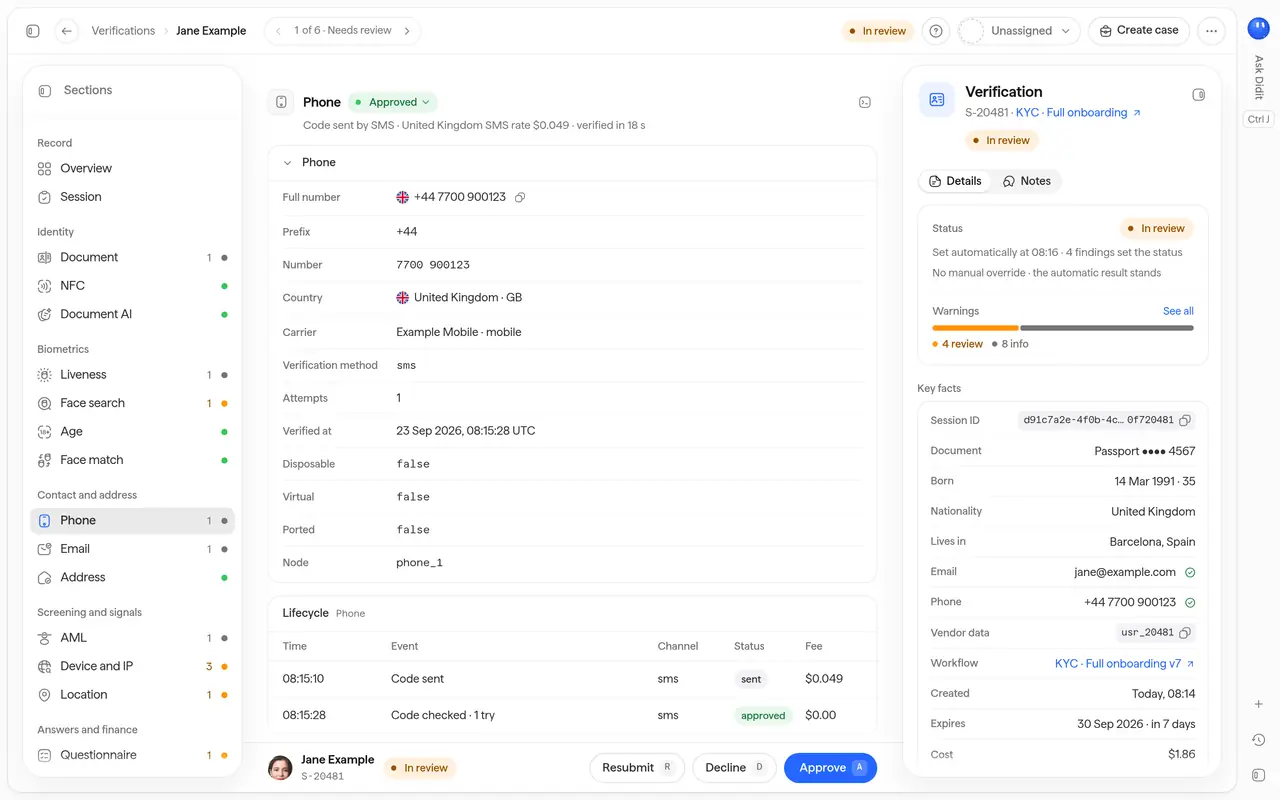
Pros.
- Published list prices for every check quoted here, so a cost model takes an afternoon.
- Phone codes are priced per country and channel, and the table is fetchable as JSON instead of negotiated.
- Number risk signals cover duplicates, disposable numbers and virtual numbers, which matter for SIM swap and for agent fraud.
- National eID sign-in is live in several European markets, including Mobile-ID and Smart-ID.
- The workflow orchestrator and the MCP server are free, so the build cost sits with your own team.
- SOC 2 Type 2 report and ISO/IEC 27001:2022 certification, certificate ES144068, with 4,000+ companies in production.
Cons.
- We founded Didit in 2023, so check whether tenure matters to your procurement.
- Database validation and non-document lookups are priced per country, so part of the budget needs a country list before it can be quoted.
- You configure the SIM registration checks and country rules in the workflow, so the build sits with your team.
- Phone codes are excluded from the Free plan credit.
Best for. Operators moving SIM registration or subscriber re-verification in-house and wanting a published cost per check, an API-first build and per-country phone pricing they control.
2. Sumsub: verification, AML and monitoring from one vendor
Verdict: Sumsub is a fit for buyers who want identity verification, AML and transaction monitoring from one vendor and can meet a monthly minimum. Sumsub Basic costs $1.35 per successful verification with a $149 monthly minimum. Selected add-ons are billed separately.
Features. Sumsub describes itself as trust infrastructure connecting identity verification, AML, transaction monitoring, fraud prevention and case data (Sumsub homepage, read November 26, 2026). The listed products are ID verification, liveness and face match, Sumsub ID for reusable KYC, email and phone verification, and AML screening. Its Custom plan is described as covering any volume, jurisdiction or language. The page we read states no specific country count or document count.
Pricing. Basic is $1.35 per verification with a $149 monthly minimum. Compliance is $1.85 per verification with a $299 monthly minimum. Custom is quote required. Add-ons run separately: ongoing AML monitoring $0.08 per initial check and per checked match, email verification +$0.04 per applicant, phone verification +$0.04 per successful verification plus SMS notification fees of $0.10, $0.14, $0.28, $0.42 or $0.63 depending on tier. Only successful verifications are charged, and there is a 14-day trial with 50 free checks.
Pros.
- Published rates, so you can build a budget model without a sales call.
- Identity verification, AML and transaction monitoring come from one vendor.
- Charging only for successful verifications softens the effect of abandoned sign-ups.
- States 4,000+ clients and cites a Forrester Total Economic Impact study of its Verification Platform.
Cons.
- At $1.35 per check, 50,000 monthly verifications cost $67,500 before any add-on.
- The $149 and $299 monthly minimums make low-volume pilots and seasonal campaigns more expensive than they look.
- Phone, email and SMS notification are priced as add-ons rather than in the base rate.
- No certifications are named on the page we read, and no country list is stated.
Best for. Buyers who want identity verification, AML and transaction monitoring from one vendor and can meet the monthly minimum comfortably.
3. Incode: stated United States carrier adoption
Verdict: Incode is the vendor to talk to first if your procurement sits inside a large United States carrier, because its page reports 8 of the top 9 telcos there as customers. It publishes no prices, so it cannot win a budget comparison on evidence, only on a quote.
Features. Incode describes itself as an enterprise identity verification company whose product confirms that the person behind an account, a transaction or an AI agent is real (Incode homepage, read November 26, 2026). Listed products include Know Your Agent, TrustGraph, GovFaceMatch and Identity Verification. Incode describes GovFaceMatch as matching biometrics against DMV records. Its page reports that 8 of the top 9 U.S. telcos are customers, 10B+ trust checks performed, and a Leader placement in the 2026 Gartner Magic Quadrant for Identity Verification.
Pricing. Not published on the page we read. Quote required.
Pros.
- States that 8 of the top 9 telcos in the United States are customers, the strongest stated telecom reference in this list.
- Also states 9 of the top 10 United States banks, which is a procurement reference when an operator group also runs lending or payments.
- GovFaceMatch is described as matching biometrics against DMV records.
Cons.
- No published per-check price, so a cost model needs a quote before it can start.
- Incode reports adoption across 8 of the top 9 U.S. telcos. The page gives no comparable adoption figure for other markets.
- No coverage count, certification list or document count appears on the page we read.
Best for. U.S. operators that prioritize stated carrier adoption.
4. Jumio: reported transaction volume and cross-transaction risk
Verdict: Jumio suits large operators evaluating cross-transaction risk and looking for a vendor that reports 1B+ processed transactions. It is the wrong choice for a small MVNO that needs a price list this week.
Features. Jumio says it provides AI-driven identity intelligence that verifies new and existing users across the customer lifecycle (Jumio homepage, read November 26, 2026). Products include Identity Verification, Risk Signals, Cross-Transaction Risk, AML Screening and the Jumio Identity Graph. AML screening covers global and regional sanctions, PEP lists and adverse media. The page states 5K+ supported ID types, a network of 30M+ identities in the identity graph, 1B+ transactions processed, 120 transactions per second and 300+ patents and patent applications.
Pricing. Not published. The pricing URL returned an error page when we read it on November 26, 2026. Quote required.
Pros.
- Reports 1B+ transactions processed and 120 transactions per second.
- Cross-transaction risk is a useful signal for agent networks and mobile money, not just onboarding.
- The page states 300+ patents and patent applications and a 30M+ identity graph.
Cons.
- Pricing not published, so a cost model waits on a quote.
- Jumio reports 5K+ supported global ID types. Ask for the exact documents your launch markets require.
- No certifications are named on the page we read.
Best for. Large operators evaluating cross-transaction risk and looking for a vendor that reports 1B+ processed transactions.
5. Entrust Identity Verification (formerly Onfido) for workforce IDV and digital signing
Verdict: the page lists customer verification, workforce IDV and digital signing from one vendor. That suits an operator that already runs Entrust for workforce identity, or that wants both from one supplier.
Features. The page says Entrust Identity Verification provides AI-powered biometrics and document intelligence to onboard customers, fight fraud and support regulatory compliance (Onfido homepage, read November 26, 2026). Listed offerings include Document Verification, Biometric Verification, KYC Compliance, Data Verification, Fraud Detection, Workforce IDV, AML Compliance, Biometric Authentication and Digital Signing. It lists integrations with Microsoft Entra Verified ID and Okta Workforce Identity, plus Workflow Studio Builder and a Smart Capture SDK. The page states Entrust was named 2026 Top InfoSec Innovator by Cyber Defense Magazine.
Pricing. Not published on the page we read. Quote required.
Pros.
- The page lists customer verification, workforce IDV and digital signing under one vendor.
- Lists integrations with Microsoft Entra Verified ID and Okta Workforce Identity, plus Workflow Studio Builder and a Smart Capture SDK.
- States it was named 2026 Top InfoSec Innovator by Cyber Defense Magazine.
Cons.
- The page we read states no pricing, no coverage count and no certification list.
- The offering is now named Entrust Identity Verification, formerly Onfido IDV, so older internal references need updating.
- Pricing not published, so any budget starts with a quote.
Best for. Operators already standardised on Entrust for workforce identity, or that need customer verification and digital signing from one supplier.
6. Persona: a published entry price and country configuration
Verdict: Persona is a fit for teams evaluating government ID, selfie and phone carrier checks alongside country and ID-type configuration, and that can commit for a year. The entry price is a floor on the contract, not a per-check rate, so a volume model still needs a quote.
Features. Persona is presented as a flexible and secure platform to verify real people and real businesses online, covering identity verification, KYB, fraud graph tooling and age assurance (Persona homepage, read November 26, 2026). Products include government ID verification, selfie verification, phone carrier verification, phone number verification and email verification. Data sources listed include authoritative databases in and outside the United States, DMV checks through AAMVA, Social Security eCBSV and business registries, with country and ID type configurations listed as a product feature. Hosting is described as SOC 2 Type 2 infrastructure. The page states Leader placements in the 2026 Gartner Magic Quadrant for Identity Verification, the Forrester Wave for Identity Verification Solutions from Q3 2025 and the 2026 KuppingerCole Leadership Compass.
Pricing. Essential starts at $250 a month, with a minimum contract term of 12 months. Growth and Enterprise are quote required and priced on volume and features. Confirm which features are included at the Essential tier, and ask for volume pricing, before you commit.
Pros.
- A published starting price, which is rare in this list.
- Persona lists phone carrier verification alongside phone number, government ID and selfie checks.
- Multiple analyst placements give internal reviewers external evidence.
- A startup program offers a monthly allotment of free services to eligible small companies.
Cons.
- Essential carries a 12-month minimum term. Ask whether you can test your document mix before committing.
- No per-check rate is published, so 50,000 registrations still needs a quote.
- No country list or AML list count is stated on the page we read.
Best for. Teams evaluating government ID, selfie and phone carrier checks alongside country and ID-type configuration.
7. Trulioo: business verification and UBO discovery
Verdict: Trulioo earns a place for the parts of telecom onboarding that are not consumer identity: dealers, agents, distributors and MVNO partners that need business verification before they can sell your SIMs.
Features. Trulioo says it turns ownership, identity and fraud signals into risk intelligence about businesses and the people and AI agents acting for them (Trulioo homepage, read November 26, 2026). Products include Person Verification, Business Verification, Fraud Prevention, Sanctions and AML Screening and Business Risk Horizon. Know Your Agent links an AI agent to a verified organisation through a signed digital credential, and UBO Discovery traces ownership through holding company layers. Trulioo reports access to more than 450 independent data partners. It offers its platform through an API or a hosted interface under a single contract. Customer names shown include Mastercard, JPMorgan, Fiserv, Airwallex, Worldpay, Webull, eToro and Nium.
Pricing. Not published on the page we read. Quote required.
Pros.
- Trulioo reports access to more than 450 independent data partners.
- Its business verification and UBO discovery are relevant to dealer and MVNO partner onboarding.
- One API or a hosted interface covers person and business checks under a single contract, according to the page.
Cons.
- Pricing and country count were not published on the page reviewed.
- Data-source matching is not the same as document capture, so confirm consumer document coverage for each launch market.
Best for. Operators that need KYB for dealers and partners alongside identity checks, and markets where authoritative data beats document capture.
8. IDnow: national eID schemes and the EUDI Wallet path
Verdict: IDnow is the natural shortlist entry for a European operator evaluating national eID schemes or the EUDI Wallet. Confirm live availability and supported methods for each market.
Features. IDnow offers a modular identity and trust product that verifies identity, assesses risk, authenticates access and enables electronic signatures across the customer lifecycle (IDnow homepage, read November 26, 2026). Products listed include Document Verification, Biometric verification, eID Schemes, EUDI Wallet and Data Verification. IDnow lists eID Schemes and EUDI Wallet and reports 371+ supported documents globally. The reviewed page gives no market-level coverage breakdown. It also states 14M+ completed transactions annually, 76+ identification specialists and 59+ sector-leading customers.
Pricing. Not published on the page we read. Quote required.
Pros.
- Reports 14M+ completed transactions annually.
- Lists 76+ identification specialists.
- eID schemes and the EUDI Wallet appear in the product list.
Cons.
- Market-level document coverage to confirm, since the reviewed page gives no regional breakdown.
- No published pricing, so comparison needs a quote.
- No certification list or AML list count on the page we read.
Best for. European operators evaluating national eID schemes or the EUDI Wallet. Confirm live availability and supported methods for each market.
The budget walk-through
We modelled 50,000 monthly registrations to show how per-check prices affect a budget. The model assumes one completed full ID check, one AML check and one SMS code per registration, each billed once, at the listed United States rate. The table uses only published Didit list prices.
| Line | Unit price | Volume | Cost |
|---|---|---|---|
| Full ID check | $0.33 | 50,000 | $16,500.00 |
| AML screening | $0.20 | 50,000 | $10,000.00 |
| SMS code, United States | $0.0473 | 50,000 | $2,365.00 |
| Total at list price | $28,865.00 |
On the Scale plan the same month prices differently, because Scale takes 10% off Didit prices while carrier charges pass through at cost. The full ID check becomes $0.33 × 0.9 = $0.297, so 50,000 × $0.297 = $14,850. AML becomes $0.20 × 0.9 = $0.18, so 50,000 × $0.18 = $9,000. The Scale Didit fee on a phone code is $0.018, and carrier billing uses the higher of the listed and route-reported prices; at the listed United States rate the code totals $0.0453, so 50,000 × $0.0453 = $2,265. For 50,000 completed ID checks, 50,000 AML checks and 50,000 SMS codes at the listed U.S. rate, Scale usage totals $26,115. The $350 plan credit leaves $25,765 to be paid from prepaid balance. The $299 subscription brings this month's modeled cost to $26,064 before applicable taxes.
For reference, the same 50,000 verifications at Sumsub's published Basic rate of $1.35 come to $67,500 before add-ons, and its phone verification is an add-on at +$0.04 per successful verification plus SMS notification fees. That figure is not a like-for-like bundle: Sumsub's Basic rate and our separate lines cover different checks with different billing events.
Ongoing monitoring is the other line that grows. At our list price, monitoring one million subscribers costs 1,000,000 × $0.07 = $70,000 per year. Confirm who your policy requires you to monitor before you put that line in a budget.

Which one to pick
SIM registration at launch
If you need a published cost per check and per-country phone pricing you control, Didit. If one vendor for identity verification, AML and transaction monitoring plus a monthly minimum suits your procurement, Sumsub. If procurement sits inside a large United States carrier and stated telco references decide shortlists, Incode. If the launch market runs on national eIDs or the EUDI Wallet path, evaluate IDnow and verify its live methods for that market, with our price list as the comparison.
Subscriber re-verification and account changes
At a number change, device change or tariff upgrade, the price per check and the phone risk signals decide the cost. Our phone check returns carrier, line type and ported status, alongside disposable and virtual number signals, and authentication is free for the first 50,000 active users each month, which matters if you re-authenticate at every login. Jumio's cross-transaction risk is worth evaluating if the fraud you see spans several accounts. Persona lists phone carrier verification and phone number verification. Essential starts at $250 a month with a 12-month minimum. Confirm which checks the quote includes.
Dealer, agent and MVNO partner onboarding
For business verification and UBO discovery, start with Trulioo and confirm consumer document coverage for each launch market. Our business verification starts at $2.00 per company for registry data. The price varies by country and data tier. Linked full ID checks and person AML for owners and officers are billed separately. Entrust lists workforce IDV, which suits a large agent or contractor population that already runs Entrust identity.
If you're switching providers, see our migration page at https://didit.me/switch/.
Sources
- Didit pricing page and Didit pricing docs, read November 26, 2026.
- Didit pricing as JSON, the live feed for Didit prices quoted here, read November 26, 2026.
- Didit phone price list, read November 26, 2026.
- Didit country-and-channel phone price feed, read November 26, 2026.
- Didit product facts, source for stated coverage, certifications and customer count, read November 26, 2026.
- Didit ID verification docs, read November 26, 2026.
- Didit non-document lookup docs, read November 26, 2026.
- Didit digital ID wallet docs, read November 26, 2026.
- Didit phone verification docs and phone verification API reference, read November 26, 2026.
- Didit Create Session API, read November 26, 2026.
- Didit MCP server and integration prompt, read November 26, 2026.
- Didit migration page, read November 26, 2026.
- Sumsub homepage, sumsub.com, read November 26, 2026.
- Onfido homepage, onfido.com, read November 26, 2026.
- Jumio homepage, jumio.com, read November 26, 2026.
- Persona homepage, withpersona.com, read November 26, 2026.
- Incode homepage, incode.com, read November 26, 2026.
- IDnow homepage, idnow.io, read November 26, 2026.
- Trulioo homepage, trulioo.com, read November 26, 2026.
- Veriff homepage, read November 26, 2026. Details could not be verified.
- FATF recommendations on customer due diligence and wire transfers.
- EUR-Lex for eIDAS 2.0 and the EU anti-money laundering directives.
Create a free Didit sandbox to test your registration flow, then estimate production costs from the published rates. No sales call is needed to start.
Try it
Try this in the sandbox
Run the check this guide describes, free.
The product this post is about, taken from its topic. Run it free in the sandbox.
Author
Alberto Rosas
Co-founder and CEO

Keep reading
Other guides in the same topic.
 What Is the Purpose of FICA in South Africa? 2026 Guide
FICA is South Africa's anti-money laundering law. It creates the Financial Intelligence Centre and requires accountable institutions to identify and verify clients, screen for PEP and sanctions risk and report suspicious.
Alberto RosasNov 26, 2026 Sixth Money Laundering Directive (6AMLD): What Changed and Which Rules Apply
6AMLD is Directive (EU) 2018/1673: Member States must criminalise laundering, widen predicate offences and set a four-year penalty floor. It adds no new due diligence duties for firms.
Alberto RosasNov 26, 2026 Automated Sanctions Screening: Canada, the Entity List and Embargoes
Automated sanctions screening matches people and companies against lists such as Canada's autonomous sanctions made under SEMA and JVCFOA and the OFAC SDN List, and returns candidate hits scored for identity confidence and.
Alberto RosasNov 26, 2026Questions
Frequently asked questions
What is the best identity verification provider for telecom and mobile operators in 2026?
We rank Didit first because we publish list prices for the checks a telecom flow needs: $0.33 per full ID check, $0.20 per AML screen, $0.07 per person a year for monitoring and per-country phone code fees. Sumsub is the alternative when you want one vendor for identity verification, AML and transaction monitoring. Incode reports 8 of the top 9 United States telcos as customers, and IDnow lists national eID schemes and the EUDI Wallet for European markets.
How much does SIM registration KYC cost per subscriber?
At our list prices a full ID check plus an AML screen is $0.53 per subscriber, and a United States SMS code at the listed rate adds $0.0473, so about $0.58. At 50,000 registrations a month that is $28,865 at list prices. On Scale the same modelled month totals $26,064 before taxes, and the arithmetic is in the budget walk-through above.
Can Didit verify a SIM applicant against a national ID database?
We check the submitted details against the source documented for each country, which may be a government register or a commercial data source. In Canada, France, Indonesia, the Netherlands, Norway, Singapore, the United Kingdom and the United States the record we can reach is a credit-bureau, financial-services, utility or residential-records file rather than a state register. A successful lookup carries the data_match assurance tier: the submitted details matched a record the source holds, and no document was inspected. Confirm the source and the evidence your market accepts before you enable a country. The exact source for every country is listed in the non-document lookup docs.
Which providers publish their per-check prices?
Didit and Sumsub publish per-verification rates. Persona publishes an entry price of $250 a month with a 12-month minimum term. Jumio, Incode, IDnow, Trulioo and Entrust Identity Verification (formerly Onfido) did not publish pricing on the pages we read on November 26, 2026, so those require a quote.
Can identity verification stop SIM swap fraud?
Only partly, because a swap happens after onboarding. Our phone check returns carrier, line type and ported status, alongside disposable and virtual number signals, and a workflow can also flag duplicate numbers. For a swap request, use a separate account-holder check with an appropriate verified reference, and note that authentication is free for the first 50,000 active users each month.
Does Didit support national eID and mobile ID sign-in for operators?
Yes, several are live in production: Mobile-ID at $0.21 for Estonia and Lithuania, Smart-ID at $0.21 for Estonia, Latvia, Lithuania and Belgium, MitID at $0.25, BankID Sweden at $0.20, Finnish Trust Network at $0.25, Bank iD in Czechia at $0.20 and iDIN at $0.95. The EUDI Wallet is listed at $0.15 in the digital ID wallet price feed but is not yet enabled in production. Availability is per environment, so check the country list in the digital ID wallet docs before promising it to a regulator.
How do we verify a phone number during SIM registration?
Send a one-time code and check it, then read the risk data that comes back. With Didit you call POST /v3/phone/send/ with the number in E.164 format, the user types the code, and POST /v3/phone/check/ with the same number, the code and the returned verification_id gives status plus carrier, line type, ported, disposable and virtual number data. Codes go over SMS, WhatsApp, Telegram, voice or Viber, and the default window is 5 minutes. The standalone check supports a VoIP action. To configure duplicate-number handling, use the PHONE step in a hosted workflow.
Can we screen existing subscribers, not just new ones?
Yes, with ongoing AML monitoring priced per person per year rather than per check. At our list price, monitoring one million subscribers costs 1,000,000 × $0.07 = $70,000 per year. Confirm who your policy requires you to monitor before you budget for it.
Do we need a sales call to test any of this?
Not with Didit. Our sandbox is free on every plan, and the integration prompt lets a coding agent wire the first flow. Enterprise starts at $15,000 a year and requires a quote.
How do identity verification prices compare at 50,000 checks a month?
For this mix, monthly usage costs $28,865 at list prices or $26,115 at Scale rates. After the $350 monthly credit and $299 subscription, the modeled Scale cost is $26,064 before taxes. Sumsub's published Basic rate of $1.35 per verification comes to $67,500 for 50,000 verifications before add-ons, with phone verification charged separately. The two cover different checks with different billing events, so compare the quote line by line.
Compliance built in
Audited, certified and attested.
We hold the certifications and build each country's rules into your flows, so you can launch anywhere without worrying. Security and Compliance center
- Regulation encoded into your flows
Tell us what you do and where. Didit lists the rules that apply to you, with sources, and builds the checks each country needs into one workflow.
- Ready for AMLR
Every requirement of the new EU anti-money laundering rules, from checking customers to human review, is already covered by a Didit check.
- Tested in Spain's Treasury sandbox
Spain's Treasury published its supervised sandbox report on Didit's NFC plus active liveness onboarding; SEPBLAC took part and valued the added measures positively.
- Audited, not self-declared
iBeta Level 1 and Level 2. Liveness tested under ISO/IEC 30107-3.
Your obligations · 3 regions
 SOC 2 Type 2
 ISO 27001
 iBeta Level 1 and Level 2
 EU regulator attestation
 FSM youth protection
 GDPR
 EBA remote onboarding
 MiCA compatible
 FIDO Alliance member
- AMLREU AML Regulation ready
Integration · Didit MCP
Run Didit from your own AI agent
Connect Didit to Claude, Cursor, VS Code or ChatGPT and just ask in plain words. Your agent can do anything you can do in the console, with the same permissions you have.
 Add to Claude
 ChatGPT
 Cursor
- Build workflowsDescribe the checks you need. The agent creates and publishes the flow.
- Run investigationsAsk why a session was declined, review cases, search people and companies.
- Change rulesCreate payment rules, test them on past data and switch them on.
- Pull reportsAsk for numbers, exports or the audit log.
Didit Academy


