The 8 Best KYC Providers for Crypto and DeFi in 2026
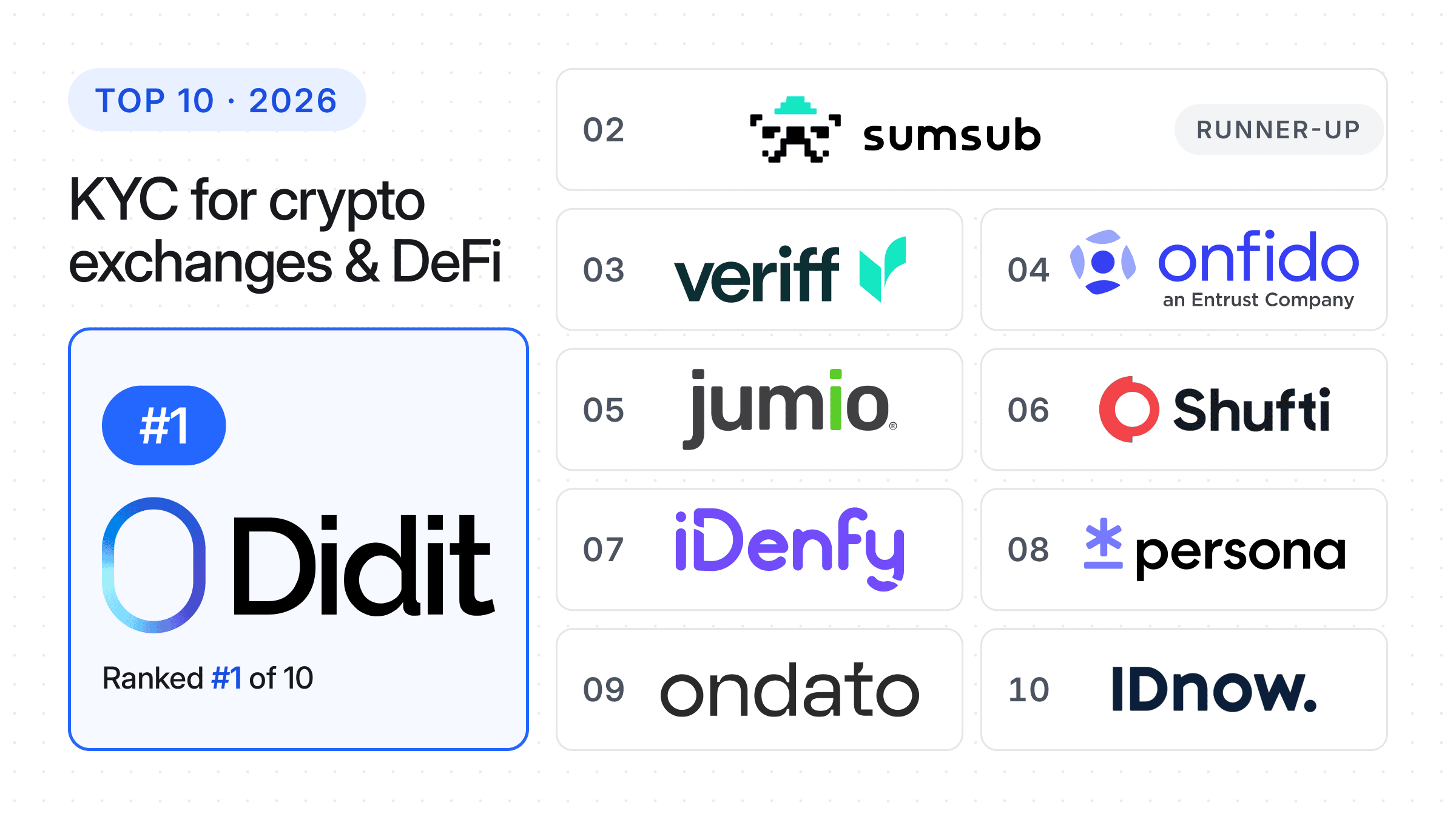
We rank Didit first for crypto and DeFi: full KYC $0.33, person AML $0.20, wallet screening $0.15 and Travel Rule $0.02 per outbound exchange on one published price list. Sumsub is next to evaluate.
 Alberto RosasCo-founder and CEO
Contents
In this guide
Jump to the part you need.
This guide is for compliance and engineering leads at exchanges, custodians, brokers and DeFi apps who need KYC that survives a withdrawal review, not just signup. We rank Didit first if you want identity checks, person AML screening, wallet screening and Travel Rule on one published price list, from $0.33 per full KYC. Several competitors publish no unit prices, so compare quotes for the same checks, billing events and monthly minimums.
Last updated: November 26, 2026. Prices checked against the live Didit price feed on November 26, 2026.
| Rank | Vendor | Best for | Price basis | Key capabilities | Main trade-off |
|---|---|---|---|---|---|
| 1 | Didit | Teams that want published unit prices for identity checks, person AML, wallet screening and outbound Travel Rule exchanges | Published: full KYC $0.33 per completed check, person AML $0.20 per check, wallet screening $0.15 per screening, Travel Rule $0.02 per outbound exchange | KYC, KYB, AML screening and monitoring, wallet screening inside Transaction Monitoring, transaction monitoring, Travel Rule | Budget for wallet screening and Travel Rule exchanges separately from KYC |
| 2 | Sumsub | Teams evaluating identity, AML transaction monitoring, fraud prevention and Travel Rule from one vendor | Published: Basic $1.35 per verification with $149 monthly minimum; Compliance $1.85 per verification with $299 monthly minimum (Sumsub homepage, read November 26, 2026) | KYC, KYB, AML transaction monitoring, fraud prevention, Travel Rule as listed by the vendor | Confirm which tier includes the features you need |
| 3 | Entrust Identity Verification (formerly Onfido) | Teams evaluating a no-code builder and Smart Capture SDK for document and biometric verification | Pricing is not published on the homepage we read; quote required (Entrust Identity Verification homepage, read November 26, 2026) | Document verification, biometric verification, KYC compliance, data verification, fraud detection, no-code Workflow Studio Builder, Smart Capture SDK | The captured page does not establish support for wallet screening or Travel Rule. Confirm coverage before budgeting. |
| 4 | Jumio | Teams evaluating identity verification, AML screening and additional fraud context from Risk Signals, Cross-Transaction Risk and the Identity Graph | Pricing is not published on the homepage we read; quote required (Jumio homepage, read November 26, 2026) | Identity verification, Risk Signals, Cross-Transaction Risk, AML screening, biometrics | The captured page does not establish support for wallet screening or Travel Rule. Confirm coverage before budgeting. |
| 5 | Persona | Teams evaluating both business and individual identity verification | Essential starts at $250 a month with a 12-month minimum; per-check pricing is not published on the homepage (Persona homepage, read November 26, 2026) | Identity verification, KYB, age assurance, humanness check, Graph | Ask Persona what the Essential fee covers and how it bills individual and business verifications. |
| 6 | Shufti Pro | Teams evaluating video identification and AML screening during onboarding | Pricing is not published on the homepage we read; quote required (Shufti Pro homepage, read November 26, 2026) | Document verification, face verification, eIDV, VideoIdent, AML screening | The captured page does not establish support for wallet screening or Travel Rule. Confirm coverage before budgeting. |
| 7 | iDenfy | Teams evaluating published add-on rates and human review | Published: $1.35 per verification with $135 monthly minimum, add-ons listed (iDenfy homepage, read November 26, 2026) | ID and face checks, 3D liveness, KYB, AML verification and monitoring, fraud prevention | Sanctions and PEP checks add $0.50 per check; the captured page does not establish wallet screening or Travel Rule support. |
| 8 | IDnow | EU teams evaluating eID alongside document and biometric checks | Pricing is not published on the homepage we read; quote required (IDnow homepage, read November 26, 2026) | Document and biometric verification, eID schemes, EUDI Wallet, AML screening under Understand, authentication | Ask IDnow to confirm availability in the target markets. The captured page does not establish wallet screening or Travel Rule support. |
Didit publishes this ranking; we explain the criteria so you can check them.
How we picked the best KYC providers for crypto and DeFi
Crypto teams may need to verify identity at signup, screen customers and assess risk when funds move. The controls depend on the service, the transfer and the rules that apply. We ranked vendors on crypto-specific product scope, the detail available on their pages, and whether buyers can estimate costs before requesting a quote.
- Scope beyond signup. Does the vendor list AML screening, wallet or transaction checks, and Travel Rule? A vendor with identity checks only can still work, but you may need to cover those checks elsewhere depending on what the vendor confirms.
- Cost visibility. Can buyers estimate costs before requesting a quote? Published unit prices and clear minimums make budgeting possible.
- Review path. What does an analyst see when a check needs a decision, and can that decision be attached to the customer record?
- Onboarding shape. Retail KYC, corporate KYB with owner checks, and high-risk manual review are three different flows. We looked at which ones the vendor describes.
- Evidence. We read each vendor's own homepage on November 26, 2026. We do not rank capability we cannot see on the captured page.
AML KYC services and software for crypto: the five jobs behind the label
Ask each vendor which controls its quoted price covers and which are billed separately.
- Identity verification (KYC). Document check, liveness, face match, and device or IP signals. This is the signup flow.
- Onboarding AML screening. The new customer is checked against sanctions, PEP and watchlist data. We charge $0.20 per completed person AML screen against 1,300+ lists.
- Ongoing monitoring. The same person is re-screened after onboarding. We charge $0.07 per user a year for ongoing AML monitoring.
- Wallet screening (KYT). Wallet screening checks a deposit or withdrawal address for risk exposure. We offer it inside Transaction Monitoring at $0.15 per screening at list price.
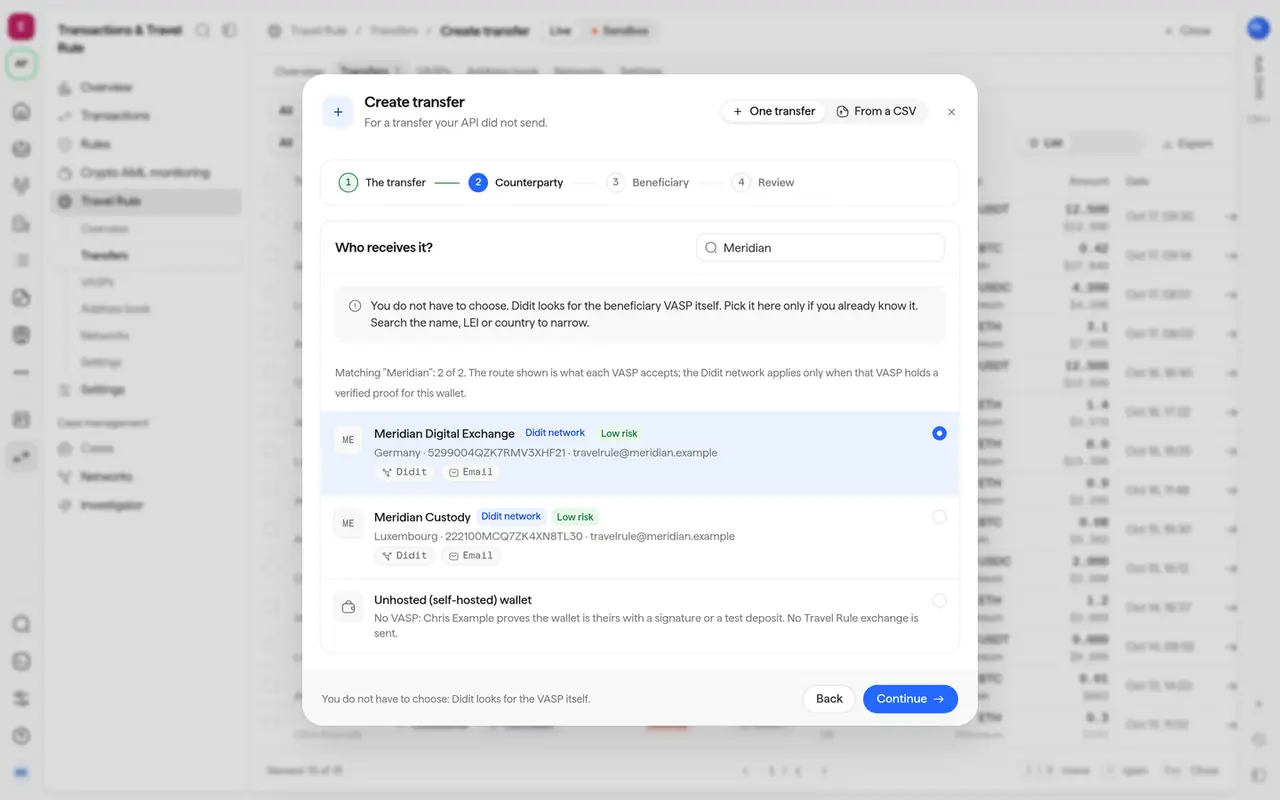
- Transaction monitoring and Travel Rule. Your rules run on activity, and originator and beneficiary data is exchanged with the counterparty. We charge $0.001 per transaction beyond the plan allowance and $0.02 per outbound Travel Rule exchange.
FATF standards inform national implementation, and obligations depend on the provider, jurisdiction and transfer. In the EU, MiCA sets authorization and operating rules for crypto-asset service providers, while the crypto transfer-information rules sit in Regulation (EU) 2023/1113. Check both against the service you operate.
Our security documentation cites an independent legal opinion on our remote onboarding's alignment with EBA guidelines and compatibility with MiCA. We also hold SOC 2 Type 2, ISO/IEC 27001:2022, and iBeta Level 1 and 2.
Controls to evaluate by onboarding scenario
| Scenario | Controls to evaluate | Evidence to request |
|---|---|---|
| Retail KYC | Document verification, liveness, face match, device and IP signals, sanctions and PEP screening | Per-check prices, supported documents for your markets, approval and decline billing rules |
| Institutional KYB | Registry data, ownership and UBO discovery, linked KYC for officers, company AML | Registry coverage by country, ownership tier pricing, per-person AML and KYC billing |
| Fiat onboarding | Bank account or payment method checks, proof of address, transaction monitoring | Unit prices for each step, monitoring allowance, overage rate |
| Wallet withdrawals | Wallet screening, Travel Rule messaging, transaction monitoring rules | Wallet screening price, Travel Rule billing event, provider options and coverage confirmation |
DeFi: identify the operator before the check
An open protocol, a hosted front end, a custodian and a fiat on-ramp can raise different questions about who operates the service and when checks may apply. Start with the entity that controls the service, then map the checks to the activity. This is a legal and compliance question for your jurisdiction, not a product choice.

1. Didit: identity, AML, wallet screening and Travel Rule on one price list
Verdict. Of the vendor pages we could verify, ours was the only one with unit prices for all four items in this guide: full KYC, person AML screening, wallet screening and outbound Travel Rule exchanges. 4,000+ companies use Didit.
Features. A full KYC check has three parts in one price: ID document verification, passive liveness with face match, and device and IP analysis, across 220+ countries and territories, 14,000+ document types, and a verification interface in 54 languages, with 200+ fraud signals scored per session. Business verification retrieves registry data priced by country and data tier. We bill completed linked full KYC checks and person AML screens separately for owners and officers. We screen against 1,300+ sanctions, PEP and watchlist sources. We offer wallet screening inside Transaction Monitoring. Travel Rule exchanges carry originator and beneficiary data with protocol tracking. The workflow builder is free, as are the MCP server and SDKs. For example, a team can build a retail KYC workflow in the workflow builder, publish it, and test it in the sandbox without a sales call.
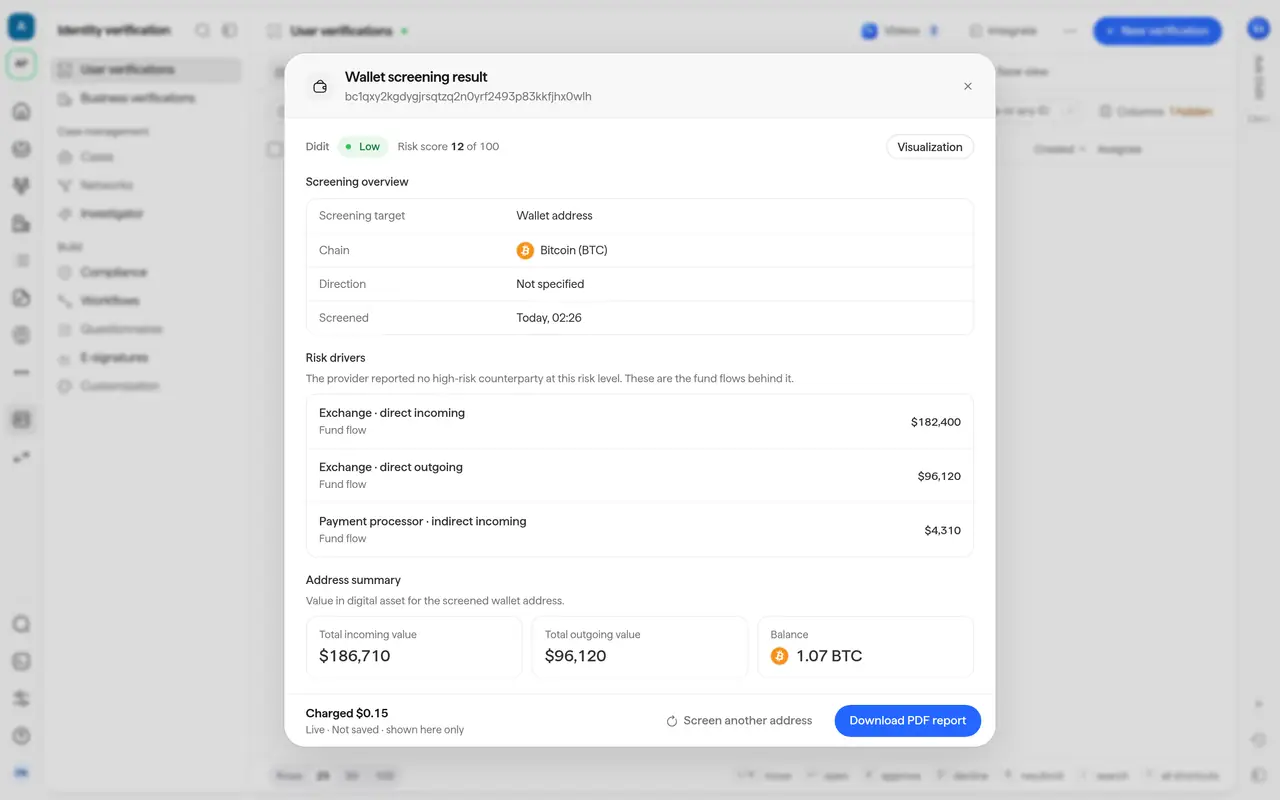
Pricing. Full KYC $0.33 per completed check. Person AML screening $0.20 per check. Ongoing AML monitoring $0.07 per user a year. Wallet screening $0.15 per screening. Travel Rule $0.02 per outbound exchange, billed once however the exchange later resolves. Transaction monitoring $0.001 per transaction beyond the plan allowance. KYB from $2.00 per company, plus $0.20 company AML, $0.20 person AML per owner or officer and $0.33 per completed linked full KYC check for an owner or officer at list price. Plans: Free at $0 a month with $10 a month for the first eligible organization created with a work email on its company domain, and unused monthly credit expires; Growth at $99 a month with $115 of credit and 4% off Didit prices; Scale at $299 a month with $350 of credit and 10% off Didit prices; Enterprise from $15,000 a year. Carrier and Meta charges pass through at cost, and transaction monitoring overage remains $0.001 per transaction. Sandbox testing is free on every plan. You pay when a check finishes with a result, and a declined check is a result, so budget on billable checks rather than approvals.
Pros
- One public price list covers full KYC, person AML, wallet screening and Travel Rule, so the budget is arithmetic rather than a negotiation.
- Wallet screening is part of Transaction Monitoring, not a separate product line.
- 220+ countries and territories, 14,000+ document types, 1,300+ AML lists, and sub-2-second inference at p99.
- SOC 2 Type 2, ISO/IEC 27001:2022, iBeta Level 1 and 2, and a Spanish regulator finding that applies to the evaluated NFC plus active liveness flow.
- The sandbox is free on every plan, and the integration prompt lets an engineer test a crypto flow before anyone talks to sales.
Cons
- Budget for wallet screening and Travel Rule exchanges separately from KYC. In the worked example, 25,000 wallet screenings cost $3,750 at list price, the largest line in that scenario.
- You build the workflow yourself in the workflow builder, so the self-serve path is yours to run.
- Person AML, ongoing AML monitoring and KYB are separate line items, so model them before you compare bundles.
Best for. Exchanges, custodians and DeFi apps that want identity, AML and wallet checks behind one API and one price list, and teams that would rather read a price page than book a call.
2. Sumsub: identity, monitoring, fraud and Travel Rule in one vendor's listed products
Verdict. Sumsub is a name to evaluate when you want identity, AML transaction monitoring, fraud prevention and Travel Rule from one vendor, and it publishes entry rates, which most of the shortlist does not. The published rates are per verification with monthly minimums, and tier feature inclusions need confirmation.
Features. Sumsub describes itself as AI-powered trust infrastructure for compliance operations at scale, connecting identity, fraud, AML, transaction and case data workflows, with products across KYC, KYB, AML transaction monitoring, fraud prevention and Travel Rule (Sumsub homepage, read November 26, 2026). Coverage is described as any country and any volume, jurisdiction or language, without a published country or document list.
Pricing. Basic is $1.35 per verification with a $149 monthly minimum. Compliance is $1.85 per verification with a $299 monthly minimum. Confirm which tier includes the features you need. The page also lists add-ons: ongoing AML monitoring for KYC at $0.08 per initial check and per checked match, email verification at $0.04 per applicant, and phone verification at $0.04 per successful verification plus SMS notification fees. The page lists SMS notification at $0.10 for Country Tier 1 and $0.14 for Country Tier 2. Its FAQ states a 14-day free trial with 50 free checks and that you are charged for successful verifications only (Sumsub homepage, read November 26, 2026).
Pros
- Publishes two entry rates and minimums, so you can estimate a monthly bill before a call.
- Lists KYC, KYB, AML transaction monitoring, fraud prevention and Travel Rule.
- Its page states 4,000+ clients and cites a Forrester Total Economic Impact study, with 272% three-year ROI and payback under six months.
Cons
- Confirm which tier includes the features you need; the page does not map crypto features to each tier.
- Ongoing AML monitoring is an add-on at $0.08, and SMS and phone checks add more.
- Its page names no specific certifications or document list.
Best for. Teams evaluating identity, AML transaction monitoring, fraud prevention and Travel Rule from one vendor, with the published Basic and Compliance rates as starting points.
3. Entrust Identity Verification (formerly Onfido): no-code builder and Smart Capture SDK
Verdict. Entrust Identity Verification, formerly Onfido, is best for teams evaluating a no-code builder and Smart Capture SDK for document and biometric verification. Pricing is not published on the homepage we read, and the captured page does not establish support for wallet screening or Travel Rule (Entrust Identity Verification homepage, read November 26, 2026).
Features. Entrust Identity Verification is described as AI-powered biometric and document verification that lets businesses onboard customers, catch fraud such as deepfakes and injection attacks, and meet KYC and AML requirements. The product list covers document verification, biometric verification, KYC compliance, data verification and fraud detection, with a no-code Workflow Studio Builder and a Smart Capture SDK (Entrust Identity Verification (formerly Onfido) homepage, read November 26, 2026). Its page states support for KYC, AML and eIDAS 2.0 requirements and names no formal certifications.
Pricing. Pricing is not published on the homepage we read; quote required (Entrust Identity Verification homepage, read November 26, 2026).
Pros
- Lists a no-code Workflow Studio Builder and Smart Capture SDK for document and biometric verification.
- The page leads on deepfake and injection-attack defence.
- Named a 2026 Top InfoSec Innovator by Cyber Defense Magazine, per its page.
Cons
- Pricing is not published on the homepage we read, so compare quotes on identical scope (Entrust Identity Verification homepage, read November 26, 2026).
- The captured page does not establish support for wallet screening or Travel Rule. Confirm coverage before budgeting for those checks.
- No formal certifications named on the page read.
Best for. Teams evaluating a no-code builder and Smart Capture SDK for document and biometric verification.
4. Jumio: identity, AML and additional fraud context
Verdict. Jumio is best for teams evaluating identity verification, AML screening and additional fraud context from Risk Signals, Cross-Transaction Risk and the Identity Graph.
Features. Jumio describes AI-driven identity intelligence that verifies new and existing users, fights fraud and helps meet compliance mandates across the customer lifecycle. Products cover identity verification, Risk Signals, Cross-Transaction Risk, AML Screening and biometrics. Its page cites 5K+ supported ID types, hundreds of data sources, a Jumio Identity Graph of 30M+ identities, 1B+ transactions processed and 300+ patents and applications (Jumio homepage, read November 26, 2026).
Pricing. Pricing is not published on the homepage we read; quote required (Jumio homepage, read November 26, 2026).
Pros
- Lists Risk Signals, Cross-Transaction Risk and the Identity Graph as fraud context.
- Lists AML screening as a product.
- Reports 1B+ transactions processed and 300+ patents and applications.
Cons
- Pricing is not published on the homepage we read (Jumio homepage, read November 26, 2026).
- The captured page does not establish support for wallet screening or Travel Rule (Jumio homepage, read November 26, 2026). Confirm coverage before budgeting for those checks.
- The page reports 5K+ supported ID types (Jumio homepage, read November 26, 2026); confirm the document types issued in your target markets.
Best for. Teams evaluating identity verification, AML screening and additional fraud context from Risk Signals, Cross-Transaction Risk and the Identity Graph.
5. Persona: business and individual identity verification
Verdict. Persona is best for teams evaluating both business and individual identity verification. The published trade-off is that Essential starts at $250 a month with a 12-month minimum, and per-check pricing is not published on the homepage (Persona homepage, read November 26, 2026).
Features. Persona says it verifies real people and real businesses online, with products for identity verification, KYB, age assurance, a humanness check and Graph. Its published coverage list includes a US authoritative database, US business registry, DMV data through AAMVA, tax identification numbers, non-US authoritative databases, business websites, non-US business registries, the Social Security Administration eCBSV service and mobile driving licences (Persona homepage, read November 26, 2026). Its page states SOC 2 Type 2 infrastructure.
Pricing. Essential starts at $250 a month with a 12-month minimum term. Persona asks buyers to contact it for Growth and Enterprise and does not list a per-verification rate on its homepage (Persona homepage, read November 26, 2026).
Pros
- Lists identity verification, KYB and Graph as products.
- SOC 2 Type 2 infrastructure, per its page.
- Named a Leader in the 2026 Gartner Magic Quadrant for Identity Verification and in the Forrester Wave for Identity Verification Solutions, Q3 2025, per its page.
Cons
- Essential starts at $250 a month with a 12-month minimum, and per-check pricing is not published on the homepage (Persona homepage, read November 26, 2026).
- The captured page does not establish support for wallet screening or Travel Rule. Confirm coverage before budgeting for those checks.
- The page gives coverage sources, not a per-country document list.
Best for. Teams evaluating both business and individual identity verification.
6. Shufti Pro: video identification and AML screening
Verdict. Shufti Pro is best for teams evaluating video identification and AML screening during onboarding. Its page also makes a specific crypto customer claim, which we attribute to the vendor in the FAQ below.
Features. Shufti Pro describes itself as a trust system for identity verification, AML and fraud prevention, with agentic AI automating compliance work across the customer lifecycle. Products listed are document verification, face verification, eIDV, VideoIdent and AML screening (Shufti Pro homepage, read November 26, 2026). Its page ranks it first on G2 for identity verification and AML in Fall 2026, cites Best KYC/KYB Innovation 2026 at Datos Insights' Impact Awards, and makes a crypto customer claim covered in the FAQ.
Pricing. Pricing is not published on the homepage we read; quote required (Shufti Pro homepage, read November 26, 2026).
Pros
- Lists VideoIdent and AML screening.
- Cites G2 and Datos Insights recognition on its page.
- Lists document verification, face verification, eIDV, VideoIdent and AML screening.
Cons
- Pricing is not published on the homepage we read, and no certifications are named (Shufti Pro homepage, read November 26, 2026).
- The captured page does not establish support for wallet screening or Travel Rule. Confirm coverage before budgeting for those checks.
- Awards and rankings are self-reported on the vendor's page.
Best for. Teams evaluating video identification and AML screening during onboarding.
7. iDenfy: published add-on rates and human review
Verdict. iDenfy is best for teams evaluating published add-on rates and an optional human review step. Published add-on rates let buyers estimate the listed identity and AML checks.
Features. iDenfy combines AI biometric and document checks with 24/7 human review, covering ID document, face match and liveness, 3D face liveness, KYB, AML verification and monitoring, and fraud prevention. Its page cites onboarding in 200+ countries and territories, 16,000+ government-issued documents and 180+ company registries, with ISO 27001 and SOC 2 commitments written into the Enterprise contract, up to $1M cyber insurance and a 99.9% uptime SLA (iDenfy homepage, read November 26, 2026).
Pricing. Basic at $1.35 per verification with a $135 monthly minimum, a Premium tier, and tailored Enterprise terms. Add-ons are published: 3D face liveness +$0.25, 24/7 manual review +$0.55, approved-only billing +$0.50, proof of address +$1.00, sanctions and PEPs check +$0.50, duplicate detection +$0.10, SMS verification +$0.10, blocklist +$0.10 and IP proxy risk +$0.10. iDenfy lists approved-only billing at an additional $0.50 and says denied verifications are not charged under that billing option. The vendor claims 24/7 human supervision within three minutes (iDenfy homepage, read November 26, 2026).
Pros
- Published add-on rates let buyers estimate the listed identity and AML checks.
- Lists approved-only billing at an additional $0.50; the vendor says denied verifications are not charged under that option.
- The vendor claims 24/7 human supervision within three minutes.
Cons
- The sanctions and PEPs check adds $0.50, which takes a checked customer to $1.85 before any other add-on.
- The captured page does not establish support for wallet screening or Travel Rule. Confirm coverage before budgeting for those checks.
- Approved-only billing is an add-on at $0.50, not the default.
Best for. Teams evaluating published add-on rates and human review.
8. IDnow: eID and EUDI Wallet for EU teams
Verdict. IDnow is best for EU teams evaluating eID alongside document and biometric checks. Ask IDnow to confirm availability in the target markets.
Features. The IDnow Trust Platform combines identity verification, risk and attribute insights, authentication, fraud prevention, and electronic signatures and seals. IDnow lists eID schemes and the EUDI Wallet under Identify and Authenticate, and AML screening under Understand. It also lists electronic signatures and seals. Its page cites 371+ documents supported globally, 14M+ completed transactions annually and 59+ sector-leading customers (IDnow homepage, read November 26, 2026).
Pricing. Pricing is not published on the homepage we read; quote required (IDnow homepage, read November 26, 2026).
Pros
- Lists eID schemes and the EUDI Wallet under Identify and Authenticate.
- Lists AML screening under Understand.
- Lists electronic signatures and seals.
Cons
- Pricing is not published on the homepage we read (IDnow homepage, read November 26, 2026).
- The captured page does not establish support for wallet screening or Travel Rule (IDnow homepage, read November 26, 2026). Confirm coverage before budgeting for those checks.
- IDnow reports 371+ supported documents globally (IDnow homepage, read November 26, 2026). Ask which documents it accepts in your target markets.
Best for. EU teams evaluating eID alongside document and biometric checks.
Budget walk-through: 10,000 new customers, 25,000 wallet checks, 8,000 Travel Rule messages
Take a mid-size exchange that verifies 10,000 new customers a month, screens all of them against sanctions and PEP lists, screens 25,000 withdrawal addresses and sends 8,000 outbound Travel Rule messages. These are published unit prices with the arithmetic shown.
Didit at list prices
- KYC: 10,000 x $0.33 = $3,300.00
- AML screening: 10,000 x $0.20 = $2,000.00
- Wallet screening: 25,000 x $0.15 = $3,750.00
- Travel Rule: 8,000 x $0.02 = $160.00
- Total usage before credits and tax: $3,300.00 + $2,000.00 + $3,750.00 + $160.00 = $9,210.00
The same month on the Scale plan. Scale applies a 10% discount to the four unit prices in this example. Transaction monitoring overage remains $0.001 per transaction. The plan costs $299 a month with $350 of credit and 100,000 monitored transactions included.
- KYC: 10,000 x $0.297 = $2,970.00
- AML screening: 10,000 x $0.18 = $1,800.00
- Wallet screening: 25,000 x $0.135 = $3,375.00
- Travel Rule: 8,000 x $0.018 = $144.00
- Usage total: $2,970.00 + $1,800.00 + $3,375.00 + $144.00 = $8,289.00
- Usage charged to top-up balance after plan credit: $8,289.00 - $350.00 = $7,939.00
- Modeled monthly cost including the plan fee, before tax: $7,939.00 + $299.00 = $8,238.00
A separate monitored transaction line: if the same month runs 120,000 monitored transactions, the Scale plan includes 100,000, so 20,000 x $0.001 = $20.00 of overage, at $0.001 per transaction on every plan.
Published competitor charges at 10,000 verifications. At 10,000 successful verifications, Sumsub Compliance is 10,000 x $1.85 = $18,500 before add-ons. Sumsub lists Travel Rule without a usable unit price in the captured material (Sumsub homepage, read November 26, 2026). At 10,000 billable Basic verifications with 10,000 sanctions and PEP checks, iDenfy is 10,000 x ($1.35 + $0.50) = $18,500 (iDenfy homepage, read November 26, 2026). These are priced line items with different scopes and billing triggers.
Persona Essential starts at $250 per month with a 12-month minimum term. Its homepage does not publish a per-verification rate, so the listed price cannot establish a cost for 10,000 verifications (Persona homepage, read November 26, 2026).
The published rates cover all four modeled lines for Didit. The competitor figures cover only the lines priced in their captured pages.
Which one to pick
- You want one vendor for identity, AML and wallet checks, billed per check. Didit. Start with the wallet screening docs and the transaction monitoring quick start, then price your own volumes against the price list.
- You are evaluating identity, monitoring, fraud and Travel Rule from one vendor. Sumsub, with the published Basic and Compliance rates to compare and tier inclusions to confirm (Sumsub homepage, read November 26, 2026).
- You are evaluating a no-code builder and Smart Capture SDK for document and biometric verification. Entrust Identity Verification (Entrust Identity Verification homepage, read November 26, 2026).
- You are evaluating identity verification, AML screening and additional fraud context from Risk Signals, Cross-Transaction Risk and the Identity Graph. Jumio (Jumio homepage, read November 26, 2026).
- You are evaluating both business and individual identity verification. Persona. Essential starts at $250 a month with a 12-month minimum, and per-check pricing is not published on the homepage (Persona homepage, read November 26, 2026).
- You are evaluating video identification and AML screening during onboarding. Shufti Pro (Shufti Pro homepage, read November 26, 2026).
- You want published add-on rates and a human review step. iDenfy (iDenfy homepage, read November 26, 2026).
- You are an EU team evaluating eID alongside document and biometric checks. IDnow. Ask IDnow to confirm availability in the target markets (IDnow homepage, read November 26, 2026).
- You are replacing a vendor mid-contract. Our switch page covers moving an existing integration, and the integration prompt lets a coding agent build the flow from the docs.
Sources
- Didit pricing and pricing as JSON, read November 26, 2026.
- Didit docs: pricing and billing rules, read November 26, 2026.
- Didit docs: AML screening and ID verification, read November 26, 2026.
- Didit docs: wallet screening, read November 26, 2026.
- Didit docs: transaction monitoring quick start, read November 26, 2026.
- Didit docs: getting started quick start, read November 26, 2026.
- Didit docs: integration prompt, read November 26, 2026.
- Didit docs: security and compliance, read November 26, 2026.
- Didit docs: create session and webhooks, read November 26, 2026.
- Didit homepage for the customer count, read November 26, 2026.
- Didit MCP server, read November 26, 2026.
- Didit switch page, read November 26, 2026.
- Didit public integration prompt, read November 26, 2026.
- Sumsub, sumsub.com, read November 26, 2026.
- Entrust Identity Verification (formerly Onfido), onfido.com, read November 26, 2026.
- Jumio, jumio.com, read November 26, 2026.
- Persona, withpersona.com, read November 26, 2026.
- Shufti Pro, shufti.pro, read November 26, 2026.
- iDenfy, idenfy.com, read November 26, 2026.
- IDnow, idnow.io, read November 26, 2026.
- FATF, fatf-gafi.org, for Recommendation 16 on virtual asset transfers.
- Regulation (EU) 2023/1113, for crypto transfer-information rules.
- Regulation (EU) 2023/1114 (MiCA), for EU crypto-asset service provider authorization and operating rules.
Next step: open business.didit.me and start a sandbox. Sandbox testing is free on every plan, and the first eligible Free organization created with a work email on its company domain gets $10 a month in credit. No sales call required to start testing.
Try it
Try this in the sandbox
Run the check this guide describes, free.
The product this post is about, taken from its topic. Run it free in the sandbox.
Author
Alberto Rosas
Co-founder and CEO

Keep reading
Other guides in the same topic.
 What Is the Purpose of FICA in South Africa? 2026 Guide
FICA is South Africa's anti-money laundering law. It creates the Financial Intelligence Centre and requires accountable institutions to identify and verify clients, screen for PEP and sanctions risk and report suspicious.
Alberto RosasNov 26, 2026 Sixth Money Laundering Directive (6AMLD): What Changed and Which Rules Apply
6AMLD is Directive (EU) 2018/1673: Member States must criminalise laundering, widen predicate offences and set a four-year penalty floor. It adds no new due diligence duties for firms.
Alberto RosasNov 26, 2026 Automated Sanctions Screening: Canada, the Entity List and Embargoes
Automated sanctions screening matches people and companies against lists such as Canada's autonomous sanctions made under SEMA and JVCFOA and the OFAC SDN List, and returns candidate hits scored for identity confidence and.
Alberto RosasNov 26, 2026Questions
Frequently asked questions
What are the best KYC providers for crypto and DeFi in 2026?
For most crypto teams the shortlist is Didit, Sumsub, Entrust Identity Verification, Jumio, Persona, Shufti Pro, iDenfy and IDnow. Didit ranks first here because we publish unit prices for full KYC, person AML screening, wallet screening and outbound Travel Rule exchanges. Sumsub publishes Basic and Compliance entry rates, and the rest fit narrower needs described above (Sumsub homepage, read November 26, 2026).
What should AML KYC software for crypto include?
Evaluate identity verification, person AML screening, ongoing rescreening, wallet screening, transaction monitoring and Travel Rule messaging separately. Match the checks to the service you operate, the transfers you handle and the rules that apply.
How much does KYC cost per verified customer on a crypto exchange?
One completed full KYC check and one completed AML screen cost $0.53 at list price or $0.477 on Scale. To estimate cost per approved customer, divide total billable spend by approvals. Sumsub publishes $1.35 Basic and $1.85 Compliance per verification, and iDenfy publishes $1.35 plus $0.50 for a sanctions and PEPs check (Sumsub homepage, read November 26, 2026; iDenfy homepage, read November 26, 2026).
Is there a free AML crypto check?
We charge $0.20 for a completed person AML screen and $0.15 for a wallet screening at list price. The sandbox is free. The first eligible Free organization created with a work email on its company domain gets $10 in monthly credit that can cover those live checks.
Which AML compliance software do crypto exchanges use most?
The vendor pages do not provide comparable crypto-exchange adoption figures, so we cannot rank providers by usage. Shufti Pro says it is trusted by two of the top three global crypto exchanges (Shufti Pro homepage, read November 26, 2026). That statement does not establish adoption across exchanges.
Do KYC providers screen crypto wallet addresses?
We offer wallet screening inside Transaction Monitoring at $0.15 per screening at list price. For other vendors, where the captured page does not list wallet screening, that page does not establish support. Confirm coverage before budgeting for those checks.
Do I need Travel Rule support to serve crypto customers?
FATF standards inform national implementation, and obligations depend on the provider, jurisdiction and transfer. In the EU, MiCA authorization is separate from the crypto transfer-information rules in Regulation (EU) 2023/1113. If you send transfers to other providers, check whether the rules require originator and beneficiary data. We charge $0.02 per outbound Travel Rule exchange.
Can I keep my own wallet screening provider and still use Didit?
Yes. On Growth and above, you can bring your own screening provider and run it inside Didit.
How long does it take to integrate one of these providers?
Our sandbox setup takes about 60 seconds. Integration time depends on your workflow rules, webhook handling and testing. To go live, switch to the live API key once your organization has credit. We have no comparable integration estimates for the other providers in this guide.
How do I integrate Didit?
Open a sandbox, build a workflow, and create a session with POST /v3/session/ using vendor_data as your internal customer ID. Verify webhook signatures using X-Signature-V2 and deduplicate on event_id. Retrieve the decision directly with GET /v3/session/{session_id}/decision/ as a fallback.
Is KYC required for DeFi?
KYC obligations depend on the activity, who provides it and which jurisdiction's rules apply. MiCA recital 22 describes fully decentralized crypto-asset services without an intermediary as outside MiCA's scope. It also says MiCA should apply to services and activities performed, provided or controlled directly or indirectly by natural or legal persons or certain other undertakings, including when part of the activity is decentralized. Assess the specific service and operator before deciding what checks apply.
Compliance built in
Audited, certified and attested.
We hold the certifications and build each country's rules into your flows, so you can launch anywhere without worrying. Security and Compliance center
- Regulation encoded into your flows
Tell us what you do and where. Didit lists the rules that apply to you, with sources, and builds the checks each country needs into one workflow.
- Ready for AMLR
Every requirement of the new EU anti-money laundering rules, from checking customers to human review, is already covered by a Didit check.
- Tested in Spain's Treasury sandbox
Spain's Treasury published its supervised sandbox report on Didit's NFC plus active liveness onboarding; SEPBLAC took part and valued the added measures positively.
- Audited, not self-declared
iBeta Level 1 and Level 2. Liveness tested under ISO/IEC 30107-3.
Your obligations · 3 regions
 SOC 2 Type 2
 ISO 27001
 iBeta Level 1 and Level 2
 EU regulator attestation
 FSM youth protection
 GDPR
 EBA remote onboarding
 MiCA compatible
 FIDO Alliance member
- AMLREU AML Regulation ready
Integration · Didit MCP
Run Didit from your own AI agent
Connect Didit to Claude, Cursor, VS Code or ChatGPT and just ask in plain words. Your agent can do anything you can do in the console, with the same permissions you have.
 Add to Claude
 ChatGPT
 Cursor
- Build workflowsDescribe the checks you need. The agent creates and publishes the flow.
- Run investigationsAsk why a session was declined, review cases, search people and companies.
- Change rulesCreate payment rules, test them on past data and switch them on.
- Pull reportsAsk for numbers, exports or the audit log.
Didit Academy


