Best KYC Solutions for Crypto & DeFi: 2026 Expert Ranking (Top 10)
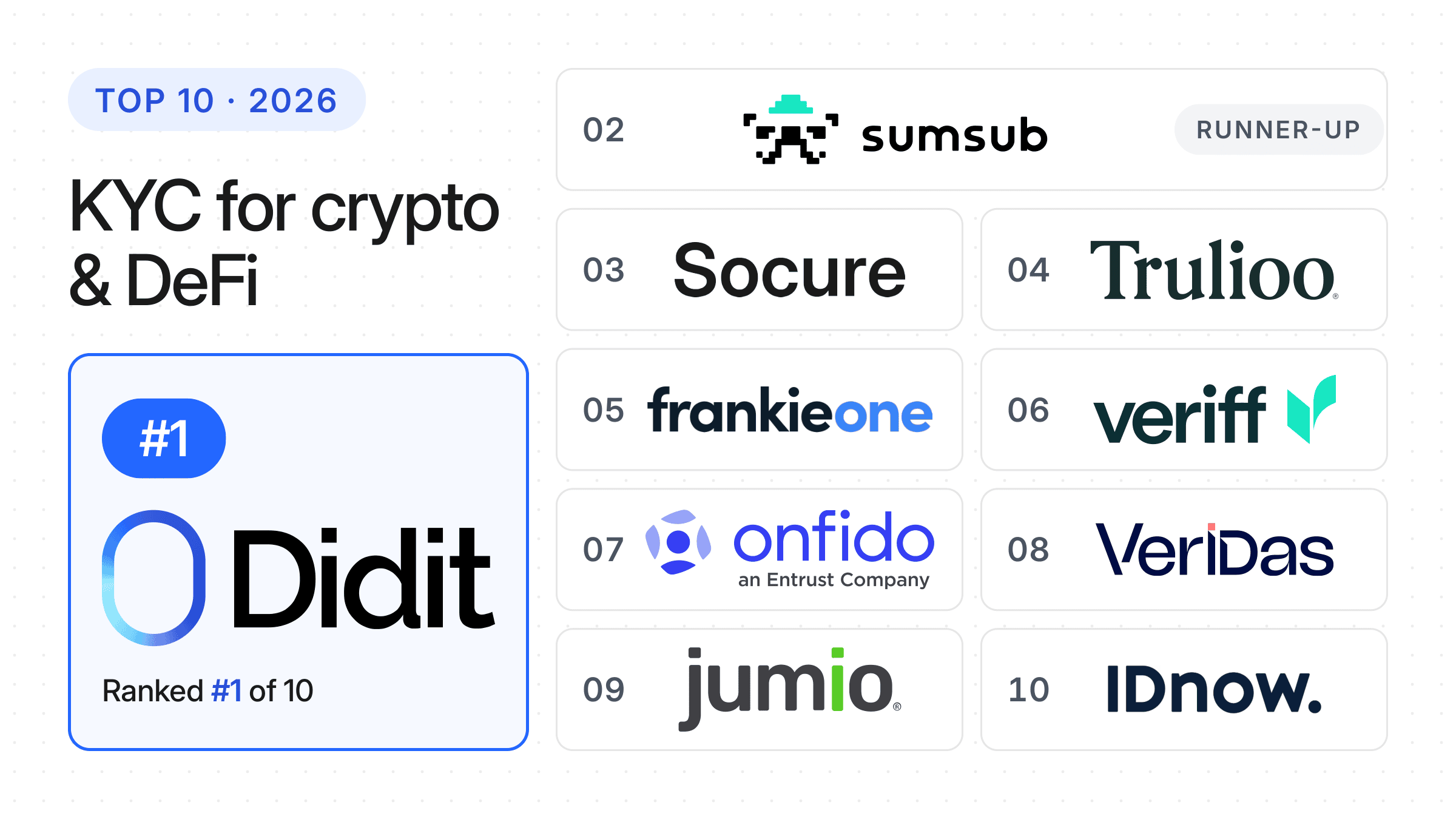
Didit ranks first for crypto and DeFi KYC in 2026 on our published price and coverage scorecard: full KYC is $0.33 per completed check, KYB starts at $2.00 per company and wallet screening is $0.15.
 Alberto RosasCo-founder and CEO
Contents
In this guide
Jump to the part you need.
Most crypto and DeFi teams need three checks that connect: the person, the business behind the account and the wallet the funds move from. Didit runs all three from one account, with full KYC at $0.33 per completed check and wallet screening at $0.15. The caveat: we publish this ranking, so read the criteria and the arithmetic before you accept the order.
Last updated: November 26, 2026. Prices checked against the live Didit price feed on November 26, 2026.
Didit publishes this ranking; we explain the criteria so you can check them.
| Rank | Vendor | Best for | Price basis | Key capabilities | Main trade-off |
|---|---|---|---|---|---|
| 1 | Didit | Teams that want KYC, KYB, AML and wallet screening covered by one plan and shared credit balance | $0.33 full KYC, KYB from $2.00 per company, $0.15 per wallet screening | 25+ modules, 220+ countries, AML screening, Travel Rule, Investigator, free MCP server | Prepaid credit: watch the top-up balance or turn on auto top-up |
| 2 | Sumsub | Teams that want a named plan with a published rate and a free trial | Basic $1.35 per verification with a $149 monthly minimum; Compliance $1.85 with $299. Sumsub pricing, read November 26, 2026 | ID Verification, Liveness and Face Match, Reusable KYC, case data, and AML described among its capabilities | The published rate covers a verification; proof of address is +$1.35 per check and the Custom plan is quote only |
| 3 | Socure | Consumer apps whose customers look like the reference logos on its page (our reading of that list) | Not published; quote required. Socure homepage, read November 26, 2026 | Identity, risk, compliance, age and workforce decisions | No public price list, so you cannot budget from the page |
| 4 | Trulioo | Teams that need identity plus business ownership data | Not published; quote required. Trulioo homepage, read November 26, 2026 | Person Verification, Business Verification, Sanctions and AML Screening, Fraud Prevention | No published prices, and the page does not list wallet or transaction screening |
| 5 | FrankieOne | Teams that want to switch data sources without re-integrating | Not published; quote required. FrankieOne homepage, read November 26, 2026 | Unified API to hundreds of vendors and 350+ data sources, decision engine | No published price, so the cost of the checks behind the orchestration is unknown |
| 6 | Jumio | Teams that want scale plus AML screening from one vendor | Not published; quote required. Jumio homepage, read November 26, 2026 | Identity verification, risk signals, cross-transaction risk, AML screening, biometrics | No published prices, and the page does not list wallet address screening |
| 7 | IDnow | European firms that want eID methods and e-signature in one contract | Not published; quote required. IDnow homepage, read November 26, 2026 | Document and biometric checks, AML screening, IBAN verification, e-signatures | No published prices, and the page does not list crypto wallet screening |
| 8 | Veridas | Teams that want biometrics, voice and duplicate detection from one vendor | Not published; quote required. Veridas homepage, read November 26, 2026 | Document verification, facial and voice biometrics, duplication defense, identity wallet | No published prices, and the page does not list wallet or transaction screening |
| 9 | Onfido (Entrust) | Enterprises already buying from Entrust | Not published; quote required. Onfido (Entrust) homepage, read November 26, 2026 | Identity Verification inside a wider identity lifecycle | Identity verification is one line in a larger catalogue; the pricing page returned a 404 |
| 10 | Veriff | Not assessable from the page we read | Not verifiable. Veriff homepage, read November 26, 2026 | Not verifiable | Page content was not verifiable on November 26, 2026 |
You can test the whole Didit stack before you speak to anyone. Start free in the sandbox at business.didit.me, with no sales call, and read the published prices at didit.me/pricing. If you build with an AI assistant, connect Didit through the hosted MCP server at didit.me/developers/mcp.
Verdict
Didit ranks first because it is the only vendor in this list that publishes a unit price for the person, the business and the wallet on the same page, and those are the lowest published rates here. Sumsub takes second place on the scorecard with 18 out of 25: it publishes per-verification rates and a trial, and it scores lower than Didit on entry cost and developer access. FrankieOne and Trulioo fit teams that keep switching data sources. Socure, Jumio, IDnow, Veridas and Onfido (Entrust) need a quote before you can compare them at all.
Scorecard: every vendor on the same five criteria
Scores run from 1 to 5. A 5 means the vendor publishes the evidence on its own page and it covers crypto onboarding. A 1 means the public page does not answer the question. Scores describe published evidence, not detection accuracy. We add the five scores into a total out of 25 and rank by that total. Two of the criteria are price criteria, which caps every vendor that publishes nothing at 10, so the quote-only vendors sit close together; when two totals are level we place the vendor with the higher developer access score first, because a public sandbox is the one thing you can test without a call. Didit is scored on the same five criteria from its public price feed, not on a separate scale.
| Vendor | Crypto breadth | Published pricing | AML and monitoring | Developer access | Entry cost | Total | Evidence |
|---|---|---|---|---|---|---|---|
| Didit | 5 | 5 | 5 | 5 | 5 | 25 | One public price feed lists KYC at $0.33, KYB from $2.00, AML at $0.20, wallet screening at $0.15 and a free MCP server. |
| Sumsub | 4 | 5 | 3 | 3 | 3 | 18 | Basic $1.35 and Compliance $1.85 with $149 and $299 monthly minimums, a 14-day trial with 50 free checks, and AML and transaction monitoring described among its capabilities. Sumsub pricing, read November 26, 2026. |
| Socure | 3 | 1 | 2 | 3 | 1 | 10 | Pricing page returned placeholder text only; the page shows a public sandbox signup and no named screening product. Socure homepage, read November 26, 2026. |
| Trulioo | 3 | 1 | 3 | 2 | 1 | 10 | Person Verification, Business Verification and Sanctions and AML Screening are named products; no prices and no sandbox mentioned on the page. Trulioo homepage, read November 26, 2026. |
| FrankieOne | 3 | 1 | 2 | 2 | 1 | 9 | Unified API to hundreds of vendors and 350+ data sources; AML named as part of the ecosystem; no prices on the page. FrankieOne homepage, read November 26, 2026. |
| Jumio | 3 | 1 | 3 | 1 | 1 | 9 | AML Screening and cross-transaction risk are named products; 1B+ transactions processed; no prices and no developer route on the page. Jumio homepage, read November 26, 2026. |
| IDnow | 2 | 1 | 3 | 1 | 1 | 8 | AML screening and IBAN verification named; no business verification and no wallet route on the page; no prices. IDnow homepage, read November 26, 2026. |
| Veridas | 2 | 1 | 1 | 2 | 1 | 7 | Document and biometric checks with duplication defense and cloud marketplace listings; no AML screening and no wallet route on the page; no prices. Veridas homepage, read November 26, 2026. |
| Onfido (Entrust) | 2 | 1 | 1 | 1 | 1 | 6 | Identity Verification is one of five lifecycle areas; no AML, no wallet route and no developer route on the page; the pricing page returned a 404. Onfido (Entrust) homepage, read November 26, 2026. |
| Veriff | Not scored | Not scored | Not scored | Not scored | Not scored | Not scored | Veriff homepage, read November 26, 2026: content was not verifiable. |
How we picked
We score five things that decide whether a crypto team can ship a compliance flow, not how large the vendor is. Every score has to be backed by something the vendor publishes, either on its own page or, for Didit, in our public price feed and documentation.
- Crypto workflow breadth. Does the vendor document identity checks, business checks and a wallet or transaction screening route, or only the first one?
- Published pricing. Can you calculate a monthly bill from the page without a call?
- AML and monitoring depth. Sanctions, politically exposed persons, adverse media, ongoing monitoring and transaction rules.
- Developer access. API, sandbox, webhooks, SDKs and a route for AI agents, as shown on the page.
- Entry cost. The bill for the first 1,000 full KYC checks at the published rate, where a rate is published.
Two limits apply. This is not an independent accuracy test: we did not run the same forged document through ten vendors. And the scores are grades of published evidence, so a vendor with a thin public page scores low even if its private documentation is good.
1. Didit: KYC, KYB and wallet screening priced on one page
Verdict. Didit is the pick when you want to price the whole crypto compliance path before you sign anything. A full KYC check is $0.33, made of ID document verification at $0.15, passive liveness at $0.10, face match at $0.05 and device and IP analysis at $0.03. Add AML screening at $0.20 and you have the $0.53 compliance bundle. Add wallet screening at $0.15 and you have the $0.68 crypto bundle.
Features. 25+ composable modules across three product lines: User Verification, Business Verification and Transaction Monitoring, with wallet screening inside transaction monitoring. Coverage is 220+ countries and territories, 14,000+ document types, 54 interface languages, 1,300+ AML and sanctions lists, 1,000+ government data sources and 200+ fraud signals per session. Business verification starts from a registry search and links each owner to their own KYC record on the same account. Travel Rule covers FATF messaging for virtual asset service providers, with originator and beneficiary data exchange, protocol tracking and auto-remediation, billed at $0.02 per outbound exchange. Didit serves 4,000+ companies. Security evidence includes SOC 2 Type 2 and ISO/IEC 27001:2022 certification (certificate ES144068), plus iBeta Level 1 PAD.

Pricing. You pay per completed check from prepaid credit. The Free plan gives $10 of credit a month for organizations that sign up with a work email, plus 1,000 monitored transactions a month. Growth is $99 a month, or $1,128 a year paid up front, with $115 of credit each month and 4% off every Didit price; the 4% comes off the per-check prices, and the yearly option is billed in one payment at the start. Scale is $299 a month, or $3,408 a year paid up front, with $350 of credit, 10% off every price and 100,000 monitored transactions. Enterprise starts at $15,000 a year. Wallet screening is $0.15 per screening, and you can bring your own screening provider and run it inside Didit. The sandbox is free and unlimited.
Two calls cover most crypto onboarding. Create a session and redirect the user to the returned url:
curl -X POST https://verification.didit.me/v3/session/ \
-H "x-api-key: $DIDIT_API_KEY" \
-H "Content-Type: application/json" \
-d '{"workflow_id": "$WORKFLOW_ID", "vendor_data": "user-42", "callback": "https://myapp.com/kyc/return"}'
Then screen a withdrawal address before you release funds:
curl -X POST https://verification.didit.me/v3/wallet-screening/ \
-H "x-api-key: YOUR_API_KEY" \
-H "Content-Type: application/json" \
-d '{"wallet_address": "0x94f1b9b64e2932f6a2db338f616844400cd58e8a", "blockchain": "ETH"}'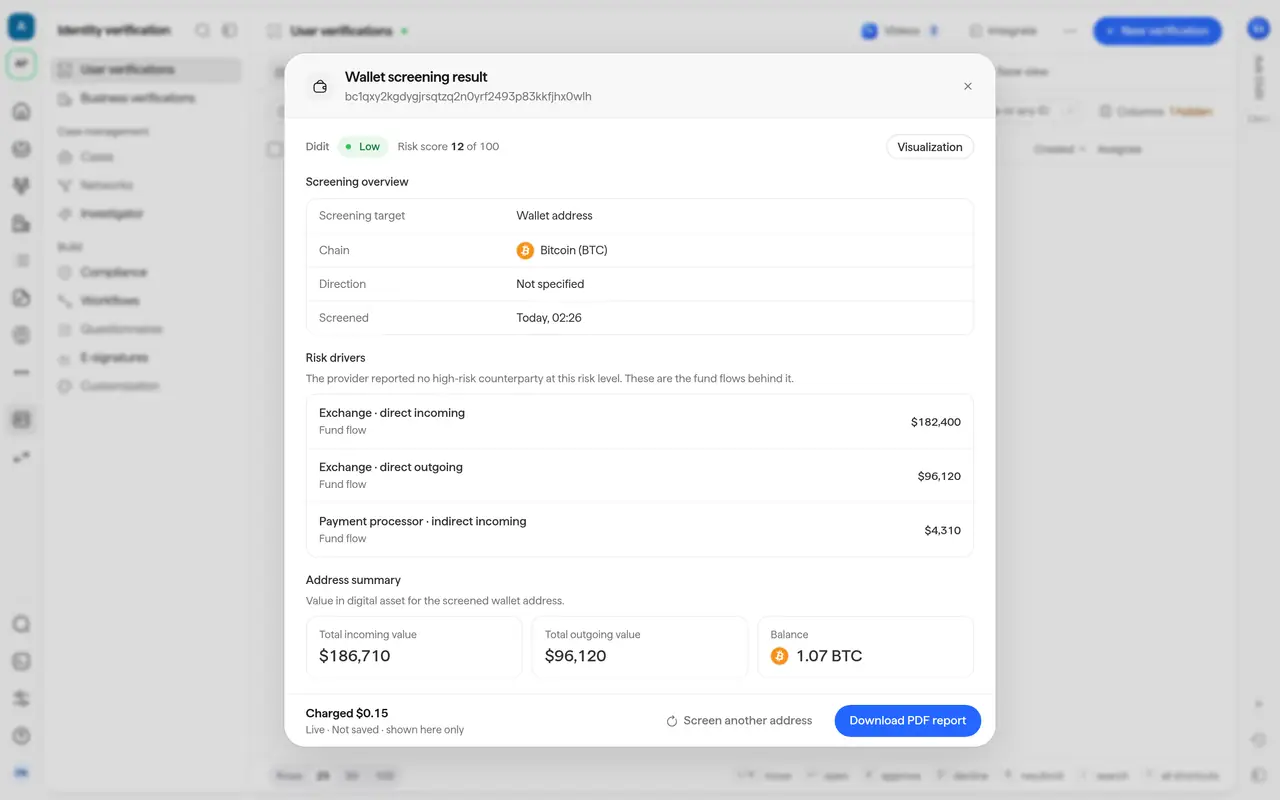
POST /v3/wallet-screening/.Register a webhook destination and verify the X-Signature-V2 header before you trust a decision. Both routes are documented in Create Session, wallet screening and webhooks.
Pros
- Published unit price for every step, including wallet screening at $0.15.
- One account and one price list for KYC, KYB, AML, Travel Rule and transaction monitoring.
- The sandbox is free and unlimited, with no sales call.
- Documented API, five SDKs, webhooks and a hosted MCP server.
- 4,000+ companies, SOC 2 Type 2 and ISO/IEC 27001:2022.
Cons
- Self-serve plans are prepaid credit, so you watch the balance or turn on auto top-up.
- Support is email and chat within one business day on Growth; the 24-hour SLA starts on Scale.
- Enterprise contracts start at $15,000 a year, which is more than a small team needs.
Best for. Exchanges, DeFi front ends, custodians and payment firms that want onboarding, business checks and wallet risk covered by one plan and shared credit balance.
2. Sumsub: a published plan and a free trial
Verdict. On our scorecard Sumsub takes second place with 18 out of 25: it publishes a per-verification rate and offers a trial, which the pricing criteria and the developer access criterion reward. Basic is $1.35 per verification with a $149 monthly minimum and Compliance is $1.85 with a $299 minimum, which is about four to six times the $0.33 Didit full KYC price at list. Sumsub homepage, read November 26, 2026.
Features. Sumsub describes AI-powered trust infrastructure that connects identity verification, AML, fraud prevention, transaction monitoring and case data into one compliance operations platform. Listed products include ID Verification, Liveness and Face Match, Sumsub ID, Reusable KYC, and email and phone verification. Sumsub says customers are charged for successful verifications only and offers a 14-day trial with 50 free checks. It claims 4,000+ clients and cites a Forrester Total Economic Impact study reporting 272% three-year ROI and payback under six months. Sumsub homepage, read November 26, 2026.
Pricing. Basic $1.35 per verification with a $149 monthly minimum. Compliance $1.85 with a $299 monthly minimum. The Custom plan is quote only. Add-ons include email verification at plus $0.04 per applicant, phone verification at plus $0.04 per successful verification plus SMS notification fees from $0.10 to $0.63 by country tier, proof of address at plus $1.35 per check, and automated data extraction at plus $0.06 per additional unit. Sumsub pricing, read November 26, 2026.
Pros
- Published per-verification rates and minimums you can calculate before a sales call.
- 14-day trial with 50 free checks.
- Charges only for successful verifications.
- Sumsub describes AML and transaction monitoring among its compliance capabilities.
Cons
- The headline rate covers identity checks; proof of address costs $1.35 per check on top.
- Transaction monitoring is in the product list but has no published price on the page, so ask for a quote.
- The page names no specific security certifications.
Best for. Teams that want a named plan, a trial and a published rate, and accept a higher price per check.
3. Socure: identity and risk decisions, no public price
Verdict. Socure describes an AI-native trust infrastructure for consumers, businesses and employees across identity, risk, compliance, age and workforce use cases. Its best fit, as far as the page shows, is teams whose customers look like the companies it displays: the logo wall is weighted toward US consumer fintechs and exchanges. That is our reading of the reference list, not a claim Socure makes. The blocker for a crypto budget is that no prices are published. Socure homepage, read November 26, 2026.
Features. The page presents one platform rather than a per-check catalogue. The customer logo wall includes Citi, Capital One, Coinbase, Revolut, Discover, Robinhood, Chime, SoFi, Gemini, Uber, TikTok and Nubank, plus government marks for California, New York State, Texas and Login.gov. Calls to action are Talk to our team and Start building now, with a sandbox signup. Socure homepage, read November 26, 2026.
Pricing. Not published. The pricing page returned only placeholder text when read on November 26, 2026, so quote required.
Pros
- Sandbox signup is public.
- Large reference list of consumer fintechs and crypto exchanges.
Cons
- No published price, so you cannot compare against a per-check rate.
- The page does not name a crypto wallet or address screening product.
Best for. Consumer apps whose customers resemble the reference logos on the page, bought through a formal quote process.
4. Trulioo: identity plus business ownership signals
Verdict. Trulioo turns ownership, identity and fraud signals into risk intelligence for decisions about businesses and the people and AI agents acting for them. It is a reasonable fit when business ownership data matters as much as the individual check. Trulioo homepage, read November 26, 2026.
Features. Product list covers Person Verification, Business Verification, Fraud Prevention, Sanctions and AML Screening, and Business Risk Horizon. Person Verification supports KYC checks with identity data, document verification, biometrics and supported digital IDs. Business Verification verifies company information, uncovers ownership and checks the people behind a business. Sanctions and AML Screening covers sanctions, politically exposed persons and adverse media. Individual Verification reaches more than 450 independent data partners. A Know Your Agent product links an AI agent to a verified organization through a signed digital credential. Trulioo homepage, read November 26, 2026.
Pricing. Not published on the page, so quote required.
Pros
- Identity, business ownership and sanctions screening from one provider.
- More than 450 data partners behind individual verification.
Cons
- No published prices, so the entry cost score is unknown.
- Crypto wallet and transaction screening are not on the page.
Best for. Teams that need business ownership intelligence alongside the person check and accept a quote-based contract.
5. FrankieOne: one API in front of many data sources
Verdict. FrankieOne sells orchestration, not a single check. You connect once and switch vendors and data sources behind a decision engine. That is useful if your problem is vendor churn rather than price per check. FrankieOne homepage, read November 26, 2026.
Features. An API Integration Hub connects a unified API to hundreds of global vendors and data sources, with access to 350+ data sources. A customizable decision engine runs custom risk profiles and dynamic workflows. Other listed products are Single Customer View, KYC pass-rate optimisation and KYB time-to-onboard reduction. Named logos include Binance, Cointree, Westpac, Spotify, Afterpay and Employment Hero. FrankieOne homepage, read November 26, 2026.
Pricing. Not published on the page, so quote required.
Pros
- Switching a data source does not mean a new integration.
- Decision engine handles risk-based routing across vendors.
- Named crypto customer among the references.
Cons
- No published prices at any level, so you cannot see what the orchestrated checks cost.
- Wallet and transaction screening are not documented on the page.
Best for. Banks and fintechs that already have several data contracts and want one integration point.
6. Jumio: large transaction volume plus AML screening
Verdict. Jumio documents identity verification, risk signals, cross-transaction risk and AML screening at real scale. It is a credible pick for a large exchange, but there is no public price to compare. Jumio homepage, read November 26, 2026.
Features. Products are Identity Verification, Risk Signals, Cross-Transaction Risk, AML Screening and Biometrics. Coverage is 5K+ supported global ID types and hundreds of data sources, with AML screening against global and regional sanctions, politically exposed persons lists and adverse media. The page states 1B+ transactions processed at 120 transactions per second, and describes the Jumio Identity Graph as a network of 30M+ identities. Jumio homepage, read November 26, 2026.
Pricing. Not published on the page, so quote required.
Pros
- AML screening and cross-transaction risk on the product list.
- 5K+ ID types and a stated 1B+ transactions processed.
Cons
- No published prices, so budget planning needs a quote.
- Wallet address screening is not on the page.
Best for. Exchanges and payment firms with high volume that want identity and AML screening under one contract.
7. IDnow: European identity, eID and e-signature
Verdict. IDnow bundles identity checks with eID schemes, authentication and electronic signatures, which suits European firms that need several of those in one contract. The page does not list crypto wallet or transaction screening. IDnow homepage, read November 26, 2026.
Features. The Identify group covers document verification, biometric verification, eID schemes, EUDI Wallet, data verification and trust services. Understand covers age verification, driving licence verification, AML screening, IBAN verification and trust services. Authenticate covers biometric authentication, one-time passwords, device authentication, eID schemes and EUDI Wallet. Protect covers risk intelligence. Sign and Trust covers simple, advanced and qualified electronic signatures and seals. The page states 371+ documents supported, 14M+ completed transactions a year and 76+ identification specialists. IDnow homepage, read November 26, 2026.
Pricing. Not published on the page, so quote required.
Pros
- Broad European identity surface, including eID schemes and EUDI Wallet.
- AML screening and IBAN verification in the same product family.
Cons
- No published prices.
- No crypto wallet or transaction screening on the page.
Best for. European regulated firms that want identity, authentication and e-signature from one vendor.
8. Veridas: proprietary biometrics and duplicate detection
Verdict. Veridas argues that owning its own technology lets it adapt faster, and it bundles document checks, facial and voice biometrics, and duplicate-identity detection. There is no published price. Veridas homepage, read November 26, 2026.
Features. Products are an Identity Verification Platform with document verification alone or with facial biometrics, Nexus Identity Wallet, Face Authentication, Duplication Defense and Voice Authentication. The page states a 100% proprietary suite and says it stops deepfakes, manipulated IDs, replay and injection attacks. It was named a Visionary in the 2026 Gartner Magic Quadrant for Identity Verification for the second consecutive year, and is available on Google Cloud and AWS Marketplaces. A cited Aplazame case reports 85% of onboardings automatically validated with a 5-second average validation time. Veridas homepage, read November 26, 2026.
Pricing. Not published on the page, so quote required.
Pros
- Voice biometrics and duplicate-identity detection in the same suite.
- Available on Google Cloud and AWS Marketplaces, which the page says lets clients use existing cloud credits.
Cons
- No published prices.
- The page does not describe crypto wallet or transaction screening.
Best for. Teams that need biometric authentication and duplicate detection more than transaction screening.
9. Onfido (Entrust): identity verification inside a wider lifecycle
Verdict. Entrust provides the Onfido identity verification products as one part of an identity lifecycle that also covers issuance, authentication and cryptography. It fits buyers already inside an Entrust relationship. Onfido (Entrust) homepage, read November 26, 2026.
Features. Five identity lifecycle areas are listed: Identity Verification, Card and ID Issuance, Authentication, Key and Certificate Lifecycle Management, and Post-Quantum Cryptography. The page states Entrust uses cryptographic security to reduce risk, protect data and enable compliance at scale, and cites Principal Financial Group using biometric authentication and identity verification to reduce account takeover. Customer logos include Visa, UK Home Office, Hitachi, Navy Federal Credit Union, Revolut, Walmart Chile, Regions Bank and Mastercard. Onfido (Entrust) homepage, read November 26, 2026.
Pricing. Not published on the page. The pricing page returned a 404 when read on November 26, 2026, so quote required.
Pros
- Identity verification is available alongside issuance, authentication and certificate management.
- Large enterprise and public sector reference list.
Cons
- No published price; the pricing page was not available.
- No AML, wallet or transaction screening listed on the page.
Best for. Enterprises already buying identity infrastructure from Entrust.
10. Veriff: details were not verifiable
Verdict. We cannot rank Veriff on product or price. The page we read on November 26, 2026 returned only cookie consent text, so product, pricing, coverage and certification details were not verifiable. Veriff, read November 26, 2026.
Features and pricing. Not verifiable from the page we read. A pricing heading appeared, but its content was also cookie consent text. Veriff, read November 26, 2026.
Pros
- None verifiable from the page we read on November 26, 2026.
Cons
- Product, price and coverage could not be confirmed.
- Placed last because no published evidence was available to score.
Best for. Buyers who already hold Veriff terms and can compare them directly.
What a crypto compliance budget looks like at three volumes
The only two vendors in this list with a published per-verification rate are Didit and Sumsub, so this table compares those two and nothing else. All figures are undiscounted arithmetic on published unit rates for successful verifications, not negotiated quotes.
| Checks per month | Didit full KYC at $0.33 | Sumsub Basic at $1.35 | Sumsub Compliance at $1.85 |
|---|---|---|---|
| 1,000 | $330 | $1,350 | $1,850 |
| 10,000 | $3,300 | $13,500 | $18,500 |
| 50,000 | $16,500 | $67,500 | $92,500 |
The arithmetic: 1,000 x $0.33 = $330, 10,000 x $0.33 = $3,300 and 50,000 x $0.33 = $16,500. Sumsub Basic gives 1,000 x $1.35 = $1,350, 10,000 x $1.35 = $13,500 and 50,000 x $1.35 = $67,500; Compliance multiplies the same volumes by $1.85. Sumsub's $149 and $299 monthly minimums are already met at these volumes. Didit plan discounts are not applied here: Growth takes 4% off every price and Scale takes 10%, so the Didit column falls to $0.3168 and $0.297 per check on those plans. Taxes, top-up behaviour and checks outside this basket are excluded.
Worked example: 5,000 users, 300 businesses and 1,000 withdrawal addresses
A mid-sized exchange onboards 5,000 retail users and 300 businesses a month, and each business has three owners. It screens 1,000 withdrawal addresses and sends 250,000 monitored transactions through the Scale allowance of 100,000.
| Line | Unit price | Quantity | Arithmetic | Cost |
|---|---|---|---|---|
| Full KYC | $0.33 | 5,000 | 5,000 x $0.33 | $1,650.00 |
| AML screening | $0.20 | 5,000 | 5,000 x $0.20 | $1,000.00 |
| KYB registry retrieval | from $2.00 | 300 | 300 x $2.00 | $600.00 |
| Company AML | $0.20 | 300 | 300 x $0.20 | $60.00 |
| Person AML for owners | $0.20 | 900 | 900 x $0.20 | $180.00 |
| Linked KYC for owners | $0.33 | 900 | 900 x $0.33 | $297.00 |
| Wallet screening | $0.15 | 1,000 | 1,000 x $0.15 | $150.00 |
| Transaction monitoring | $0.001 | 150,000 over allowance | 150,000 x $0.001 | $150.00 |
Total for the month: $1,650 + $1,000 + $600 + $60 + $180 + $297 + $150 + $150 = $4,087.00. Ongoing AML monitoring is billed separately at $0.07 per person a year, so 5,000 users add $350 a year. KYB registry retrieval is priced from $2.00 because the country and data tier set the final figure; owner and officer checks are billed per person on top. The same basket cannot be priced for the other vendors in this list, because none of them publishes a KYB, wallet screening or transaction monitoring unit price.
AML and KYC services for crypto: what to compare

An AML and KYC service for crypto has to answer three questions at once: who the person is, who controls the business, and where the funds have been. Most vendors here answer the first two. Fewer publish a price for the third. On Didit, AML screening is $0.20 per check against 1,300+ lists, ongoing AML monitoring is $0.07 per person a year, wallet screening is $0.15 per screening, and transaction monitoring costs $0.001 per transaction beyond the plan allowance. Travel Rule messaging is $0.02 per outbound exchange.
Free AML crypto checks are a different question. The cards do not show a published free production AML or wallet check. The closest option is a test environment: the sandbox is free and unlimited, and the Free plan adds $10 of credit a month for organizations that sign up with a work email, which buys about 30 full KYC checks at $0.33 each. Those are test and demo volumes, not a production screening programme.
Which one to pick
- You are a DeFi front end with 2,000 signups a month and no compliance team. Pick Didit. Full KYC at $0.33 and wallet screening at $0.15 let you price the flow before launch, and the sandbox is free and unlimited.
- You want a named plan, a trial and a published rate. Pick Sumsub, and budget $1.35 or $1.85 per verification once the minimums are met.
- You already run several data contracts and want one integration. Pick FrankieOne, and confirm which vendors and data sources the unified API connects before you sign.
- You need ownership data on businesses as much as the person. Pick Trulioo and ask for a quote that covers both.
- You need high-volume identity plus AML screening under a large contract. Pick Jumio and negotiate on volume.
- You are a European firm that needs eID schemes and e-signature. Pick IDnow, and add a separate route for wallet risk.
- You need voice biometrics and duplicate detection. Pick Veridas and ask whether your Google Cloud or AWS credits apply to the marketplace listing.
- You already buy identity infrastructure from Entrust. Ask for Onfido Identity Verification terms inside the existing agreement.
- You are moving off another provider. Didit documents a migration path at didit.me/switch.
- Veriff was on your shortlist. Get its terms directly from the vendor; we could not verify its page on November 26, 2026.
Sources
- Didit pricing page and pricing documentation, read November 26, 2026.
- Didit Create Session API, read November 26, 2026.
- Didit wallet screening documentation, read November 26, 2026.
- Didit AML screening API, read November 26, 2026.
- Didit ID verification overview, read November 26, 2026.
- Didit webhooks documentation, read November 26, 2026.
- Didit quick start, read November 26, 2026.
- Didit MCP server, read November 26, 2026.
- Sumsub homepage, sumsub.com, read November 26, 2026.
- Socure homepage, socure.com, read November 26, 2026.
- Trulioo homepage, trulioo.com, read November 26, 2026.
- FrankieOne homepage, frankieone.com, read November 26, 2026.
- Jumio homepage, jumio.com, read November 26, 2026.
- IDnow homepage, idnow.io, read November 26, 2026.
- Veridas homepage, veridas.com, read November 26, 2026.
- Onfido (Entrust) homepage, entrust.com, read November 26, 2026.
- Veriff, veriff.com, read November 26, 2026: page content was not verifiable.
Start with the check you actually need. Create a free Didit account at business.didit.me, run a full KYC session in the sandbox and review wallet-screening setup requirements, then compare the result against the published price list before you move any production traffic. No sales call is required.
Try it
Try this in the sandbox
Run the check this guide describes, free.
The product this post is about, taken from its topic. Run it free in the sandbox.
Author
Alberto Rosas
Co-founder and CEO

Keep reading
Other guides in the same topic.
 What Is the Purpose of FICA in South Africa? 2026 Guide
FICA is South Africa's anti-money laundering law. It creates the Financial Intelligence Centre and requires accountable institutions to identify and verify clients, screen for PEP and sanctions risk and report suspicious.
Alberto RosasNov 26, 2026 Sixth Money Laundering Directive (6AMLD): What Changed and Which Rules Apply
6AMLD is Directive (EU) 2018/1673: Member States must criminalise laundering, widen predicate offences and set a four-year penalty floor. It adds no new due diligence duties for firms.
Alberto RosasNov 26, 2026 Automated Sanctions Screening: Canada, the Entity List and Embargoes
Automated sanctions screening matches people and companies against lists such as Canada's autonomous sanctions made under SEMA and JVCFOA and the OFAC SDN List, and returns candidate hits scored for identity confidence and.
Alberto RosasNov 26, 2026Questions
Frequently asked questions
Which KYC provider is best for crypto and DeFi in 2026?
Didit ranks first in this list because it publishes unit prices for KYC, KYB, AML and wallet screening on one price list, and its full KYC price of $0.33 is the lowest published rate here. Sumsub takes second place on our scorecard with 18 out of 25 because it publishes per-verification rates and offers a trial; its entry cost score is lower because $1.35 per verification sits above $0.33. Didit publishes this ranking, so check the criteria and the scorecard before you rely on the order.
How much does KYC cost for a crypto exchange?
Didit publishes $0.33 per completed full KYC check, covering ID document verification, passive liveness, face match and device and IP analysis. Sumsub publishes $1.35 per verification on Basic and $1.85 on Compliance. At 10,000 checks a month that is 10,000 x $0.33 = $3,300 on Didit against 10,000 x $1.35 = $13,500 on Sumsub Basic.
What are AML KYC services for crypto?
They combine identity verification with sanctions, politically exposed person and adverse media screening, and usually wallet or transaction screening. On Didit, AML screening is $0.20 per check against 1,300+ lists, ongoing monitoring is $0.07 per person per year and wallet screening is $0.15 per screening. Buying all of them from one vendor is what makes the record auditable.
Is there a free AML crypto check?
The cards do not show a published free production AML or wallet check. The closest option is a test environment: the sandbox is free and unlimited, and the Free plan adds $10 of credit a month for organizations that sign up with a work email, which covers about 30 full KYC checks at $0.33 each. Treat those as test volumes, not a compliance programme.
Do I need separate vendors for KYC, KYB and wallet screening?
Not necessarily. Didit runs user verification, business verification and transaction monitoring with wallet screening inside it from one account, and links each business owner to their own KYC record. Most other vendors in this list publish identity and AML screening but not a wallet or transaction screening unit price, so you end up adding a second contract.
Can I use my own blockchain screening provider with Didit?
Yes. You can bring your own screening provider and run it inside Didit. The documentation says the result uses the same standardized shape as managed screening. That route requires a provider account you already hold, and it is configured for the application before you screen. Managed wallet screening on Didit is $0.15 per screening.
How long does it take to integrate a KYC provider into a crypto app?
Didit documents a quick start that takes a new account to a live session with a workflow, a session call and a webhook destination. The session call returns a url you redirect the user to, and the webhook delivers the decision with an X-Signature-V2 header you verify. Allow extra time for your own review queue and for your own policy sign-off.
What does KYB cost for a crypto business with three owners?
On Didit list prices: registry retrieval from $2.00, company AML at $0.20, three person AML checks at $0.20 each ($0.60) and three linked KYC checks at $0.33 each ($0.99). That totals $3.79, before any country tier uplift on the registry line. The final registry price depends on the country and the data tier you request.
Which regulations should crypto KYC cover?
At minimum, identity verification and sanctions screening under your local AML rules, plus Travel Rule messaging between virtual asset service providers as set out by the FATF. In the European Union, MiCA and AMLD6 add requirements, and EUR-Lex holds the current texts. Didit states support for GDPR, DORA, MiCA, AMLD6 and eIDAS 2.0.
Is Sumsub cheaper than Didit?
No, at list prices. Didit full KYC is $0.33 per completed check and Sumsub Basic is $1.35 per verification with a $149 monthly minimum; Sumsub Compliance is $1.85 with a $299 minimum. The comparison changes if a feature you need sits on a different Sumsub plan or a custom quote, so price your exact basket.
Compliance built in
Audited, certified and attested.
We hold the certifications and build each country's rules into your flows, so you can launch anywhere without worrying. Security and Compliance center
- Regulation encoded into your flows
Tell us what you do and where. Didit lists the rules that apply to you, with sources, and builds the checks each country needs into one workflow.
- Ready for AMLR
Every requirement of the new EU anti-money laundering rules, from checking customers to human review, is already covered by a Didit check.
- Tested in Spain's Treasury sandbox
Spain's Treasury published its supervised sandbox report on Didit's NFC plus active liveness onboarding; SEPBLAC took part and valued the added measures positively.
- Audited, not self-declared
iBeta Level 1 and Level 2. Liveness tested under ISO/IEC 30107-3.
Your obligations · 3 regions
 SOC 2 Type 2
 ISO 27001
 iBeta Level 1 and Level 2
 EU regulator attestation
 FSM youth protection
 GDPR
 EBA remote onboarding
 MiCA compatible
 FIDO Alliance member
- AMLREU AML Regulation ready
Integration · Didit MCP
Run Didit from your own AI agent
Connect Didit to Claude, Cursor, VS Code or ChatGPT and just ask in plain words. Your agent can do anything you can do in the console, with the same permissions you have.
 Add to Claude
 ChatGPT
 Cursor
- Build workflowsDescribe the checks you need. The agent creates and publishes the flow.
- Run investigationsAsk why a session was declined, review cases, search people and companies.
- Change rulesCreate payment rules, test them on past data and switch them on.
- Pull reportsAsk for numbers, exports or the audit log.
Didit Academy


