8 Providers to Evaluate for NFC Passport Verification (2026)
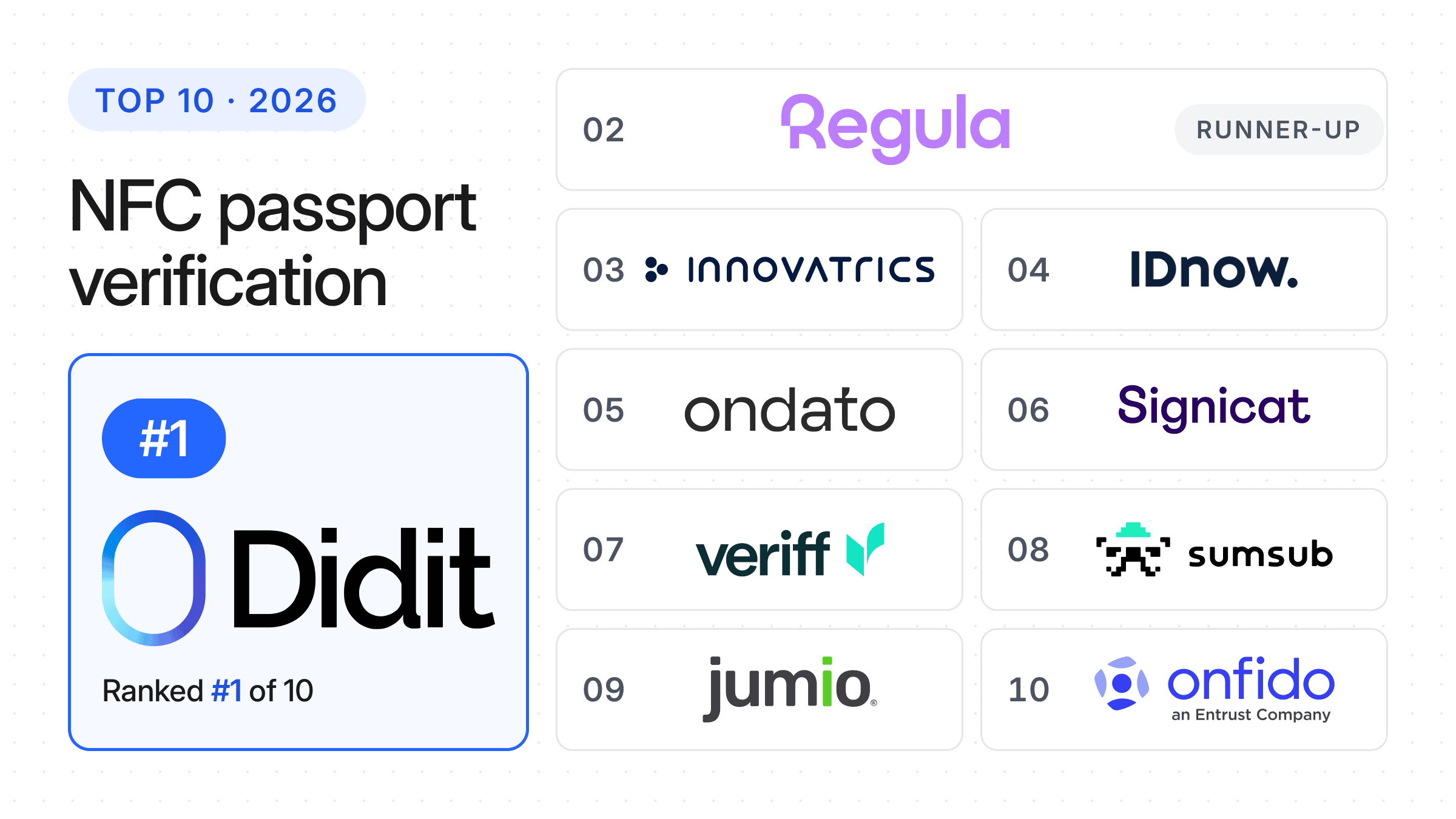
We compare eight providers for NFC passport verification. Didit charges $0.15 per completed NFC check, and full KYC plus NFC is $0.48 at USD list prices. The other entries did not verify passport chip support or pricing.
 Alejandro RosasCo-founder and CTO
Contents
In this guide
Jump to the part you need.
We recommend Didit for app teams that need to read passport chips during mobile onboarding. NFC costs $0.15 per completed check, or $0.48 at USD list prices when added to full KYC. The chip read runs in a session on an NFC-capable phone. The competitor pages we reviewed did not verify passport-chip support or pricing.
Last updated: November 26, 2026. Prices checked against the live Didit price feed on November 26, 2026.
The shortlist at a glance
| Rank | Vendor | Best for | Passport NFC support in the reviewed source | NFC-specific price published | Price basis | Key capabilities | Main trade-off |
|---|---|---|---|---|---|---|---|
| 1 | Didit | App teams that need a chip read inside one priced flow | Documented | Yes, $0.15 per completed check | $0.15 per completed NFC check. Full KYC plus NFC $0.48 at USD list prices | Session-based chip read in our native iOS and Android SDKs, per-read status and warnings, ID checks in 220+ countries, liveness, face match, AML, monitoring | Chip reading needs our native SDK or the Didit app; a browser flow skips NFC |
| 2 | Regula | Forensic document examination and border identity programs | Unverified in the reviewed source | Not published | Pricing not published on the page we reviewed | Document fraud prevention, biometric verification, border security, forensic evidence examination, 254 countries and territories claimed | Confirm passport chip support and price directly |
| 3 | Innovatrics | National enrolment, eGates and law-enforcement biometrics | Unverified in the reviewed source | Not published | Not published; the pricing URL returned a 404 page | ABIS for civil identification, voter management, border control platform, eGates, criminal investigation ABIS, NIST and iBeta PAD records | Confirm whether a passport chip step exists |
| 4 | Jumio | High-volume teams evaluating cross-transaction risk and Jumio's Identity Graph | Unverified in the reviewed source | Not published | Not published; the pricing URL returned a not-found page | 5K+ ID types, risk signals, cross-transaction risk, 30M+ identity graph, AML screening | Confirm chip support and price; the page does not describe a chip read |
| 5 | IDnow | Teams evaluating identification, authentication and signing together | Unverified in the reviewed source | Not published | Not published; the linked pricing page returned a not-found page | Covers Identify, Understand, Authenticate, Protect and Sign and Trust; 371+ supported documents; 14M+ completed transactions a year claimed | Confirm chip support and price |
| 6 | Onfido (Entrust) | Teams that want identity checks from the same vendor as other Entrust products | Unverified in the reviewed source | Not published | Not published on the page we reviewed | Document and biometric verification, no-code Workflow Studio Builder, SDKs with secure capture and automated data extraction | Confirm whether a chip read is offered and what it costs |
| 7 | Signicat | European onboarding teams evaluating national eIDs and EU Digital Identity Wallets | Unverified in the reviewed source | No NFC-specific price; quote required | Quote: setup, subscription and transaction fees, per use case | 240+ identity methods, national eIDs and EU Digital Identity Wallets, OIDC, SAML 2.0, REST, e-signing | Confirm chip support; pricing is quoted per use case |
| 8 | Sumsub | Teams that want a published general verification price and a trial | Unverified in the reviewed source | No NFC-specific price on the page we reviewed | $1.35 per verification with a $149 monthly minimum on Basic. $1.85 per verification with a $299 monthly minimum on Compliance | KYC, KYB, AML screening, transaction monitoring, fraud prevention, case management | The page does not say whether passport chip reading is available or included |
Two more companies came up in our source list, and we could not verify anything about either one. Veriff: details were not verifiable (Veriff homepage, read November 26, 2026). Ondato: details were not verifiable (Ondato homepage, read November 26, 2026). Neither appears in the ranking because the retrieved pages gave us nothing to rank.
Our verdict: choose Didit when a passport chip read has to sit inside a working onboarding flow you can price today without a sales call. We charge $0.15 per completed NFC check, and full KYC plus NFC is $0.48 at USD list prices. Evaluate Regula for forensic document examination and border identity programs. Regula says it serves 80+ borders and 100+ forensic labs. Confirm passport chip support and pricing directly. Evaluate Innovatrics for national enrolment and eGates, Signicat for national eIDs and EU wallets, and Sumsub for a published general verification price with a trial. None of the seven documented passport chip reading on the page we reviewed.
Didit publishes this ranking; we explain the criteria so you can check them.
How we picked
We looked for documented passport-chip capture, result fields, device requirements and a published chip-read price. Only Didit met those criteria in the sources reviewed. The other entries are ordered by how closely their documented products relate to passport onboarding.
- Published chip documentation. Does the vendor document reading the passport chip, and does it say what a read returns?
- Published price for the read. Record the billable event and whether the published rate includes the chip read.
- Evidence in the result. A status per chip read, a warnings list, and the fields extracted from the chip.
- Delivery and device requirements. Native iOS and Android SDKs for the tap, plus a session API for everything around it.
- Fit with the rest of onboarding. Document checks, liveness, face match, screening and monitoring on the same account, so the chip read is not an island.
We did not run comparative lab tests on the same passport set, and we say so wherever a conclusion would need one. Didit sits at number one on the documented chip read, the native iOS and Android delivery, the per-read status and warnings in nfc_verifications[], and the published $0.15 NFC price. It is the only vendor in the sources we reviewed with all four.
What an NFC passport read actually proves
A chip read is not a photo of a passport. The phone reads the secure element inside the booklet, and our checks work on the signed data it returns.
- Our native SDK photographs the document first, so it can derive BAC or PACE keys from the machine readable zone.
- The user taps the passport on the phone and the chip returns its signed data groups.
- Passive Authentication validates the signature on the chip data against a trusted issuer. If the certificate does not chain back to a trusted CSCA, we stop the flow.
- Our OCR comparison checks whether extracted printed fields agree with chip data.
- Liveness and face match help check whether the person presenting the passport matches its portrait.

We run NFC inside a verification session. There is no standalone /v3/nfc/ endpoint. A workflow includes the NFC feature, the session runs on a phone with NFC, and the result comes back in nfc_verifications[] on the decision payload. The NFC verification documentation covers the full flow.
The documented path, end to end
- Enable NFC on the workflow. Do it in the console or with
POST /v3/workflows/. NFC runs alongside ID verification: the user photographs the document first so the SDK derives BAC or PACE keys from the MRZ, then taps the chip. - Create the session with
POST /v3/session/, sending the workflow id, your own identifier for the user and a callback. The create session docs list every field. - Run the native capture. Use our native iOS or Android SDK for the chip read. If you open the hosted session in a mobile browser, guide the user to the Didit app for NFC. A session that stays in the browser skips NFC.
- Fetch the decision with
GET /v3/session/{sessionId}/decision/, or subscribe tosession.status.updated. The retrieve session docs show the response shape. - Inspect
nfc_verifications[]and thewarnings[]codes on each entry.
curl -X POST 'https://verification.didit.me/v3/session/' \
  -H 'x-api-key: YOUR_API_KEY' \
  -H 'Content-Type: application/json' \
  -d '{"workflow_id": "YOUR_WORKFLOW_ID", "vendor_data": "user-123", "callback": "https://yourapp.com/post-kyc"}'
Each entry carries a status from Not Started through Approved, In Review and Declined, plus a warnings[] list with codes such as NFC_NOT_READ, NFC_BAC_FAILED, NFC_PASSIVE_AUTHENTICATION_FAILED, NFC_DATA_DOES_NOT_MATCH_OCR and NFC_CHIP_CLONED. Those codes are the reason to prefer a vendor that publishes them: they tell your support team what to do next. Offer a retry for an incomplete tap with NFC_NOT_READ or NFC_BAC_FAILED. Stop on NFC_PASSIVE_AUTHENTICATION_FAILED and withhold approval on NFC_DATA_DOES_NOT_MATCH_OCR. An empty nfc_verifications[] means the decision contains no NFC evidence. The full list is in the NFC warnings catalogue.
Our chip reading runs in the native iOS or Android SDK. A mobile web flow can guide users to the Didit app. If users continue in the browser, the flow skips NFC and falls back to document capture and a selfie. iOS 13 and later is the floor on the Apple side. Our Japan My Number Card route runs through JPKI rather than ICAO 9303 and is not enabled in production yet.

An acceptance checklist for your own test plan
- Target passport editions. Check the NFC supported documents list against the passports your users carry.
- iOS and Android capture. Run the chip read on both native SDKs. The iOS SDK handles ePassport NFC configuration and entitlements.
- Skipped NFC. Use a phone without NFC or with NFC disabled, and confirm the session falls back instead of failing.
- Incomplete taps. Expect
DeclinedwithNFC_NOT_READorNFC_BAC_FAILED, and confirm your retry path. - Failed issuer validation. Confirm your code stops on
NFC_PASSIVE_AUTHENTICATION_FAILED. - OCR mismatches. Confirm you withhold approval on
NFC_DATA_DOES_NOT_MATCH_OCR. - Billing per outcome. You pay $0.15 per completed NFC check; the pricing docs list which lookups and retries are billable.
1. Didit: session-based chip reading with published pricing
Verdict. The pick when a passport chip read has to be one step inside a flow that also handles documents, selfies and screening, and when you want the price before you talk to anyone.
Features. We run NFC inside a verification session, and our native SDK reads the chip alongside ID document verification. That check covers 220+ countries and 14,000+ document types, with 54 capture and UI languages; for chip coverage, read the NFC-specific supported-document list rather than the general document count. Passive liveness is $0.10, active liveness $0.15, face match $0.05 and device and IP analysis $0.03. The decision returns nfc_verifications[] with a per-read status and a warnings list. Workflows are built in the console or through the API, every check carries 200+ fraud signals, and our MCP server is free for agent builds. We have a SOC 2 Type 2 report and ISO/IEC 27001:2022 certification, and 4,000+ companies use Didit.
Pricing. We charge $0.15 per completed NFC check as an add-on to a document check. Full KYC plus NFC is $0.48 at USD list prices: document verification $0.15, passive liveness $0.10, face match $0.05, device and IP analysis $0.03, and the chip read $0.15. The Free plan costs $0 a month. The first organization created with an eligible company-domain work email gets $10 in monthly credit. Growth is $99 a month and discounts the checks in this example by 4%. Scale is $299 a month and discounts them by 10%. Enterprise contracts start at $15,000 a year. All of it is on the pricing page and in the pricing docs.

Pros
- Our NFC price is published at $0.15 per completed check, with full KYC plus NFC at $0.48, and no sales call is needed to start.
- Documented warnings catalogue per chip read, so retries and stops are decidable in code.
- Native iOS and Android SDKs for the tap, session APIs for the rest, and a free hosted MCP server.
- One account covers document checks, liveness, face match, device and IP analysis, AML screening at $0.20, monitoring, and KYB from $2.00 per business.
- The sandbox is free on every plan.
Cons
- Chip reading runs in our native iOS or Android SDK; a browser flow skips NFC and falls back to document capture and a selfie.
- NFC has no standalone endpoint; it runs inside a session.
- Japan My Number Card support through JPKI is not enabled in production yet.
Best for. Product and engineering teams putting passport onboarding into an iOS or Android app, and buyers who need a per-check number before the first call. If you are moving from another vendor, the switch page covers the migration path.
2. Regula: forensic document science first
Verdict. Evaluate Regula for forensic document examination and border identity programs. Regula says it serves 80+ borders and 100+ forensic labs. Confirm passport chip support and pricing directly.
Features. Regula says it provides identity verification with forensic science inside, covering document fraud prevention, identity lifecycle management, biometric verification, border security and forensic evidence examination. It claims coverage of 254 countries and territories and says it serves 2000+ enterprises (Regula homepage, read November 26, 2026). Passport NFC support unverified in the reviewed source.
Pricing. Pricing was not published on the page we reviewed, and no NFC chip-read rate is stated there. Both chip support and price are questions for the vendor.
Pros
- Coverage of 254 countries and territories, as the vendor states.
- Forensic evidence examination sits in the same catalogue as software checks.
- Stated customers among borders and forensic labs, a different buyer from consumer onboarding.
Cons
- Passport NFC support unverified in the reviewed source.
- Pricing was not published on the page we reviewed.
- The page describes document examination, not a chip-read result format.
Best for. Forensic labs, border agencies and teams that examine physical documents alongside digital checks.
3. Innovatrics: biometric benchmarks and government scale
Verdict. Evaluate Innovatrics when the buyer is a government programme or a biometric enrolment project rather than a team shipping a mobile onboarding screen.
Features. Innovatrics develops biometric solutions for governments, businesses and law enforcement, covering identity enrolment, border control, criminal investigation and enterprise identity verification. Products include an ABIS for civil identification, a voter management platform, a border control platform, smart corridors and eGates, and an ABIS for criminal investigation. It cites 20 years in the biometric business and over 600 projects in over 80 countries, with NIST MINEX III, NIST IREX 10, NIST FRVT and NIST ELFT participation and iBeta Presentation Attack Detection Conformance Level 1 and 2 (Innovatrics homepage, read November 26, 2026). Passport NFC support unverified in the reviewed source.
Pricing. Pricing was not published on the page we reviewed. The pricing URL on that page returned a 404 error page.
Pros
- Independent benchmark participation and iBeta PAD conformance at levels 1 and 2.
- Deep catalogue for enrolment, border control and eGates, not just onboarding.
- A stated project record across 80+ countries.
Cons
- Passport NFC support unverified in the reviewed source.
- Pricing was not published on the page we reviewed, and the pricing link itself was broken when we checked.
- The catalogue is built around enrolment and ABIS work.
Best for. National enrolment programmes, eGates and law-enforcement biometrics.
4. Jumio: global ID coverage and a fraud graph
Verdict. Evaluate Jumio when transaction volume and cross-transaction risk matter more to you than a published chip-read price.
Features. Jumio describes AI-driven identity intelligence covering identity verification, biometrics, risk signals, cross-transaction risk and AML screening, used to verify new and existing users across the customer lifecycle. It cites 5K+ supported global ID types, an Identity Graph of 30M+ identities, 120 transactions per second, 1B+ transactions processed and 300+ patents and patent applications (Jumio homepage, read November 26, 2026). Passport NFC support unverified in the reviewed source.
Pricing. Pricing was not published on the page we reviewed. The pricing URL on that page returned a not-found page.
Pros
- Broad document coverage claim at 5K+ ID types.
- Cross-transaction risk and a 30M+ identity graph, which is useful beyond the first verification.
- Stated throughput and volume history at large scale.
Cons
- Passport NFC support unverified in the reviewed source; the page we read does not describe a chip read.
- Pricing was not published on the page we reviewed, so a budget line needs a quote round.
- Plan contents and per-step units are not broken out on the page we read.
Best for. High-volume teams evaluating cross-transaction risk and Jumio's Identity Graph.
5. IDnow: identity checks through signing
Verdict. An option for teams evaluating identification, authentication and signing together.
Features. IDnow describes a scalable identity platform combining adaptive compliance, real-time fraud prevention and end-to-end trust, framed as moving beyond KYC to Trust Your Customer. Its product areas are Identify, Understand, Authenticate, Protect, and Sign and Trust. The page states 14M+ completed transactions annually and 371+ documents supported globally (IDnow homepage, read November 26, 2026). Passport NFC support unverified in the reviewed source.
Pricing. Pricing was not published on the page we reviewed. The pricing page linked from that page returned a not-found page.
Pros
- 371+ supported documents is stated rather than implied.
- The product line covers identification, authentication and signing in one catalogue.
- Stated annual transaction volume gives a sense of operating scale.
Cons
- Passport NFC support unverified in the reviewed source.
- Pricing was not published on the page we reviewed, and the pricing link we tried was broken.
- The page leads with positioning language rather than product or API detail.
Best for. Teams evaluating identification, authentication and signing together.
6. Onfido (Entrust): no-code journeys inside Entrust
Verdict. Evaluate it if you want a no-code journey builder and documented SDKs from an established security vendor.
Features. Entrust Identity Verification, formerly Onfido IDV, describes a no-code Workflow Studio Builder and SDKs with secure capture and automated data extraction. The page says its solutions support KYC, AML, eIDAS 2.0 and other regulatory requirements with auditable verification and QES, and it cites a 2026 Top InfoSec Innovator award from Cyber Defense Magazine plus G2 badges for Summer 2026 and Best Software 2026 (Onfido (Entrust) homepage, read November 26, 2026). Passport NFC support unverified in the reviewed source.
Pricing. Pricing was not published on the page we reviewed.
Pros
- No-code Workflow Studio Builder for journey design.
- SDKs document secure capture and automated data extraction.
- eIDAS 2.0 and QES framing for European requirements.
Cons
- Passport NFC support unverified in the reviewed source.
- Pricing was not published on the page we reviewed.
- The page does not break down per-step pricing or a chip-read rate.
Best for. Teams that want identity checks from the same vendor as their other Entrust security products.
7. Signicat: many European eIDs behind one API
Verdict. Signicat is the option to evaluate when national eIDs and EU Digital Identity Wallets carry more of your onboarding than passport chips do. For documented passport chip reading at a published price, Didit is the fit.
Features. Signicat describes an identity platform covering the customer lifecycle, from compliant onboarding and secure login through electronic signing and orchestration, from one access point. Products include Identity Proofing, eID and Wallet Hub, ID Document and Biometric Verification, ReuseID and Data Verification. It states over 240 identity methods and 240+ data sources, national eIDs and all EU Digital Identity Wallets through a single integration, OpenID Connect, SAML 2.0 or REST API options, and says more than 25,000 companies trust it (Signicat homepage, read November 26, 2026). Passport NFC support unverified in the reviewed source.
Pricing. Signicat describes one point of access for onboarding, login, e-signing and orchestration. It quotes setup, subscription and transaction fees per use case and offers security add-ons with custom pricing.
Pros
- Method breadth that covers national eIDs and EU wallets in one integration.
- Choice of OIDC, SAML 2.0 or REST, which simplifies fitting an existing stack.
- A documented quote model that separates setup, subscription and transaction fees.
Cons
- Passport NFC support unverified in the reviewed source.
- No per-check number was published on the page we reviewed.
- Security add-ons carry custom pricing, so the full scope arrives as a quote.
Best for. European onboarding teams evaluating national eIDs and EU Digital Identity Wallets.
8. Sumsub: published general verification plans
Verdict. Worth a look when you want a published general verification price and a trial for KYC work. Sumsub publishes general verification plan prices and offers a trial. The page we reviewed does not specify whether passport chip reading is available or included.
Features. Sumsub describes AI-powered trust infrastructure for compliance operations, combining identity verification, AML, fraud and transaction monitoring, case management and workflow tools, with product areas for KYC, KYB, AML screening, AML transaction monitoring and fraud prevention. The page states 4,000+ clients and cites a Forrester Total Economic Impact study with 272% three-year ROI and under six months payback (Sumsub homepage, read November 26, 2026). Passport NFC support unverified in the reviewed source.
Pricing. Basic is $1.35 per verification with a $149 monthly minimum commitment; Compliance is $1.85 per verification with a $299 monthly minimum; Custom is on request. Add-ons are $0.04 per applicant for email verification, $0.04 per successful phone verification plus SMS notification service fees, $1.35 per proof-of-address check and $0.06 per additional extracted field. There is a 14-day free trial with 50 free checks, and billing is for successful verifications only.
Pros
- Per-verification plan prices with the minimums stated.
- 14-day trial with 50 free checks before a commitment.
- Charged for successful verifications only, with add-ons priced individually.
Cons
- Passport NFC support unverified in the reviewed source.
- The reviewed page does not specify whether the quoted verification price includes a passport chip read, so we cannot compare it directly with our $0.48 full KYC plus NFC workflow.
- A monthly minimum applies before any volume.
Best for. Teams that want a trial and a published entry price for general KYC.
What an NFC flow costs: a worked example
Two baskets, both at Didit USD list prices. The first example uses our published full KYC price plus NFC. The second adds the published unit prices for a custom workflow using active liveness. Both assume every listed check completes.
| Step | Unit price | 10,000 passive-liveness checks | 10,000 active-liveness checks |
|---|---|---|---|
| ID document verification | $0.15 | $1,500 | $1,500 |
| NFC chip reading | $0.15 | $1,500 | $1,500 |
| Liveness | $0.10 passive, $0.15 active | $1,000 | $1,500 |
| Face match 1:1 | $0.05 | $500 | $500 |
| Device and IP analysis | $0.03 | $300 | $300 |
| Total | $4,800, at $0.48 each | $5,300, at $0.53 each |
The arithmetic: $0.15 + $0.15 + $0.10 + $0.05 + $0.03 = $0.48 per verification, so 10,000 x $0.48 = $4,800. That $0.48 is full KYC plus NFC at USD list prices: document verification, passive liveness, face match and device and IP analysis, plus the chip read. With active liveness at $0.15: $0.15 + $0.15 + $0.15 + $0.05 + $0.03 = $0.53, so 10,000 x $0.53 = $5,300. 15 cents for document verification plus 15 cents for NFC equals 30 cents per completed pair. These are USD list-price usage estimates before taxes, they assume every listed check completes, and they exclude database lookups, digital ID wallets and AML screening at $0.20 per check.
How plan pricing moves the same basket
Growth discounts the checks in this example by 4%, and Scale discounts them by 10%. Both examples below run 1,000 completed flows, and the monthly fees of $99 on Growth and $299 on Scale are billed separately. On Growth, full KYC is $0.3168 and the chip read is $0.144, so the passive-liveness basket is $0.3168 + $0.144 = $0.4608 per verification, or $460.80 for 1,000. The plan's $115 of monthly credit pays the first $115 and top-ups pay the remaining $345.80. On Scale, full KYC is $0.297 and the chip read is $0.135, which makes the basket $0.297 + $0.135 = $0.432 per verification, or $432 for 1,000 checks. The plan's $350 of monthly credit pays $350 and top-ups pay the remaining $82.
On the Free plan, the first organization created with an eligible company-domain work email gets $10 in monthly credit, which covers 20 complete $0.48 flows at list prices. The sandbox is free on every plan and sits separately from that live credit. Top-ups run from $50 to $20,000 at face value and last 12 months. Enterprise contracts start at $15,000 a year, and there the annual commitment becomes your credit for the contract year.

What the comparison can and cannot include
Sumsub publishes general verification plan prices: $1.35 per verification with a $149 monthly minimum on Basic, and $1.85 per verification with a $299 monthly minimum on Compliance (Sumsub homepage, read November 26, 2026). Sumsub publishes general verification plan prices and offers a trial. The reviewed page does not specify whether the quoted verification price includes a passport chip read, so we cannot compare it directly with our $0.48 full KYC plus NFC workflow. Signicat quotes setup, subscription and transaction fees per use case. Pricing was not published on the pages we reviewed for Regula, Innovatrics, Jumio, IDnow and Onfido. If your budget line needs a number, ask each vendor two questions: is the chip read inside the quoted price, and what does the result return when a chip fails authentication.
Which one to pick
You are putting passport onboarding into your own app
Didit. The chip read is $0.15 per completed check, full KYC plus NFC is $0.48 at list prices, the result arrives as nfc_verifications[] with a status and a warnings list, and the sandbox is free on every plan.
You need a chip read and a forensic lab in the same programme
Evaluate Regula for forensic document examination and border identity programs. Regula says it serves 80+ borders and 100+ forensic labs. Confirm passport chip support and pricing directly.
You are running national enrolment or eGates
Innovatrics, on the strength of its ABIS, border and eGate catalogue and its NIST and iBeta records. Confirm whether a passport chip step exists and what it costs.
Your users mostly hold EU national eIDs or wallets
Signicat for the method breadth, with a quote per use case. For documented passport chip reading at a published price, Didit is the fit.
You want one supplier for onboarding, screening and monitoring
Didit, where AML screening is $0.20 per check, ongoing AML monitoring is $0.07 per user per year, transaction monitoring is $0.001 per transaction beyond the plan allowance, and KYB starts at $2.00 per business, all on the same credit balance.
You want to test before any commitment
Our sandbox is free on every plan, and Sumsub offers a 14-day trial with 50 free checks.
You already have a quote you need to benchmark
Put the quote next to $0.48 for full KYC plus NFC at USD list prices, then check whether the quote includes the chip read and what its failure handling returns.
Sources
- Didit pricing page, read November 26, 2026.
- Didit pricing as JSON, read November 26, 2026.
- Didit pricing documentation, read November 26, 2026.
- Didit NFC verification overview, read November 26, 2026.
- Didit NFC warnings catalogue, read November 26, 2026.
- Didit supported documents for NFC verification, read November 26, 2026.
- Didit ID verification overview, read November 26, 2026.
- Didit ID verification methods, read November 26, 2026.
- Didit create session API, read November 26, 2026.
- Didit retrieve session API, read November 26, 2026.
- Didit integration prompt, read November 26, 2026.
- Didit MCP server, read November 26, 2026.
- Didit pricing change notice, November 2026, read November 26, 2026.
- Regula homepage, regulaforensics.com, read November 26, 2026.
- Innovatrics homepage, innovatrics.com, read November 26, 2026.
- IDnow homepage, idnow.io, read November 26, 2026.
- Jumio homepage, jumio.com, read November 26, 2026.
- Onfido (Entrust) homepage, onfido.com, read November 26, 2026.
- Signicat homepage, signicat.com, read November 26, 2026.
- Sumsub homepage, sumsub.com, read November 26, 2026.
- Veriff homepage, veriff.com, read November 26, 2026.
- Ondato homepage, ondato.com, read November 26, 2026.
The next step is a sandbox, not a call: open an account at business.didit.me and build a workflow with ID verification and NFC. Use the free sandbox to test session creation and decision handling. To validate the production flow, run a live session with a supported ePassport and an NFC-capable phone before you compare any vendor's quote.
Try it
Try this in the sandbox
Run the check this guide describes, free.
The product this post is about, taken from its topic. Run it free in the sandbox.
Author
Alejandro Rosas
Co-founder and CTO

Keep reading
Other guides in the same topic.
 What Is the Purpose of FICA in South Africa? 2026 Guide
FICA is South Africa's anti-money laundering law. It creates the Financial Intelligence Centre and requires accountable institutions to identify and verify clients, screen for PEP and sanctions risk and report suspicious.
Alberto RosasNov 26, 2026 Sixth Money Laundering Directive (6AMLD): What Changed and Which Rules Apply
6AMLD is Directive (EU) 2018/1673: Member States must criminalise laundering, widen predicate offences and set a four-year penalty floor. It adds no new due diligence duties for firms.
Alberto RosasNov 26, 2026 Automated Sanctions Screening: Canada, the Entity List and Embargoes
Automated sanctions screening matches people and companies against lists such as Canada's autonomous sanctions made under SEMA and JVCFOA and the OFAC SDN List, and returns candidate hits scored for identity confidence and.
Alberto RosasNov 26, 2026Questions
Frequently asked questions
What is the best NFC passport verification provider in 2026?
Didit, on the basis of this ranking: it is the only vendor in the sources we reviewed with a published chip-read price at $0.15 and a documented warnings catalogue for the read. We found one published NFC-specific price in the sources reviewed. Regula describes forensic document examination and border security. Innovatrics describes national enrolment and border biometrics. Passport chip reading was unverified in both reviewed sources.
How much does NFC passport verification cost per check?
With us, the chip read is $0.15 per completed check as an add-on to a document check, and full KYC plus NFC is $0.48 at USD list prices. That $0.48 covers document verification, passive liveness, face match, device and IP analysis, and the chip read. No other vendor in the sources we reviewed published an NFC-specific price.
Does Didit have an ePassport NFC reader API?
Yes, with one design constraint: NFC is session-only and there is no standalone /v3/nfc/ endpoint. You create a workflow that includes the NFC feature, create a session with POST /v3/session/, and the native SDK reads the chip on the phone. The decision then carries nfc_verifications[] with a status and warnings per read.
Can I read an NFC passport in a web browser?
Our chip reading runs in the native iOS or Android SDK. A mobile web flow can guide users to the Didit app. If users continue in the browser, the flow skips NFC and falls back to document capture and a selfie. That is a platform restriction, not a configuration choice.
Which providers publish a price for NFC chip reading?
In the sources we reviewed, we found one published NFC-specific price: our $0.15 per completed NFC check. Sumsub publishes general verification plan prices and a trial but does not say whether passport chip reading is available or included. Signicat quotes per use case, and pricing was not published on the pages we reviewed for Regula, Innovatrics, Jumio, IDnow and Onfido.
What happens when a user's phone has no NFC?
The flow skips NFC and falls back to document capture and a selfie, and nfc_verifications[] comes back empty rather than failing the session. If the user has NFC but does not hold the passport still long enough, the status is Declined with NFC_NOT_READ or NFC_BAC_FAILED, and a retry is the right response.
Is a chip read enough on its own for KYC?
Passive Authentication checks the signature on the chip data against a trusted issuer. OCR comparison checks whether the printed fields agree with the chip data. Liveness and face match add evidence about the person presenting the passport. Choose the checks your KYC program requires.
What are affordable identity verification options for financial connectivity?
Start from a published unit price and build the smallest flow that satisfies your rules. With us, full KYC is $0.33, adding a chip read takes it to $0.48 at USD list prices, AML screening is $0.20, wallet screening is $0.15 per screening and transaction monitoring is $0.001 per transaction beyond the plan allowance. Budget $0.48 per completed full KYC plus NFC flow. Add $0.20 per AML check, $0.15 per wallet screening, and $0.001 per monitored transaction beyond your plan allowance if you use those features.
What are advanced identity verification options for enterprises?
We can run NFC chip reading, biometrics and device and IP analysis in a passport workflow. We also offer ongoing AML monitoring at $0.07 per user per year. Authoritative lookups and digital ID wallets are separate methods, and their availability depends on the country; our published wallet list includes MitID, BankID Sweden, iDIN, the Finnish Trust Network, Smart-ID and Mobile-ID. We offer Enterprise contracts from $15,000 a year with a named team, custom data retention and a private channel.
Is there an affordable cloud-based way to test NFC reading before we commit?
Yes. The sandbox is free on every plan. Use the free sandbox to test session creation and decision handling. To validate the production flow, run a live session with a supported ePassport and an NFC-capable phone. Live checks draw on plan credit, and the first organization created with an eligible company-domain work email gets $10 a month, which covers 20 complete $0.48 flows at list prices.
What does the chip read return when it fails?
Each returned NFC entry has its own status and a warnings array. An empty array of NFC entries means the decision contains no chip evidence. Expect NFC_PASSIVE_AUTHENTICATION_FAILED when the chip certificate does not chain to a trusted CSCA and NFC_DATA_DOES_NOT_MATCH_OCR when chip and printed data disagree. Offer a retry for an incomplete tap with NFC_NOT_READ or NFC_BAC_FAILED, stop on failed Passive Authentication, and withhold approval on an OCR mismatch.
Compliance built in
Audited, certified and attested.
We hold the certifications and build each country's rules into your flows, so you can launch anywhere without worrying. Security and Compliance center
- Regulation encoded into your flows
Tell us what you do and where. Didit lists the rules that apply to you, with sources, and builds the checks each country needs into one workflow.
- Ready for AMLR
Every requirement of the new EU anti-money laundering rules, from checking customers to human review, is already covered by a Didit check.
- Tested in Spain's Treasury sandbox
Spain's Treasury published its supervised sandbox report on Didit's NFC plus active liveness onboarding; SEPBLAC took part and valued the added measures positively.
- Audited, not self-declared
iBeta Level 1 and Level 2. Liveness tested under ISO/IEC 30107-3.
Your obligations · 3 regions
 SOC 2 Type 2
 ISO 27001
 iBeta Level 1 and Level 2
 EU regulator attestation
 FSM youth protection
 GDPR
 EBA remote onboarding
 MiCA compatible
 FIDO Alliance member
- AMLREU AML Regulation ready
Integration · Didit MCP
Run Didit from your own AI agent
Connect Didit to Claude, Cursor, VS Code or ChatGPT and just ask in plain words. Your agent can do anything you can do in the console, with the same permissions you have.
 Add to Claude
 ChatGPT
 Cursor
- Build workflowsDescribe the checks you need. The agent creates and publishes the flow.
- Run investigationsAsk why a session was declined, review cases, search people and companies.
- Change rulesCreate payment rules, test them on past data and switch them on.
- Pull reportsAsk for numbers, exports or the audit log.
Didit Academy


